

Your team probably started with one prompt in one feature. A support assistant. A product description generator. A search enhancement. Then someone tweaked the wording in code. Someone else copied a “better” version into a doc. A third person changed model parameters in production. Now nobody is fully sure which prompt is live, why yesterday's output looked different, or why costs seem to swing without warning.
That's the point where AI stops feeling like innovation and starts feeling like operational debt.
For most businesses, the problem isn't writing a clever prompt. It's managing prompts as production assets across web apps, mobile apps, internal tools, and customer-facing workflows. If your company is modernizing software with AI, prompt management tools are the layer that turns fragile experiments into systems you can govern, secure, and scale.
Why Your AI Prompts Are a Ticking Time Bomb
Unmanaged prompts create the same kind of risk that unmanaged code once did. They hide in source files, Slack threads, product specs, and someone's memory. That works for a prototype. It breaks fast in a live application.
The business symptoms are easy to recognize. Customer support answers become inconsistent. Personalization quality drifts. Internal teams hesitate to change anything because one tiny prompt edit can affect multiple user journeys. Finance sees AI spend, but not what caused it. Security and compliance teams ask who approved a prompt change, and nobody has a clean answer.
The problem isn't prompting
A lot of teams still treat prompts like copywriting. They aren't. In production, prompts are a control surface for how your application behaves.
That means a prompt change can alter:
- User experience quality across desktop and mobile interfaces
- Cost behavior when prompts become bloated or inefficient
- Latency perception when responses take longer or trigger larger generations
- Compliance posture when safety instructions or handling rules change
- Team productivity when debugging depends on tribal knowledge
One of the most practical shifts in modern AI operations is separating prompts from application releases. As noted in this explanation of prompt versioning in AI applications, prompt management tools enable teams to decouple prompts from code, so prompts can be updated on the fly without redeploying the application.
Practical rule: If changing a prompt requires a code deploy, your AI workflow is still immature.
Why this gets worse as you scale
Small teams can survive chaos longer than large ones. Once you add more products, more developers, more prompts, and more models, the cost of ambiguity rises. A retail app might have prompts for search, merchandising, customer support, content generation, and internal operations. A fintech platform may add stricter review requirements around every prompt touching sensitive workflows.
At that point, prompt management tools stop being “nice to have.” They become infrastructure.
The strongest teams treat prompt changes the way they treat software changes. They need a system of record. They need approvals. They need rollback. They need observability. They need to know what changed, who changed it, and what happened after the change shipped.
That's the fundamental shift. Prompt management isn't about clever wording. It's about reducing operational risk in AI-enabled software.
What Are Prompt Management Tools Really
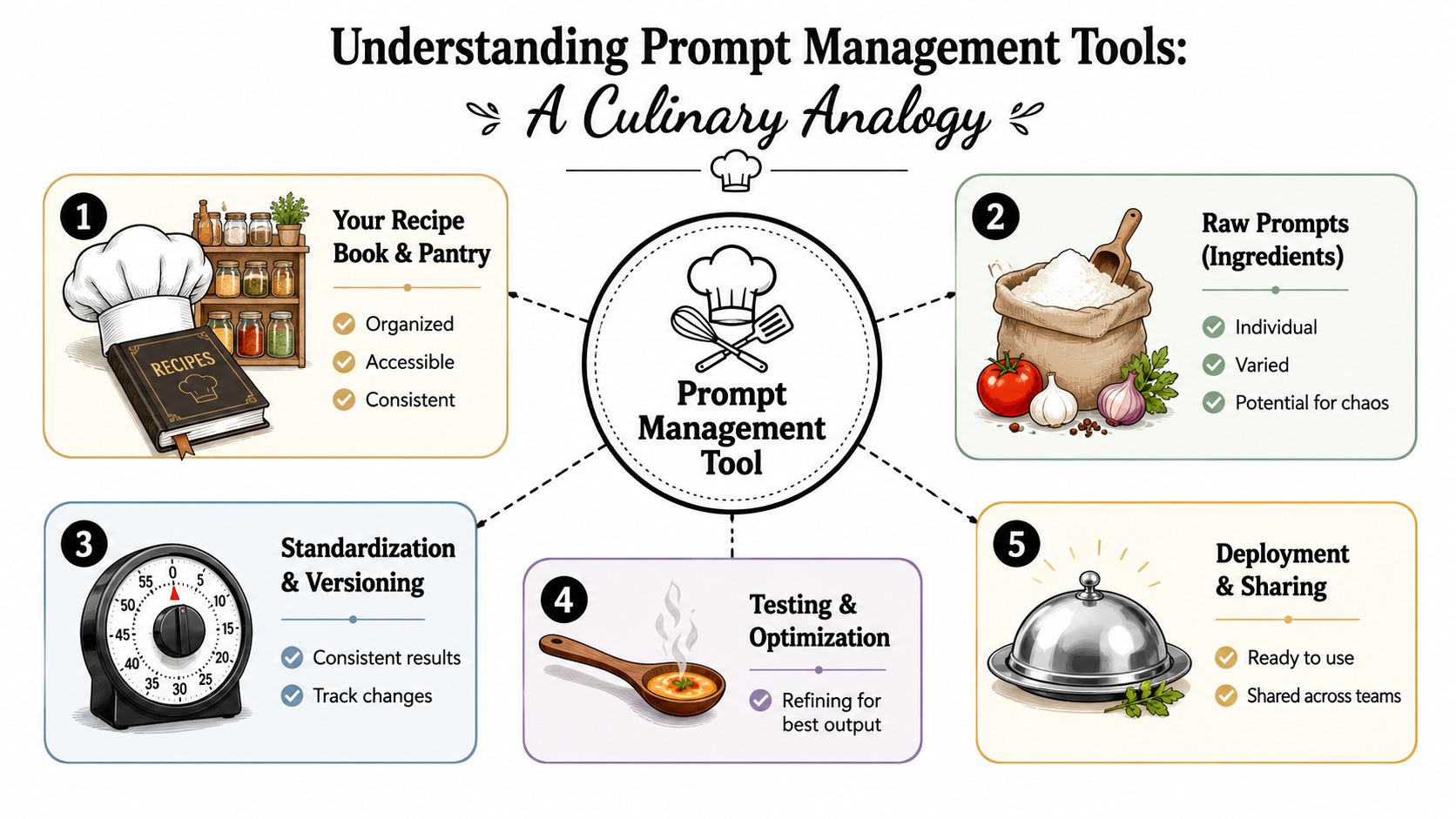
If your application code lives in GitHub, your prompts should live in a prompt management system.
That analogy lands because it's accurate. Prompt management tools create a single source of truth for the instructions, parameters, metadata, and deployment state that shape LLM behavior inside your software. Instead of hardcoding prompt text into backend services or copying snippets between teams, you manage prompts as governed assets.
Think of it as an operating layer
A prompt management tool sits between your application and your AI models. Your product calls the tool or its managed prompt configuration, then the tool supplies the current prompt version, parameters, and rules for that use case.
That changes how teams work in a few important ways:
- Product teams gain visibility into what the AI is supposed to do
- Developers stop chasing prompt strings through codebases
- QA teams can test prompt variants intentionally
- Operations teams can log and review behavior over time
- Leaders get a better path to governance and cost oversight
A good prompt management system also becomes the place where prompt context lives. That includes tags, environment labels, ownership, usage notes, and approval history.
More than storage
Weak tools act like a text repository. Useful tools behave like AI infrastructure.
At a minimum, prompt management tools should help teams organize prompt assets, version changes, retrieve the right prompt at runtime, and support safe iteration. Stronger systems also support evaluation workflows, runtime logging, and governance controls.
Prompt management becomes even more useful when teams pair it with disciplined prompt design. That's where prompt engineering best practices for production apps matter. Good writing still matters. It just can't be the only control mechanism.
Prompt management tools are where experimentation grows up and becomes operations.
Why business leaders should care
This isn't a developer-only concern. It affects roadmap speed and software resilience.
When prompts are centralized, teams can improve AI behavior without touching unrelated code. They can coordinate changes across web and mobile experiences. They can reduce the odds that one well-meaning edit breaks a critical workflow.
Prompt management tools also create a foundation for modernization. Legacy systems usually struggle when AI logic is embedded directly into application code. Decoupling prompts creates a cleaner architecture, one that's easier to update, audit, and extend as your AI usage expands.
Key Features Your Prompt Management System Must Have
A prompt management system earns its place when an AI feature starts affecting revenue, service quality, or compliance. At that point, storing prompts is not enough. The system has to control changes, reduce waste, and create a reliable audit trail across teams and environments.
The core question is simple: can this platform help you scale AI safely without turning prompt changes into an operational risk?
Prompt vault and version history
Start with a centralized prompt vault and real version history. Every prompt should have a clear owner, release record, environment status, and rollback path. If a support assistant suddenly starts giving weaker answers after Friday's update, the team should be able to identify the exact prompt version in production, see what changed, and revert quickly.
That sounds basic. In practice, many tools still treat prompts like snippets, not governed application assets.
A useful system should answer five questions without manual digging:
- Which version is live
- What changed from the last release
- Who approved the change
- Can the team roll back immediately
- Which apps or environments use this prompt
Without that discipline, debugging turns into archaeology, and every prompt edit carries more business risk than it should.
Parameter management and secure data handling
Production prompts are assembled from variables, retrieval results, customer context, and policy instructions. That makes parameter handling a security and reliability issue, not just a developer convenience.
The platform should let teams inject variables in a controlled way, validate inputs, and separate reusable prompt logic from sensitive data. That reduces the number of places where engineers manually stitch together user content, internal fields, and hidden instructions.
This matters for cost control too. Poor parameter handling often leads to bloated prompts, repeated context, and inconsistent formatting. All three raise token usage and make behavior harder to predict.
For business leaders, the trade-off is straightforward. Flexible prompt composition helps teams ship faster. Uncontrolled prompt assembly creates exposure, especially in regulated workflows or customer-facing systems.
Logging, traceability, and evaluation workflows
If a generated output causes a bad customer experience, the team needs more than an error log. They need the full execution record: prompt version, model, parameters, retrieved context, response, and environment.
Look for systems that support this level of traceability:
| Capability | Why it matters |
|---|---|
| Execution logs | Reconstruct a specific interaction and investigate failures |
| Prompt-to-output traceability | Identify which prompt version produced the result |
| Environment visibility | Separate test behavior from production incidents |
| Team ownership signals | Route issues to the right reviewer fast |
Traceability alone is not enough. Strong teams pair it with structured testing before prompt changes go live. A platform becomes far more useful when it supports comparison workflows and connects to AI model evaluation methods for production systems, so teams can judge quality, latency, and cost together instead of by intuition.
Cost controls that go beyond invoices
Many companies first notice AI cost problems in the monthly bill. By then, the money is already gone.
A better system exposes cost at the prompt and workflow level. Teams should be able to compare prompt variants, identify instructions that inflate token usage, and see where long context windows are producing limited business value. This is one of the clearest differences between a prompt library and a management system. One stores text. The other helps control margin.
Good cost controls support practical decisions:
- shorten repetitive instructions
- remove low-value context
- reserve expensive models for high-stakes interactions
- test lighter prompt variants before expanding usage
That is how prompt management becomes part of financial governance, not just model operations.
Access controls, approvals, and policy enforcement
As AI adoption spreads, prompt changes stop being an engineering-only activity. Product teams request faster iteration. Operations teams care about reliability. Legal and compliance teams want review points and records.
The system should support role-based access, approval flows, and environment-specific permissions. It should also make ownership obvious. If no one knows who can approve a prompt change for a customer service workflow, governance has already broken down.
Policy enforcement is where enterprise value becomes clear. The right platform helps an organization decide who can edit prompts, who can publish them, what review is required, and which changes need stronger controls because they affect regulated data, customer communications, or brand risk.
That is the missing link for scaling AI responsibly. Versioning matters, but governance, cost control, and security are what turn prompt management into a real operating layer for the business.
Choosing the Right Tool and Evaluating Your Options
Choosing among prompt management tools isn't just a feature comparison. It's an architectural decision. You're selecting how your organization will control one of the most changeable parts of its AI stack.
Some teams will prefer open-source flexibility. Others need a managed platform with clearer support and enterprise controls. Some can justify building an internal layer. Many underestimate the maintenance burden of doing that.
Use a decision framework, not a shopping list
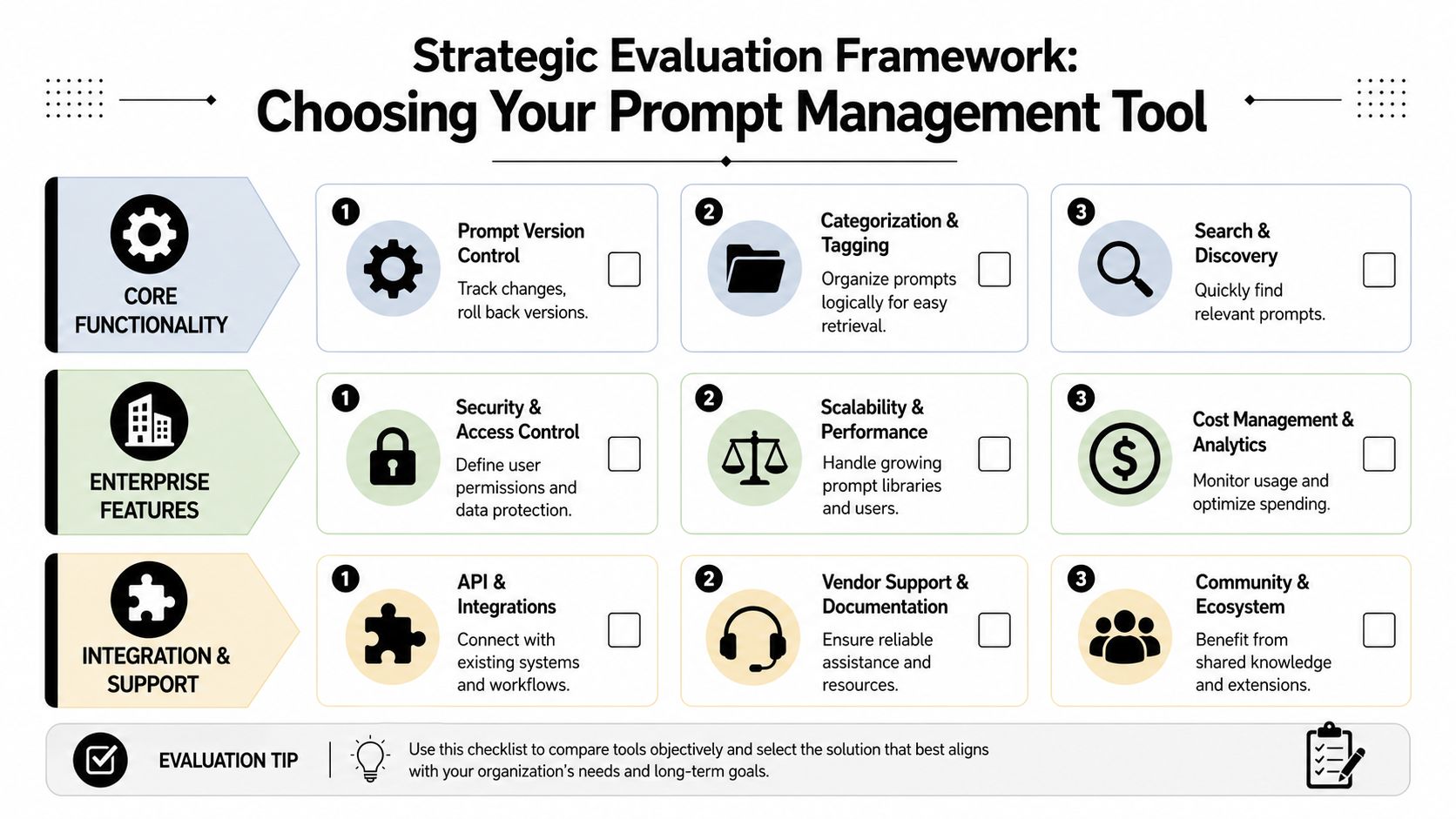
A modern prompt platform has to do more than store text. Industry analysis summarized in this review of AI prompt management tools in 2026 argues that strong platforms must address version control, governance, evaluation integration, deployment automation, and production monitoring together.
That's a helpful filter because it rules out lightweight tools that work in demos but struggle in production.
When evaluating options, compare them across these dimensions:
- Integration fit with your current stack, including backend services, mobile apps, observability tooling, and model providers
- Governance depth such as approvals, access control, and audit support
- Operational visibility so teams can investigate prompt behavior in context
- Deployment flexibility for multi-environment workflows
- Support model if your internal team doesn't want to maintain core infrastructure
If your team still needs to mature its measurement discipline, this guide to AI model evaluation in real-world products is a useful complement. Tool selection gets easier when you already know how you'll judge output quality.
Build, buy, or blend
There isn't one right answer for every company. The trade-offs are usually organizational.
| Option | Best fit | Main trade-off |
|---|---|---|
| Open-source | Teams with strong engineering capacity and specific deployment needs | More internal responsibility for governance layers |
| Commercial platform | Teams that want faster rollout and packaged workflows | Less flexibility in edge cases |
| In-house build | Organizations with very unusual requirements | Ongoing maintenance can sprawl quickly |
Questions that expose weak options
Good vendors handle hard questions well. Weak ones redirect to UI polish.
Ask these:
- How do we roll back a bad prompt version fast?
- How do we restrict who can change production prompts?
- How do we see prompt behavior in production, not just in a playground?
- How do we connect prompt changes to business outcomes or cost signals?
- How does this tool behave when multiple teams share the same AI infrastructure?
A prompt tool is mature when it helps teams say “yes” to change with less risk, not when it simply stores more prompts.
Your Roadmap for Implementing a Prompt Management System
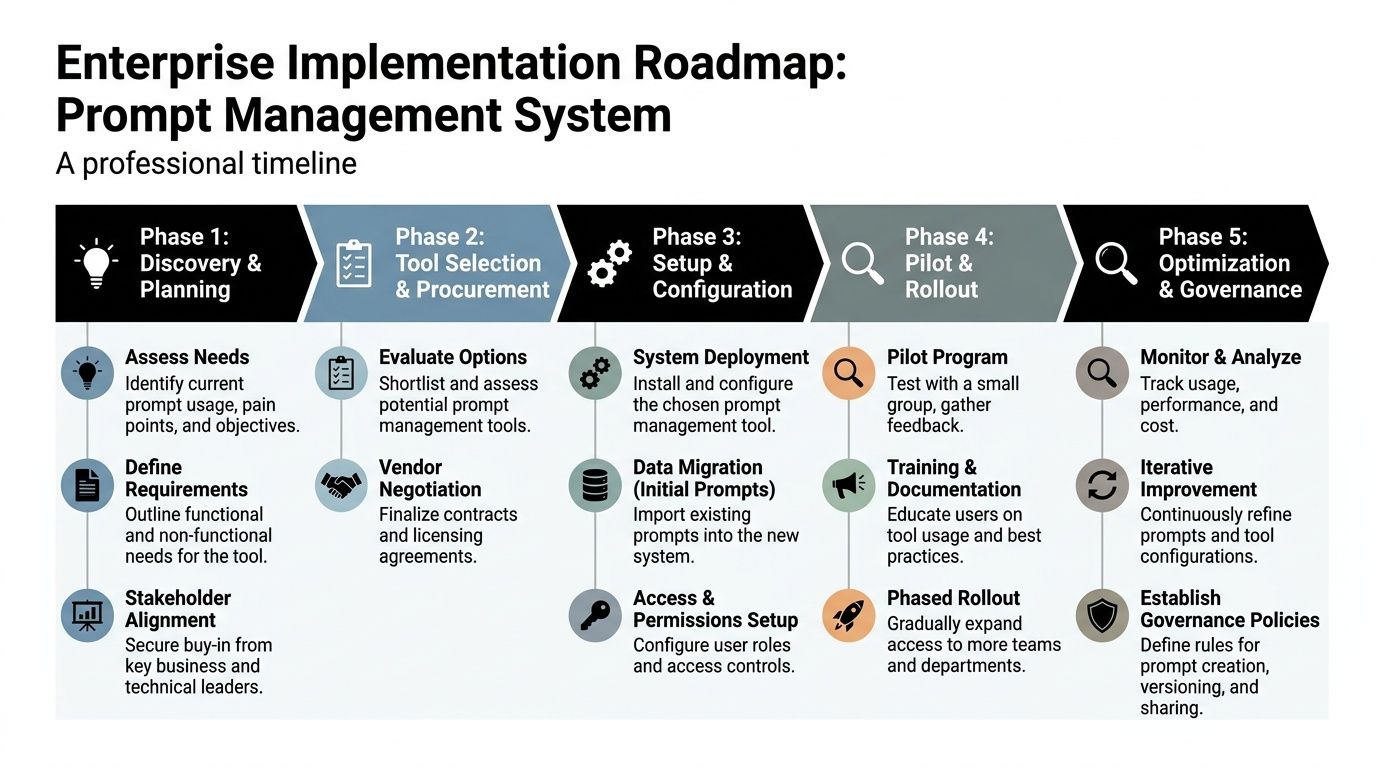
Teams often delay prompt management because they assume adoption will be disruptive. It doesn't have to be. The cleaner approach is phased rollout, starting with visibility and control in one high-value workflow.
Phase 1 and Phase 2
Start with an audit. Inventory every prompt currently used in production, staging, prototypes, and internal tools. Most organizations discover duplicates, outdated instructions, hidden dependencies, and prompts that nobody officially owns.
Then choose one pilot use case. Pick a workflow that matters enough to prove value but isn't so critical that any friction becomes politically expensive. Good candidates include support assistants, product content generation, internal search, and agentic workflows with clear review criteria.
A simple early checklist helps:
- Map prompt locations across code, docs, notebooks, and orchestration tools
- Assign owners for each prompt or prompt family
- Tag business purpose such as support, recommendations, onboarding, or summarization
- Identify risk level based on customer visibility, compliance sensitivity, and operational dependency
Phase 3 and Phase 4
Next, migrate the selected prompts into the new system and connect runtime retrieval. At this stage, the architectural benefit shows up. Once prompts are externalized, teams can iterate without bundling every change into app deployments.
For organizations still shaping their broader AI architecture, this overview of AI integration for software products helps frame prompt management as one layer inside a larger modernization effort.
During the pilot, define practical rules before adoption spreads:
- Naming conventions that humans can follow
- Environment separation for dev, staging, and production
- Approval paths for sensitive prompts
- Logging expectations for traceability and review
- Success criteria tied to the workflow, not vague “AI improvement”
Phase 5
After the pilot works, scale by pattern, not by improvisation. Reuse the same ownership model, retrieval pattern, and review process in each new AI feature.
This is also the stage where teams need to stop thinking of prompts as isolated strings. Prompt management works best when it's treated as part of delivery operations, alongside testing, QA, release management, and application observability.
Teams that implement prompt management well usually don't move slower. They stop wasting time on mystery failures.
Common rollout mistakes
These are the ones I see most often:
- Migrating everything at once and overwhelming the team with cleanup work
- Skipping ownership because “everyone uses the prompts”
- Treating testing as optional after prompts leave the sandbox
- Ignoring business context and naming prompts in ways nobody outside engineering understands
- Assuming the tool creates governance automatically without policies and permissions
The best implementations are boring in the best sense. Clear owners. Clear environments. Clear rollback. Clear review.
Enterprise Best Practices for Cost Control and Governance
A common enterprise failure looks like this. One business unit launches a useful AI workflow, three more copy it, and six months later nobody can explain why model spend doubled, which prompt version is live, or who approved a risky change in customer-facing behavior.
That is the fundamental job of prompt management at scale. It is not just version control for prompt text. It is the operating layer that keeps AI usage governable, secure, and economically defensible as adoption spreads.

Cost control has to happen at the prompt level
By the time finance flags an oversized model bill, the expensive behavior is already in production. Teams need cost visibility at the point where spend is created: prompt structure, context volume, model selection, and runtime frequency.
Analysts at Arize describe prompt management systems as a practical way to reduce waste because they connect prompt changes to traces, evaluations, and production behavior. That matters in day-to-day operations. Teams make better cost decisions when they can see which prompt variants add tokens, trigger retries, or pull in too much context for a low-value task.
Small prompt choices add up fast. A verbose system prompt, a loose retrieval pattern, or unnecessary examples in every request can turn a profitable workflow into an expensive one at scale.
Governance is what makes AI scalable
Governance protects margin as much as it protects compliance. If anyone can edit production prompts, teams lose cost discipline, auditability, and customer consistency at the same time.
A workable enterprise baseline usually includes:
- Versioned prompt changes with a clear history of who changed what and why
- Role-based access controls so production behavior is not editable by every builder
- Approval workflows for prompts used in regulated, customer-facing, or revenue-affecting workflows
- Tested rollback procedures so a bad prompt can be reversed quickly
- Prompt metadata for owner, business purpose, model dependency, and deployment status
The approval model should match the risk. An internal summarization prompt can move faster than a prompt that shapes claims handling, medical guidance, pricing explanations, or financial recommendations.
Governance works when the control level matches business risk and cost exposure.
Practices that work in production
The strongest teams combine policy with a few repeatable operating habits.
| Practice | Why it works |
|---|---|
| Keep prompts short and intentional | Cuts token waste and makes reviews easier |
| Reuse stable prompt components | Reduces duplication and lowers the chance of inconsistent behavior across apps |
| Tag prompts by business function and owner | Makes spend allocation and accountability clearer |
| Review high-cost prompt families on a schedule | Finds waste before it becomes normal operating cost |
| Deploy prompt changes independently from app releases | Speeds improvement while limiting blast radius |
Caching also matters, but the business point is broader than retrieval speed. If a prompt or prompt component is stable, teams should avoid rebuilding or re-fetching it in ways that add unnecessary overhead. In distributed systems, that discipline improves latency, reduces repeat work, and makes behavior more predictable under load.
The same logic applies to model usage. Do not send every task to the most expensive model by default. Route work by value and risk. Reserve premium models for prompts where accuracy, reasoning depth, or user impact justifies the cost.
Security belongs in the same operating model
Prompt management becomes part of the security surface as soon as prompts touch internal context, customer records, pricing logic, or regulated content. The prompt itself may be harmless. The variables injected into it, the retrieval sources behind it, and the logs around it often are not.
Enterprise teams should control which data can be inserted dynamically, limit exposure of sensitive fields, review logs for secret or personal data leakage, and restrict who can view or edit prompts tied to protected workflows. Security reviews should cover the full prompt path, not just the model endpoint.
Well-run prompt management systems do three things at once. They control spend, document decision-making, and reduce avoidable security risk. That is the difference between experimenting with AI and running it as a reliable business capability.
Industry-Specific Governance and Integration Checklists
Different sectors don't need the same controls. A media company building AI-assisted content workflows won't govern prompts the same way a healthcare platform handles patient-facing guidance. Prompt management tools are most useful when teams adapt them to the risk profile of the business.
Industry-Specific Prompt Management Checklists
| Industry | Top Governance Concern | Key Integration Checklist Item |
|---|---|---|
| Ecommerce | Preventing inconsistent pricing, merchandising, or customer service messaging | Connect prompts to catalog, search, and personalization systems with environment-based testing before rollout |
| Fintech | Auditability for customer-facing explanations and sensitive decision support | Log prompt versions tied to workflow events and restrict production edits through role-based approvals |
| Healthcare | Protection of sensitive health-related context and controlled changes to patient-facing responses | Enforce masking or minimization of sensitive fields before prompt injection and document ownership for every production prompt |
| Media | Brand consistency and editorial control across fast-moving content operations | Integrate prompt workflows with CMS publishing review so AI-generated content doesn't bypass editorial checks |
| Public sector | Transparency, retention, and defensible change management | Maintain approval records, access boundaries, and deployment history for prompts used in citizen-facing services |
What leaders should check first
A practical review starts with three questions:
- Which prompts touch sensitive data or regulated workflows
- Which prompts shape public-facing outputs
- Which prompts depend on internal systems that can't tolerate careless changes
From there, align the process to the risk. Ecommerce teams usually care about margin leakage, inconsistent recommendations, and support quality. Fintech and healthcare teams care more about traceability, approvals, and data handling discipline. Public sector teams often need stronger procedural controls and longer-lived records.
The implementation pattern stays similar. The governance rules change.
The right prompt management setup doesn't look identical across industries. It looks appropriate to the consequences of a bad prompt change.
If your organization is modernizing a web app, mobile product, or internal platform with AI, Wonderment Apps can help you build the operational layer that keeps prompts governed, observable, and cost-aware. Their team supports AI integration, scalable product delivery, and administrative tooling for prompt vault versioning, parameter management, logging across integrated AI systems, and cumulative cost visibility. If you want a practical look at how that works inside real software, schedule a demo and see how prompt management can become part of a durable AI modernization strategy.