

A familiar moment arrives after a promising app idea has won internal support: someone asks when it will launch, who's building it, and whether the team can add AI without creating a security headache. The answer isn't a headcount. It's a clear division of responsibility, a delivery process that catches problems early, and a plan for what happens after launch.
A capable mobile app development team brings product, design, engineering, quality, security, and release work together. AI belongs in that operating model too, whether you're adding an intelligent feature to an app or modernizing the software behind it. For teams exploring that step, Wonderment Apps' prompt management system is an administrative layer developers and entrepreneurs can connect to existing software, with prompt versioning, access parameters, AI logging, and cost visibility.
What a Mobile App Development Team Actually Needs
A business leader may start by asking for two app developers. The first planning meeting often reveals gaps: nobody owns prioritization, designs haven't been tested with users, the backend contract is unclear, and "QA" means asking a developer to tap through the app before release. More coding capacity won't resolve those ownership problems.
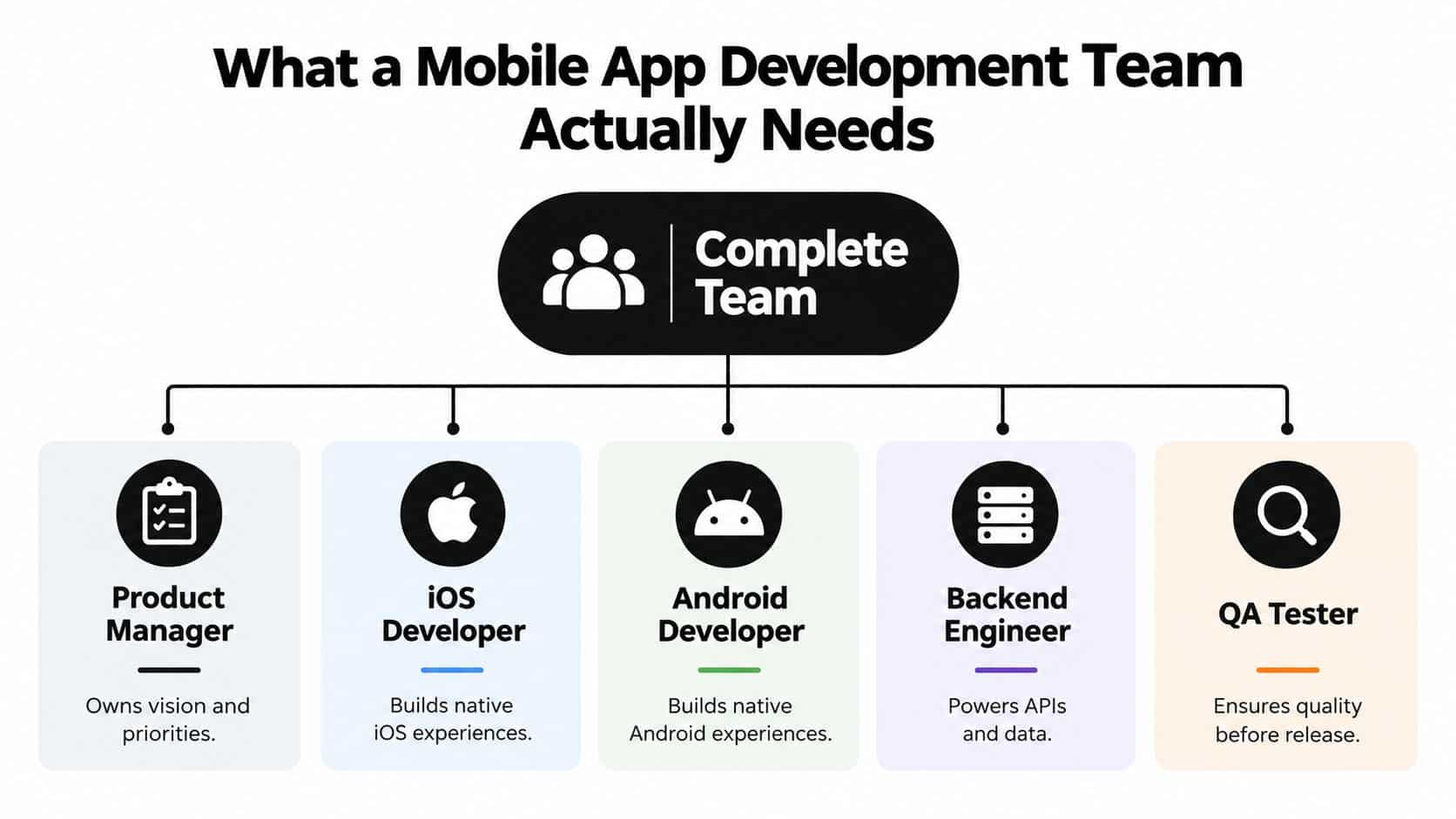
A complete team doesn't mean hiring every specialist as a full-time employee. It means making sure each critical responsibility has an owner. Product sets direction and trade-offs; design shapes usable flows; mobile engineers implement the app; backend engineers support APIs and data; QA helps the team find failures systematically; and release or platform owners manage delivery and operational readiness. Security should also have an explicit owner, especially when the app handles sensitive information or payments.
The UK government's app-developer research used a mapping exercise, a survey of 600 app developers, and 20 follow-up depth interviews. Estimates from multiple sources put the number of UK app developers at roughly 10,000 to 13,340, with reported figures of 13,340, more than 10,000, and 10,787; the report also found that app development is concentrated in specialized businesses (UK app-developer technical report). The different estimates reflect how counts can vary depending on whether researchers measure individual developers, developer businesses, or firms whose primary activity includes apps.
That distinction matters when planning. A large hiring pool doesn't mean a project can succeed with engineers alone. You need complementary skills and decision-makers who can resolve dependencies instead of letting them linger between teams. For a practical perspective on distributed delivery and vendor considerations, review these 2026 offshore mobile development insights when deciding how work should be staffed and coordinated.
Practical rule: Plan around work and ownership first. Add headcount only after you know which responsibilities are missing or overloaded.
Choosing the Right Team Structure for Your Project
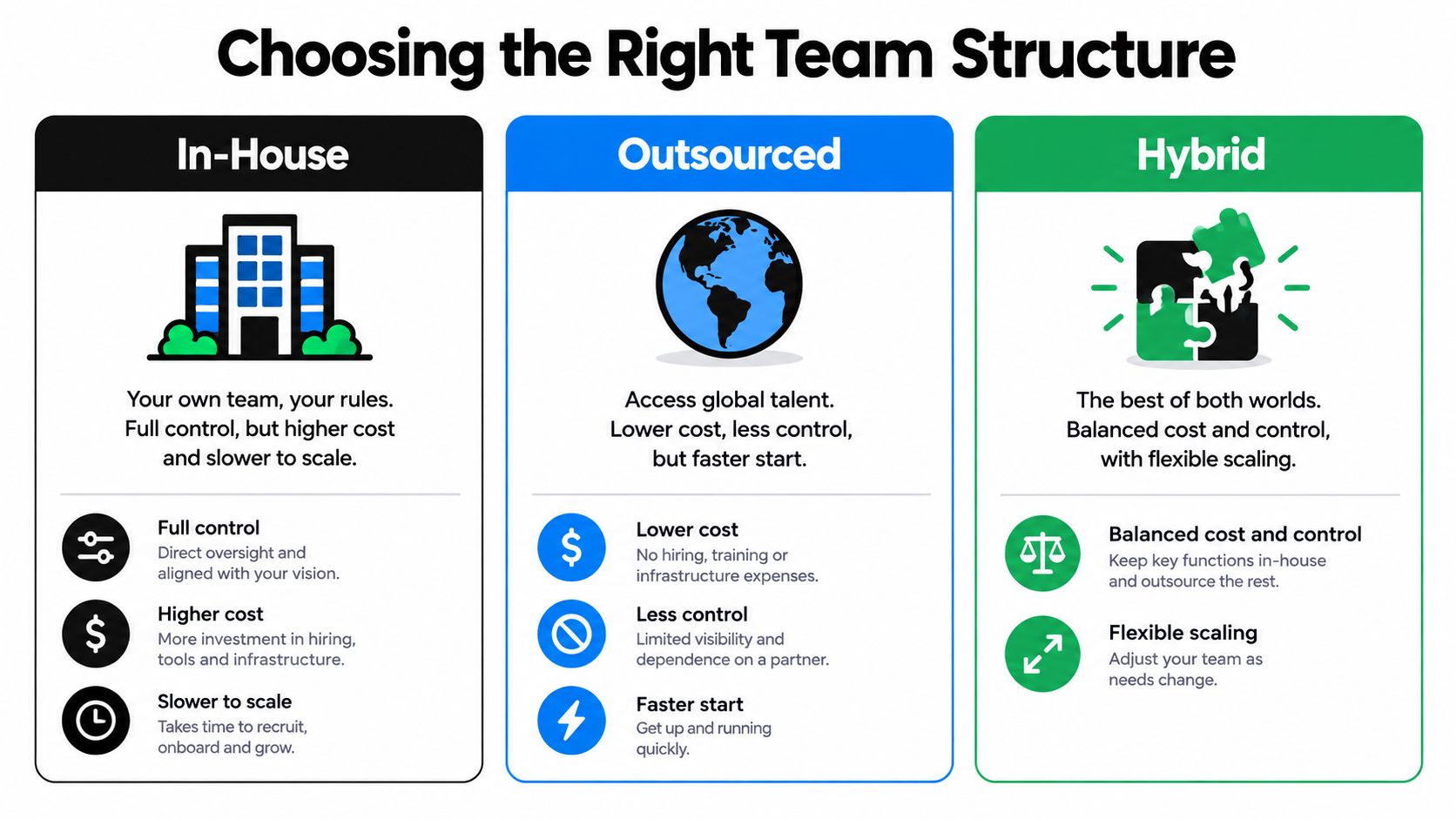
The right structure depends on what the project needs from its team after the first release. In-house hiring can build durable product knowledge and close collaboration, but it takes management attention and may be difficult when the needed specialists aren't readily available. An outsourced team can get work moving without building every capability internally, though the client still needs to provide direction and make timely decisions. A hybrid model combines an internal product owner and key technical leads with external delivery capacity.
| Model | Best For | Cost | Control | Speed |
|---|---|---|---|---|
| In-house | Products that need sustained internal ownership and accumulated domain knowledge | Higher ongoing staffing commitment | Direct day-to-day control | Hiring can take time; the team can respond closely once established |
| Outsourced | Projects that need specialist delivery capacity or a faster start | Contract scope and delivery model determine the commitment | Shared; the client must set priorities and approve decisions | Can start quickly when scope and access are clear |
| Hybrid | Organizations that want internal product ownership with flexible implementation capacity | Balanced across internal roles and contracted work | Shared, with internal owners directing product decisions | Flexible when responsibilities and handoffs are explicit |
Use the table as a conversation starter, not a substitute for checking the work. For an outsourced engagement, establish who owns acceptance criteria, code review, release approval, and documentation. For an internal team, make sure leadership understands that recruiting and people management are part of the investment. In either case, low initial cost won't rescue a project that lacks a decision-maker or leaves product knowledge with a single person.
| Decision factor | In-house | Outsourced | Hybrid |
|---|---|---|---|
| Talent availability | Depends on recruiting access | Draws on a partner's available specialists | Fills selected gaps through a partner |
| Management overhead | Internal hiring and team management | Requires clear client-side ownership and partner coordination | Requires coordination across internal and external roles |
| Knowledge retention | Strong when documentation and succession are planned | Must be protected through agreed documentation and handover | Internal owners retain product context; delivery knowledge needs active sharing |
| Long-term capability | Builds internal expertise | Depends on ongoing engagement and transfer of knowledge | Can develop internal ownership while scaling delivery |
If you're weighing partner-led delivery, Wonderment Apps' guide to mobile app development outsourcing can help frame the practical questions around scope, communication, and ownership. For broader organizational considerations, MyCulture.ai's team design insights offer another lens on how roles and collaboration fit together.
The hybrid model often works well when a company has strong product leadership but needs experienced mobile or backend capacity. It works poorly when nobody on the client side can answer questions, approve trade-offs, or accept the work. Choose the model that matches not only your budget, but also your ability to manage the relationship and retain the knowledge the product will need.
The Essential Roles and Skills to Hire For
A résumé can tell you which tools someone has used. It won't reliably show how they handle unclear requirements, production failures, or a design that behaves differently on real devices. Build the team by defining the work, then interview for judgment as well as technical depth.
Tricentis's 2024 State of Mobile Application Quality Report surveyed more than 1,000 senior IT professionals and application developers in the United States, Germany, Singapore, and the United Kingdom. 87% said mobile application quality was critical to their business, 86% considered testing important to organizational success, yet only 27% believed their existing mobile development and testing strategy exceeded expectations (Tricentis mobile quality report coverage). That gap is a useful warning: testing can't be an afterthought or a handoff that engineers treat as someone else's job.
Start with product and design ownership
A product manager translates business goals into priorities, acceptance criteria, and decisions about what won't make the release. A UX designer researches user needs, designs flows, and checks that interface decisions work across the product's core journeys. These roles can be shared across products, but they can't be left as informal responsibilities that no one has time to perform.
Ask product and design candidates to explain how they handled conflicting stakeholder requests or changed a flow after user feedback. Strong candidates connect decisions to the user problem and the delivery constraints, rather than defending a feature only because it was already planned.
Match engineering roles to the product
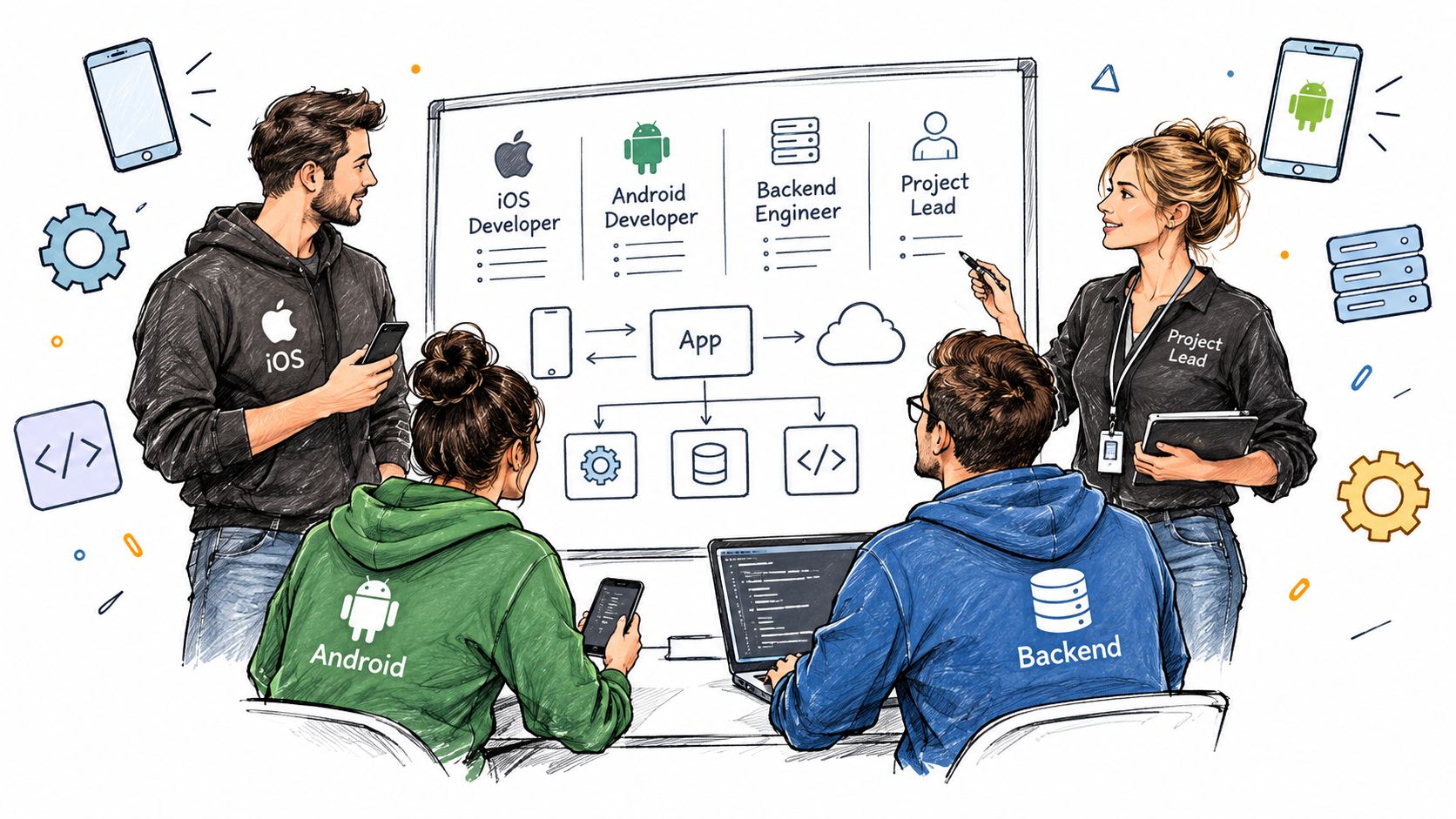
An iOS developer and an Android developer bring platform-specific knowledge, from app lifecycle behavior to native interface conventions. A cross-platform engineer can be a good fit where a shared codebase matches the product's needs, but don't choose a framework to avoid hiring for platform expertise. Backend engineers own services, APIs, data flows, and authorization; full-stack generalists can cover a range of work on smaller teams, but shouldn't become the unexamined owner of every system.
Ask engineers to walk through a real technical trade-off: how they'd debug an intermittent failure, structure an API change, or keep sensitive data out of logs. Listen for how they reason and communicate, not just the names of frameworks they list.
Make quality part of the team
A QA engineer builds test strategy with developers and product, including automated checks and exploratory testing on devices. DevOps or release engineering supports build automation, delivery pipelines, monitoring, and rollback readiness. A security specialist can be shared or engaged for focused reviews, but a named owner still needs to coordinate security requirements and follow-up.
Some roles can be fractional, particularly specialist security review or design research, depending on the product's risk and stage. The work itself can't be optional. Hire for the gaps that would otherwise create bottlenecks, and make sure every major responsibility has a person who can answer, “Who owns this?”
Building a Workflow That Ships Quality Apps
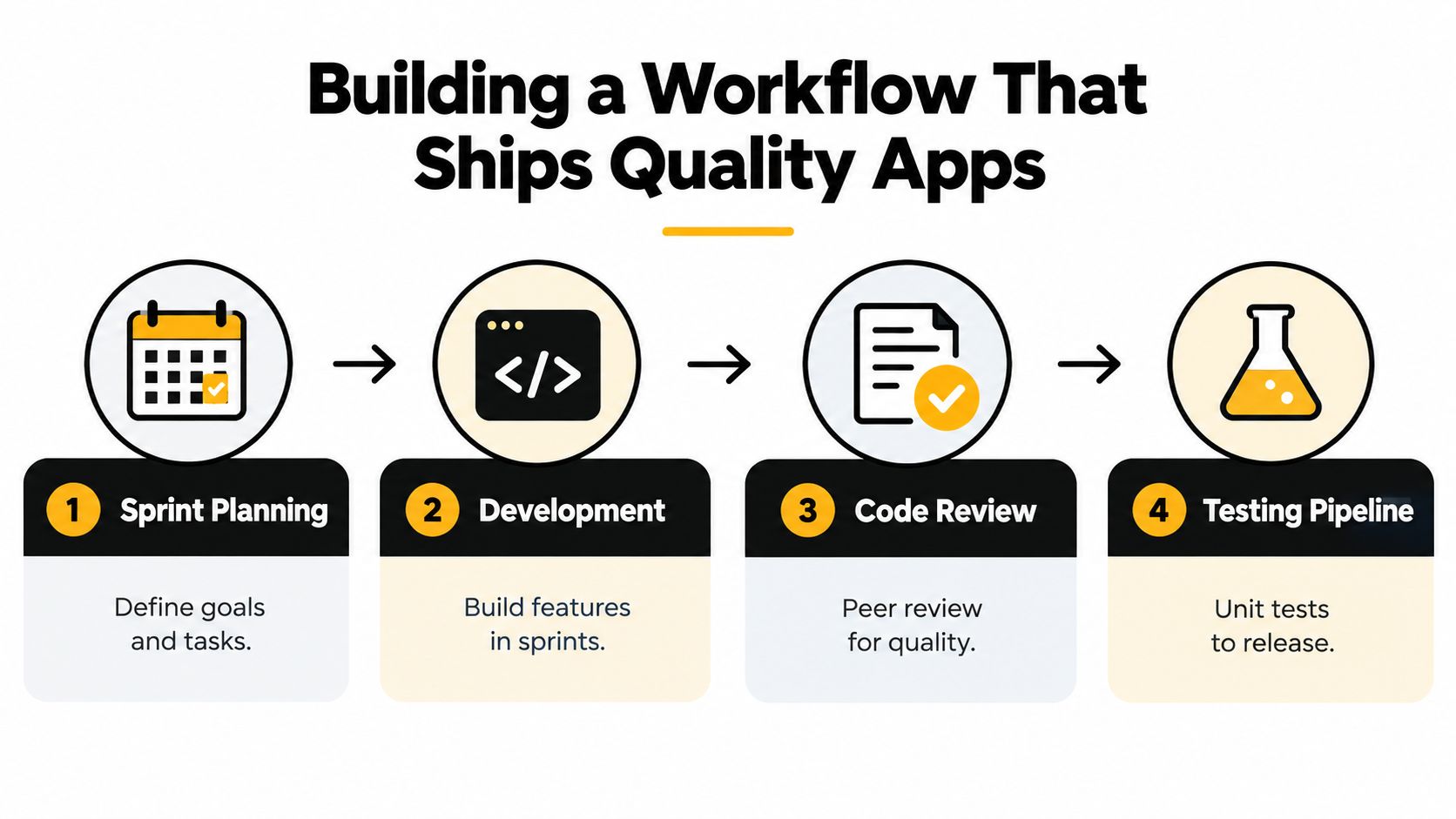
A dependable workflow makes quality visible while changes are still inexpensive to fix. Start each sprint by agreeing on the user outcome, acceptance criteria, dependencies, and release risks. During development, keep changes reviewable, have another engineer inspect code, and run automated checks before changes move into the shared build.
Build a reliability-first delivery loop
Set thresholds before implementation, establish a baseline on representative devices and networks, and test the app under varied connectivity, battery, memory, and operating-system conditions. Use device farms to widen coverage efficiently, then keep physical-device testing for important journeys and issues that depend on hardware or real-world behavior. Neither approach replaces the other.
Practical release gates can include cold-start P95 below 2.5 seconds on mid-range Android devices, crash-free sessions above 99%, and ANR below 0.5%. These are engineering targets, not guarantees that apply to every product (mobile performance testing guidance). Track P95 and P99 latency as well as averages, because tail performance can reveal slow or inconsistent experiences that a median hides.
Put checks in the delivery pipeline
A useful pipeline runs unit tests and other automated checks on proposed changes, builds a testable app, and makes it straightforward to distribute a release candidate. On top of that foundation, combine integration and UI checks with hands-on testing of important user flows. The exact mix should follow the product's risks, not a target for how many tests appear in a dashboard.
Quality belongs to the whole team. QA should help engineers discover failures early, not inherit a nearly finished app and carry responsibility for every missed defect.
Track cold-start time, time to interactive, frame rate, CPU and memory use, battery impact, network latency, ANR rate, crash-free sessions, and retention by install cohort. Any regression affecting authentication, payment, accessibility, or another critical journey should block release until the team understands its impact and has a fix or an explicit, informed exception. For concrete pipeline practices, use this guide to CI/CD pipeline best practices.
A release loop should end with observation, not deployment. Roll changes out incrementally, inspect telemetry by app version, device, and operating system, then feed what you learn into the next planning cycle. That gives product, engineering, and QA a shared basis for deciding whether to proceed, pause, or roll back.
Launching Your App and Scaling the Team
Launch day is the start of live-product responsibility. Before release, confirm that the team can monitor crashes and other key signals, identify the deployed app version, handle support reports, and prepare a fix if users hit a critical issue. If those responsibilities are unclear, a polished launch checklist won't make the response reliable.
Crash prevention deserves named ownership. A commonly cited benchmark reports that apps with crash rates above 1% experience approximately a 26% decline in 30-day user retention, while recommended crash-free-session targets are generally above 99% (crash-prevention and retention benchmark). Treat that as a reason to investigate reliability carefully, not as a forecast for every product or user group.
Make launch telemetry useful
Segment operational data by app version, device, operating system, and acquisition cohort so an overall average can't conceal a failure isolated to a particular group. Report crash-free users and crash-free sessions, and examine retention by install cohort rather than relying only on a blended monthly figure. When a crash appears, classify its impact, reproduce high-priority failures on physical devices, add a regression test, release a staged fix, and check whether affected cohorts recover.
Scaling the team should follow a specific constraint. A growing backlog may signal a need for engineering capacity, while repeated confusion about priorities points to product ownership. Slow defect investigation can call for QA or observability work; recurring security findings may require dedicated AppSec support. Support volume is a signal too, especially when reports cluster around the same flow or device.
Don't hire because the roadmap looks ambitious. Identify the work that's repeatedly delayed, assign the role responsible for it, and decide whether that capability needs to be permanent, shared, or contracted. Add people in a way that preserves existing ownership: document decisions, clarify interfaces, and pair new contributors with the people who understand the system. That helps the team grow without turning every change into a fresh round of discovery.
Modernizing Your Team with AI Tools
AI creates two related jobs for a mobile team: decide how AI should improve the product, and govern how the organization builds and operates those features. A useful product addition might involve an AI-backed assistant or personalized recommendations, but the team still needs to decide what data the model can access, how responses are logged, and how failures appear to users. AI-assisted coding can speed up implementation, but it doesn't transfer responsibility for reviewing, testing, or securing the resulting code.
That distinction matters because security confidence and security outcomes don't always align. Global research found that 62% of surveyed organizations experienced at least one mobile-app security incident in the previous year, while 93% believed their protections were sufficient; the average reported breach cost was $6.99 million, and 71% said pressure to accelerate releases compromised security (mobile application security research from Guardsquare). Teams need an accountable mobile AppSec owner for threat modeling, mobile binary analysis, backend authorization, secrets management, fraud signals, and incident response. General QA coverage alone won't take on that work.
For a broader view of how AI fits into software engineering, compare AI adoption in development. In practice, a team should agree on which data an AI feature may use, where human review is required, and how it will measure quality, latency, privacy risk, and operating cost. These decisions belong in architecture and acceptance criteria, not in a last-minute review after implementation.
A prompt management system can provide an administrative layer for AI integration with an existing app or software product. Wonderment Apps' system includes a versioned prompt vault, a parameter manager for internal database access, logging across integrated AI systems, and cost management that lets entrepreneurs see cumulative spend. Those controls help teams track prompt changes, manage access, inspect activity, and keep an eye on usage costs; they don't replace security review or product judgment. For practical approaches to integrating AI into software work, see this guide to AI-assisted software development.
Modernization works best when product, engineering, security, and operations share ownership. Choose a small, well-defined AI use case, set its data and access boundaries, and test its behavior in the same disciplined release process as the rest of the app. Then expand only when the team can explain how the feature behaves, what it costs, and who responds when it fails.
Wonderment Apps helps organizations build and modernize mobile and web products with right-sized teams spanning product management, design, engineering, and QA. If you're planning a mobile app or adding AI controls to existing software, visit Wonderment Apps to discuss the team and delivery approach your product needs.