

You're probably here because your mobile roadmap suddenly got bigger than your team.
Maybe product wants a new customer app before peak season. Maybe your operations team needs a field app that works offline. Maybe leadership now expects AI inside the app too, whether that means smarter search, support, recommendations, or workflow automation. At the same time, hiring mobile specialists in Swift, Kotlin, Flutter, or AI integration isn't quick, and waiting rarely helps.
That's why mobile app development outsourcing has changed shape. It's no longer just a budgeting decision. It's often a capability decision. Teams use external partners to fill skill gaps, speed up delivery, and modernize older systems without surrendering product ownership. That modernization increasingly includes the AI plumbing behind the scenes, such as prompt versioning, usage logging, parameter control, and spend visibility, which is where an administrative prompt management layer can make a legacy app far more practical to operate over time.
Why Mobile App Development Outsourcing Matters Now
A common leadership scenario looks like this: the business knows what it wants the app to do, but it doesn't have the full team needed to ship it well. The gap usually isn't “developers” in the abstract. It's missing specialties. You may have strong web engineers but no mobile release manager. You may have product vision but no one who has handled Bluetooth, offline sync, or app store submission at scale.

That pressure is showing up in the market. The mobile app development outsourcing market was estimated at USD 704.9 million in 2023, and one forecast projects it will reach USD 1,536 million by 2033, implying an 8.1% CAGR over 2024–2033 according to Market.us market data on mobile app outsourcing. That doesn't prove every outsourcing engagement works. It does show that demand for external mobile delivery capacity remains durable.
The shift from cheaper labor to better capability
Leaders used to ask, “Can we outsource this for less?” The better question now is, “Who can help us ship the right thing without creating a maintenance mess?”
One outsourcing guide notes that 80% of executives plan to maintain or increase third-party outsourcing investment, while also pointing to the growing need for specialized skills like Swift, Kotlin, Flutter, React Native, .NET MAUI, offline sync, Bluetooth, and hardware integration in TechnBrains coverage of outsourcing capabilities. That's a very different buying lens from simple cost arbitrage.
Practical rule: If your app needs scarce expertise, outsourcing is usually a capability bridge, not a substitute for product leadership.
AI adds another layer. Recent industry coverage says 54% of outsourced app projects now include AI-powered features and 59% of IT outsourcing contracts in 2026 are explicitly focused on AI/ML in Bolder Apps analysis of app outsourcing and AI. Once AI enters the app, vendor selection changes. You're no longer only evaluating UI polish and sprint velocity. You're also evaluating governance, model updates, token-cost control, and how prompts are managed after launch.
That's why many business stakeholders also need an operational layer for AI modernization, not just a build team. If you want a broader perspective on why outsourced delivery has become standard operating practice, this Wonderment Apps article on outsourcing as the new norm is a useful companion read.
Understanding What Mobile App Development Outsourcing Really Means
Mobile app development outsourcing is easiest to understand if you stop thinking of it as “handing over the app” and start thinking of it as bringing in a specialized crew.
If you were opening a retail store, you might keep brand direction and customer strategy in-house, but hire electricians, millworkers, and general contractors to build the physical space. Software works the same way. Your company should own the vision, priorities, and business rules. The external team supplies execution capacity and technical depth.
What the client should keep
Good outsourcing does not mean losing control. Independent guidance emphasizes that the client should retain control of the product roadmap, source code, cloud accounts, and app-store credentials, while the vendor provides specialized development capacity in Hireslink guidance on mobile outsourcing governance. That setup reduces lock-in and lowers security and compliance exposure.
That single idea clears up a lot of confusion. You're not renting out your company's judgment. You're extending your ability to deliver.
What the vendor usually provides
A vendor may provide some or all of the following:
- Engineers with targeted expertise such as iOS, Android, Flutter, React Native, backend APIs, or QA automation
- Delivery roles such as a project manager, scrum lead, or release coordinator
- Design and testing support when your internal team doesn't have bandwidth
- Operational continuity so the project doesn't stall when one individual is unavailable
Some engagements are light-touch. Others are full-service.
Here's the basic spectrum:
- Staff augmentation means individual specialists join your team and work in your systems.
- Dedicated team means a stable external pod works primarily on your product.
- Managed project means the vendor owns day-to-day delivery against agreed goals.
If you're comparing structures and want another perspective on how companies evaluate external development arrangements, the GENTY recruitment insights page is a practical reference.
Outsourcing fits best when the business knows what outcome it wants, but needs extra skills or delivery capacity to reach it.
It fits poorly when no one inside the company can make product decisions, approve trade-offs, or define success. An external team can build with you. It can't replace business ownership.
Comparing Outsourcing Models and Engagement Options
The right model depends less on ideology and more on your operating reality. A fintech team with strict review cycles will choose differently from a retailer racing toward seasonal launch. A startup validating one feature will choose differently from an enterprise integrating mobile into a larger platform.
Geography changes the working rhythm
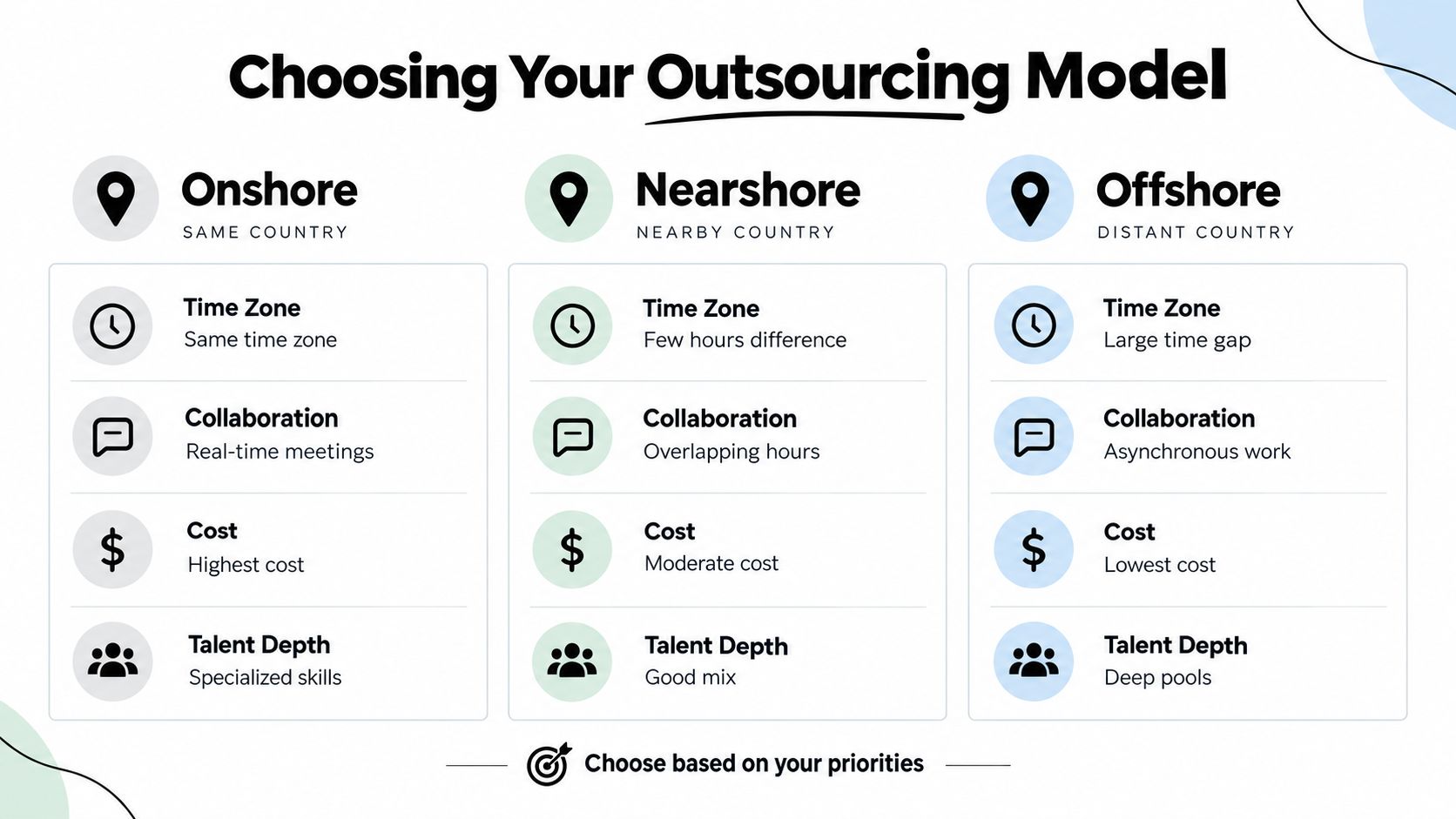
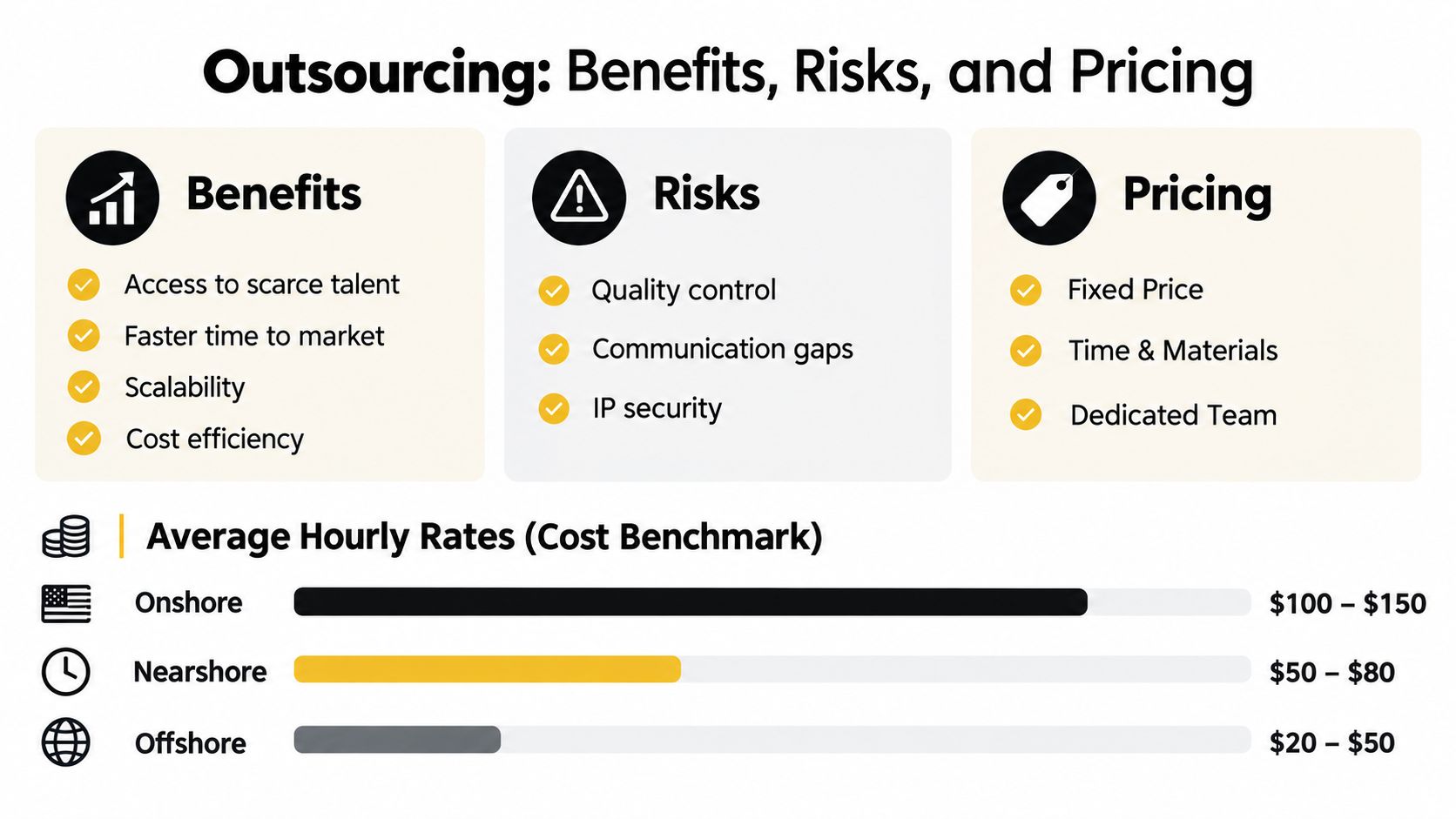
Onshore, nearshore, and offshore each change how a project feels day to day.
| Model | Best For | Trade-offs | Cost Profile |
|---|---|---|---|
| Onshore | Tight collaboration, regulated environments, heavy stakeholder access | Highest rates, smaller talent pool in some niches | Highest |
| Nearshore | Teams that want overlap without full onshore cost | Slight time-zone and market variation | Moderate |
| Offshore | Access to broad talent pools and round-the-clock progress | More asynchronous communication, stronger need for documentation | Lower |
The mistake is choosing only by hourly rate. A cheaper team that needs constant rework isn't cheaper. A pricier team that ships clean releases with strong communication may lower total delivery risk.
Engagement model changes accountability
Staff augmentation and managed delivery aren't interchangeable.
- Staff augmentation works well when you already have strong product management, engineering leadership, and QA practices.
- Managed project delivery works better when you need a partner to coordinate design, development, testing, and release governance as one unit.
- Hybrid structures often make the most sense. Keep product and architecture ownership internal, then add external specialists for mobile execution or AI features.
Regional pricing also varies sharply. Typical hourly rates are about $20–$40 in India, $25–$55 in Eastern Europe, and $150–$250 in North America, with hybrid team models saving 35–42% versus fully onshore development, according to Code Brew regional outsourcing cost benchmarks.
If you're also comparing agency delivery with freelance options for narrower assignments, this piece on how to compare freelance talent on Freeeup gives a useful lens on marketplace hiring.
A simple decision shortcut helps:
- Choose augmentation if your internal team can lead.
- Choose managed delivery if you need an integrated execution engine.
- Choose hybrid if you want control over core decisions but need outside specialists to move fast.
For a focused breakdown of the structural difference, this Wonderment Apps article on outstaffing vs outsourcing is worth reading.
Benefits Risks Pricing Models and Cost Benchmarks
Outsourcing works best when leaders evaluate upside and downside at the same time. The benefits are real. So are the failure modes.
Where the upside usually comes from
One broad outsourcing survey reported that 64% of organizations outsourced at least part of their app development in 2023, up 8 percentage points from 2019. The same source said 46% increased the amount of work they delegated, while only 8% reduced it, according to DoIT outsourcing statistics coverage. That pattern suggests outsourcing has become a mainstream delivery model, not a temporary experiment.
The most practical benefits usually look like this:
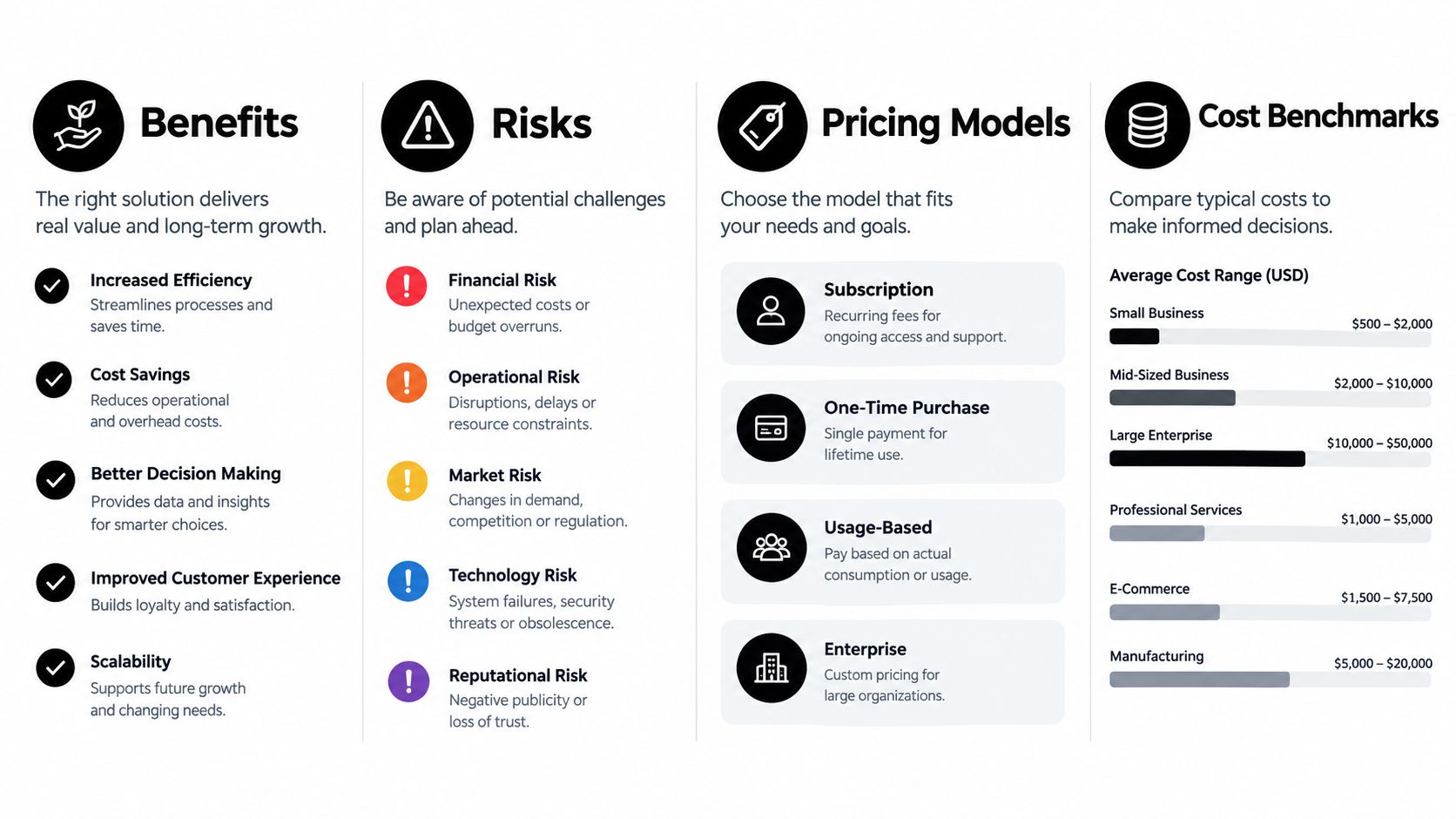
- Access to scarce skills when you need mobile specialists, AI implementation support, or platform-specific QA
- Faster ramp-up because you're adding an already-formed capability instead of hiring role by role
- Focus for internal teams so your staff can own roadmap, compliance, and stakeholder decisions
What can go wrong
The recurring risks are less mysterious than people make them sound.
- Communication drift happens when requirements live in scattered messages instead of a shared backlog.
- Quality surprises happen when QA is treated as a phase instead of a discipline.
- Security exposure rises when vendors control credentials or production infrastructure they shouldn't own.
- Budget confusion appears when the pricing model doesn't match the uncertainty of the work.
A healthy outsourcing relationship is boring in the best way. Roles are clear, quality checks are routine, and nobody is guessing who owns the next decision.
Pricing models and how to think about them
Three pricing models dominate:
- Fixed price suits tightly defined scope, but change gets expensive fast.
- Time and materials fits evolving products because it supports learning and reprioritization.
- Dedicated team works when the roadmap is continuous and capacity matters more than a single deliverable.
Quality outcomes also matter. One source reports outsourced software projects have a 15-20% lower defect rate than in-house projects and a 25% higher chance of delivering on time and within budget when outsourcing is executed well, according to WorldMetrics software outsourcing statistics. For mobile apps, that usually depends on disciplined QA, release control, and measurable defect-escape practices rather than outsourcing alone.
How to Choose the Right Vendor and Protect Your IP
A vendor interview should feel less like buying labor and more like evaluating an operating partner. Portfolio screenshots are nice. Delivery habits matter more.
What to test before signing
Ask vendors to walk through a real delivery example. Not just the final app. Ask how they handled change requests, defect triage, architecture decisions, and launch readiness.
Use a checklist like this:
- Relevant portfolio. Have they built apps with similar constraints, such as regulated workflows, offline usage, device integration, or multi-role access?
- Technical depth. Can they explain why they'd choose native iOS and Android versus Flutter or React Native for your case?
- Communication habits. Do they propose a regular cadence for demos, backlog review, and issue escalation?
- QA discipline. Who owns test planning, regression coverage, and release signoff?
- Team continuity. Will the same people stay on your account, or will the team rotate after kickoff?
A strong vendor can answer plainly. If every answer sounds polished but vague, that's a warning sign.
What you should never hand over
Keep ownership clean from day one.
- Source control should live in a repository your company administers.
- Cloud accounts should be in your organization's name.
- App store credentials should remain with your business.
- Analytics and logging tools should be accessible to your internal stakeholders.
- Data handling rules should be written, especially for healthcare, fintech, or any product touching sensitive records.
For regulated products, add legal structure around data access, confidentiality, incident reporting, and IP assignment. NDAs matter, but they're only one part of protection. Operational control matters just as much.
A short trial sprint is often more revealing than a long proposal. Give the vendor a contained problem with genuine collaboration points. Watch how they clarify ambiguity, document decisions, and respond to feedback. That behavior predicts the actual relationship better than a sales deck.
If you need a deeper framework for screening offshore partners, this Wonderment Apps guide to picking an offshore software development company offers a practical set of evaluation criteria.
Inside the Outsourced Development Process From Kickoff to Scale
A strong outsourced project usually feels structured early and adaptive later. The team doesn't start by writing code. It starts by reducing ambiguity.
What good kickoff looks like
The first phase should define a few essentials:
- business goal
- target users
- core workflows
- success criteria
- technical constraints
- launch responsibilities
Then the team moves into UX and architecture. For mobile products, architecture decisions show up early because they shape performance, release process, analytics, and future scalability.
Where scalable architecture enters the picture
Apps that need to serve large audiences usually depend on a few proven design habits. Scalable application design commonly relies on stateless application design, database read replicas and caching from the start, asynchronous processing for slow operations, and a modular architecture that can evolve according to Senavia guidance on architecture for scale.
For very high traffic products, one practical scaling pattern combines stateless horizontal application scaling, multi-tier caching that can absorb 80–95% of read traffic before it reaches the database, CDN delivery, asynchronous processing, and database read scaling through replicas and sharding, according to Intigate Technologies guidance on scaling software products.
That matters even in a mobile article because the app on the phone is only part of the product. Users experience the whole system. A slow API, overloaded database, or fragile job queue still feels like “the app is broken.”
Where AI features change the process
AI-enabled mobile features add a second operational track alongside normal app delivery. Teams now need to manage prompts, model settings, logging, and ongoing cost visibility after release, not just before it.
That's where an administrative layer becomes useful. One example is Wonderment Apps' prompt management system, which includes a prompt vault with versioning, a parameter manager for internal database access, a logging system across integrated AIs, and a cost manager for cumulative spend visibility. Tools like that help teams modernize existing software without burying AI behavior inside scattered code or undocumented prompt files.
If AI is part of your app, treat prompts and model settings like product assets. They need ownership, version history, and operating controls.
From there, the process becomes familiar again: sprint delivery, demos, QA, release readiness, app store submission, monitoring, and iterative improvement.
Avoiding Pitfalls and Launching Your Outsourcing Partnership
Most outsourcing problems don't start with malicious vendors. They start with fuzzy decisions made too early or ownership gaps left unresolved.
The pitfalls leaders can prevent
Four problems show up repeatedly:
Vague requirements
If the team can't tell the difference between must-have and nice-to-have, timelines blur and costs drift.Weak QA ownership
If testing sits at the end instead of throughout the workflow, defects pile up until launch pressure exposes them.Vendor lock-in by accident
This happens when the vendor controls repos, cloud access, app store accounts, or undocumented deployment steps.Underestimating AI operations
AI features don't stop requiring attention after release. Prompts change, models evolve, logs need review, and token spend can surprise teams that didn't plan for it.
A practical kickoff checklist
Use a procurement and onboarding process that forces clarity.
- Write a sharp brief that states the user problem, platforms, must-have features, integrations, security needs, and decision-makers.
- Ask for a trial sprint rather than betting everything on a long initial contract.
- Define governance rituals such as weekly demos, backlog review, risk tracking, and release approval.
- Set success measures tied to delivery quality, responsiveness, and business outcomes, not just velocity.
- Confirm ownership in writing for code, credentials, environments, and documentation.
- Plan post-launch operations including bug handling, app updates, analytics review, and AI prompt or model maintenance.
The leaders who get the most from mobile app development outsourcing tend to treat it neither as a cheap shortcut nor as magic. They treat it as a managed partnership with clear operating rules.
If your app also needs AI modernization, keep the administrative side in view from the start. Prompt vaults, version control, parameter management, cross-model logging, and cost tracking aren't glamorous. They are what keep an AI-enabled app maintainable a year from now.
Outsourcing succeeds when you keep ownership of the product, choose partners for capability fit, and design the relationship for durability instead of convenience.
Wonderment Apps helps organizations outsource mobile and software development with structured delivery teams, AI modernization support, and operational tools for prompt management, logging, parameter control, and spend visibility. If you're evaluating partners for a scalable mobile product or planning AI features that need real governance after launch, visit Wonderment Apps to explore how their team and demo tools fit that work.