

Your store has plenty of products, but shoppers keep circling the same category pages. The related-products widget suggests something out of stock, your marketing team wants more personalization, and your engineers want to know whether this means rebuilding the platform. A recommendation engine for ecommerce can help, but the useful starting point isn't a model. It's the shopping decision you're trying to make easier.
What a Recommendation Engine Does for Your Store
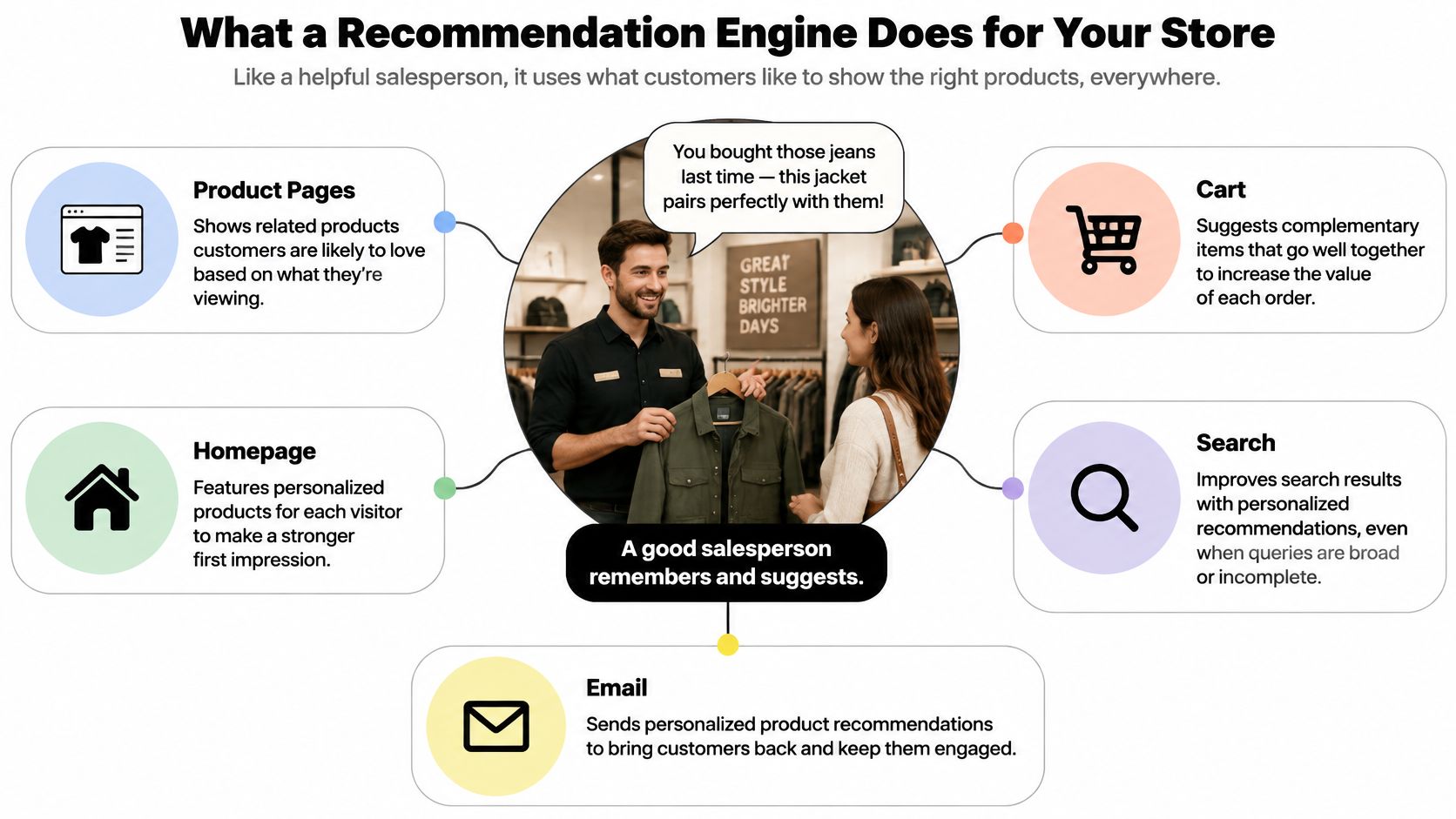
A good shop-floor salesperson remembers that a regular bought walking boots and suggests a matching jacket before being asked. They also notice when that customer wants to browse without help. A recommendation engine applies that kind of judgment across a digital storefront, using recorded evidence in place of memory.
The engine turns a large catalog into a useful shortlist. It works with partial evidence about the customer. What it cannot work without is a clear task: find a substitute, complete an outfit, replenish a purchase, or surface something relevant. That task defines what a good suggestion looks like, and what a wasted slot costs in margin and attention.
Every recommendation system has three working parts:
- Signals describe the shopper's activity, product characteristics, and current context.
- A scoring model estimates which products suit the task.
- Ranking rules decide which eligible products appear, in what order, and in which placement.
The ranking layer is where commercial logic sits. Stock status, margin, and merchandising priorities can all outweigh raw similarity scores, which is why the engine behaves as a business system rather than a model that runs itself.
The discipline took shape in the early 1990s, when collaborative filtering became a foundation for recommendations based on user behavior, as documented in the ACM review of recommender systems. That distinction still matters: products can be related because their attributes match, because shoppers interact with them similarly, or both.
Keep the intelligence manageable
Adding AI shouldn't mean losing control of the application. Wonderment Apps offers an administrative toolkit for managing prompts, integrations, and token costs, which helps teams keep AI features controllable inside an existing application.
Many recommenders work well without prompts or a generative model. Traditional retrieval and ranking can do the heavy lifting, cost less to operate, and are easier to audit when a suggestion looks wrong. AI earns its place for conversational discovery or explanations, not as a label on a carousel.
Practical rule: Buy sophistication only when you can name the shopping problem it solves.
The important decisions span algorithms, data readiness, placement, measurement, architecture, governance, and ownership. Getting them right matters more than attaching an AI label to the storefront.
Algorithm Types and Which One Fits Your Catalog
Recommendation algorithm types compared
| Approach | Core signal | Strength | Main limitation | Best fit |
|---|---|---|---|---|
| Popularity baseline | Top sellers and trends | Simple and works on day one | Ignores the individual shopper | Fallback for every placement |
| Collaborative filtering | Shopper-item interactions | Finds non-obvious links | Weak for new products and shoppers | Mature stores with steady traffic |
| Content-based | Product attributes and shopper profile | Handles new items | Can feel narrow and repetitive | New or niche catalogs |
| Hybrid | Interactions plus attributes | Balances accuracy and coverage | More engineering to run | Most mid-size and large stores |
| Embedding-based | Text, images and behavior as vectors | Finds close substitutes at scale | Needs a vector index and tuning | Large catalogs with rich product text |
Say a shopper opens a trail running shoe. Collaborative filtering can suggest products that attracted shoppers with similar interaction patterns. That's useful for discovering relationships your merchandising team didn't explicitly encode, but a newly listed shoe has no behavioral history to work with.
Content-based filtering can immediately compare heel-to-toe drop, cushioning, terrain, price band, and available sizes. It works only as well as those attributes are maintained. If every description says lightweight and comfortable, the model has little useful distinction to learn.
Embeddings represent products as numerical vectors. With suitable training and product text, they can surface a comparable shoe from a newer brand even when the wording doesn't match exactly. However, semantic similarity isn't proof of functional equivalence: a road shoe and a trail shoe can sound similar while serving different needs.
Choose the simplest useful combination
A hybrid system can combine these candidate sources, then apply eligibility and merchandising rules. Treat hybrid as an architecture choice, not a guarantee that every blended model beats a simpler one.
Popularity still deserves a seat at the table. It gives you an understandable baseline and an operational fallback, although category-aware popularity is usually a more sensible starting point than showing the same storewide bestsellers everywhere.
For Shopify teams comparing implementation ideas, Presidio's guide to improve Shopify conversions with AI recommendations provides a platform-specific companion to this decision.
I would start with popularity plus explicit product rules, add collaborative signals when interactions become dependable, and consider embeddings when catalog breadth and descriptive product text justify the infrastructure. Don't introduce image embeddings just because product images exist. Add them when visual similarity is part of the shopping task.
The Data a Recommendation Engine Needs Before It Works
Recommendation signals and when they are usable
| Signal | Example | Why it matters | Usable at launch |
|---|---|---|---|
| Product views and clicks | Repeatedly viewed trail shoes | Shows browsing intent | Yes, once tracking is live |
| Purchase history | Bought running socks previously | Strong evidence of a completed buying decision | For returning shoppers with available history |
| Cart and session contents | Added a jacket, removed a tee | Captures current intent | Yes |
| Search queries | Searched for waterproof jacket | Shows an explicit need | Yes, if search is instrumented |
| Product attributes | Category, color, size, price band | Powers content-based matches | Yes, after catalog cleanup |
| Ratings and reviews | Reviews mention a narrow fit | Signals perceived quality and suitability | Only with enough volume |
| Inventory and margin | Low stock, healthy contribution margin | Guardrails for business rules | Needs a live feed |
Data quality is the first engineering constraint. A complex model can't reliably recover a missing size attribute or reconcile product identifiers that mean different things across channels.
Consider a shopper comparing trail shoes, adding a waterproof jacket, then removing a tee. That sequence suggests an outdoor shopping mission, but the removal isn't proof that they dislike tees. They might have changed size, budget, or plans.
Keep event order and timestamps. A bag of disconnected clicks loses the distinction between an item considered early and the product selected at checkout.
Audit the joins before training
Legacy stores often have tracking that fires twice on desktop and not at all in a mobile webview. Other familiar problems include duplicate categories, mismatched variant identifiers, overnight inventory updates, and consent records stored separately from sessions.
Start with the transport and validation work described in our data pipeline architecture guide. Validate that the storefront, warehouse, and serving system agree on what each event means.
Use this readiness checklist:
- Agreed event names with documented payloads and deduplication rules.
- Unified product IDs with explicit parent-product and variant relationships.
- Complete decision-making attributes for the products eligible for the pilot.
- Fresh inventory and margin feeds with defined behavior when values are missing.
- Session consent flags that downstream services can enforce.
For a new visitor, use category context and permitted session activity. Don't invent a lasting customer profile from a passing click, and don't collect more personal information merely because the model could accept it.
Where Recommendations Appear and How to Personalize Them
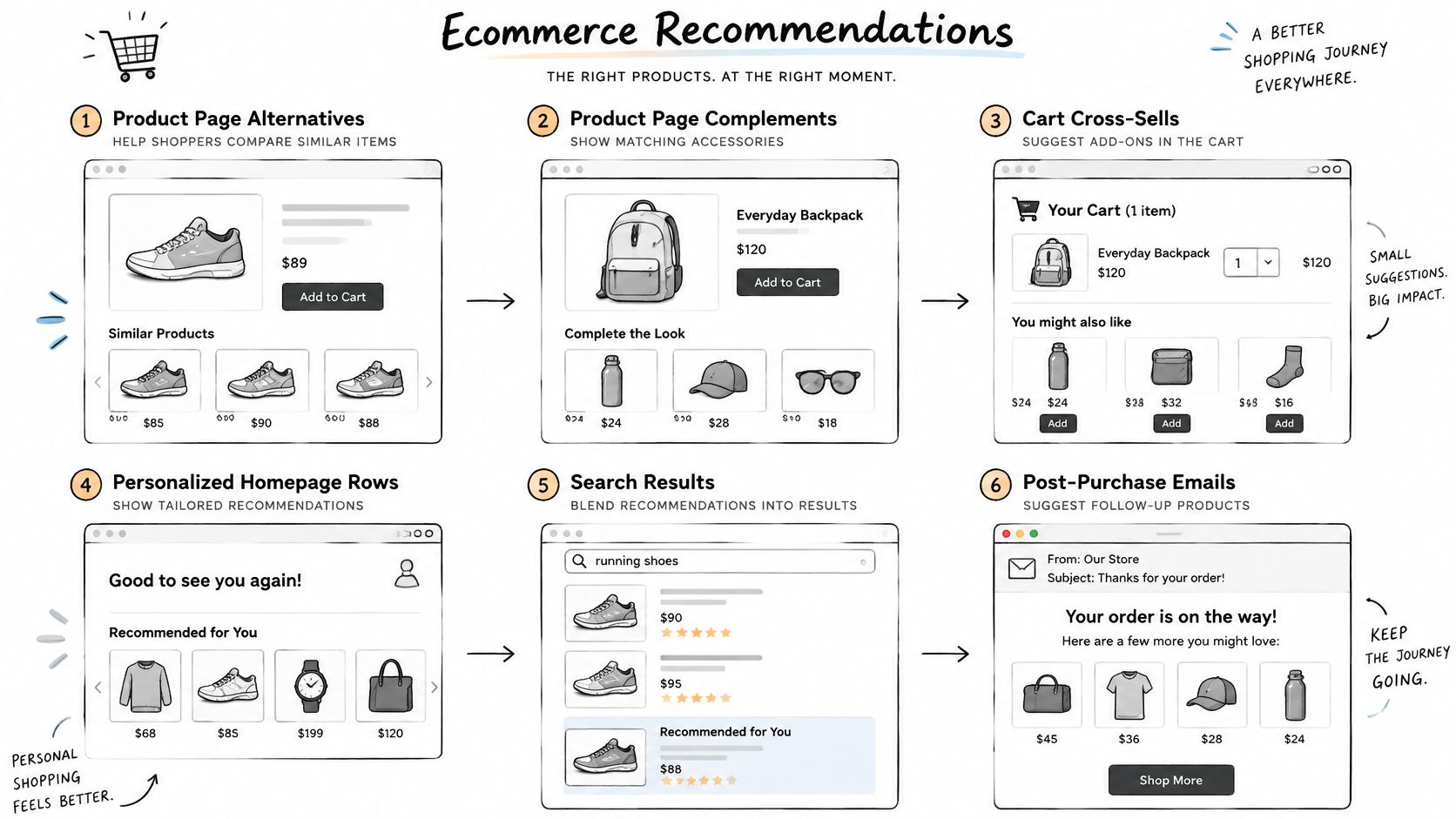
- Product-page alternatives help shoppers compare products that meet the same need.
- Product-page complements identify compatible accessories or useful additions.
- Cart cross-sells complete the basket without interrupting checkout.
- Homepage rows help shoppers resume a visit or discover a relevant category.
- Search recommendations help refine an explicit request or recover from limited results.
- Post-purchase emails support setup, replenishment, or an appropriate next purchase.
In Baymard Institute's benchmark of 50 major ecommerce websites, only 42% recommended both alternatives and supplementary products on product pages. Keep those shopping tasks visibly separate: comparable jackets belong in an alternatives row, while compatible waterproofing spray belongs with accessories.
Increase personalization as evidence improves
Begin with category bestsellers and compatibility rules for visitors without usable history. Adapt suggestions to current-session activity, and offer a short preference question when an answer would materially improve the results. Returning shoppers can receive deeper behavioral personalization where their preferences and consent allow it.
A cart containing a waterproof jacket doesn't justify recommending any outdoor accessory. Check material compatibility, intended use, availability, and whether the shopper already has the item in the basket. A plausible suggestion is better than a busy recommendation slot.
Our guide to ecommerce personalization software addresses the application-level choices involved. For a broader commercial perspective, Next Point Digital on personalized ecommerce growth is a useful companion when coordinating merchandising and customer journeys.
Make the rationale understandable
In a 2025 UK retail study, 74% of consumers said retailers should clearly disclose when AI-generated content, recommendations, or images are used, according to Adobe's UK retail digital trends report.
Label placements clearly and offer accurate explanations, such as compatibility with the selected product. Don't claim a suggestion reflects purchase history when it came from a paid merchandising rule. Give shoppers usable controls over personalization, and treat opt-outs as product feedback rather than an obstacle to overcome.
Measuring Quality Beyond Clicks and Conversion
Recommendation metrics and what each one misleads on
| Metric | What it tells you | Watch out for |
|---|---|---|
| Click-through rate | Whether a slot draws attention | Rewards attractive items that don't sell |
| Add-to-cart rate | Early purchase intent | Can rise without completed orders |
| Conversion rate | Share of exposed sessions that buy | Needs a holdout group for causal interpretation |
| Average order value | Basket size per order | Can rise by pushing expensive items |
| Gross merchandise value per impression | Merchandise value per recommendation shown | Sensitive to a few large orders |
| Incremental revenue | Lift over a control group | Requires a clean randomized test |
| Return rate | Whether purchases stick | Arrives after the initial sale |
| Category coverage and diversity | Breadth of product discovery | Can cost short-term sales |
| Latency at the 95th percentile | Tail response time | Doesn't describe only the single slowest request |
A click isn't a sale. In an ecommerce study comparing ranking objectives, models trained for add-to-cart or order-submit improved the corresponding outcomes and gross merchandise value per impression, while click optimization didn't reliably deliver the same commercial gains. The order-submit objective slightly reduced clicks while increasing completed orders.
That's a practical warning against selecting models solely on engagement. A striking product can earn attention without being affordable, available in the right size, or suitable for the shopper.
More interaction can mean more friction. Measure whether shoppers complete a valuable task, not whether they keep tapping.
Use offline evaluation to qualify, not crown, a winner
Precision and recall help eliminate weak retrieval candidates. Also inspect recommendations for missing sizes, repeated brands, category imbalance, and products that appear relevant only because of accidental wording.
Then run a controlled online experiment:
- Randomize by shopper, keeping assignment stable across eligible visits.
- Choose incremental revenue per visitor as the primary metric before launch.
- Maintain a control experience and verify that impression logging works in both groups.
- Cover the weekly purchase cycle and continue until the sample size supports the decision, accounting for delayed purchases.
- Set guardrails for latency, unavailable items, margin, returns, and customer complaints.
For a hypothetical 50/50 test, suppose click-through rises 8% but revenue per visitor stays flat. Don't ship a revenue-focused change on the strength of those clicks. Keep the control while checking statistical uncertainty and whether the treatment merely redirected shoppers from another useful navigation path.
Report the commercial result honestly
Leadership needs incremental revenue, contribution margin, and a trust measure such as complaints or personalization opt-outs. Report uncertainty and include implementation and serving costs.
Don't count all revenue following a recommendation click as incremental. Some customers would've bought anyway. The control group is what lets you distinguish influenced purchasing from purchasing that merely happened nearby.
Architecture That Scales Across Catalog and Checkout
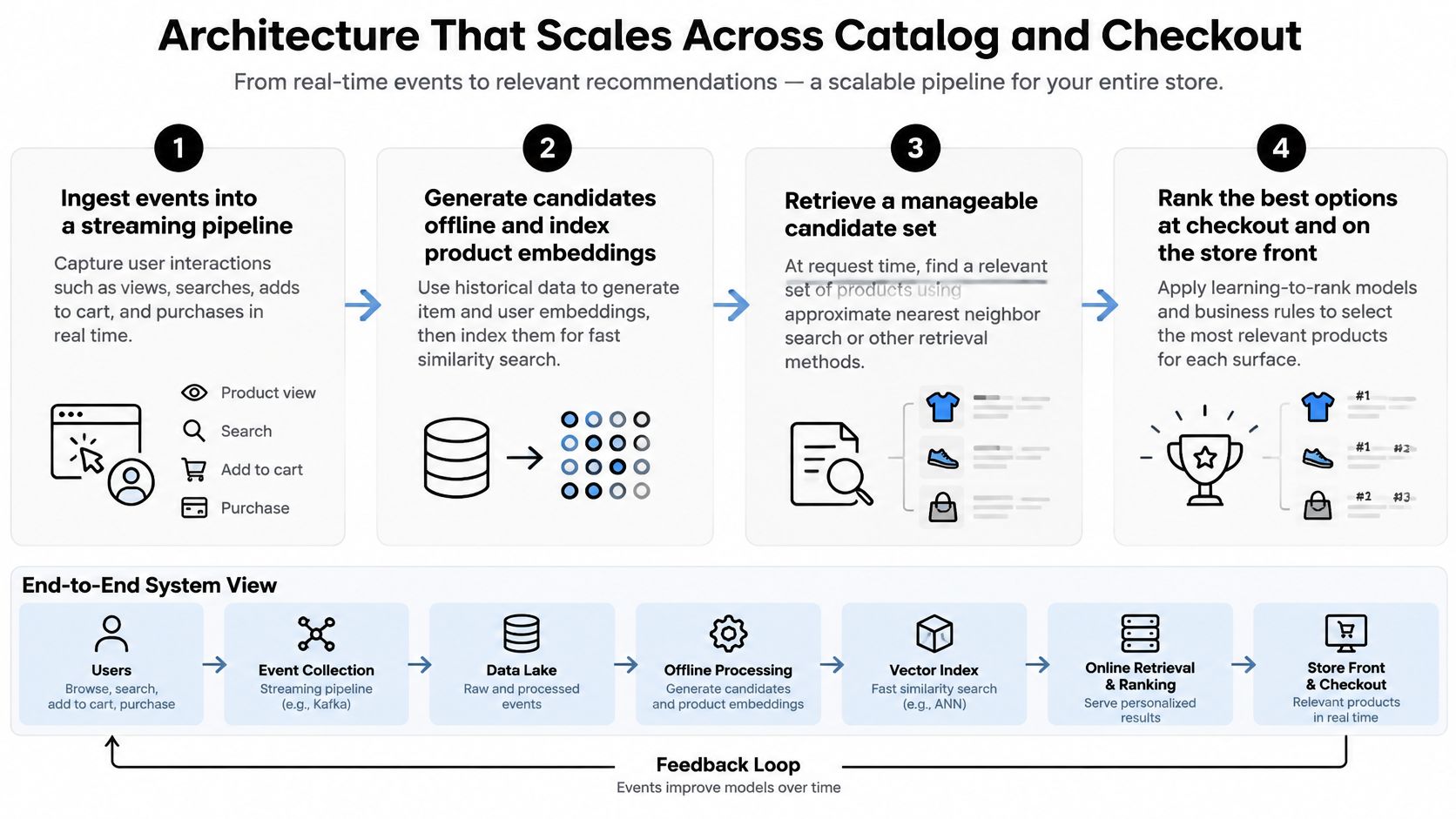
Separate candidate generation from online ranking. The first finds plausible products across the catalog; the second chooses what this shopper should see now. Running an expensive catalog-wide comparison during every page request is an avoidable design mistake.
- Ingest events into a streaming pipeline. Validate schemas and handle duplicate delivery before computing features.
- Generate candidates offline and index product embeddings, updating changed products incrementally.
- Retrieve a manageable online candidate set using approximate nearest-neighbor search.
- Rank eligible candidates using relevance, price, inventory, margin, availability, and current context.
- Serve reusable results from a cache, with a popularity fallback when personalization exceeds its deadline.
- Log impressions, selections, and outcomes with enough context to support evaluation and subsequent training.
An alternative-product recommendation study combined product text and behavioral signals, used NMSLIB approximate search across millions of products, and reported a statistically significant 12% conversion-rate increase over its baseline in a production A/B test. That supports the retrieval pattern, not a promise of the same lift for another retailer.
Integrate without rebuilding the store
Keep the engine behind an API rather than embedding its implementation into storefront templates. Our CMS integration work covers WordPress, WooCommerce, Joomla, Shopify, and BigCommerce, and we create foundational connections to the AI models that best fit each business's needs.
The service boundary in our microservice architecture example illustrates the separation to aim for. The storefront should receive product identifiers and presentation metadata, not become responsible for model internals.
Scale the shopping experience
Set request deadlines so recommendation failures can't block product pages or checkout. Autoscale serving capacity against measured traffic and resource pressure, and keep training jobs away from customer-facing compute.
Test the entire mobile and desktop path, including image rendering and selection. Google's mobile reliability guidance emphasizes critical interactions, responsiveness, freshness, and crashes rather than infrastructure availability alone.
During sale-day load tests, include cache misses, delayed inventory, and an unavailable model service. Budget for embedding updates, index memory, inference, logs, and operational support, not just the API bill.
Governing and Monitoring the Engine in Production
Governance keeps an initially useful system useful after the catalog, customers, and models change. Assign an owner who can pause a harmful recommendation strategy without waiting for an architecture meeting. That owner needs authority over the strategy, the data it consumes, the prompts or rules that shape it, and the placements where shoppers see the result.
A practical failure can look mundane. A catalog update changes category names, the engine excludes a product group, and commercial reporting still shows activity because the remaining recommendations receive traffic. Governance exists to catch that gap before it becomes normal.
The GOVERN, MAP, MEASURE, and MANAGE functions of the NIST AI Risk Management Framework guidance provide an operational structure:
- GOVERN establishes ownership and approval rules. A merchandising override should have an approver and an expiry condition.
- MAP identifies models, prompts, data sources, and affected shopping contexts. Include external services and sensitive inputs.
- MEASURE tracks recommendation quality, drift, and operational behavior. Watch whether a catalog change suddenly excludes a category.
- MANAGE defines responses. Roll back a failing version, disable a problematic input, or retire a strategy that no longer earns its operating cost.
Keep an auditable decision trail
Record model and prompt versions, permitted inputs or protected references to them, recommendation outcomes, and reason codes where appropriate. Store enough information to determine whether a change came from the model, its inputs, or an approved override without unnecessarily retaining raw personal data.
Run a weekly review of category coverage, latency, inventory freshness, and commercial outcomes. Use immediate alerts for failures that cannot wait for that meeting, and test that the rollback procedure restores the prior version.
Operational safeguard: A dashboard without a named responder and a recovery action is just a colorful incident archive.
Wonderment Apps offers an administrative toolkit for prompt management, integrations, and token cost control. Teams can use that layer to keep prompt changes version-controlled and monitor AI spend alongside the application's own authorization, logging, and rollback rules.
Set spend alerts alongside quality alerts and review token use whenever a model, prompt, or feature changes. An explanation feature that becomes unexpectedly expensive should be independently switchable without disabling the underlying product recommendations.
Choose Build, Buy or Hybrid and Launch a Pilot
Build when recommendations are a core differentiator and you can maintain the system for years. Buy when standard placements and launch speed matter most. Choose hybrid when you want custom ranking logic without owning every retrieval component.
Build, buy and hybrid compared
| Option | Best when | Gains | Costs and risks |
|---|---|---|---|
| Build in-house | Recommendations are a core differentiator and you have data and ML staff | Full control over models, ranking and data use | Highest ownership burden and years of team time |
| Buy hosted engine | Speed to launch, a small team and standard placements matter most | Fast launch with low staffing load | Less control over ranking; ongoing vendor fees |
| Hybrid (buy retrieval, build ranking) | Mid-size stores that want custom business rules | Balanced cost and control over ranking | Separate systems to integrate and maintain |
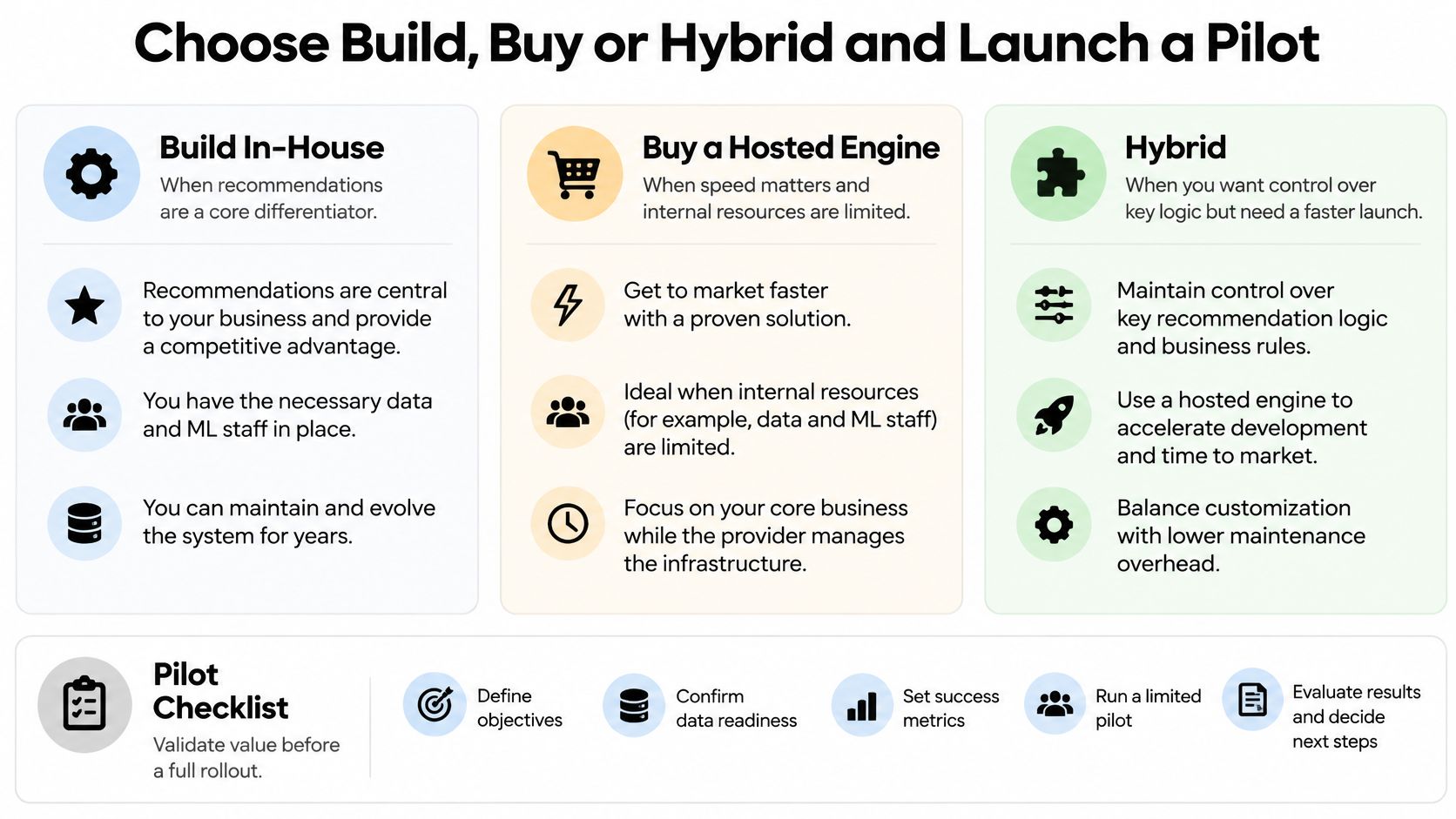
Make the pilot a business decision
- Define success as incremental revenue with margin safeguards.
- Confirm readiness across events, catalog attributes, inventory, and consent.
- Score internal capacity, including maintenance and incident response.
- Estimate run cost across inference, infrastructure, vendor fees, and team time.
- Select a placement with a stable control group.
- Set a decision date and the evidence required to proceed, extend, or stop.
If you're building, assess developers on API design, experiment design, failure recovery, and separating deterministic rules from model output. Ask them to explain how they'd diagnose a revenue drop after deployment.
In our staffing process, department managers and recruitment review only the top selection of candidates, and clients choose from a curated list of vetted talent. For this project, the selection should prioritize production judgment alongside model knowledge.
Wonderment Apps offers custom AI integration, web and mobile engineering, and an administrative toolkit for managing prompts, connected AIs, and cumulative costs. Visit Wonderment Apps to request a prompt management system demo, then scope a recommendation pilot around a single placement, a control group, and measurable incremental revenue.