


Your team wants to add AI to an existing app. Someone has mocked up a chat interface, someone else is comparing models, and the product lead is asking when customers can try it. Then the harder questions arrive: Which records can the assistant access? Can it change an account? Who fixes an incorrect answer, and how will you know whether the feature helped?
A useful AI implementation changes a workflow, not just an interface. It connects trusted data to a bounded task, gives users a safe recovery path, and produces an outcome the business can measure. Whether the application runs on desktop or mobile, the engineering challenge extends well beyond getting a convincing response.
Wonderment Apps' prompt management system addresses the administrative side of that challenge. Teams can plug it into existing software to manage prompt versions, control internal data access, centralize AI logs, and see cumulative costs. That's a practical modernization layer, not a reason to rebuild an otherwise useful product.
The model generates an answer. Your application still needs to decide what that answer is allowed to do.
These AI implementation examples span customer support, recommendations, language practice, fraud prevention, clinical documentation, merchant operations, education, and production governance. Their reusable lessons concern where AI belongs, how it connects to existing software, and what teams must operate after launch.
1. Klarna's AI Customer Service Assistant (Fintech)
A customer asking about a refund doesn't want a demonstration of artificial intelligence. They want to know where their money is and what happens next. Klarna's app-based customer service assistant illustrates why conversational AI is more useful when it sits inside an authenticated customer workflow.
The support pattern covers questions about refunds, returns, payment rescheduling, and accounts. For a similar implementation, the application should retrieve relevant account information through controlled services, while the assistant explains policy and proposes permitted next steps. A fluent conversation shouldn't grant the model authority to invent a refund decision.

Design for resolution, not containment
Start with bounded intents such as order status and refund eligibility. Keep exceptions, disputed transactions, and unclear policy interpretations on a fast path to a person. Klarna's subsequent emphasis on adding human service capacity is a useful reminder that automation and service quality aren't interchangeable.
- Preserve context: Give the human agent the conversation and relevant records so the customer doesn't have to start again.
- Measure resolved cases: Track repeat contacts, escalation, review effort, and cost per resolved conversation, not merely chatbot usage.
- Trace policy changes: Record which prompt and policy version supported each answer.
Wonderment Apps' prompt vault, versioning, and logging can support this integration without replacing the core app; a demo is available for teams assessing that administrative layer.
The same design principle applies beyond support. A service like AI-marked practice for A-Levels should be evaluated against the user's underlying task, not merely whether it produces polished text.
2. Netflix Personalized Recommendations and Artwork (Media and Entertainment)
Netflix's personalized home screen and artwork illustrate a different kind of AI implementation: users don't need to ask the system anything. Recommendations influence which titles they encounter and how those titles are presented.
For a custom media application, separate candidate selection from ranking and presentation. Candidate selection gathers plausible content; ranking orders it for a viewer; presentation determines how the app explains or displays those choices. This separation lets developers improve a component without rewriting the entire browsing experience.

Personalization needs an escape hatch
Collaborative filtering can help identify relationships between viewing preferences, while content metadata offers a starting point when behavioral history is limited. Onboarding preference picks can also give a new account useful recommendations before the app has much activity to analyze. Spotify's Discover Weekly is another recognizable example of recommendations delivered as a finished product experience rather than a visible AI tool.
The trade-off is between relevance and discovery. If every recommendation resembles the last selection, the experience can become repetitive; editorial picks, exploration slots, and user controls give viewers alternatives.
A recommendation is successful when the user finds something worthwhile, not merely when the thumbnail earns a click.
Measure retention, session depth, and satisfaction alongside clicks. For implementation, keep a nonpersonalized fallback available when recommendation services fail, and cache suitable results so browsing doesn't depend on a fresh model request for every screen.
Don't assume the language model should do the ranking. A focused recommendation system may suit the task better, with generative AI reserved for search interpretation or helpful explanations.
3. Duolingo Max and Generative AI in a Mobile Learning App
A learner gives an unexpected answer during a speaking exercise. A fixed lesson may mark it wrong; a conversational feature can respond to what the learner meant and keep the practice focused. Duolingo Max, with Explain My Answer and Roleplay, applies generative AI to that gap in an established mobile learning product.
The product pattern is additive: AI features sit alongside familiar lessons, progression, and navigation. Learners can ask why an answer was incorrect or practice a conversation tied to a learning goal. Video call practice extends that interaction into a more direct format, while keeping the app's existing learning experience as the foundation.
AI practice earns its place when it helps learners understand or use a skill, not simply when it makes an app feel more advanced.
For a subscription app, the value needs to be clear in the moment. An explanation of a specific mistake is easier to assess than a general promise of an AI upgrade. Conversation content should also reflect the learner's level and current objectives. Subject-matter experts can define what counts as a helpful explanation, correction, or increase in difficulty.
The product and operations decisions are linked. Usage limits need to fit both the subscription value and the cost of delivering AI responses. Prompt versioning lets developers connect learner ratings and error reports to the exact instructions in use, making regressions easier to investigate. For interrupted sessions, preserve enough state to resume practice without retaining more conversation history than the experience requires.
The core instructional trade-off is freedom versus control. An unconstrained conversation can drift away from the learning goal; a tightly scripted exchange may add little to the lesson engine. Teams need to test both teaching quality and how reliably the AI stays within the intended practice.
Mobile recovery matters too. Provide clear loading, retry, and resume states so a failed request does not feel like a learner's mistake. The interface should make recovery straightforward without asking learners to understand the system behind the conversation.
4. Stripe Radar and Machine Learning Fraud Detection for Payments
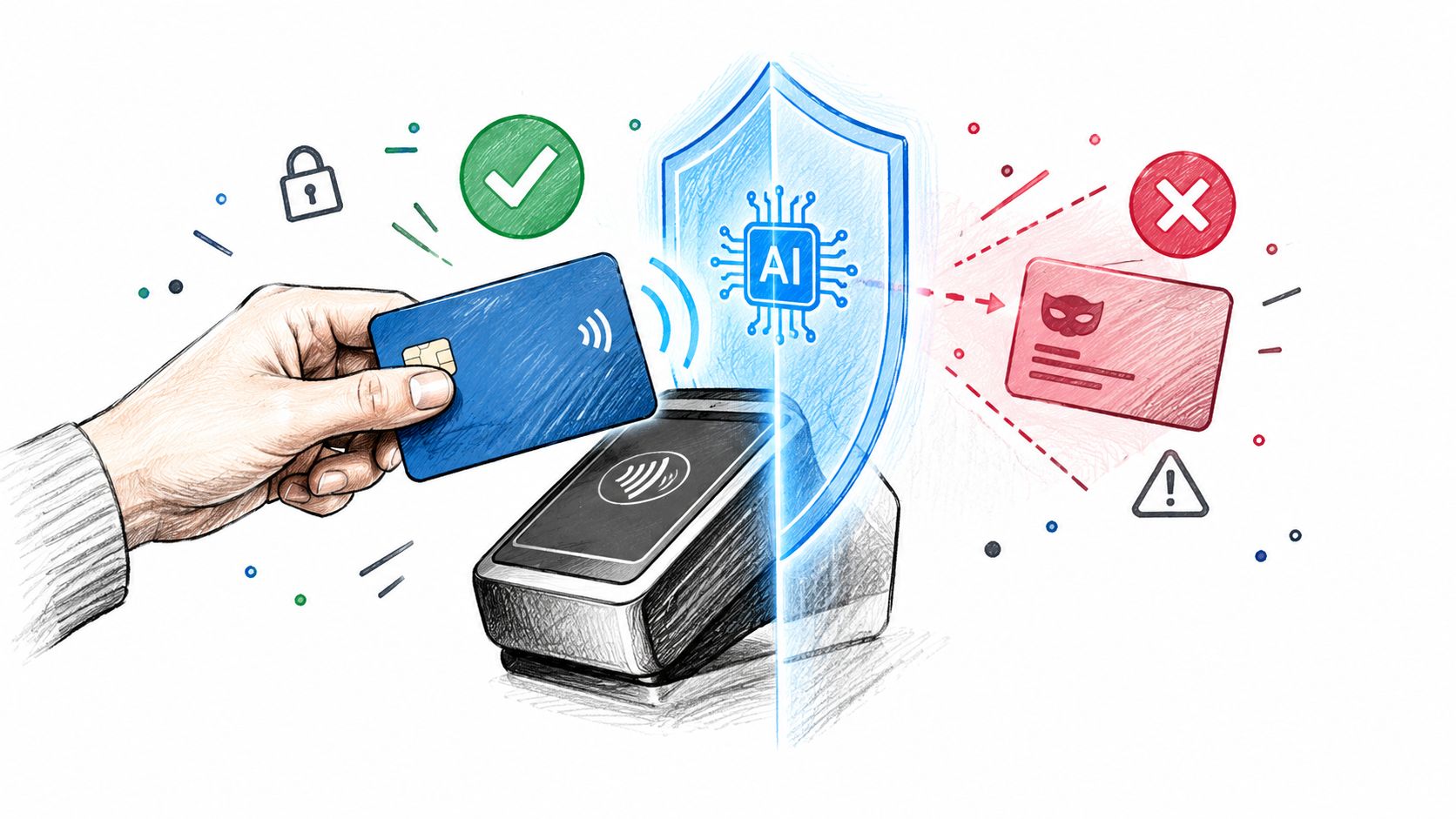
A payment risk decision has two costs: fraud that gets through and legitimate customers turned away. Stripe Radar shows how machine learning can run inside an established payment flow, where the system's output must support a clear action rather than optimize an accuracy score in isolation.
Radar combines machine-learning risk assessment with rules that merchants can configure. Its shared-network model gives businesses access to signals beyond their own transaction history. The trade-off is that teams must fit a service's capabilities to their checkout policies and exception-handling needs.
Separate the signal from the action
In a custom payment flow, the risk score and the policy response belong to distinct parts of the decision path. A policy can approve a transaction, request additional verification, or send it for review. Log the applicable rule and decision context, while limiting sensitive payment data in operational logs.
Review both sides of the error: legitimate customers blocked and fraudulent transactions that pass. Use explicit rules for clear business policies, not every ambiguous pattern. Authorized staff also need enough context to investigate disputes and adjust policies. Set checkout behavior in advance for an outage in the risk service, including whether to pause, retry, or use another review path.
Wonderment Apps' discussion of machine learning for businesses offers broader context for assessing predictive applications.
Buy versus build depends on where a team can add value. A payment platform's risk service may be a better fit than a custom fraud model. Product and engineering effort can then focus on checkout experience, permissions, auditability, and the merchant's process for handling exceptions. That division connects the model to the operating system around it, where staff can review decisions and teams can refine policies without treating every risk signal as an automatic block.
5. Ambient AI Clinical Documentation at Kaiser Permanente (Healthcare)
The clinician should be talking with the patient, not wrestling with another interface. Kaiser Permanente's ambient documentation rollout with Abridge illustrates AI placed around an existing encounter: capture the conversation with consent, produce a structured draft, and return it for clinician review. DAX Copilot offers another example of the clinical note-drafting pattern.
The critical distinction is drafting versus signing. A useful implementation helps prepare documentation without treating generated text as an independently verified medical record.

Design the entire information lifecycle
For a similar system, map every audio and text artifact from capture through deletion or retention. Establish consent handling, access permissions, vendor data-use terms, and an appropriate business associate agreement. Clinicians should be able to inspect, edit, and reject a draft before filing it.
Regulated device implementation offers useful context, though it's distinct from documentation software: a JAMA Network Open analysis of FDA-authorized AI-enabled medical devices identified 903 devices, with radiology representing approximately 76% of historical authorizations through mid-2024. Those findings shouldn't be treated as evidence of an ambient scribe's safety or effectiveness.
Clinical design principle: Preserve the clinician's authority and make correction easier than blind acceptance.
Measure documentation time together with review burden, omitted information, and correction effort. If clinicians save drafting time but spend it repairing notes, adoption alone won't prove value.
Teams exploring AI solutions for healthcare should prioritize workflow integration and privacy architecture alongside model performance. A polished transcript is not the same thing as a clinically useful note.
6. Shopify Sidekick and an AI Assistant for Merchants (Ecommerce)
A merchant checking a sales report needs a different level of access from one creating a discount. Shopify Sidekick, built into the Shopify admin, illustrates how an AI assistant can connect conversation to store operations while keeping the merchant's existing software at the center of the workflow.
The product pattern brings natural-language requests to store data and administrative capabilities. Merchants can ask about sales, request reports, draft product descriptions, or create discounts without switching tools or copying information between systems. Each request still needs the right boundary: interpreting a question is different from changing a live store.
Keep store controls in application code
A custom assistant should retrieve data through authorized application services. The model can interpret a request and suggest an action, while backend code checks the user's role, required fields, and business rules before making any change. Store data stays behind those controls.
A practical rollout: Begin with reporting and drafts. Add write access only after the team can validate proposed changes and handle mistakes.
For actions that alter a store, show merchants what will change before applying it. Scope each request to the correct store and role, make changes reversible where possible, and retain an audit trail. Track whether merchants accept, edit, or reject suggestions, then use those outcomes to identify where the assistant misunderstands intent.
Reporting needs its own safeguards. A sales answer should specify its time period and explain how it treats refunds, returns, and other relevant adjustments. Without a clear definition, a fluent response can still mislead the merchant.
This pattern applies to how SaaS companies use AI to improve their products: keep the existing application authoritative, and let AI make its capabilities easier to access. Start read-only when uncertainty is high. Expand permissions as the team demonstrates that it can validate actions and recover from errors.
7. Khanmigo and AI Tutoring for a Nonprofit Education Platform
A student asks for the answer to a math problem. A tutor that gives it immediately may satisfy the request while missing the learning goal. Khanmigo, Khan Academy's AI tutor, illustrates how an education product can shape model behavior around instruction rather than answer accuracy alone.
Khanmigo supports guided tutoring and teacher tasks such as lesson planning. Its school-district pilots and teacher access programs offer a model for connecting an AI feature to existing classroom practice, where educators remain part of how the product is evaluated and used.
Design for learning, then test the interaction
A tutoring system needs clear rules for how it responds: when to offer a hint, ask a student to explain their reasoning, or show a worked explanation. Test these choices against realistic inputs, from requests to skip the work to incomplete attempts and confidently wrong answers. The goal is useful guidance that keeps the student involved.
A system prompt can set the intended behavior, but it cannot enforce every boundary on its own. Pair prompt instructions with curated learning content, test cases, teacher review, and application controls. This gives teams several ways to spot and address responses that miss the instructional goal.
Teachers should assess instructional fit before a wider rollout. Families and districts also need clear explanations of what data the system collects, how long it is retained, who can access it, and how it may be used. Plan for accessibility, language needs, and devices with limited connectivity as part of the product, not as later additions.
Measure whether students demonstrate understanding and seek help appropriately, rather than relying on conversation volume. A guide to AI language tutors offers another starting point for designing conversational learning experiences.
The operating trade-off is how much help to provide. Too much assistance can reduce practice; too little can frustrate students. Teacher-informed evaluation helps product teams adjust the balance for different learning tasks and gives educators a practical role in improving the tutor after launch.
8. Running AI in Production with Prompt Versioning, Logging, and Cost Control
A prompt change can make production answers less useful before anyone spots the pattern. Without version history and request-level records, developers may not know which change caused the decline. Production governance is part of implementation, because teams need to diagnose issues and reverse changes after launch.
An EY survey on responsible AI governance found that 99% of respondents reported financial losses from AI-related risks, while 64% said losses exceeded US$1 million. These findings make a case for operational risk controls, not a prediction of losses for any particular app.
Wonderment Apps has developed a prompt management system that developers and entrepreneurs can connect to existing software. Its modules address different parts of production oversight: Prompt Vault keeps version history for comparison, auditing, and rollback; Parameter Manager controls AI access to internal databases through scoped parameters; Logging System records model requests, responses, and errors; and Cost Manager tracks cumulative spend as usage grows.
Tools need clear operating procedures. Document why each prompt changes, redact personal information before storing logs, and review cost alongside response quality. Set up feature-level alerts, define how to handle failed integrations, and test rollback before a change reaches users.
The same workflow-first approach applies when teams look to speed up cash flow with RPA. Assign ownership and define how staff handle exceptions when automation cannot complete a task.
Request a demo to assess how Wonderment Apps' modules fit your existing stack. Operational visibility should improve decisions, giving teams enough context to act without collecting logs they will not use.
AI Implementation Examples: 8-Case Comparison
| AI Implementation Example | Implementation Complexity | Resource Requirements | Expected Outcomes | Ideal Use Cases | Key Advantages |
|---|---|---|---|---|---|
| Klarna AI Customer Service Assistant | High: app integration, policy grounding, escalation design | LLM access, current policy data, monitoring, human agents | Faster resolutions; handles high chat volume | Fintech and other high-volume customer support | 24/7 multilingual service; frees staff for complex cases |
| Netflix Personalized Recommendations | High: data pipelines, recommendation models, continuous testing | Large-scale viewing data, ML infrastructure, privacy controls | Higher engagement and retention; easier content discovery | Streaming and other large content catalogs | Personalized rankings and artwork at scale |
| Duolingo Max Generative AI | Medium–high: AI features integrated into an existing app and subscription | LLM access, expert-reviewed content, usage and cost controls | More personalized language practice; premium subscription value | Learning apps offering interactive practice | Conversational feedback within a familiar app |
| Stripe Radar Fraud Detection | High: real-time payment integration and risk tuning | Transaction data, ML infrastructure, review processes | Reduced fraud losses and chargebacks, with fewer false declines | Payment platforms and ecommerce | Network-wide fraud signals and real-time scoring |
| Kaiser Permanente Ambient AI Documentation | High: clinical workflow and EHR integration | Consent processes, secure audio handling, EHR access, clinician review | Less documentation time and more patient-facing interaction | Healthcare systems with high clinical documentation workloads | Drafts notes within existing visits while retaining clinician oversight |
| Shopify Sidekick Merchant Assistant | Medium: admin integration and permission controls | Store data access, LLM, preview and undo controls | Faster routine tasks and easier access to store insights | Ecommerce administration and small-business operations | Natural-language assistance grounded in merchant data |
| Khanmigo AI Tutoring | High: curriculum alignment, learner safeguards, and evaluation | LLM access, educator input, privacy controls, guardrails | Scaled personalized learning and teacher support | K–12 education and tutoring services | Socratic guidance designed to support learning rather than provide answers |
| AI Production Operations Management | Medium–high: operational tooling and workflow adoption | Prompt and model logs, access controls, cost monitoring, privacy safeguards | Improved traceability, change control, and cost visibility | Teams operating AI features across existing applications | Prompt versioning, centralized logging, and spend oversight |
The Pattern Behind Every Successful AI Launch
These AI implementation examples share a product strategy, even though their interfaces differ. Start with a bounded workflow, connect trusted application data, preserve appropriate human authority, and measure an outcome that matters. A support assistant, recommendation engine, and clinical drafting tool shouldn't share the same success metric.
Adoption is no longer the most interesting question. Stanford's 2025 AI Index report found that 78% of surveyed organizations used AI in at least one business function in 2024, up from 55% in 2023. For a product leader, the useful question is whether a particular implementation improves the workflow enough to justify its full operating cost.
Establish the baseline before the pilot
Document how the task works today: completion time, errors, review effort, abandonment, and relevant revenue or costs. Include integration work, monitoring, human review, and fallback operations in total cost of ownership. Time saved isn't automatically cash saved; specify how the organization will use the released capacity.
The measurement gap is substantial: a Governance Institute of Australia survey found that 93% of respondents couldn't effectively measure AI return on investment, while 88% struggled to integrate generative AI with existing systems. Model selection won't fix either problem on its own.
Choose developers who can explain permission boundaries, integration contracts, evaluation methods, and failure recovery. Ask how they'll test a prompt change, isolate tenant data, preserve the mobile experience during an outage, and distinguish a compelling pilot from a maintainable production feature.
Build for change, not a permanent model choice
Keep AI services behind stable application interfaces so the team can update models or prompts without redesigning the whole product. Assign owners for quality, privacy, operational incidents, and spend. Maintain evaluation cases and rollback procedures as deliberately as you maintain application tests.
Durable AI products are products plus governance. Begin by assessing an existing web or mobile workflow, then identify where controlled automation can remove friction without removing accountability. Request a demo of Wonderment Apps' prompt management system to see how its Prompt Vault, Parameter Manager, Logging System, and Cost Manager can support a scalable implementation without a full rebuild.
Wonderment Apps offers AI modernization, web and mobile development, and an administrative toolkit for operating integrated AI features. Visit Wonderment Apps to discuss a workflow in your existing application and request a prompt management system demo focused on data access, traceability, and cost control.