

A merchandising team launches a recommendation widget. Then it upgrades search. Then it adds an AI shopping assistant. A few months later, nobody can say which prompt is live, what each feature costs, or why one shopper received a particular offer.
That's the operational reality behind today's ecommerce personalization trends. Personalization is no longer one model attached to a product page. It's a portfolio of AI features across search, content, service, offers, and live shopping sessions. Each feature needs the right data, controlled access, reliable logging, sensible budgets, and a way to explain its decisions.
The nine trends below focus on those practical decisions. You'll see where hybrid recommendation systems work better than single signals, why conversational AI needs strict handoff rules, and how visual tools can create new privacy obligations. You'll also see why governance belongs in the architecture from the start.
Wonderment Apps has developed a prompt management system that developers and entrepreneurs can plug into an existing application to modernize it for AI. A demo is available for teams that want to see the system in action, including prompt versioning, data-access controls, logging, and cost visibility.
1. AI-Powered Product Recommendation Engines
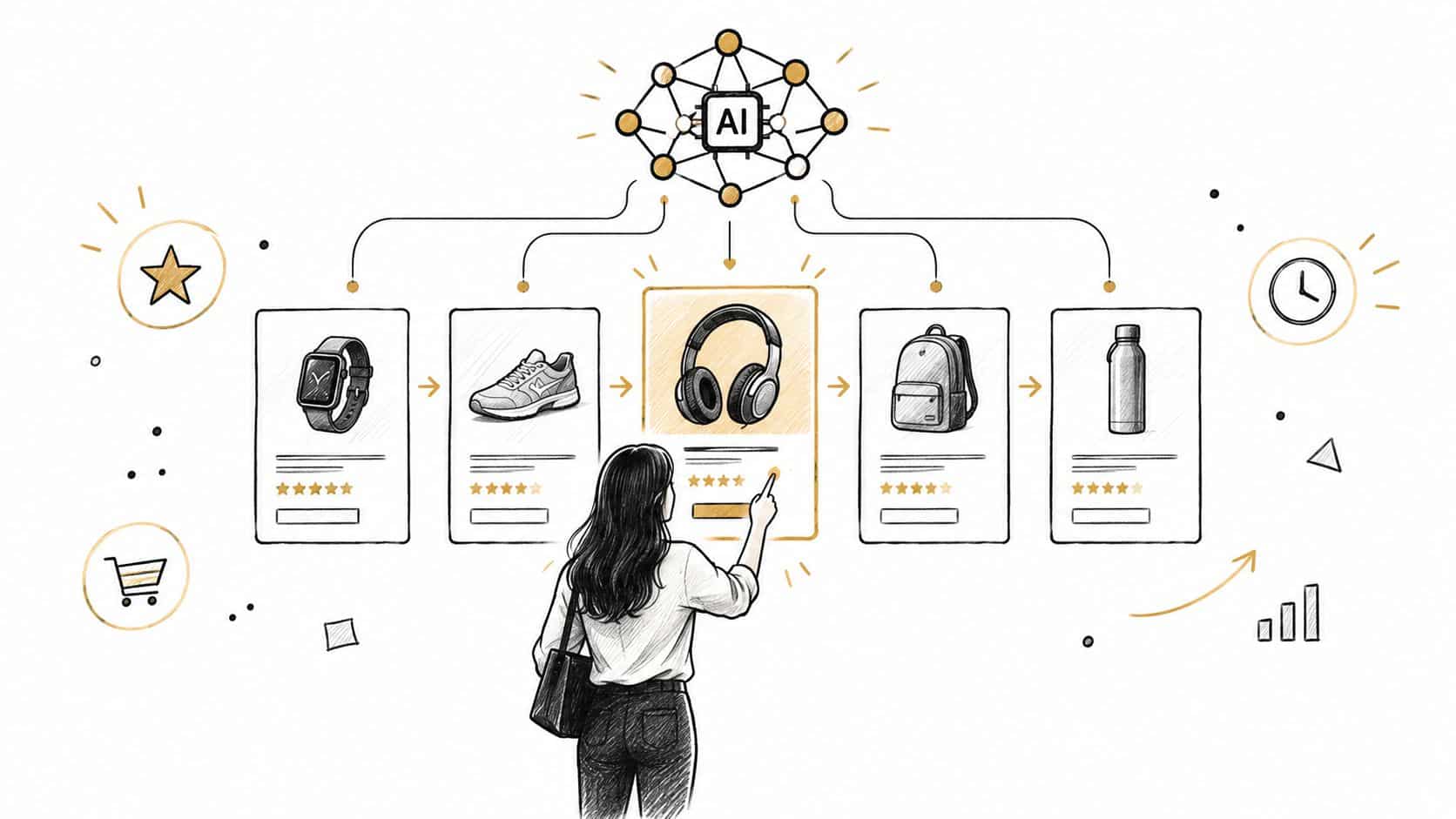
Product recommendations remain one of the clearest ways to turn behavioral data into a shopping decision. A useful engine combines browsing activity, purchase history, catalog attributes, and patterns from similar shoppers. It might show complementary products, substitute items, or products that match a shopper's current intent.
The strongest systems use a hybrid ranking approach. Collaborative methods identify products associated with similar customers. Content-based methods compare attributes such as brand, category, color, or material. A real-time layer can then adjust the ranking when a shopper changes direction.
Research published in 2022 found that recommendation relevance, product quality, price, service quality, the online shopping experience, and review credibility all influence willingness to purchase personalized products. The same study found that combining collaborative, content-based, and user-based methods produced higher satisfaction than relying on one method alone. The peer-reviewed ecommerce study supports treating recommendations as a hybrid-ranking problem rather than a simple similarity widget.
What to build first
Amazon's early item-to-item collaborative filtering work showed how recommendation logic could connect products without requiring a full shopper profile. Modern platforms such as Bloomreach and Constructor extend that idea across search, merchandising, and recommendations.
Start with a simple hybrid model. Then measure whether it improves the customer journey before adding deeper model complexity.
- Handle cold starts: Use bestsellers, trending products, category rules, or editorial selections when a shopper has little history.
- Separate the metrics: Track click-through, add-to-cart activity, and revenue per session independently. A recommendation can earn clicks and still send shoppers toward low-value products.
- Protect variety: Add diversity constraints so a carousel doesn't display several near-identical products.
- Govern the changes: A controlled prompt and data-access layer makes it easier to test ranking logic without losing track of what changed or why.
Recommendation engines are useful infrastructure, but they need operational ownership. Someone must monitor catalog quality, retraining, experiments, fallback rules, and the business impact of every ranking change.
2. Personalized Search and Dynamic Merchandising
Search is where shopper language meets catalog structure. A visitor may type a vague phrase, misspell a brand, use a synonym, or describe a need in natural language. A modern search system can interpret that intent, connect it to product attributes, and rank results using both the query and the shopper's context.
Personalized search can also reorder category pages and landing pages. A returning shopper interested in running equipment might see technical footwear and hydration products first. A new visitor may receive a broader assortment. The difference should come from useful evidence, not from a mysterious black box.
Keep merchants in control
Dynamic merchandising can adjust facets, sort orders, banners, and featured collections based on behavior, location, device, or time. That flexibility creates a common failure mode. The algorithm may optimize immediate clicks while hiding a new product, a high-margin collection, or a seasonal launch.
Blend AI ranking with explicit business rules. Algolia and Bloomreach are examples of platforms used for search and discovery, but the tool matters less than the operating discipline around it. Merchandisers should be able to inspect why products moved and override the system when commercial context requires it.
Practical rule: Optimize search for revenue per search and customer satisfaction, not clicks alone.
Review your top search queries each month. Start with zero-result and low-click queries. They often expose missing synonyms, poor product attributes, broken filters, or gaps in the assortment. Log the query, the ranking decision, and the applied business rules. Without that trail, a search upgrade becomes a guessing game with nicer software.
3. Generative AI for Personalized Product Content
Generative AI can adapt product titles, descriptions, bullet points, and campaign copy for different channels or audiences. A marketplace seller can create variants for a large catalog. A retailer entering a new market can generate localized drafts. A mobile app can present a shorter description while a desktop product page provides more detail.
The useful input is structured and verified. Product dimensions, materials, compatibility, ingredients, inventory status, and approved claims should come from trusted catalog data. A model shouldn't invent a feature because the product description sounded incomplete.
Shopify's Magic AI tools illustrate the appeal of assisted product-description generation. Stitch Fix offers a different model, combining algorithmic recommendations with human stylists. Both examples point to the same operational lesson. Automation can increase the amount of content a team handles, but human judgment still matters where accuracy, fit, safety, and brand voice matter.
Put review into the workflow
A retailer selling supplements, cosmetics, or medical devices should require human approval for regulated or high-risk claims. Even ordinary apparel copy needs review when the model could confuse fabric composition, care instructions, or sizing.
- Use verified fields: Feed the model structured catalog data instead of asking it to fill gaps.
- Version the instructions: Store prompts and brand rules in version control so a change can be reviewed or rolled back.
- Measure downstream effects: Watch conversion and returns together. Persuasive copy that creates the wrong expectation can increase avoidable returns.
- Separate drafts from publication: Keep generation, review, approval, and publishing as distinct states.
For teams experimenting with product copy, Trendlytic's AI description writer is one example of the category. The important question isn't whether a tool can produce text. It's whether your application can verify, approve, attribute, and maintain that text over time.
4. Conversational AI Shopping Assistants
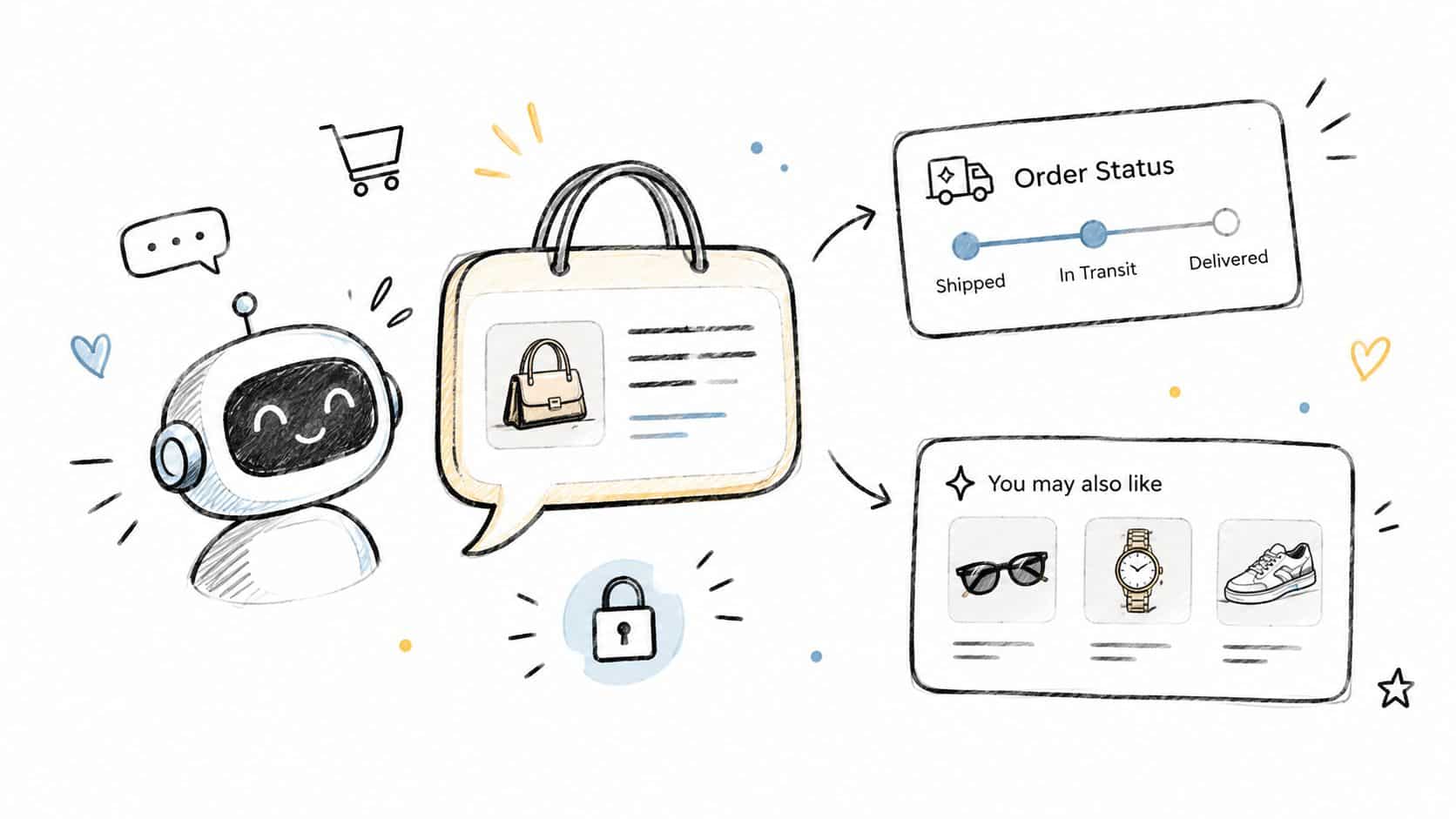
A conversational assistant can answer product questions, compare options, check an order, explain a return policy, and guide a shopper through a decision. A request such as “What jacket works for a rainy commute under $150?” requires product attributes, price constraints, weather-related language, and a useful way to narrow the assortment.
That assistant needs more than a language model. It needs retrieval from live inventory, product data, order systems, and policy content. It also needs access controls. A shopper should receive the order information relevant to their account, not a broad dump of customer records.
Klarna's 2024 AI assistant and Sephora's Virtual Artist, developed with ModiFace, show two different directions for conversational and visual commerce. Their relevance depends on the surrounding systems. A polished chat window cannot fix stale inventory or an unclear returns policy.
Design for uncertainty
Recent U.S. research found that 57% of surveyed consumers use generative AI for product research and 45% use it for personalized recommendations, while 85% report concerns involving privacy, personalization, or AI fatigue. The same research found that 37% worry AI will misinterpret their preferences and 35% fear irrelevant recommendations. The reported consumer findings make a strong case for restraint.
- Use live retrieval: Ground answers in current inventory, order, and policy systems.
- Set handoff rules: Escalate after repeated failed answers or whenever the request involves a sensitive exception.
- Review conversations: Log chats and inspect a random sample each week for accuracy and tone.
- Minimize access: Give the assistant only the customer fields it needs.
A good assistant knows when to ask a clarifying question. A bad one confidently recommends the wrong raincoat.
5. Predictive Next-Best-Action and Customer Lifetime Value Modeling
Recommendation systems often react to what a shopper just did. Predictive models try to estimate what the shopper may do next. That might mean buying again, responding to an offer, becoming inactive, or needing replenishment.
Next-best-action systems combine those predictions with inventory, margin, channel, and frequency rules. A replenishment brand might show a reminder when a customer is likely to need the product again. A subscription business might intervene before cancellation. A loyalty program might select a useful reward instead of another generic discount.
Starbucks' Deep Brew platform is a well-known example of personalization across app offers and recommendations. The pattern is transferable, but the first implementation should remain narrow. Predicting everything creates a complicated pile of scores that nobody trusts.
Test one prediction at a time
Start with one defined outcome. Create a control or holdout group, then compare the action against what would have happened without it. A model that identifies likely buyers isn't automatically creating incremental value. It may just target people who were already going to purchase.
Document every feature definition. Marketing and engineering should agree on what “active customer,” “likely to churn,” or “high value” means. Without shared definitions, teams can argue about results while using different populations.
Machine learning for retail provides additional context for applying predictive systems to retail workflows.
Use frequency caps across email, push, SMS, and on-site messages. High-propensity customers are valuable, but they're still people. Over-message them and the model may optimize the next click while damaging the next purchase.
6. Personalized Offers and Pricing Strategies
Personalized offers can make promotions more relevant without giving every shopper the same discount. A retailer might offer a bundle based on complementary products, a loyalty reward tied to a known preference, or a coupon that supports a specific retention goal.
Personalized list prices are more sensitive. Different prices for different customers can raise fairness, legal, regulatory, and trust questions. Many retailers start with offers, bundles, and rewards instead, because those mechanisms are easier to explain and constrain.
Kroger and dunnhumby are examples associated with personalized digital coupons for loyalty members. Retailers also use complementary checkout bundles to encourage a larger basket. Both approaches require commercial controls. An algorithm should not trade away margin just because a customer is likely to respond.
Put guardrails inside the decision engine
- Start with rewards: Test loyalty benefits and bundles before changing list prices.
- Protect margin: Set discount caps and margin floors in the decisioning system.
- Review market rules: Ask legal counsel to assess pricing personalization in every market you serve.
- Measure the full outcome: Track redemption, margin impact, repeat purchase, and retention together.
The best offer is not always the largest offer. It may be the product combination that solves the shopper's problem with less discounting. It may also be no offer at all when the shopper is already likely to buy.
7. Visual Search and AR-Powered Virtual Try-On
Some shoppers can describe a product precisely. Others have a screenshot, a room, or a vague memory of something they saw online. Visual search lets them use an image to find similar products. Augmented reality tools can show how eyewear, cosmetics, furniture, or other products might look in a particular context.
Pinterest Lens, Sephora's Virtual Artist using ModiFace technology, and Warby Parker's eyewear try-on represent different applications of computer vision. The technology classifies visual attributes, matches products, and estimates placement or appearance. It can shorten discovery when words aren't enough.

Treat the camera as a permission, not a default
Start with categories where visual similarity or fit matters most. Test across skin tones, body types, lighting conditions, devices, and image quality. A try-on experience that works only in a bright studio will fail in ordinary homes, which is where shoppers use it.
Ask for camera access at the moment it's needed. Explain how images are processed, whether they're stored, and how a shopper can delete or avoid that data flow. Augmented reality in ecommerce explores the role of AR in digital shopping experiences.
Measure more than engagement. Track category-level returns, correction behavior, opt-outs, and customer feedback. Visual confidence that produces the wrong size or color can move the problem downstream rather than solve it.
A 2025 systematic review identified product recommendations, user-interface customization, augmented reality, and generative AI as major ecommerce personalization directions. It also highlighted privacy, algorithmic bias, and implementation complexity as ongoing constraints. The systematic review supports pairing visual features with explicit governance rather than treating them as harmless interface decoration.
8. Real-Time Session Personalization and Behavioral Triggers
Real-time personalization changes the experience during a single visit. A homepage banner can respond to a category view. Product sorting can adjust after repeated interactions. A cart reminder can appear when intent is clear. Back-in-stock notifications can connect an inventory event to a shopper who previously asked for the item.
Dynamic Yield, acquired by Mastercard, is an example of a platform used for on-site personalization. Retailers also use event-triggered email, push, and SMS messages for abandoned carts and returning inventory. The value comes from timing, but timing can turn into interruption quickly.
Begin with a small event vocabulary
Choose a limited set of high-intent events at launch. Repeated product views, cart abandonment, a back-in-stock event, and a clear preference signal are easier to explain than every mouse movement. Use event streaming when the decision genuinely depends on recent behavior.
Coordinate frequency caps across channels. An on-site message, an email, and a push notification may all originate from the same event. If each channel team manages limits separately, the shopper experiences one loud campaign.
Keep a non-personalized control group. A live system needs a baseline, even when the personalized experience looks obviously better. Measure conversion, repeat purchase, opt-outs, and longer-term retention, not just the immediate click.
Personalization should respond to intent, not manufacture urgency where none exists.
Real-time systems also need failure behavior. If the event stream is delayed, inventory data is stale, or the customer profile is incomplete, show the standard experience. A quiet fallback is better than a strange message that reveals too much about what the system thinks it knows.
9. Governed AI Personalization Stacks
Personalization becomes harder to operate when an organization moves from one recommendation model to a portfolio of AI features. Assistants, content generation, search reranking, offer explanations, and customer-service tools may all use different prompts, models, data sources, and budgets.
Teams need clear answers. Which prompt is live? Who changed it? What customer or product data can the model access? What did the request cost? Why did this shopper receive that recommendation? Without those answers, production incidents become archaeology.
NIST's AI Risk Management Framework organizes the work around Govern, Map, Measure, and Manage. It recommends testing before deployment and regularly during operation, with documented test sets, evaluation metrics, tool details, error reports, and periodic reassessment. The NIST framework gives ecommerce teams a practical lifecycle for recommendation, search, personalization, and customer-service AI.
Add administration to the application
Wonderment Apps focuses its administrative toolkit on this front. Its prompt management system is designed for developers and entrepreneurs who want to add AI governance to an existing app or software platform without rebuilding the whole application.
The system includes four core components:
- Prompt vault with versioning: Store prompts, owners, change notes, and prior versions so teams can review and roll back instructions.
- Parameter manager: Define and control the internal database parameters an AI feature can use.
- Unified logging: Record activity across integrated AIs so teams can investigate inputs, outputs, failures, and behavior.
- Cost manager: Track cumulative AI spend and connect usage to features or owners.
These controls are also security controls. OWASP identifies prompt injection as a major risk when language models process user input, retrieved content, or connected tools. Product reviews, seller descriptions, support tickets, webpages, and uploaded documents should not automatically be treated as trusted instructions. OWASP's guidance on prompt injection recommends separating instructions from data, limiting permissions, validating tool calls, sanitizing inputs, and logging interactions.
For a broader view of what's inside an AI tech pack, consider how the administrative layer fits with the rest of the application stack. Wonderment Apps offers a demo of its prompt management system so teams can inspect the vault, parameter manager, logging, and cost manager before deciding how to adopt them.
9-Point Comparison of Ecommerce Personalization Trends
| Solution | Implementation complexity | Resource requirements | Expected outcomes | Ideal use cases | Key advantages |
|---|---|---|---|---|---|
| AI-Powered Product Recommendation Engines | Intermediate | Event/data pipelines, ML engineers, real-time compute, experiment tooling | Higher AOV, increased repeat purchases, scalable discovery | Large catalogs, cross-sell/up-sell, homepage and email placements | Proven revenue lift; scales to millions of SKUs; surfaces long-tail products |
| Personalized Search & Dynamic Merchandising | Intermediate | Vector/NLP search infra, relevance tuning, merchant rules, synonym maintenance | Improved findability, fewer zero-results, higher conversion from search | Sites with high search intent, multi-language catalogs, category landing pages | Direct conversion impact; merchandiser control; better intent matching |
| Generative AI for Personalized Product Content | Beginner–Intermediate | LLM access, prompt engineering, structured product data, human review | Faster cataloging, multiple copy variants, faster localization | Marketplaces, large SKU catalogs, sellers entering new markets | Scales content creation; rapid A/B testing of copy; reduces manual cost |
| Conversational AI Shopping Assistants | Intermediate–Advanced | LLMs + retrieval, integrations to inventory/orders, conversation logging, privacy controls | 24/7 guided discovery, reduced support load, improved conversion | Complex purchase decisions, customer support automation, order queries | Personalized assistance; scalable support; real-time guidance |
| Predictive Next‑Best‑Action & CLV Modeling | Advanced | Historical customer data, data science team, decisioning engine, holdout testing | Better-targeted spend, improved retention, increased customer LTV | Subscriptions, loyalty programs, retention and reactivation campaigns | Optimizes marketing ROI; reduces message fatigue; anticipatory personalization |
| Personalized Offers & Pricing Strategies | Intermediate–Advanced | Customer signals, pricing models, legal review, decisioning and guardrails | Higher promo ROI, increased basket size, protected margins | Loyalty programs, targeted coupons, checkout bundle offers | More relevant promotions; margin protection; higher redemption rates |
| Visual Search & AR-Powered Virtual Try‑On | Advanced | Computer vision models, AR SDKs, device testing, diverse image datasets | Easier visual discovery, lower returns in fit-sensitive categories, higher engagement | Fashion, eyewear, cosmetics, furniture and home decor | Supports visual intent; reduces sizing/fit uncertainty; immersive experience |
| Real‑Time Session Personalization & Behavioral Triggers | Intermediate | Event streaming, low-latency decisioning, experimentation and frequency caps | Faster intent capture, improved cart recovery, timely conversions | Abandoned-cart recovery, dynamic banners, event-triggered messaging | Acts on intent instantly; cross-channel triggers; boosts short-term conversion |
| Governed AI Personalization Stacks (prompt/versioning, logging) | Intermediate–Advanced | Governance tooling, prompt vault, access controls, unified logging, cost tracking | Auditable AI, reduced operational risk, cost and data-access visibility | Organizations scaling multiple AI features or modernizing legacy apps | Centralized governance; versioning and rollback; expense and access control |
Turning Personalization Trends Into a Retail Roadmap
The right starting point isn't the trend with the most impressive demo. It's the trend that matches your largest revenue, conversion, retention, or service problem.
If shoppers search for products and find nothing useful, start with search quality. If the catalog is large and discovery is weak, test recommendations. If customers repeatedly abandon carts or miss replenishment windows, behavioral triggers or next-best-action modeling may be a better fit. If support teams answer the same product and order questions all day, a grounded assistant could reduce friction, provided it has reliable retrieval and a clear human handoff.
Rank the nine options against your current gaps. Then choose one use case with a measurable control group. A recommendation widget should be compared with a standard experience. A triggered offer should be compared with no offer. A conversational assistant should be evaluated for answer accuracy, escalation quality, and customer outcomes, not just conversation volume.
Document the data requirement before building the feature. List the events, catalog fields, customer attributes, inventory signals, policy documents, and permissions it needs. This step exposes missing integrations early. It also prevents teams from granting broad database access just because the first prototype was easier that way.
Add governance before the stack becomes difficult to untangle. Record prompt versions and owners. Define database parameters. Log inputs and outputs with personal data redacted. Set retention periods that match your privacy policy. Track cost per feature, not only the combined invoice. A feature that looks inexpensive in isolation can become costly when it runs across every session and channel.
A practical first-week exercise is simple. Audit your zero-result search queries, or list every live AI prompt and its owner. For each prompt, record the model, data access, purpose, last change, expected output, and monthly spend. You'll probably find a few undocumented experiments hiding in plain sight. That's normal. It's also why governance should start before the next launch.
Wonderment Apps' prompt management system is designed to add this control layer to existing applications. Its prompt vault with versioning helps teams manage changes. Its parameter manager for internal database access makes data permissions explicit. Its logging system across integrated AIs creates an operational record for investigation and evaluation. Its cost manager shows cumulative spend so entrepreneurs and engineering leaders can connect AI usage to specific features.
The system is relevant when a retailer wants to modernize an existing platform rather than replace it. Request a demo to see how the four components fit together, then test the workflow against one real personalization use case. The goal isn't to collect every trend. It's to build a retail experience that remains useful, explainable, affordable, and maintainable as more AI capabilities arrive.
Wonderment Apps offers AI modernization, web and mobile development, and a prompt management system for versioned prompts, controlled data access, integrated AI logging, and cumulative cost tracking. Visit Wonderment Apps to explore how its tools can help you add governed personalization to an existing ecommerce application and request a demo.