

The most popular advice about data migration is also the most dangerous: copy the records, move the application, and clean things up later. That approach treats migration as an infrastructure relocation exercise. Modern teams need something more demanding. They need to move data while preserving integrity, lineage, permissions, retention rules, and operational meaning, so the destination can support reliable software, analytics, and AI.
That distinction matters for ecommerce, fintech, healthcare, government, and SaaS organizations. A cloud data lake filled with poorly mapped records won't make a recommendation engine smarter. A migrated patient record with unclear provenance won't make a clinical workflow safer. And an AI copilot connected to inherited permissions can turn a successful cutover into a governance incident.
The right data migration services partner helps you make the destination useful, not merely populated. That includes the data platform, application integrations, validation controls, and the administrative layer that governs how AI models use the information. A prompt management system with versioning, controlled database parameters, centralized AI logging, and cumulative cost visibility can provide that missing layer. It gives developers a way to modernize applications without scattering model behavior throughout the codebase.
Redefining Data Migration for the AI Era
A migration is complete when the data works correctly in its new operating environment, not when a transfer job reports success. That sounds obvious, yet many programs still optimize for extraction, transformation, and loading while treating quality and governance as cleanup tasks.
The historical enterprise pattern explains why. A 2020 Data Connectivity Report surveyed 1,840 respondents and found legacy-systems migration was the leading modernization project among government and military respondents, selected by 58%. It was also the leading priority in insurance, where 62% selected legacy migration compared with 56% selecting cloud migration, and in logistics and transportation, where 58% selected legacy migration compared with 47% selecting cloud migration. Migration became an enterprise program because organizations had to reconcile long-lived systems with newer architectures while protecting continuity and compliance.
From relocation to data product engineering
The old question is, “How do we move this database?” The better questions are:
- What does each field mean now? A legacy status code may not map cleanly to a modern lifecycle state.
- Which record is authoritative? Customer, order, claim, and account data often exists in several systems.
- Who may access it? Permission inheritance can change when databases, identity providers, or application boundaries change.
- Can an AI system use it safely? Models need lineage, freshness, deduplication, consent context, and record-level authorization.
A row that arrives intact can still be unusable. Currency fields may change meaning through type conversion. Timestamps may lose timezone context. Historical records may be duplicated, merged incorrectly, or mixed with current truth. AI retrieval systems then surface confident answers from data nobody can explain.
Practical rule: Treat every migrated dataset as a product with an owner, a documented contract, quality tests, access policies, and a defined business purpose.
This is the core of data modernization. The destination should support repeatable use, not just storage. For a mobile personalization feature, that may mean a clean customer profile with consent and event lineage. For a desktop operations tool, it may mean reliable access to current inventory and historical decisions. For a generative AI assistant, it means retrieval boundaries that reflect the user's actual authority.
Build the AI control plane alongside the migration
An administrative AI layer gives applications a stable boundary between business logic and model providers. A prompt vault with versioning lets teams test changes deliberately. A parameter manager can control which internal data sources a prompt may query. Centralized logs preserve the request, response, model context, and relevant configuration. A cost manager gives business owners visibility into cumulative spend across integrated AI systems.
That architecture matters because migration rarely ends the modernization program. It creates the foundation for features that will evolve. If prompts, provider-specific settings, and database access rules are embedded directly into multiple applications, every model change becomes a codebase-wide risk. If those controls sit behind an administration layer, developers can improve the experience while preserving auditability and rollback options.
Cost Drivers and Timeline Realities
Data migration budgets fail when leaders price the transfer rather than the risk. Storage and compute are visible costs, while schema reconciliation, security review, test environments, business validation, integration repair, and cutover rehearsals determine whether the program finishes safely. Those controls also determine whether the destination can support governed AI use. Data that arrives without lineage, permission boundaries, or reliable validation may be cheaper to move, but it is difficult to trust in production models and retrieval systems.
A 2021 survey of IT leaders reported that 77% viewed data security, continued data access, or cost savings as the primary motivation for moving legacy systems to cloud infrastructure. Security and compliance were the leading migration challenge, cited by 59% of respondents. The survey also found that 43% said projects took too long, 38% cited excessive cost, and 33% identified insufficient internal skills. These findings explain why professional data migration services cover architecture, security, testing, scheduling, and specialist staffing rather than simple file movement. (BetaNews coverage of the survey)
Why the calendar expands
Security and compliance create dependencies that cannot be compressed safely. Teams must identify regulated fields, confirm encryption and access requirements, map retention policies, test audit evidence, and verify that downstream applications still enforce the correct controls. A healthcare migration needs more than a successful load. It must show that sensitive records remain restricted and that workflows behave correctly after transformation.
Internal skills create another bottleneck. A database engineer may understand replication but not application behavior. An application team may know customer workflows but lack the methods to validate a heterogeneous schema. Compliance specialists may identify obligations without having the tooling to test every inherited permission. Projects slow when one group discovers an assumption made earlier by another group.
The financial exposure is substantial. The same survey reported that 69% of respondents said a typical legacy-to-cloud migration cost between $100,000 and $250,000, while 57% said such projects rarely came in under budget. Those figures are not a universal quote for a specific project. They warn against building a business case around transport costs alone.
Build a budget around failure prevention
A credible plan accounts for:
- Discovery: source profiling, dependencies, undocumented jobs, ownership, and data classification.
- Transformation: type conversion, schema redesign, deduplication, normalization, and exception handling.
- Validation: checksums, record reconciliation, business queries, application tests, and acceptance evidence.
- Cutover: rehearsal environments, change-data capture, traffic switching, rollback, and support coverage.
- Stabilization: performance tuning, monitoring, access reviews, and decommissioning evidence.
The same 2021 survey found that 78% of respondents identified IT-management systems as the legacy applications most likely to move to the cloud, followed by 46% citing security systems and 39% citing ecommerce systems. These systems support access, transactions, customer interactions, and operational decisions. Their migration also shapes the quality and permissions available to later AI applications, so delays can affect revenue, service continuity, and readiness for governed automation.
Engineering Low-Downtime Migration Workflows
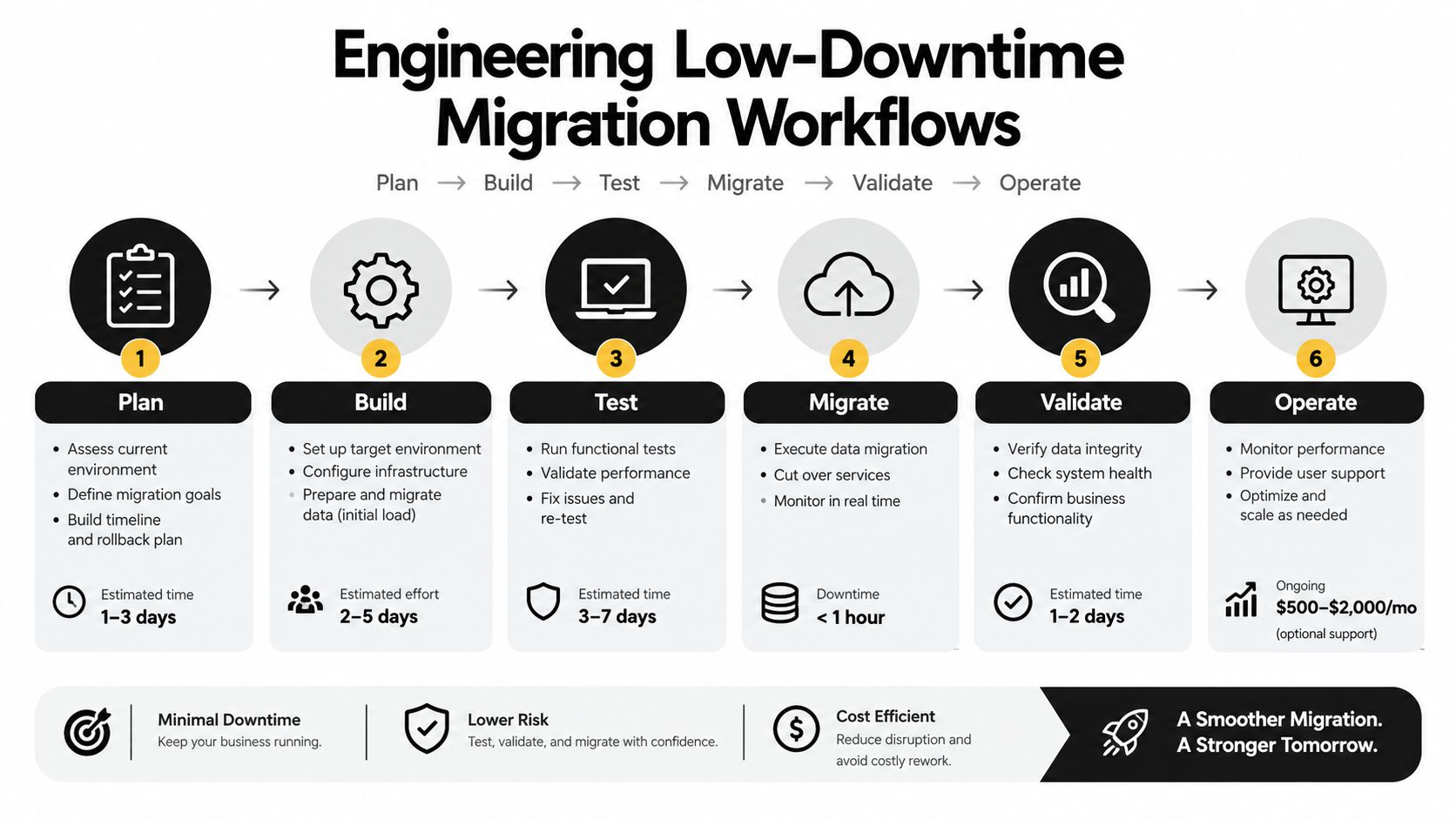
Low downtime doesn't mean low rigor. It means the team moves most data while production continues, then uses controlled synchronization and evidence-based cutover to limit the interruption.
NIST defines data integrity across data at rest, data in transit, and data during processing. (NIST integrity guidance) A migration program should therefore validate more than whether a transfer job completed.
Use a layered validation sequence
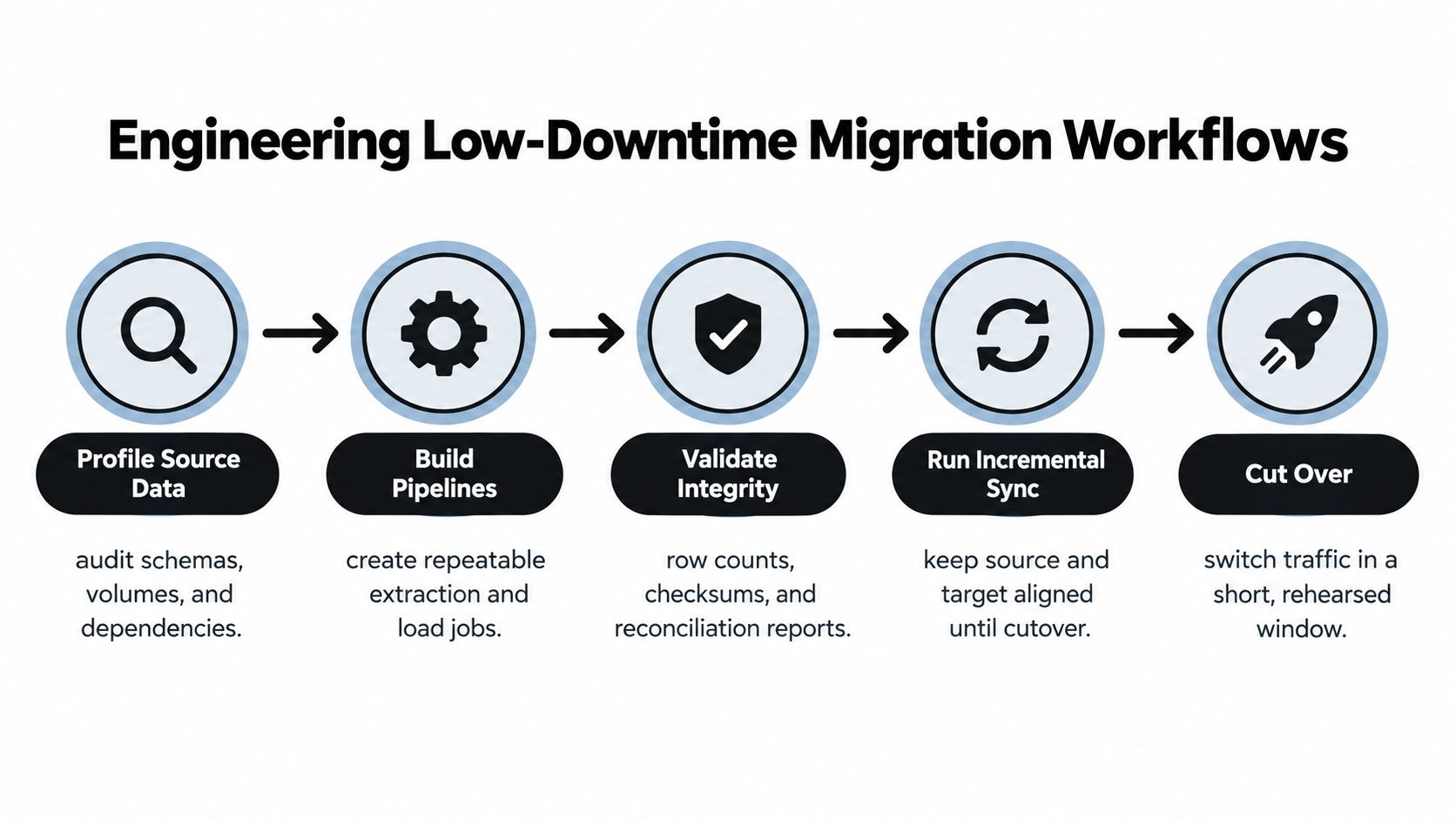
1. Profile the source. Inventory schemas, volumes, dependencies, indexes, triggers, jobs, integrations, sensitive fields, and ownership. Record assumptions before transformation begins. Unknown dependencies are a common reason a clean database cutover creates broken background jobs.
2. Create an immutable baseline. Generate cryptographic hashes or equivalent checksums for source objects before transfer. Retain manifests and timestamps so the team can distinguish an altered record from an intentional transformation.
3. Load and reconcile. Compare source and target record counts, rejected-record queues, checksums, schemas, constraints, and referential relationships. A matching row count isn't enough. It can conceal truncation, duplicate creation, corrupted files, or changes in field semantics.
4. Test business behavior. Run representative application workflows against the target. Check carts, balances, claims, subscriptions, customer profiles, and reporting queries where those workflows apply. Business rules often expose defects that infrastructure checks miss.
5. Validate in parallel. Dual-write validation sends the same record or event to the legacy and target platforms while both operate. Compare canonicalized representations when schemas differ, rather than comparing raw payloads. Stable identifiers, source timestamps, sequence numbers, and idempotent writes help detect retries, ordering problems, and duplicate handling issues.
6. Rehearse cutover and rollback. Use production-like volumes and integrations. Define mismatch thresholds and severity classes before testing. Perform a final change-data-capture catch-up, stop legacy writes, verify lag and reconciliation, switch traffic only after rollback criteria are satisfied, and keep evidence of every decision.
Cutover rule: A green transfer dashboard is not approval to switch traffic. Approval requires reconciled data, tested business workflows, known exceptions, and a rollback path that operators have actually rehearsed.
The trade-off is operational complexity. Dual writes can create divergent defaults, delayed events, and inconsistent retries if the systems apply different validation rules. Teams that need a broader planning framework can compare these controls with Kagool's enterprise data migration approach, particularly when defining governance, sequencing, and acceptance criteria.
Embedding Governance and Compliance Early
Governance is a product requirement, not an audit activity added after the application goes live. A technically accurate migration can still fail if it copies excessive permissions, breaks segregation of duties, loses retention evidence, or gives an AI feature access to records that a user shouldn't see.
A 2025 survey of 620 IT, compliance, and security leaders found that 39% had experienced security or compliance incidents linked to governance gaps introduced during cloud migration. Only 7% updated governance, risk, and compliance controls before migration, while 52% didn't embed GRC strategy from the outset. (Pathlock's 2025 Digital Transformation and Access Risk Report) The figures point to a practical failure pattern: teams secure the destination infrastructure but leave authorization and evidence design until too late.
Remap access instead of copying it
Legacy permissions often reflect old departments, temporary exceptions, shared accounts, and application limitations. Blindly copying them preserves the history of the old system, including access no one can justify.
A safer migration maps business roles to destination roles, tests inherited access, and separates duties that should never be combined. The team should capture who approved each mapping, which records each role can reach, and what happens when a user changes position or leaves.
The same discipline applies to retention and deletion:
- Retention: Identify which records must remain, for how long, and in which locations.
- Deletion: Verify that deletion requests propagate to replicas, indexes, backups, and AI retrieval stores where applicable.
- Consent: Preserve consent state, purpose, scope, and timestamps with the record or its authoritative reference.
- Residency: Confirm that transformed copies and operational logs remain within permitted locations.
- Auditability: Retain pre-migration evidence, transformation logs, access decisions, exceptions, and post-load reviews.
This is why a data governance framework belongs in the delivery plan rather than the post-migration checklist.
Make AI access part of the control model
AI systems need more than a connection string. They need rules for whether a historical record is current truth, whether a restricted record may enter retrieval results, and whether deleted content remains in an index or embedding store. Lineage should identify the source, transformation, approval status, and permitted uses of the data.
For fintech, healthcare, and government organizations, “zero data loss” is insufficient if nobody can demonstrate who accessed a record or why an AI response included it. Acceptance testing should cover retrieval permissions, provenance, restricted-record exclusion, retention behavior, and human review for sensitive workflows.
Evaluating Managed Services Versus Internal Teams
Internal teams understand the business better than an outside partner. They also carry production responsibilities, roadmap commitments, incident duty, and institutional knowledge that may not be documented. A migration can expose all those gaps at once.
Managed data migration services bring specialized experience with profiling, replication, schema conversion, validation, and cutover operations. The trade-off is cost, coordination, and the need to explain your business rules clearly to an external team. Internal ownership offers control and context, but it can become expensive when engineers spend months building one-off tooling they won't maintain afterward.
Compare the operating models
| Decision factor | Internal team | Managed partner |
|---|---|---|
| Business context | Strong, because staff know workflows and exceptions | Must be transferred through workshops and documentation |
| Migration specialization | Depends on existing database and cloud experience | Usually available from the start |
| Delivery capacity | Competes with product and operational work | Dedicated capacity can be assigned |
| Long-term ownership | Clear after handover | Requires knowledge transfer and support agreements |
| Risk exposure | Concentrated inside one team | Shared through defined responsibilities and controls |
DIY works well when the source and target are familiar, downtime is acceptable, the schema is simple, and the team can dedicate people to testing and rollback. It becomes a weak choice when the migration changes database engines, touches regulated data, requires online replication, or depends on undocumented integrations.
A blended model often works better. Internal leaders define business acceptance, access policy, and priority workflows. A specialist partner builds repeatable pipelines, validation evidence, and cutover rehearsals. If permanent capacity is the problem rather than migration expertise, remote hiring services can help add engineers without turning a short-term program into a permanent headcount decision.
The selection process should test practical competence. Ask candidates to explain how they handle rejected records, semantic transformations, permission remapping, replication lag, rollback, and post-cutover support. Review their proposed evidence, not just their architecture diagram. The distinction between managed services and staff augmentation matters because you may need accountable delivery rather than additional hands.
Industry-Specific Migration and AI Strategies
Migration design should follow business risk, not a standard cloud template. Retail, fintech, healthcare, and public-sector organizations may all leave legacy infrastructure, but their validation criteria and AI readiness requirements differ.
Ecommerce and retail
A retailer may move customer profiles, product data, orders, inventory, and behavioral events to support search, recommendations, personalization, and customer-service assistants. The difficult part is distinguishing current truth from historical behavior. An old address must not replace a verified current address, and a deleted preference must not remain available to a recommendation workflow.
The target model should retain event time, source lineage, consent context, and customer identity resolution. Validation should cover carts, inventory reservations, promotions, returns, and customer-service retrieval. The migration succeeds when transactions remain correct and relevant context reaches mobile and desktop experiences without weakening customer controls.
Fintech and SaaS
Financial systems require accurate balances, transaction ordering, reconciliation, access control, and audit evidence. Changes to decimal handling, timezone interpretation, duplicate detection, or event order can create a technically valid database that produces incorrect business outcomes. AI features must use approved, traceable records rather than unreviewed copies.
SaaS platforms face a related problem with tenant isolation. Teams must prove that a user cannot retrieve another organization's records through an application query, background job, analytics view, or AI assistant. Model access should inherit tenant boundaries, while logs should show which data a feature used and under whose permissions.
Healthcare and public services
Healthcare migrations may include patient records, appointments, clinical documents, identity matching, and consent data. Missing records are only one risk. Incorrect joins can associate a clinical event with the wrong person, while weak provenance makes historical information difficult to assess and unsafe for AI-supported decisions.
Government and public-sector systems often depend on long-lived integrations, legal retention, and service continuity. Evidence preservation and phased validation matter more than transfer speed. Teams should map custodianship, preserve retention records, test public-facing workflows, and confirm that downstream agencies receive the same authorized information before retiring the source.
Across sectors, AI readiness rests on attributable, authorized, sufficiently current data. Governance must travel with the records, including lineage, consent, retention status, and access controls. Moving data without those controls leaves an organization with a larger repository, not a dependable foundation for modern AI applications. Exclude records from downstream workflows whenever policy, consent, or retention rules require it.
Securing AI Integrations Post-Migration
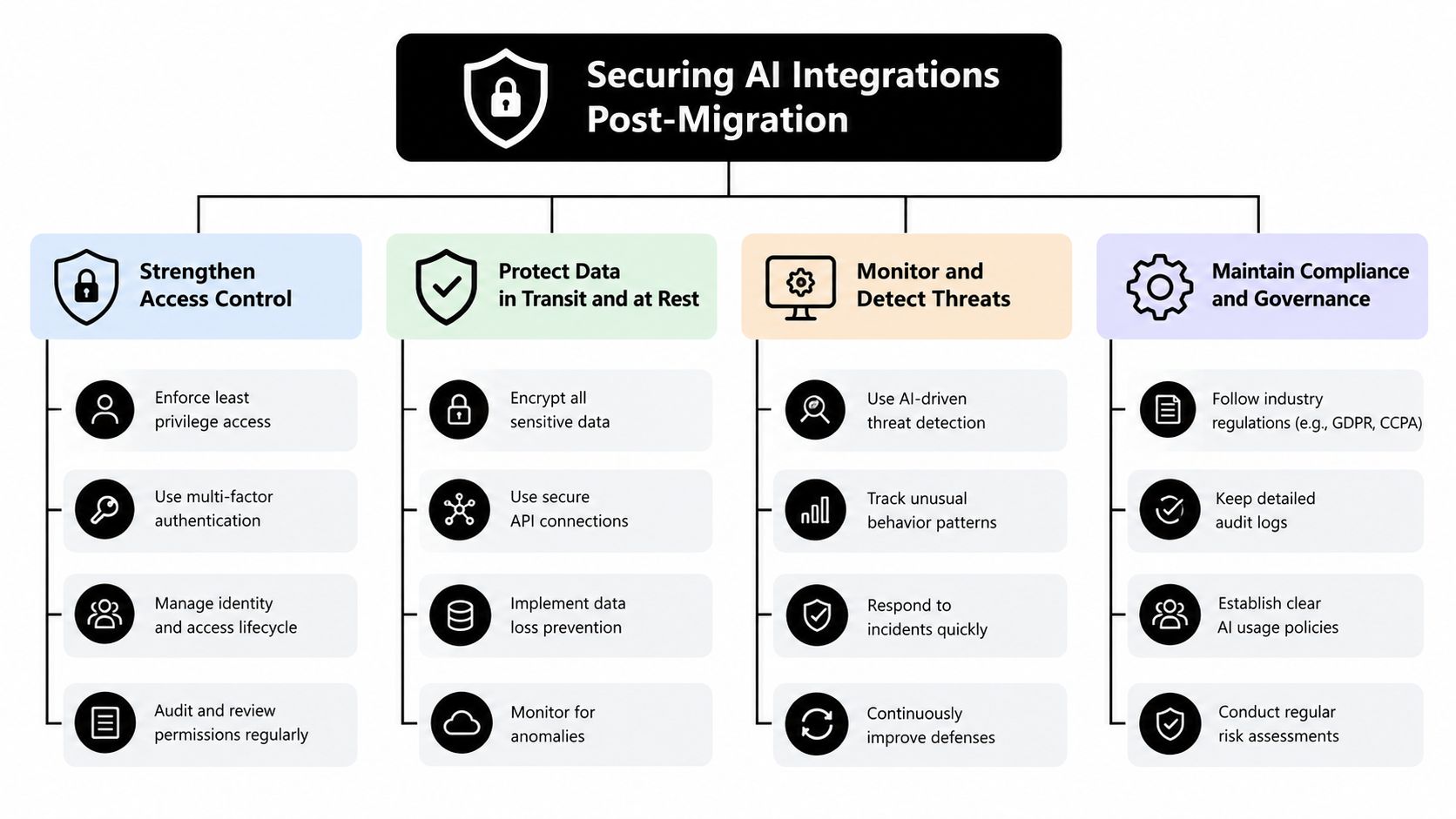
Moving data into a modern platform doesn't govern how applications use it. Once teams add copilots, recommendations, anomaly detection, or automated decisions, model behavior becomes part of the production system. Prompt changes, retrieval sources, provider updates, and safety settings can all alter outcomes.
An administrative layer gives engineering and business teams a controlled place to manage that behavior. Wonderment Apps' prompt management system is one example of this category. It includes a prompt vault with versioning, a parameter manager for internal database access, logging across integrated AI systems, and a cost manager for cumulative spend. Those capabilities address operational concerns that application code alone tends to distribute across services and teams.
Treat prompts and models as governed components
The EU AI Act makes this practical rather than theoretical. Governance requirements and obligations for general-purpose AI providers became applicable on 2 August 2025. Providers placing models on the EU market after that date must comply when they enter the market, while providers of models already on the market generally receive until 2 August 2027 to meet the requirements. (EU AI Act implementation timeline)
For software teams, that means maintaining a model inventory, recording which applications use each model, tracking versions, and preserving documentation around integration behavior. A provider-neutral administration layer can help teams replace a model without rewriting every client application.
A useful control set includes:
- Versioned prompts: Compare a new prompt against an approved version and evaluation set before release.
- Controlled parameters: Restrict database, retrieval, and tool access to defined capabilities.
- Centralized logs: Record requests, responses, model versions, prompt versions, and relevant errors.
- Cost visibility: Attribute cumulative usage to products, features, tenants, or environments.
- Rollback controls: Return to a known-good prompt, model, retrieval source, or safety configuration.
- Access reviews: Confirm that AI features enforce the same role and tenant boundaries as the underlying application.
The EU AI Act defines a general-purpose AI model as one trained with large-scale data, capable of a wide range of distinct tasks, and suitable for integration into different downstream systems or applications. (EU AI Act FAQ) That breadth is exactly why centralized administration matters. One model may serve multiple products, and each product may expose different data and permissions.
Operational test: Before approving a model or prompt update, identify who approved it, what evaluation data was used, how failures are logged, and how the team will revert the change.
The migration program should therefore end with an AI usability review, not just a cloud acceptance review. Test lineage, freshness, authorization, retention, retrieval quality, and downstream business outcomes. Data that moved successfully but can't be trusted by an AI feature is unfinished modernization.
Wonderment Apps helps organizations modernize legacy software, build scalable web and mobile products, and connect AI models through governed application architectures. Explore Wonderment Apps to discuss your migration, prompt management, access control, logging, and long-term AI delivery needs with a team that can support the work beyond cutover.