

Your leadership team knows the feeling already. The dashboards don't agree, the data team spends half the week reconciling spreadsheets, and one or two people keep the integrations alive with heroic effort and too little sleep. The business wants AI features, better forecasting, and cleaner reporting, but the data estate underneath all of it still behaves like a room full of loose cables.
That's where data modernization enters the conversation. It isn't just a technology refresh, and it definitely isn't just a cloud move. It's the work of turning scattered, fragile, hard-to-trust data into something the business can build on, which is why a practical explainer like why fleet data in spreadsheets fails feels so familiar to anyone who's lived through spreadsheet sprawl.
One reason this topic keeps resurfacing is that companies are still far from finished. Deloitte found only 34% of companies said they had fully implemented data modernization, while 50% had initiatives in progress, and the main blockers were budget or cost concerns (55%), lack of understanding of the technology (44%), lack of consensus among decision makers (41%), and unclear metrics (40%) (Deloitte survey summary). That's a strong hint that this is an operating challenge as much as a technical one.
If your team has already spent time on legacy systems, this legacy system modernization strategy guide is a useful companion. The key question isn't whether your stack looks modern on paper. It's whether your data can support trustworthy analytics, real-time decisions, and AI without your team babysitting every step.
The Moment Every Growing Company Eventually Hits
The pattern is easy to spot once you've seen it a few times. Sales says one thing, finance says another, and operations has a third version because each team exports from a different system at a different time. A dashboard looks polished in the board deck, but the moment someone asks where a number came from, the room gets quiet.
That's usually when leaders realize the issue isn't just reporting. It's the shape of the underlying data estate. When information lives in siloed systems and the pipes between them are brittle, every new initiative becomes slower, riskier, and more dependent on a few people who understand the old environment.
Why the business feels the pain before IT names it
Executives usually notice the symptoms first. An AI pilot stays stuck in pilot because the training data is inconsistent. A customer experience team can't personalize reliably because the customer record isn't unified. A finance leader doesn't trust a KPI because the source systems disagree.
That's why data modernization matters. It creates a foundation where the business can trust analytics outputs instead of cross-checking them constantly. As a practical resource for teams wrestling with the same issue in another domain, change management for leadership teams is worth reading, because modernization fails fast when leaders treat it like a pure IT swap.
Practical rule: if a data initiative depends on one “go-to” engineer to keep working, it isn't modern enough to scale.
The best way to think about it is simple. Data modernization is the bridge between messy operational reality and an environment where reporting, automation, and AI can run on trustworthy inputs. Without that bridge, teams keep patching the same gaps, just faster and with newer tools.
What Data Modernization Means
What is data modernization? It is the transformation of an organization's data infrastructure, architecture, governance, and analytics so the business can use data reliably now and support AI-ready use cases later. The scope is wider than moving databases from one place to another. It changes how data is collected, cleaned, governed, stored, and consumed.
A simple analogy helps. Migration is like moving furniture into a new house. Modernization is like renovating the house so the wiring, plumbing, layout, and security fit the way you live now. You may move quickly with migration, but if the structure itself is outdated, the same frustrations follow you into the new place.
Cloud adoption often sits inside the program, but cloud alone does not equal modernization. Organizations can lift old patterns into new infrastructure and still keep the same silos, the same broken handoffs, and the same unclear ownership. That is why the operating model matters as much as the technology stack.
The difference between moving data and changing the system
A migration project focuses on relocation. A modernization program focuses on making the data estate more usable, more scalable, and more trustworthy. As explained in database migration best practices, moving systems is only one part of the work. Modernization also includes consolidation, cleansing, transformation, and cloud-native architecture, not just transport.
A useful test is simple. If the move finishes and nothing about data quality, access, governance, or analytics gets better, you probably completed a migration, not a modernization. Executives should ask not only “Where did the data go?” but also “How does the business use it differently now?”
The modernized estate usually shows three visible traits. Data is easier to integrate. The business trusts it more. Teams can support new workloads without rebuilding the foundation each time.
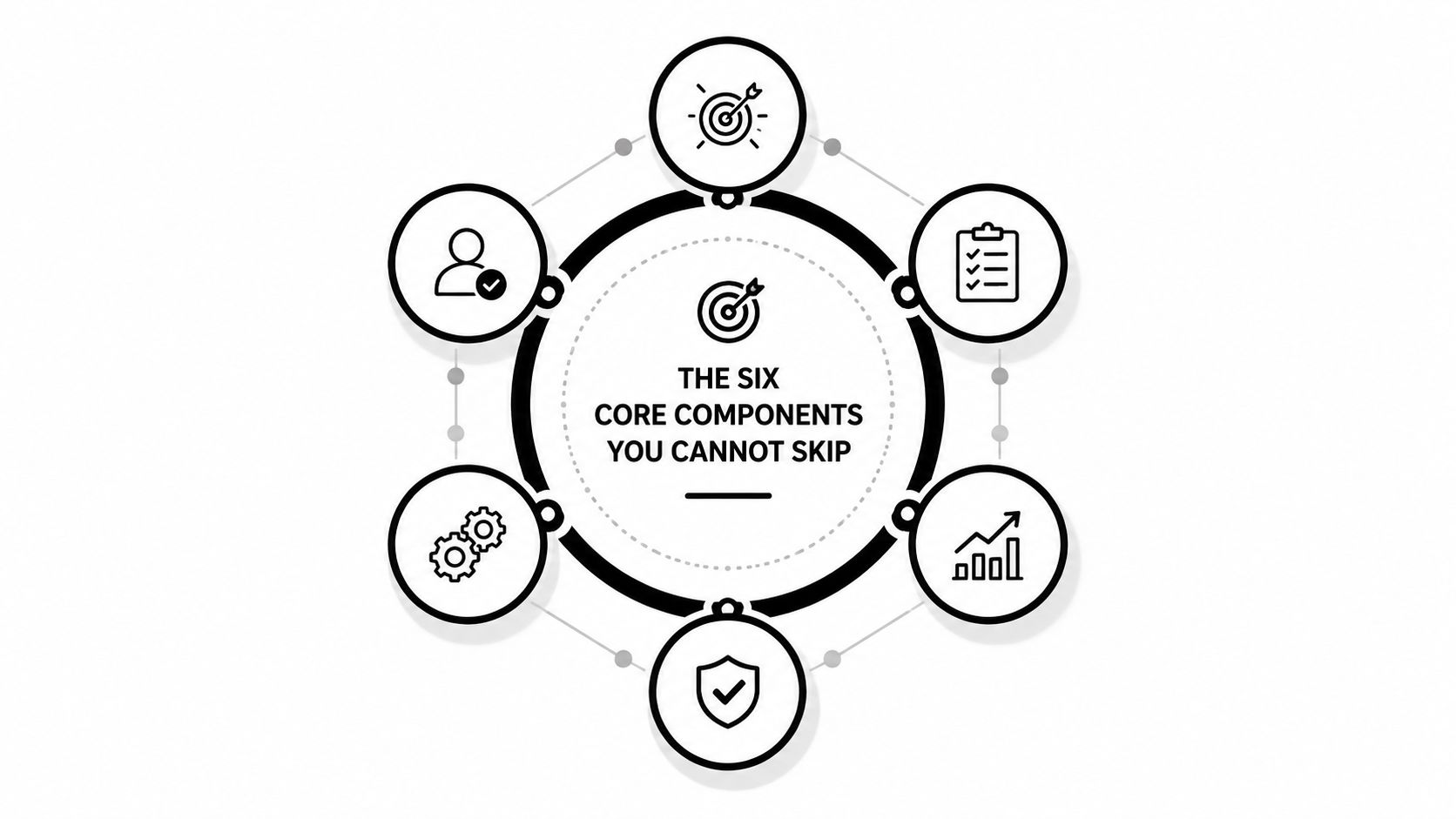
IBM's overview adds a practical point. Modernization is not a one-time platform swap. It combines cloud migration, governance, and a data-driven culture, with core components like integration, data quality, warehousing, analytics, cloud, and security (IBM). That framing matters because it places governance and security in the design, not as cleanup after the fact.
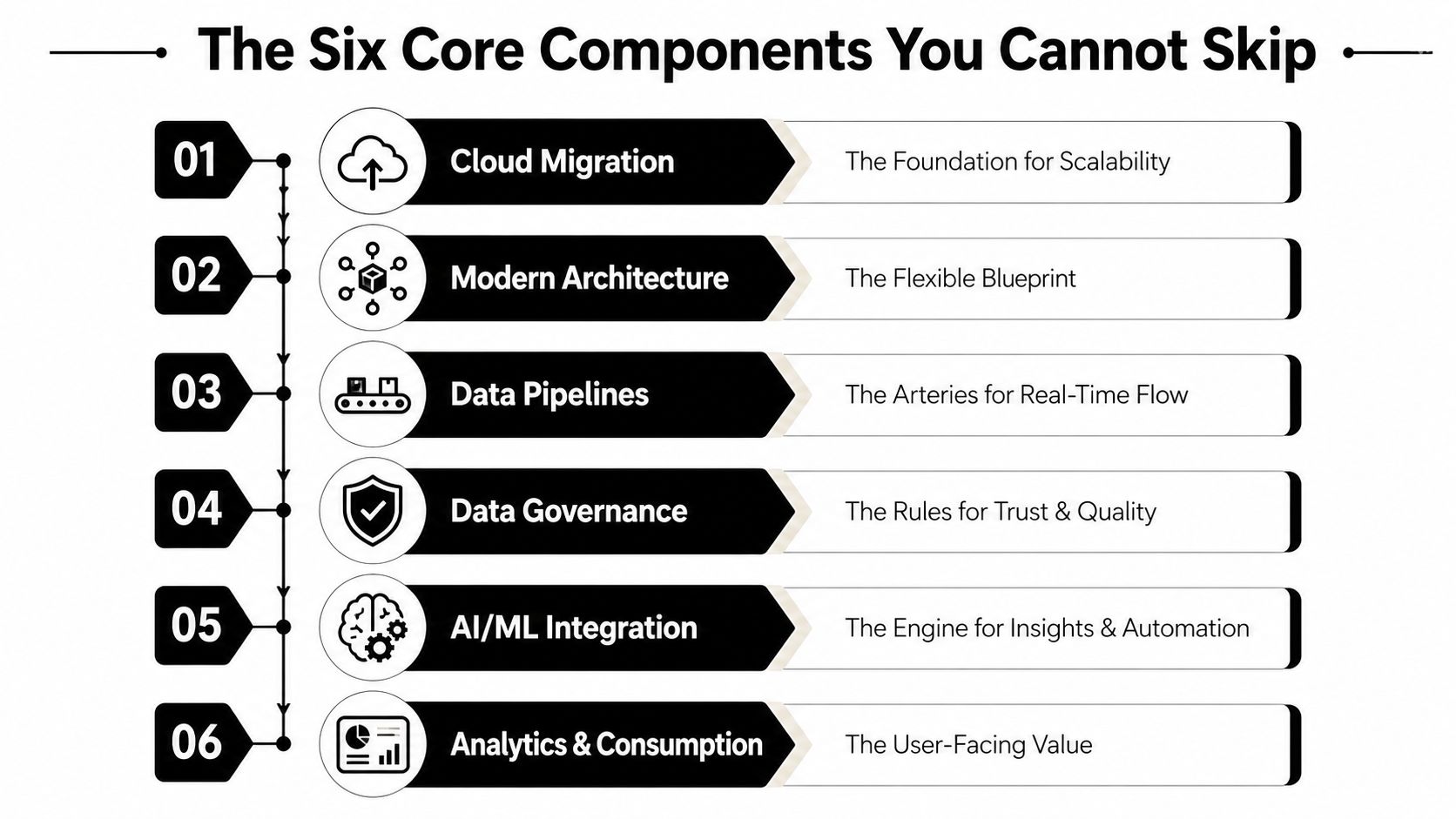
The Six Core Components You Cannot Skip
A mature modernization effort behaves like a building system, not a pile of separate upgrades. If the foundation is weak, the building shakes. If the plumbing is badly designed, every floor has problems. If the security system is an afterthought, people notice the first time something goes wrong.
That's why the components need to reinforce each other. You can't fix pipelines and ignore architecture. You can't automate AI use cases before governance decides who can access what. And you can't promise reliable analytics if observability isn't telling you when the data flow breaks.
Architecture, cloud, and pipelines form the load-bearing structure
The architecture is the blueprint. It decides whether data stays boxed into fragile point-to-point connections or moves through a more flexible design that can support change. Databricks describes modernization as a transformation that spans infrastructure, architecture, governance, and analytics, which is a useful reminder that the blueprint touches the whole estate (Databricks).
Cloud migration is the foundation for scale, but the cloud itself isn't the destination. It gives teams room to expand, standardize, and modernize how data services run. The pipeline layer then becomes the plumbing, moving data from source systems through cleansing, consolidation, and transformation before anyone consumes it. Acceldata's description of modernization highlights those mechanics directly, integration, cleansing, consolidation, transformation, and migration (Acceldata).
Data pipelines only look simple on slides. In production, they're judged by whether they move trustworthy data on time, every time.
Governance, AI, and observability decide whether trust survives scale
Governance is the security and rules layer. It answers who owns the data, who can access it, what the quality standards are, and how sensitive information is protected. IBM's overview is blunt on this point, governance and security aren't extras, they're part of the modernization core (IBM Korea).
AI and ML integration sit on top of that foundation. They don't create value by themselves, they depend on clean, integrated, well-governed data. If the inputs are inconsistent, the model may look smart in a demo and fail in production. That's why most serious programs sequence AI after the data layer is trustworthy, not before.
Observability is the monitoring system for the whole estate. It tells teams when pipelines stall, when data quality slips, and when downstream reports are likely to be wrong. Without it, the business sees the issue later than it should, and confidence erodes.
For teams debating warehouse patterns, this data lakehouse vs. data warehouse guide can help frame storage and consumption choices in the broader modernization picture.
A Practical Modernization Roadmap With KPIs
A modernization program usually starts with pressure from the business. Reports take too long, teams argue about which numbers are right, and every new initiative seems to require another temporary fix. The teams that get results treat modernization as a sequence of decisions, not a single technology swap, and they measure whether the data environment is becoming easier to trust and reuse.
A six-stage sequence that keeps the program honest
Assess the current estate. Map data sources, integrations, quality gaps, and ownership. The first KPI is a baseline, so teams can see where data quality breaks down and where systems are unreliable.
Prioritize what matters most. Select the domains that affect revenue, risk, or customer experience first. The main KPI is business alignment, which means the work connects to a visible outcome instead of a generic platform refresh.
Modernize the foundations. Standardize architecture, tighten governance, and replace brittle handoffs. One sign of progress is that pipelines and access rules become easier to maintain without constant exceptions.
Migrate and integrate. Move data into scalable environments and connect sources cleanly. A database migration best practices approach matters here because cutover discipline, validation, and rollback planning matter more than optimism.
Enable analytics and AI. Make trusted datasets available for reporting, forecasting, and model development. The KPI is whether teams can move from idea to usable output without reopening the same data-cleaning problems.
Scale the operating model. Extend the pattern across more domains and keep improving. At this point, leadership should watch whether the program can repeat success without relying on a few people doing everything by hand.
What leaders should ask for in steering meetings
A roadmap only helps if it comes with measures that show progress. The right KPIs depend on the use case, but the program should always show whether data is more trustworthy, whether delivery is more predictable, and whether the business can use the platform faster than before.
| Stage | Primary Objective | Headline KPI |
|---|---|---|
| Assess | Understand current gaps | Baseline data quality and reliability |
| Prioritize | Focus on the highest-value domains | Business-aligned use case selection |
| Modernize foundations | Reduce fragility | Lower operational friction |
| Migrate and integrate | Move and connect data safely | Stable cutover and validated movement |
| Enable AI and analytics | Support intelligent use cases | Faster path from data to decision |
| Scale | Extend the pattern | Repeatable delivery across domains |
Steering meetings should keep returning to one question. Are we building a platform the business can reuse, or are we just moving problems to a new place?
How Different Industries Modernize Their Data
The playbook changes by sector, even when the underlying logic stays the same. A retail team cares about personalization and inventory signals. A fintech team is focused on fraud, risk, and compliance. Healthcare leaders care about governed access and patient safety. The modernization core is shared, but the business priorities shape the order of work.
The clearest way to see the difference is side by side.
| Industry | Top Modernization Priority | Key Data Capability |
|---|---|---|
| Ecommerce and retail | Real-time personalization | Unified customer and product data |
| Fintech | Fraud and risk modeling | Governed, low-latency transaction data |
| Healthcare | Compliant analytics | Secure access and traceable records |
| Media | Content recommendation engines | Rich behavioral and content metadata |
| Public sector | Citizen service modernization | Cross-system data integration |
What changes by sector, and what doesn't
Retail teams usually feel pressure first in the customer journey. They need better data integration so recommendations, promotions, and stock signals stay aligned. Fintech teams tend to lead with controls, because risk modeling without strong governance creates more trouble than value.
Healthcare is different again. The work often revolves around access, compliance, and making sure the right people see the right data at the right time. Media organizations lean into recommendation engines and content operations, which depend on reliable metadata and user behavior signals.
Public sector teams often face the hardest integration challenge because services span old and new systems. That makes data sharing, identity, and workflow consistency especially important. The common thread is that every sector needs trustworthy data before it can make AI, analytics, or automation dependable.
A good modernization plan starts with the business moment that hurts most, not with the platform the vendor wants to sell.
The same principle applies across all five sectors. If the use case is fuzzy, the roadmap gets fuzzy too. When the use case is specific, the architecture choices start making sense.
Common Pitfalls and How to Avoid Them
Modernization projects often fail in familiar ways. The team gets excited about new tools, the first migration waves start, and then the old operating habits reappear inside a cloud environment. The stack changes, but the work model does not, so the business ends up with a new platform carrying the same old friction.
The four mistakes that show up most often
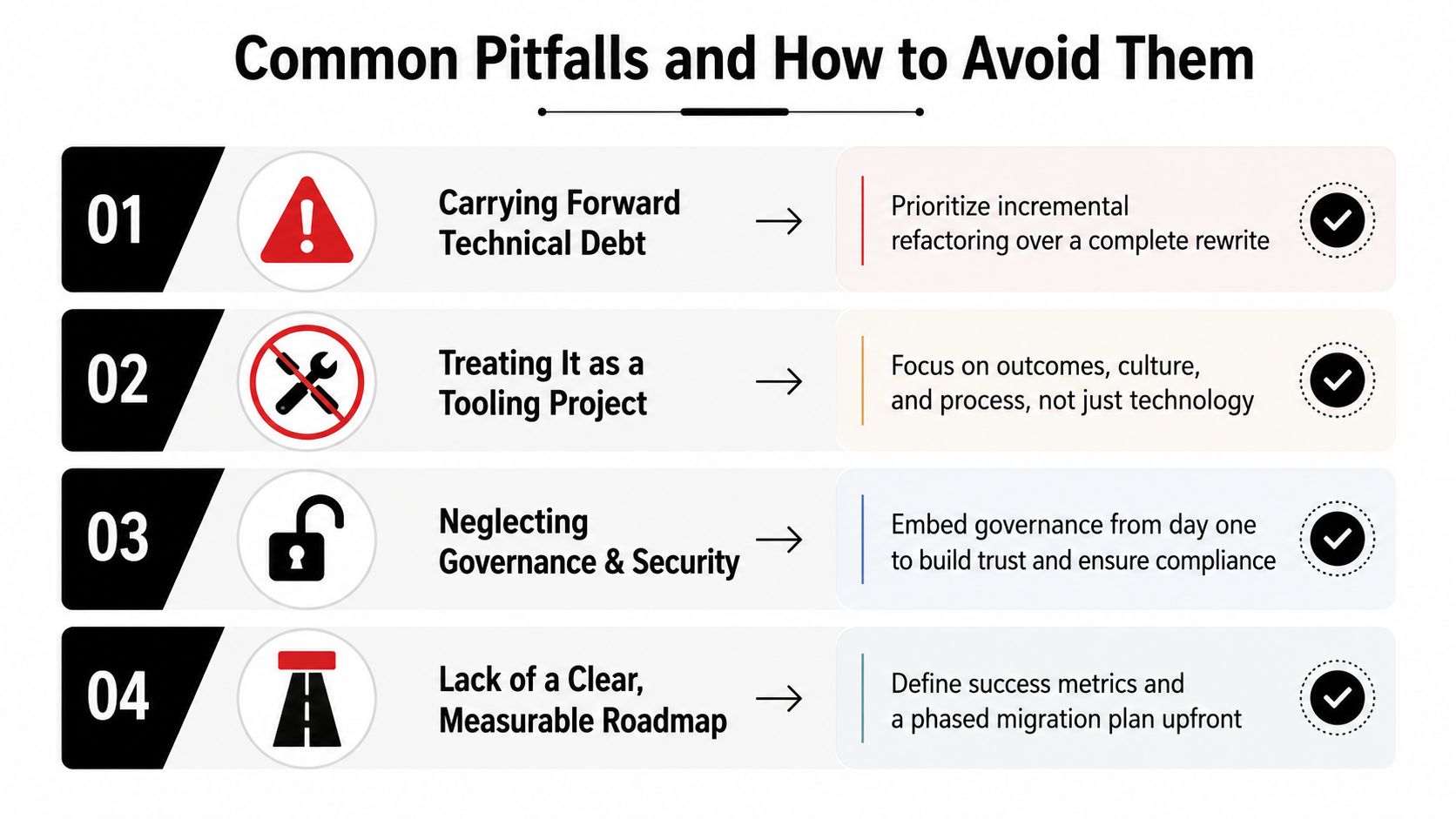
Carrying forward technical debt. Many teams move old schemas, old assumptions, and old exception handling into the new environment without questioning them. A better approach is to refactor in stages, because a full rewrite is rarely the only path and often becomes a delay tactic.
Treating modernization as a tooling project. New platforms do not fix unclear decisions or weak ownership. If leaders focus only on the software, the organization usually gets faster versions of the same bottlenecks.
Neglecting governance and talent. Strong technology can still fail if accountability stays blurry. Modernization needs owners for quality, access, security, and change management, along with people who know how to operate the environment after cutover.
Chasing AI hype without a foundation. AI is not the plan by itself. Trusted data, clear use cases, and observable pipelines come first, and AI sits on top of that base.
The earlier Deloitte survey summary helps explain why these failures keep coming back. Cost pressure, limited understanding, lack of agreement, and unclear metrics are program issues, not just infrastructure issues. If leadership does not address those questions, the effort slows down even when the architecture looks polished.
What to watch for in a review meeting
A healthy modernization review has the right kind of friction. It checks whether governance is live, whether data quality is improving, and whether observability can catch failures before users feel them. It also asks whether the business can describe the outcome in plain language.
If nobody can explain why a phase exists, that phase probably does not belong in the plan. If nobody owns the data after migration, the organization has not modernized. It has only moved risk into a new system.
Choosing Partners and Measuring ROI
The partner question matters because modernization isn't a slide deck exercise. You need people who can work across cloud and on-prem environments, handle governance and security properly, understand AI integration, and deliver without hiding the trade-offs. You also need a team size that fits the work instead of a bloated group that creates coordination drag.
A good evaluation conversation sounds practical. How do they handle data mapping and migration planning? How do they avoid breaking downstream reporting? How do they make ownership clear after cutover? Those questions matter more than shiny architecture language.
ROI should be measured in three buckets. First, cost reduction, which includes lower manual effort and less duplicated work. Second, risk reduction, which shows up as better governance, fewer surprises, and more reliable access controls. Third, revenue enablement, where better data supports personalization, analytics, and AI-powered experiences.
Wonderment Apps takes part in this category with a prompt management system that sits as an administrative layer for AI-enabled applications. It includes a versioned prompt vault, a parameter manager for internal database access, logging across integrated AI systems, and a cost manager that shows cumulative spend. Used well, that kind of control layer helps teams keep AI usage observable instead of chaotic.
Key Takeaways for Your Modernization Journey
Data modernization is an operating-model shift, not just a platform move. The stack matters, but ownership, governance, and measurement decide whether it sticks.
Trust comes from foundations. Clean pipelines, clear governance, and observability need to be in place before AI gets the keys.
Milestones are not enough. Use KPIs that show whether the business can rely on the data estate.
The best partners build for the long haul. The program should still make sense after launch week ends.
Modernized data becomes a compounding asset. The platform matters, but the durable advantage lives in the quality of the data and the discipline of the teams that run it.
If your team is planning a modernization effort, Wonderment Apps can help you turn legacy data and application sprawl into a more AI-ready environment with practical engineering support and an administrative layer for prompt management, integrations, and cost control. Visit Wonderment Apps to see how that approach fits your modernization roadmap and what it could look like in your own stack.