

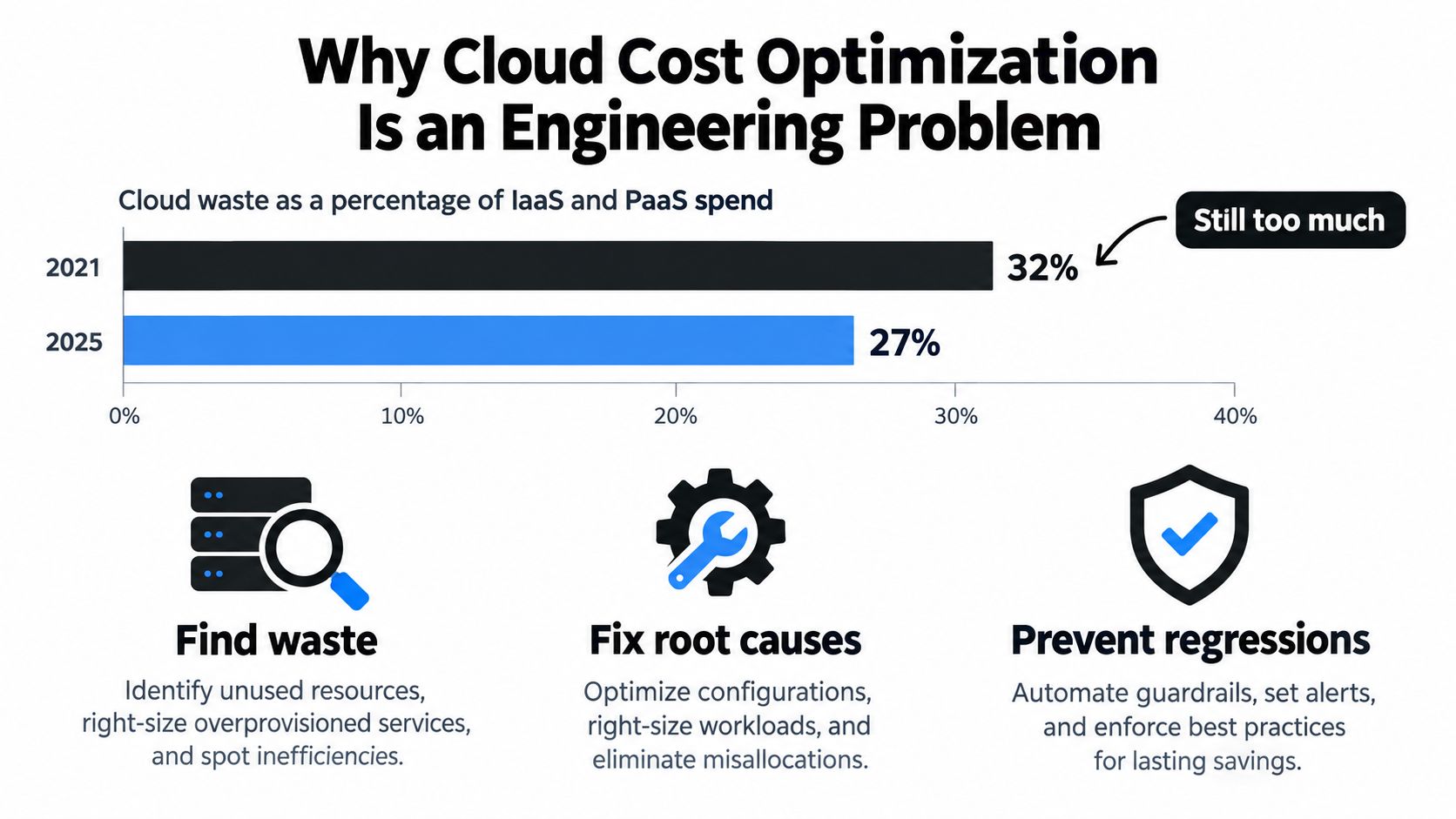
Flexera's 2025 cloud research found that 27% of Infrastructure as a Service and Platform as a Service spending was wasted, even though that figure had improved from 32% four years earlier. The improvement proves that rightsizing, scheduling, commitment management, and FinOps practices work. The remaining waste proves that cloud cost optimization isn't a procurement exercise you complete once. It's an engineering discipline tied to architecture, workload behavior, ownership, and product economics.
The practical question isn't only, “Which instance should we reduce?” It's also, “Which team owns this spend, what business result does it produce, and how quickly will someone notice when the cost stops making sense?” That question becomes even more important as AI services add model, token, API, and data costs to the same technology budget.
Why Cloud Cost Optimization Is an Engineering Problem
Cloud waste reached 27% of IaaS and PaaS spending in 2025, according to Flexera's 2025 State of the Cloud findings. The same research found that 84% of surveyed organizations viewed managing cloud spend as their top cloud challenge. The trend is moving in the right direction, but a substantial amount of consumption still delivers no useful product capacity.
Find the engineering causes
Procurement can negotiate rates, but it can't fix a database that was sized for an imagined peak, a development cluster that runs overnight, or storage that remains attached after its workload disappears. Waste usually comes from ordinary engineering decisions:
- Idle compute: Instances, containers, notebooks, and build runners continue running after demand ends.
- Overprovisioned databases: Teams select generous CPU, memory, or storage capacity and never revisit the choice.
- Unattached storage: Volumes, snapshots, logs, and artifacts survive the resources that created them.
- Inefficient architectures: Services exchange data across regions or availability zones when a simpler placement would work.
- Unclear ownership: Nobody knows whether an abandoned resource belongs to a product, a team, a test, or a former experiment.
The Uptime Institute's 2025 data-center survey gives useful context. Average PUE improved from 2.5 in 2007 to 1.65 in 2014, while the weighted-average PUE in the 2025 survey was 1.54 and had remained flat for six consecutive years. Facility efficiency still matters, but the easiest gains have already been captured in many environments. The optimization frontier increasingly sits in workload placement, software architecture, utilization, scheduling, and data lifecycle controls.
Practical rule: Treat every cloud bill as a record of architecture and operating-model decisions, not just a finance document.
Apply the same discipline to AI
AI workloads add another cost surface, but they belong in the same governance loop. A model request consumes a provider service, infrastructure, tokens, data movement, and sometimes human review. If your team tracks only the monthly invoice, it won't know which prompt version, model, feature, or customer workflow caused the change.
Wonderment Apps' prompt management system can serve as an administrative layer for that problem. Its prompt vault supports versioning, its parameter manager supports internal database access, its logging system records activity across integrated AI services, and its cost manager gives entrepreneurs a view of cumulative spend. That makes prompt-driven consumption visible beside compute, storage, and transfer, rather than leaving AI as a mysterious line item.
Start with a closed loop: assign ownership, collect usage data, identify waste, remediate the cause, and review the result. Teams looking for a concise introduction to budgeting can also use this practical cloud budget guide for small businesses as a supplementary resource. The important shift is mental: cost is an output of engineering choices, so sustainable optimization must live where those choices are made.
Measure First with Tagging, Dashboards, and Unit Economics
Optimization without measurement is mostly guesswork. Before changing instance types or purchasing commitments, establish a reliable answer to four questions: what consumed the money, who owns it, what workload produced it, and what business outcome did it support?
Build an allocation spine
Use a required metadata model across cloud accounts and providers. At minimum, capture:
- Workload: The service, application, or data pipeline using the resource.
- Team: The accountable engineering or product group.
- Environment: Production, staging, development, testing, or experimentation.
- Product: The customer-facing product, feature, or internal capability receiving value.
Enforce these fields during provisioning instead of asking engineers to repair them after deployment. Untagged resources should trigger an alert, enter a quarantine workflow, or require an explicit exception with an owner and expiry. Tagging is useful only when it leads to a decision. A dashboard that identifies an orphaned volume but gives nobody authority to delete it is decoration.
Centralize billing exports, provider usage records, allocation data, and application telemetry. Use daily views for trend direction and budget tracking, then move to hourly analysis when investigating a workload spike. AWS recommends examining each workload component, measuring business output against delivery cost, evaluating elasticity at hourly granularity, and decommissioning obsolete resources in its Cost Optimization Pillar guidance.
Prefer unit economics to vanity metrics
CPU utilization can reveal a problem, but it isn't a business metric. A service can show low CPU usage while its memory, database, network, or licensing costs remain high. It can also look more efficient after aggressive throttling while customer latency and conversion deteriorate.
| Metric Type | Example | Best Used For | Watch Out For |
|---|---|---|---|
| Unit economics | Cost per order, transaction, active customer, or API request | Connecting technology spend to product output | Averages can hide expensive customer segments or workflows |
| Infrastructure metrics | CPU, memory, storage, network, and request saturation | Diagnosing resource pressure and sizing decisions | Optimizing one resource can damage performance elsewhere |
| Reliability metrics | Latency, errors, availability, and saturation | Protecting customer experience during cost changes | Cost cuts that breach service objectives |
| AI workload metrics | Cost per successful inference, accepted workflow, or resolved case | Comparing models and prompt paths against outcomes | Choosing a cheap model that creates retries or poor results |
Set budgets at useful ownership boundaries, then add anomaly detection for unusual consumption. A team budget should produce an actionable notification, not a monthly apology. The FinOps Foundation's 2025 survey identifies optimization as a continuing priority for 50% of practitioner respondents, as summarized in the AWS cost guidance above. For forecasting practices that connect spend to sequential planning, see this guide to sequential forecasting for technology budgets.
Rightsize, Schedule, and Autoscale Compute the Right Way
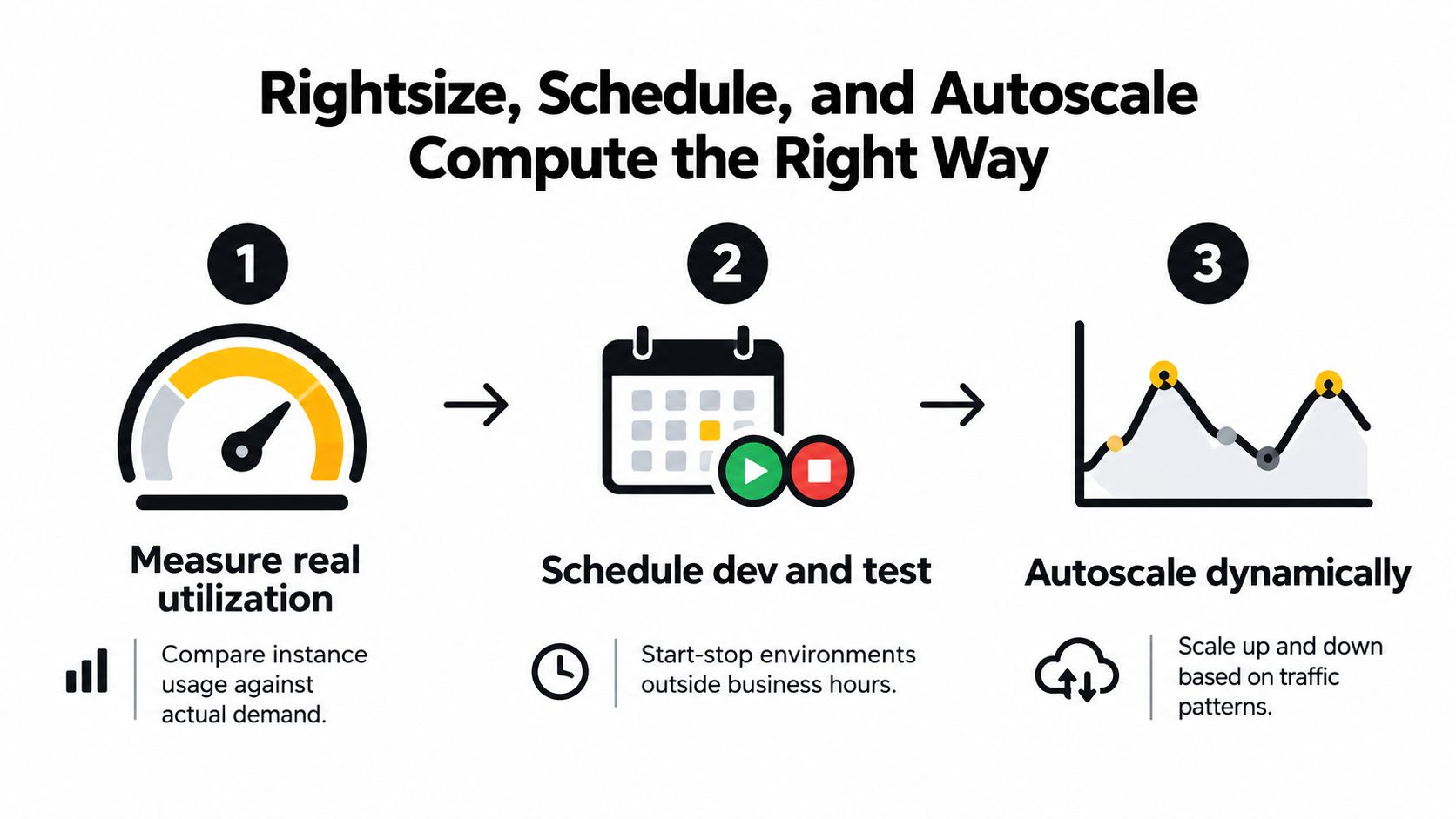
Compute optimization works best as a sequence, not a shopping list. Measure first, rightsize second, commit only to a stable baseline, then use autoscaling or flexible capacity for variation. Reversing that order creates expensive commitments around assumptions.
Start with real demand
Review utilization across representative operating conditions, including busy periods, background jobs, deployments, and failure recovery. CPU alone isn't enough. Check memory pressure, storage IOPS, network throughput, queue depth, request latency, and throttling. A smaller instance that constantly hits memory limits isn't a saving. It's deferred incident work.
Non-production environments are usually safer candidates for schedules. Start and stop development, test, preview, and batch resources around actual working patterns. Keep exceptions explicit for environments used by automated jobs, international teams, or overnight testing. Ephemeral environments are particularly effective when they attach to a branch or pull request and disappear after the work ends.
Google Cloud's scalable and resilient applications guidance recommends autoscaling when defined conditions are exceeded and load balancing across resource groups. It also emphasizes the four SRE golden signals: latency, traffic, errors, and saturation. Use those signals to test both scale-up and scale-down behavior, including sudden demand, maximum capacity, and the risk of removing resources while traffic is still rising.
Match pricing models to workload behavior
| Pricing model | Good fit | Main trade-off |
|---|---|---|
| On-demand | New, irregular, or uncertain workloads | Flexible, but usually carries the highest unit price |
| Savings Plans or Reserved Instances | Stable baseline capacity with reliable demand | Commitment can outlast the workload |
| Spot or preemptible capacity | Interruptible batch jobs, CI workloads, and fault-tolerant processing | Capacity can disappear, so restart and checkpoint behavior matters |
| Autoscaling | Variable demand layered over a known baseline | Poor thresholds can cause thrashing, latency, or excess headroom |
Commitment discounts earn their place after the baseline is visible. Buying them before rightsizing can lock a team into obsolete capacity. Spot capacity can reduce the cost of interruptible work, but it won't rescue a stateful system that can't tolerate eviction.
Serverless can also change the cost shape, especially for event-driven or sporadic workloads. The decision depends on invocation behavior, latency requirements, platform limits, and observability. This overview of serverless computing use cases offers useful context before moving a workload because the pricing model sounds attractive. For teams estimating the economics of autonomous software, this resource on AI employee deployment costs can help frame infrastructure and service consumption together.
Storage, Data Transfer, CI/CD, and AI Token Costs
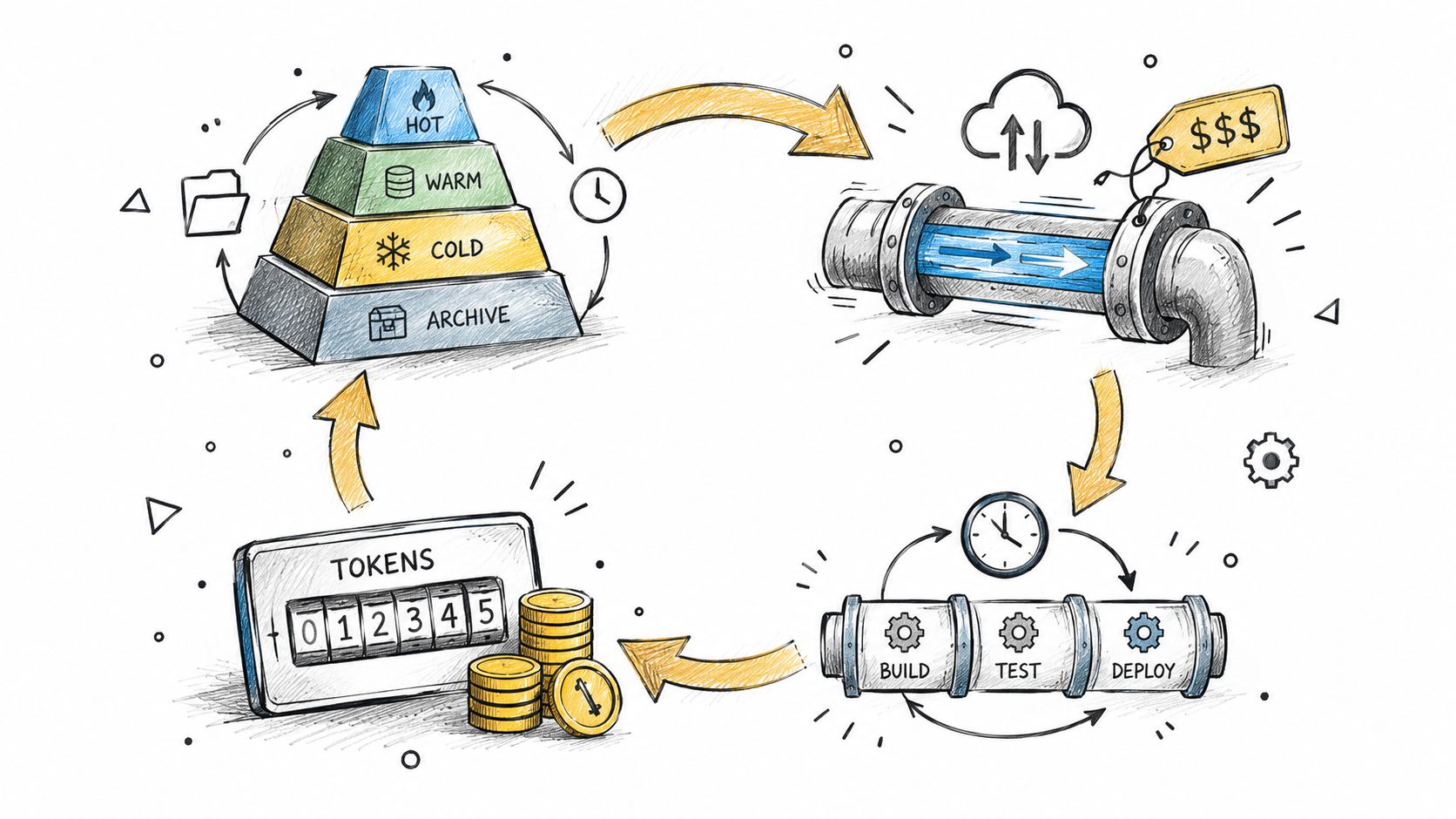
Compute gets attention because instance sizes are easy to see. Storage, transfer, pipelines, and AI requests often create a slower leak that survives for months. Treat them as first-class workload costs.
Put data on the right lifecycle
Use hot storage for active data and move aging objects, backups, logs, and artifacts to lower-cost tiers when access patterns permit. Lifecycle rules should archive or delete temporary data automatically, with retention exceptions documented for legal, security, or clinical requirements.
Audit unattached volumes, stale snapshots, duplicate backups, and forgotten log exports. A deletion policy without ownership is dangerous, but keeping everything forever is not a policy. Define who approves removal, how restoration works, and which records must remain available.
Data transfer deserves architectural review. Cross-region replication, cross-zone service calls, repeated downloads, and origin traffic that a CDN could cache can outweigh a successful compute reduction. Place chatty services thoughtfully, cache stable content near users, and measure egress by product workflow rather than accepting it as an unavoidable provider charge.
Make delivery environments temporary
CI/CD costs rise when runners, staging stacks, test databases, and preview environments remain alive between jobs. Use ephemeral runners where practical, cache dependencies without retaining unnecessary build infrastructure, and shard tests only when parallel execution reduces total elapsed and resource time. A faster pipeline isn't automatically cheaper if it multiplies expensive workers.
Long-lived staging environments deserve an owner and an automatic shutdown schedule. If a team needs a persistent environment, record why and review the exception periodically. Otherwise, the default should be creation for a purpose and removal when that purpose ends.
Apply workload economics to AI
AI cost controls should include caching, batching, routing, smaller models, and prompt compression, but each has a quality or reliability trade-off. Cache deterministic responses where freshness allows it. Batch offline work instead of paying interactive-serving costs. Route simple classification or extraction tasks to a smaller model, while reserving a more capable model for workflows where quality affects revenue, safety, or compliance.
Track the model, prompt version, workflow, customer or feature context, token volume, latency, retries, and outcome for each request. The AI app development cost guide provides a useful starting point for thinking about AI expenses beyond the model call itself. Wonderment Apps' prompt management system can connect prompt versioning, integrated-AI logging, parameter control, and cumulative cost visibility in one administrative workflow.
The cheapest token is not always the cheapest business result. A lower-cost model that increases retries, human review, support volume, latency abandonment, or fraud risk can raise the cost per successful outcome.
Real-World Examples Across Ecommerce, Fintech, Healthcare, and Media
The same loop works across industries: tag, measure, decide, act, review. The resource differs, but the ownership question remains constant.
Ecommerce
An ecommerce team should separate ordinary browsing traffic from flash-sale behavior. Autoscaling can respond to demand while a stable baseline handles normal traffic. Product images, thumbnails, and user-generated media need different retention and access policies, so catalog storage shouldn't automatically receive the same tier as active checkout data.
The team can attribute compute, database, cache, storage, and inference costs to product areas such as search, recommendations, checkout, and fulfillment. A recommendation model should be evaluated on cost per accepted recommendation or completed purchase, not token price alone.
Fintech
A fintech platform may have predictable overnight settlement or reporting workloads alongside unpredictable customer transactions. Batch processing can use scheduled capacity, while transaction services need carefully tested scaling and stronger availability controls. Database rightsizing must account for latency, encryption, replication, and recovery requirements.
For AI-assisted fraud review or support, route low-risk work differently from high-risk decisions. Track cost per reviewed transaction alongside false positives, analyst escalation, and response time. A cheap inference path that creates additional manual work isn't efficient.
Healthcare
Healthcare teams need to combine cost controls with privacy, retention, access, and compliance requirements. Archival imaging may belong on a different storage tier from active clinical records, but the lifecycle must preserve required availability and auditability. Redundant backups should be reviewed against recovery objectives, not deleted blindly.
Patient portals can autoscale around demand, while sensitive services retain carefully controlled network and identity boundaries. Cost tags should include application, environment, data classification, and accountable owner so an optimization proposal doesn't ignore clinical or regulatory constraints.
Media
Media platforms often carry heavy transcoding, recommendation, delivery, and archival workloads. Queue-based transcoding can use interruptible capacity when jobs checkpoint safely, while CDN caching can reduce repeated origin delivery. Old content may move to colder storage, but the decision should reflect audience demand and contractual availability.
A useful review might compare cost per delivered stream, processed asset, or active viewer. The objective isn't merely to shrink infrastructure. It's to keep the cost of a successful viewing experience aligned with the value of that audience.
Run FinOps as an Operating Model with Runbooks and Ownership
Tools don't create accountability by themselves. A FinOps program works when product, engineering, finance, and operations agree on who can act, what evidence they need, and how quickly they respond.
A 2025 survey of engineering leaders and developers found that 52% viewed disconnects between FinOps and development teams as a source of waste, while organizations took an average of 31 days to identify and eliminate cloud waste, according to Harness' 2025 FinOps in Focus report. The operational target should therefore be a faster feedback loop, not another dashboard nobody opens.
Assign ownership close to the decision
A central FinOps function should define taxonomy, reporting, guardrails, and review routines. Product and engineering teams should own the decisions that create consumption. Finance should connect forecasts and budgets to planning, while executives resolve trade-offs between cost, growth, reliability, and margin.
Use showback before chargeback if internal billing would create political noise or encourage unsafe behavior. The essential requirement is visibility with a named owner. A team doesn't need permission to optimize every shared platform resource, but it should know which platform group owns the decision and how to request action.
Write runbooks for recurring failures
A useful runbook turns an alert into a safe sequence:
- Runaway transfer: Identify the source service, destination, route, and recent deployment. Check whether caching or placement changed, then apply a temporary limit while the owner reviews the architecture.
- Stuck autoscaling: Inspect latency, traffic, errors, saturation, scaling signals, and capacity limits. Stabilize the service first, then correct thresholds or cooldown behavior.
- AI cost spike: Compare model, prompt version, workflow, token volume, retries, and customer or feature allocation. Route safe traffic to an approved alternative, pause nonessential experiments, and preserve quality checks.
- Orphaned resource: Confirm tags, dependencies, backup requirements, and owner. Delete only after the retention and recovery checks pass.
Alerts belong in the same channels as operational incidents, with severity based on financial exposure and service risk. AI cost monitoring should expose cumulative spending, token usage, API calls, and the workflow behind the request. Wonderment Apps' cost manager is one way to extend this visibility to integrated AI services, so prompt-driven consumption can follow the same ownership and remediation process as compute and storage.
The review cadence should combine daily anomaly response, regular team-level trend review, and architecture discussions when a product or model changes. Optimization becomes durable when teams treat cost regressions like reliability regressions, with detection, ownership, remediation, and learning.
Implementation Checklist, Troubleshooting, and Next Steps
Use a staged rollout so the program produces evidence before it adds complexity.
A practical 30, 60, and 90-day plan
- First 30 days: Enforce workload, team, environment, and product metadata. Centralize billing data, create baseline dashboards, identify owners, and remove clearly idle resources.
- By 60 days: Apply rightsizing recommendations, schedule non-production environments, test autoscaling, add storage lifecycle rules, and commit only to a measured stable baseline.
- By 90 days: Formalize FinOps roles and runbooks, report unit economics, connect anomaly alerts to operational workflows, and add AI controls for prompt versions, model choice, token volume, and cumulative spend.
Troubleshoot the usual failures
- CPU-only optimization: Check memory, IOPS, network, latency, errors, and business output before changing capacity.
- Reporting-only tags: Require an owner who can approve, remediate, or retire the resource.
- Early commitments: Baseline demand and rightsizing first, then commit to capacity that remains stable.
- Cheapest-model thinking: Compare cost per successful outcome with quality, latency, retries, support, and risk.
Cloud cost optimization works when the organization can explain not only what it spent, but why it spent it and who can change the result. Start with visibility, move decisions into engineering workflows, and keep AI spending in the same control loop instead of creating a separate budget island.
Wonderment Apps offers a prompt management and cost manager toolkit that helps teams version prompts, manage parameters, log activity across integrated AI services, and monitor cumulative AI spend. Visit Wonderment Apps to explore a demo and see how those controls can support the wider cloud cost optimization process.