

You're staring at a legacy stack that's creaking under real demand, your internal team is already stretched, and leadership wants outside help yesterday. Maybe you're trying to modernize a customer portal, add AI into a product workflow, or untangle a vendor mess that's been patched together for years. In that moment, the RFP can feel like paperwork, but it's really a way to force clarity before money, time, and trust get committed.
If you're also dealing with AI features, the stakes go up fast. A modern admin layer, with prompt management, versioning, internal parameter access, AI logging, and cost tracking, changes what “good” looks like in a vendor conversation because the buyer isn't just purchasing features, they're buying an operating model. That's why first-time buyers need more than a form and a deadline, they need a process they can run.
Picture the Day You Realize You Need a Vendor
The trigger is usually ordinary. A product lead sees one more release slip because the team can't maintain the old system, and someone in leadership asks whether an outside partner can move faster without breaking everything. That's when the buying process stops being theoretical and starts being operational.
At that point, the temptation is to send a few emails and compare hourly rates. That usually creates noise, not clarity, because the key question isn't just who can build the thing, it's who can handle the scope, the handoff, and the long tail after launch. If the project involves AI modernization, you also need to know how the vendor will manage prompt workflows, model changes, and usage controls inside the product itself.
A good first-time buyer doesn't start by asking vendors to guess. They start by making the internal problem legible, then they use a structured process to compare options fairly. The same discipline applies whether you're buying a website redesign, a mobile app, or a more complex platform rebuild.
That's where a practical intake and planning discipline helps, including an internal system for prompts, parameters, logs, and cumulative cost visibility when AI is part of the work. Wonderment Apps has written about choosing the right offshore partner in this guide to picking the best offshore software development company, and that same kind of upfront thinking matters here.
So, what is the RFP process, really, and how does it move from first meeting to signed contract without turning into a bureaucratic swamp?
What the RFP Process Is
An RFP, or request for proposal, is a structured ask for vendors to respond against the same requirements. Public-procurement guidance treats it as a package built around a statement of need or statement of work, submission requirements, and evaluation criteria, so proposals can be compared on the same yardstick instead of by instinct or whoever argued the loudest in the meeting (New York State procurement guidance).
That structure matters because the RFP acts like a control system for the buying team. It helps the buyer decide where to invite bids, how much effort to invest, and how to compare vendors against defined requirements. It also shows why the process consumes so much time and coordination. In benchmark reporting, organizations responded to an average of 147 RFPs per year in 2019 and 150 per year in 2020, while average win rate moved from 53% in 2019 to 47% in 2020 and then to about 45% in more recent reporting (Loopio benchmark report).
Why the numbers matter
Those benchmark figures show that RFPs are routine, high-volume decisions with real labor behind them. The average team involved in a response was 7.3 people in 2019, later reporting showed an average of 8 people, and a single response often involved about 9 contributors (Loopio benchmark report).
Practical rule: if one person can write the whole response without talking to sales, subject matter experts, legal, product, or operations, the RFP probably isn't real enough yet.
The time burden matters just as much. Organizations reported spending 23.8 hours writing a single response in 2019, 23 hours in 2020, and newer estimates place the average at 25 hours (Loopio benchmark report). That is why the process needs planning, governance, and a clean workflow instead of a rushed inbox scramble.
A useful way to start is to write down the project in plain language before anyone drafts buyer language. A project summary template can help the team capture the problem, the goals, and the boundaries before the RFP turns into a stack of assumptions.
Planning and Drafting the RFP
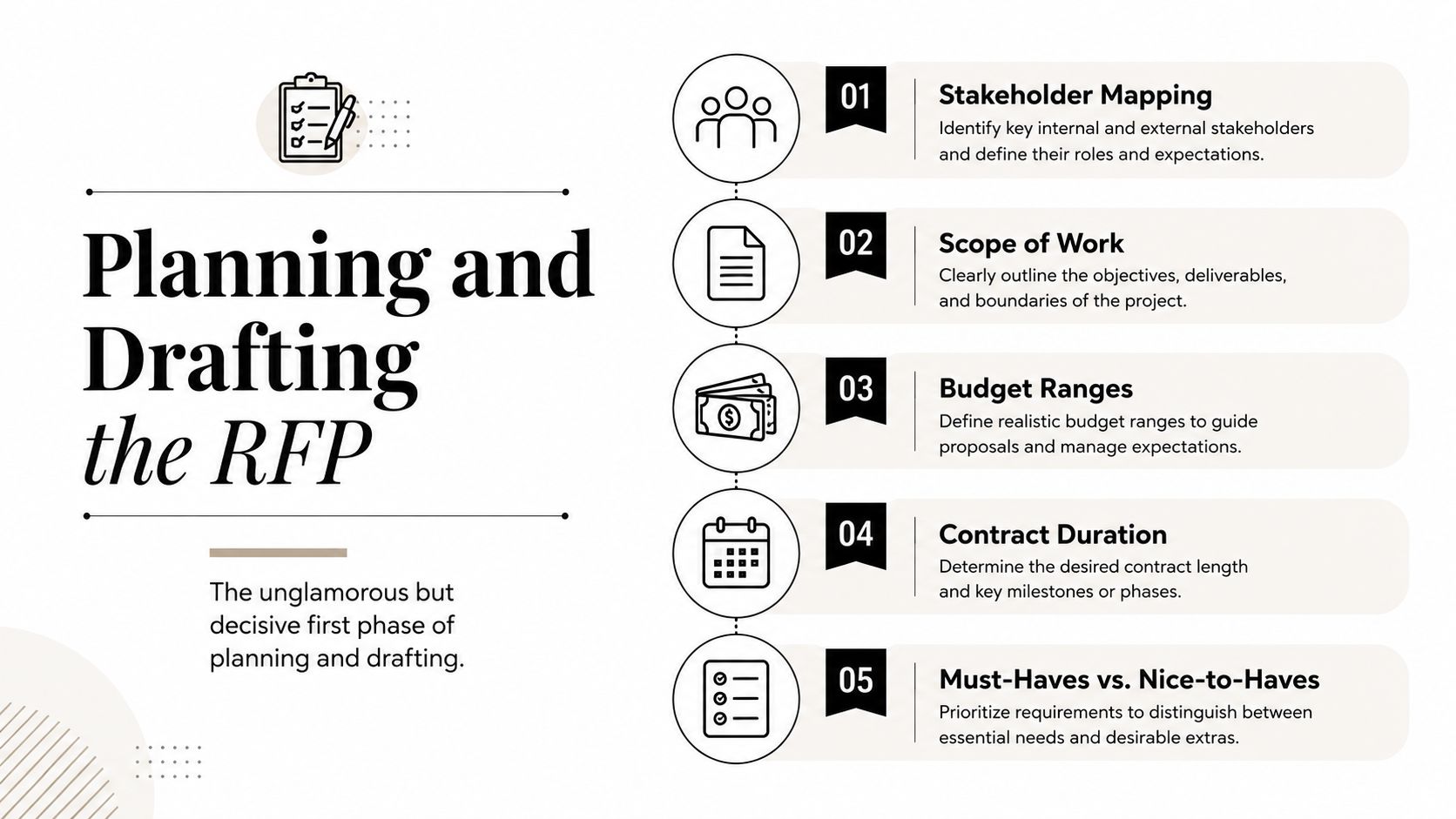
The unglamorous part comes first, and it's the part that saves you from expensive confusion later. A university procurement checklist makes the drafting work concrete, the requestor needs to define the scope of work, the estimated contract value or budget, potential vendors, the difference between specific needs and nice-to-haves, contract duration, and the key internal stakeholders before procurement assigns a new RFP number and runs a kickoff call (Catholic University work instructions).
What should be locked down before you draft
You don't need perfect certainty, but you do need internal alignment. If sponsors haven't agreed on the problem, the RFP becomes a guessing game where vendors fill in the blanks with their own assumptions. That's how teams end up comparing proposals that answer different questions.
Use a simple internal checklist before drafting anything:
| Required Inputs Before You Draft an RFP | Why It Matters | Owner |
|---|---|---|
| Scope of work | Keeps vendors focused on the actual deliverable | Product or operations lead |
| Budget range | Prevents proposals that are far outside the feasible range | Sponsor or finance partner |
| Contract duration | Shapes pricing, implementation, and support expectations | Procurement and sponsor |
| Must-haves vs. nice-to-haves | Separates deal-breakers from preferences | Functional lead |
| Internal stakeholders | Makes sure review, approvals, and scoring don't stall later | Project owner |
A strong draft also reflects who will live with the decision. If legal, security, finance, and product all need to weigh in later, they should be named early, not invited in at the last minute to approve a document they never helped shape. That's one reason a project summary template can be useful for getting internal clarity before the RFP goes out, and Wonderment Apps has a practical project summary template that fits neatly into that kind of pre-RFP intake.
One more thing first-time buyers often miss, every decision deferred to the vendor becomes a future change-order conversation. If you haven't decided what's in scope, what's out, and what success means, you haven't saved time, you've just postponed the hard part.
Issuing the RFP and Running Vendor Q&A
Once the RFP is ready, the job shifts from writing to managing fairness. A procurement guide from a bank shows the administration phase as a chain of checkpoints, including forming a committee, preparing the RFP and questionnaire, creating an invitee list, allowing a clarifying question period, checking completeness, grading, committee discussion, selecting finalists, doing reference checks, and even face-to-face meetings before final selection (Bank of America private bank procurement guide).
That sequence tells you something useful. The issue phase is not just “send it and wait.” It's a controlled communication window where every vendor needs the same information at the same time.
How to keep the Q&A clean
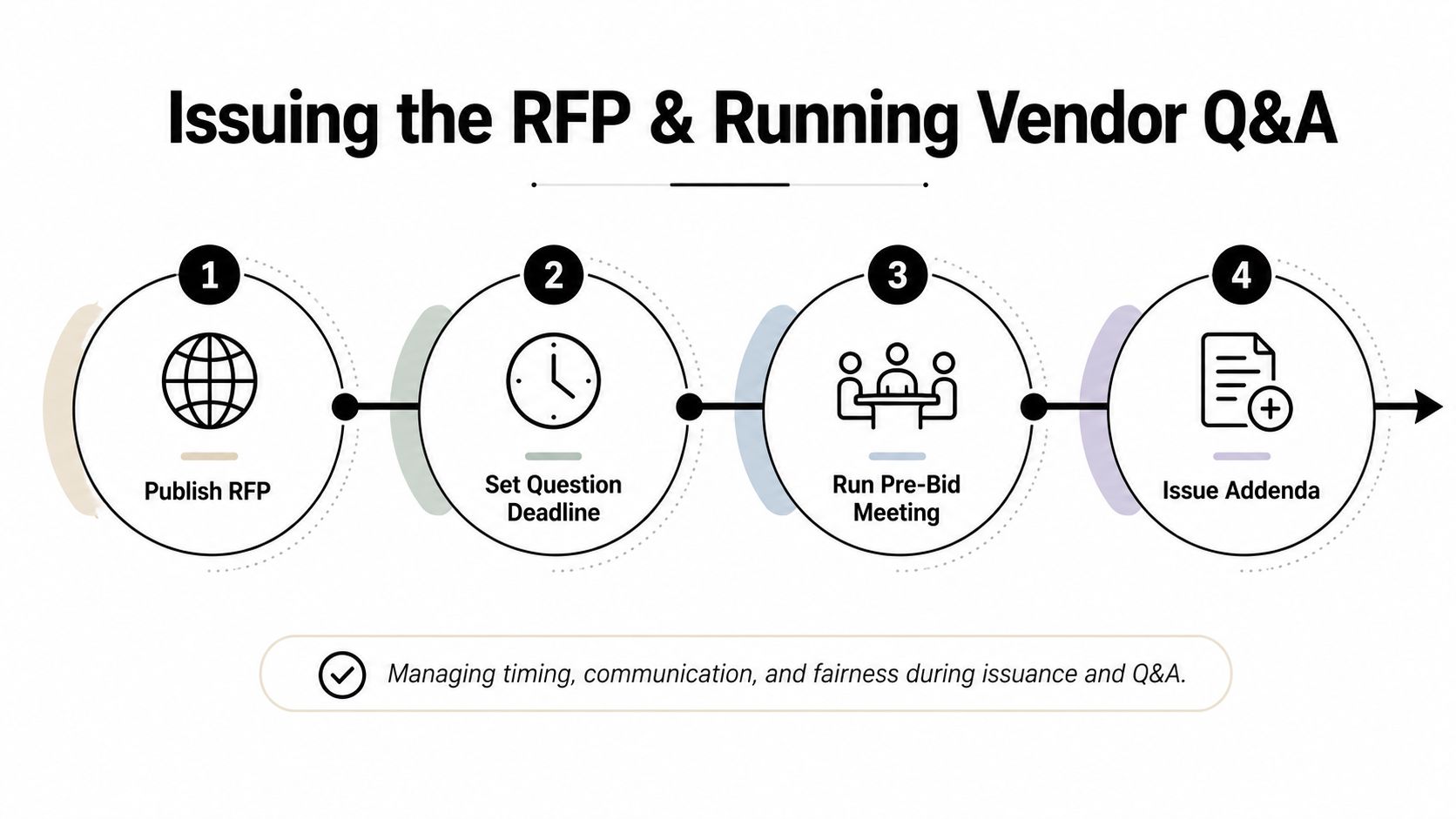
A pre-bid meeting or question period is valuable because it surfaces requirement gaps before proposals are locked in. Expert procurement guidance treats that as a way to reduce downstream change-order risk and improve conformity to the buyer's actual technical needs (Tenderbolt process guide).
The mechanics are simple, but they matter:
- Publish once, consistently: every invited vendor should receive the same version of the RFP.
- Set one question deadline: late questions create unfairness and make responses harder to compare.
- Log every question: keep a single source of truth so no one answers differently in separate emails.
- Issue addenda when needed: if a clarification changes the RFP, everyone gets the same update.
- Share answers broadly: a private answer to one bidder is a fairness problem waiting to happen.
If a question reveals that your team is still debating scope, stop and fix the scope before you answer the vendor.
The hard part for digital and AI modernization work is timing. Leave enough room for thoughtful responses, but don't stretch the window so long that the project loses momentum. The point is to give vendors a fair shot at understanding the work, not to turn the process into a months-long inbox negotiation.
Evaluating Proposals, Demos, and Shortlisting
Many first-time buyers get overconfident. A polished deck or a charismatic demo can make a weak fit look strong, which is why the scoring process needs discipline before anyone starts talking about favorites. The safest approach is a committee with clear roles, separate scoring, and predefined criteria, because the goal is to defend the shortlist on paper, not just in a room.
The bank guide's checkpoint list is a useful model here because it includes completeness checks, grading, committee discussion, finalist selection, reference checks, and face-to-face meetings (Bank of America private bank procurement guide). That's a lot of structure, but it prevents the most common mistake, which is treating evaluation like a casual opinion swap.
A simple scoring model
Keep the scorecard weighted in advance. Technical fit, implementation approach, security, support, and commercial terms should not all carry the same importance if the project doesn't require that. If you're buying modern software or AI-enabled delivery, the quality of the implementation plan matters more than a glossy slide about features.
A useful evaluation rhythm looks like this:
- Screen for completeness before anyone scores.
- Score independently so one loud voice doesn't shape the room.
- Compare section by section, not just with a final total.
- Check references before you get emotionally attached to a finalist.
- Run a structured demo, with the same prompts for every vendor.
If you're unsure what to ask in the vendor conversation, Wonderment Apps has a practical list of questions you should ask before hiring outsourcing companies, and the logic applies directly to RFP shortlisting too.
Good evaluation habit: score the proposal first, then discuss the proposal. If you reverse that order, the discussion starts scoring people instead of evidence.
The best shortlist usually isn't the cheapest or the flashiest. It's the one that can show, clearly and repeatedly, that the team can deliver what the buyer needs without creating hidden work for everyone else.
RFP vs RFI vs RFQ and When to Skip the RFP Entirely
Buyers often reach for an RFP because it feels official. Sometimes that's exactly the problem. If you don't yet know what success looks like, forcing vendors to compete inside a vague document just creates theater.
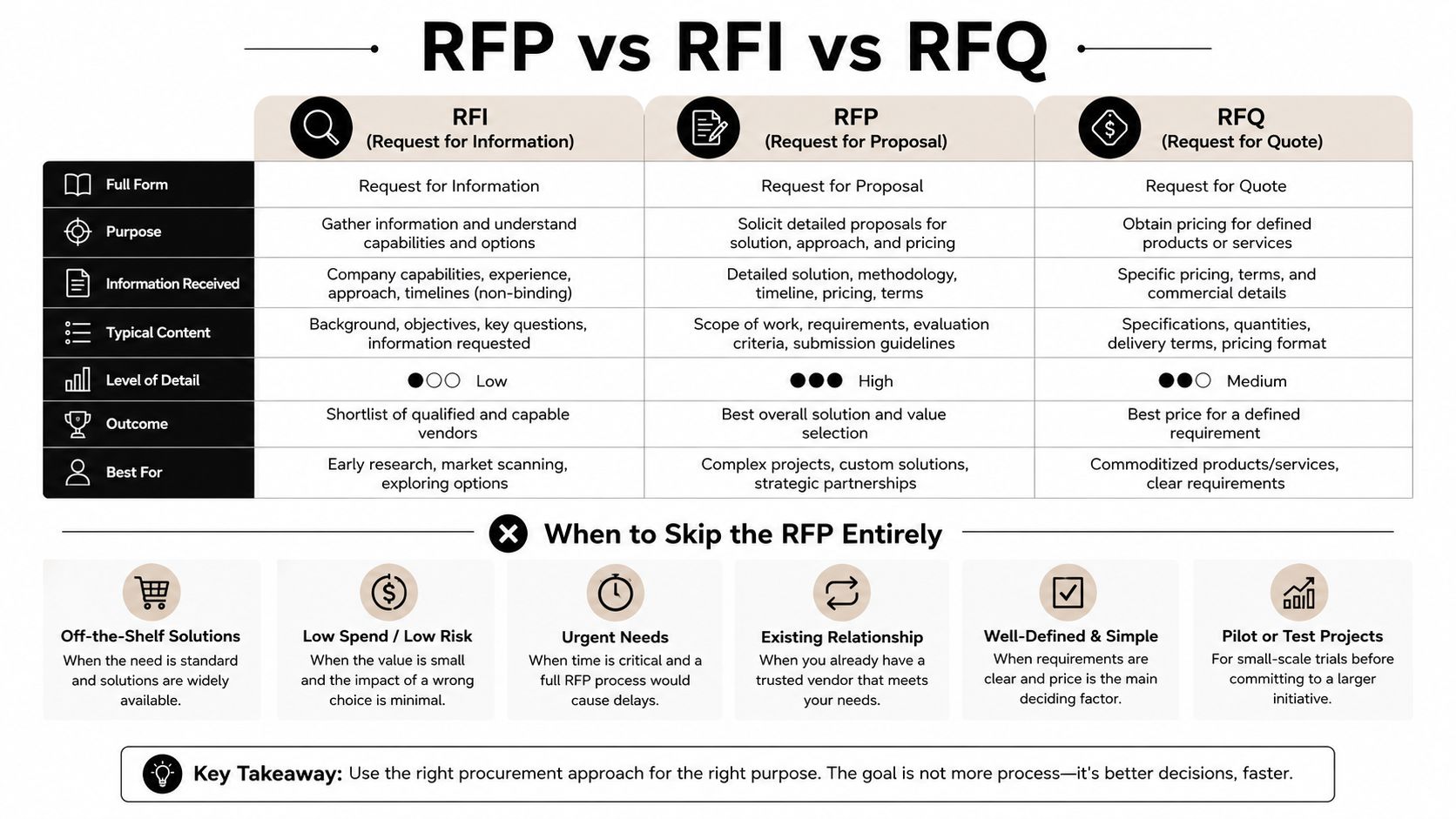
An RFI is for discovery. It helps you explore the market, understand what vendors do, and sharpen your own requirements before you commit to a purchase path. An RFQ is price-driven and works best when the product or service is already well specified. An RFP sits between them, useful when you know the goal and need vendors to propose the best path, not just the lowest number.
A quick decision rule
- Use an RFI when the problem is still fuzzy and you need market input.
- Use an RFQ when the work is clearly defined and price comparison is the main issue.
- Use an RFP when you can define requirements and need vendors to compete on solution quality, delivery approach, and fit.
A contrarian point matters here. For ambiguous AI modernization, product strategy, or platform redesign questions, a paid discovery engagement or a discovery-first process often beats a heavyweight RFP. Vendors can't responsibly compete on criteria you haven't defined yet, and the buyer ends up wasting everyone's time.
That's why recent guidance increasingly separates discovery from bidding, especially for complex digital projects where scope changes fast and implementation realities surface late (Clinisys on the RFP process). If you're still arguing internally about what the platform should become, you're probably not ready for a formal RFP.
The fastest way to waste an RFP is to use it as a substitute for internal clarity.
Common Pitfalls and Best Practices Buyers Always Miss
The same mistakes show up again and again. Buyers write vague requirements, skip budget guidance, leave out a pre-bid meeting, evaluate on price alone, forget reference checks, and then act surprised when the shortlist feels shaky. None of those problems are mysterious, they're just consequences of rushing the front end.
A better pattern is to treat the draft like a quality gate. The process guides from Responsive and Prokuria both emphasize stakeholder alignment, supplier pool identification, scope and contract alignment, and structured approval before award (Responsive guide, Prokuria guide). That's the right instinct, because the draft should be strong enough that the vendor sees a real project, not a vague idea.
A short buyer checklist
- Vague requirements: write the scope until someone outside your team can repeat it back accurately.
- Missing budget guidance: give vendors enough financial context to avoid fantasy proposals.
- No Q&A discipline: assign one owner for every clarification so answers stay consistent.
- Price-only selection: compare delivery fit, support, and risk, not just the number at the bottom.
- No reference checks: talk to real customers before you sign.
- No onboarding plan: don't wait until after award to figure out who hands off what.
If you're buying for ecommerce or retail, this same discipline pairs well with conversion optimization tips for Shopify Plus, because the vendor decision and the post-launch performance plan should never be treated as separate problems.
The biggest miss is usually post-award thinking. Teams celebrate the win, then discover they never defined how the work will be handed over.
From Signed Contract to a Product That Lasts
Award is not the finish line. For digital and AI projects, it's the start of the part that determines whether the contract turns into a usable product or a pile of unresolved assumptions. A good handoff includes kickoff, scope lock, change-order governance, implementation planning, and an explicit path for support after launch.
That post-award period is where modern delivery gets real. If the vendor is integrating AI into an existing application, the buyer needs to know how prompts are governed, how versions are managed, how internal data access is controlled, how logs are reviewed, and how cumulative usage cost is tracked. Those are not side details, they're the operating rails for responsible AI delivery.
Wonderment Apps builds that kind of administrative layer into its modernization work, with a prompt vault with versioning, a parameter manager for internal database access, a logging system across integrated AI providers, and a cost manager that shows cumulative spend. In an RFP, those capabilities matter because they show whether the vendor can support not just the launch, but the ongoing reality of a product that will keep changing.
What to ask before you sign
A vendor should be able to explain how they'll manage handoff between sales, delivery, engineering, and support. They should be able to describe how changes get approved, how integration risks are tracked, and how the buyer's team stays informed after go-live. If they can't speak clearly about that phase, the RFP has only solved part of the problem.
That's also where a stronger delivery partner stands out. A solid partner doesn't just answer the RFP well, they make the transition into active work less chaotic, especially when the project involves AI, compliance, or multi-team coordination. In those cases, the buyer isn't really purchasing a document response, they're purchasing a system that can survive the handoff.
So the answer to what is the RFP process is this, it's a structured way to define a need, compare vendors fairly, and manage the move from selection to delivery without guessing. If you're planning an AI or software modernization project and want a team that can help with product discovery, delivery planning, and the admin infrastructure behind prompt management and cost control, visit Wonderment Apps and start the conversation there.