

A release is ready, but it can't ship. The checkout service depends on an undocumented batch job, the healthcare claims workflow still relies on a manual spreadsheet, and the AI feature your product team wants to launch can't safely reach the data it needs. Nobody caused one spectacular failure. The organization accumulated dozens of reasonable shortcuts, each one small enough to defer.
That's technical debt in its most expensive form. It isn't just duplicated code or an ugly module. It includes missing knowledge, slow processes, rigid systems, unsupported vendors, and redundant platforms that force capable teams to spend their best hours working around yesterday's decisions.
Why Technical Debt Management Matters Right Now
Technical debt becomes a business problem when it changes what the organization can deliver. In ecommerce, a fragile promotion engine can turn a routine campaign into a release-risk discussion. In fintech, a tightly coupled ledger integration can make a regulatory change unexpectedly large. In healthcare, an old claims interface can keep staff dependent on manual checks long after the original workflow has disappeared.
The cost is often hidden inside normal delivery activity. Engineers add compatibility code instead of improving the product. Product managers postpone useful features because nobody can estimate the impact of touching a core service. Operations teams keep monitoring exceptions that should have been eliminated. Leaders then see slower delivery, recurring incidents, and rising modernization budgets without a shared explanation.
The scale is larger than most portfolio conversations suggest. A 2025 CAST technical-debt study, based on analysis of more than 10 billion lines of code across 17 countries representing 51% of global GDP, estimated that organizations face 61 billion workdays in repair time to pay off accumulated debt. CAST describes that estimate as conservative because it captures repair effort tied to coded systems, not every downstream business cost, and identifies the United States, Italy, and France as carrying the largest burdens.
Practical rule: Don't ask whether a system has technical debt. Ask which debt is actively taxing revenue, reliability, compliance, or change capacity.
The historical direction matters too. Oliver Wyman's 2024 analysis estimated that global technical debt roughly doubled from 2012 to 2023, increasing by approximately $6 trillion. In the United States, banking and investment services, communications, media and services, and government accounted for 64% of the estimated $2.2 trillion growth. Digitization creates value, but it also leaves organizations with integrations, legacy platforms, and postponed modernization decisions.
AI makes the conversation more urgent. An AI feature can be added to an existing application without rebuilding everything, but only if the organization controls prompts, data access, model behavior, logs, and spend. Wonderment Apps' prompt management system is one example of that modernization approach. It provides a prompt vault with versioning, a parameter manager for internal database access, logging across integrated AI systems, and cost visibility. The important idea isn't the tool itself. It's the decision to add governed capability around an existing product instead of creating another unmanaged dependency.
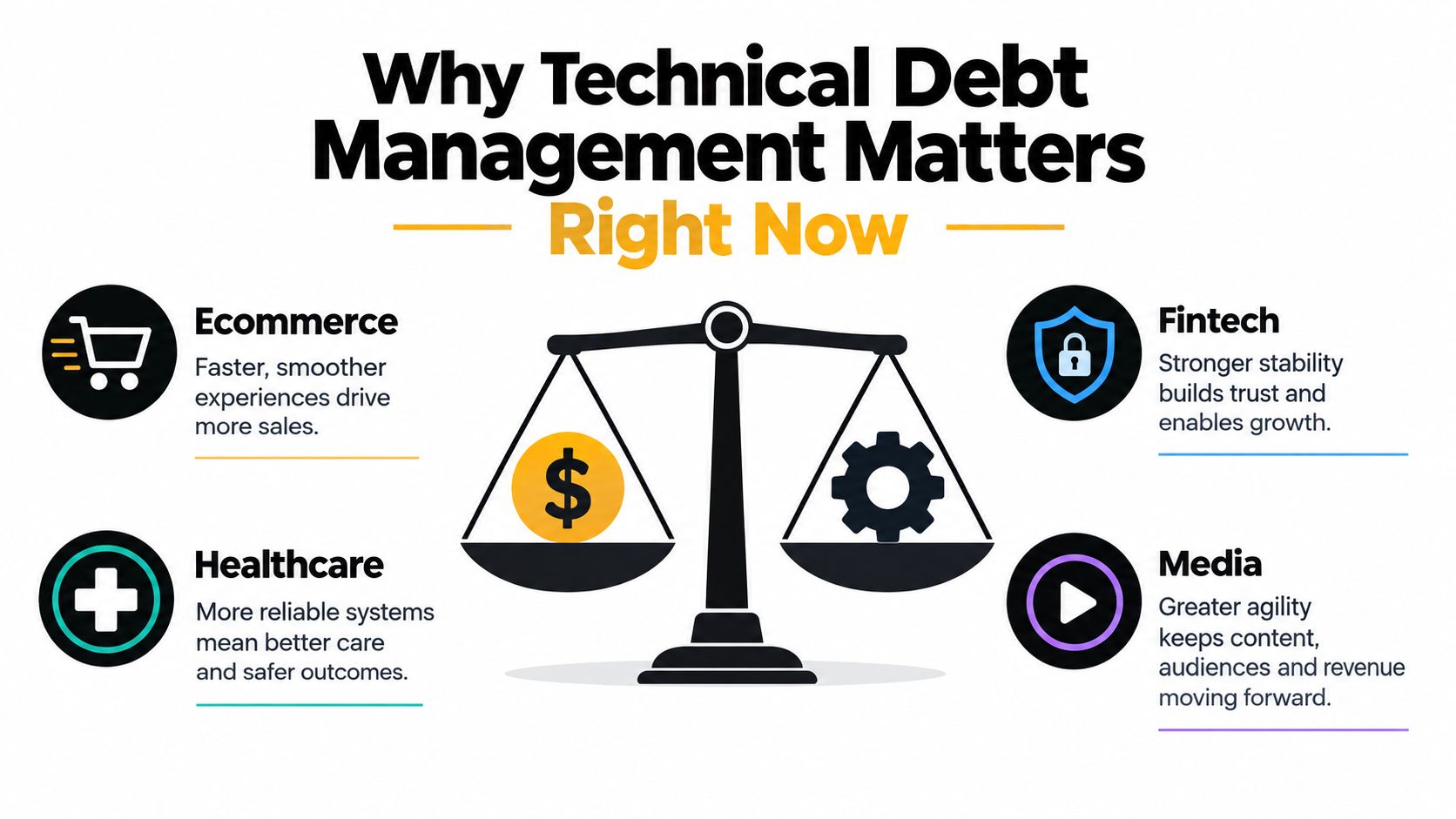
A workable technical debt management framework gives leaders a portfolio view, a common classification system, an economic model, and a backlog ritual. It helps teams decide what to tolerate, what to contain, and what to remove. Start with visibility, then connect every serious debt item to an owner, a consequence, and a decision.
Finding and Classifying Debt Beyond Code
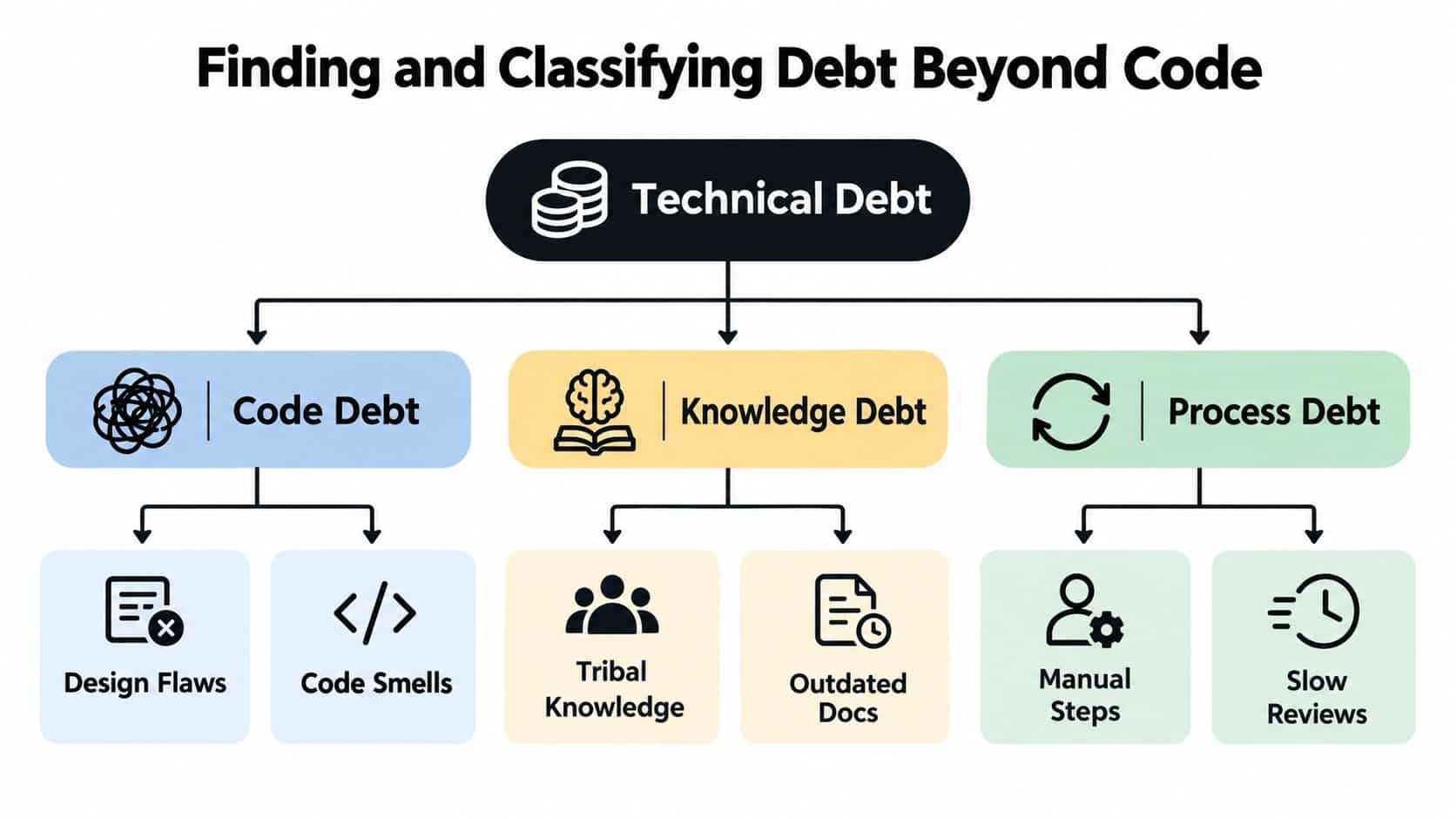
The first mistake teams make is opening a static-analysis dashboard and calling the result a debt inventory. Code analysis matters, but it only exposes one part of the problem. A useful inventory captures anything that makes future change slower, riskier, or more expensive.
A 2025 Forrester survey of IT professionals found that only 27% associated technical debt primarily with code quality. Larger shares identified knowledge and process debt at 37%, system inflexibility at 35%, and unsupported vendor software or redundant systems at 30% to 32%. The message is practical: if your intake form only asks for a file, function, or code smell, it excludes much of the debt your teams experience.
Use four categories that people can recognize
Code debt includes duplicated logic, brittle tests, excessive complexity, and design choices that make a local change spread through unrelated modules. A retail team might find three checkout services applying slightly different discount rules. The immediate fix may be small, but every campaign now requires cross-service verification.
Knowledge debt appears when only one engineer understands an integration, documentation no longer matches behavior, or a team can't explain why a data transformation exists. In healthcare, a claims-processing workaround may depend on institutional memory held by someone who moved to another team. The code still runs, but the organization has lost the ability to change it confidently.
Process debt lives in approvals, handoffs, manual reconciliation, and release rituals. A fintech batch job might be technically sound yet depend on a fragile sequence of manual checks before posting results. The process creates operational interest every time the job runs.
Vendor and platform debt covers unsupported software, redundant products, expired contracts, and systems that can't meet current security or integration needs. System inflexibility deserves its own flag because a platform can be well maintained and still block a necessary business change.
Make every item comparable
Use one intake record for every category. Record:
- Owner: Name the team accountable for the decision, not merely the person who discovered the issue.
- Location: Identify the service, workflow, vendor, repository, or business process affected.
- Consequence: Describe the observed delivery, reliability, compliance, or operating impact.
- Trigger: Note the change, incident, audit, or request that exposed the debt.
- Dismantling tasks: Break remediation into work another team could estimate.
- Interest burden: Capture the recurring effort or risk created while the item remains open.
This structure turns “the claims process is painful” into an item that can be compared with “checkout logic is duplicated” or “the payment gateway SDK is unsupported.” It also prevents teams from treating debt as a complaint queue. Each record becomes a decision object with context, ownership, and a path to reduction.
Measuring Debt and Tracking What It Costs
A debt register without measurement becomes a museum of good intentions. Teams need enough economics to compare remediation with feature work, not a false promise that every item can be priced perfectly.
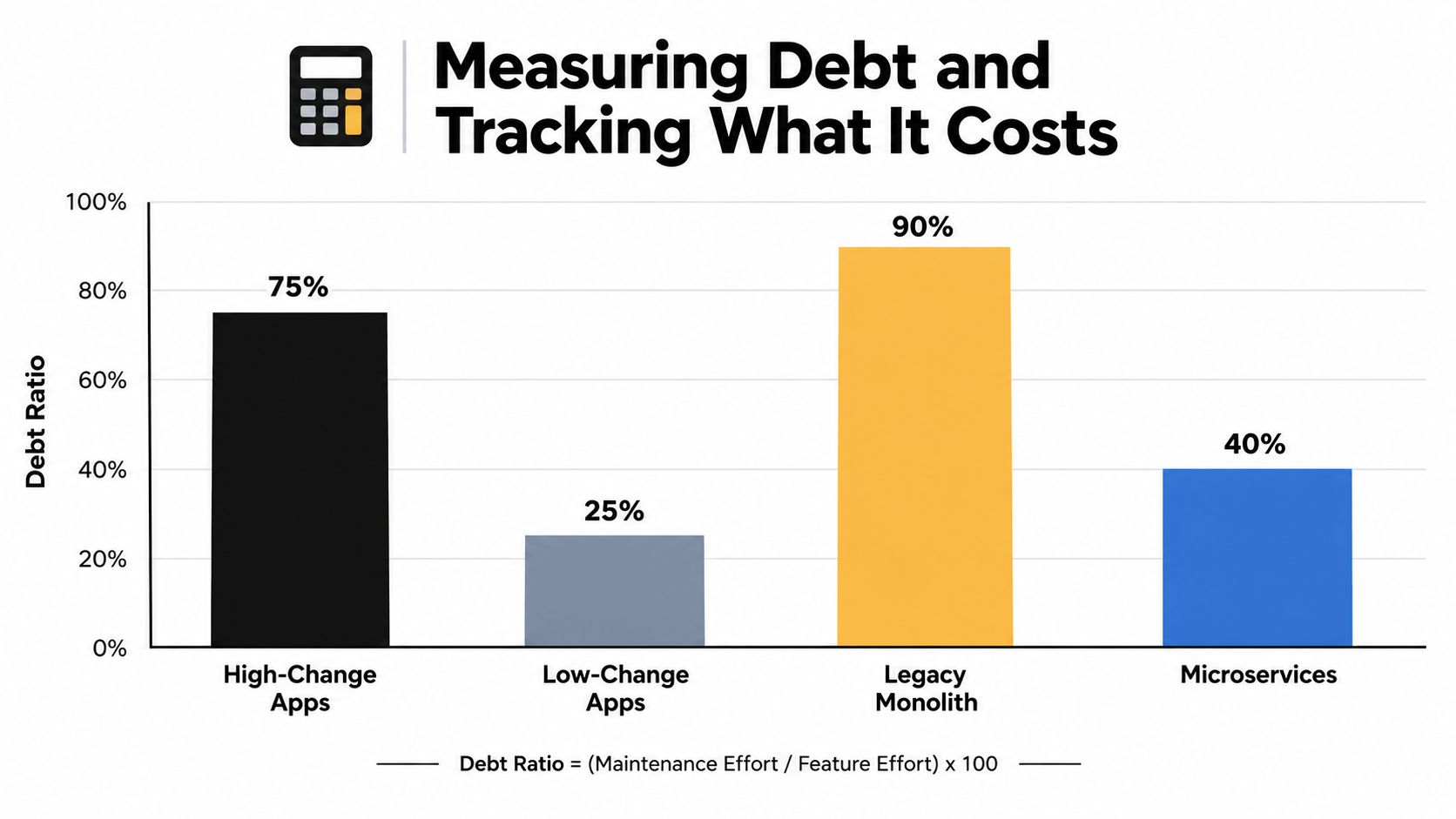
Start with two estimates. Remediation cost is the effort required to dismantle or reduce the item. Interest burden is the recurring cost of leaving it in place, such as extra review time, manual reconciliation, incident exposure, duplicated testing, or delay to a strategic initiative. Both estimates can be directional. Consistency across applications matters more than manufactured precision.
Build a portfolio model
A strong benchmark classifies applications by deployment type, such as on-premises, virtualized, containerized, SaaS, or FaaS. The organization then collects metadata appropriate to each type and converts it into application-level cost curves. McKinsey describes this debt-ratio approach as a gold-standard model because it supports consistent comparisons, a Tech Debt Score, and pricing debt into IT services and operating-model decisions.
Don't compare a low-change internal tool with a transaction-critical platform using the same raw signal. Compare like with like, then overlay business criticality, change frequency, operational exposure, and planned lifespan. A high debt score in a system scheduled for retirement may be tolerable. A moderate score in the service behind a fast-growing product may deserve immediate attention.
Track movement, not just a snapshot
The technical-debt management workflow described in recent guidance is straightforward:
- Identify debt items.
- Document the owner, location, consequence, and dismantling tasks.
- Estimate remediation cost and interest burden.
- Prioritize items against business features.
- Monitor open and closed items over time.
Useful measures include open debt by application, closed debt by period, estimated remediation effort, aggregate interest burden, age of the oldest high-risk item, and the share of delivery work spent on recurring workarounds. These measures tell different stories. A shrinking item count can hide a growing burden if teams close small issues while high-interest items remain untouched.
For finance and engineering, the useful output is a cost curve, not a vanity score. Show what happens if the organization funds targeted remediation, leaves the portfolio unchanged, or replaces a platform. For a practical grounding in the broader economics of software delivery, see this guide to decoding the cost of software development.
A budget signal reinforces the need for this discipline. Deloitte's 2026 Global Technology Leadership Study estimates that technical debt consumes 21% to 40% of organizational IT spending. That estimate shouldn't become a universal target or a reason to launch a sweeping rewrite. It should prompt leaders to find out where that spend sits and whether it protects current operations or funds avoidable friction.
Prioritizing Debt and Fitting It Into Your Backlog
The worst prioritization rule is “fix the oldest code first.” Age matters, but age alone doesn't tell you whether debt is expensive, dangerous, or close to irrelevant. A stable component near retirement may be a better candidate for containment than a newer service that changes weekly and sits on a critical customer path.
Use a decision conversation that combines dependency exposure, business value, component history and age, decommissioning risk, usage, and change frequency. Agile Alliance guidance also emphasizes the probability of negative impact, along with the dependencies between scopes of change. That creates a risk-based ranking instead of a cleanliness contest.
Debt Prioritization Decision Matrix
| Debt Item | Business Risk | Remediation Effort | Recommended Action |
|---|---|---|---|
| Duplicated checkout pricing rules | High, incorrect promotions and release coupling | Medium | Refactor behind a shared pricing interface, then retire duplicate paths |
| Manual claims-processing workaround | High, operational and compliance exposure | Medium | Document the workflow immediately, automate the highest-risk handoff, assign a process owner |
| Fragile fintech batch dependency | High, posting and recovery risk | High | Add observability and replay controls first, then isolate or replace the dependency |
| Unsupported media pipeline component | Medium to high, vendor and security exposure | High | Compare replacement options against remaining platform life and migration complexity |
| Debt in a system scheduled for retirement | Low if retirement is funded and credible | Low to medium | Contain risk, document dependencies, and avoid broad redesign |
A backlog item should state the business consequence, not just the implementation task. “Extract payment adapter” is less useful than “isolate payment adapter so regulatory changes don't require edits across ledger workflows.” The second version helps product, finance, security, and engineering evaluate the same work.
Reserve capacity without hiding the trade-off
Debt work can sit beside feature work, inside a platform roadmap, or within a modernization program. None is automatically correct. A shared platform team can handle cross-cutting architecture, while product teams should own debt they create or directly experience. The key is visible allocation, explicit ownership, and a review cadence.
Set a service expectation for high-risk items. Review the portfolio with the same seriousness as incidents and security findings. Close an item only when the consequence has changed, the dismantling task is complete, or leadership has consciously accepted the remaining risk.
Fixing Debt With Refactoring Replacement and Risk Controls
Remediation should match the shape of the debt. Refactoring, replacement, and risk control solve different problems, and teams get into trouble when they choose a rewrite because the existing system is unpleasant to work in.
Refactor when the boundary still works
Targeted refactoring fits a service with sound ownership and a business role that remains stable. Extract duplicated logic, simplify an interface, improve tests around a risky path, or separate data access from business rules. Keep the change narrow enough that production behavior can be compared before and after.
A strangler approach works when a legacy capability can be surrounded gradually. Route one bounded operation to a new component, compare results, migrate consumers, and retire the old path only after dependencies have moved. Ecommerce teams often use this pattern for catalog or promotion services because they can isolate a business capability without freezing the entire storefront.
For a concrete sequence of safety checks, branch discipline, characterization tests, and incremental extraction, AppLighter's code refactoring workflow is a useful reference. The mechanics matter because refactoring fails when teams change structure and behavior simultaneously without a reliable comparison point.
Replace when the platform is the constraint
Replacement makes sense when the vendor is unsupported, the platform can't satisfy a required security or integration model, or the cost of preserving the current environment exceeds its strategic value. It also makes sense when the architecture has no credible seam for incremental change.
A fintech ledger modernization needs stronger controls than a routine service rewrite. Preserve authoritative data, define reconciliation rules, run parallel calculations where appropriate, and plan recovery before switching traffic. A media company replacing a content pipeline should protect ingestion, metadata, publishing, and asset delivery separately instead of treating the pipeline as one indivisible migration.
Contain risk when timing matters more than elegance
Sometimes the right answer is neither refactoring nor replacement. Add feature flags, circuit breakers, data isolation, replayable queues, compensating checks, or stronger monitoring. These controls don't remove debt, but they can reduce its interest while a larger decision is prepared.
Smallest effective intervention: restore safe change capacity first. A controlled seam is often more valuable than a beautiful redesign that never reaches production.
Write down what the control protects, who owns it, and when the organization will revisit the underlying debt. Otherwise, temporary mitigation becomes permanent architecture by accident.

For legacy systems, the legacy-code refactoring guidance from Wonderment Apps can help teams frame modernization as a sequence of bounded decisions rather than an all-or-nothing rewrite. The useful question is always the same: which intervention lowers the most important risk without creating a larger transition risk?
Governing Debt and Making Modernization Pay
Technical debt management lasts when it becomes part of operating rhythm, not when a leadership team approves a one-time cleanup project. Assign portfolio ownership, require each item to name an accountable team, and review the highest-interest items alongside roadmap commitments. Product and engineering leaders should be able to explain what they're accepting, what they're reducing, and why.
The governance model can stay lightweight:
- At intake: Record the category, owner, location, consequence, remediation tasks, and interest burden.
- During planning: Compare debt with features using business value, dependencies, change frequency, and risk.
- During delivery: Add tests, observability, flags, or isolation that prevent the debt from worsening.
- During review: Track open and closed items, effort spent, and whether the original consequence has fallen.
- During portfolio planning: Fund replacement or modernization where recurring cost and strategic exposure justify it.
AI initiatives need one additional discipline. Include the cost of addressing technical debt in the business case before approving the initiative. IBM Institute for Business Value research reports that enterprises fully accounting for this cost in AI business cases project 29% higher ROI than those that don't. The decision isn't “AI or no AI.” It's whether the AI plan includes data access, integration, governance, testing, monitoring, and the work required to make the host application ready.
At the system level, the economics can become tangible. Independent reporting from Software Improvement Group states that reducing code-level technical debt can save €870,000 in developer time per system per year. Treat that figure as an example of how remediation can be framed, not as a universal forecast. Your own baseline should come from time spent on workarounds, incidents, support, manual operations, and delayed delivery.
Add controls around AI instead of scattering them
Prompt-driven features introduce their own operational debt when teams store prompts in code, grant inconsistent data access, or lose track of model and token spend. A prompt vault with versioning lets teams review and roll back prompt changes. A parameter manager can govern internal database access. Cross-AI logging creates a record of requests and outputs across integrated models, while a cumulative cost manager shows the entrepreneur what the AI estate is spending over time.
That toolkit belongs inside a broader application modernization roadmap, not outside it. Start with one business workflow, measure its current friction, introduce the smallest governed AI capability, and keep the prompt, access, logging, and cost decisions visible to engineering and business owners.
The next step is deliberately unglamorous. Inventory the debt, classify it beyond code, price its interest, rank it against business work, assign owners, and review the portfolio regularly. Modernization starts paying when teams stop arguing about whether debt exists and start making clear choices about what it costs to keep.
Wonderment Apps helps organizations modernize web and mobile products, integrate AI into existing applications, and govern prompts, data access, model activity, and token costs through its administrative toolkit. Visit Wonderment Apps to discuss a practical modernization path that reduces technical debt without forcing an unnecessary rebuild.