

Your roadmap looked sensible when you approved it. Then hiring dragged. AI requirements changed twice. The team still hasn't agreed on where prompts should live, how model calls should be logged, or who owns the growing bill for experimentation. Meanwhile, product wants velocity, compliance wants control, and engineering wants fewer surprises.
That's the point where many software leaders start looking seriously at software development nearshore. Not because it sounds trendy, but because local hiring can become slow, expensive, and too narrow for the mix of app development, platform work, and AI integration now sitting on the same backlog. The teams that get through this well usually do two things at once. They add delivery capacity in a nearby region, and they put better operational guardrails around AI work so prompts, parameters, logs, and spend don't turn into a mess.
Is Your Software Project Hitting a Wall
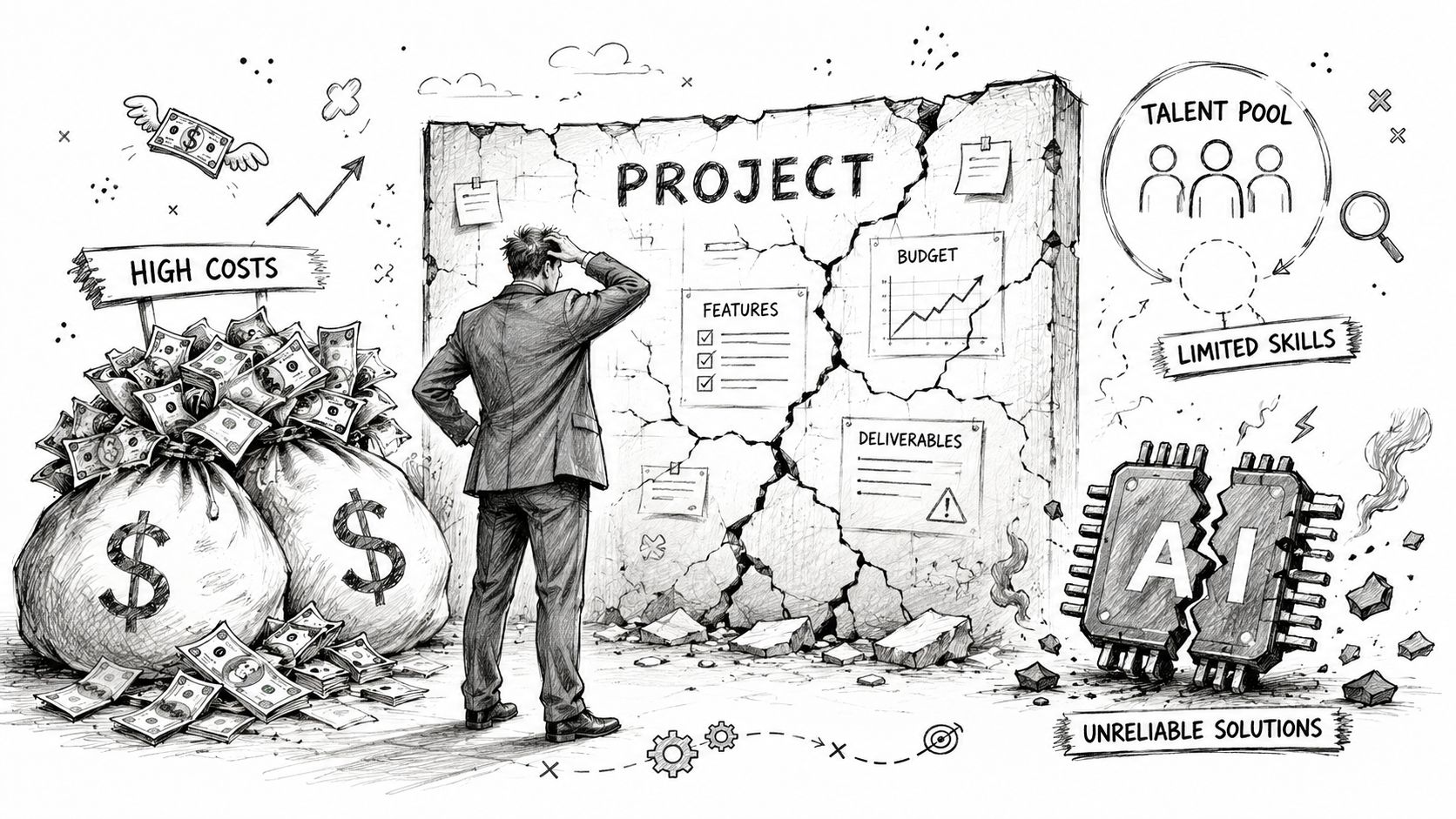
The pattern is familiar. A company needs to modernize a customer portal, rebuild a shaky mobile experience, and add AI features that deliver real value to users instead of generating novelty. Leadership approves the initiative. Recruiting opens roles. Then the friction starts. Senior engineers are hard to hire. AI specialists are even harder. Internal teams get stretched across roadmap work and production support, so “modernization” becomes a slide in a quarterly planning deck rather than shipped software.
That's why software development nearshore has moved from backup plan to core operating model. A nearshore development statistics roundup from HatchWorks says 80% of North American companies are actively using or considering nearshore software development, and 59% choose it specifically as a cost-cutting tool. That doesn't mean everyone is chasing the cheapest labor. It means companies are trying to unblock delivery without giving up working-hour overlap and daily collaboration.
What the wall usually looks like
A stalled project rarely fails for one reason. It usually looks more like this:
- Hiring lags behind roadmap pressure. You need product engineers, QA, and someone who understands AI integration patterns now, not after a long recruiting cycle.
- Local salary bands distort planning. Teams shrink scope early because they assume every role has to be filled in the same high-cost market.
- AI work creates new operating overhead. Prompts sprawl across repos and documents. Model settings drift. Nobody can answer basic questions about logging, versioning, or spend with confidence.
Some teams try to solve that by piling contractors onto an overloaded internal process. That rarely works. If the delivery model is broken, more people just increase the noise. A more durable approach is to pair a nearby delivery team with tighter operating discipline. The build team needs to be able to work in real time with product and engineering leadership. The AI layer needs admin tooling from day one, not after the first production incident.
Teams don't hit a wall because they lack effort. They hit it because the work now spans product delivery, platform reliability, and AI operations at the same time.
If you're weighing staffing options before making a move, this breakdown of in-house tech hiring vs bringing in burstable partners is a useful reality check. The key question isn't whether external help is acceptable. It's whether your current setup can ship what the business already approved.
Why this matters more in AI modernization
AI modernization work punishes vague ownership. If one team handles app logic, another team experiments with prompts, and nobody governs model access or cost visibility, you don't have a modernization program. You have a future cleanup project.
That's where nearshore can be more than a staffing decision. Done well, it gives you people who can join standups, resolve blockers the same day, and help build the admin rails that keep AI features maintainable.
Onshore Nearshore and Offshore Development Explained
The simplest way to explain the three delivery models is to think about distance in terms of collaboration, not geography.
Onshore is like working with a team in your own city. Same business norms, same working day, and usually the least friction in meetings.
Nearshore is like working with a team in the next city over. You still share most of the day, but your access to talent and pricing changes.
Offshore is like coordinating with a team on the other side of the world. It can work well for some delivery patterns, but handoffs become a bigger part of the operating model.
Onshore vs Nearshore vs Offshore at a Glance
| Criteria | Onshore | Nearshore | Offshore |
|---|---|---|---|
| Location | Same country as the client | Nearby country or region | Distant country or region |
| Working hours | Fully aligned | Largely aligned | Often limited overlap |
| Communication rhythm | Fastest for live collaboration | Strong for daily coordination | Often depends on async handoffs |
| Cost profile | Usually highest | Mid-range, often lower than onshore | Often lowest on paper |
| Culture and business context | Most familiar | Often easier to align than distant teams | More variation to manage |
| Best fit | Highly sensitive internal work, leadership-heavy collaboration | Product builds, modernization, agile delivery, AI iteration | Well-defined execution with mature handoff processes |
| Main trade-off | Cost and hiring constraints | Requires vendor selection discipline | Time-zone and coordination overhead |
Nearshore sits in the middle for a reason. It preserves enough proximity for active product development while widening your hiring options.
Why nearshore behaves differently in practice
A key advantage isn't abstract proximity. It's the daily operating rhythm. Grid Dynamics notes in its nearshore guide that nearshore software development typically involves a 1 to 3 hour time-zone difference, which supports real-time collaboration during overlapping business hours. That matters in sprint planning, standups, code reviews, incident response, and AI tuning sessions where fast feedback beats perfect documentation.
If your process depends on same-day answers, nearshore usually feels like one team. If your process depends on overnight handoffs, offshore can be perfectly viable.
A practical way to choose the model
Use the model that matches the work, not the one that sounds cheapest in procurement.
- Choose onshore when leadership access, legal constraints, or deep domain immersion matter more than cost flexibility.
- Choose nearshore when you need continuous collaboration across engineering, product, design, QA, and AI operations.
- Choose offshore when the work is already structured for clear specifications, asynchronous delivery, and predictable handoffs.
Most companies don't need one model forever. They need the right model for the phase they're in. Early product discovery and AI integration usually benefit from high collaboration. Mature maintenance work may not.
Weighing the Benefits and Risks of Nearshoring
Nearshoring gets oversimplified. The popular version goes like this: lower cost, close time zones, problem solved. Real projects are messier. Nearshore can absolutely improve delivery, but only when you treat it as an extension of your operating model instead of a purchasing shortcut.
Where nearshore helps most
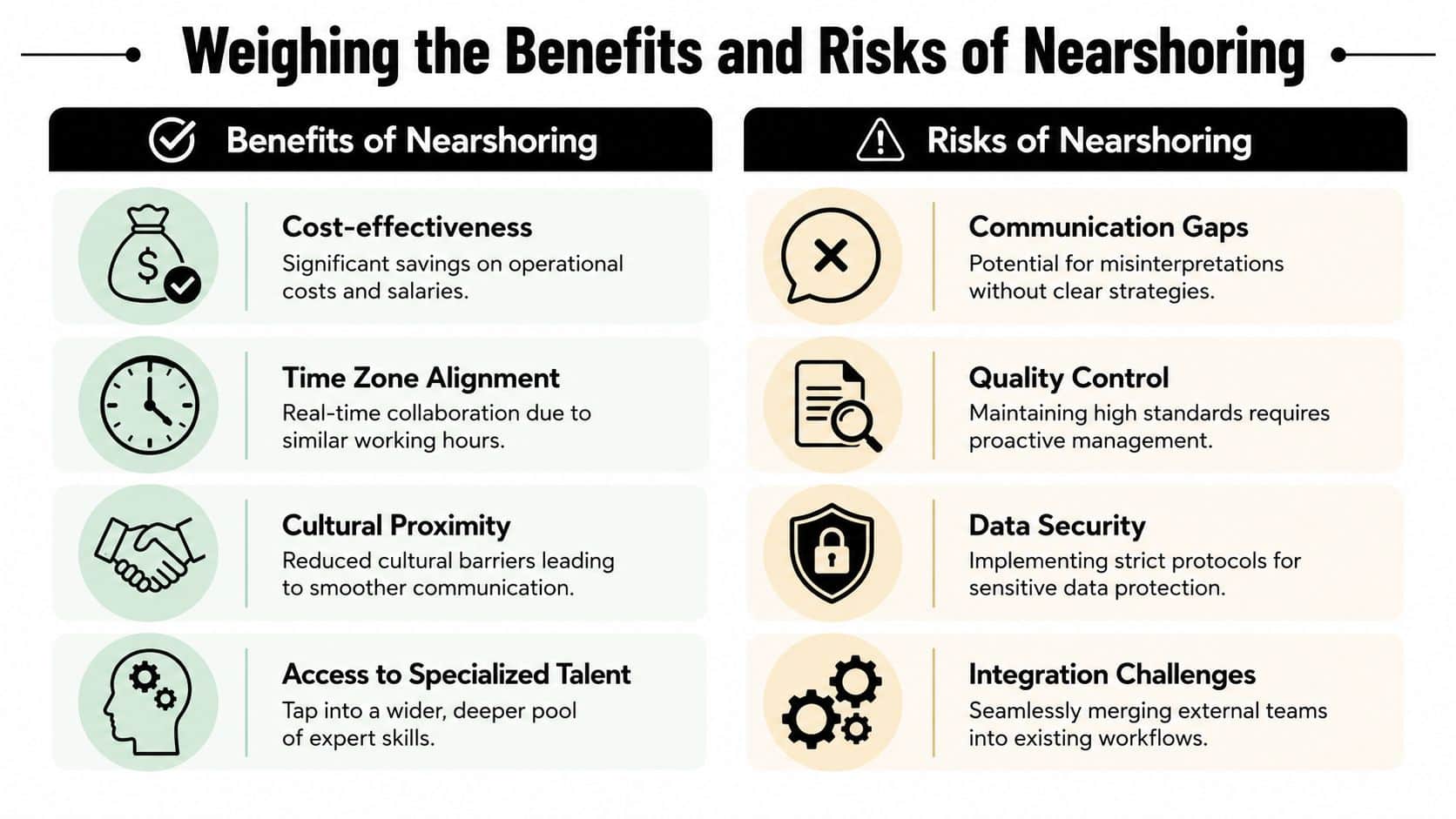
The upside usually shows up in four areas.
Practical rule: Nearshore works best when the work requires daily decisions, not just task completion.
- Broader access to specialists. You can often add engineers with stronger depth in mobile, QA automation, cloud, or AI integration than you could hire quickly in one local market.
- Healthier delivery cadence. Shared working hours reduce the dead time between question and answer. Teams review code, clarify tickets, and resolve blockers while everyone is still online.
- Better product context. A nearshore team that joins planning and demos regularly tends to understand user intent better than a disconnected vendor fed only tickets.
- Less operational drag than distant models. You still need discipline, but you spend less energy on midnight meetings and long async clarification threads.
The risks leaders tend to underestimate
The risks are real, and they usually come from management habits rather than geography.
- Communication gaps. Even with strong English skills and overlapping hours, teams can interpret vague requirements differently.
- Quality drift. If acceptance criteria are soft and code review standards are inconsistent, a nearshore team will mirror that ambiguity.
- Security and IP concerns. Sensitive applications require explicit rules around environments, access, logging, and data handling.
- Integration friction. External teams struggle when internal stakeholders treat them like a ticket sink instead of part of delivery.
A lot of failed nearshore engagements are really failed onboarding efforts. The client expected instant alignment. The vendor expected clearer ownership. Both sides assumed the other would adapt.
How to reduce the downside
The fixes are practical.
- Write better product decisions. Short tickets are fine. Ambiguous tickets are not. Define business rules, edge cases, and what “done” means.
- Make ceremonies operational. Standups, backlog grooming, and demos should drive decisions, not just status reporting.
- Set engineering controls early. Use branch policies, code review rules, QA gates, and environment access policies from the start.
- Name owners clearly. One person on your side must own product scope. One person must own engineering quality. If AI is in scope, someone must own prompt and model governance too.
The most expensive nearshore team is the one you hired to move faster but forced to wait for answers.
When teams do this well, nearshore feels less like outsourcing and more like distributed product delivery. When they do it badly, even talented engineers can't compensate for unclear leadership.
Understanding Nearshore Pricing and Engagement
Pricing only becomes useful when it's tied to the way you plan to work. Too many buyers compare hourly rates first, then discover later that the engagement model doesn't fit the project. A lower rate won't save you if the scope is fuzzy, priorities move weekly, or the team needs deep product context to make good decisions.
What the rate ranges actually tell you
A nearshore rate guide from N-iX Cube says nearshore rates can start at $20/hour, while comparable onshore talent in the U.S. and Europe often starts at $80/hour. The same guide cites potential savings of up to 50% on development costs. It also places Latin America between $34 and $92/hour on average and CEE between $37 and $101/hour on average.
Those numbers are useful, but they don't mean every team in the lower range is a bargain or every team in the higher range is overpriced. Rate bands usually reflect a mix of seniority, domain knowledge, language proficiency, delivery maturity, and regional market conditions.
Match the engagement model to the work
Here's the practical breakdown.
- Time and Materials works well when you're still learning. Use it for discovery, modernization assessments, AI prototyping, or projects where requirements will evolve as users react.
- Fixed Price fits tightly defined work with stable requirements. It can work for contained builds, but it often becomes painful when the product team is still making decisions in flight.
- Dedicated Team makes sense when software is an ongoing capability, not a one-time project. This is usually the strongest fit for product roadmaps, platform modernization, and AI-enabled applications that need continuous iteration.
What buyers often miss
The rate is only one layer of cost. You also need to price in:
| Cost factor | What to check |
|---|---|
| Management load | How much direction will your internal team need to provide day to day? |
| Delivery maturity | Does the vendor bring PM, QA, architecture, and reporting discipline? |
| Context retention | Will the same people stay on the account long enough to learn your product? |
| Change tolerance | Can the model absorb shifting priorities without constant contract friction? |
If you're comparing structures, this guide to staff augmentation vs managed services helps clarify whether you need extra hands, outcome ownership, or something in between.
The best pricing decision usually isn't the cheapest monthly line item. It's the model that lets the team ship reliably without turning every scope update into a procurement event.
How to Select the Right Nearshore Vendor
A polished sales deck won't tell you whether a vendor can survive a hard sprint, support a production incident, or handle regulated data correctly. Vendor selection gets better when you stop asking, “Who has the lowest rate?” and start asking, “Who reduces delivery risk while helping us move?”
Use risk-adjusted criteria, not rate cards alone
Deloitte's nearshoring guidance advises buyers to evaluate a nearshore location using risk-adjusted factors such as tech talent supply, English ability, graduate pipeline, security and natural-disaster risk, business climate, physical infrastructure, and operating cost. That lens matters even more in fintech and healthcare, where continuity and compliance can matter more than a lower hourly rate.
That means “nearshore in LATAM” is not one decision. It's a series of trade-offs between locations, vendors, and operating conditions.
The due diligence checklist that actually matters
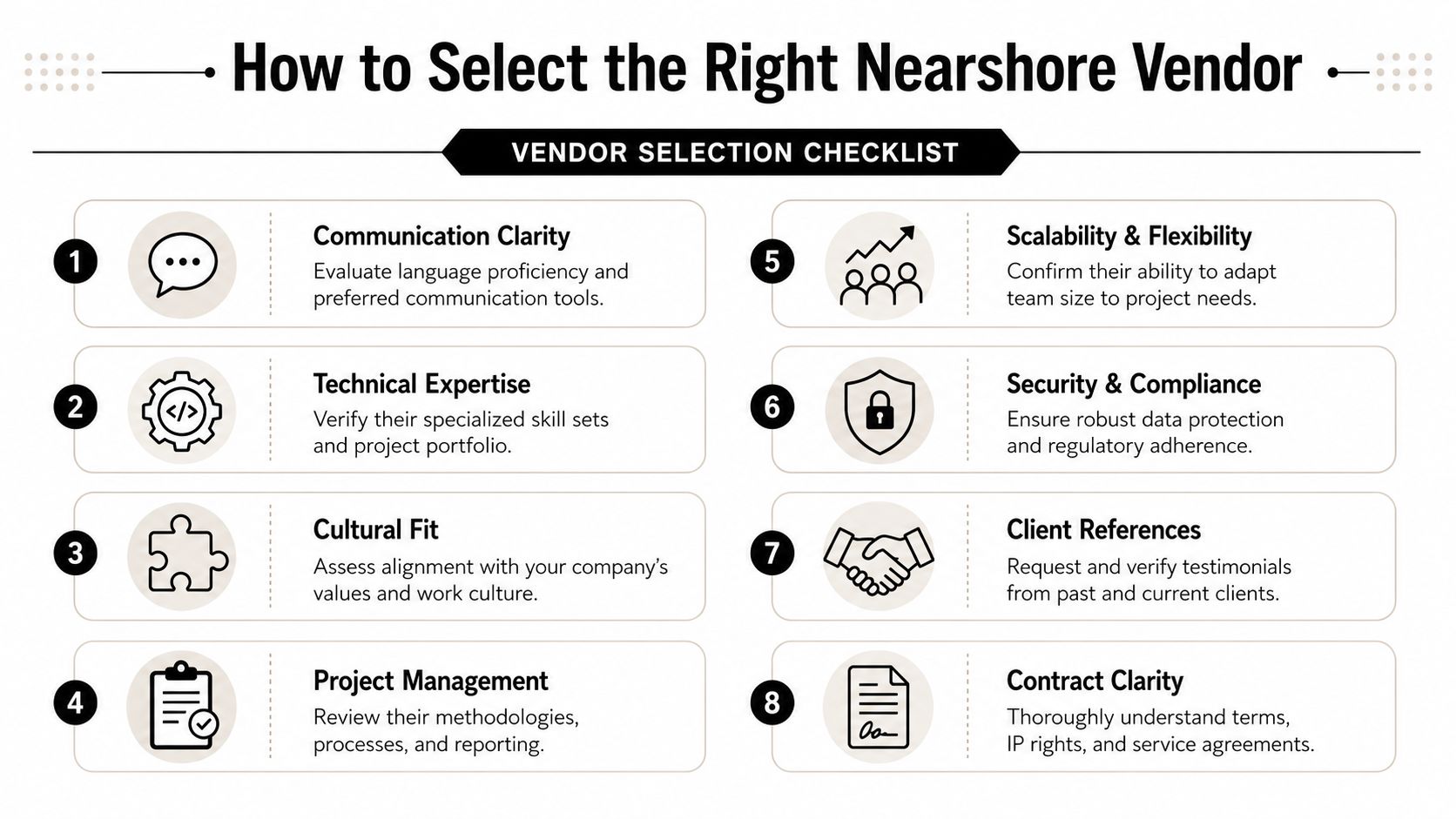
Run your evaluation through questions like these:
- Technical depth. Can the team explain how they handle architecture decisions, testing strategy, CI/CD, and production support?
- Communication habits. Who joins standups? Who writes status updates? How are blockers escalated the same day?
- Security posture. How do they handle access controls, least privilege, auditability, and separation between client environments?
- Delivery consistency. Will you meet the people who will do the work, or only the people who sold the contract?
- Scalability. Can they add QA, design, DevOps, or AI specialists when the roadmap shifts?
- Business resilience. What happens if a local disruption affects the team's office, connectivity, or staffing?
What to ask in live interviews
The best vendor interviews feel like engineering reviews, not procurement formalities.
Ask the vendor to walk through a project that went off plan. Their answer will tell you more than a success story.
Use direct questions:
- Show me your handoff from discovery to delivery.
- Who owns quality when requirements are incomplete?
- How do you onboard into a legacy codebase with sparse documentation?
- How do you protect sensitive data during development and support?
- What reporting do I get weekly, and who is accountable for it?
If you want a deeper view of what modern partnerships can look like, Wonderment's guide to nearshore application development is a useful companion read.
A strong vendor doesn't promise that nothing will go wrong. They show you how they work when something does.
Supercharge Nearshore Teams for AI Modernization
AI modernization changes the shape of software delivery. You're not just building features. You're also managing prompt behavior, model parameters, auditability, fallback logic, evaluation, and cost control. That makes software development nearshore especially useful when the team can collaborate in real time with product, compliance, and engineering leadership.
A recent nearshore software development guide from HatchWorks argues that nearshore's value grows in the AI era because real-time collaboration supports the iterative development and fine-tuning required for AI-native applications. That lines up with what teams experience on the ground. AI work usually needs rapid feedback loops, not long-distance handoffs.
Why AI projects break standard outsourcing habits
Traditional outsourced delivery assumes a relatively stable spec. AI projects don't behave that way. Teams adjust prompts, compare outputs, tighten retrieval, tune guardrails, and revisit evaluation criteria as they learn from real usage. If your developers are asleep while product and operations are testing the latest behavior, cycle time stretches fast.
That's why nearby collaboration matters so much in AI modernization. A prompt tweak can affect user experience, support workflows, compliance review, and token spend at the same time.
The operating layer most teams forget
An administrative toolkit holds as much importance as engineering talent. For AI features inside desktop and mobile apps, teams need a place to manage prompts as production assets, not scattered snippets.
One option is Wonderment Apps, which offers a prompt management system designed for AI integration work. It includes a prompt vault with versioning, a parameter manager for internal database access, a logging system across integrated AI tools, and a cost manager so entrepreneurs and product leaders can see cumulative model spend. Those controls are useful when a nearshore team is shipping quickly and multiple people touch the same AI workflows.
AI features become easier to maintain when prompts, parameters, logs, and spend are governed in one operating layer instead of spread across code, docs, and dashboards.
Where this model fits by industry
Different industries hit different pressure points.
- Ecommerce and retail. Teams use AI for search assistance, merchandising support, and personalization logic. The risk isn't only output quality. It's inconsistent behavior across channels and unclear cost visibility.
- Fintech. Teams need strong controls around internal data access, model behavior, and audit trails. A nearshore team can move quickly, but only if the operational rails are defined.
- Healthcare and wellness. User-facing AI needs tighter governance, clear boundaries, and dependable review processes. Same-day collaboration helps product, engineering, and compliance stay aligned.
If you're thinking through platform-specific build concerns alongside AI integration, this piece on Yassine Malti app development is a worthwhile read, especially for teams modernizing commerce experiences where app workflows and AI-assisted operations start to overlap.
Nearshore earns its keep in AI work when the team can do more than code. They need to participate in iteration, governance, and cost-aware delivery.
Make Your Next Project a Wonderment
Nearshore isn't a magic trick. It's a delivery choice. The payoff comes from pairing the right team model with the right operating discipline.
For standard software projects, that means clear ownership, strong product decisions, and a vendor you'd trust in a production incident. For AI modernization, the bar is higher. You also need prompt governance, logging, parameter control, and visibility into model spend. Without that layer, even a skilled team can leave you with fast-moving chaos.
The good news is that software development nearshore fits this kind of work unusually well. Shared working hours support better decisions. Better decisions reduce rework. And when the team has the right admin tools, AI features stop feeling experimental and start behaving like maintainable product capabilities.
If your backlog includes legacy modernization, new mobile or web experiences, and AI features that need adult supervision, don't treat those as separate conversations. They're one delivery problem. Solve them as one system.
If you want to see how a managed prompt vault, parameter controls, cross-model logging, and AI cost tracking can support a nearshore delivery model, book a demo with Wonderment Apps.