

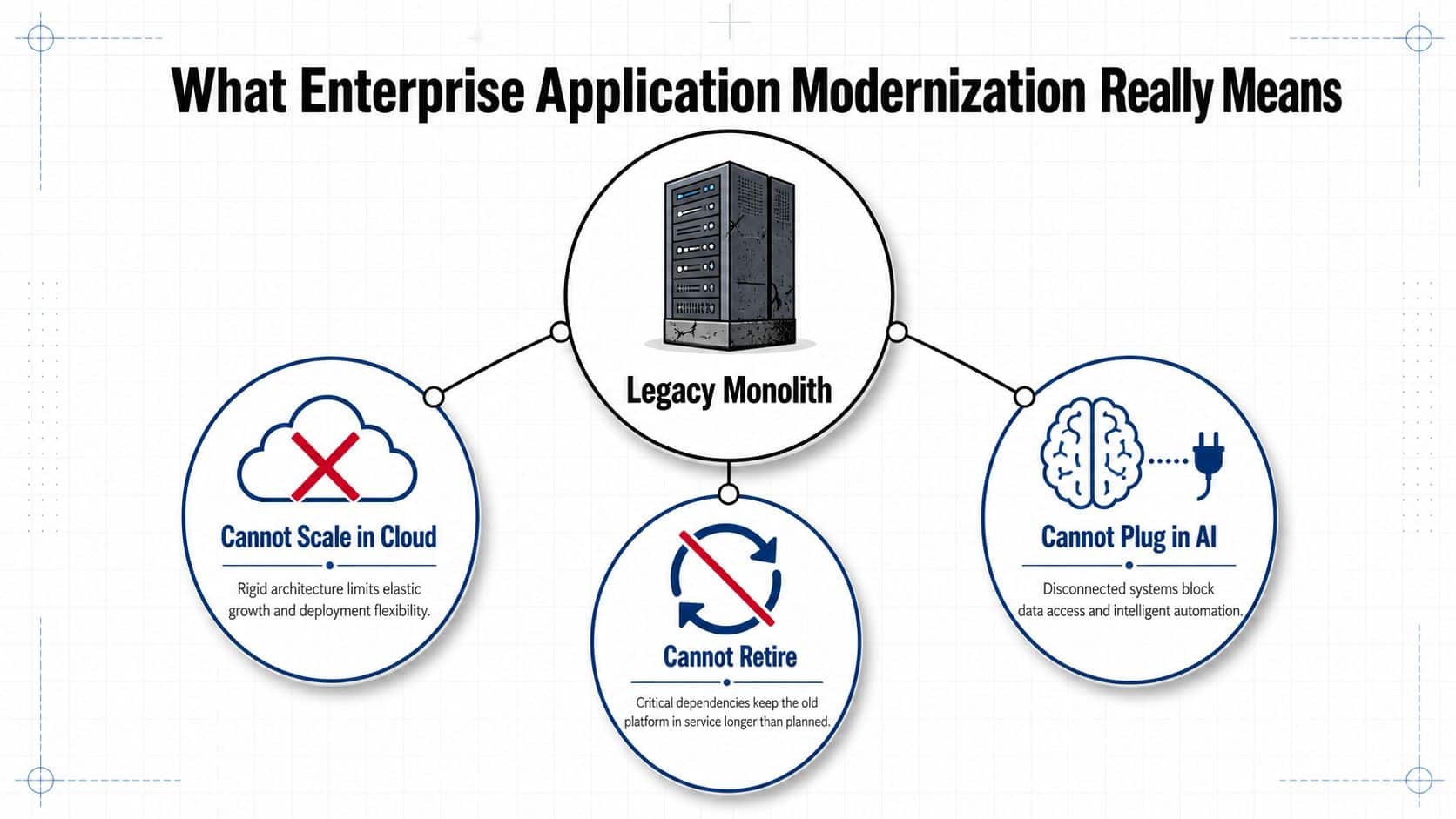
You're sitting on a legacy system that still makes money, still scares the cloud team, and still blocks the AI pilot everyone keeps talking about. The business won't retire it. Engineering can't scale it cleanly. And every new initiative hits the same wall, because the app was never built for governed data, clean APIs, or model-driven workflows.
That's enterprise application modernization in the actual world. Not a tidy migration project, not a one-time rewrite, but a portfolio decision about which systems to keep, which to reshape, and which to wrap with controls so they can survive another few years of growth. The market reflects that reality, with the global application modernization market valued at USD 21.32 billion in 2024 and forecast to reach USD 74.63 billion by 2032 in one estimate, while another pegs the services market at USD 28.40 billion in 2026 and USD 111.18 billion by 2035 market data. That's not cleanup spend, that's strategic enterprise budget.
For teams trying to make AI useful in existing products, the missing piece is usually not another framework. It's the plumbing around prompts, access, logging, and cost control. A prompt vault with versioning, a parameter manager for internal data access, a logging layer across integrated AI systems, and a cost manager that tracks cumulative spend is the kind of operational layer that turns “we can add AI” into “we can run AI safely.”
What Enterprise Application Modernization Really Means
A CTO inherits the same story over and over. The monolith still runs revenue, the cloud migration stalled halfway, and the new AI assistant can't touch the data because no one trusts the interfaces. That's when people start saying “modernize,” but they often mean three different things at once.
Enterprise application modernization is a portfolio discipline. It's the work of deciding, application by application, what gets retired, retained, rehosted, replatformed, refactored, rebuilt, or replaced. Konveyor's 2024 modernization report calls out six standard paths, Retire, Retain, Rehost, Replatform, Refactor, and Repurchase, and splits modernization into two broad buckets, modernizing legacy systems or building new cloud-native services Konveyor report. That framing matters because it stops teams from treating every system like a rewrite candidate.
What it is not
It is not just “moving to the cloud.” Rehosting might solve infrastructure friction, but it won't automatically fix brittle coupling, unsupported runtimes, or the fact that the application still can't expose clean data to an AI layer. Microsoft's modernization guidance makes the practical point clearly, assess response times, error rates, and resource utilization, then prioritize systems that are underperforming or failing demand, while also checking for outdated or unsupported languages, frameworks, databases, and tools Microsoft guidance. That's telemetry-led modernization, not intuition-led theater.
Practical rule: if a system can't scale, can't integrate, and can't be safely changed, it's not “stable,” it's stranded.
The other mistake is treating modernization as a single project with a finish line. Capgemini's guidance leans on portfolio scoring, business value, technical health, security risk, operational cost, and strategic alignment, then sequencing by dependency order Capgemini manual. That's the right mental model. You're building a sustained capability that keeps revenue-critical systems alive while making them ready for new channels, new integrations, and AI-driven experiences.
The 7R Framework for Choosing What to Modernize
The 7R model works only if you use it as a decision lens, not a ritual. The point is to match the degree of change to the application's business value, technical health, security exposure, and integration complexity. If you skip that discipline, “modernization” turns into an expensive reflex where every problem looks like a rewrite.
Use each R for the right signal
Rehost changes infrastructure, not code. It's the fastest path when the app is basically sound but tied to old hardware or hosting. Pick it when you need a cleaner operating environment and can't justify deeper surgery yet.
Replatform changes the runtime or platform layer with limited code edits. The cost is higher than rehost, but lower than refactor or rebuild. Choose it when the app is mostly fit for purpose and the platform is the bottleneck, not the business logic.
Refactor changes code structure without changing user-facing behavior. The cost profile is more surgical and more dangerous, because you're paying to reduce technical debt while preserving function. Use it when architecture debt is capping performance, delivery speed, or scalability.
Rebuild replaces the application with a new implementation. It's expensive, risky, and sometimes necessary. Pick it only when the current codebase is too constrained, too fragile, or too entangled to keep patching.
Replace swaps the application for a package or SaaS product. That changes your operating model more than your code. Choose it when the capability is commoditized and differentiation doesn't live in the software itself.
Retire removes the application entirely. That sounds simple, but it's often the hardest decision because it forces teams to confront business process overlap, compliance retention, and data migration. Use it when the system no longer earns its keep.
Retain keeps the system in place, often temporarily, because the cost of touching it is higher than the value of changing it right now. This is not laziness. It's a legitimate portfolio choice when the app is stable, low-risk, or blocked by dependencies.
Score the portfolio, not the opinion
Teams should score every application on a small set of factors, then make the call. Business value, technical health, security or compliance risk, and integration complexity are the four that matter most in practice. A stable finance system with high business value and heavy integration debt might deserve replatforming, while a low-value internal utility with weak ownership might deserve retirement.
If the team can't explain why an app is being changed, it probably isn't ready to change.
The 7R model becomes useful when it gives you a map. It breaks the “rewrite everything” habit, and it keeps leadership honest about cost, risk, and timing. That's the core purpose of the framework: to force trade-offs into the open before engineers spend months building the wrong future.
Architecture and Data Strategies That Actually Work
Architecture and data are the first places AI workloads hit, and they expose weaknesses fast. If those layers are messy, personalization gets brittle, recommendations go stale, and anomaly detection depends on the oldest integration still buried in the monolith. Modernization should buy operational runway before it chases novelty.
The patterns that actually reduce risk
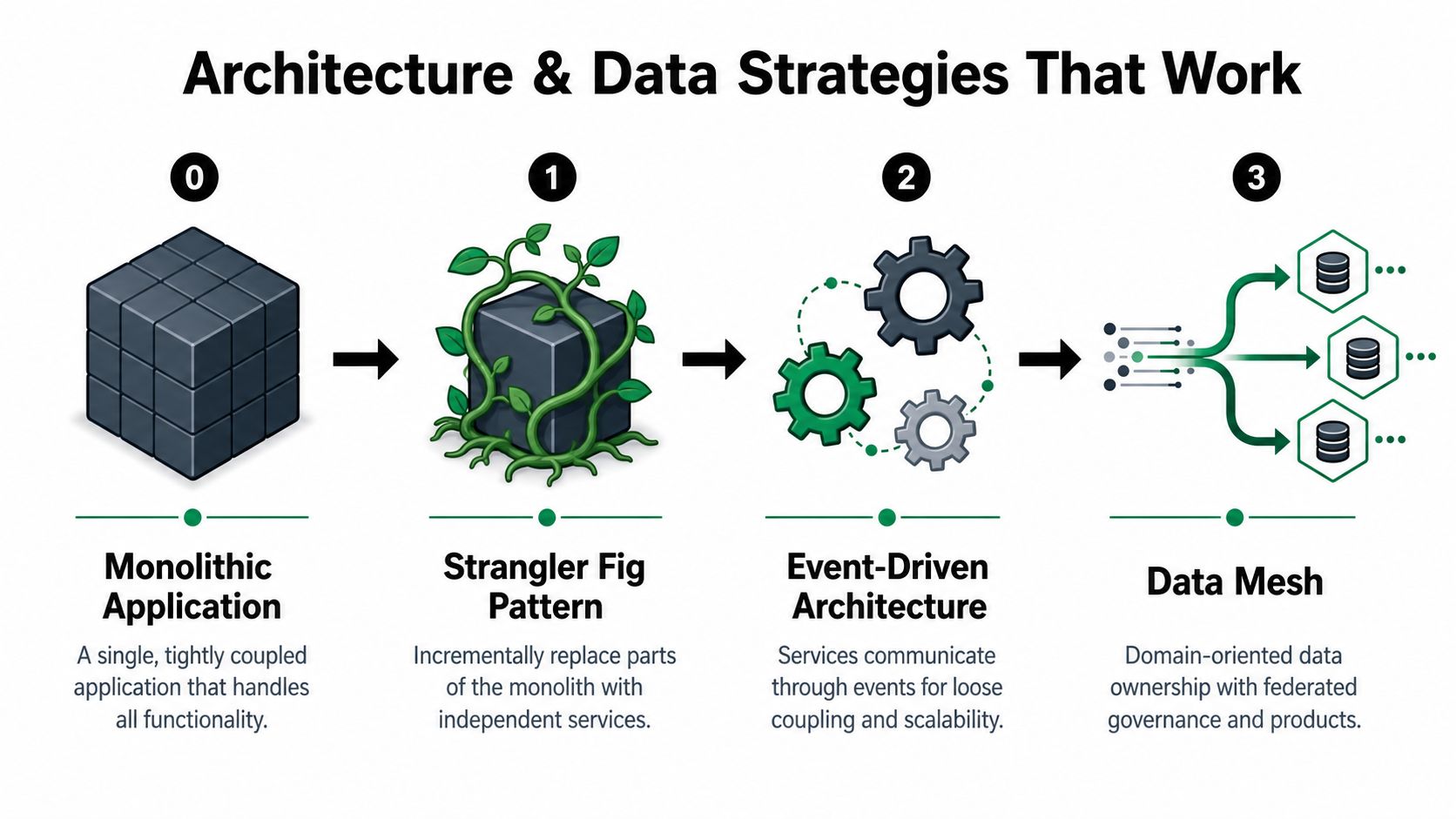
The strangler fig pattern is the cleanest way to peel functionality away from a monolith without blowing up the whole system. You route a slice of traffic to a new service, keep the old system running, and expand the new surface over time. That matters because it limits blast radius, and blast radius is what kills modernization efforts when the legacy app still carries revenue.
Event-driven decomposition works best when the application is already packed with cross-system side effects. Instead of hardwiring every action into synchronous chains, you publish events and let downstream services react. That gives teams a path to looser coupling and stronger real-time behavior, especially where auditability and asynchronous processing matter.
API-first layering is the practical way to expose a legacy system without exposing its mess. You place a stable contract in front of unstable internals, which lets mobile apps, partner systems, and AI services consume capabilities without touching the core every time. It is not glamorous. It is one of the most valuable architecture moves you can make.
Data fabric becomes useful when data is spread across warehouses, line-of-business databases, and SaaS tools, but the enterprise still needs a governed view. The win is controlled access, clearer lineage, and fewer duplicate pipelines, not some fantasy of perfect centralization.
Data modernization is the AI readiness test
If you want AI to do more than demo theater, you need governed data products. That means clear ownership, defined access, and a deliberate path for sensitive data instead of a pile of ad hoc extracts. It also means retiring duplicate warehouses when they exist only because different teams never settled ownership and control. A clear data warehousing concept helps teams separate reporting structures from the broader modernization work and keeps the data conversation grounded in actual operating needs.
Streaming paths matter too. Personalization and anomaly detection depend on fresh signals, not just nightly batch jobs. If the business needs faster decisions, design the data flow for that requirement instead of pretending a reporting warehouse will suddenly behave like a real-time engine.
The trigger is telemetry. When response times climb, errors spike, or resource use stays hot under normal demand, the problem is usually architectural, not just operational. That is the point where a refactor or replatform becomes the honest call, because the architecture is now setting the ceiling on the business.
If your data team is still debating what good looks like for foundational analytics and warehouse design, the data strategy for bank leaders piece is a useful reference point. In enterprise terms, the rule is simple. Separate the data moves that make AI possible from the plumbing changes that only reshuffle cost.
Integrating AI Without Creating a Governance Mess
Most modernization programs fail here, because they bolt AI onto old software and hope the mess stays contained. It doesn't. The model needs access to data, the business needs observability, finance needs cost control, and security needs a trail that explains what happened when the system made a decision.
IBM's 2025 CEO study points to the pressure on leaders to accelerate AI deployment and modernize data and application foundations at the same time IBM AI modernization perspective. Microsoft also reported that 75% of knowledge workers were already using AI at work in 2024 Microsoft 2024 AI use data, which means the demand is already inside the enterprise whether IT planned for it or not. That pressure is exactly why modernization has to include AI-readiness, not just cloud migration.
Put a prompt layer between the app and the model
A prompt management system is the missing control plane. A prompt vault with versioning gives teams traceability, rollback, and change control for the actual instructions being sent to models. A parameter manager handles internal database access so the model doesn't get direct, uncontrolled reach into systems it shouldn't see.
A logging system across every integrated AI gives you the audit trail you'll wish you had during a production incident. A cost manager surfaces cumulative spend, which matters because AI cost control is a business problem, not a developer side quest. This is the layer that keeps model orchestration from turning into a black box wrapped around your most sensitive systems.
AI should inherit your governance, not bypass it.
That means developers wire AI through the modernization layer the same way they wire any other service, through APIs, policies, and logs. Business owners get visibility into usage, finance gets predictable reporting, and engineering gets versioned behavior instead of prompt chaos.
Wonderment Apps offers exactly this kind of administrative toolkit as part of its modernization work, including prompt management, integrations, and token cost control. Its what is AI integration resource is a useful framing for teams that need to connect models to existing products without losing oversight.
What changes for the business
The biggest change is that AI becomes an operating capability, not a special project. Once the prompt layer exists, teams can add personalization, recommendations, anomaly detection, and assistant workflows without hardcoding one-off model calls into core business logic. That lowers the chance that one successful experiment becomes ten ungoverned deployments.
It also changes release discipline. Versioned prompts, parameter controls, and logging force teams to treat AI behavior like any other production dependency. That's the standard enterprise software should already be living by.
Governance, Risk, and Compliance You Cannot Skip
Governance is not a sign-off exercise after the architecture is done. It's the gate. If a modernization wave can't answer where data lives, who can touch it, and how decisions will be audited, then it isn't ready for production, especially in regulated industries.
The risk stack that breaks projects
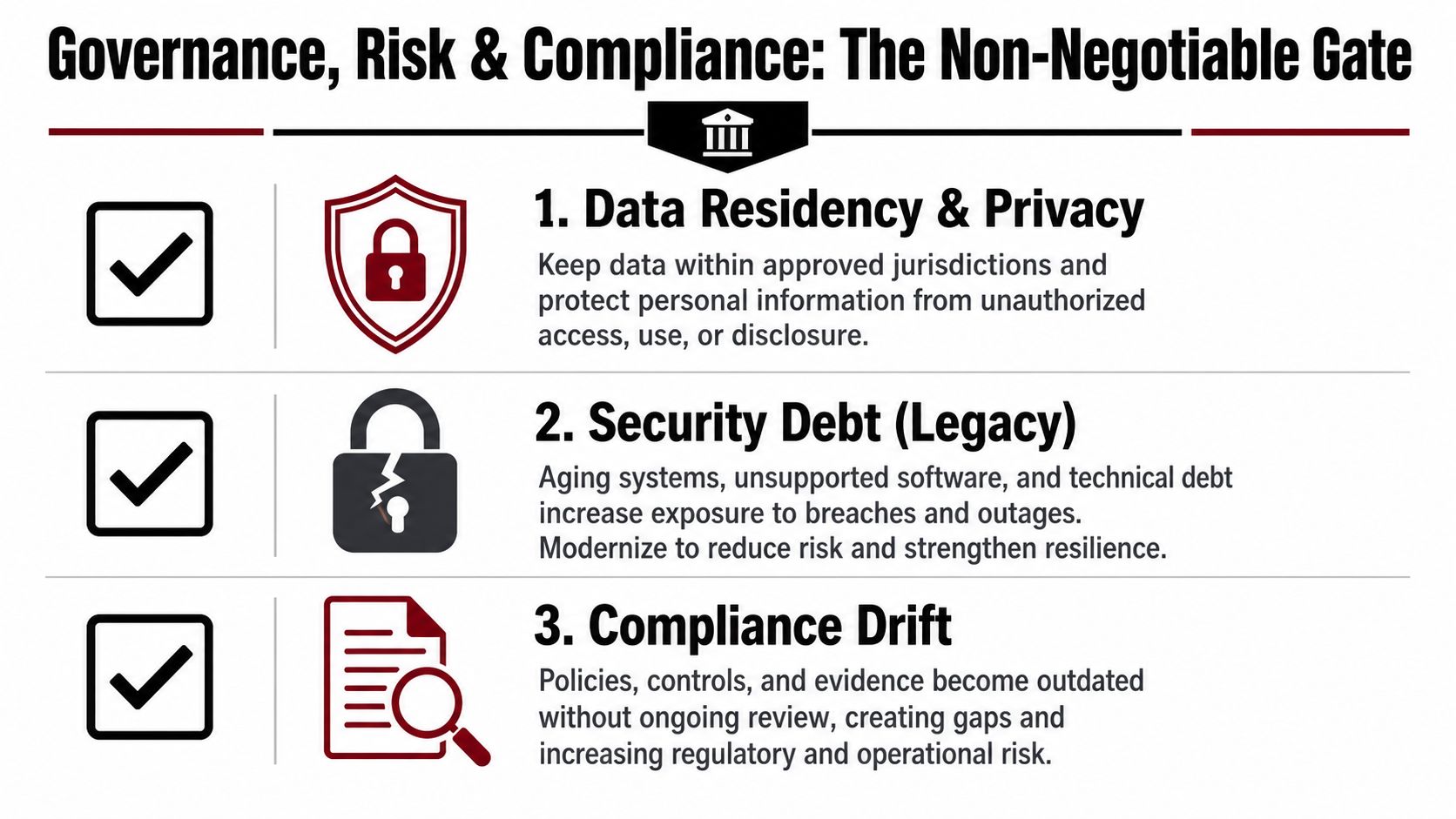
The first risk is data residency and privacy. Modernization often moves workloads across environments, and teams need to know whether that changes where sensitive records live or who can process them. If the answer is fuzzy, stop.
The second is security debt inherited from legacy components. Sonatype's 2025 report says 96% of organizations use open source, 74% depend on components with known vulnerabilities, and 81% had a security incident from an OSS dependency in the prior year Sonatype report. That makes “leave it alone” a real risk decision, not a neutral one.
The third is compliance drift. Legacy systems often keep working long after the people who understood the original controls are gone. Once that happens, modernization work can accidentally widen the gap between what the business thinks the system does and what auditors can verify.
Talent is part of the governance problem
Modernization teams also lose people. The engineers who built the old system often hold the only working map of its edge cases, and when they leave, the organization loses more than code knowledge. It loses judgment about what must not break. That's why documentation and rollback planning aren't paperwork, they're operational insurance.
Before the first wave starts, four artifacts should exist:
- Portfolio register: a live inventory of applications, owners, dependencies, and modernization intent.
- Data classification map: a clear view of what data is sensitive, regulated, or public.
- AI usage policy: rules for model access, prompt handling, logging, and approval.
- Rollback plan per application: a tested path back to the previous state if the change fails.
If those four things are missing, the project is not modernizing. It's improvising.
A Phased Roadmap and Real-World Outcomes
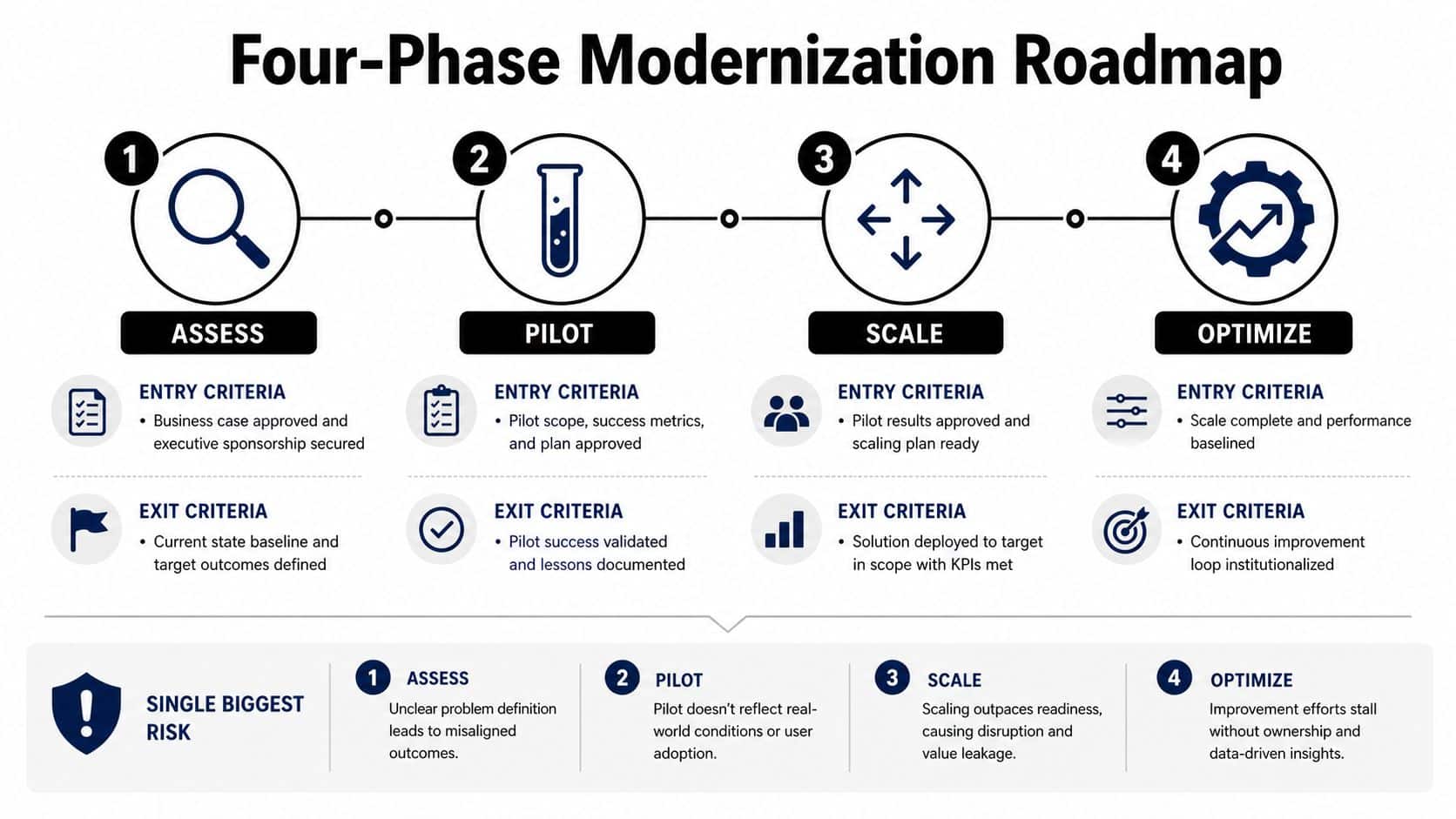
The only roadmap that holds up in enterprise work is phased, iterative, and brutally specific about entry and exit criteria. Big-bang rewrites create hero stories and postmortems. Controlled waves create systems that survive contact with reality.
Assess and pilot
Assess starts when the portfolio is mapped, dependencies are visible, and the team can explain the business value of each app. The biggest mistake here is pretending every system deserves equal attention. It doesn't.
Pilot starts when one slice of the portfolio has a clear owner, low-to-moderate dependency risk, and a rollback path. The biggest mistake is picking a “safe” pilot that teaches the team nothing. A pilot should prove the method, not just the tooling.
Scale and optimize
Scale starts after the pilot produces evidence, working controls, and a repeatable delivery pattern. The usual failure is expanding too fast before the operating model is stable. That's how modernization turns from disciplined change into a new source of entropy.
Optimize starts after the new baseline is live and teams can tune for throughput, reliability, and cost. The common mistake is stopping as soon as migration finishes. That just relocates old inefficiencies into a cleaner environment.
A useful way to compare the sequence is simple.
| Phase | Entry criterion | Exit criterion | Biggest mistake |
|---|---|---|---|
| Assess | Portfolio and dependencies are visible | Clear app-by-app decisioning | Treating all systems the same |
| Pilot | One bounded use case is selected | Controls and rollback are proven | Picking a trivial example |
| Scale | The pilot pattern is repeatable | Multiple waves move safely | Expanding before stability |
| Optimize | The new stack is running in production | Cost, reliability, and flow improve | Declaring victory too early |
Where the patterns show up
An ecommerce retailer can use the strangler fig pattern to peel checkout off a monolith and reduce risk around a revenue-critical flow. A fintech team can replatform a core ledger so real-time fraud scoring has a better operational base. A healthcare organization can refactor an EHR integration layer so AI-assisted triage can consume governed data without breaking compliance constraints.
A media company can rebuild a recommendation engine as a data product when the old architecture can't keep pace with content and user signals. A public-sector agency can modernize a citizen portal behind strict controls by sequencing changes around residency, auditability, and service continuity. In every case, the outcome should be tied to the KPI the business cares about, not to how many services got moved.
For teams looking for a stronger operational blueprint, the application modernization roadmap resource is a useful companion to this phased approach. The key idea is constant, sequence the work so each wave lowers risk for the next one.
Success Metrics, Common Pitfalls, and the Case for Leaving Some Systems Alone
Modernization succeeds when the team measures flow, reliability, and AI operating cost, not just how much code got rewritten. Deployment frequency, change lead time, mean time to recovery, AI cost per workflow, and the percentage of portfolio retired or consolidated tell you whether the program is improving the business. Lines of code rewritten tell you mostly that people were busy.
The five mistakes that keep repeating
The first mistake is starting without a portfolio view. If you don't know what you own, what it costs, and what depends on it, you'll modernize the loudest problem instead of the most valuable one.
The second is treating AI as a bolt-on. That produces fragile implementations, inconsistent prompts, and no audit trail.
The third is underestimating integration debt. Every old interface you leave untouched becomes a constraint on speed, data quality, and testing.
The fourth is over-investing in frameworks before telemetry. If you can't see response time, errors, resource use, or model spend, you're guessing.
The fifth is skipping the change management layer. Engineers can ship the code, but operations, security, support, and business owners still have to live with the result.
My rule: if a modernization plan doesn't include a rollback path, it's not a plan, it's optimism.
Leave some systems alone
The contrarian move is sometimes the smartest one. Not every application deserves modernization right now, and some should be retained or wrapped with APIs because they're stable, low-risk, or too expensive to touch relative to the value they create. The goal is not to modernize the most code. The goal is to modernize the portfolio in a way the business can sustain.
Run this check over the next 30 days:
- Inventory every application: name the owner, dependencies, and business function.
- Rank by risk and value: identify the systems where modernization changes the most outcomes.
- Separate AI-ready from AI-resistant: don't force model integration where the data foundation isn't ready.
- Define rollback before rollout: no wave goes live without a tested escape path.
- Set one operational metric per app: track the metric that proves the change mattered.
Modernization is a decision discipline. The teams that win are the ones that know what to change, what to leave alone, and how to bring AI in without losing control.
Wonderment Apps helps teams modernize legacy software into AI-ready products with integration, prompt management, and controlled rollout support. If you're planning a modernization program and need a partner that can connect architecture, AI governance, and delivery, visit Wonderment Apps and start the conversation.