

You're in the meeting where the roadmap looks simple on paper and messy in real life. One team wants Scrum because the next release has dates attached, another wants Kanban because support tickets keep interrupting sprint work, and a third group is lobbying for squads so product, design, and engineering can stay close to the customer. The hard part isn't picking a label, it's building a team shape that can ship, absorb change, and still connect to shared specialists, AI tooling, and governance without turning into an org-chart museum piece.
That tension is exactly why agile team structure still matters. The old answer was to separate people by function and throw handoffs at the problem. The newer answer is to keep delivery units small, cross-functional, and accountable for outcomes, then connect them to the expertise they can't or shouldn't duplicate in every squad. Wonderment Apps takes that same idea into AI modernization work with a prompt management system that gives teams a vault for versioned prompts, a parameter manager for internal database access, logging across integrated AI tools, and cost tracking so leaders can see cumulative spend without guessing.
When One Team Shape Doesn't Fit Anymore
A product leader usually hits this wall when the second or third product line shows up. The first team was easy to organize because everyone sat in the same lane, the backlog was tidy, and one delivery rhythm worked for months. Then the work gets more complicated, a regulator appears, the customer base goes remote, and the original shape starts leaking time through coordination and approvals.
The choice is rarely Scrum versus Kanban in the abstract. It's whether the team needs a fixed cadence, a continuous flow, product-aligned autonomy, or a structure that can separate shared platform work from customer-facing delivery. That's why the useful comparison is between Scrum teams, Kanban teams, squads and tribes, feature teams, and component teams.
What changes first
The first thing that breaks is usually not the ceremony, it's the boundary. A team that was fine when it owned one product feature suddenly has to share security reviews, DevOps support, analytics, or UX. If the structure doesn't answer who decides, who builds, and who gets pulled in when the work gets specialized, the team starts behaving like a mini waterfall with stand-ups.
Practical rule: if every important decision still needs permission from outside the team, the structure isn't agile yet, it's just re-labeled.
There's also a people problem hiding underneath the process problem. Remote collaboration has made old assumptions about being co-located much weaker, and the current reality is that many teams are distributed and working across time zones. The right team shape has to protect focus while giving specialists a clean way to contribute without becoming permanent bottlenecks.
What Agile Team Structure Actually Means
Agile team structure is the way work, roles, and decision rights are arranged so a team can deliver value with minimal handoffs. The roots go back to the 2001 Agile Manifesto, which was created as a response to heavyweight, document-driven delivery models, and the model has since become mainstream in major software markets through team-level adoption and broader organizational change. A 2026 industry survey reported that 71% of respondents use Agile in software development and 69% of IT overall has adopted Agile practices, while only 13% say Agile is embedded across the whole business, which tells you adoption often reaches teams before it reaches the enterprise (Breeze PM agile statistics).
A kitchen brigade is a useful mental model
A functional department is like a kitchen where prep, cooking, plating, and service sit in separate rooms. An agile squad is closer to a brigade line, where a small group owns the meal from ticket to table and can swap support internally when the rush hits. The value of that shape is not chaos or improvisation, it's tighter feedback and fewer waits between specialized steps.
That's why the common traits keep showing up across modern guidance. Teams are small, cross-functional, autonomous, and organized around short feedback loops rather than long approval chains. A reader trying to build a remote-friendly team can use a good guide to virtual team building to reinforce trust and communication habits, but the structure still has to do the heavy lifting.
The checklist that matters
A team structure is agile only if it can do these things without constant escalation:
- Own the outcome: the same team can define, build, test, and deliver the increment.
- Keep work visible: the backlog and flow are clear enough that blockers aren't hidden.
- Limit handoffs: specialists help the team, they don't own the work from the outside.
- Support fast learning: retrospectives and reviews change how the team works.
- Stay small enough to coordinate naturally: once the group gets too large, alignment costs start to dominate.
If those traits aren't present, the team may still be organized, but it's not really structured for agility. It's structured for reporting.
The Five Team Models Side by Side
A team can look agile on paper and still fail in practice if the model does not match the work. Scrum suits teams that need a steady sprint rhythm and clear role boundaries. Kanban fits a stream of incoming work, especially in support, maintenance, or mixed-priority environments. Squads and tribes give product organizations a way to preserve autonomy while keeping a larger operating model intact. Feature teams work well when the customer journey matters more than internal component boundaries. Component teams make sense when a platform or shared capability needs deep ownership.
A quick comparison view
| Model | Typical Size | Cadence | Best Fit | Main Risk |
|---|---|---|---|---|
| Scrum | Usually small, often within the common 5 to 9 or 10 or fewer range (RingCentral, Adobe) | Sprint-based | Predictable delivery and clear ownership | Ceremony can overwhelm delivery |
| Kanban | Small to moderate | Continuous flow | Support, ops, and variable demand | Work-in-progress can sprawl |
| Squad and tribe | Small squads inside larger tribes | Mixed cadence | Product organizations with multiple aligned streams | Tribe layers can become bureaucracy |
| Feature team | Small and cross-functional | Product-driven | End-to-end customer journeys | Needs strong product clarity |
| Component team | Varies by platform scope | Integration-based | Shared services and deep technical domains | Can create dependency chains |
Where each model shines
Scrum is strongest when the team can commit to a slice of value and inspect it on a predictable cadence. That rhythm gives product, design, and engineering a shared checkpoint, but it can turn into ceremony if the team is forced to run meetings without enough delivery context. Kanban is better when interruptions are part of the job and the team needs to protect flow instead of forcing work into fixed timeboxes. It works well for operational work, but only if the team keeps work-in-progress under control.
Squads are useful when product leaders want autonomy at the delivery edge without giving up a broader operating model. In a larger organization, they also create a clear place to connect scarce specialists, AI tooling, and governance checks without pulling every decision back to a central team. That balance matters. Too much central control slows delivery, while too much independence creates drift and duplicated effort.
Feature teams and component teams solve a different set of trade-offs. A feature team is the better fit when one group can own a customer outcome end to end, while a component team is the right answer when a shared platform, domain service, or technical subsystem needs deep expertise and stable ownership. A strict component setup can keep quality high in a complex codebase, but it also risks creating dependency chains across the product. A feature setup cuts those handoffs, yet it only works when the team can get the right specialists quickly enough.
The wrong choice usually shows up fast. A team that handles live incidents, regulatory changes, and roadmap work rarely fits a pure feature model. A platform group with dense technical dependencies does not need a pretend all-in-one squad, it needs clear ownership, careful integration points, and a realistic way to bring in specialists when the work demands it. For a practical example of how team design connects to product leadership, see how high-performing tech teams bridge delivery and product management.
Roles, Responsibilities, and Right-Sized Teams
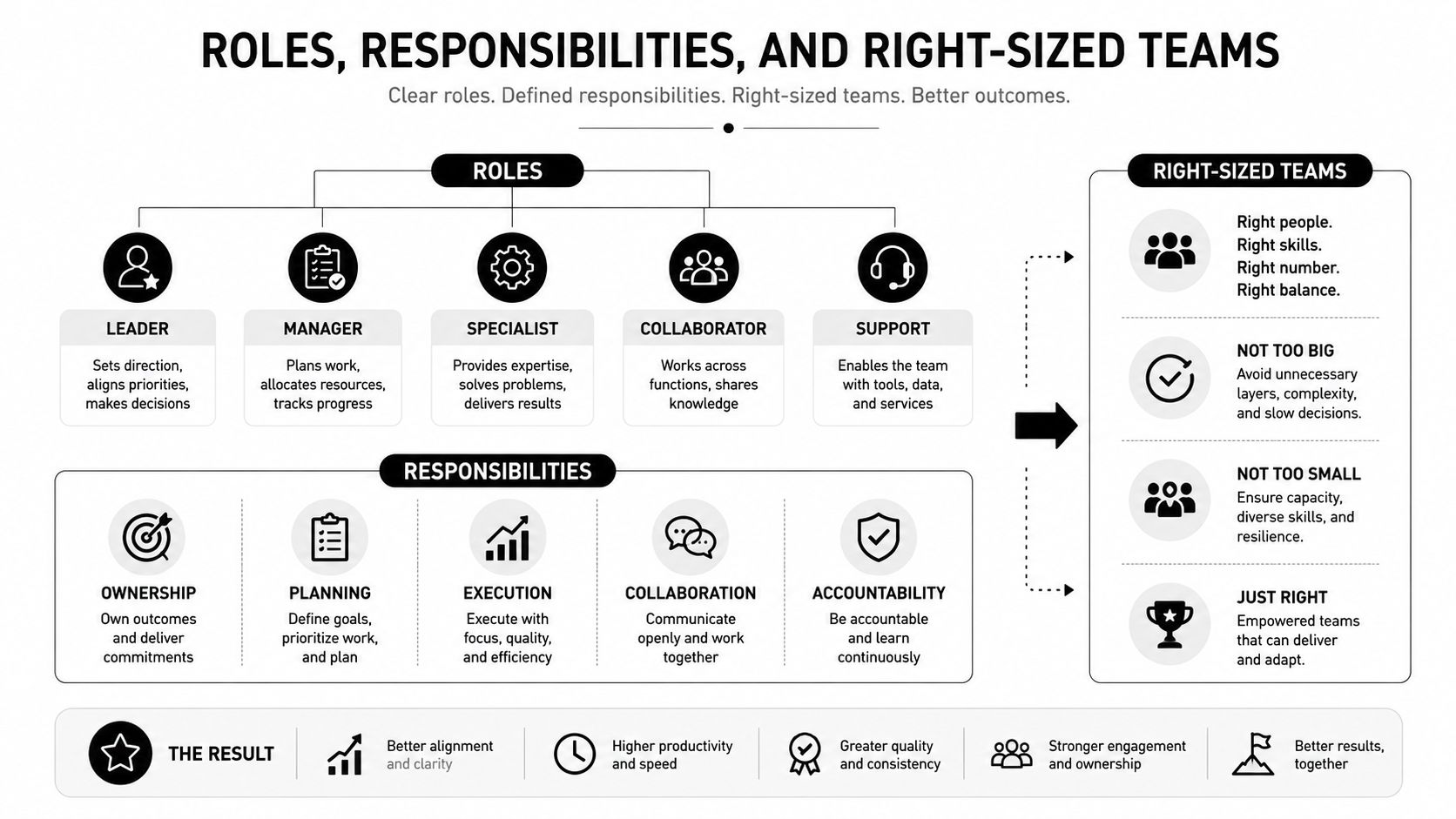
Sizing and staffing are where good intentions either hold up or fall apart. A practical agile team is usually a cross-functional unit of 10 or fewer people with the skills needed to define, build, test, and deliver value (Scaled Agile), and many practitioners keep the group even smaller so coordination stays light. Adobe's guidance sits in the same range at 5 to 10 people (Adobe), while a commonly used Scaled Agile definition still treats 10 or fewer as the outer boundary (Scaled Agile).
Build the roster around the work, not the title
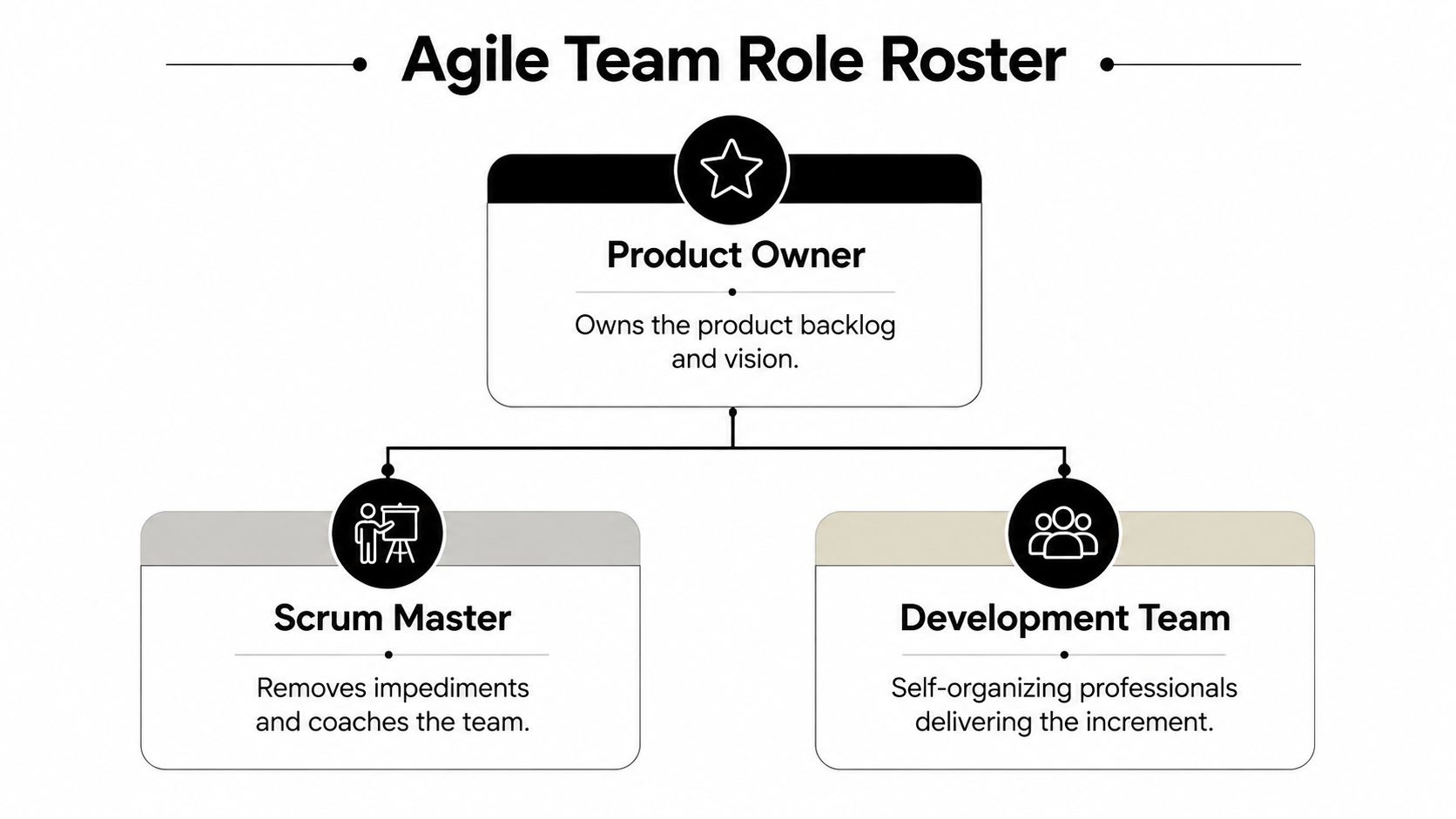
In Scrum, the cleanest roster still centers on the familiar trio, Product Owner, Scrum Master, and the development team. The titles matter less than the operating model. The Product Owner owns prioritization, the Scrum Master removes friction and coaches the system, and the developers own delivery. In Kanban, the roster often looks flatter, with flow ownership and service ownership taking the place of heavier role separation.
A useful staffing benchmark in agile guidance is roughly one business analyst for every 4 to 5 developers, with quality responsibility kept inside the team and support work rotated rather than pushed outside the team boundary (Slideshare agile teams). That pattern helps when frontend and backend work need to ship as one story, because it keeps testing close to implementation instead of turning QA into a late-stage checkpoint.
Practical rule: if a specialty is needed every day, it belongs in the team. If it is needed occasionally, it should be shared through a chapter, guild, or enablement function.
How to handle scarce expertise
Most leaders overcorrect. They either stuff security, DevOps, data, and UX into every squad until the teams become too large, or they centralize all expertise and recreate the handoff problem they were trying to avoid. The better pattern is a hybrid one, where a small embedded core owns the product work and scarce specialists participate through shared services, chapter structures, or scheduled design and architecture support.
A strong staffing rule is simple. If the team cannot deliver without outside approval every week, it is not right-sized. If it can deliver but keeps dragging specialists into low-value meetings, it is probably overstaffed or badly partitioned. The goal is a team that can move fast without pretending every capability must be duplicated everywhere.
For a practical view of how roster design connects to product leadership, see how high-performing tech teams bridge delivery and product management.
The same logic applies when you compare team shapes across a larger organization. A scalable structure for SMBs can be a useful reference for deciding how much specialization to keep close to the squad and how much to share across the org.
Scaling Without Losing Agility
Once one squad works, the problem becomes coordination across many squads. At that point, structures like tribes, chapters, and squads become useful because they let organizations group people by product area and skill area at the same time, with chapters acting as skill homes, squads as multidisciplinary delivery units, and tribes as larger collections of related squads (Nakisa). That model is especially helpful in larger product organizations, because it separates the question of what customers need from the question of where expertise lives.
Coordination needs a light framework, not a bigger meeting
Scaled delivery often uses an Agile Release Train to keep squads moving on a shared cadence, especially inside SAFe-style environments. The point is to align timing and dependencies without forcing every decision into a central committee. That can work in fintech or healthcare, where product lines, risk controls, and release governance need a shared rhythm, but it fails quickly if leaders use the train as a status-report machine instead of a delivery coordination tool.
An internal operating model often works better when it connects tribes to product lines, chapters to capability areas, and guilds to practice improvement. A scalable structure for SMBs can be a useful reference for leaders who need to keep growth from turning into role sprawl. For distributed organizations, a practical guide to managing remote teams helps reinforce the communication patterns that make these structures hold together.
What leadership should watch
Leadership still needs visibility, but not via heavy reporting theater. A short review cadence that surfaces blockers, cross-team dependencies, and delivery risk is usually enough if decision rights are clear. Portfolio leaders should fund priorities, product managers should shape outcomes, architecture groups should set guardrails, and squads should own the execution.
The most common scaling trap is copying the labels without changing the authority model. If squads still need three layers of approval to release, the organization has not scaled agility, it has just added nouns.
Metrics, Tooling, and AI in the Loop
Structure without measurement is just org chart art. The metrics that matter most are the ones that show whether the team can move work through the system cleanly and keep quality intact. That means looking at cycle time, throughput, sprint predictability, escaped defects, and team stability, then pairing those numbers with health checks that catch morale issues, unclear ownership, or hidden dependency drag.
Measure flow, quality, and team health together
Dashboards can tell you that tickets are moving. They can't tell you whether the team is burning out or whether a dependency is freezing progress every second sprint. That's why retrospectives, check-ins, and explicit self-accountability questions matter as much as the board itself, a point reinforced in Wonderment Apps' own material on agile performance metrics.
A practical tooling stack usually includes a sprint board, a product roadmap, incident tracking, test automation, and a way to connect delivery work to customer impact. In AI-assisted teams, you also need tooling for prompt control, model logging, parameter governance, and spend oversight, because AI output has to be traceable if it's going to live inside a real product.
Where AI tooling fits
Wonderment Apps' prompt management system is a concrete example of this layer. The prompt vault gives teams version control for prompts, the parameter manager supports internal database access, the logging system records activity across integrated AI tools, and the cost manager shows cumulative spend so entrepreneurs and delivery leads can see what the AI layer is costing. Used well, that kind of administrative tooling keeps AI from becoming a shadow process living outside the team's normal release discipline.
Practical rule: if AI work is changing customer-facing behavior, treat prompts, logs, and spend as release artifacts, not side notes.
The right tooling doesn't replace team structure, it makes the structure honest. If a team says it owns delivery, it should also own the signals that show whether delivery is healthy.
Common Pitfalls and a Migration Playbook
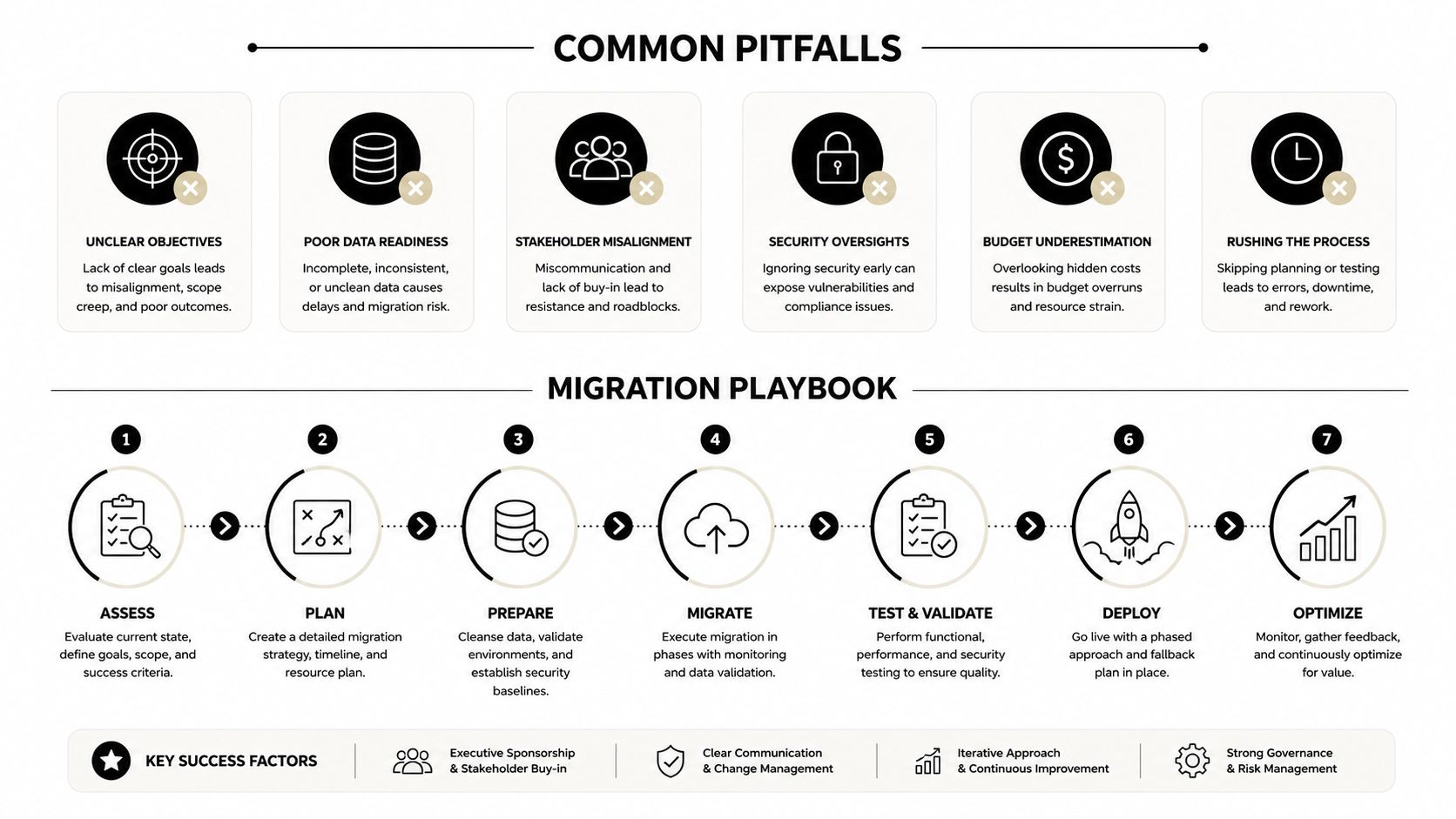
The most common failure is not picking the wrong framework, it's moving too fast and leaving the incentives behind. Teams get “migrated” into feature squads while specialists still report to functional managers, and then everyone wonders why the handoffs never disappeared. Another trap is letting squads grow until they're coordinating more than they're building, which is usually the point where autonomy starts to evaporate.
What usually goes wrong
- Specialists stay centralized: the squad owns the roadmap but still needs outside approval for design, security, or release decisions.
- The Scrum Master becomes a project manager: the role gets turned into tracking instead of coaching and impediment removal.
- Product ownership is weak: priorities bounce around and the team never gets a stable decision-maker.
- The team gets too large: communication overhead starts eating the value of the model.
- Shared services are unmanaged: everyone knows the experts exist, but nobody knows when they're available or how they engage.
A better migration path starts with value streams, not job titles. Map where the work flows, identify natural product boundaries, and staff to skill profiles instead of organizational labels. Then pilot one squad, instrument the metrics, and expand only after the team proves it can own a slice of value end to end.
A migration sequence that holds up
- Map the value stream. Find where work starts, stalls, and gets handed off.
- Define product boundaries. Group work around customer outcomes, not internal departments.
- Identify scarce skills. Decide which specialties must be embedded and which can be shared.
- Pilot one squad. Keep the experiment small enough to learn quickly.
- Track the right signals. Watch flow, quality, and decision latency.
- Adjust decision rights. Give the squad authority that matches its accountability.
- Scale only after proof. Copy what worked, not the org chart that surrounded it.
A find the right extension for your workflow guide can help individual contributors tighten their daily setup, but the bigger win is making sure the operating model does not force every task back through a central queue. If the migration is working, the team gets faster while leadership gets less noisy.
Choosing and Piloting the Right Structure
The right choice starts with a blunt diagnostic. If the work is predictable and release timing matters, Scrum is a strong default. If the work arrives continuously or includes a lot of support load, Kanban usually fits better. If you have multiple products or product lines and need autonomy at scale, squads and tribes are usually the better operating model. If one shared platform or capability is the bottleneck, component ownership may be the honest answer.
A quick decision lens
- Choose Scrum when the team needs stable cadence, clear roles, and bounded sprint goals.
- Choose Kanban when demand is variable and interruptions are part of the job.
- Choose squads and tribes when several product streams need independence without losing alignment.
- Choose feature teams when customer journeys matter more than internal system boundaries.
- Choose component teams when deep technical specialization is the main source of value.
How to pilot without betting the roadmap
A useful pilot runs for a narrow slice of work, with clear ownership and visible metrics. Start with one team that has enough scope to own an outcome, enough support to avoid being starved of expertise, and enough leadership backing to make real decisions. Then inspect the data and the lived experience together. If the team ships cleanly but still waits on outside approvals, the structure is only half fixed.
The best agile team structure is the smallest one that can deliver value end to end, connect cleanly to shared specialists, and stay adaptable as the product grows. That's where AI tooling, governance, and cross-functional delivery can work together without dragging the team back into functional silos.
If you're redesigning product squads, modernizing a legacy workflow, or adding AI into an existing delivery model, Wonderment Apps builds the team structure and the software stack around that reality. Visit Wonderment Apps to see how their delivery teams and AI modernization toolkit can support a structure that's built to ship and built to last.