

The popular advice is simple: move workloads to the cloud, break the monolith into microservices, and add AI later. That sequence sounds modern, but it often produces a familiar result, expensive infrastructure wrapped around the same slow decisions, fragile integrations, and unclear ownership. Infrastructure modernization is not a technology refresh. It's a coordinated investment in reliability, delivery capacity, data quality, and organizational focus.
The financial stakes are substantial. The OECD, World Bank, and UN Environment analysis estimates that the world needs about US$6.9 trillion in annual infrastructure investment by 2030 to align with the Sustainable Development Goals and the Paris Agreement, while the OECD says the cumulative gap could reach US$18 trillion by 2040 (OECD analysis of sustainable infrastructure investment). At the enterprise level, modernization capital is also moving, with private investment in infrastructure projects in primary markets reaching US$380 billion in 2023, according to the World Bank infrastructure investment report.
The practical question isn't whether to modernize. It's how to do it without creating a cloud bill, a talent crisis, or an AI platform nobody can govern. This roadmap focuses on the hidden organizational constraints, the technical foundations that matter, and the decisions that help software remain adaptable long after the migration project ends.
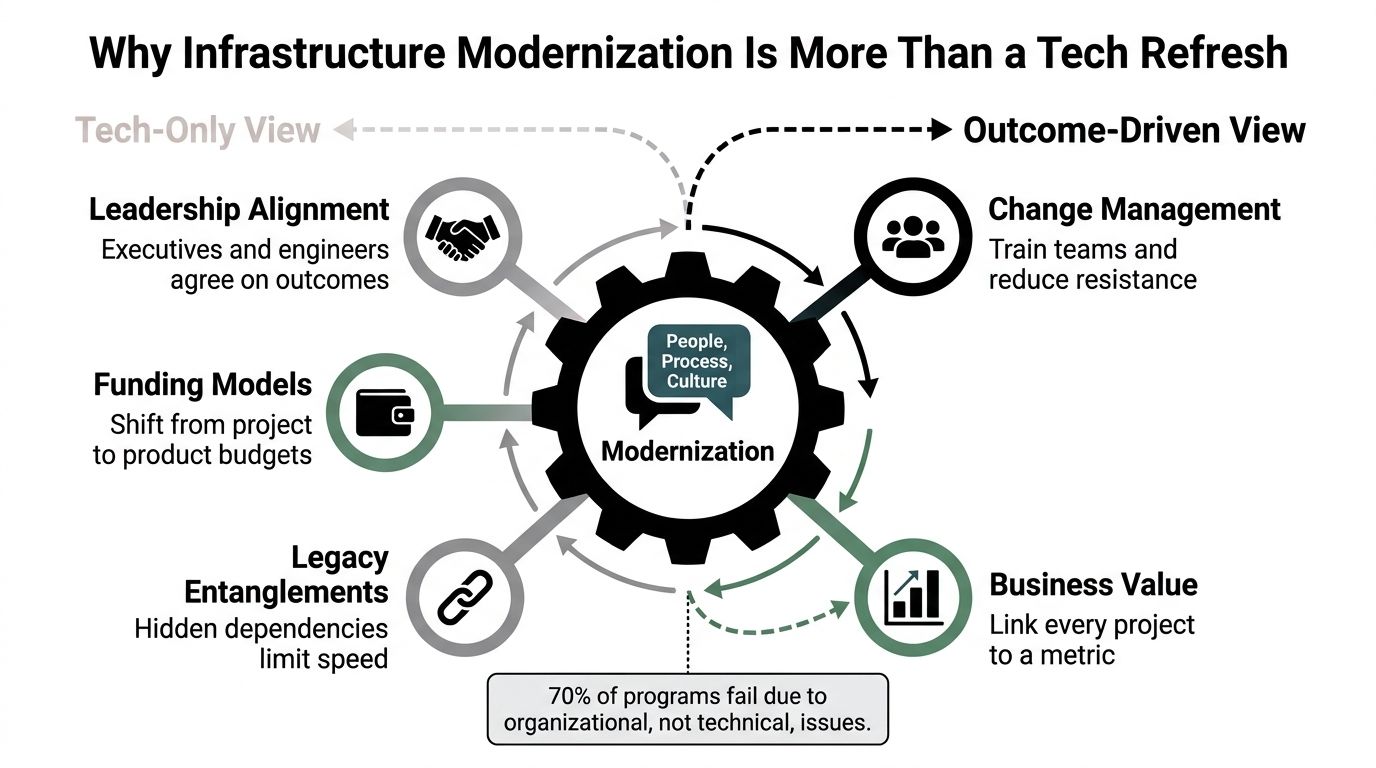
Why Infrastructure Modernization Is More Than a Tech Refresh
A cloud migration can leave an organization just as slow and fragile as before. Modernization changes how the business operates, not only where applications run.
A team can lift an old application into a cloud environment and preserve manual releases, undocumented dependencies, weak testing, and a database shared by every service. The hosting location changes, but delivery capacity does not. Start with a business outcome, such as shorter recovery times, safer releases, faster product experimentation, or lower run costs, rather than a target number of migrated workloads.
Legacy platforms also create costs that rarely appear clearly in an infrastructure budget. Engineers spend time coordinating deployments, investigating failures without distributed traces, and shielding brittle integrations from harmless-looking changes. Those interruptions reduce product capacity while appearing as routine maintenance.
The hidden technical debt ledger
A credible modernization case starts with a quantified technical debt baseline. One bank measured $2.8 million in annual technical debt across licensing, specialist maintenance, and hardware support, then reported a 40% reduction in operational IT costs within 12 months after modernization (Vrintra Labs' core banking modernization case study). The useful lesson is the method: expose run costs first, then compare migration options against a financial baseline.
That baseline makes trade-offs visible. Rehosting can reduce immediate hardware exposure. Replatforming may simplify operations. Refactoring can produce a stronger long-term architecture, but it consumes more product and engineering capacity. Without a cost and capability model, teams debate tools instead of selecting a workable sequence.
Modernization requires organizational capacity
Architecture will not fix unclear ownership or weak delivery habits. Before approving a major change, leaders should ask whether product managers own outcomes, engineers can release safely, security can encode policy early, and operations, data, and application teams share accountability for each service.
The World Bank's infrastructure investment data highlights uneven access to modernization capital. In 2023, high-income countries captured 0.4% of GDP in private infrastructure investment, compared with 0.2% of GDP in low- and middle-income countries. The practical implication is clear: sequence the work around available funding, skills, and operating capacity instead of assuming those resources will appear when needed.
AI readiness exposes the same organizational gap. Clean interfaces, governed data ownership, repeatable delivery, and teams that can measure system behavior matter before an AI workload reaches production.
Practical rule: Fund modernization as a product capability with measurable outcomes, not as a temporary construction project that ends at migration.
The Core Technical Pillars of Modern Infrastructure
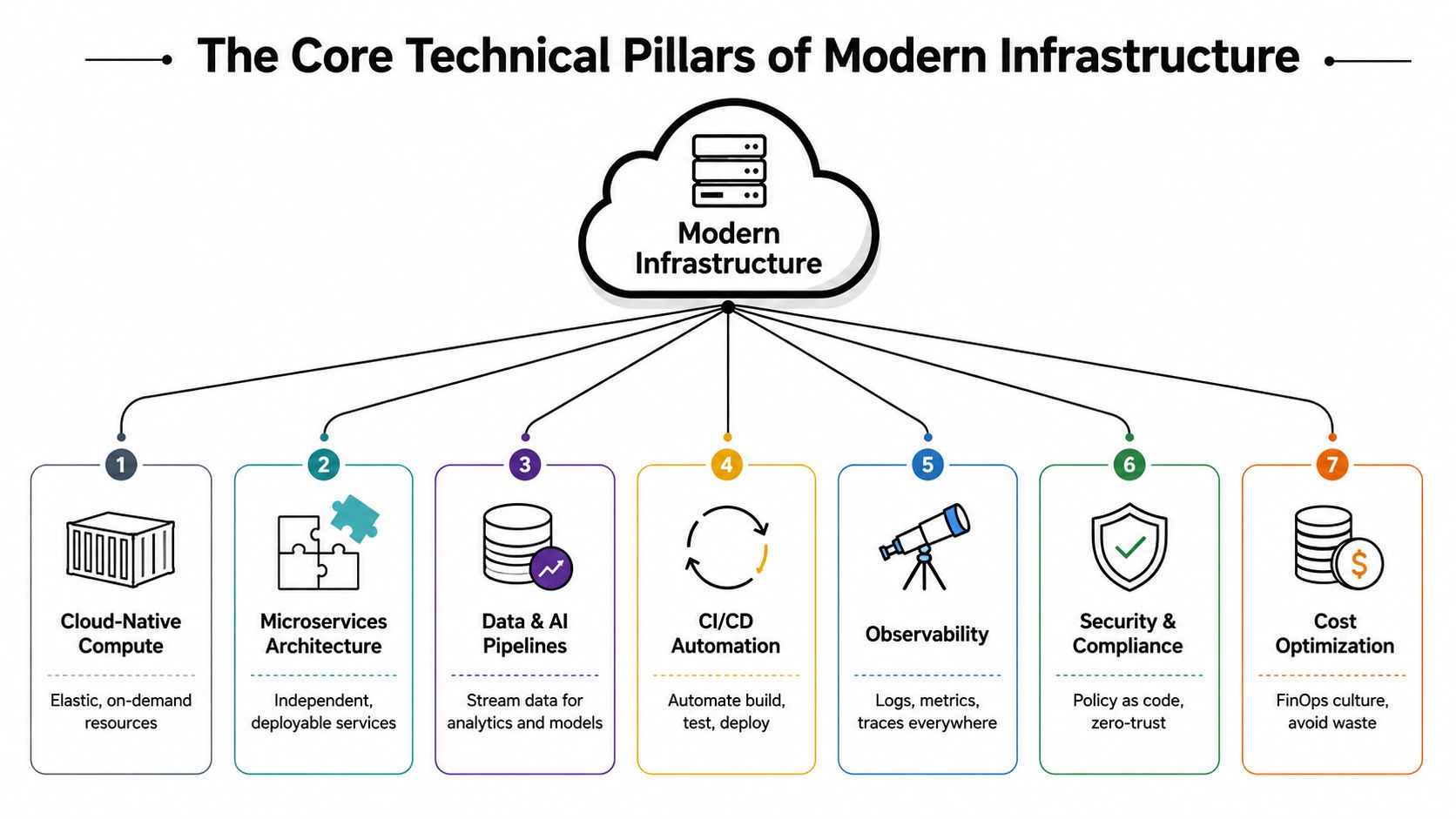
Modern infrastructure has seven connected pillars. They shouldn't be treated as a shopping list. Each one should reduce a known constraint and make the next layer easier to operate.
Compute and application boundaries
Cloud-native compute replaces fixed capacity assumptions with elastic resources, containers, managed databases, and infrastructure as code. The benefit isn't “being in the cloud.” It's making environments reproducible and allowing capacity to follow demand.
Microservices architecture can isolate failure domains and let teams deploy parts of a product independently. It can also create operational sprawl when teams split a monolith without clear service ownership, contract testing, or observability. Keep a coherent modular monolith when independent deployment doesn't solve a real bottleneck.
Delivery and operational visibility
CI/CD automation is the delivery backbone. Source control, repeatable builds, automated tests, security checks, deployment approvals, and rollback paths turn releases into a managed system rather than a coordination ritual.
Observability needs more than a dashboard wall. Logs, metrics, traces, and service-level objectives should help engineers answer which user journey failed, where latency accumulated, and whether a dependency or deployment introduced the problem. Google's SRE guidance centers service health on latency, traffic, errors, and saturation, the four key service metrics described in its SRE guidance on monitoring.
Data, security, and economics
Data and AI pipelines need dependable ingestion, governed transformation, feature management, and retrieval systems such as vector databases when applications use embeddings. Real-time inference is only useful when the data feeding it is timely, consistent, and access-controlled.
Security and compliance belong in architecture and delivery. Zero-trust access, secrets management, encryption, identity-aware policies, and policy-as-code reduce the chance that modernization moves old exposure into a new environment.
Cost optimization connects architecture to FinOps. Teams should review resource utilization, storage behavior, data transfer, model usage, and the cost of a business transaction. A managed service may reduce maintenance but increase usage charges, while a self-managed platform may lower unit cost at scale and consume more specialist capacity.
Data migration is where many modernization programs discover undocumented dependencies. For practical guidance on planning a seamless PEO transition, pay attention to data ownership, validation, cutover planning, and rollback design. Those disciplines apply well beyond PEO systems.
A Phased Roadmap for Legacy Modernization
A big-bang rewrite usually fails for organizational reasons before it fails for technical ones. The team loses feedback from production, business priorities shift, and the replacement system grows while the old system continues to absorb urgent work.
A phased roadmap creates usable checkpoints.
Phase one builds the delivery foundation
Start with source control, automated testing, CI/CD, environment consistency, and an observability baseline. This phase can improve release safety without requiring a complete application rewrite.
Map services, databases, queues, scheduled jobs, external integrations, and owners. Record the failure modes that matter to customers. If the team can't see a deployment's effect or identify the dependency behind an outage, architectural change will be difficult to evaluate.
Phase two extracts value safely
Use the strangler pattern to move a high-value capability out of the monolith while keeping the existing product operational. An API gateway can preserve external contracts, while an event-driven facade can publish changes for downstream consumers.
Choose synchronous APIs when the caller needs an immediate answer and the operation has a clear response contract. Choose asynchronous messaging when work can complete later, needs buffering, or must tolerate temporary downstream unavailability. Dual writes may be necessary during a transition, but treat them as temporary complexity with reconciliation, ownership, and a removal date.
For a broader treatment of how to modernize legacy systems, the same principle applies: preserve business continuity while replacing the parts that constrain change.
Phase three modernizes the data layer
Move databases selectively. Managed services can reduce patching and hardware responsibility, but they don't remove schema coupling, data ownership problems, or migration risk. Use parallel validation where the business can tolerate it, and define how the team will handle discrepancies before cutover.
Event sourcing can help where a durable history of state changes matters, but it adds conceptual and operational complexity. Don't introduce it just because the architecture diagram looks cleaner.
Phase four makes the platform AI-ready
Add retrieval, feature management, model-serving controls, and prompt administration after the foundation can support them. Tie each phase to a business outcome, such as faster support resolution, better discovery, safer workflow automation, or improved anomaly detection.
The sequence must reflect available talent and funding. Ensono reports that 9 in 10 respondents have at least one talent gap hindering modernization, with cloud architecture and migration expertise among common shortages (Ensono's modernization report). A technically elegant plan that assumes unavailable skills isn't a plan. It's a dependency list.
Making Your Infrastructure AI-Ready
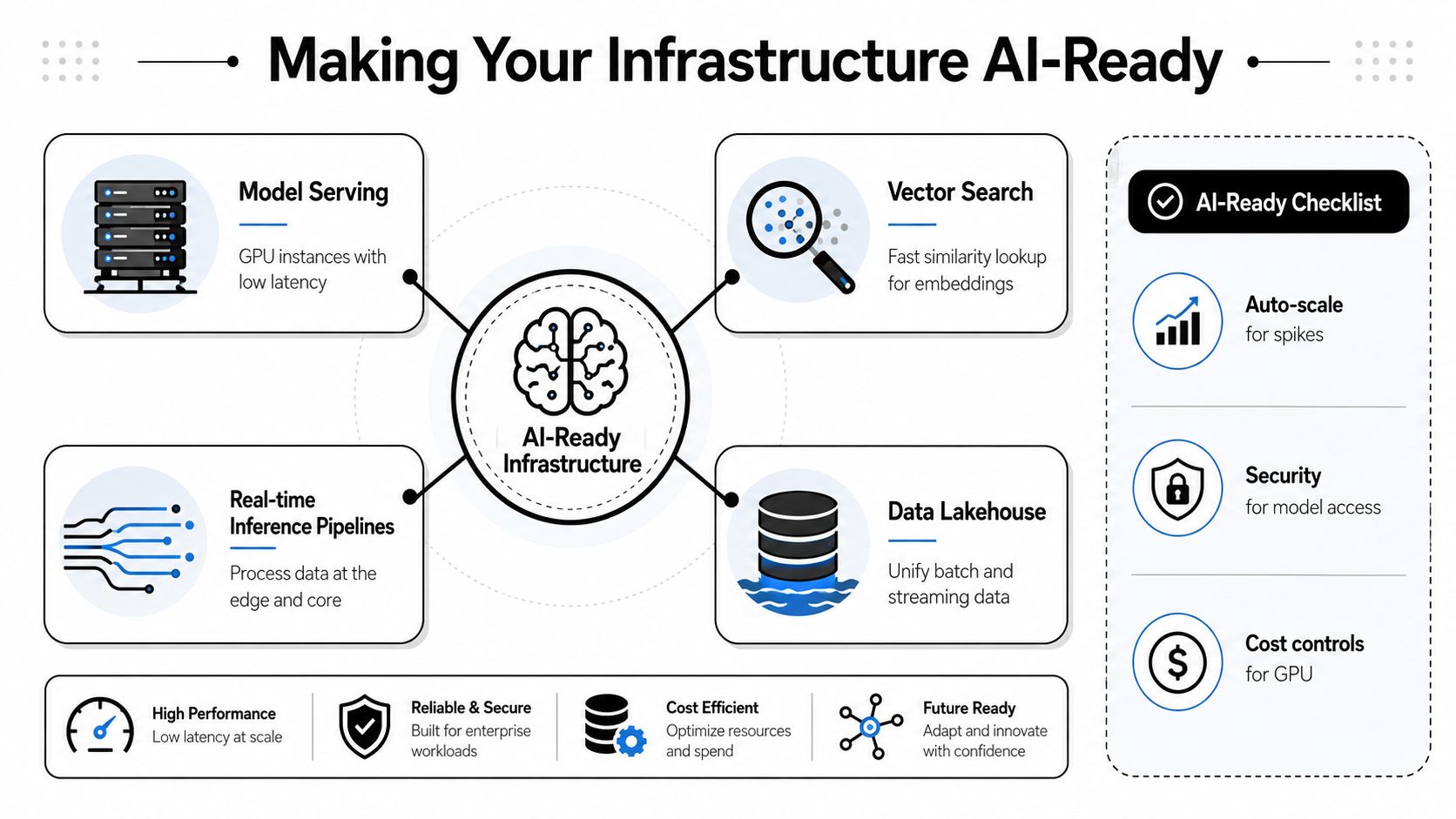
AI readiness begins before a model enters production. A new cloud environment can still fail to support useful AI if it lacks dependable data flows, controlled access, sufficient compute, and a way to understand model and usage behavior.
Design for the real workload
Model-serving infrastructure needs low-latency compute and an approach to GPU capacity that accounts for spikes, idle time, access controls, and recovery. Vector search needs reliable embedding generation, index management, metadata filtering, and a clear data-retention policy. Real-time inference needs streaming paths that can process events without turning every application request into a fragile chain of dependencies.
A data lakehouse can unify batch and streaming data, but it won't fix poor data contracts. Teams still need ownership, lineage, quality checks, and controls that prevent sensitive information from entering an inappropriate model workflow.
AI integration also changes observability. Track response latency, failures, retrieval quality, model behavior, prompt versions, and usage costs. NIST's AI Risk Management Framework organizes AI risk work around governance, mapping, measurement, and management, a useful structure for turning experimental features into accountable services.
Treat prompts as governed application assets
Prompt templates shouldn't live as scattered strings inside source files or informal documents. They need version history, review, rollback, parameter controls, and logs that connect an output to the model, prompt, inputs, and relevant application context.
AI adoption is already operational rather than purely experimental. The 2026 Software Lifecycle Engineering Decision Maker Survey reports that 76.6% of organizations actively use AI in development workflows, while 20.4% are evaluating it (survey synthesis on AI coding adoption). That scale makes governance a delivery requirement, not an optional administrative layer.
For teams connecting AI to custom desktop and mobile applications, AI integration patterns should account for permissions, fallbacks, offline behavior, accessible interaction design, and human review. Wonderment Apps offers an administrative prompt management system that can plug into an existing application, with a versioned prompt vault, an internal parameter manager, logging across integrated AI systems, and cost management for cumulative spend visibility. The tool matters because AI features become difficult to maintain when nobody can answer which prompt changed, who approved it, or what the request volume cost.
Choosing the Right Staffing and Partnership Model
The right partnership model depends on where the organization has capability, not where it wishes it had capability. A team with deep domain knowledge but limited cloud expertise may need embedded specialists. A team with strong engineers but no delivery bandwidth may benefit from an outcome-owned project team.
Staffing and Partnership Model Comparison
| Criteria | Managed Project | Curated Staffing | Hybrid Approach |
|---|---|---|---|
| Delivery ownership | Partner owns defined delivery outcomes | Internal leaders retain primary ownership | Ownership is divided by workstream |
| Cost predictability | Stronger when scope and acceptance criteria are clear | Variable as team composition changes | Moderate, depending on governance |
| Knowledge retention | Requires deliberate documentation and handover | Stronger inside the client team | Strong if responsibilities are explicit |
| Speed to production | Fast for well-scoped migrations | Depends on onboarding and internal decisions | Fast when the partner owns a bounded stream |
| Capability building | Can be limited without pairing | High potential through embedded work | High when teams share standards |
| Primary risk | Vendor dependency or lock-in | Onboarding overhead and unclear accountability | Governance gaps between teams |
Managed projects work well for a defined platform migration, a new mobile product, or an application with clear acceptance criteria. The partner can assemble engineering, QA, design, and delivery leadership around a single outcome. The risk appears when internal teams don't understand the architecture well enough to operate it afterward.
Curated staffing fits systems tightly coupled to business rules, regulatory workflows, or institutional knowledge. Embedded specialists can work alongside internal developers, but the client must provide product decisions, access, feedback, and technical ownership. Staff augmentation doesn't solve a decision bottleneck.
Hybrid models can balance both needs. One partner-owned stream might establish the platform, while embedded engineers handle domain-heavy services. This arrangement only works when interfaces, escalation paths, coding standards, and release authority are documented. A useful comparison of staff augmentation versus managed services can help leaders test the model against project complexity and internal maturity.
Measuring Success and Avoiding Common Pitfalls
Migration completion is a weak success metric. A workload can move to the cloud and still be expensive, unreliable, hard to change, and impossible to support during an incident.
Use measures that connect engineering behavior to customer and business outcomes:
- Reliability indices: For distribution networks, SAIDI measures outage duration, SAIFI measures interruption frequency, and CAIDI measures average interruption duration. One modernization study recorded a baseline of SAIDI 53.81 hours per year, SAIFI 34.21 interruptions per year, and CAIDI 1.57 hours per interruption. After simulated interventions, SAIDI improved to 22.88 hours and SAIFI fell to 22.13, while losses declined from 15.4% to as low as 5.7% (distribution-network modernization study).
- Delivery health: Track deployment frequency, lead time, change failure rate, and mean time to recovery. These indicators reveal whether the new platform helps teams ship safely.
- Economic efficiency: Measure infrastructure cost per transaction, storage growth, data-transfer behavior, and AI usage. A lower invoice isn't enough if the business also receives less capability.
- Product experience: Monitor task completion, latency on important journeys, support volume, and accessibility. Desktop and mobile apps need user-centered measures, not infrastructure dashboards alone.
Five failure modes to catch early
Lift and shift without redesign preserves capacity waste and operational habits. Use rehosting when speed or risk reduction is the priority, but identify which components need replatforming afterward.
Security after migration creates avoidable rework. Establish identity, secrets, logging, vulnerability management, and recovery requirements before workloads move.
Data gravity underestimated appears when teams discover that services share schemas, reports depend on undocumented tables, or data cannot move at the required speed. Build a dependency map and validate data contracts early.
CI/CD left behind turns modern infrastructure into a manual release machine. Automate tests, deployment, rollback, and environment provisioning alongside application changes.
Cost governance treated as a project allows waste to return. Assign owners, review architectural trade-offs, and connect usage to product decisions continuously.
Building Software That Lasts Beyond the Modernization Cycle
A successful modernization program leaves behind an organization that can absorb the next change without another prolonged rewrite. The platform should make safe evolution ordinary, not heroic.
That requires habits. Teams can use architectural fitness functions to test whether services preserve required boundaries, resilience, security, and performance characteristics. They can track technical debt as explicit work with owners and review dates instead of hiding it in vague maintenance categories. Platform engineering teams should treat internal developer experience as a product, with documentation, paved deployment paths, useful templates, and feedback from the engineers who use them.
The operating model must also protect platform health while product teams ship features. A fixed capacity allocation for reliability, security, automation, and debt reduction can work, but the exact allocation should reflect the system's condition and business risk. The important point is to reserve capacity deliberately rather than waiting for infrastructure work to compete with every feature request.
AI makes this discipline more urgent. Developer adoption is broad, but trust and review still matter. One synthesis reports that 51% of professional developers use AI every day, while trust in AI accuracy was 29% in one survey (AI software development statistics synthesis). Teams should pair AI-assisted development with code review, automated tests, security scanning, runtime observability, and clear ownership.
The durable pattern is consistent: modernize the foundation, sequence change around capacity, measure reliability and economics, and govern AI as part of the product rather than as a novelty. Organizations that build those muscles can turn future technology shifts into incremental platform work instead of another existential migration.
Wonderment Apps helps organizations modernize legacy software, design scalable desktop and mobile experiences, and integrate governed AI capabilities into existing products. Visit Wonderment Apps to discuss a modernization roadmap or request a demo of its prompt management tooling for versioning, AI logging, internal parameters, and cumulative cost visibility.