

An API integration example is most useful when it shows the complete path from authentication or request creation through data handling, failure recovery, testing, and monitoring. The eight examples below cover conventional APIs and AI-powered application experiences, including the operational controls that keep both reliable as they grow.
APIs Are the Connective Tissue of Modern Apps
A polished desktop, web, or mobile experience rarely depends on one system. A product page may call a catalog API, recommendation service, payment provider, analytics platform, identity service, and content delivery network before the user sees a complete screen. The integration works only when those systems agree on authentication, data contracts, timing, and failure behavior.
REST became the default connective pattern after Roy Fielding formalized its architectural style in his 2000 doctoral dissertation. Industry summaries still place REST in 81% to 93% of enterprise API architectures, which helps explain why REST appears in ecommerce, fintech, SaaS, media, healthcare, and public-sector software. GitHub's REST API documentation provides a practical reference point for the style's continuing use.
A useful API integration example should show more than a successful request. Look for the request flow, authentication method, data contract, architecture, error handling, code shape, testing plan, and production monitoring. The same discipline applies to deterministic execution APIs, where predictable inputs and outputs matter.
AI adds another control layer. Wonderment Apps' prompt management demo is a natural example, with a prompt vault, version management, secure parameters, integrated logging, and visibility into cumulative spend. Those controls become important when an application moves from one AI experiment to several models, workflows, and teams.
Organizations are responding to that complexity. 82% have adopted some level of API-first strategy, 25% are fully API-first, and adoption increased 12% from 2024, according to API integration statistics from DreamFactory. The examples below show how to turn that interest into dependable software.
1. E-Commerce Product Recommendation Engine via REST API
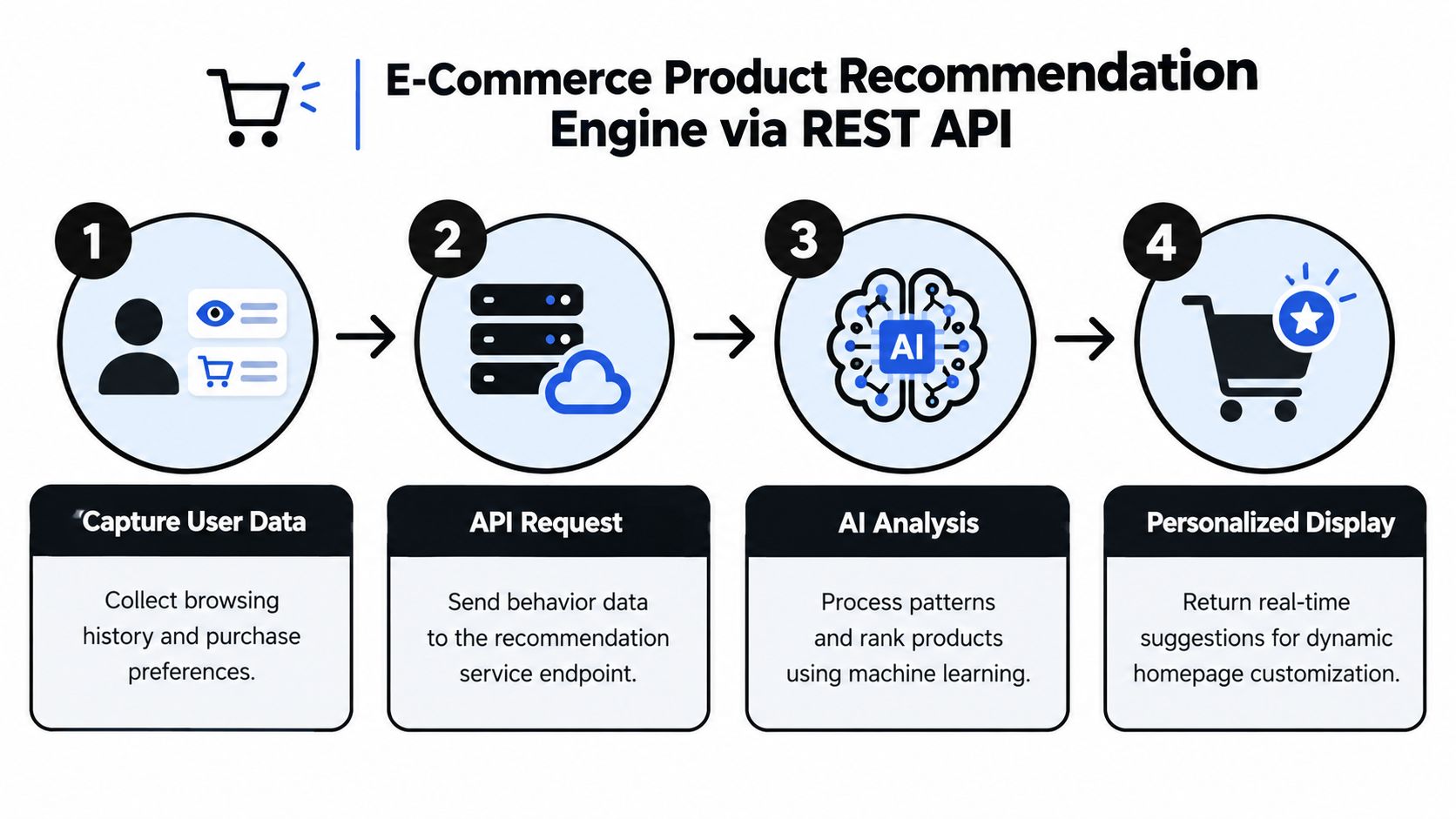
A recommendation engine is a strong REST integration pattern because the application can send a well-defined context and receive ranked products in return. The request might include a customer identifier, browsing history, recent purchases, preferences, locale, and the products currently available. The response should contain product identifiers and ranking signals that your catalog service can resolve into current names, prices, inventory, and images.
Keep the recommendation service separate from the catalog API. The catalog remains the source of truth, while the recommendation service proposes an ordered set of product IDs. That separation prevents stale prices or unavailable products from appearing in the interface.
Build a fast path and a safe fallback
Cache popular recommendation sets in Redis, especially for anonymous visitors or broad product categories. A cache reduces repeated requests, but it shouldn't become the only source of truth. Set an expiration policy, invalidate entries when catalog availability changes, and fall back to static bestseller or category recommendations when the service times out.
The request path should include a timeout, structured error logging, and a response-time metric. Test empty histories, discontinued products, malformed customer IDs, and partially unavailable catalog records. A recommendation endpoint that returns a technically valid response can still damage the experience if the application renders products that can't be purchased.
Practical rule: Keep ranking logic replaceable. Your storefront shouldn't need a redesign when you change recommendation providers or model prompts.
Wonderment's AI recommendation engine guidance is relevant when recommendations are generated or refined with AI. Its prompt vault can preserve prompt versions, while the parameter manager can control which catalog or customer fields reach the model. Centralized logs help connect recommendation requests with latency, fallback behavior, and conversion analysis. The cost manager also gives teams a way to review cumulative AI spend instead of treating each request as an isolated experiment.
2. Payment Processing Gateway Integration with Webhook Callbacks
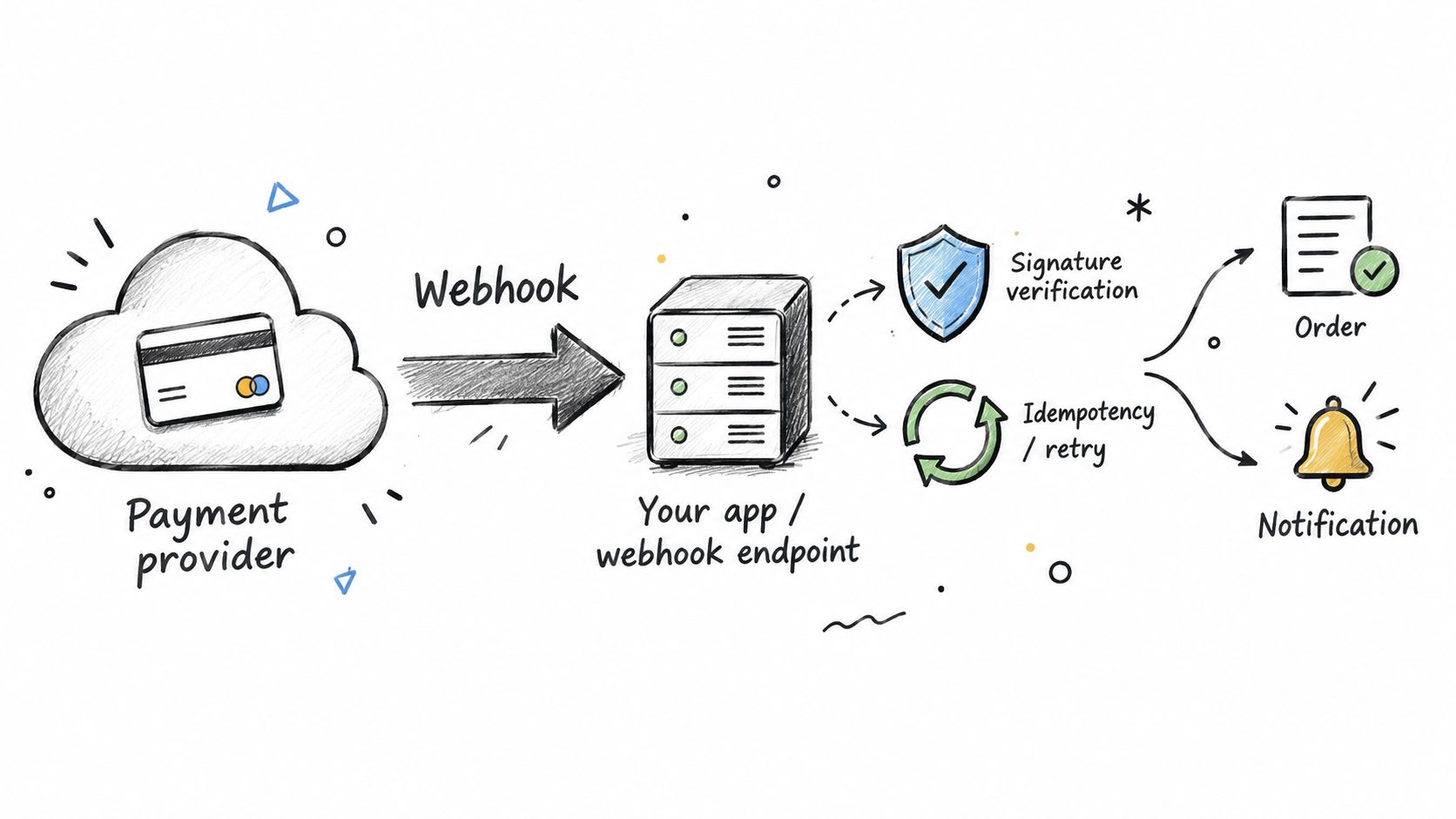
Payment integration is where a simple request and response quickly becomes an event-driven system. The application creates a payment with Stripe, Square, or PayPal, but the final state may arrive later through a webhook. The payment provider can notify the application that a charge succeeded, failed, or needs additional customer action.
Treat the webhook as a durable business event, not as a casual callback. Verify the provider's signature before accepting it, store the original event in a database, and only then begin order fulfillment or customer notification. Storing first gives the team a replay path when downstream processing fails.
Make retries harmless
Webhook delivery and application processing can both retry. Use an idempotency key for payment creation and a unique event identifier for webhook handling. If the same event arrives twice, the application should recognize it and avoid double fulfillment or duplicate email notifications.
A dead-letter queue gives operations staff a place to inspect events that still fail after automated retries. Log the provider, event type, order identifier, processing result, and correlation identifier, but don't place sensitive payment details in ordinary application logs.
Use the PCI DSS compliance checklist to keep payment controls connected to the wider application design. The integration should also integrate compliance into payments, rather than bolting security on after the checkout flow is complete.
Payment events deserve their own dashboards. Track accepted, rejected, delayed, and manually reviewed events, then compare processor behavior and transaction fees. Wonderment's logging system can provide a unified view when an application uses more than one payment processor, while a cost manager can help teams review cumulative transaction costs alongside other integration expenses.
3. Healthcare Data Exchange via FHIR API Standards
Healthcare integrations need a shared vocabulary as much as they need an HTTP client. A FHIR integration structures requests and responses for patient records, appointments, medications, and clinical observations, allowing an electronic health record system, patient portal, and clinical application to exchange data through recognizable resources.
Start with the FHIR profiles that match the use case, such as US Core or relevant international profiles. Don't assume that two partners supporting FHIR expose identical fields, validation rules, or authorization behavior. Define the subset your application supports, validate payloads before they enter your database, and maintain a compatibility layer for partner-specific differences.
Protect access and preserve an audit trail
Healthcare credentials and access tokens belong in a secret manager or controlled parameter store, not in source code or mobile bundles. Wonderment's parameter manager can provide a controlled place for FHIR endpoint credentials and tokens when it is configured as part of the application's administrative layer.
Audit logging should record who accessed which resource, when the request occurred, what operation was attempted, and whether it succeeded. Avoid logging full clinical payloads unless the retention and access policy explicitly permits it. Encrypt data in transit and at rest, apply least-privilege scopes, and separate operational logs from sensitive patient content.
A valid response isn't proof that a healthcare integration is safe. Validate the resource, authorization context, provenance, and audit event together.
Cache only data that the use case can safely serve slightly out of date. Appointment availability may need a more current request than a static educational record. Test expired tokens, incomplete resources, partner version changes, duplicate observations, and interrupted pagination. The software engineering in healthcare perspective is useful here because compliance, usability, and maintainability have to be designed together.
4. Content Delivery Network Integration for Media Applications
A media application usually has two distinct integration paths. The application uploads images, video, or large files to a storage origin through an administrative API, while end users retrieve optimized assets through CDN URLs. Providers such as Cloudflare, Akamai, and AWS CloudFront expose APIs for distribution settings, cache behavior, invalidation, and reporting.
The architecture should keep large media payloads away from the application server. A client can request an upload authorization, send the asset to the designated origin, and receive a versioned URL. The application then stores metadata, not the full file, and serves the asset through the CDN.
Treat cache behavior as product behavior
Cache busting matters whenever an image or video changes but its URL remains familiar. Use file versioning or a controlled URL parameter, and make invalidation an explicit part of the publishing workflow. Monitor cache hit ratios, origin errors, transfer volume, and regional latency through the provider's analytics API.
Image optimization rules can deliver smaller formats to supported devices, but test quality on real mobile connections. A technically smaller asset isn't useful if it introduces visible artifacts or causes an expensive transformation on every request.
A scalable app architecture commonly combines stateless API servers, load balancing, Redis caching, read replicas, asynchronous queues, a CDN, and gateway-level authentication and rate limiting. This mobile architecture checklist lays out that pattern in practical terms. A broader guide to applications that scale also emphasizes modular services, containerization, and automatic scaling.
Don't monitor only availability. CDN reporting should feed decisions about TTLs, origin capacity, file formats, and bandwidth consumption. Wonderment's cost manager can consolidate CDN costs with AI and other API expenses, giving product leaders a clearer view of the complete delivery path.
5. AI-Powered Chatbot Integration via Conversational AI APIs
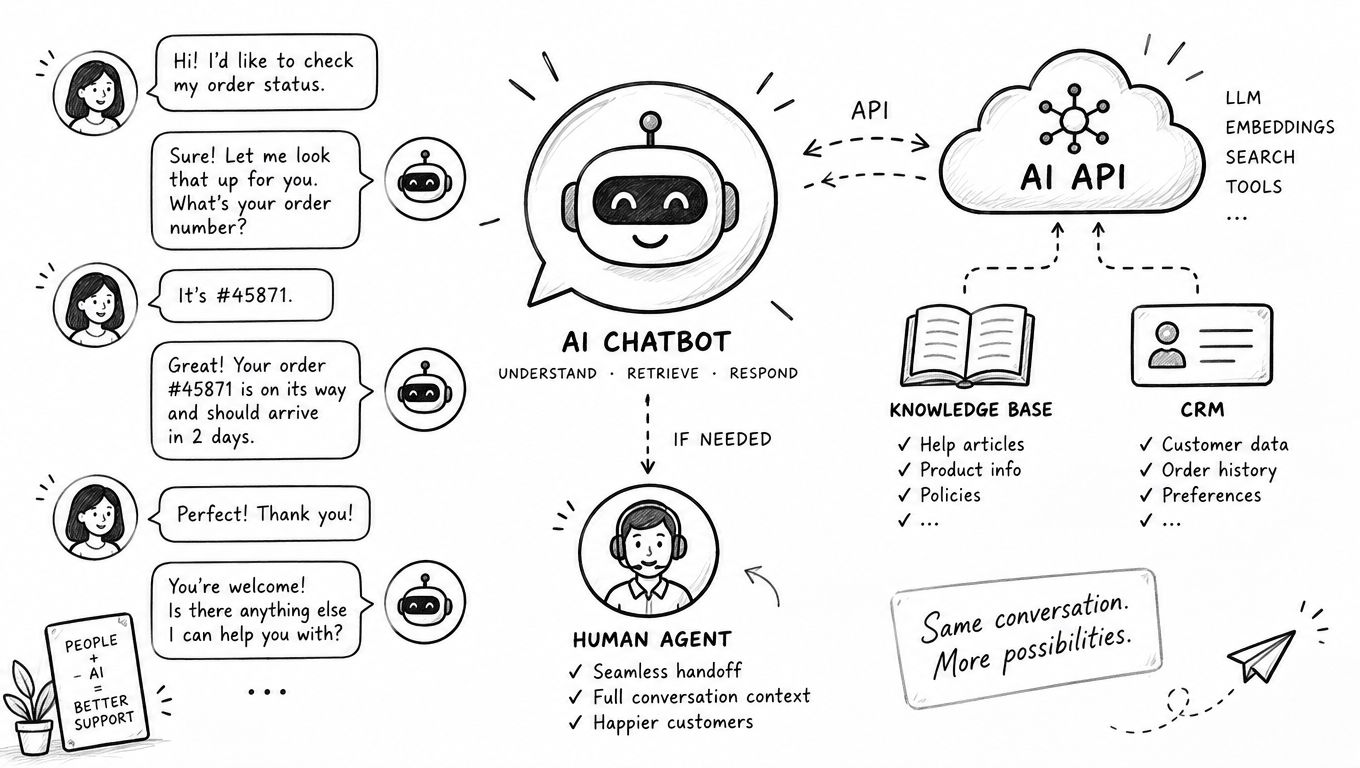
A chatbot integration begins with a message but ends with a governed application workflow. The client sends a user message and conversation context to an AI service such as Dialogflow, AWS Lex, or another conversational API. The application receives a response, applies safety and business rules, and decides whether to display text, call an internal API, escalate to a person, or ask for clarification.
Start with a narrow system prompt and a carefully maintained knowledge source. Define what the assistant can answer, what it must refuse, and which actions require confirmation. If the assistant can access account or order data, keep retrieval and action execution behind authenticated application services rather than exposing internal credentials to the model.
Version prompts like code
Prompt changes can alter tone, routing, tool selection, and factual behavior. Store prompts as versioned artifacts, record the model and relevant parameters used for each request, and compare outputs against a repeatable evaluation set before releasing a new version. Specialist tools such as PromptLayer, Langfuse, and Vellum have helped establish logging, versioning, and trace capture as common prompt-management controls, as described in this overview of AI records-management vendors.
Context windows also require judgment. More history can improve continuity, but it increases payload size and can introduce irrelevant or sensitive information. Summarize old turns, retrieve only the records needed for the current task, and set explicit limits.
AI traffic introduces failure modes that ordinary REST examples often omit. A provider can time out, return malformed structured output, refuse a request, or produce an answer that passes syntax validation but fails a business rule. Log request metadata, prompt version, tool calls, latency, error category, and usage. Monitor cumulative spend closely, because a small change in context or conversation volume can affect cost quickly.
Recent API trend coverage highlights AI-driven consumption, federated API management, and Model Context Protocol-style discovery as important directions for 2026. The discussion of API trends in 2026 reinforces why schema strictness, authorization boundaries, tool discovery, and observability matter for non-human callers.
6. Weather and Location Services Integration for Mobile Applications
Location-aware applications combine permission handling, device capabilities, and third-party APIs. A weather app can obtain coordinates, query a forecast provider such as OpenWeatherMap, and render current conditions. A delivery or travel product may combine Google Maps or HERE with weather data, routing, geofencing, and local recommendations.
The mobile client shouldn't request location without explaining the value. Ask for the least intrusive permission that supports the feature, handle denial gracefully, and let the user continue with a manual location when possible. On the server, normalize coordinates, units, time zones, and provider-specific response fields before passing them to the interface.
Reduce calls without making data stale
Weather forecasts and geospatial metadata are often cacheable for a defined period. Cache by normalized location rather than by raw GPS precision, and choose the refresh policy based on the user task. A casual forecast screen can tolerate cached data, while a safety alert or delivery decision may need a fresh request.
Offline behavior matters on mobile networks. Store the last valid response, show its age clearly, and avoid presenting stale information as live. Set timeouts and retry only transient failures. Repeated retries during poor connectivity can drain battery, increase API usage, and make the interface feel frozen.
Geofencing can support location-specific notifications, but it should be tied to a clear user benefit and a transparent privacy policy. Log location queries without retaining more precision than the product needs. Wonderment's logging system can help identify request patterns, provider failures, and unusually frequent refreshes, while the parameter manager can keep provider credentials out of client applications.
Test permission denial, revoked permissions, inaccurate coordinates, provider rate limits, invalid locations, offline startup, and a provider response in an unexpected unit system. The best integration is often the one the user barely notices.
7. Social Media Authentication and Data Aggregation via OAuth APIs
OAuth integration has two separate responsibilities, authentication and authorization. A user may sign in with Google, Facebook, Twitter, or LinkedIn, but the application still needs to understand which profile fields and actions the user has permitted. Keep those concerns explicit in the data model so a login relationship doesn't silently become broad data access.
For mobile applications, use the authorization code flow with PKCE to reduce the risk of intercepted authorization codes. Exchange the code on a trusted backend where possible, store refresh tokens securely, and refresh access tokens before they expire. Never treat a social provider's user profile as a complete internal account record without validating the provider, subject identifier, and account-linking rules.
Ask for less and handle more
Request only the scopes required for the feature. A user is more likely to understand and approve access when the consent screen matches the application's actual behavior. Provide an opt-out path for social sharing and a way to disconnect the provider without deleting the user's primary account unless that is the user's choice.
Token revocation is normal, not exceptional. Handle expired, revoked, malformed, and insufficient-scope tokens with a clear reauthorization path. Don't retry an authorization failure indefinitely. Record the provider, flow stage, outcome, and correlation ID, while keeping secrets and token values out of logs.
Wonderment's parameter manager can hold OAuth client credentials and other environment-specific secrets under controlled access. Teams should also compare authentication completion, account-linking errors, and onboarding behavior before and after launch. That comparison is more useful than merely counting successful callback requests.
Test interrupted consent, a user who denies one scope, an existing account with a different email, provider downtime, mobile app reinstalls, and a revoked token. OAuth succeeds only when the application gives users understandable choices and gives operators enough context to resolve failures.
8. Enterprise Integration Platform for System-to-System Data Synchronization
An iPaaS workflow connects systems that were never designed as one product. A Zendesk ticket can update Salesforce, a HubSpot lead can connect to Stripe customer data, an ERP can publish inventory changes, and an HR system can trigger onboarding tasks. Zapier, MuleSoft, and custom orchestration services all implement versions of this pattern, with different trade-offs in control, governance, and engineering effort.
Start with one high-value synchronization path. Define the source system, destination system, field mappings, ownership rules, and acceptable delay before adding more workflows. Validate data before writing downstream, especially when one system allows free-form values that another system treats as an enumerated field.
Design for drift and partial failure
Every workflow needs an idempotency strategy. A retry shouldn't create a second customer, duplicate employee record, or repeated inventory adjustment. Store source event IDs, map them to destination IDs, and make updates explicit about whether they replace, merge, or append.
A queue can separate source-system availability from destination-system processing. Retry transient failures with backoff, route persistent failures to a dead-letter queue, and notify the team with enough context to make a manual correction. Don't hide errors inside a successful workflow status. A workflow that completes technically but drops a field is still a failed business process.
API integrations also fail through silent schema drift, expired sessions, pagination bugs, webhook retries, and tenant-specific edge cases. API integration challenge coverage from Apideck calls attention to field renames without version changes, session expiry in multi-tenant environments, and cursors expiring during large synchronizations. Contract tests, pagination tests, replayable events, and rollback procedures address those risks more effectively than a happy-path demo.
Use an integration platform when orchestration, retries, visibility, and connector maintenance justify its cost. Use custom services when the workflow has unusual domain rules, strict latency requirements, or security boundaries that a general platform can't express. Wonderment's prompt management system can sit alongside these workflows as a control layer for versioning AI-assisted integration rules, logging transformations, and tracking platform and model costs.
API Integration: 8 Use-Case Comparison
| Title | Implementation Complexity | Resource Requirements | Expected Outcomes | Ideal Use Cases | Key Advantages |
|---|---|---|---|---|---|
| E-Commerce Product Recommendation Engine via REST API | Medium, REST integration, catalog mapping, caching, A/B testing | Moderate, user behavior data, product catalog API, caching (Redis), analytics | Higher conversions and AOV (typical lift 10–30%); improved engagement | Retail/e-commerce personalization, cross-sell, dynamic homepages | Real-time personalization, scalable, quick to deploy vs. building in-house |
| Payment Processing Gateway Integration with Webhook Callbacks | Medium, webhook endpoints, signature verification, idempotency | Moderate, payment provider accounts, secure public endpoints, logging, retry queues | Reliable async payment handling; reduced PCI scope; consistent order state | Checkout flows, subscriptions, marketplaces, recurring billing | Offloads card handling, asynchronous UX, sandbox testing from providers |
| Healthcare Data Exchange via FHIR API Standards | High, FHIR spec, SMART on FHIR OAuth, validation, versioning | High, HIPAA compliance, secure auth, audit logging, legacy adapters | Interoperable standardized clinical data exchange; regulatory alignment | EHR integrations, patient portals, clinical data sharing between systems | Industry standard for interoperability; strong security and app ecosystem |
| Content Delivery Network (CDN) Integration for Media Applications | Low–Medium, upload/serve APIs, cache control, invalidation workflows | Moderate, CDN account, origin servers, bandwidth, analytics | Reduced latency (50–80%), bandwidth offload, higher availability | Global media delivery, streaming, image/video optimization, large-file distribution | Fast global delivery, built-in security (DDoS/WAF), pay-as-you-go scalability |
| AI-Powered Chatbot Integration via Conversational AI APIs | Medium, conversation state, context management, fallback handling | Moderate–High, AI API usage (tokens), KB/CRM integration, monitoring, prompt engineering | Support deflection (30–40%), 24/7 responses, improved response consistency | Customer support automation, virtual assistants, lead qualification | Scales to many users, multi-channel support, reduces routine ticket load |
| Weather and Location Services Integration for Mobile Applications | Low, simple REST calls, geolocation, caching and background refresh | Low–Moderate, API keys, permission flows, local cache, offline fallback | Location-aware personalization; real-time environmental data for decisions | Weather apps, delivery/logistics, location-based offers, travel apps | Easy integration, affordable tiers, cross-platform consistency |
| Social Media Authentication and Data Aggregation via OAuth APIs | Medium, OAuth 2.0 flows, token refresh, multi-provider handling | Low–Moderate, platform developer apps, secure token storage, scope management | Reduced signup friction, richer user profiles, higher conversion/retention | Consumer apps, social features, quick onboarding, social sharing | Frictionless onboarding, verified identity signals, social sharing capabilities |
| Enterprise Integration Platform (iPaaS) for System-to-System Data Synchronization | Low–Medium to High, no-code for simple flows, custom connectors for complex logic | Moderate–High, iPaaS subscription, connectors, governance, monitoring, transformation rules | Automated data sync, fewer manual processes, faster integrations | Multi-system enterprises syncing ERP/CRM/HR/accounting, process automation | Rapid integrations, non-technical builders, centralized orchestration and monitoring |
Turn Integration Examples Into an Operating Pattern
The eight examples use different providers and data types, but dependable integrations share the same engineering habits. Teams define a contract before writing the connector, secure credentials and tokens, validate inbound and outbound payloads, make retries idempotent, cache deliberately, record important events, test failure paths, and monitor latency, errors, usage, and cost.
A request that returns a successful status code can still produce a bad product outcome. A payment event may be processed twice. A location response may be stale. An AI assistant may return valid JSON with an unsafe action. An iPaaS workflow may complete while losing a field. Production design has to account for those paths.
Use this implementation checklist
- Define the contract: Document authentication, request fields, response fields, status codes, pagination, rate limits, and version behavior.
- Protect credentials: Keep API keys, OAuth secrets, refresh tokens, and healthcare access tokens out of source code, URLs, mobile bundles, and ordinary logs.
- Validate data: Check schemas, required fields, identifiers, units, permissions, and business rules before processing a response.
- Make retries safe: Use idempotency keys, event identifiers, deduplication records, backoff, and dead-letter handling.
- Cache deliberately: Cache stable reads, define freshness, invalidate changed content, and provide an offline or static fallback where the experience needs one.
- Test failure paths: Exercise timeouts, expired authentication, malformed payloads, revoked permissions, duplicate events, pagination interruptions, and provider outages.
- Observe the whole chain: Correlate client requests, gateway calls, provider responses, queue events, database writes, and user-visible outcomes.
- Govern AI usage: Version prompts, restrict parameters, log model calls, evaluate changes, and attribute cumulative spend to applications or workflows.
The choice of integration pattern should follow the behavior of the data. Use REST polling when the provider exposes reliable resource reads and slight delay is acceptable. Prefer webhooks when the provider can notify your system about state changes. Use OAuth when a user delegates access to a third-party account. Add streaming when users need continuous updates rather than periodic refreshes. Add caching when repeated reads are expensive and the data has a defensible freshness window. Choose orchestration when several systems must react to one business event.
Modernization also needs a realistic capacity plan. One API gateway migration case reported about 6,000 transactions per second, 280,000 consumers, and 99.99% uptime, alongside lower gateway latency and operating cost, as documented in API7's enterprise gateway coverage. Those figures belong to that reported case, not to every project. They do show why gateway policy, observability, and capacity testing deserve attention before traffic arrives.
Other reported programs show the organizational side of integration. One modernization effort consolidated 150 applications into 30, cut time to market by 25%, and enabled customer self-service. A separate NZ Post program delivered services 3x faster, with 30% API reuse and estimated 20% cost savings, according to MuleSoft's case studies. These outcomes depend on architecture, governance, and delivery discipline, not on selecting a connector alone.
Wonderment Apps' prompt management system fits the same operating model for AI modernization. Its prompt vault with versioning gives teams a controlled history of instructions and variations. Its parameter manager can govern access to internal database values and other runtime inputs. Its logging system across integrated AI systems creates a shared operational record, while the cost manager helps entrepreneurs see cumulative spend as models and workflows multiply.
When hiring developers for this work, assess more than framework familiarity. Review portfolios and technical assessments for API integration, identity and authentication, cloud deployment, security, compliance, testing, and long-term maintenance. This developer hiring guidance also supports checking awareness of requirements such as GDPR and HIPAA when the product handles regulated data.
A scalable app is not just a collection of successful API calls. It's a set of explicit contracts, safe defaults, recoverable events, measurable behavior, and controlled change. Explore the Wonderment Apps demo at https://wondermentapps.com to see how an administrative layer can support AI integrations as your application evolves.
Wonderment Apps helps teams modernize legacy software and build web and mobile products with API integrations, AI capabilities, and UX-driven engineering. Visit Wonderment Apps to explore the prompt vault, parameter management, cross-model logging, and cost controls that can bring practical governance to your next integration project.