

About 70% of digital transformation initiatives fail to meet their objectives, and the main reasons aren't the shiny parts of the stack. They're resistance to change, weak execution, and poor adoption, not a lack of software options or cloud capacity, as noted in this digital transformation data roundup.
That number changes how a CEO should read the room. The hard part isn't deciding whether to modernize. It's deciding how to avoid joining the majority that buys tools, funds pilots, announces a strategy, and still ends up with fragmented systems, frustrated teams, and no durable business gain.
The challenge has also shifted. A few years ago, "digital transformation" usually meant cloud migration, workflow automation, or replacing a legacy platform. In 2026, it also means embedding AI into products, operations, service flows, and internal decision-making. That raises a newer operational question that remains widely underestimated: can you govern the economics of AI after launch, not just the demo?
Navigating Digital Transformation Challenges in 2026
If your definition of transformation is still "move to the cloud and add a dashboard," you're solving yesterday's problem. Your customers already expect faster service, smarter recommendations, cleaner self-service flows, and applications that feel consistent across desktop and mobile. Your operators want fewer manual handoffs. Your product team wants data they can trust. Your engineers want less brittle infrastructure.
That means digital transformation challenges now sit in three layers at once:
- People problems: leadership alignment, adoption, training, accountability
- System problems: legacy architecture, disconnected data, brittle integrations
- Economic problems: AI usage costs, governance gaps, and unclear operating discipline
A lot of firms get the first two partially right and then trip over the third. They prove that AI works in a prototype, then discover nobody has clear ownership of prompts, parameters, usage logs, or cumulative model spend. At that point, the transformation isn't failing because the model is bad. It's failing because the operating model is immature.
Practical rule: Don't treat AI integration like a feature add-on. Treat it like a governed product capability with cost, versioning, and audit requirements.
Teams need a more serious admin layer around their applications. A prompt management system, for example, isn't cosmetic. It's the difference between "we launched AI" and "we can safely operate AI across environments, teams, and budgets."
If you're still defining the strategy, start with a sharper frame than "modernize everything." Map the business outcome, the operating workflow, and the human behavior that must change. Then decide which capabilities belong in the product, which belong in the platform, and which need explicit governance. If you need a refresher on that planning foundation, this overview of digital transformation strategy is a useful place to start.
Why Organizational Inertia Is Your Biggest Hurdle
Most transformation programs don't stall because the roadmap was too ambitious. They stall because the organization keeps voting for the status quo in a hundred small decisions.
A product team wants to simplify a flow. Compliance asks for another review layer. Operations wants to preserve the old exception path. Finance wants certainty before funding the next phase. Engineering wants to avoid touching the oldest integration because nobody owns it. Every decision sounds reasonable on its own. Together, they freeze motion.
What inertia looks like in practice
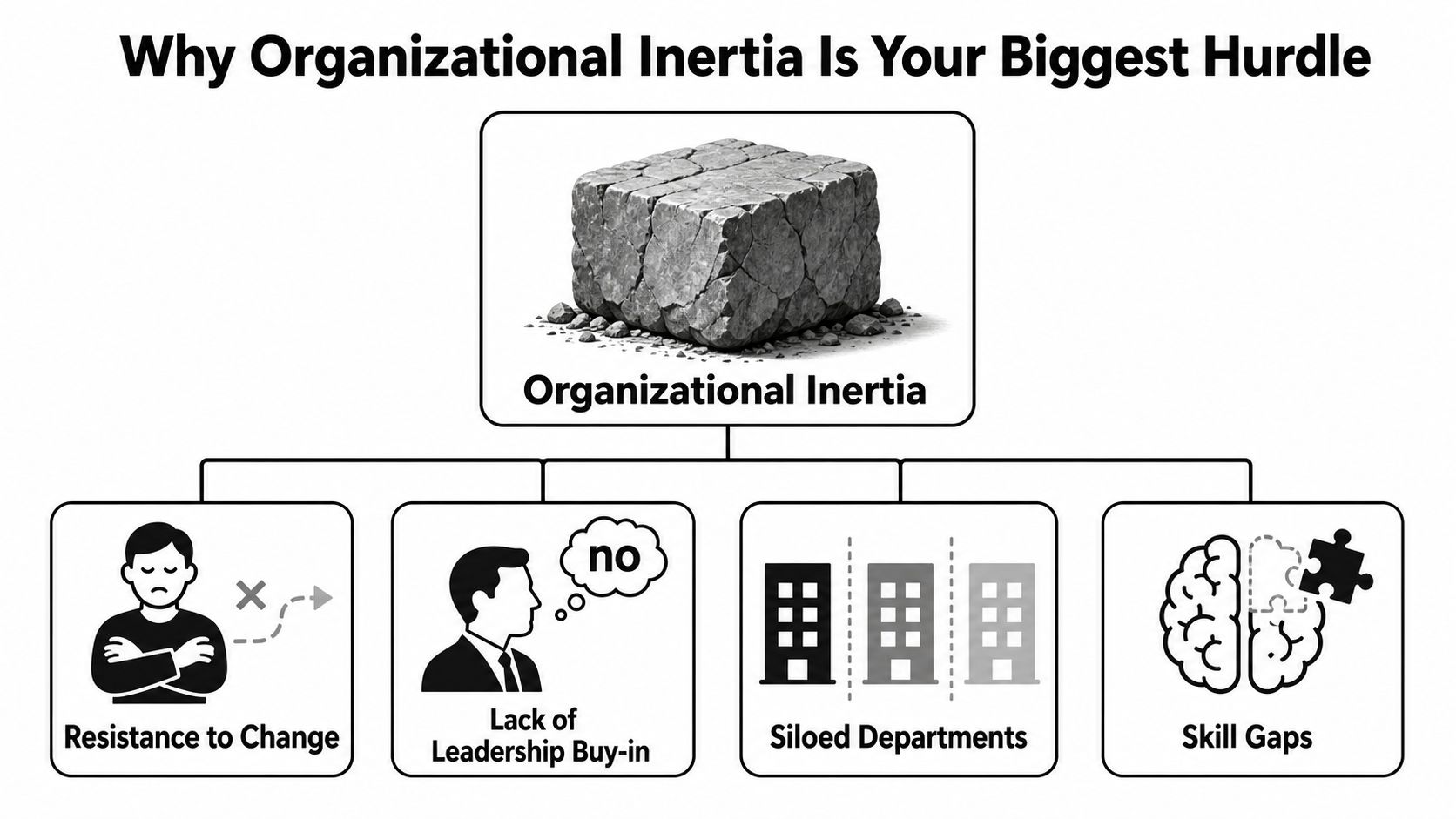
The pattern shows up in the numbers. Collaboration breakdown affects 47% of transformation efforts, skills gaps impact 41% of digital initiatives, and risk-averse cultures slow 40% of transformation projects, according to research on organizational barriers in transformation.
You'll usually see it in four behaviors:
- Silos protect local wins: departments optimize for their own KPIs and hand off messy work downstream.
- Leaders sponsor passively: they approve the initiative but don't remove blockers, make trade-offs, or model new behavior.
- Teams avoid controlled experimentation: every pilot needs perfect certainty, so nothing meaningful gets tested quickly.
- Training arrives too late: people meet the new workflow after launch instead of shaping it before launch.
Software can't fix that. A new platform dropped into an unchanged culture becomes an expensive wrapper around old habits.
Leadership support has to be active
CEOs often hear that culture matters, but that phrase gets too abstract to be useful. Culture, operationally, is the set of behaviors your team gets rewarded for repeating. If leaders still reward local optimization, risk avoidance, and preserving legacy approvals, your transformation will inherit those same traits.
Use a simple diagnostic:
| Symptom | What it usually means |
|---|---|
| Teams keep escalating small decisions | Decision rights are unclear |
| The roadmap keeps growing but delivery slows | Nobody is killing lower-value work |
| New tools launch but usage stays uneven | Managers aren't reinforcing behavior change |
| Cross-functional meetings end with "follow up offline" | The initiative lacks an accountable owner |
If your executives only talk about transformation at kickoff, your staff will treat it like a campaign, not a company priority.
For leaders who want a concrete way to address the people side, Synopsix's culture playbook is a practical read because it focuses on how teams change behavior, not just how they announce change.
Untangling Your Technical and Data Challenges
Some transformation programs have willing teams and still get stuck. That's usually the point where the architecture tells the truth.
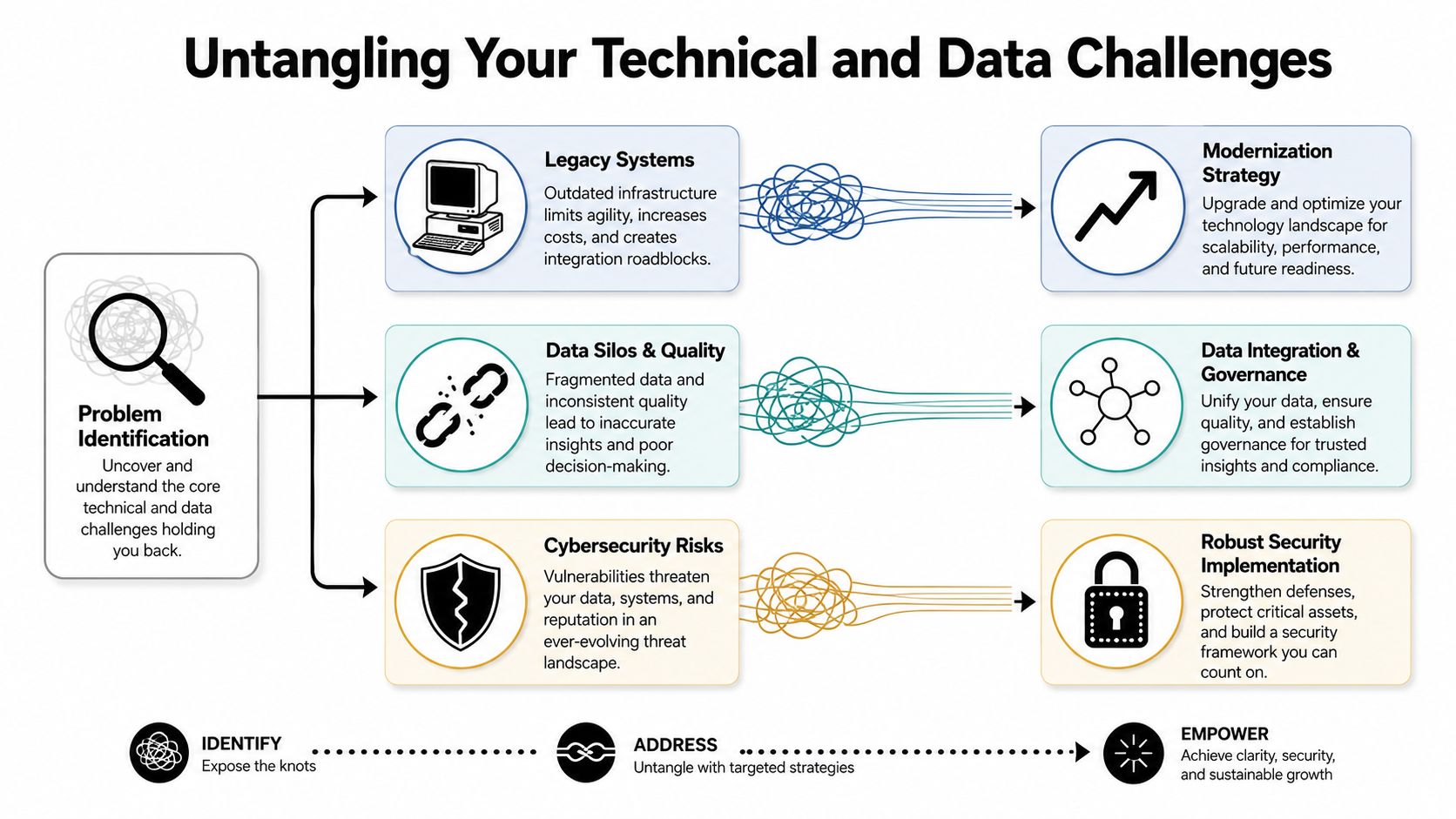
Legacy systems don't merely look old. They constrain what your business can attempt. They slow release cycles, hide business logic in obscure places, and make every new capability depend on brittle workarounds. That becomes painful when you try to add real-time personalization, AI-assisted support, product recommendations, or a unified mobile and desktop experience.
Why AI makes technical debt impossible to ignore
Digital transformation challenges manifest as 78% of enterprises are struggling to integrate AI with their existing systems, and infrastructure integration is the most cited barrier at 41% among surveyed leaders, according to Zapier's reporting on AI integration barriers.
That tracks with what product and engineering leaders run into on the ground:
- Data is trapped in operational silos: customer records, transaction history, support logs, and inventory signals live in different systems with different definitions.
- Core workflows depend on old interfaces: one fragile integration can hold up an entire modernization effort.
- AI needs context your systems can't cleanly provide: if the application can't access trusted data in a structured way, the model becomes a guess engine.
- Performance expectations rise immediately: users will forgive a clunky internal admin screen. They won't forgive a slow customer-facing app.
Data quality is not a back-office detail
Teams often say they need AI when they really need cleaner data contracts, more reliable pipelines, and stricter governance over what enters the model context.
A useful test is this: can your team explain where a customer attribute comes from, who owns it, how fresh it is, and which downstream applications rely on it? If the answer is fuzzy, the problem isn't model selection. It's your data estate.
Strong AI experiences usually start with boring work. Clean inputs, clear permissions, stable integrations, and predictable response patterns.
This is why modernization plans should include application architecture and data plumbing in the same conversation. If you're trying to connect product signals, operational data, and decisioning logic, a practical primer on applying data pipelines to business intelligence helps frame what "usable data" requires.
A quick technical triage
Before approving another platform replacement, ask your team these questions:
- Which systems are mission-critical but hard to change?
- Where does data get re-entered, duplicated, or transformed manually?
- Which customer-facing experiences depend on hidden manual work?
- What would break if AI usage doubled inside the application?
Those answers usually reveal whether you need a replatform, an integration layer, a service decomposition effort, or a phased coexistence plan instead of a dramatic rewrite.
Uncovering Security Compliance and Talent Gaps
Some of the hardest digital transformation challenges don't show up in the prototype. They show up in procurement, audit reviews, hiring plans, and budget meetings.
A transformation can look healthy in product demos and still be operationally exposed. That's common when leaders underinvest in security review, treat compliance as a late-stage approval step, or assume the current team can absorb a large modernization effort on top of daily delivery.
Start with capability, not ambition
The talent market puts a hard ceiling on how fast you can move. A critical barrier to digital transformation is the severe talent shortage, with 27% of organizations struggling to secure skilled staff, compounded by budget constraints from economic uncertainty cited by 24% of companies, according to Market.us digital transformation statistics.
That matters because transformation work isn't one role. You need product direction, UX, engineering, QA, security, delivery management, and often domain-specific expertise. If one of those is missing, the rest of the plan slows down.
A practical way to reduce hiring chaos is to build role sequencing instead of opening every requisition at once. This guide to tech recruiting talent pipelines is useful for thinking through how to plan staffing before the delivery crunch hits.
Security and compliance have to shape the design
If you're in fintech, healthcare, or any regulated environment, security isn't a gate at the end. It changes architectural decisions from the start. Access controls, auditability, vendor due diligence, data retention, model logging, and environment separation all affect how you build.
Use this review structure with your team:
- Security posture: what new attack surfaces does the modernization create?
- Compliance path: which controls must exist before launch, not after?
- Vendor flexibility: can you swap components later, or are you trapped in one ecosystem?
- Operational ownership: who maintains the controls after the implementation team leaves?
Compliance teams don't kill velocity by default. Teams lose velocity when they involve compliance after the architecture is already committed.
For product leaders, one of the easiest wins is to align security review with delivery planning early. These application security best practices are a solid baseline for framing the right questions before technical debt turns into risk debt.
Budget pressure changes your rollout strategy
When budgets tighten, big-bang transformation plans become fragile. Your team needs phased delivery, explicit trade-offs, and a short feedback loop between what ships and what gets funded next. That doesn't mean thinking small. It means proving value in controlled increments instead of betting the whole program on one deadline.
Your Prioritized Digital Transformation Checklist
A strong transformation plan doesn't try to fix everything at once. It puts the irreversible decisions first, the risky assumptions under test early, and the expensive commitments behind evidence.
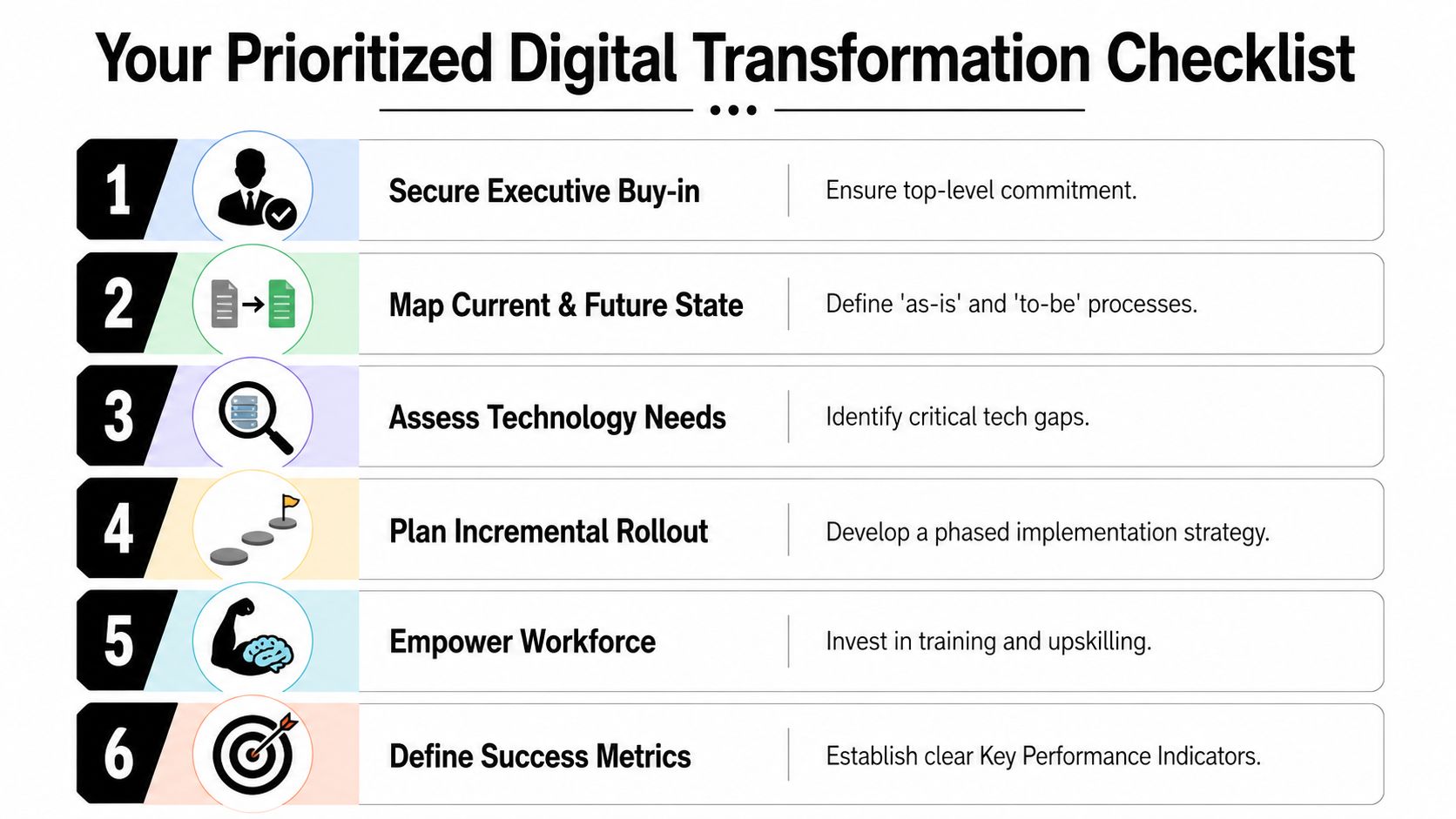
The six items worth doing first
Secure real executive ownership
Not a sponsor in name only. One leader should own business outcomes, approve trade-offs, and unblock cross-functional conflicts fast.Map current and future workflows
Don't start with the vendor demo. Start with the current user journey, the current operational process, and the future-state behavior you want.Audit your stack and your readiness together
Technical readiness without team readiness is fake progress. Cultural enthusiasm without technical feasibility is theater.Choose a phased rollout path
A pilot should prove one meaningful outcome in production conditions. It shouldn't be a sandbox forever.Train managers, not just end users
Managers reinforce new behavior. If they don't know what good adoption looks like, the old process survives underneath the new interface.Define success before build starts
Every team should know what will count as a win, what will trigger a reset, and which signals matter most after launch.
What good looks like
This doesn't need to become a giant transformation office exercise. Keep it crisp. A useful first-pass checklist for your leadership team can fit on one page.
| Priority | Good signal | Red flag |
|---|---|---|
| Executive ownership | One accountable decision-maker | Steering committee with no owner |
| Workflow mapping | Clear future-state process | Tool selection before process clarity |
| Readiness audit | Risks surfaced early | Surprises appearing mid-build |
| Phased rollout | Narrow scope with real users | Pilot detached from production reality |
| Manager enablement | Team leads reinforce usage | Training treated as a launch task |
| Success metrics | Defined before delivery | Metrics debated after release |
A simple operating cadence
Use a short weekly review with three questions:
- What shipped or was validated this week?
- What blocker needs executive action?
- What assumption just changed?
That rhythm keeps the transformation grounded in evidence instead of optimism.
Operator's note: If your roadmap cannot survive one uncomfortable truth learned in production, it isn't a strategy. It's a hope document.
The teams that move well don't confuse motion with progress. They reduce ambiguity, sequence the hard calls, and keep the scope tied to an outcome people can see.
Transformation Challenges Across Key Industries
The phrase "digital transformation challenges" sounds broad until you look at how differently it lands by industry. The pattern is shared. The pressure points are not.
Ecommerce and retail
An ecommerce team usually hits the wall when customer experience goals outrun platform reality. Marketing wants personalization, merchandising wants flexibility, operations wants accuracy, and the storefront still depends on rigid data models and old integrations. You can't deliver a clean omnichannel experience if product data, inventory, support history, and loyalty signals all tell different stories.
Fintech and SaaS
Fintech teams often have the opposite problem. They can see the product opportunity clearly, but every speed gain has to survive security review, audit requirements, and risk controls. The challenge isn't just building a faster onboarding flow or smarter support experience. It's doing that while preserving traceability, access discipline, and confidence in every automated decision path.
Healthcare and wellness
Healthcare modernization gets tangled fast because patient experience depends on systems that were never designed to work cleanly together. Teams need to unify scheduling, records access, intake, messaging, and internal workflows without creating compliance risk or forcing clinicians into awkward interfaces. If the app experience is elegant but the staff workflow is chaotic, adoption collapses on the inside.
Media and entertainment
Media organizations deal with scale and speed at the same time. They need content-rich applications that perform well under heavy usage, support mobile and desktop audiences, and feed recommendation or discovery logic with reliable data. The challenge isn't just serving content. It's serving the right content fast, while keeping analytics, monetization, and editorial systems aligned.
Public sector and nonprofits
Public sector teams often inherit the toughest version of inertia. Procurement cycles are slower, approvals are layered, and legacy systems sit behind mission-critical services. The work succeeds when leaders simplify the citizen journey, modernize in manageable slices, and design for clarity instead of bureaucratic mimicry.
Modernize Your Stack with Smart AI Governance
A lot of AI modernization efforts don't fail because the model output is weak. They fail because nobody put operating discipline around usage, prompts, parameters, logging, and cost.
The governance gap is real. While 74% of enterprises use AI, only 12% have clear governance to control token spend, and unmonitored operational costs contribute to failure in 40% of cases, according to V2Soft's analysis of digital transformation challenges.
That matters most when you're embedding AI into real software applications, not just testing it in a lab. Desktop and mobile apps need repeatability. Product teams need version control over prompts. Engineers need a safe way to manage parameters tied to internal database access. Operators need logging across integrated models. Finance and leadership need visibility into cumulative spend before costs drift beyond the original business case.
This is the category of problem an administrative layer is meant to solve. One example is Wonderment Apps, which offers a prompt management system with a prompt vault for versioning, a parameter manager for internal database access, logging across integrated AI systems, and a cost manager so teams can track cumulative spend inside a modernized application environment.
If your team is building AI into an existing product, these are the practical questions to ask before scaling:
- Prompt control: who can change prompts, and how do you track revisions?
- Parameter safety: how is internal data access controlled inside model workflows?
- Operational logs: can you see what happened across models and integrations?
- Cost visibility: can product, engineering, and leadership all see usage economics clearly?
The point isn't to slow down AI adoption. It's to keep AI useful, supportable, and financially sustainable after launch.
If you're modernizing a legacy product, adding AI to a desktop or mobile app, or trying to make your software stack last for years instead of quarters, Wonderment Apps can show you what that governance layer looks like in practice. Schedule a demo to see how prompt management, integration controls, logging, and token cost visibility fit into a real product environment.