


Your team probably already has monitoring. Dashboards are up. Logs are flowing. Pager notifications exist. And yet the most expensive problems often slip through because nothing is technically “down.”
A checkout flow can stay online while conversion drops unnoticed. A fintech product can process transactions normally while a new fraud pattern blends into everyday traffic. A healthcare app can keep syncing data while one integration starts producing values that are valid enough to avoid a hard failure but wrong enough to damage trust.
That's where anomaly detection systems earn their keep. They don't just ask whether a service is available. They ask whether your product is behaving the way it should.
The Hidden Problems Costing Your Business Money
A common Saturday problem looks like this: revenue softens, customer support volume creeps up, and nobody gets an urgent alert because every core service still returns a successful response. Engineers see green lights. Product sees a bad weekend. Finance sees the result a month later.
These problems hide in the gap between system uptime and business health. A rule-based alert might catch a server crash. It won't always catch a subtle change in refund behavior, a weird shift in search results, or a payment retry pattern that signals friction before customers complain.
Why manual monitoring breaks down
Manual review worked when teams watched a handful of metrics and could inspect trends by hand. That doesn't hold up when your app emits events across mobile, web, APIs, recommendation systems, fraud checks, and third-party integrations.
The category is growing for a reason. The global anomaly detection market was valued at approximately $8.07 billion in 2026 and is projected to reach $28 billion by 2034, growing at a 16.83% CAGR, reflecting its role across cybersecurity, finance, and healthcare, according to Articsledge's anomaly detection market overview.
For product leaders, that growth matters less as a market headline and more as a signal: teams increasingly treat anomaly detection as core product infrastructure, not an optional analytics add-on.
What these systems actually catch
Think of anomaly detection as a smoke detector for product behavior.
- Revenue anomalies: A payment authorization flow still works, but approval patterns drift in a way that hurts sales.
- Trust anomalies: A suspicious account action doesn't match a customer's normal history, even though it passes a static rule.
- Experience anomalies: Search latency, add-to-cart behavior, or push notification delivery starts acting oddly before a full outage appears.
If you work with event-driven products, it helps to understand the mechanics behind time series anomaly detection methods, especially when the signal lives in changing patterns rather than one broken endpoint.
Practical rule: If a business metric can drift without triggering a hard failure, it should probably have anomaly monitoring.
Retention issues often show up this way too. A “quiet” behavioral shift can become a churn problem long before someone labels it as one, which is why product teams often pair anomaly monitoring with work on reducing customer churn in digital products.
There's also a second challenge that shows up after the first model is live. Detecting anomalies is one problem. Operating those systems alongside the rest of your AI stack is another. That's where teams often discover that model choice was only half the job.
What Are Anomaly Detection Systems Really
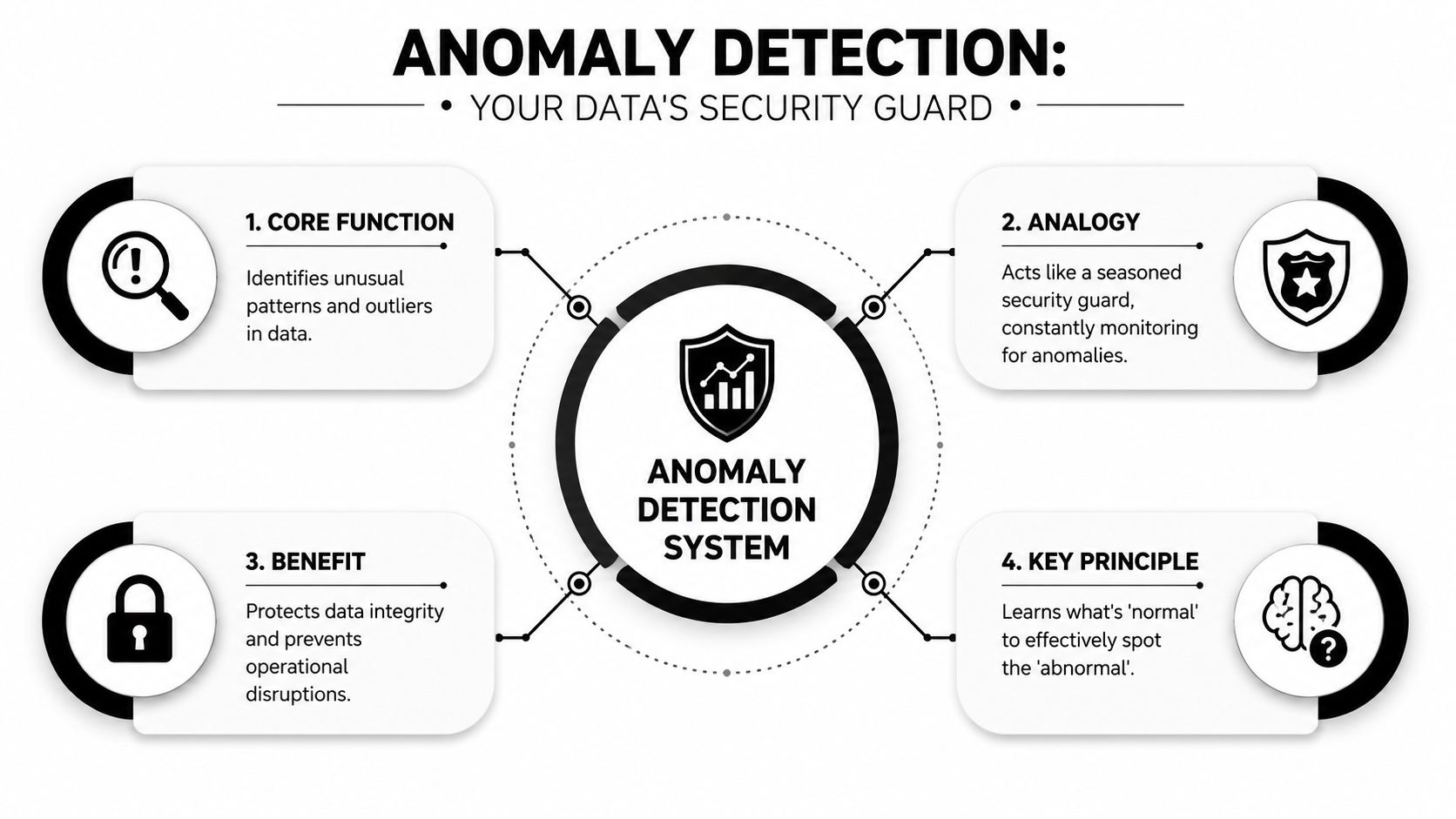
An anomaly detection system is best understood as a security guard for your data. Not a guard who checks one door with one rule, but a guard who has watched your building long enough to know the normal rhythm of the place.
It knows when customer logins usually rise. It knows what order volume looks like on weekdays versus weekends. It knows that some spikes are fine and some are strange. When something breaks that pattern, it flags it for review.
An anomaly is not the same as an outlier
At this stage, many product discussions get muddy.
- Anomaly: Something unusual that may indicate a real issue. Example: a sudden drop in completed purchases after a checkout release.
- Outlier: A data point that looks statistically unusual but may still be valid. Example: one very large enterprise order.
- Noise: Small random variation that doesn't mean much. Example: minute-to-minute fluctuation in homepage traffic.
A good system doesn't react to every odd value. It tries to separate signal from normal messiness.
Why modern systems beat static rules
Traditional monitoring often uses fixed conditions like “alert if CPU is above a threshold” or “alert if transactions fall below a threshold.” That's useful for some operational cases, but it's blunt.
Modern AI anomaly detection systems don't rely on predefined static thresholds. They use machine learning to learn historical “normal” patterns and flag statistical deviations, which can significantly reduce false positives compared to rule-based systems, as explained in OpenObserve's guide to AI anomaly detection.
That matters because “normal” changes.
A retailer expects very different traffic behavior during a promotion than on a quiet Tuesday. A healthcare platform sees different usage during working hours than overnight. A SaaS platform may see batch jobs create spikes that are healthy, not dangerous. Static rules often miss these nuances or alert too often to be useful.
The mental model product managers should use
Don't think of anomaly detection systems as magic fraud detectors or universal bug finders. Think of them as systems that answer one question well:
Is current behavior meaningfully different from established normal behavior?
That question can apply to many signals:
- Product signals: conversion, search success, add-to-cart events
- Operational signals: error rates, queue depth, latency
- Risk signals: account actions, transaction sequences, device behavior
- Customer signals: churn indicators, support patterns, engagement drops
The best anomaly detection system isn't the one with the fanciest model. It's the one your team trusts enough to act on.
That trust comes from choosing the right algorithm family, then integrating it into workflows that people already use.
A Guide to Anomaly Detection Algorithms
Teams generally don't need a research seminar. They need to know which class of algorithm fits the job, what trade-offs come with it, and where each one breaks.
The easiest way to think about anomaly detection algorithms is to group them into three families: statistical methods, classic machine learning, and deep learning. Each has a place.
Statistical methods
These are the practical workhorses. They're often fast, interpretable, and easy to explain to both engineering and compliance stakeholders.
Common examples include Z-Score, Interquartile Range (IQR), and related threshold-based statistical tests. Brown's survey on anomaly detection describes statistical methods that build behavioral profiles and compare current observations to an expected baseline, including techniques such as Z-Score, IQR, Grubbs' test, and methods that use the 0.9 quantile of surprise values to detect sudden changes in a collection window, summarized in this anomaly detection survey from Brown University.
These methods are good when:
- you need explainability,
- labeled anomaly data is scarce,
- and fast deployment matters more than model sophistication.
Classic machine learning
This family covers both supervised and unsupervised approaches.
In supervised anomaly detection, models are trained on labeled data to learn expected behaviors, while unsupervised learning allows the system to establish a “normal” baseline from historical data and identify future deviations without needing predefined labels, as outlined in RTS Labs' explanation of supervised and unsupervised anomaly detection.
That distinction matters a lot in product work.
If you have labeled fraud examples, supervised learning can work well. If you're trying to catch novel operational failures, unsupervised methods are often more practical because nobody has neatly labeled every future problem for you.
For real-time systems, teams often use methods such as Isolation Forest, k-nearest neighbors, plus simpler statistical methods such as Z-score and IQR depending on data shape and latency needs. Tinybird's real-time overview notes that simpler expressions can support microsecond-level decisions, while heavier models such as SVMs and neural networks demand more compute for more complex pattern recognition in its real-time anomaly detection guide.
If you're building for security workflows, this guide for SOC teams on threat detection is a useful complement because it ties behavioral anomaly detection to actual operational response.
Deep learning
Deep learning earns its place when your data is high-dimensional, nonlinear, or too complex for simple baselines.
That includes use cases like intrusion detection across many interacting signals, complex transaction sequences, or sensor-heavy environments where the relationship between variables is messy.
A useful example comes from intrusion detection benchmarks. Deep neural network models achieved 99.98% accuracy on the KDDCup99 dataset, compared with 99.47% for recurrent neural networks, with false positive rates below 1% on KDDCup99 and NSL-KDD. On UNSW-NB15, the same study reported 95.96% for DNNs versus 82.00% for RNNs, with false positive rates remaining under 8%, according to Scientific Reports.
Those numbers are benchmark results, not a promise for your production environment. But they do show why richer architectures can help when the signal is subtle and multidimensional.
Anomaly Detection Approaches Compared
| Approach | How It Works | Pros | Cons | Best For |
|---|---|---|---|---|
| Statistical | Compares current values to a baseline using methods like Z-Score or IQR | Fast, interpretable, easy to launch | Can miss complex relationships | Operational metrics, time series monitoring, early-stage systems |
| Unsupervised ML | Learns normal patterns from historical data and flags deviations | Useful when labels are unavailable, adaptable | Can be harder to tune in production | Product analytics, fraud exploration, evolving behaviors |
| Supervised ML | Learns from labeled examples of normal and anomalous events | Precise when labels are strong | Needs quality labeled data and maintenance | Known fraud patterns, repeated defect classes |
| Deep Learning | Learns complex nonlinear patterns across many features | Strong on high-dimensional data | Higher compute cost, harder to explain | Intrusion detection, sensor-rich systems, complex event streams |
How to choose without overcomplicating it
Start with the simplest method that can support the business decision.
- Use statistical methods first when you need speed, clarity, and low implementation risk.
- Use unsupervised ML when normal behavior shifts and labels are weak.
- Use supervised ML when you have trustworthy historical labels and a repeated anomaly type.
- Use deep learning when simpler approaches fail on complex patterns.
For product teams working with event streams, model choice also connects to how you analyze trend behavior over time, making time series analysis techniques for product and business data part of the engineering conversation, not just the analytics one.
Architecting an Anomaly Detection Pipeline
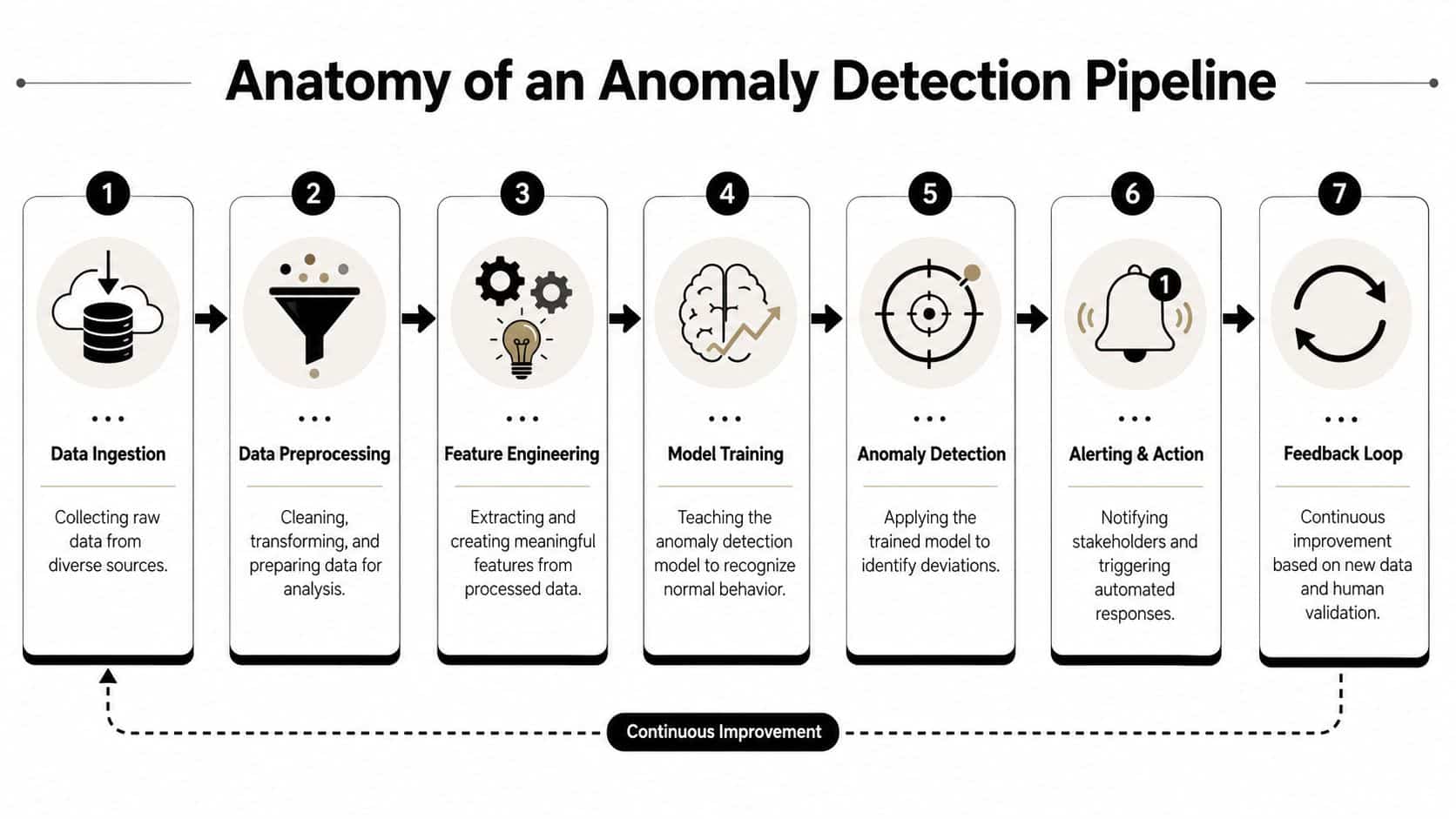
A model alone doesn't solve much. Production anomaly detection systems need a pipeline that moves data from raw events to trusted action.
That pipeline usually fails for boring reasons. Data arrives late. Events are inconsistent. Labels are weak. Alert destinations are unclear. The team can train a model but can't wire the result into PagerDuty, Slack, Jira, or an internal admin panel in a way people use.
The implementation workflow for AI anomaly detection follows a four-step process: data scoping, data exploration and preprocessing, model training and validation, and deployment and integration, with most of the effort concentrated in the first two phases, as discussed in this walkthrough on AI anomaly detection implementation.
Step one through step four
Data scoping
Decide what problem matters. Fraud detection, checkout degradation, unusual API use, patient-risk signals, inventory drift. If the use case is vague, the system will be vague too.Data exploration and preprocessing
Serious engineering time goes into these efforts. Teams clean missing values, align timestamps, normalize formats, handle seasonality, and decide what “normal” should even mean across channels and devices.Model training and validation
Choose a method that fits the business need. A fast Z-score baseline might be enough for one metric. A multivariate model may be better when several weak signals combine into one important event.Deployment and integration
Get the output into the operating system of the business. An anomaly that lives only in a notebook doesn't help anyone.
Real time or batch
This choice changes your architecture more than is typically expected.
- Real-time processing fits fraud, intrusion detection, and urgent operational failures. You care about immediate action.
- Batch processing fits trend review, retrospective quality checks, and lower-urgency reporting. You care more about pattern discovery than instant intervention.
Engineering shortcut to avoid: Don't force everything into real time just because streaming sounds modern. Real-time systems cost more to build, tune, and maintain.
The integration layer people underestimate
Once the detector flags something, what happens next?
- Notify a human: send a Slack alert, open a Jira ticket, or route to an operations console.
- Trigger automation: pause a release, block a risky flow, or switch traffic.
- Capture feedback: record whether the alert was useful, noisy, urgent, or wrong.
That final piece matters. A detection pipeline gets stronger when users can mark alerts as useful or irrelevant. Without feedback, the system becomes a one-way siren.
Teams building modern products often discover that anomaly detection becomes one layer inside a broader analytics and automation stack. If you're designing that foundation, this guide on applying data pipelines to business intelligence is a practical companion because it frames data flow as a business system, not just an ETL task.
How to Evaluate and Validate Your System
Most anomaly detection projects don't fail because the model is mathematically weak. They fail because the team stops trusting the alerts.
That trust problem has a name: false-positive fatigue.
Many guides on anomaly detection systems skip this operational issue, even though unsupervised methods can generate false positive rates over 30% in real-world scenarios, causing operations teams to ignore 40% to 60% of alerts, according to this arXiv discussion of operational false-positive fatigue.

The metrics that actually matter
Product teams often hear model metrics and assume they tell the whole story. They don't.
Here are the three evaluation concepts worth keeping close:
- Precision: Of all alerts raised, how many were useful?
- Recall: Of all real issues, how many did the system catch?
- F1 score: A combined view that balances precision and recall.
A fraud team may tolerate lower precision if missing a real threat is costly. A product operations team may prefer higher precision because noisy alerts burn trust fast. This is why evaluation has to match business cost, not just model elegance.
Validation tactics that work in practice
You don't need a perfect lab environment. You need disciplined validation.
Backtest on historical incidents
Run the detector against periods where you already know what happened. Did it catch the checkout dip? Did it detect the suspicious account behavior? Did it fire too early, too late, or constantly?
This gives teams a grounded sense of whether the model is useful on business events they already understand.
Tune thresholds with business ownership
Even “smart” systems still involve tuning. Product, engineering, and operations should agree on what level of noise is acceptable.
A mediocre detector with clear escalation rules beats an advanced detector that floods the team with low-confidence alerts.
Add human-in-the-loop review
Give operators a fast way to classify alerts:
- Correct alert: the system found something important.
- Benign anomaly: unusual, but not harmful.
- Bad alert: the system flagged noise.
That feedback loop helps with retraining, threshold tuning, and stakeholder confidence.
What a trustworthy system looks like
A trustworthy anomaly detection system has a few visible properties:
- It alerts rarely enough to be read
- It catches patterns the team would otherwise miss
- It explains enough context for fast triage
- It improves over time as teams label outcomes
The right question isn't “Is this model accurate in the abstract?” The right question is “Will the team act on this alert at 2:13 p.m. on a busy Tuesday?”
If the answer is no, the model isn't ready.
Anomaly Detection in Action Across Industries
The mechanics matter, but the clearest way to understand anomaly detection systems is to see what they look like inside actual products.
Fintech
A customer usually spends in a narrow behavioral pattern. Then the account starts making purchases in a new sequence, from a new device context, at an odd time relative to the account's history.
A rule engine might miss it if each individual event looks acceptable. An anomaly detection system looks at the pattern and flags the behavior because it doesn't fit the learned baseline.
Ecommerce
Your storefront loads. Search works. Checkout still returns success responses. But product detail views rise while add-to-cart events soften in one category after a release.
That's the kind of problem product analytics dashboards often show only after the damage is done. An anomaly detector can flag the behavioral shift early, before the issue becomes a week-long revenue postmortem.
Healthcare
A patient monitoring workflow may not fail outright. Instead, several inputs drift together in a combination that suggests increased risk.
The value of anomaly detection here isn't just spotting a single abnormal reading. It's recognizing when the overall pattern departs from expected behavior for a patient or population and routing that signal into a clinical workflow for review.
SaaS and enterprise software
A SaaS platform might see unusual database access patterns, strange resource consumption, or a burst of actions from an internal automation process that never behaved that way before.
That signal could point to:
- a security issue,
- a deployment regression,
- or a runaway background job.
The important point is that anomaly detection doesn't have to decide the root cause instantly. It needs to surface the unusual behavior early enough for the right team to investigate.
Media, public sector, and high-volume digital services
Content platforms can watch for unexpected drops in playback starts, recommendation oddities, or traffic changes isolated to one app version. Public-facing services can monitor unusual demand spikes, form completion failures, and behavior that suggests abuse rather than normal citizen use.
In every case, the business value is similar. The system notices meaningful deviation before the organization pays the full price of delay.
Integrating and Managing AI for the Long Haul
Shipping one anomaly detector is a milestone. Running AI features across a product portfolio is a different discipline.
Teams usually start with one focused use case. Then the stack grows. A fraud model gets added. A support assistant appears. Product search becomes AI-assisted. A recommendation workflow needs prompt logic, model settings, logging, and cost visibility. Before long, AI isn't a feature. It's an operating layer.
That creates management problems that don't show up in a prototype.
Where long-term complexity comes from
The pain points are usually operational:
- Prompt sprawl: multiple prompt versions live across codebases and admin tools
- Parameter inconsistency: one team changes model inputs or database access logic without strong visibility
- Fragmented logging: output quality and failure analysis live in too many places
- Cost ambiguity: leaders know AI spend is rising but can't easily connect cost to product behavior
Those issues matter even more when anomaly detection sits beside other machine learning systems. An unusual event often requires downstream actions, generated explanations, human review notes, and internal data access controls. That's not one model problem. It's a systems problem.
Why central AI operations matter
The more durable approach is to manage AI the way you manage the rest of your production stack: with versioning, observability, governance, and cost tracking.
For teams working on industrial and reliability-heavy use cases, this primer on implementing predictive maintenance ML is a useful reminder that long-term success comes from repeatable operations, not just a smart initial model.

The teams that handle this well usually put a few controls in place early:
- Prompt vault with versioning so developers can track changes cleanly
- Parameter management for internal database access and model configuration
- Unified logging across integrated AI services
- Cost management so entrepreneurs and product owners can see cumulative spend clearly
Anomaly detection systems are valuable because they help software notice when reality shifts. But durable AI products need more than detection. They need a clean way to manage prompts, integrations, logs, and operating costs as the product matures.
That's the difference between adding an AI feature and building software that can keep evolving for years.
If you're modernizing a product with AI and want a cleaner way to manage prompts, integrations, logs, and spend, take a look at Wonderment Apps. Their team builds and supports AI-powered web and mobile products, and they've developed an administrative toolkit with a prompt vault, versioning, parameter controls, unified logging, and cost visibility to help teams scale AI without losing control.