

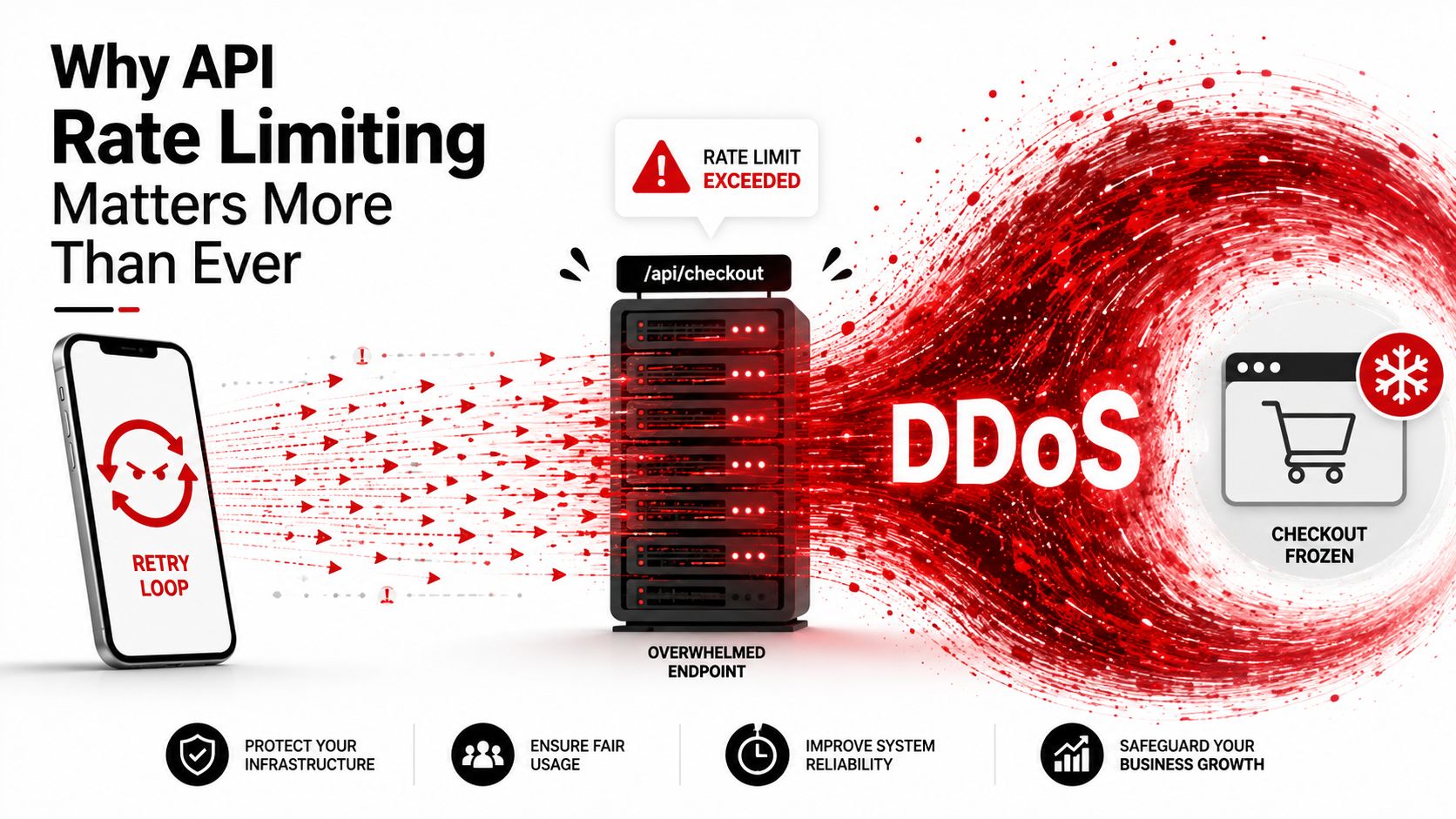
A mobile user taps “pay,” loses signal, and the app retries. Then it retries again. A small network hiccup becomes a runaway request loop, the checkout endpoint spends its capacity processing duplicates, and customers with perfectly healthy connections start seeing slow responses or failures. Product sees abandoned carts, platform sees an overloaded dependency, and finance sees infrastructure and third-party charges climbing together.
That's the practical reason API rate limiting deserves design attention before launch. It controls throughput, protects shared capacity, and gives clients a clear signal when they need to slow down. The need is even sharper for AI-enabled applications, where many teams may share upstream models and one unbounded prompt job can consume a budget far faster than a human user would expect. The same principle applies to administrative prompt management systems that coordinate prompt versions, database parameters, AI logging, and cumulative spend. Rate limiting helps turn those controls into an operating model rather than a collection of emergency switches.
A shared problem for product, platform, and finance
Older systems often treated quotas as a polite per-tenant rule. Modern applications contend with shared model pools, unstable third-party APIs, background jobs, mobile reconnects, and endpoint costs that vary widely. A lightweight read and an AI generation request may both look like “one request” to a basic counter, while their effects on latency, compute, and spend are very different.
RFC 6585, published in April 2012, formalized HTTP status code 429 Too Many Requests and described the optional Retry-After header, giving clients a machine-readable way to back off (RFC 6585 and the rate-limiting milestone). That standardization helped make rate limiting a recognizable HTTP-level control rather than an isolated gateway convention.
For a broader foundation before choosing a limiter, review these API design principles. In 2026, rate limiting should sit alongside authentication, authorization, observability, and cost governance in the architecture decision record. It's not a defensive patch added after an outage. It's part of how the product promises fair, reliable access.
What API Rate Limiting Does
An API gateway performs three jobs at the access boundary: it identifies the caller, counts recent activity, and decides whether to admit the request. The identity might be an API key, user, IP address, or tenant. That decision also needs to account for the work a request creates, because a lightweight read and an AI generation request can consume very different amounts of latency, compute, and spend.
A simple implementation keeps a counter for each key during a defined window. A sliding window checks recent activity continuously instead of waiting for a blunt reset. Depending on the route and workload, the gateway can take several actions:
- Throttle the request: Slow processing or place it in a queue.
- Reject the request: Return
429 Too Many Requests, the standard signal for exceeding a rate limit (HTTP status codes for rate limiting). - Queue work: Hold an asynchronous job until capacity becomes available, which suits batch processing better than an interactive checkout.
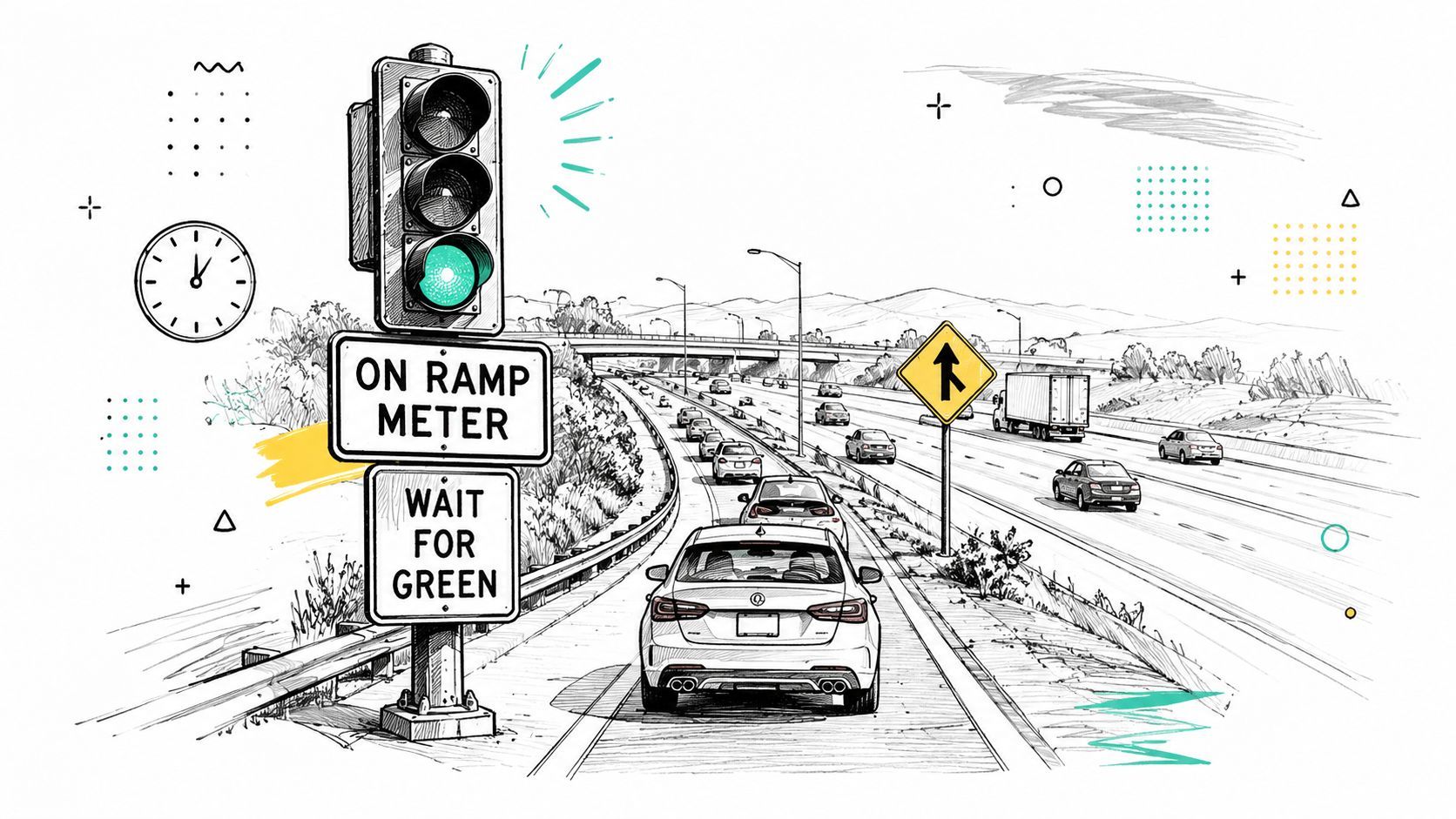
A highway on-ramp shows why pacing matters. A ramp meter releases cars onto a busy freeway at controlled intervals, preventing one entrance from sending a whole convoy at once. A limiter applies the same control before requests reach a database, payment provider, search cluster, or model endpoint.
Identify the client and communicate the decision
A public endpoint may use IP-based limits, although shared networks can make that rule unfair. An authenticated API usually keys limits to an API key, user, account, or tenant. Production systems often layer these scopes: one rule for abuse protection, another for customer fairness, and a tighter rule for expensive routes. Shared quotas make coordination important, since several workers or users may consume the same pool.
Clients should not have to guess. Legacy APIs commonly expose X-RateLimit-* headers, while the IETF draft defines RateLimit-Limit, RateLimit-Remaining, and RateLimit-Reset for machine-readable limit state (IETF RateLimit fields draft). A useful response tells the client how much capacity remains and how to pace future work. Teams reviewing a provider's policy can also consult this explanation of how rate limits work on this API.
Rate limiting is separate from authentication, authorization, and circuit breaking. Authentication identifies the caller. Authorization determines what that caller may access. Circuit breaking pauses calls to a failing dependency. Rate limiting controls request frequency and resource consumption, so these controls must work together rather than replace one another.
Token Bucket vs Leaky Bucket at a Glance
Token bucket and leaky bucket solve different traffic problems. Token bucket preserves bounded burst capacity, while leaky bucket smooths output for downstream safety. The difference becomes visible when a client sends a spike after being quiet.
With token bucket, tokens accumulate at a configured rate until the bucket reaches its capacity. Each accepted request consumes one token. A quiet client can therefore build capacity and send a short burst, but only up to the stored tokens. Once the bucket is empty, new requests are rejected until more tokens arrive (token bucket mechanics).
Leaky bucket accepts incoming work into a queue and releases it at a defined outflow rate. The queue absorbs some variation, then rejects new requests when it reaches its limit. This behavior protects legacy services, databases, and third-party payment APIs that cannot safely handle sudden concurrency, although queued work takes longer to complete.
| Dimension | Token bucket | Leaky bucket |
|---|---|---|
| Primary goal | Preserve responsiveness while enforcing an average rate | Smooth output for downstream safety |
| Burst behavior | Allows bursts up to bucket capacity | Converts bursts into a steady flow |
| Client experience | Usually lower latency for short spikes | Can add queueing delay |
| Failure mode | Empty bucket causes rejection | Full queue causes rejection |
| Strong fit | User-facing APIs and mobile traffic | Fragile backends and strict partner APIs |
Consider payment webhooks arriving in a short burst after a provider reconnects. A token bucket can admit the burst if enough capacity has accumulated, helping the application catch up quickly. A leaky bucket queues the events and releases them at a predictable pace. That reduces pressure on the payment processor, but completion takes longer and the queue can eventually fill.
Practical rule: choose token bucket when the product benefits from quick, bounded bursts. Choose leaky bucket when a dependency benefits more from a flat, carefully paced stream.
Both algorithms require state for each limiting key. They can use a counter-based implementation or a more precise approximation in Redis or another dedicated datastore. Storage affects accuracy and coordination, not the central tradeoff: more burst capacity improves responsiveness while increasing instantaneous load variation, whereas stricter smoothing lowers overload risk while increasing waiting and the possibility of drops when the queue fills.
Choosing the Right Algorithm for Your Traffic
Algorithm selection should begin with traffic shape, not habit. A public API used by people, devices, scheduled jobs, and partner systems rarely has one uniform pattern.
| Algorithm | Best Traffic Profile | Burst Handling | Memory Cost | Typical Use |
|---|---|---|---|---|
| Token bucket | Bursty user-facing traffic | Allows bounded bursts | Low state per key | Public APIs and mobile clients |
| Leaky bucket | Downstream systems needing steady output | Smooths bursts through a queue | Queue state required | Payment providers and legacy services |
| Fixed window | Low-risk traffic where simplicity matters | Can be uneven near boundaries | Very low | Internal utility endpoints |
| Sliding window log | Traffic needing precise history | Controls recent activity closely | Higher, because timestamps are retained | Sensitive or high-value operations |
| Sliding window counter | General-purpose production traffic | Reduces boundary distortions | Moderate | Public APIs needing a practical compromise |
Match the limiter to the caller
A mobile client that reconnects after leaving a tunnel may send several queued reads together. Token bucket is a sensible fit because it absorbs a bounded reconnect burst without treating normal recovery as abuse.
A background worker fanning out updates to a partner CRM has a different constraint. The partner may process calls safely only at a steady pace, so leaky bucket is a better outbound shape. The queue becomes a buffer between your internal job scheduler and the external service.
A chatty SDK used by many kiosks may need a sliding window counter. The product team may care about fair recent usage without storing every request timestamp. This approach offers a practical middle ground between fixed-window simplicity and sliding-log precision.
Fixed window still has a place. A low-risk health-related endpoint or internal administrative route may not justify complex state. The tradeoff is less precise behavior around the boundary, so it shouldn't be the automatic choice for expensive public operations.
Use sliding window log when the exact recent sequence matters more than memory efficiency. That can apply to security-sensitive actions or valuable operations where a coarse approximation creates unacceptable fairness problems.
Layer controls instead of forcing one algorithm to do everything
A single product can combine strategies. An edge token bucket can absorb ordinary client bursts, while a leaky bucket shapes calls entering a fragile upstream. Inside the application, a sliding window can enforce a tenant-wide policy across several routes.
The useful question isn't “Which algorithm is best?” It's “Which resource am I protecting, and what kind of delay can the user tolerate?” Pick the simplest algorithm that matches that answer, then add a second layer only when it protects a distinct boundary.
From Static Limits to Adaptive Cost-Aware Controls
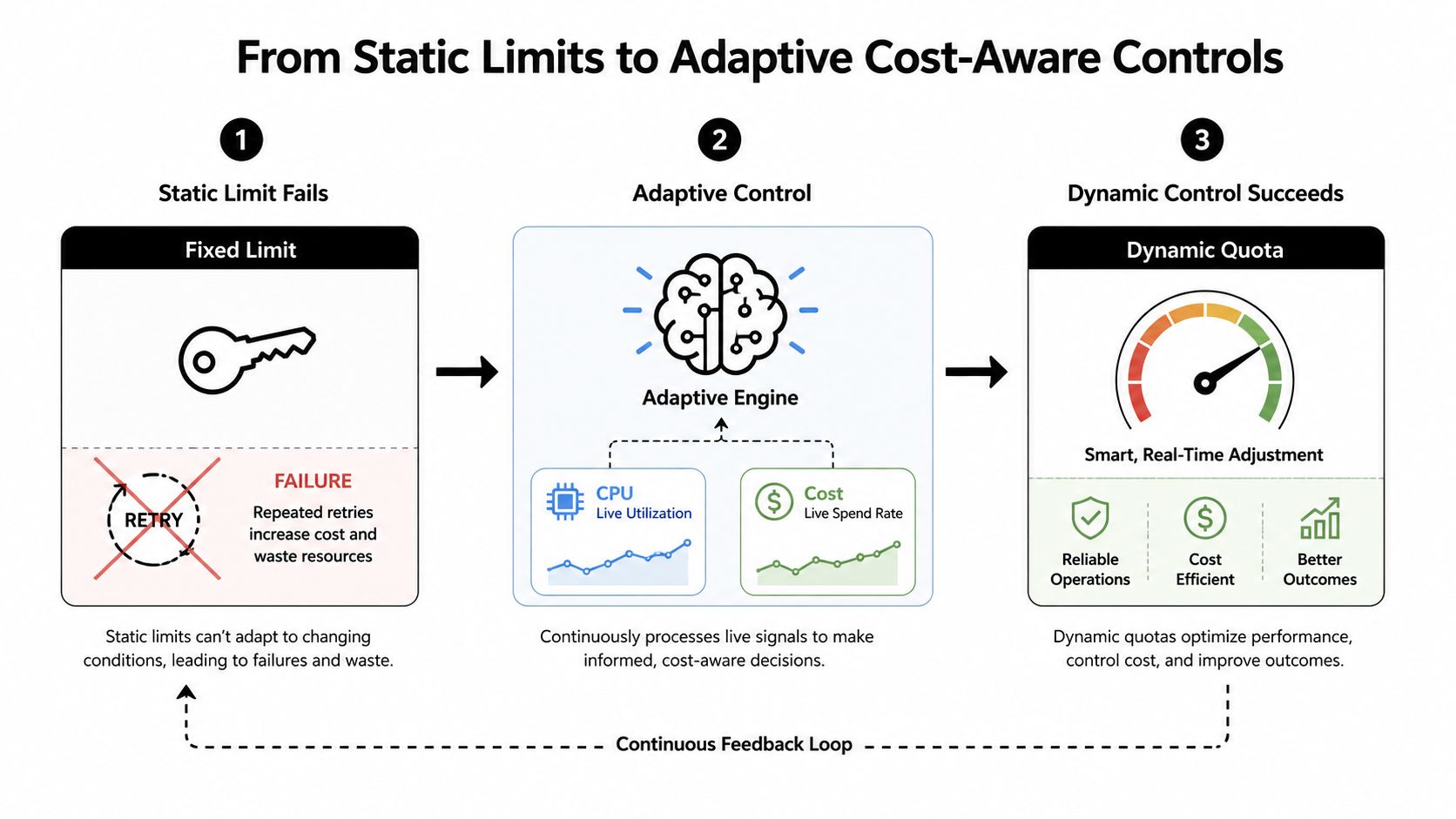
A status-check endpoint and a model-inference endpoint may each count as one request to a basic limiter, yet they can consume very different amounts of database capacity, compute, or paid service usage. A cost-aware rule gives those operations different weights instead of treating every call alike.
A fixed requests-per-window rule cannot express that difference. It may throttle a customer running valuable, expensive work while allowing enough cheap calls to create pressure on another dependency. Repeated retries intensify the load, because clients send failed work again while the server is already struggling.
Give requests a cost, not just a count
A cost-aware limiter assigns weights based on actual resource behavior. A small read might consume one unit. A search, upload, report, or model generation might consume more because it fans out, uses more compute, or calls a paid dependency. Set those weights with service characteristics and business priorities, then review them as the system changes.
This approach fits products where endpoint costs vary sharply. Current cost-aware API rate-limiting practices describe a shift from static thresholds toward controls that account for resource cost, traffic patterns, and live server conditions.
Let live conditions influence admission
A gateway can observe p95 latency, upstream error rate, queue depth, dependency health, and, for AI endpoints, model token usage. Rising latency or queue depth can trigger tighter admission. As conditions recover, the gateway can restore capacity gradually rather than opening the floodgates.
The important design choice is the feedback loop. Server-side adaptation and client-side cooperation need a shared signal. On rejection, return 429 with Retry-After. Clients should honor that guidance, apply exponential backoff with jitter, and stop launching synchronized retries.
The strongest limiter doesn't merely say no. It explains when and how the client can try again.
Rate limiting then becomes distributed flow control. The server adjusts admission to protect current capacity, while the client paces work before the next request reaches the gateway. That coordination reduces wasted retries, limits retry storms, and gives the product team better control over infrastructure and model spending.
Distributed Coordination and Shared Quotas
A limiter stored only in one application instance stops being authoritative when requests can land on other instances. Each local counter sees only part of the traffic, so a customer may exceed an intended shared quota by reaching different gateways.
The remedy is to decide where the truth lives and how much inconsistency the product can tolerate. A centralized store such as Redis or DynamoDB can provide shared state, while local counters provide lower latency but only an approximation. Gossip-based designs, probabilistic structures, and CRDTs can improve availability or reduce coordination pressure, but they introduce their own consistency and interpretation tradeoffs.
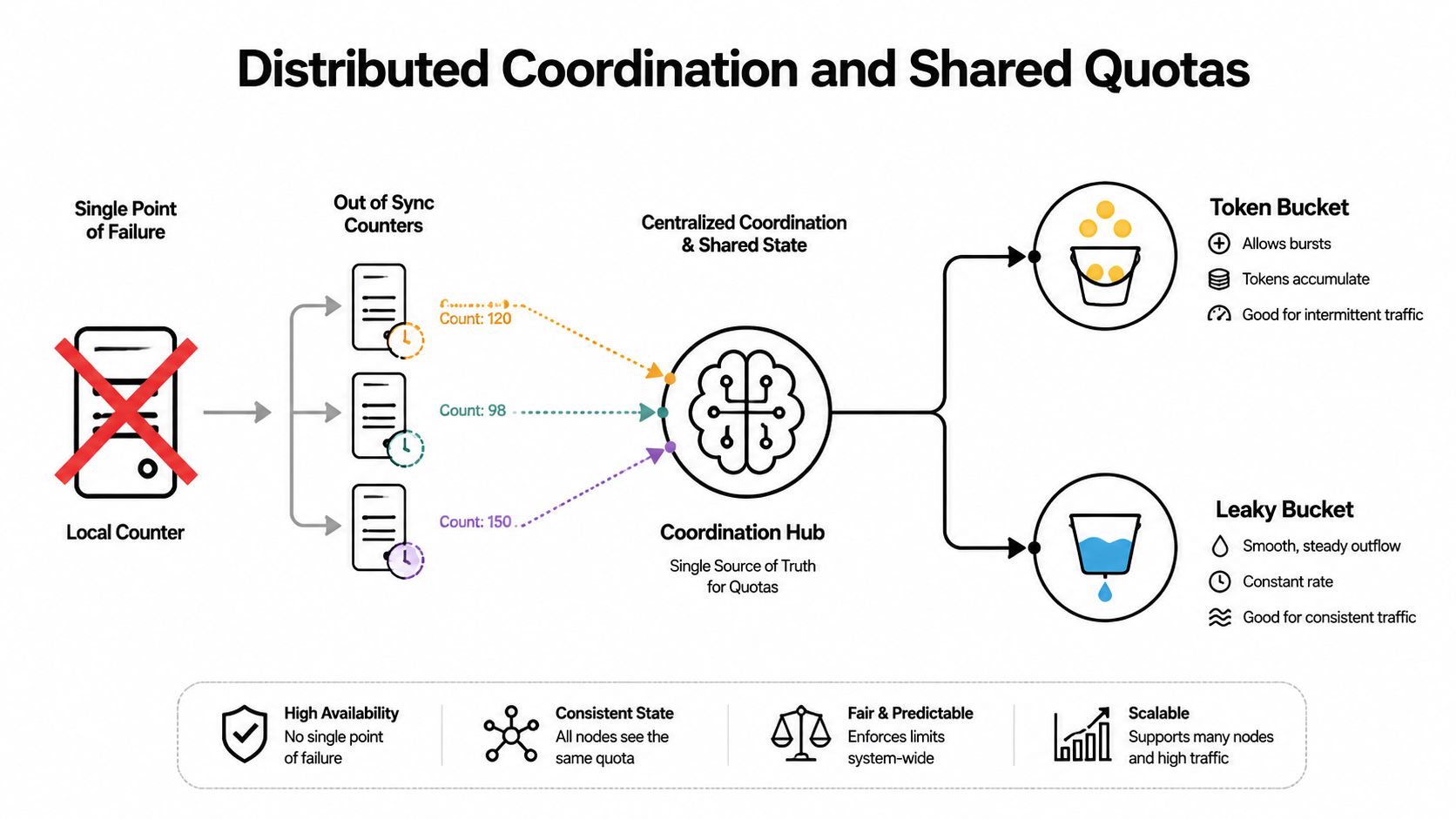
A shared quota across regions
Suppose a B2B customer has a quota of 10,000 requests per hour shared across three regional gateways and two read-replica services. A local counter at each gateway can't enforce that total accurately. Each region needs access to shared usage state, or the system must explicitly accept an approximation.
A Redis-backed sliding window can store recent request activity under a tenant key. Gateway operations should be atomic, so two simultaneous requests don't both observe the same remaining capacity and pass incorrectly. The implementation also needs a consistent time source. Region clocks can disagree, so use coordinated server time or a datastore-side timestamp rather than trusting each client.
Choose behavior during failure
Coordination introduces a dependency on the coordination store. If it slows down or becomes unavailable, decide in advance whether the limiter should fail open, allowing traffic to preserve availability, or fail closed, rejecting traffic to protect a costly or sensitive dependency.
Neither choice is universally correct. A public read endpoint may accept temporary overage, while a payment operation or expensive model route may need stricter protection. Record the decision in the service runbook and test it during a failure exercise.
Use this API authentication best practices resource alongside quota design, because the identity used for authorization often determines the fairness boundary.
A practical coordination checklist includes:
- Counter location: Decide whether local, centralized, or approximate shared state fits the risk.
- Consistency need: Define how much quota overage a partition can tolerate.
- Clock discipline: Use a trusted time source for windows and resets.
- Failure mode: Choose fail-open or fail-closed per endpoint, not globally.
- Recovery behavior: Prevent a recovered gateway from releasing queued work all at once.
Monitoring, Alerting, and Tuning Limits Over Time
A limit isn't successful because it returns 429. It's successful when it protects the intended dependency without repeatedly blocking legitimate work.
Start with the limiter's own health. Track the 429 ratio, limiter latency at the p99, queue saturation by tenant, and rejection reasons segmented by client tier or endpoint. A rising rejection rate may indicate abuse, a broken client, an overly narrow policy, or a downstream incident. Those causes require different responses, so aggregate counts alone won't tell the story.
Build a feedback loop
A useful tuning cycle looks like this:
- Start conservatively: Protect the weakest dependency rather than the most powerful server.
- Observe real distributions: Review traffic across a meaningful operating period, including quiet periods, launches, reconnects, and batch activity.
- Classify behavior: Separate normal bursts, inefficient clients, accidental retry loops, and deliberate abuse.
- Adjust gradually: Raise or lower ceilings in controlled changes while watching dependency latency and errors.
- Document the contract: Tell consumers how limits work and how to request an increase.
Alerting should focus on sustained throttling and its impact, not only an instantaneous spike. A brief burst may be healthy if the token bucket absorbs it. Persistent 429 responses from one enterprise tenant, however, may signal that the quota no longer matches its contracted workload.
Test the limiter like a production feature
A synthetic probe should intentionally approach and exceed a limit in a safe environment, verifying that the gateway returns the expected status and headers. Test Retry-After, remaining capacity, reset behavior, queue handling, and recovery after the dependency stabilizes.
Dashboards should connect limiter behavior to the broader golden signals, including latency, traffic, errors, and saturation. Teams building that observability foundation can compare their approach with these performance monitoring tools.
Give API consumers a feedback channel. A quota increase request should include the tenant, endpoint, workload pattern, and business timing, not just “please raise my limit.” That information helps platform teams distinguish a legitimate capacity conversation from a client that needs better batching or retry behavior.
Building a Rate Limiting Mindset That Lasts
Rate limiting works best as a published product contract, not a hidden gateway setting. Consumers need to know how the system identifies them, which operations share capacity, what headers mean, and what their clients should do after a 429.
Treat those rules like API behavior. Version them when semantics change, document exceptions, and review them whenever a dependency, pricing model, or application workflow changes. A new search provider, payment processor, or AI model can alter the cost and safe throughput of an endpoint even when the endpoint's public path stays the same.
Make fairness visible
AI-driven products make quota design impossible to ignore. A heavy tenant can consume shared model capacity, drive inference spend, or occupy a prompt-processing queue that other customers also need. A mature control plane can combine tenant identity, prompt workload, model choice, request priority, and cost signals so the platform doesn't treat every generation as interchangeable.
That same discipline applies to a prompt management system. Versioned prompt assets, parameter controls for approved internal data access, cross-model logging, and cumulative spend visibility give teams the information needed to set sensible limits. Rate limiting then becomes the enforcement layer that keeps one automated job from overwhelming shared models or turning an unexpected retry loop into a budget incident.
Rate limiting is shared communication between provider and consumer, not a defensive wall.
Put quota reviews into architecture decision records. Run game days where limits trip intentionally. Keep a living runbook for raising ceilings safely, handling coordination-store failures, and investigating unusual cost. When developers can see their remaining capacity and receive actionable retry guidance, they can help protect the platform instead of fighting it.
The lasting mindset shift is straightforward: every limit expresses a promise about fairness, availability, and cost. Product teams should design that promise, platform teams should implement it consistently, and finance teams should understand its relationship to variable usage.
Wonderment Apps helps teams modernize web and mobile products with AI while keeping prompt operations under control through administrative tooling for prompt versioning, parameter management, integrated AI logging, and cumulative spend visibility. Visit Wonderment Apps to explore the platform and discuss how a cost-aware rate-limiting strategy can support your next application.