


A lot of teams reach the same painful point at once. Shipping gets slower, every new integration feels risky, mobile and web clients drift apart, and no one wants to touch the API because one “small” change might break three downstream systems.
That usually isn't a framework problem. It's a design problem.
The good news is that api design principles are still one of the most effective tools you have for building software that scales cleanly. That matters even more now, when products aren't just connecting a database to a frontend. They're also orchestrating third-party services, internal platforms, and increasingly, AI models that need strong contracts, traceability, and operational control. Teams modernizing for AI often discover that prompt flows, model routing, logging, and cost visibility create the same governance challenges as any mature API surface. Good interface design stops being a backend detail and becomes product infrastructure.
Why API Design Is Your App's Foundation
A familiar scenario. Product wants a new partner integration. Mobile wants lighter payloads. Support wants clearer error messages. Security wants stronger auth controls. Engineering wants to avoid rewriting the same endpoint behavior in five places. If the API was designed as an afterthought, all of those requests collide.
That's why strong API design works best when the interface is treated as a contract before implementation. API-first teams define endpoints, payloads, authentication, and error behavior before UI or business logic, which reduces downstream rework and makes the API a first-class deliverable instead of an afterthought, as noted by Future Processing on API-first design.
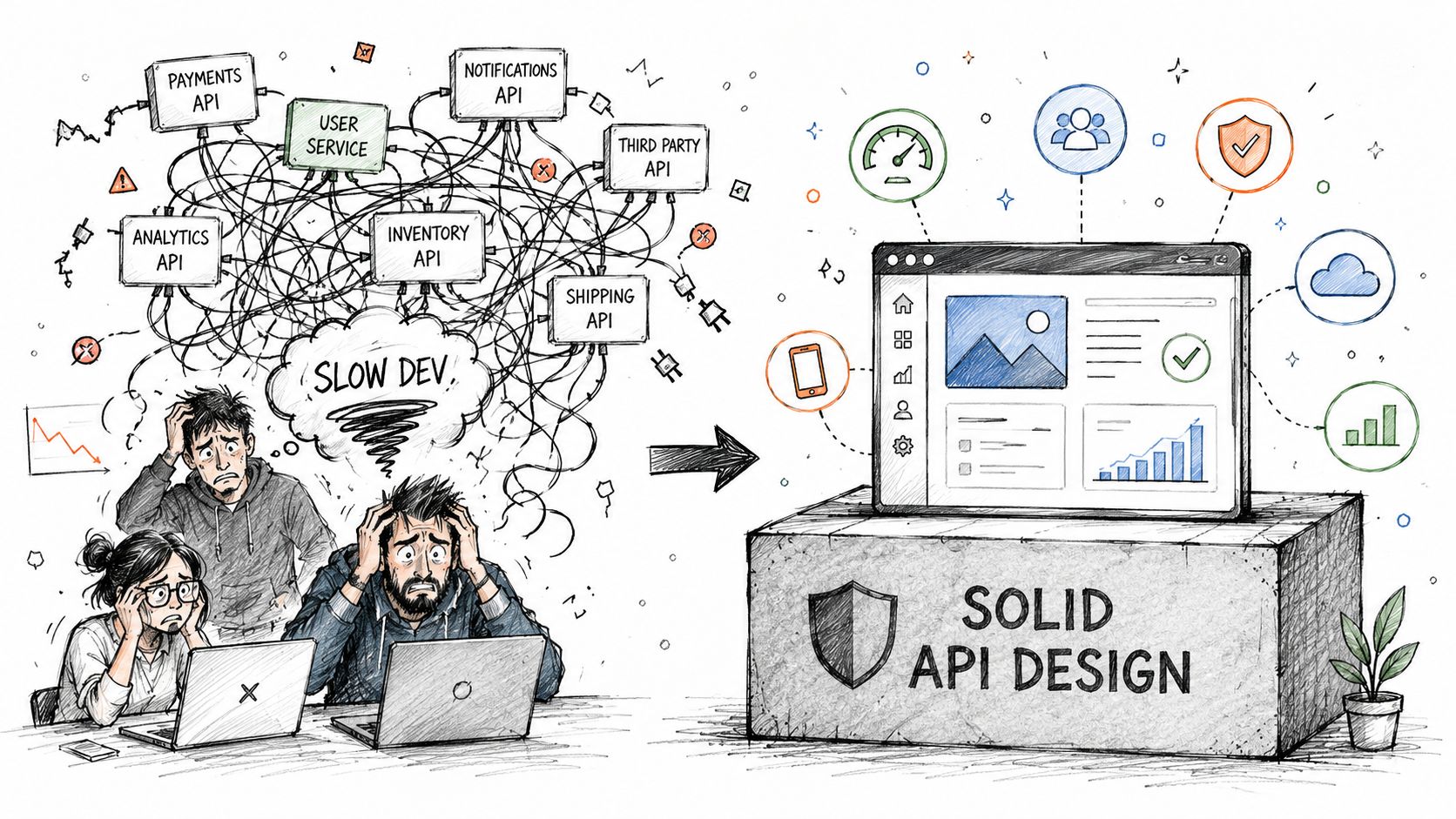
What bad foundations look like
Poor API design rarely announces itself on day one. It shows up later as friction:
- Inconsistent endpoints: One endpoint returns
snake_case, another returnscamelCase, and a third uses a different nesting pattern entirely. - Leaky abstractions: Clients need to know internal workflow steps just to perform a basic action.
- Unclear ownership: Nobody knows which team can safely change behavior.
- Fragile integrations: Every enhancement feels like a breaking change.
These aren't just technical annoyances. They slow delivery, increase QA burden, and make product bets more expensive.
Practical rule: If a frontend team needs tribal knowledge to use your API correctly, the contract isn't finished.
Why this matters more with AI in the mix
AI integrations amplify design flaws. A product that combines user data, business rules, model prompts, retrieval, and external AI providers needs clear boundaries between services. Without stable APIs, teams end up hardcoding behavior into clients or burying business logic in places that can't be governed well.
That's one reason modern AI-enabled products need operational tooling around interfaces, not just code. Prompt versioning, parameter controls for internal data access, cross-model logging, and spend visibility all depend on the same discipline that makes APIs durable. Build the contract cleanly, and those capabilities fit naturally. Skip the discipline, and modernization turns into a tangle fast.
The Core Tenets of Great API Design
Think of a great API like a well-organized kitchen. You shouldn't have to open six drawers to find a knife, and the stove controls shouldn't change shape every time you cook. The best APIs feel familiar quickly because they use the same logic everywhere.
One historical reason this pattern feels so natural is that the REST architectural style was formally defined by Roy Fielding in his 2000 doctoral dissertation, which is why modern REST APIs are typically organized around resources, not actions, and use standard HTTP methods such as GET, POST, PUT, PATCH, and DELETE, as summarized in Upsun's RESTful API design guidance.
Consistency beats cleverness
A clever API might impress its author. A consistent API helps every other developer move faster.
Use the same naming conventions, the same response envelope strategy, and the same status code logic across the platform. If /orders/{id} returns a certain structure, /customers/{id} shouldn't invent a new one unless there's a strong reason.
A few practical examples:
- Use nouns for resources:
/orders,/products,/customers - Use HTTP verbs for actions:
GETfetches,POSTcreates,PATCHchanges,DELETEremoves - Keep shapes predictable: Don't make one list endpoint return an array and another return an object with a totally different wrapper unless the contract requires it
Simplicity matters, but minimalism can go too far
Teams often hear “keep the API surface area small” and interpret that too strictly. Small is good. Incomplete is not.
A simple API is easy to understand. A simplistic API forces clients to stitch together awkward workarounds. If every real workflow requires three undocumented calls and client-side reconciliation, the design isn't elegant. It's underpowered.
Good APIs remove unnecessary choices. They don't remove necessary capability.
Developer experience is a business decision
When engineers can read an API and predict how it behaves, onboarding gets easier and defects drop. That translates into lower maintenance cost and faster iteration.
Here's a practical checklist I use when reviewing an API design:
- Can a new developer guess the endpoint name?
- Can they predict the response shape before reading every field?
- Do errors tell them what to fix next?
- Do similar resources behave similarly?
If the answer is “not really,” the API needs another design pass.
Discoverability and flexibility need to coexist
Clear documentation matters, but the structure should also help developers orient themselves without constantly checking docs. That means logical resource hierarchies, descriptive field names, and behavior that matches expectations.
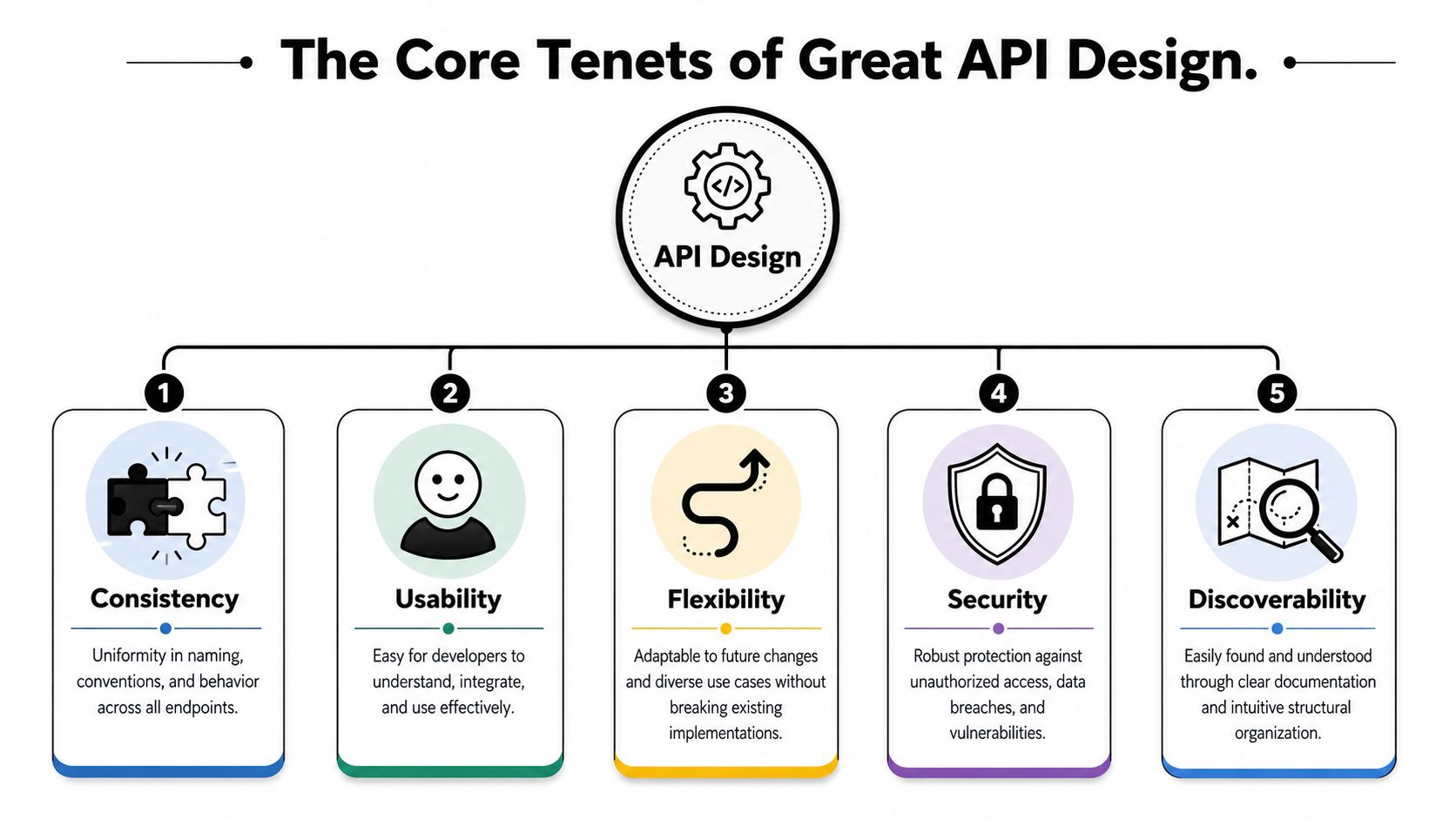
| Tenet | What it looks like in practice | Business outcome |
|---|---|---|
| Consistency | Standard naming, formats, and status handling | Faster delivery across teams |
| Usability | Predictable workflows and clear errors | Lower integration friction |
| Flexibility | Additive changes and room for growth | Better long-term fit |
| Security | Auth, validation, and logging designed in | Stronger trust and compliance posture |
| Discoverability | Intuitive structure and useful docs | Faster adoption |
Choosing Your Flavor REST vs GraphQL vs gRPC
Most architecture debates get derailed by labels. REST, GraphQL, and gRPC aren't identity choices. They're tools with different trade-offs. The right decision comes from your product shape, your team's skill set, and the kind of consumers you serve.
If you're building a public ecommerce API for partners, your priorities probably include predictability, broad compatibility, and easy onboarding. If you're wiring internal services that need fast, typed communication, your constraints are different. If your frontend needs to assemble complex views from many resources, the data-fetching model matters more.
The quick comparison
| Paradigm | Best For | Data Fetching | Performance | Complexity |
|---|---|---|---|---|
| REST | Public APIs, CRUD-heavy platforms, broad integrations | Fixed resource responses | Strong for common web patterns | Lower |
| GraphQL | Frontends with complex, variable data needs | Client requests exact fields | Efficient when query design is disciplined | Medium to high |
| gRPC | Internal services and high-throughput service communication | Contract-driven RPC calls | Strong for service-to-service communication | Higher for external adoption |
When REST is the right answer
REST remains the default for good reasons. It's easy to reason about, easy to cache, and widely understood by product teams, frontend teams, mobile teams, and partners.
Choose REST when you want:
- Straightforward resource modeling
- Clear HTTP semantics
- Broad ecosystem support
- Lower onboarding friction for external developers
REST also pairs well with governance. It's usually easier to standardize naming, auth patterns, error formats, and documentation across a large portfolio.
When GraphQL earns its keep
GraphQL shines when clients need flexibility in data fetching. A complex product detail page, account dashboard, or multi-pane admin interface may need data from several domains at once. In that situation, letting the client ask for exactly what it needs can reduce waste and simplify some frontend orchestration.
The trade-off is operational discipline. GraphQL can get messy if teams don't control schema growth, resolver performance, and authorization paths carefully. It gives clients power. That means your platform team needs guardrails.
When gRPC is the practical choice
gRPC is often a strong fit for internal systems where service-to-service communication matters more than public developer ergonomics. Typed contracts and efficient communication patterns are useful when many backend services need to talk to each other reliably.
It's less ideal as the primary interface for broad third-party adoption. Public consumers usually benefit more from the familiarity of HTTP-friendly contracts.
Pick the paradigm your consumers can succeed with, not the one your architecture diagram makes look sophisticated.
If your roadmap includes agent-driven buying, structured workflows, or machine-to-machine commerce experiences, it's worth reviewing Zinc's overview of the Agentic Commerce Protocol. It's a useful example of how protocol choices affect interoperability beyond a single app.
Security and Compliance by Design
Security failures in APIs usually start with a design shortcut. A rushed auth scheme. Incomplete authorization checks. Missing validation because “the frontend already handles that.” Those shortcuts don't stay small.
IBM notes that API design now includes endpoint definition, data modeling, standard error handling, and authentication methods such as API keys, OAuth, and JWT, reflecting how security has become a core design concern in modern API practice, as described in IBM's guide to API design.
Authentication is only the first gate
A secure API answers two different questions:
- Who are you? That's authentication.
- What are you allowed to do? That's authorization.
Teams sometimes solve the first and underinvest in the second. A valid token doesn't mean a client should access every account, every record, or every administrative action. The contract should make permission boundaries explicit.
For a deeper look at common patterns, Wonderment's guide to API authentication best practices is a useful companion read.
The controls that actually hold up
Good security design usually includes a stack of reinforcing habits rather than one magic mechanism.
- Use HTTPS only: Encryption in transit is the baseline, not a bonus.
- Validate every input: Never assume the client sent safe or well-formed data.
- Log meaningful events: Authentication attempts, denied access, and unusual request behavior should be visible.
- Return safe errors: Help legitimate developers fix requests without leaking sensitive internals.
Compliance starts in interface decisions
If you work in fintech, healthcare, or regulated commerce, compliance pressure lands on your API long before an auditor shows up. The payload shape, field naming, access model, and logging strategy all affect how well you can support privacy, auditing, and controlled access later.
A design that clearly separates public data, sensitive data, and privileged operations is easier to secure and easier to govern. That also builds trust with partners. They need confidence that your platform won't surprise them with vague permissions or inconsistent controls.
Security is part of developer experience. Partners trust APIs that are strict, clear, and boring in the best possible way.
Designing for Performance and Reliability
An API doesn't need to be “fast” in the abstract. It needs to stay responsive under real usage, degrade gracefully under stress, and avoid dragging your infrastructure into expensive work that clients never needed.
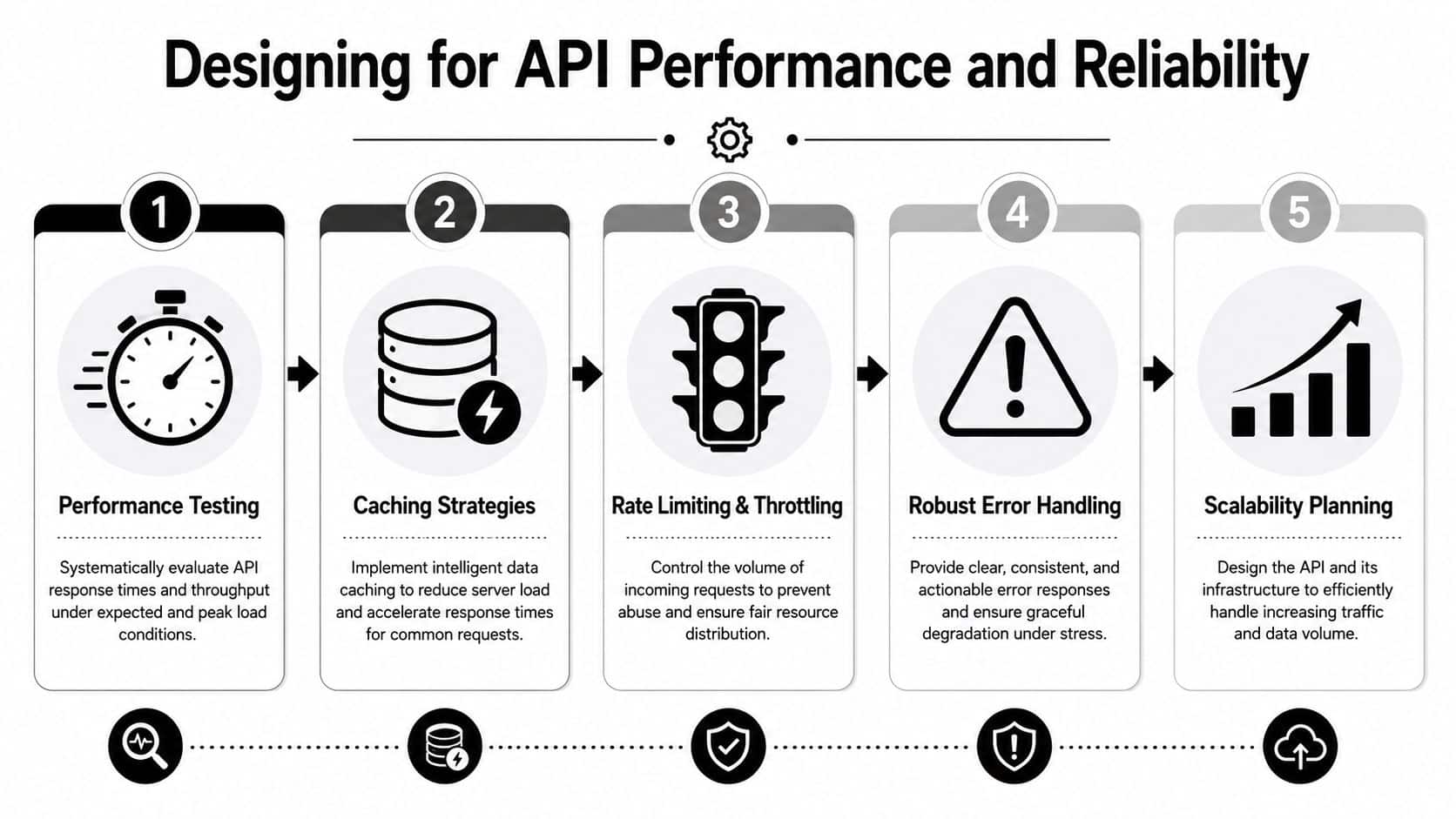
That starts with the contract. For high-traffic APIs, pagination, filtering, and caching are not optional design details. They directly control latency, bandwidth, and backend load. Gravitee's design guidance recommends limiting response size with pagination and supporting filtering so clients retrieve only the data they need, while rate limiting patterns such as 1000 requests/hour can help prevent abuse, with HTTP 429 used when limits are exceeded, as outlined in Gravitee's API design principles for product managers.
Start with bounded responses
If an endpoint can return “everything,” someone will eventually ask it to. That's how APIs become expensive.
Use patterns like:
- Pagination: Break large collections into manageable pages
- Filtering: Let clients narrow by relevant fields
- Sorting: Support stable ordering so pagination stays usable
- Partial response strategies: Return only what the client needs when that pattern fits your API style
Microsoft guidance mentioned in earlier source material also recommends defaults such as limit=25 and offset=0 for manageable pagination behavior. The point isn't the exact shape. The point is to make bounded access the default.
Reliability comes from operational restraint
Caching matters because repeated reads shouldn't always trigger repeated heavy work. Rate limiting matters because one noisy client shouldn't degrade the experience for everyone else. Clear error handling matters because clients need to know whether to retry, wait, or fix the request.
A practical reliability review often includes these questions:
- What happens when a client retries the same action?
- Which requests are safe to cache?
- Which endpoints are abuse-prone and need tighter quotas?
- Do error responses help clients recover correctly?
If the answers are fuzzy, production behavior will be fuzzy too.
Performance is also a cost conversation
API design has a direct effect on cloud spend, database pressure, and support effort. A bloated endpoint costs more to serve. A chatty mobile client costs more to support. An API that lacks caching and filtering pushes infrastructure to solve what contract design should have prevented.
Wonderment's article on improving application performance is worth reading alongside this topic because app performance and API performance usually rise and fall together.
Versioning Your API Without Breaking Things
Every product changes. The teams that handle change well aren't the ones that avoid evolution. They're the ones that design for it early.
One of the trickiest gaps in api design principles is balancing simplicity with extensibility. Fullstory's guidance points out that while many teams aim for a small surface area, long-term usability often requires deliberately exposing more capability early, because features are easier to add than to remove without breaking clients, as discussed in Fullstory's first-principles approach to API design.
Versioning is not the first tool
A lot of teams reach for /v2 too quickly. Sometimes that's necessary. Often it's a sign the original design was brittle.
Before creating a new version, try to preserve compatibility through additive change:
- Add new optional fields instead of changing existing ones
- Avoid reusing fields with changed meaning
- Keep existing behaviors stable
- Introduce new capabilities in new endpoints when necessary
That approach respects clients and reduces migration pain.
The common versioning options
Each strategy has trade-offs.
| Strategy | Strength | Weakness |
|---|---|---|
| URI path versioning | Easy to understand and document | Can create visible version sprawl |
| Header versioning | Keeps URIs cleaner | Harder for some consumers to test and debug |
| Query parameter versioning | Simple to add | Often less clean as a long-term convention |
There isn't a universal winner. Public APIs often benefit from visibility and simplicity. Internal ecosystems may accept more nuance if governance is strong.
A practical breaking-change checklist
When a breaking change is unavoidable, act like a product team, not just a code team.
- Define the change clearly: What exactly breaks, and for whom?
- Set a deprecation policy: Consumers need time and predictable communication.
- Provide a migration path: Docs, examples, and side-by-side behavior help.
- Watch usage closely: Don't turn off the old path blindly.
- Keep trust front and center: Partners remember surprise breakage for a long time.
Stability doesn't mean “never change.” It means clients can predict how change will happen.
Launching Your API and Taking Control
Shipping the first stable version is the midpoint, not the finish line. After launch, the real job begins. You need to know which endpoints get used, where clients fail, what latency looks like, and how behavior changes over time.
That's where many API teams underinvest. Many API design guides stop at the contract, but modern teams also need operational data. Recent guidance treats observability and API-as-a-product thinking as first-class concerns, focusing on telemetry, adoption, and error rates so an API remains safe to evolve after release, as described in Langate's API design best practices.

Operability is part of the design
A well-run API platform usually has these traits:
- Traceable requests: Correlation headers and logs help teams follow failures across systems.
- Actionable documentation: Developers can test and understand the contract quickly.
- Feedback loops: Teams review usage, support issues, and error trends.
- Governance after launch: Deprecations, policy changes, and release practices stay controlled.
If your docs are weak, your support queue becomes the documentation. A solid reference center prevents that. Wonderment's guide to technical documentation best practices is a good reminder that docs are product surface, not admin work.
AI products need the same discipline, plus tighter controls
Traditional API design and modern AI operations start to overlap. Once your application integrates multiple AI models, prompt templates, internal data parameters, and cost-sensitive workflows, you need a control plane. Teams benefit from a versioned prompt vault, parameter management for internal database access, unified logging across integrated AI systems, and a cost manager that shows cumulative spend. Those aren't side features. They're what make AI-enabled products governable over time.
That same mindset applies to APIs. Build for visibility, control, and safe evolution from day one, and your platform lasts longer with less drama.
If your team is modernizing an app, adding AI capabilities, or cleaning up a brittle integration layer, Wonderment Apps can help you design the right foundation. They build scalable web and mobile products, support AI modernization, and offer an administrative toolkit for prompt management, logging, parameter control, and spend visibility so your software doesn't just launch. It stays manageable.