

A fintech app can have a polished interface and still fail for reasons users never see. The risk engine may miss a suspicious transfer, a regional data rule may invalidate an otherwise sensible architecture, or an AI feature may expose sensitive information through an uncontrolled prompt. That's why fintech app development is a security, compliance, and systems-design discipline first, and a feature project second.
The market now operates at a scale that leaves little room for “we'll harden it later.” BCG reported that global fintech revenues surpassed $504 billion in 2025, growing 22% year over year, while its outlook projected approximately $1.5 trillion by 2030. BCG's global fintech update puts the engineering challenge in plain view: teams are building financial infrastructure for mass adoption, not a small experiment.
AI adds another layer of operational responsibility. A prompt vault with versioning, controlled parameters for internal data access, cross-model logging, and cumulative token-cost tracking can give product and engineering teams the administrative control they need before generative features spread across customer service, fraud analysis, and financial guidance. A demonstration of that kind of prompt management system should happen early, not after an AI feature has already become impossible to audit.
The Scale of Modern Fintech App Development
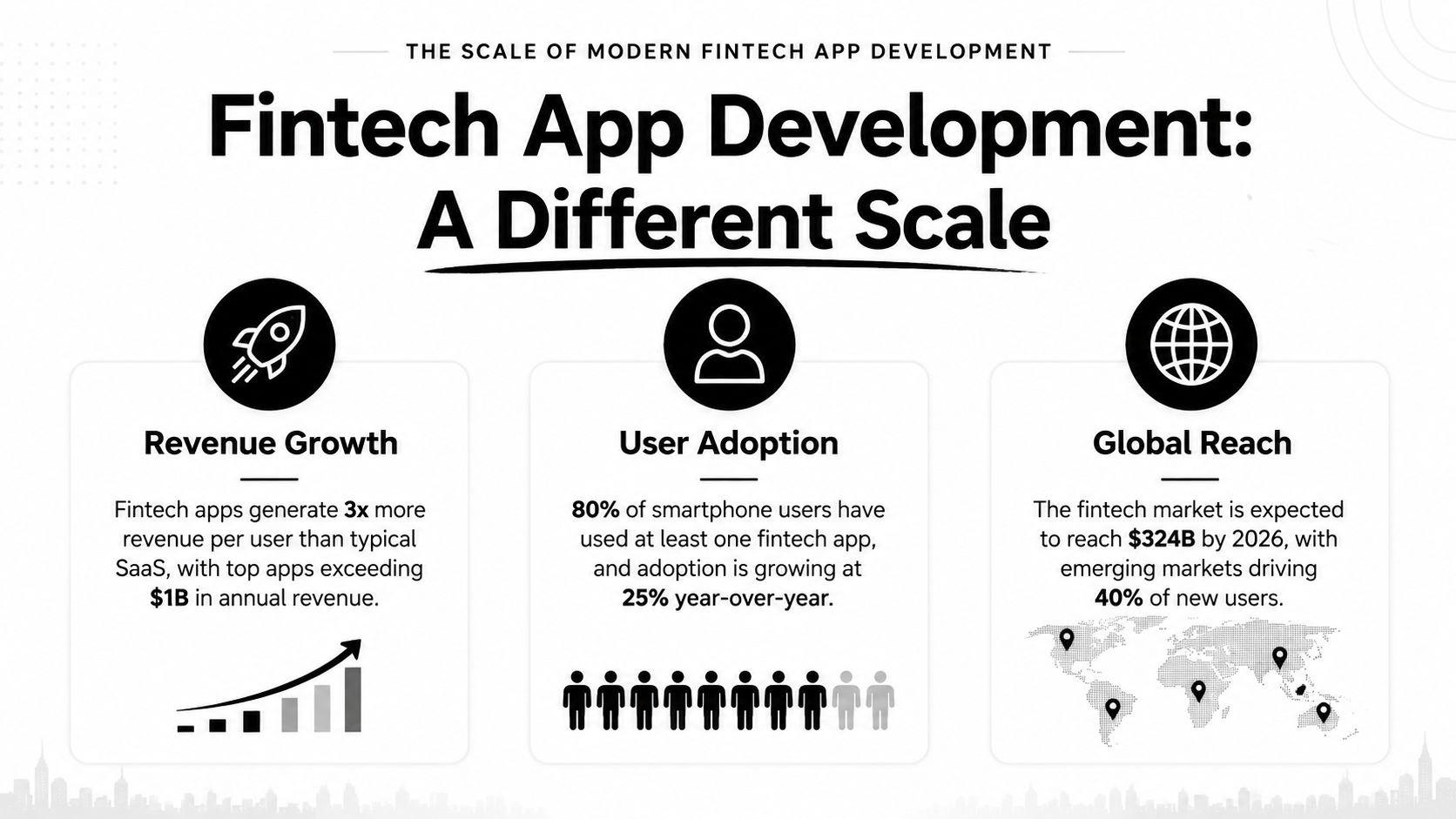
Global fintech has become a very large software market. BCG reported more than $504 billion in global fintech revenue in 2025, with 22% year-over-year growth, and projected that the sector could reach about $1.5 trillion by 2030. BCG's market update also noted that fintech expanded faster than incumbent financial institutions, which means product teams must prepare for rapid growth while handling the reliability expectations associated with financial services.
User behavior has reached the same scale. One 2026 industry summary reported more than 2.17 billion mobile banking users worldwide in 2025, an increase of 35% since 2020. A separate digital banking report said banking applications generated approximately 2.3 billion downloads worldwide in the 12 months ending May 2026, up 7% year over year. The same report found that 76% of consumers prefer digital banking, 54% use a mobile app first to manage an account, and 87% of checking accounts are associated with active digital banking users. These figures are reported in Woodstone Research's fintech market summary.
Why mainstream usage changes the build
A typical SaaS product can often tolerate a limited feature set, delayed processing, or a manual support workaround during early adoption. A financial app has less tolerance. Users expect balances, transaction status, authentication, alerts, and support to remain dependable when money is moving.
That expectation changes the starting architecture:
- Availability becomes a product feature. A payment or banking outage is visible immediately, so teams need health checks, controlled degradation, reconciliation workflows, and clear operational ownership.
- Trust must survive every screen. A confusing balance view or opaque verification step can create support volume and abandonment even when the underlying transaction is correct.
- Scale includes complexity, not just traffic. Mobile banking, payments, lending, and wealth products may involve different rails, risk policies, currencies, jurisdictions, and data-retention requirements.
- The app and backend must evolve together. Authentication, ledger behavior, notifications, fraud controls, and audit records are coupled. Treating them as isolated features creates expensive rework.
The practical lesson is simple: design for financial correctness and operational visibility from the first release. You don't need every advanced feature on day one, but you do need the foundations that prevent a successful product from becoming a fragile one.
Regulatory Requirements That Shape Architecture
Compliance isn't a document your team attaches to a finished application. In regulated fintech, it changes the shape of the product, the event model, and the authentication pipeline.
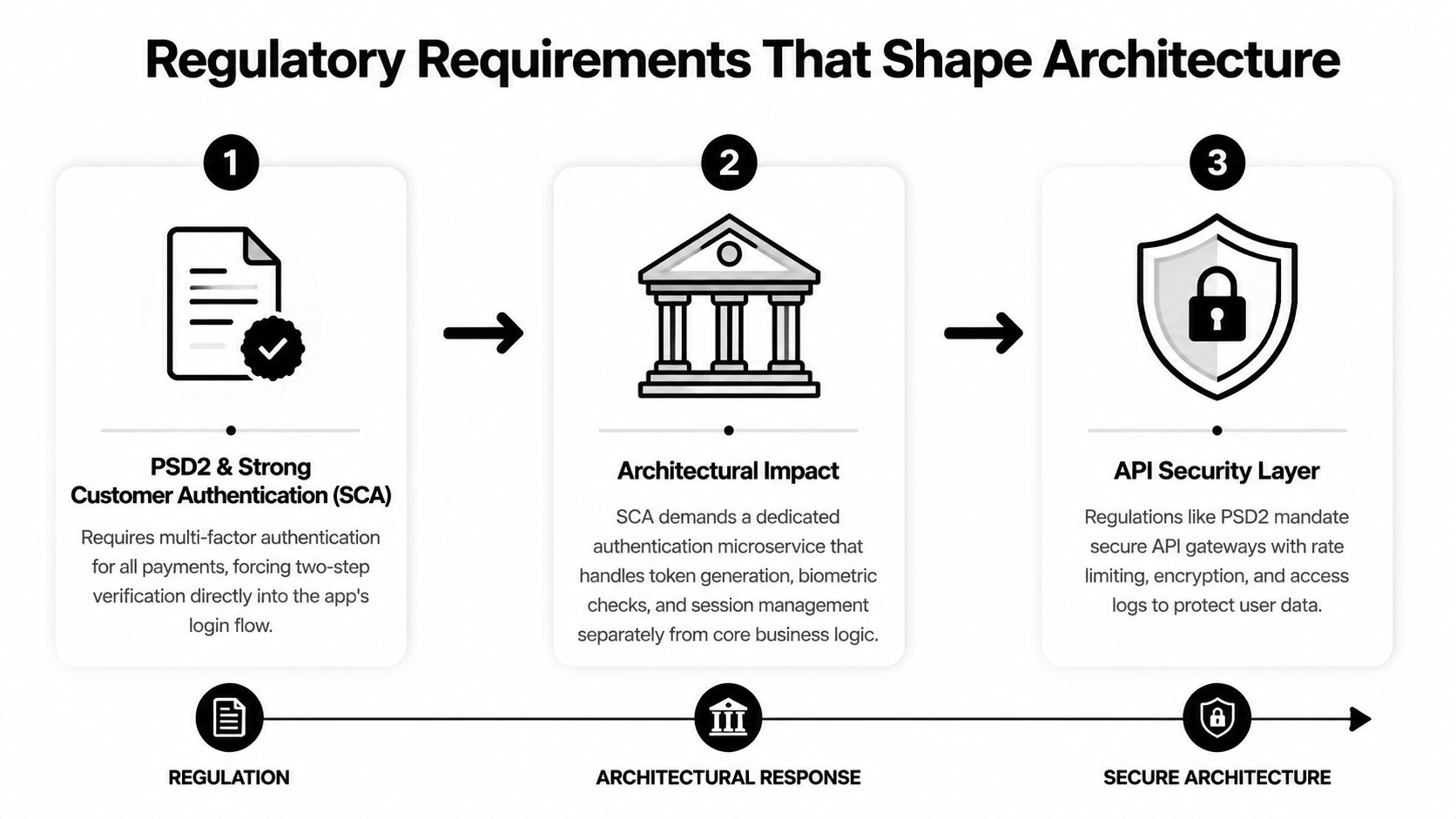
Under PSD2, strong customer authentication applies when a payer accesses a payment account online, initiates an electronic payment, or performs a remote action that may imply fraud risk. The European Banking Authority also requires transaction-monitoring systems capable of detecting unauthorized and fraudulent payment transactions. The PSD2 mobile strong customer authentication guidance shows why authentication belongs inside the transaction lifecycle, not only on the login screen.
Turn regulatory language into services
A sound implementation separates authentication orchestration from core financial logic. That service should be able to evaluate context and route a user through an appropriate challenge, such as 3DS, an OTP, biometrics, or device binding, without forcing the payment service to understand every interface detail.
The transaction pipeline should emit events for:
- Account access and session creation.
- Payment initiation and authorization.
- Changes to beneficiary, device, profile, or security settings.
- Challenge presentation, completion, failure, and abandonment.
- Risk decisions, overrides, and post-transaction review.
Those events support risk scoring, anomaly detection, low-latency decisioning, and an audit trail. They also make it possible to measure whether a control protects users or merely interrupts them.
The EBA's technical standards publish reference fraud-rate thresholds including 0.01%, 0.005%, and 0.06%, depending on transaction type and amount band. The EBA's final draft technical standards.pdf) make the engineering implication clear: fraud rate isn't only a business report; it's a platform metric that must be segmented and monitored.
Practical rule: Measure challenge rate, authentication success, authorization outcome, and fraud rate by payment rail, geography, amount band, and journey step. A single global average hides the places where controls fail.
Regional compliance also affects tokenization, custody, identity, and reporting. Teams working on regulated assets may find Blocsys Technologies' guidance on building FCA compliant tokenization platforms useful when mapping product requirements to jurisdiction-specific controls.
Building Architecture That Scales to Millions
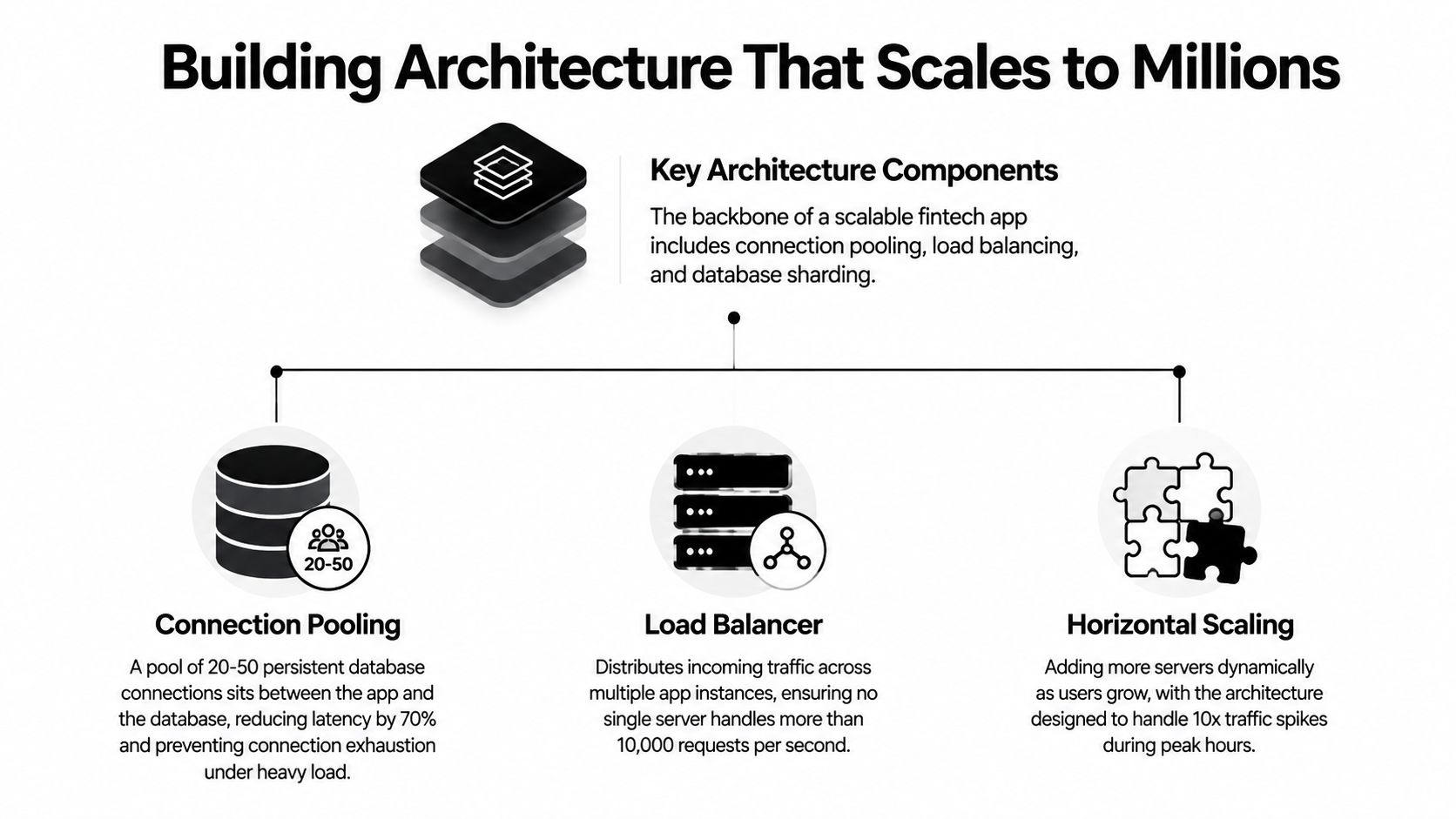
Scale failures in fintech usually begin with ordinary infrastructure decisions. An application opens too many database connections, sends every read and write to the same path, or retries a money-moving request without a stable idempotency key. The system may look fine in testing and then behave unpredictably during a transaction spike.
Put connection management in the critical path
Connection pooling should sit between the application and the database before launch. The pool limits concurrent database sessions, reuses established connections, and prevents each application instance from creating an uncontrolled demand for database resources. Skynite's scalability guidance emphasizes this pattern alongside early separation of read-heavy and write-heavy workloads.
A practical design usually gives the ledger and transaction writer a conservative, strongly consistent path. Read models, statement views, search, and reporting can use separately tuned infrastructure where the product permits it. That separation reduces contention without pretending that every financial read can tolerate stale data.
Protect money movement from retries
Every endpoint that can create a transfer, charge, withdrawal, or account mutation should accept an idempotency key. The backend stores the outcome associated with that key and returns the original result when the client retries. This protects users from double charges caused by double taps, mobile reconnects, queue redelivery, or a timeout that occurs after the provider has accepted the request.
Other architectural choices matter just as much:
- Use a durable ledger boundary. Treat financial entries as append-oriented records with explicit reconciliation rather than mutable balance fields scattered across services.
- Queue noncritical work. Notifications, analytics enrichment, and some reporting tasks shouldn't block the authorization path.
- Make failure visible. Monitor queue age, database saturation, provider latency, reconciliation exceptions, and idempotency conflicts.
- Design controlled degradation. If a third-party service is unavailable, the app should explain whether a transaction is pending, rejected, or safe to retry.
Microservices can help teams isolate payment, identity, fraud, and notification responsibilities, but they don't automatically create resilience. A small number of well-bounded services with clear ownership often works better than a distributed maze that nobody can reconcile.
Integrating Payments, KYC, and Fraud Detection
The build-versus-buy decision is most useful when applied to boundaries. Payment processing, identity verification, and fraud controls all carry specialist maintenance obligations, but outsourcing every decision can leave the product with poor portability and limited control.
| Integration Type | Build Approach | Buy Approach | Hybrid Approach |
|---|---|---|---|
| Payments | Maximum control over orchestration, ledger behavior, and user experience, but significant compliance and operational responsibility | Faster access to established rails, operational tooling, and provider support, with dependency and fee trade-offs | Use providers for rails while owning orchestration, ledger mapping, retries, and reconciliation |
| KYC | Custom workflows can fit unusual customer segments and regional rules, but require deep verification expertise | Faster document and identity coverage, with vendor dependency and possible data-residency constraints | Combine a primary provider with internal policy orchestration and a controlled fallback |
| Fraud detection | Tailored models and rules can reflect proprietary risk signals, but require quality data and ongoing review | Faster deployment and specialist capabilities, with less model transparency | Use vendor signals as inputs to an internal decision layer with explainable policies |
A provider abstraction layer should normalize statuses, error codes, webhooks, and evidence records. Your core domain shouldn't know whether a provider calls a result “approved,” “clear,” or “verified.” Store the provider response, map it to an internal state, and retain enough context for support, reconciliation, and regulatory review.
For payment gateways, Tagada's gateway integration advice is a useful reference point for thinking through the operational details that sit beyond the first successful API call. Provider selection should include support responsiveness, incident communication, webhook reliability, sandbox quality, settlement reporting, regional coverage, data handling, and contractual service commitments.
Teams should also plan for provider failure. A fallback can mean a second processor, a queued transaction, a manual review route, or a clear “pending” state. It shouldn't mean submitting the same payment to multiple providers without notice, which can create duplicate authorization and reconciliation problems.
Fraud detection needs its own operating model. Product, risk, compliance, and engineering teams should agree on who can change a rule, how changes are tested, and how false positives are reviewed. For implementation patterns, the fraud detection systems guide offers a relevant companion resource.
Security as a Product-Defining Design Problem
Security added after feature development is expensive because identity and risk decisions influence nearly every user journey. A recent independent report found that 60% of financial institutions saw fraud increase in the past year, with enterprise banks near 70%, and that one in three institutions lost more than $1 million to fraud. Those figures are presented in DesignRush's fintech fraud and identity coverage.

Start with identity, not controls
An identity-first design begins by establishing what the system knows about the user, device, session, account, beneficiary, and transaction. The app can then apply proportionate controls rather than forcing every customer through the same sequence.
That means separating several decisions:
- Identity proofing: Is this person who they claim to be?
- Authentication: Is the current actor allowed to access the account?
- Authorization: Is this actor allowed to perform this action?
- Risk evaluation: Does this action fit the established behavior and context?
- Response: Should the system allow, challenge, delay, decline, or escalate?
This model supports better user experience because low-risk activity can remain quiet while unusual behavior receives targeted scrutiny. It also creates a clearer audit trail than a collection of disconnected security checks.
Security should narrow uncertainty before it adds friction.
AI-enabled features and instant payments raise the stakes because decisions happen quickly and data may move through more systems. A chatbot that can access account information needs strict tool permissions. A fraud model needs controlled features and reviewable outputs. A recommendation engine shouldn't receive raw data just because it makes integration easier.
Treat security as part of product design by testing the user journey under challenge, failure, recovery, and appeal conditions. The safest flow isn't necessarily the one with the most prompts. It's the one that gives the system enough trustworthy context to make a defensible decision.
Integrating AI Features with Compliance and Control
AI can improve fraud review, customer support, document processing, and personalization, but regulated applications need more than a model endpoint. They need token-level governance, data boundaries, and a record of how an output was produced.
Sensitive prompts can expose account information, internal schemas, business rules, or personally identifiable data. A safer pattern centralizes prompt storage, versioning, permissions, and model selection rather than allowing every feature team to hard-code its own prompt in application logic.
Build an administrative control plane
A practical AI control plane should include:
- A prompt vault with versioning. Store approved prompts, owners, change history, environment status, and rollback options. A production prompt should be identifiable and reproducible.
- A parameter manager for internal database access. Keep query permissions, field allowlists, retrieval limits, and environment-specific settings outside ad hoc prompt text.
- Cross-model logging. Record which model received a request, which approved prompt version was used, what tools were called, and what policy checks ran.
- A cumulative cost manager. Track usage by model, feature, environment, tenant, and period so leaders can see spend before it becomes an unpleasant surprise.
- Data minimization and redaction. Pass only the fields a task needs, remove sensitive values where possible, and block unapproved tool calls.
These controls are especially important when multiple AI providers serve different tasks. The model may change, but the policy boundary should remain owned by your platform.
For audit preparation, teams can use the compliance audit checklist alongside application-specific evidence requirements. The checklist doesn't replace legal advice, but it reinforces a useful engineering habit: every important control should produce evidence that a reviewer can understand.
Wonderment Apps offers an administrative prompt management system that can plug into an existing application. Its stated capabilities include a versioned prompt vault, parameter management for internal database access, logging across integrated AI systems, and cost management for cumulative spend, making it a practical option for teams modernizing regulated software without scattering AI governance across feature repositories.
Hiring and Scaling Development Teams
Fintech teams need developers who can explain why a system behaves safely, not only developers who can make it compile. A strong engineer should be comfortable with secure authentication, distributed systems, auditability, incident response, and the limits of third-party services.
Vague interviews don't test that combination. Structured screening works better because it lets the team evaluate the skills the product needs.
Create a deliberate hiring process
Start by defining exact roles and ownership. Depending on the product, that may include mobile engineering, backend and ledger engineering, platform reliability, security, quality assurance, product management, and compliance operations. A candidate shouldn't be assessed against an undefined expectation that they somehow cover everything.
Use practical evaluation:
- Coding assessment: Test correctness, error handling, and maintainability rather than puzzle memorization.
- Architecture discussion: Ask the candidate to design an idempotent transfer flow, a provider abstraction, or an auditable authentication service.
- Security review: Present a deliberately flawed API or data flow and ask what they would change.
- Technical team participation: Engineers who will work with the candidate should help evaluate code and collaboration.
- Continuous pipeline: Maintain an always-interviewing process so deadlines don't force rushed hiring.
The guidance on hiring a dedicated development team provides useful context for choosing between an internal team, a dedicated partner, and targeted augmentation.
Onboarding should include the product's regulatory boundaries, data classifications, incident process, release controls, and domain vocabulary. Code review templates can require checks for authorization, idempotency, logging, secrets handling, and failure behavior. Documentation should serve both developers and reviewers, with decisions tied to evidence rather than tribal knowledge.
Scaling headcount without scaling communication creates its own risk. Keep service ownership clear, make architectural decisions searchable, and give compliance and security reviewers a predictable path into delivery rather than inviting them only before launch.
Your Fintech App Development Roadmap
A reliable roadmap sequences risk before polish.
Phase one, define the boundary. Choose the financial use case, launch jurisdictions, user roles, transaction types, data classes, and external providers. Write down what the first release won't do, because unclear scope creates compliance ambiguity.
Phase two, establish the foundation. Design identity, authentication orchestration, authorization, ledger behavior, idempotency, audit events, connection management, and provider abstractions before expanding the feature list.
Phase three, validate the controls. Map each regulatory obligation to an owner, an implementation, a test, and retained evidence. Test normal transactions, retries, provider outages, suspicious behavior, account recovery, and regional variations.
Phase four, add intelligence carefully. Introduce AI behind approved prompts, controlled parameters, redaction, model logs, access policies, and spend monitoring. Keep human review available for decisions that carry material risk.
Phase five, scale the operating team. Use structured assessments, clear service ownership, technical review, incident exercises, and release checklists. Measure reliability and fraud outcomes alongside conversion, because a fast journey that cannot be trusted isn't a successful fintech product.
The right balance is not “move fast” versus “be compliant.” It's build a narrow product on durable foundations, then expand through measured change. That approach protects the user journey and gives engineering, risk, and leadership a shared way to decide what ships next.
Wonderment Apps helps organizations modernize fintech software through secure web and mobile development, AI integration, UX-led delivery, and administrative controls for prompts, integrations, logging, and token costs. Visit Wonderment Apps to discuss an architecture, development team, or AI modernization plan built for compliance and long-term scale.