


You're deciding whether the next product should use React, while your existing application already has a different problem: slow releases, inconsistent components, rising AI costs, or a legacy frontend nobody wants to touch. The obvious question is, “Can React build the new experience?” The more useful question is whether your team can operate, secure, test, and modernize that experience for years.
That's what serious React development services should provide. You're not buying JSX in isolation. You're buying architectural judgment, product design, delivery capacity, quality assurance, performance work, and a plan for what happens after launch. Modern partners are also adding AI modernization tools to that package. For example, Wonderment Apps' prompt management system is designed to help teams connect AI capabilities to existing software while controlling prompts, data access, activity logs, and model spending.
React remains a powerful default, but popularity alone isn't a strategy. The right partner will help you decide where React belongs, where a simpler approach would be wiser, and how to turn an application into durable business infrastructure rather than another short-lived rewrite.
Why React Development Services Matter in 2026
A product leader at an ecommerce company might start with a familiar brief: build a fast storefront, add personalization, support mobile users, and create an internal dashboard for merchandising. The team chooses React because it's widely understood. Then the work begins. The storefront needs accessible components, the dashboard needs complex state, the mobile experience needs a shared development strategy, and the old checkout code must keep working during the transition.
React has become infrastructure-level technology rather than a niche experiment. React was publicly released in May 2013, after beginning as an internal Facebook project. In the State of JavaScript 2024 libraries survey, React was used by 82% of respondents and recorded a 75% retention rate. The same survey placed React among only three libraries with more than half of respondents reporting usage while also maintaining retention above half. For a business, that combination matters because it supports hiring, staffing, maintenance, and modernization across a mature professional ecosystem.
The service is bigger than the library
A capable React partner helps you make decisions that surround the code:
- Architecture: Decide between a single-page application, server rendering, server components, or a more selective component strategy.
- Product experience: Translate workflows into accessible navigation, responsive layouts, useful feedback states, and interaction patterns that users understand.
- Delivery capacity: Add engineers, designers, QA specialists, or project managers without forcing your internal team to coordinate every task.
- Modernization: Replace fragile screens incrementally instead of betting the business on a risky rewrite.
- Operations: Establish testing, observability, deployment, security, and support practices before production incidents teach those lessons expensively.
Practical rule: Hire a partner for the decisions your team must live with after launch, not simply for the number of React developers it can place on a project.
React's web footprint reinforces the size of the installed base. W3Techs reported on 21 August 2026 that React appeared on 7.9% of websites where the JavaScript library could be identified, equivalent to 6.1% of all websites worldwide according to its React technology history data. That installed base creates ongoing demand for upgrades, dependency work, testing, and support.
The opportunity also includes AI modernization. A development partner can add intelligent search, recommendations, content assistance, or workflow automation, but those features need prompt ownership, access controls, traceability, and cost visibility. Treat AI as part of the application's operating model, not as a decorative chatbot bolted onto a React screen.
What React Development Services Include
React development can mean one engineer building a component or a multidisciplinary team delivering a production product. Those are different purchases. Define the business outcome, technical boundaries, and decisions the partner must own before comparing vendors.
A serious engagement can include:
- Discovery and UX: User journeys, information architecture, wireframes, design systems, accessibility requirements, and acceptance criteria.
- Component architecture: Reusable components, composition rules, naming conventions, design tokens, and boundaries between presentation and business logic.
- State and data management: Local and shared state, server-state caching, forms, optimistic updates, error handling, and authorization-aware views.
- Performance engineering: Bundle analysis, code splitting, lazy loading, rendering strategy, image handling, caching, and controls that limit unnecessary client-side work.
- Quality assurance: Unit, integration, and end-to-end tests, accessibility checks, regression coverage, and release validation.
- Delivery and support: CI/CD, environment management, monitoring, incident response, documentation, dependency upgrades, and post-launch maintenance.
For a workflow-heavy product, a modern React single-page application can support frequent in-app interactions. The architecture still needs deliberate routing, loading states, browser history, accessibility, and search visibility. Use this guide to React single-page application development to assess whether a SPA fits the product instead of accepting it as the default.
Industry requirements change the shape of the work
An ecommerce platform needs fast product discovery, resilient carts, experimentation, personalization, and checkout flows that preserve context. A fintech dashboard needs strict permission boundaries, reliable data presentation, auditability, and defensive handling of sensitive actions. A SaaS product needs reusable interaction patterns, workspace isolation, billing states, onboarding, and frontend boundaries that can absorb new modules without becoming difficult to maintain.
React Server Components can help with data-heavy pages where interactivity is limited. They render ahead of time in an environment separate from the client application or server-rendered application, reducing client-side JavaScript work and potentially lowering main-thread pressure as described in this React performance discussion. Treat this as an architectural decision, not a performance switch. The team must still define data boundaries, loading behavior, caching, and the interface areas that require client interactivity.
React Development Service Tiers
| Service Tier | Core Deliverables | Team Composition | Best For |
|---|---|---|---|
| Focused implementation | Components, screens, API integration, and basic testing. Usually 4–8 weeks with one React engineer and client-side product direction. | React engineer with client-side product direction | A defined feature or contained frontend gap |
| Product delivery | UX, architecture, React implementation, QA, and deployment support. Often a multi-month engagement with engineers, a designer, QA, and a delivery lead. | Engineers, designer, QA, and delivery lead | A new product or substantial product area |
| Modernization partnership | Technical assessment, migration plan, incremental delivery, observability, and ongoing support. Structured as a longer program with senior engineers and specialist support. | Senior engineers, QA, product leadership, and specialist support | Legacy platforms, regulated products, and long-lived applications |
Match the tier to the consequences of failure. A $2M payment migration with regulatory exposure needs senior review even if the implementation is narrowly scoped. Ask each vendor who approves architecture, who owns release readiness, what your team must provide, and how they will demonstrate reliable behavior under real operating conditions. AI features require the same discipline, including prompt ownership, access controls, traceability, and cost visibility.
Choosing the Right Engagement Model
The engagement model determines who carries delivery risk, who manages the work, and how quickly you can change direction. Pick it before you discuss staffing numbers. Otherwise, you'll end up solving a relationship problem with more engineers.
Dedicated teams
A dedicated team fits a product that will evolve continuously. The same engineers build context around your domain, product decisions, technical constraints, and users. This model works well for a startup moving from MVP to a larger product, or an enterprise modernizing a core platform across multiple releases.
The trade-off is management responsibility. You'll need product ownership, prioritization, access to subject-matter experts, and a clear decision process. A dedicated team can provide continuity, but it can't compensate for an organization that changes direction without resolving priorities.
Project-based delivery
Project-based work suits a defined outcome with a firm boundary, such as rebuilding a customer portal, launching a new commerce experience, or delivering a specific dashboard. The partner can organize the team around milestones, acceptance criteria, and a release plan.
This model reduces long-term coordination, but scope clarity becomes critical. If the underlying requirements are uncertain, insist on a discovery phase before committing to a fixed delivery plan. Otherwise, every unresolved product decision becomes a change request or a quality compromise.
Staff augmentation
Staff augmentation makes sense when your internal team owns the roadmap but lacks a specific capability. You might need a React architect for a migration, a QA engineer for release hardening, or a frontend specialist who can work inside an established delivery process.
The model gives you flexibility, but your company retains more management overhead. You must supply tickets, technical direction, reviews, access, and feedback. For a broader comparison of responsibility, control, and operating fit, use this guide to staff augmentation versus managed services.
| Situation | Recommended model | Why |
|---|---|---|
| Startup validating a product direction | Project-based delivery, then dedicated support if traction follows | Keeps the initial outcome focused while preserving a path to continuity |
| Enterprise replacing legacy screens | Dedicated team or managed project | Modernization requires context, sequencing, testing, and sustained ownership |
| Internal team facing a temporary skill gap | Staff augmentation | Adds targeted expertise without changing the entire operating model |
Ask each partner who owns prioritization, who approves architecture, how defects are handled, and what happens when the scope changes. Their answers reveal more than a polished capabilities deck.
How to Evaluate React Development Partners
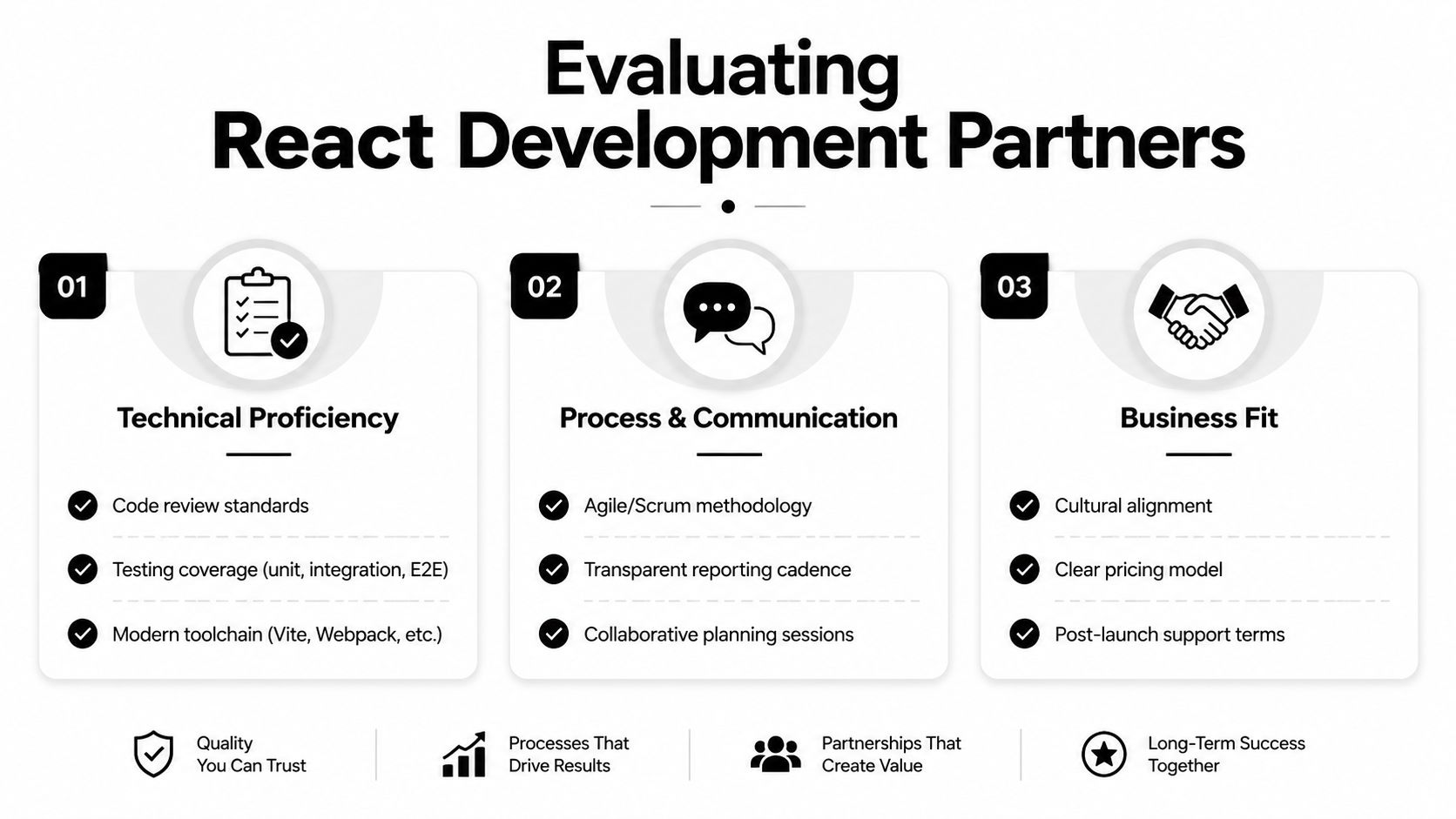
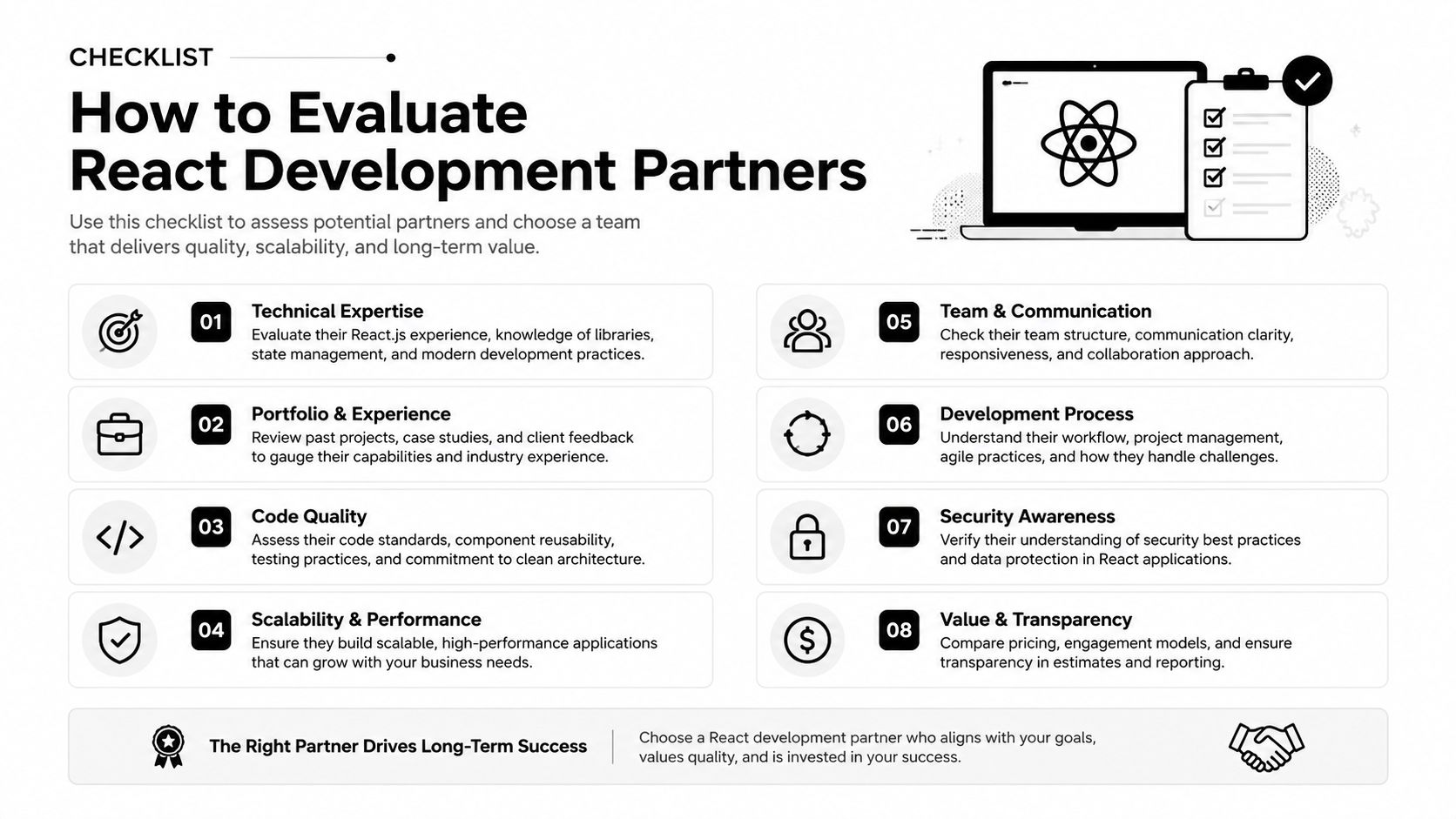
Start with a technical working session, not a portfolio slideshow. Give the candidate a representative problem from your product, such as a permission-sensitive dashboard, a slow data table, or a legacy screen that must be replaced without disrupting users. Ask the team to explain its assumptions, trade-offs, testing plan, and release strategy.
Examine engineering habits
Look for practical fluency with modern React patterns, including hooks, context, component composition, server-state management, and server components where they fit. You don't need a vendor to use every new tool. You do need evidence that the team can explain why it selected a tool and what complexity that choice introduces.
Request examples of:
- Code review: Who reviews pull requests, what standards apply, and how does the team prevent rushed changes from reaching production?
- Testing: Which behavior receives unit, integration, and end-to-end coverage, and how does QA participate before release?
- Performance: How does the team identify oversized bundles, unnecessary rendering, slow data paths, and poor behavior on constrained devices?
- Accessibility: How are keyboard navigation, semantic structure, focus management, and assistive technologies included in acceptance criteria?
- Operations: What logs, alerts, rollback procedures, and ownership rules exist after launch?
The candidate should discuss failure modes without prompting. A vendor that only shows successful launches hasn't demonstrated that it knows how to recover from a difficult one.
Test the business relationship
Technical ability won't rescue a partnership with poor communication. Ask how often you'll receive progress reports, where decisions are recorded, how risks are escalated, and who attends planning and review meetings. Confirm whether the people in the sales process will remain involved after the contract begins.
The HackerRank hiring checklist recommends a stage-gated process that includes blind resume review, standardized interview questions, independent scoring before a debrief, and a 21-day path from job posting to offer. Those mechanics also help businesses evaluate development partners objectively. Score candidates against the same criteria, separate individual impressions from evidence, and require written reasons for the final decision.
Red flags include guaranteed delivery without discovery, vague answers about testing, reluctance to show code review practices, rotating teams, unclear post-launch terms, and estimates that ignore integration or migration risk. Ask for references from clients with similar operational constraints, not only visually impressive products.
When React Might Not Be the Right Choice
React's adoption is strong, but developer enthusiasm has softened. Stack Overflow survey coverage reported that React usage rose from 39% to 44%, while admiration fell from 62% to 52% and desired use declined from 33% to 30% in the cited survey coverage. Those figures don't make React a bad technology. They do challenge the lazy argument that the most-used option is automatically the most satisfying or maintainable choice.
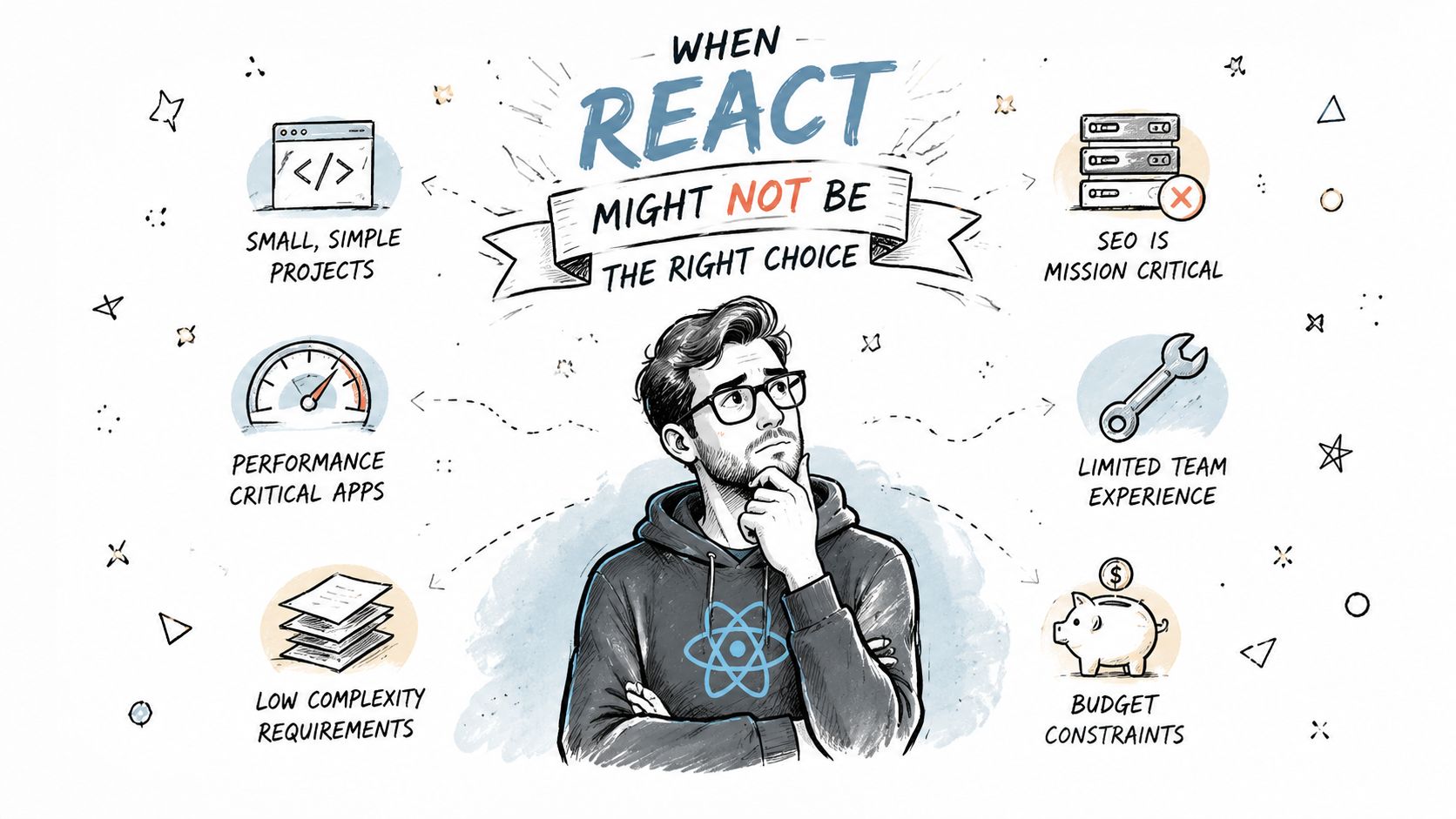
React can add unnecessary machinery to a simple content site, a straightforward administrative interface, or a server-heavy application that needs only modest interactivity. If your team already works effectively with a server-rendered stack and the product doesn't require complex client-side state, adding a large frontend architecture may create more maintenance than value.
A smaller or more opinionated approach may also suit teams that prioritize convention over flexibility. Hybrid architectures can be sensible, with server-rendered pages handling ordinary workflows and React reserved for interactive areas. The best choice depends on the product's interaction model, the team's existing expertise, the deployment environment, and the expected pace of change.
Make the decision against requirements
Choose React when you need reusable interactive components, advanced client-side workflows, shared web and mobile expertise, or a substantial ecosystem for a complex product. Be cautious when your main requirement is publishing content, rendering simple forms, or delivering a limited interface with minimal state.
For teams weighing mobile alternatives, a practical comparison of Flutter vs KMP vs MAUI can help frame the decision around platform strategy rather than familiarity. React Native is useful, but it isn't the only credible route to mobile software.
Popularity reduces hiring friction. It doesn't remove architectural complexity.
Ask two questions before approving React: what user problem requires its flexibility, and what team will own the resulting complexity? If the answers are weak, choose the simpler stack and spend the saved effort on accessibility, reliability, and product quality.
Integrating AI into React Applications
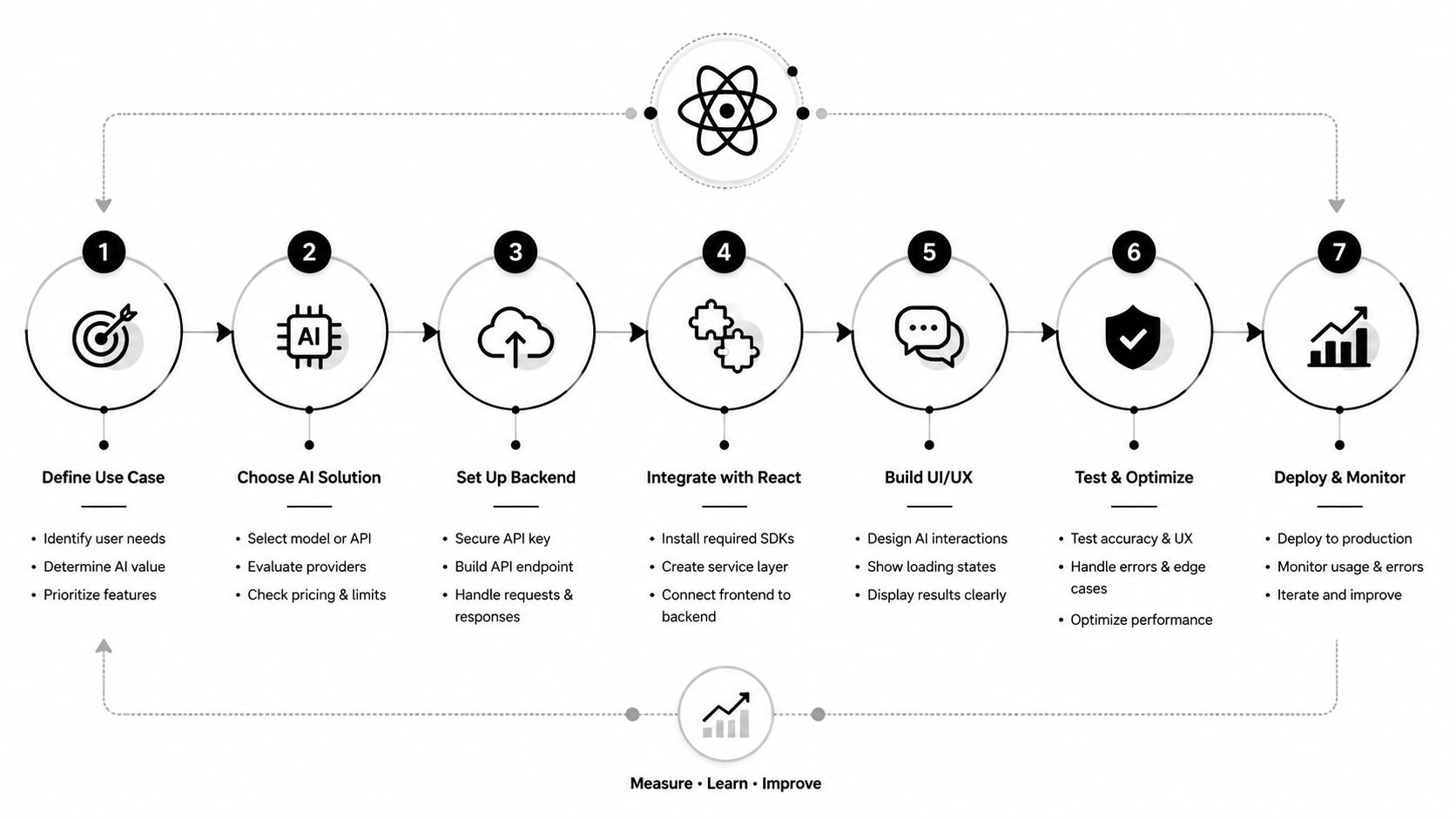
AI features become valuable when they remove friction from a real workflow. In a React application, that might mean intelligent search across a product catalog, personalized recommendations, assisted content creation, document classification, anomaly detection, or a support interface that can use approved business data.
The frontend needs more than a text box and an API call. AI responses arrive incrementally, fail unpredictably, and may require user review. React teams must design loading states, cancellation, retries, partial output, citations, permissions, and clear boundaries between generated suggestions and committed business actions.
Design the application around controlled data flow
Keep model calls behind a server-side boundary whenever prompts include sensitive business data or credentials. The server should enforce authorization, select approved models, validate parameters, and record useful events. The React client should present the interaction clearly without becoming the place where governance rules are hidden.
State management needs equal care. Treat an AI request as a lifecycle with input, pending status, streamed or completed output, validation, user correction, and final persistence. For desktop and mobile applications, preserve graceful behavior when connectivity drops, avoid blocking the main interface, and make it obvious when the system is generating rather than confirming.
Authentication deserves specific attention when AI agents interact with browser sessions or protected workflows. Teams designing those flows can consult how to handle MFA for AI agents, especially when automated actions must respect existing security controls.
Add governance before the feature spreads
Wonderment Apps' prompt management system is one example of an administrative layer for AI-enabled software. It includes a prompt vault with versioning, a parameter manager for internal database access, a logging system across integrated AI systems, and a cost manager that shows cumulative spending. Those controls help teams compare prompt changes, restrict data access, investigate outputs, and understand operational costs as AI features expand across a product.
The business case for AI integration is concrete, but speed isn't guaranteed. A 2024 MIT Sloan summary of GitHub Copilot field experiments reported that access to the tool increased completed weekly tasks by 26% on average, with junior developers gaining 27% to 39% and senior developers gaining 8% to 13% in the reported field experiments. An earlier pair-programming study reported that the AI group completed a task 55.8% faster than the control group in that experiment. Yet a 2025 study of experienced open-source developers found that allowing AI increased completion time by 19% in the studied setting.
Use AI where it improves a measured workflow, and establish review, logging, privacy, and cost controls before scaling adoption.
Building React Applications That Last
A fintech dashboard still running React 16 in production three years later is not a badge of honor. It is a migration bill waiting to come due. Durable React delivery requires architecture, dependencies, testing, observability, and product evolution to remain active engineering responsibilities.
React's widespread adoption makes this risk easy to miss. Earlier W3Techs data showed a large share of React sites still using older versions, while newer releases represented a smaller share in its reported version distribution. Do not treat that historical split as a current 2026 benchmark. Treat it as a warning: React development services should include version tracking and migration planning. A mature upgrade can affect rendering behavior, dependency compatibility, test coverage, build tooling, and architectural assumptions.
Build for change deliberately
Give the component system clear ownership and documented usage rules. Separate business logic from visual primitives, define API contracts, and make important user journeys executable in automated tests. Track frontend errors, slow routes, failed requests, and meaningful product events so engineers can distinguish a code defect from a backend or workflow problem.
Plan upgrades as routine engineering work, not emergency projects. Maintain dependency visibility, reserve refactoring capacity, and release changes in independently testable slices. Server rendering and server components can support different performance and data strategies, but adopt them only to solve a defined problem. Use this guide to evaluate React server-side rendering before changing the rendering model.
Long-term advice: The cheapest React build is rarely the one with the lowest initial quote. It is the one your team can safely change without reopening every old decision.
An ongoing partnership fits products with revenue exposure, regulated data, operational dependence, or a roadmap that extends beyond one launch. The right partner can combine React engineering with UX, QA, product management, mobile expertise, and AI modernization support as requirements change. AI tooling can help map dependencies, identify outdated patterns, and accelerate migration work, but engineers still need tests, review, and ownership of the resulting architecture.
Wonderment Apps helps organizations design, build, modernize, and support web and mobile products with React expertise, managed delivery, and AI integration tooling for prompt versioning, access parameters, logging, and cost visibility. Visit Wonderment Apps to discuss an application roadmap, assess modernization priorities, or request a prompt management system demo.