

You shipped an AI feature. Customers like it. Your product team wants more of it. Then someone asks the question that tends to quiet the room.
How are we auditing the AI layer?
That question lands harder than it used to. A normal web or mobile release already carries familiar risk around authentication, permissions, APIs, cloud configuration, and logging. Once you add prompts, model routing, retrieval pipelines, third-party AI services, or internal data access through an LLM, you've created a second security surface that many teams still treat like a product experiment instead of production infrastructure.
Business leaders feel that tension fast. The app is modernized. The roadmap looks stronger. But the controls often lag behind the features. Teams can see the user experience. They can't always see how prompts changed, who approved them, which model handled which request, what data was exposed to a model call, or how to reconstruct a questionable output later.
That's why modern security audit services matter more than the annual checkbox. They've become part of how smart companies protect product velocity while still giving engineering, compliance, and leadership enough evidence to trust what they've built.
Why Security Audits Are More Critical Than Ever
A common scenario looks like this. A retailer adds AI-assisted search to improve product discovery. A healthcare platform introduces summarization to reduce admin work. A fintech app adds a conversational layer so users can ask complex account questions in plain language. The launch works. Adoption starts. Then the harder conversations begin.
Who reviewed the prompts?
Can the model expose internal data through a badly handled parameter?
Are logs good enough to investigate a bad response?
Did anyone audit the system as a whole, or just the code around it?
Those questions are driving a much bigger market shift. The global auditing services market was valued at USD 233.95 billion in 2025 and is projected to reach USD 338.28 billion by 2034, growing at a 4.20% CAGR, while North America held a 37.20% market share in 2025 according to Fortune Business Insights research on the auditing services market. That scale tells you something useful. Boards, operators, and regulators are spending real money to reduce uncertainty around digital systems.
What has changed in practical terms
The old security conversation focused on perimeter issues and obvious application flaws. That still matters. But product teams now work with APIs, cloud permissions, mobile clients, event pipelines, plugins, third-party data processors, and AI services that can alter system behavior in less visible ways.
For leaders evaluating complex platforms, adjacent ecosystems can also raise the bar for assurance. If your roadmap touches digital assets, exchanges, or trading functionality, architecture patterns from a specialized DEX development company are a useful reminder that security design needs to match the actual operating model, not a generic checklist.
Practical rule: If a feature can make decisions, access sensitive data, or trigger downstream actions, it deserves audit attention before it becomes business-critical.
The gap executives feel before they can name it
Most leaders don't need a lecture on cyber risk. They need clarity on whether the controls around their software still match the reality of the product. That's especially true when a modernized app serves large audiences across desktop and mobile and keeps evolving every sprint.
A good starting point is to treat audits as part of product quality, not just compliance. That mindset lines up with broader application security best practices for modern software teams, especially when release speed can otherwise hide control failures until a customer, partner, or auditor finds them first.
Security audit services work best when they answer a business question. Can we trust this system at scale? Can we defend our process? Can we prove what changed and why? If the answer is fuzzy, the audit isn't optional anymore.
Decoding Security Audits and Assessments
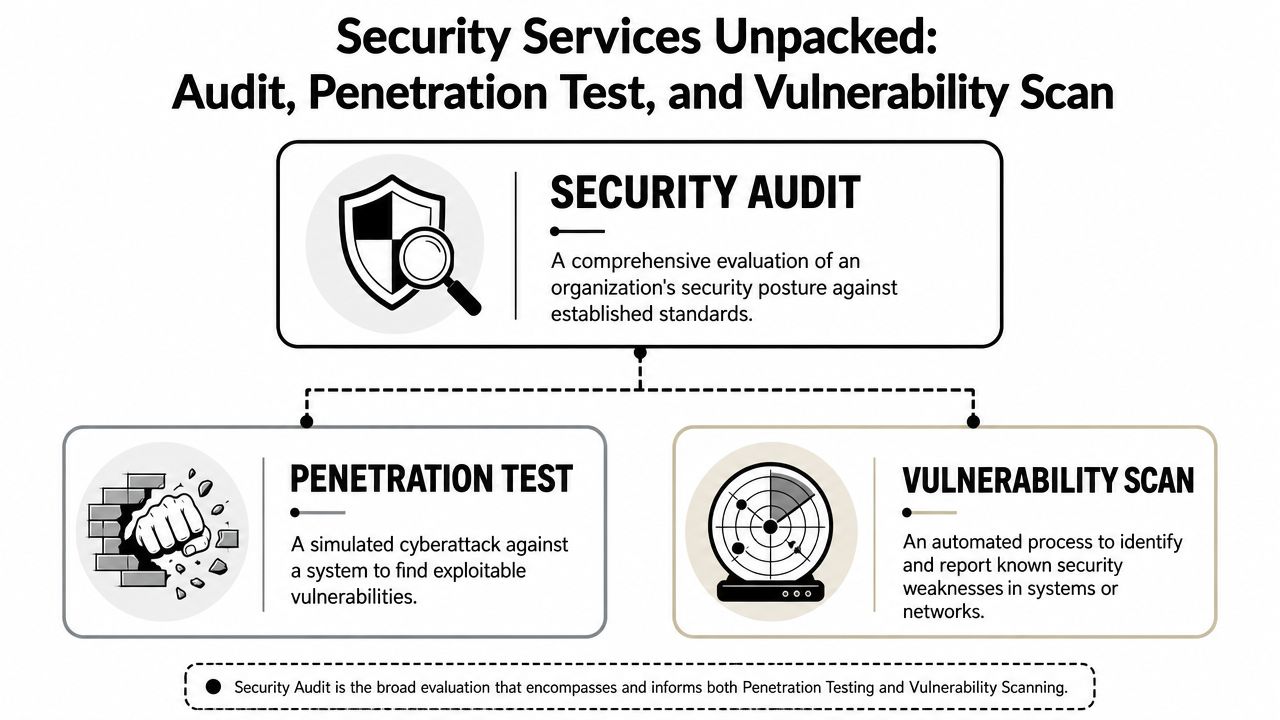
Leaders often hear four terms used as if they mean the same thing: vulnerability scan, penetration test, gap assessment, and security audit. They don't.
That confusion causes wasted spend. Teams buy a pen test when they need evidence for certification. They buy an audit when they only need a lightweight readout on readiness. They run a scanner and think they've assessed the system. Then procurement, compliance, or a customer asks for proof they don't have.
Here's the clean way to think about it.
The quick analogy that actually helps
- Vulnerability scan checks for known issues. It's like walking the perimeter to see whether doors and windows are obviously open.
- Penetration test simulates an attacker trying to get in. It asks whether a real person can exploit weaknesses in practice.
- Gap assessment compares your current state to a target framework or policy and points out what's missing.
- Security audit gathers evidence and validates whether your controls conform to requirements and operate the way you say they do.
Gap assessment versus internal audit
The importance of this distinction is frequently overlooked. A formal InfoSec Internal Audit is a "heavier touch" review that rigorously collects evidence to validate conformance, which makes it suitable for third-party attestation such as ISO 27001. A Gap Assessment is a "lighter touch" design review that identifies non-conformance with minimal evidence collection and is often used before a formal audit, as described by Pivot Point Security's explanation of gap assessments and internal audits.
That means a gap assessment is often best when you want answers like:
- Are we close enough to a framework to start preparing seriously?
- Which policies, records, or technical controls are missing?
- What should we fix before paying for a formal audit?
An internal audit is better when the question changes to:
- Can we prove conformance with evidence?
- Would this hold up under external review?
- Are controls operating in the actual environment, not just on paper?
A scan finds symptoms. A test proves exploitability. An audit tests the whole control story.
What business leaders should ask for
If you're buying security audit services, the first task is to define the outcome you need. Ask the vendor to name the deliverable in plain English.
| Service type | Best use | Main output |
|---|---|---|
| Vulnerability scan | Routine hygiene and broad detection | List of known weaknesses |
| Penetration test | Adversarial validation | Exploitable findings and attack paths |
| Gap assessment | Readiness and planning | Missing controls and improvement roadmap |
| Formal audit | Evidence-based assurance | Conformance findings and documented evidence |
A lot of frustration comes from mismatched expectations, not bad intent. If you want certification readiness, ask for that. If you want technical exploitation paths, say that. If you want board-level assurance around your application and AI workflows, ask for an audit scope that covers both.
Anatomy of a Security Audit Engagement
A solid audit engagement shouldn't feel mysterious. It should feel like a disciplined project with known inputs, named participants, and usable outputs. When teams get nervous about audits, it's usually because nobody has explained the mechanics clearly.
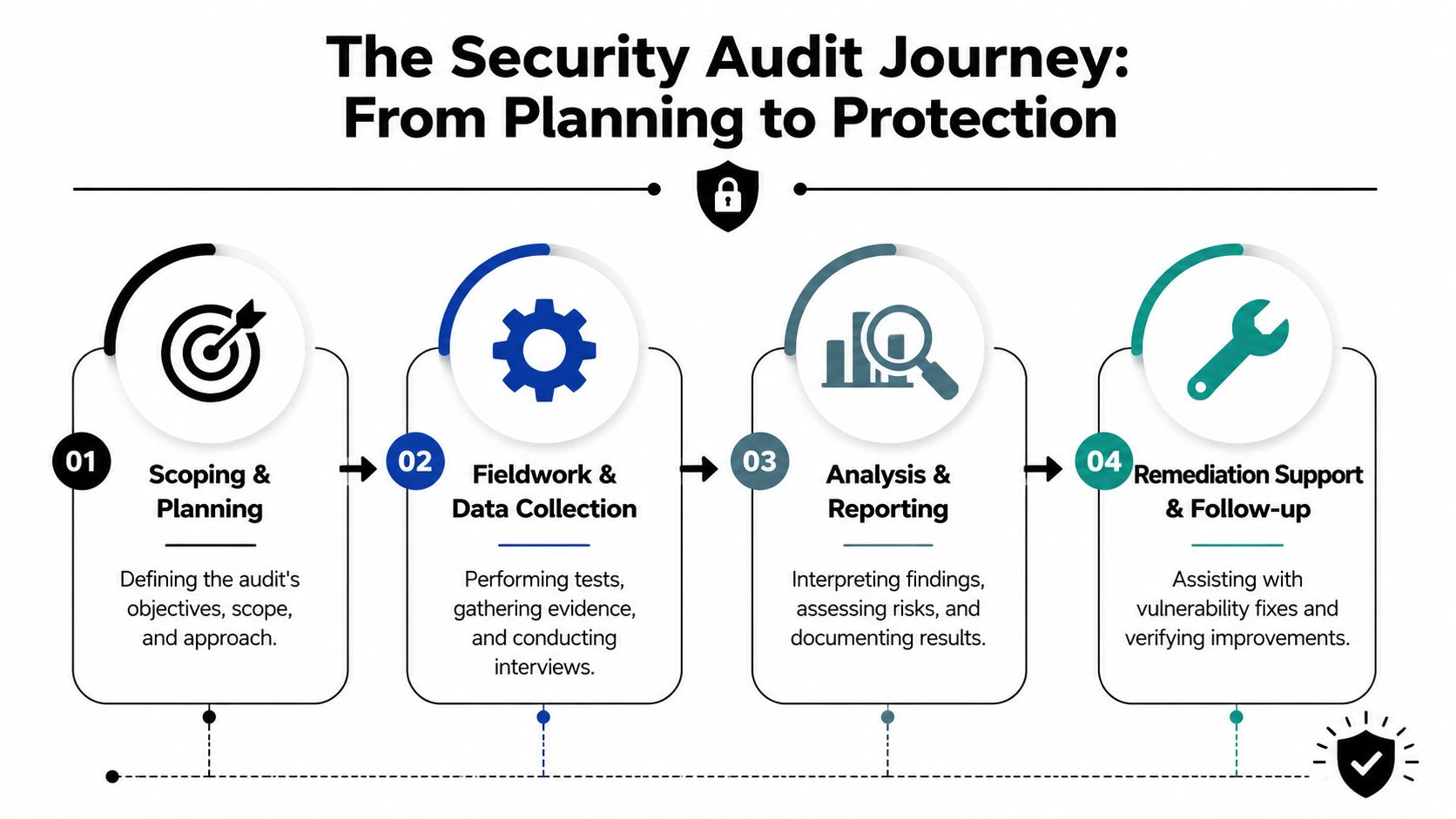
Most engagements follow a fairly predictable path.
Phase one and two
A standard technical audit process includes baseline screening, in-depth technical review, findings compilation, and prioritized reporting, according to SentinelOne's breakdown of data security audit steps. That four-part model is practical because it mirrors how good audit teams work.
During baseline screening, auditors compile user lists, map networks, identify systems in scope, and look at roles, integrations, and environments. This part often exposes the first real problem. The company doesn't have a single agreed inventory of what exists.
Then comes the in-depth technical review. Auditors assess code, encryption, key management, identity controls, and system configuration. If the environment includes cloud storage, mobile APIs, admin tools, or AI-enabled services, those paths should be reviewed too.
What your team needs to provide
The cleanest engagements happen when the client assigns real owners early.
- Engineering lead: Explains architecture, dependencies, and recent changes.
- Security or IT owner: Provides policies, tooling context, and access control logic.
- Product or operations lead: Clarifies workflows, sensitive business processes, and user impact.
- Compliance stakeholder: Maps findings to framework obligations if attestation is part of the goal.
If one person tries to represent all four perspectives, the audit slows down and the report gets shallower.
Phase three and four
The third phase is findings compilation. Auditors document specific issues, such as weak encryption handling, exposed storage, injection risk, or inappropriate privilege design. The best reports don't stop at naming the flaw. They explain where it lives, how it can be abused, and what business risk it creates.
The fourth phase is prioritized reporting. Here, a good audit becomes useful. Findings are ranked not only by severity but also by exploit feasibility and remediation priority.
The best audit report doesn't overwhelm your team. It tells them what to fix first, what can wait, and what evidence to preserve for follow-up.
What a useful report should contain
A mature report usually includes:
- Scope statement that names systems, applications, environments, and exclusions.
- Method summary so your team can defend the process internally and externally.
- Findings register grouped by issue, affected system, and business risk.
- Remediation guidance written for the people who must implement it.
- Executive summary that leadership can read without losing the thread.
A weak report is stuffed with generic warnings. A useful one reflects your stack, your workflows, and your risk.
The Ultimate Vendor Selection Checklist
Choosing an audit partner is part technical evaluation, part judgment call. Plenty of firms can talk smoothly about controls. Fewer can understand your actual product, test it intelligently, and write a report your engineering team respects.
Start by screening for fit, not just brand recognition. If your application handles transactions, regulated data, personalization logic, or AI-assisted decision support, the vendor needs relevant operating experience. General security language won't save a weak scope.
Questions worth asking before you sign
- Who does the work? Ask whether senior auditors will participate directly or only appear in the kickoff.
- What evidence do you collect? This reveals whether the engagement is control-based or mostly procedural.
- How do you handle applications with APIs, mobile clients, and third-party services? Modern systems rarely live in one layer.
- Can you explain findings to developers and executives differently? If they can't, the report may fail both audiences.
- How do you address AI-enabled features? If the answer sounds bolted on, that's a warning sign.
For companies reviewing disposal, retirement, and vendor lifecycle controls alongside app risk, a due diligence resource on secure ITAD partner selection can sharpen the same instinct you should use with audit providers. You're validating process maturity, evidence handling, and accountability.
Security Audit Vendor Checklist by Industry
| Evaluation Criteria | Ecommerce Focus | Fintech Focus | Healthcare Focus | SaaS Focus |
|---|---|---|---|---|
| Regulatory awareness | Understands payment flows, customer account protection, and platform integrations | Understands financial controls, transaction integrity, and evidence expectations | Understands protected health data, access boundaries, and audit trails | Understands multi-tenant risk, customer trust requirements, and enterprise security reviews |
| Application depth | Can review checkout, personalization, admin roles, and third-party plugins | Can assess APIs, fraud controls, permissions, and sensitive workflows | Can assess patient portals, clinician tools, and data sharing paths | Can assess auth, tenancy separation, configuration, and deployment workflow |
| Cloud and integration skill | Comfortable with commerce stacks, cloud storage, and marketing integrations | Comfortable with high-assurance environments and transaction ecosystems | Comfortable with hosted services, vendors, and records handling | Comfortable with CI/CD, identity providers, and customer-facing integrations |
| Reporting quality | Maps findings to revenue impact and customer trust | Maps findings to operational integrity and governance | Maps findings to safety, privacy, and compliance risk | Maps findings to product reliability and buyer scrutiny |
| Retest and remediation support | Helps validate fixes before peak release cycles | Helps validate critical fixes with evidence | Helps document remediation for compliance teams | Helps fit remediation into sprint-based delivery |
| AI readiness | Can evaluate recommendation and support features | Can evaluate AI in advisory, support, or risk workflows | Can evaluate AI summaries, intake, and decision support | Can evaluate embedded copilots, search, and workflow automation |
Red flags that show up early
Some vendors still scope audits as if the application were a static website plus a server. That doesn't work for products with mobile apps, event-driven services, model gateways, analytics layers, or customer-specific environments.
Watch for these signs:
- Overly generic scoping language: It usually produces generic findings.
- No sample report: If they won't show a redacted example, assume the output won't help much.
- No questions about architecture: Good auditors ask hard questions before the contract is signed.
- Weak AI discussion: If they fold AI into “application security” without specifics, they may miss the modern attack surface entirely.
The best vendor isn't the one with the biggest logo. It's the one that can understand how your software behaves.
Securing the Blind Spot Your AI Modernization
A product team ships an AI feature on top of a well-secured application. Access controls are in place. Data is encrypted. Infrastructure checks out. Then a customer pastes crafted input into the assistant, the model pulls from the wrong retrieval source, and a plausible but unsafe answer lands in a workflow that nobody designed for failure. The application passed review. The AI behavior did not.
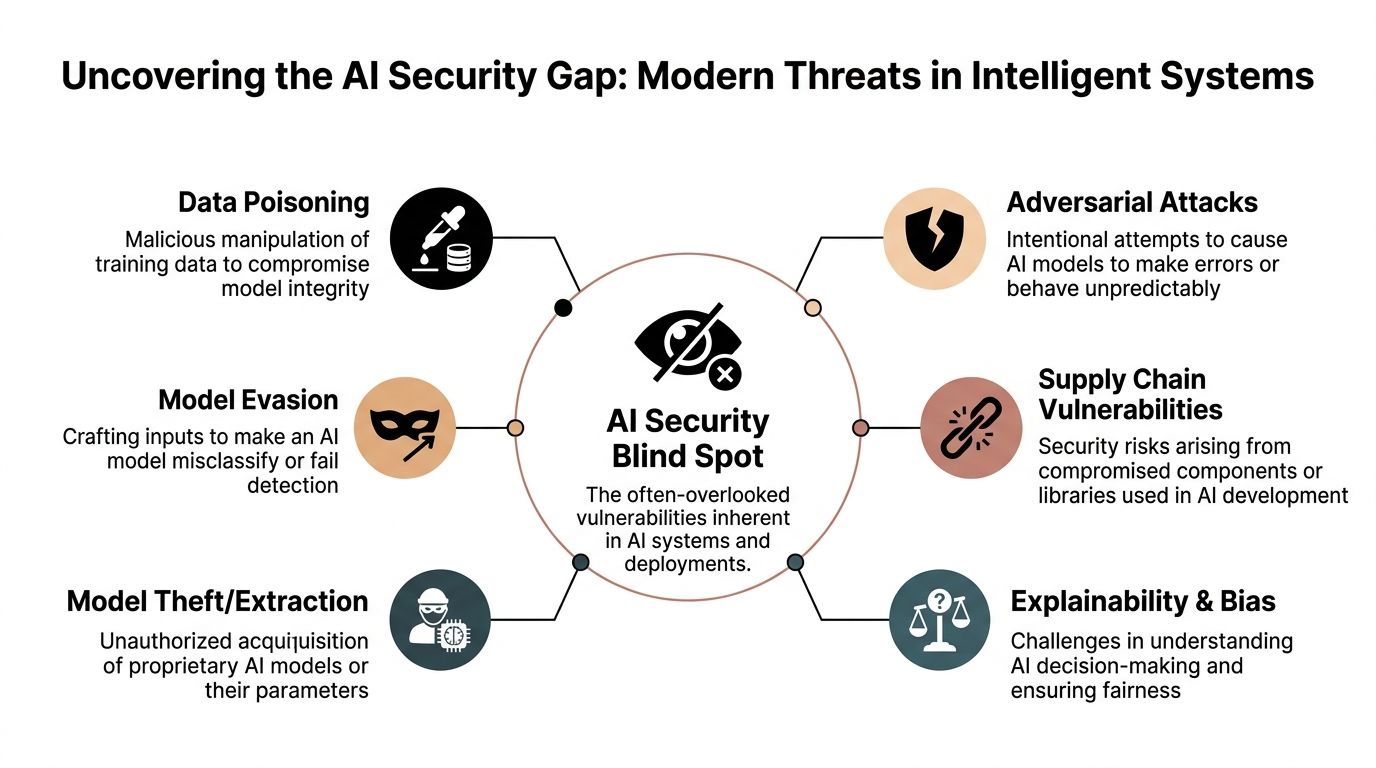
That gap shows up often in modern audit work. Traditional audits usually assess the application around the model more thoroughly than the model-driven behavior itself. For companies adding copilots, recommendations, search, summarization, or workflow automation, that leaves a meaningful part of risk untested.
The pace of adoption makes that harder to excuse. Gartner forecast that 80% of software and engineering organizations would use enterprise generative AI APIs or deploy GenAI-enabled applications by 2026, as cited in Digital Aptech's summary of Gartner's forecast on AI in software. McKinsey has also reported broad AI adoption across business functions, as referenced in this roundup citing McKinsey's AI adoption figure. Adoption is outpacing control design in many teams.
Where classic audits often stop too soon
A conventional review can confirm that users authenticate properly, secrets are handled correctly, and privileged access is restricted. That still leaves a separate set of questions unanswered.
- Prompt injection: Can user input alter system behavior beyond the intended guardrails?
- Output handling: Can the model generate unsafe, misleading, or sensitive content that flows into downstream actions?
- Training or retrieval contamination: Can poisoned content affect responses, ranking, or business decisions?
- Model access paths: Can connectors, hidden instructions, tools, or parameters expose data that should stay isolated?
- Traceability: Can the team reconstruct which prompt, model version, retrieval context, and settings produced a harmful output?
Those are not edge cases. They are design and governance questions, and they belong inside the audit scope for any AI-enabled product.
Regulators are also narrowing the room for vague answers. The EU AI Act puts more attention on risk management, documentation, human oversight, and post-market monitoring for higher-risk systems. Even when a product does not fall into a regulated category, enterprise buyers increasingly ask for evidence that AI behavior is controlled, logged, and reviewable.
If your team cannot answer who changed a prompt, when it changed, what retrieval sources were available, which model settings were active, and what outputs followed, the system is not yet auditable.
What modern audit readiness looks like for AI
Audit readiness for AI comes from operational control, not a one-time clever test. Prompts need ownership and version history. Retrieval sources need defined boundaries. Model settings need change control. Logs need to connect user input, system instructions, model responses, tools, and downstream actions.
A stronger operating pattern includes:
- Versioned prompt control: Prompts are treated as governed assets with history, review, and approvals.
- Parameter governance: Model settings, tools, and contextual inputs are constrained and visible.
- Central logging: Teams can follow behavior across model providers, orchestration layers, and product workflows.
- Spend visibility: Usage anomalies can reveal abuse, runaway automations, or hidden failure modes.
- Model evaluation discipline: Output quality, safety behavior, and failure patterns are reviewed routinely. A practical starting point is a defined AI model evaluation process for production software.
This is also the point where many teams discover they need better tooling, not just better policy. Wonderment's tools help close that control gap by giving teams a clearer administrative layer for prompts, evaluations, and AI operations. That matters during an audit, but it also matters six months later when a customer asks for evidence, an internal reviewer asks what changed, or a model update shifts behavior in production.
Security audits still matter. For AI modernization, they need to examine the system people use, not just the application shell around it.
Budgeting for Audits The Real Cost and ROI
A CFO asks for the audit budget. The security lead says it is needed. The product leader agrees in principle. Then the obvious question lands on the table.
What will this change?
That question should shape the purchase. Audit budgets get stuck when the proposal lists activities instead of decisions. Hours, interviews, testing windows, and a final report describe effort. They do not explain business value.
Why pricing conversations break down
Security audit pricing often feels arbitrary because scope quality varies more than the fee sheet suggests. Two vendors can quote similar numbers and deliver very different outcomes. One will validate controls against the way your teams build and ship software. The other will produce a generic report with findings your engineers could have guessed on day one.
The gap gets wider in AI-heavy products. Traditional auditors often know web apps, cloud configuration, and access control. Fewer can examine prompt change control, model routing, retrieval boundaries, evaluation evidence, and approval paths for AI behavior changes. If those risks sit outside the audit scope, the budget buys partial assurance.
That is a poor trade.
A better way to judge return
Treat audit ROI as a decision-quality question. A useful engagement helps leaders decide what to fix first, what to defer, what to document for customers, and where the organization needs tighter operating discipline.
Use a few practical tests:
- Risk prioritization: Does the audit distinguish between theoretical weaknesses and issues that can materially affect your product, data, or revenue?
- Sales and procurement support: Will the output help your team answer customer security reviews with evidence instead of ad hoc explanations?
- Engineering efficiency: Will findings point to recurring control failures, so teams fix a pattern once instead of patching the same issue across multiple services?
- Readiness for follow-through: Can the remediation plan plug into your existing security in DevOps workflow rather than living in a report no one reopens?
- AI oversight: Does the work cover the systems that create AI-specific exposure, including prompts, evaluations, model access, logging, and operational approvals?
For modern organizations, that last point matters more than many buyers expect. AI features now influence customer communications, internal decisions, code generation, search results, and operational workflows. An audit that ignores that layer can still look polished while missing one of the fastest-growing sources of security and governance risk. Wonderment's tools help close that gap by giving teams clearer control over prompts, evaluations, and AI operations, which makes audit evidence easier to produce and easier to defend.
Common pricing models
| Pricing model | Best fit | Watch-out |
|---|---|---|
| Fixed scope | Stable environments with clearly defined assets and objectives | Low bids often mean shallow sampling or narrow testing assumptions |
| Time and materials | Changing environments, active modernization, or unclear boundaries | Costs can drift if milestones, evidence expectations, and reporting depth are not defined |
| Retainer or ongoing advisory | Teams that want audit, remediation review, and follow-up tied together | Value drops fast if ownership is unclear inside the client team |
Budget for evidence, prioritization, and follow-through. Those are the parts that change outcomes.
What to ask before approving spend
Ask the vendor to show how they will scope the environment, what evidence they need, how they rank findings, and what retesting or remediation review is included. Ask who will perform the work and whether that team has audited AI-enabled systems, not just conventional applications. If your buyers, regulators, or internal reviewers care about documentation quality, verify how the firm handles evidence standards and chain of custody. The requirements behind essential audit documentation for ITAD are a useful benchmark for that discipline.
Clear answers justify budget. Fuzzy answers create expensive paperwork.
From Audit Report to Continuous Assurance
A security audit only creates value when the report changes behavior. Too many teams treat the final document like a finish line. It's the starting gun.
The right follow-through is simple in concept and hard in execution. Assign owners. Translate findings into backlog items. Preserve evidence. Retest important fixes. Then bake the lessons into release practice so the same weaknesses don't return next quarter under a new feature name.
Turning findings into operating discipline
A good pattern is to align audit outputs with the development workflow your team already uses. Security reviews belong inside delivery, not beside it. That's why mature teams connect remediation, code review, change approval, logging, and release verification through a DevSecOps model. This broader security in DevOps approach is how organizations move from episodic cleanup to continuous assurance.
If your environment also includes device retirement, infrastructure turnover, or regulated asset handling, teams should keep evidence standards equally disciplined. Requirements around essential audit documentation for ITAD are a good reminder that assurance always depends on documentation quality, chain of custody, and proof of action.
Security maturity shows up in the repeatability of your controls, not the thickness of your last report.
The companies that handle AI best will treat prompt changes, model configuration, logging, and parameter access with the same seriousness they already apply to code, infrastructure, and customer data. That's how an audit becomes part of a product that lasts, scales, and stays defensible as the software evolves.
If your team is modernizing software with AI, the hard part isn't just adding model capabilities. It's keeping those capabilities observable, governable, and secure over time. Wonderment Apps helps organizations do that with full-service product engineering and an administrative AI toolkit built for real production use, including a prompt vault with versioning, a parameter manager for internal database access, logging across integrated AI systems, and a cost manager for cumulative spend visibility. If you want a practical look at what continuous AI governance can look like inside your app, request a demo.