

Behavioral segmentation groups people by observable interactions with a product, service, or brand, using dimensions such as benefits sought, user status, usage rate, loyalty status, and buyer-readiness stage rather than age, income, or geography. Those groups must be allowed to change as people's behavior changes.
You might already have a dashboard full of clicks, purchases, and logins, yet still send everyone the same welcome message. The opportunity isn't to collect more activity for its own sake. It's to decide which differences deserve a different experience, without pretending a click tells you everything about a person.
What Behavioral Segmentation Actually Means
Consider a hypothetical pair of subscribers with nearly identical profile forms. One keeps opening introductory tutorials; the other uses advanced features regularly and skips every walkthrough. Give them identical onboarding, and you'll probably bore the experienced subscriber while leaving the newcomer confused.
Then there's the subscriber who used to be active but has gone quiet. That person needs a different decision again: perhaps an invitation to return, perhaps support, or perhaps no message at all.
Behavioral segmentation changes the starting question from who someone is to what they do. The University of Minnesota's explanation of market segmentation describes behavioral dimensions including benefits sought, usage, loyalty, and readiness to buy. The useful shift is historical as well as practical: customer groups become descriptions of changing relationships, not just static profiles.
From activity to a useful response
In a digital product, relevant evidence can include:
- Discovery activity: Page views and searches can help identify where someone is exploring.
- Product use: Feature adoption and session frequency can distinguish learning from established use.
- Relationship events: Abandoned carts, renewals, support contacts, and responses to earlier messages add context.
These signals don't replace judgment. They give your product and marketing teams something concrete to investigate before choosing a treatment.
Practical rule: A segment should help your team decide what to do differently. Otherwise, it's just a colorful dashboard label.
Keep personalization controllable
Once segments influence AI-generated onboarding or recommendations, teams also need administrative controls. Wonderment's prompt management system is one option developers and entrepreneurs can plug into an existing desktop or mobile application.
It includes a prompt vault with versioning, a parameter manager for internal database access, logging across integrated AI systems, and a cost manager for cumulative spend. A demo is available for teams evaluating that administrative layer.
The distinction matters: segmentation determines which experience might fit; prompt administration helps teams manage how an AI-assisted experience gets produced. Neither should become a mysterious box that only its original developer understands.
Behavior Versus Demographics and Fixed Labels
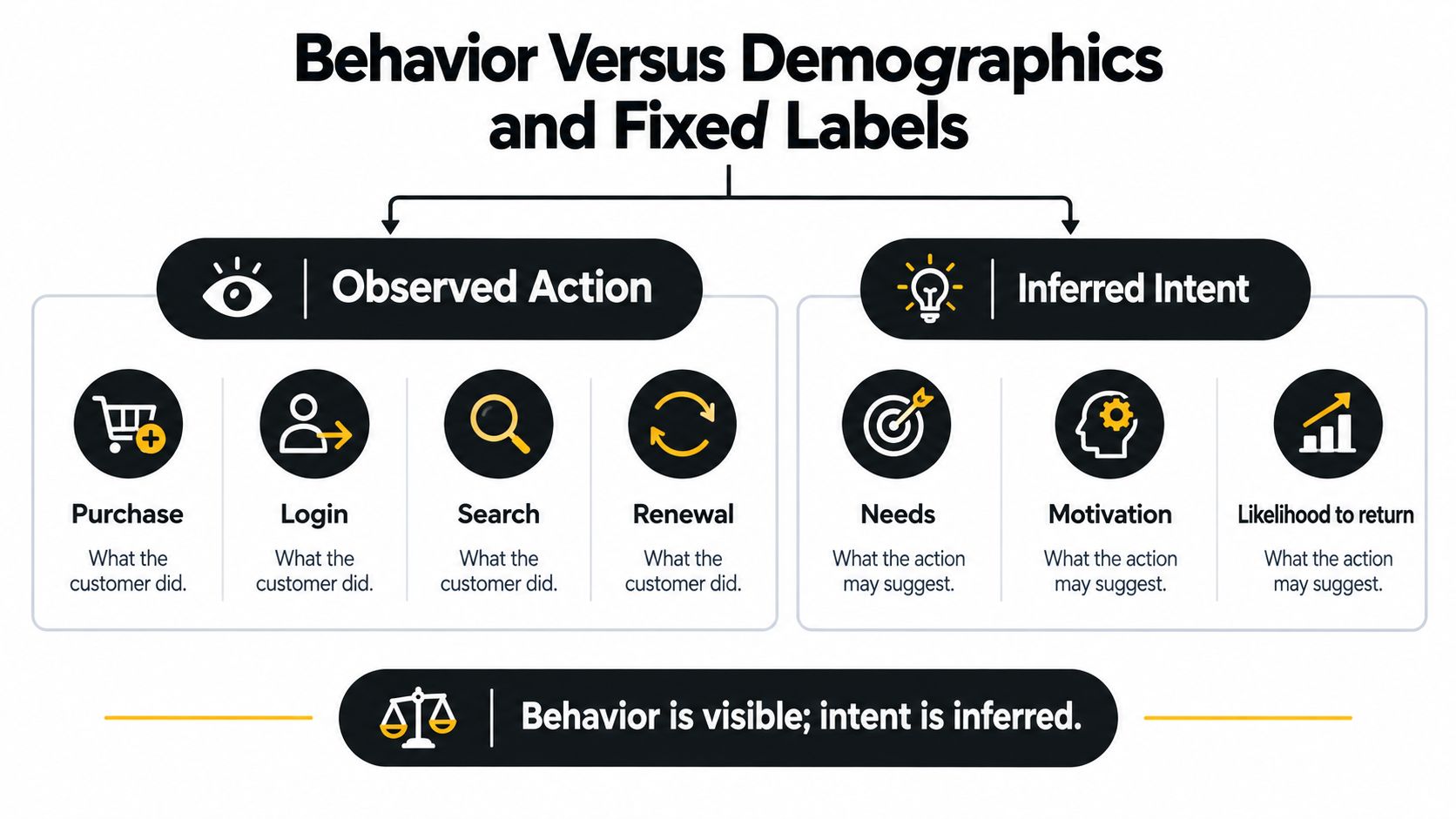
A purchase proves that a purchase happened. It doesn't prove why someone bought, whether they can comfortably afford another purchase, or whether they'll return.
That's the boundary many teams blur. Observed action is evidence. Inferred intent is an interpretation. Both can inform decisions, but they shouldn't carry the same confidence.
The University of Washington behavioral segmentation study applied segment-level messaging to existing customers who had transaction histories and had agreed to receive email. That scope matters. A method evaluated within an identifiable, permissioned customer population doesn't automatically justify equally confident assumptions about anonymous visitors or prospects.
Ask what the signal actually establishes
Before using an action for targeting, put it through a short decision test:
- Check repetition and timing: Is this a repeated, timestamped pattern, or an isolated event?
- Name the inference: Does the record establish a completed action, or are you using it as a proxy for motivation?
- Inspect the context: Could the occasion, product category, channel, or lifecycle stage change its meaning?
- Check what's missing: Are you ignoring customers whose activity happens somewhere you don't measure?
Past behavior and future intention are different things. Previous purchases, spending, experience, and information searches describe what happened. A prediction about returning describes what might happen.
Don't turn a temporary situation into an identity
Suppose someone repeatedly opens a help page. Your team might infer confusion, but the person could be checking compatibility, navigating an accessibility barrier, or helping someone else. A click records an interaction, not its full explanation.
Similar caution applies to financial constraints, health sensitivity, and temporary crises. My recommendation is to treat these interpretations as hypotheses to test, not personal attributes to attach permanently.
Prefer operational labels such as recently inactive over character judgments such as disloyal. A previously valuable customer can stop buying; a newcomer can develop a strong relationship through repeated positive experiences.
Validate segment membership against later outcomes and examine whether the pattern remains stable. When the evidence changes, change the classification. Your database shouldn't insist someone is the same customer they were last season.
Signals and Methods That Make Segments Real
Start with events your application can verify: a completed transaction, an authenticated session, a feature used, or a subscription renewed. Define what each event means before asking an algorithm to organize it.
For a practical introduction to connecting those records with product decisions, Wonderment's guide to behavioral analytics provides related context. The engineering task is to turn activity into comparable measures, rather than treat every event as equally meaningful.
Make behavior measurable with RFM
Recency, frequency, and monetary value, commonly shortened to RFM, provide a concrete starting point for purchase-based segmentation.
Recency asks when someone last purchased, distinguishing recent activity from a lapse. Frequency asks how often they purchase, separating occasional buying from habitual buying. Monetary value describes differences in economic contribution.
A published retail segmentation study analyzed 18,535 transactions, 541,909 transaction-line details, 4,339 customers, and 3,665 products across two years of purchasing history, then used RFM features with Partitioning Around Medoids clustering. Treat that as an illustration of measurable scale, not a prescription for your own thresholds.
In plain language, the researchers represented customer behavior with comparable measurements, then grouped customers with similar shopping patterns. You can begin with explicit rules if your team can explain and act on them.
Behavioral Signals and the Decision They Support
| Signal | Question it answers | Fitting action |
|---|---|---|
| Purchase recency | Has the customer purchased recently or lapsed? | Consider a win-back message |
| Purchase frequency | Is buying occasional or habitual? | Offer a replenishment reminder |
| Monetary value | How does spending contribution differ? | Evaluate suitable loyalty benefits |
| Feature adoption | Which functionality has someone used? | Suggest relevant feature guidance |
| Login and renewal activity | Is the subscription relationship active? | Review onboarding or renewal support |
Repeated, timestamped records mean surveys aren't always necessary to construct a behavioral segment. However, asking customers about their needs can help your team interpret patterns rather than guess at their causes.
Keep other evidence in its proper lane, too. MyMentions' resource on analyzing sentiment in AI brand mentions is useful context when assessing brand discussion, but that's a different question from identifying an individual customer's transaction behavior.
Refresh the underlying features and group assignments as activity changes. A beautifully named cluster isn't useful if your team is acting on an outdated customer relationship.
Benefits and Metrics Worth Tracking
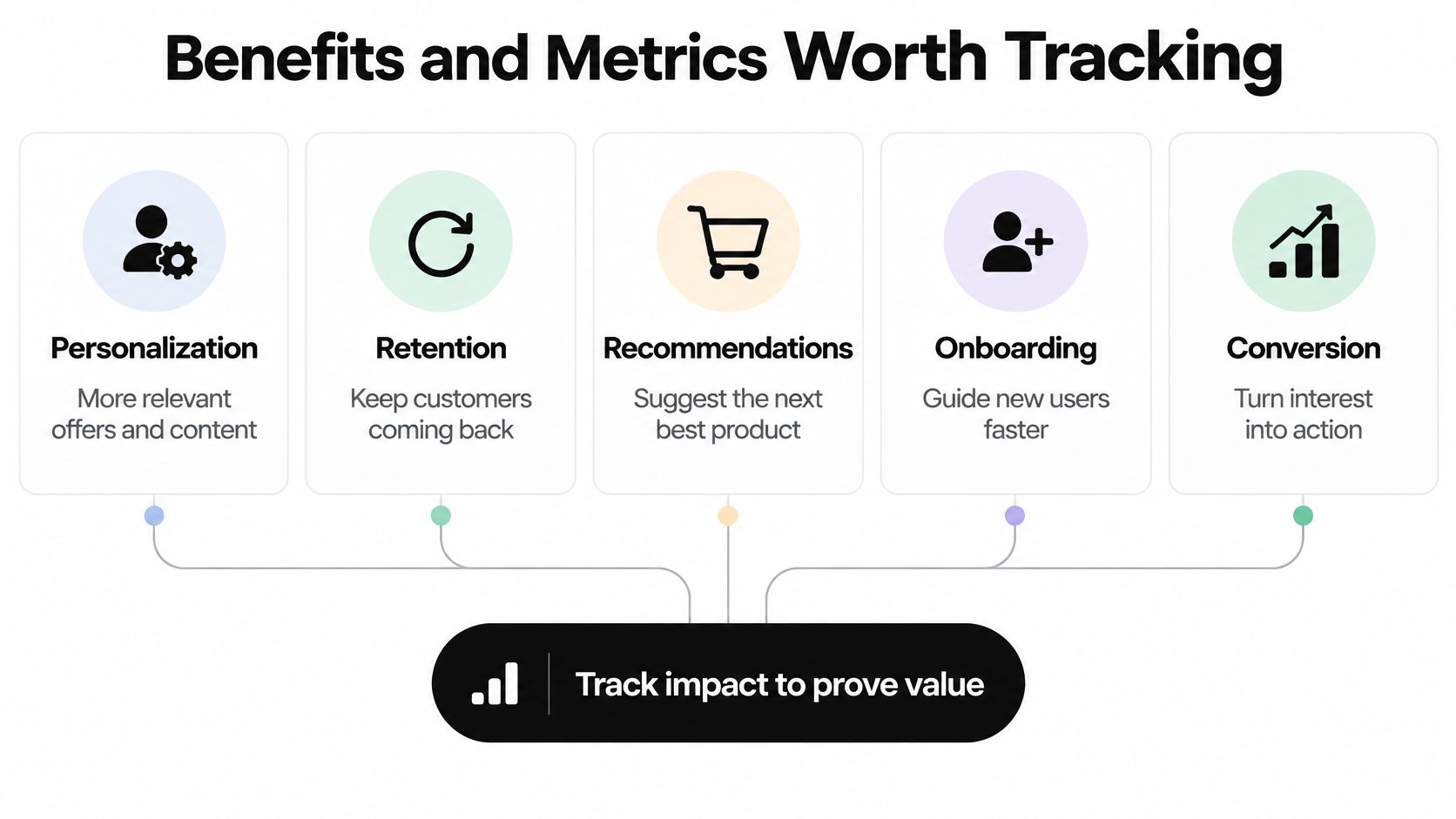
The business case isn't that your team can create more precise audience names. It's that people with different needs can receive meaningfully different experiences.
For a first-time user, that might mean education. For a frequent user, it might mean fewer repetitive steps. For an inactive customer, it might mean an appropriately timed invitation to return. These are proposed treatments, not guaranteed improvements.
Match each treatment to an outcome
Choose the outcome before launching the experience:
- Personalized offers and recommendations: Track conversion or average order value, depending on the decision you're trying to improve.
- Onboarding and feature guidance: Watch feature usage to see whether people adopt the relevant functionality.
- Reactivation and lifecycle messaging: Evaluate retention rather than celebrating message clicks alone.
- Product prioritization: Check whether the resulting product change improves the intended usage or retention outcome.
A demographic average can conceal these differences. An overall conversion result, for example, may obscure whether a treatment helped new users while distracting established customers.
If nobody can name the decision a segment changes, don't add it to the dashboard yet.
Run a measurement loop
Define the qualifying behavior, then ship a distinct treatment to an eligible audience. Compare the intended outcome with a suitable baseline or comparison group, keeping other differences in mind.
Record both the result and the limits of the comparison. A changed offer, a seasonal event, or a different acquisition channel can complicate your interpretation. Don't credit segmentation for every movement in the chart.
Retire or revise segments that don't support better decisions. That can mean combining overlapping groups, changing a treatment, or acknowledging that the signal wasn't useful.
Your dashboard can remain compact: conversion, retention, average order value, and feature usage, selected according to the intervention. Consistent event definitions matter more than a crowded screen.
Large event volumes also make analytics infrastructure part of the investment. If teams can't reproduce membership or connect a treatment to its outcome, they can't confidently evaluate the work. The deliverable is a testable decision process, not a segment museum.
Behavioral Segmentation Across Four Industries
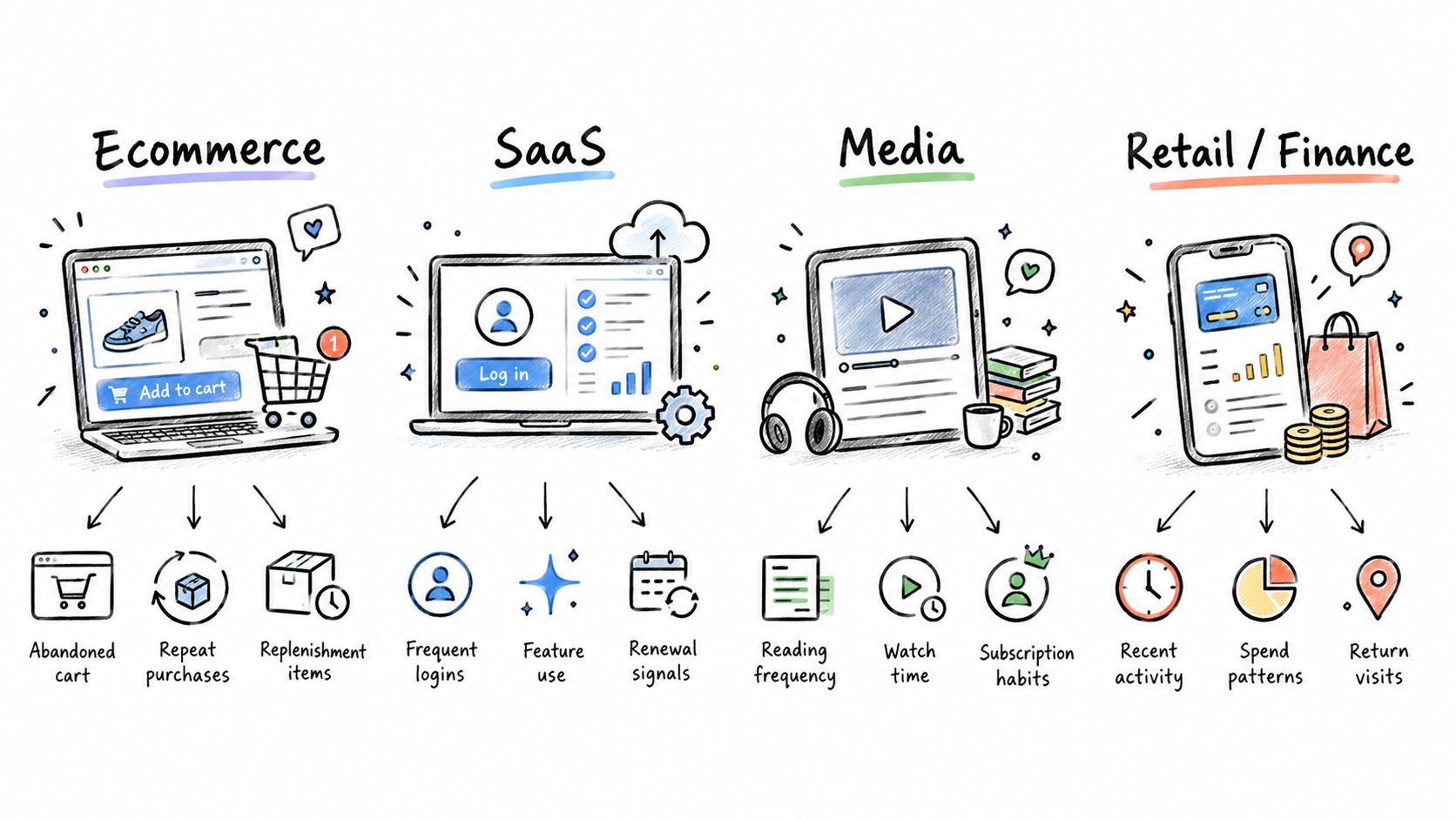
The same event can require a different response depending on the product. An extended gap between interactions might be concerning in a frequently used service and perfectly normal in an occasional-use application.
The following scenarios are illustrative design choices, not reported customer results. Each pairs a proposed treatment with an outcome a team could evaluate.
Ecommerce and fintech
Ecommerce: Consider a store selling replenishable products. Browsers, habitual purchasers, and lapsed customers may share an age band but need different experiences. Purchase history, spend, and cart activity provide a more relevant starting point than that shared demographic trait.
A proposed treatment for repeat purchasers is an optional replenishment reminder, with retention as the outcome to check. Match the message to the benefit sought, such as convenience, rather than assuming everyone wants a discount. An abandoned cart can justify reviewing checkout friction; it doesn't establish that price caused the abandonment.
Fintech: A financial application might use transaction frequency and feature adoption to identify customers who could benefit from guidance on an existing budgeting feature. The proposed treatment is an in-app explanation, with feature usage as the outcome.
A spending spike shouldn't automatically produce a permanent customer category. Before changing the experience, investigate whether the activity reflects an isolated occasion. In my view, helpful feature discovery is a safer starting experiment than sensitive judgments about someone's financial condition.
Healthcare and media
Healthcare and wellness: Appointment and engagement patterns can help a team investigate where users encounter friction. Suppose someone starts scheduling but doesn't finish. The proposed treatment could be an accessible continuation path or a clearly presented support option, with conversion to a completed booking as the outcome.
Don't convert that interaction into a diagnosis or an assumption about urgency. Sensitive circumstances may be inferable even when explicit demographic fields are absent. Minimize what downstream systems receive, and keep service access separate from speculative labels.
Media: A viewing or listening service can use activity, session frequency, and responses to recommendations to propose relevant content. A possible treatment is a discovery experience based on recent activity, evaluated through retention.
A burst of viewing doesn't establish lasting loyalty. Let people dismiss recommendations or redirect their preferences rather than trapping them in yesterday's interests.
Across these scenarios, a useful review question is: Would this treatment still be reasonable if our explanation of the behavior were wrong? If the answer is no, require stronger evidence or human review before acting.
Building Segments into Personalization and AI
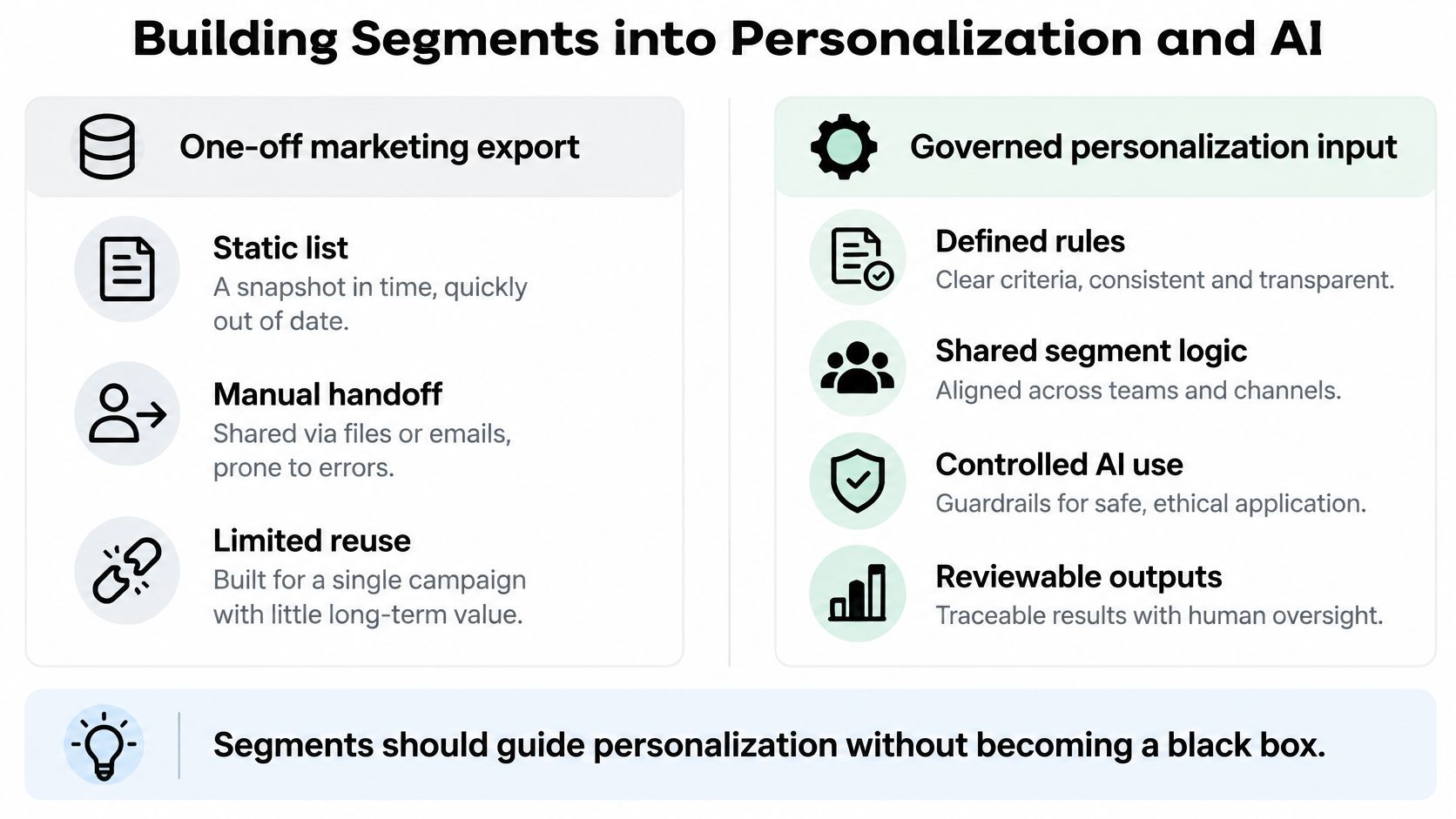
A one-off marketing export can be suitable for a bounded experiment. It becomes harder to manage when teams repeatedly reuse the list without checking its age, permissions, or original purpose.
A governed personalization pipeline takes a different approach: refresh the events, apply documented membership rules, limit downstream use, and record what happened. Wonderment's discussion of data-driven personalization offers context for connecting behavioral inputs with application experiences.
Compare convenience with control
The privacy trade-off is concrete. In Adobe's retail AI and digital trends research, 87% of consumers expected responsible, secure handling of personal data, but only 46% believed brands delivered; 74% considered disclosure of AI-generated recommendations or content important, while only 26% believed brands met that expectation.
The same Adobe research reported 45% of retailers applying AI to personalize experiences from real-time behavior, alongside priorities involving advanced segmentation, predictive modeling, real-time processing, and cross-channel unification.
That gap argues for explicit controls:
- Minimize inputs: Prefer aggregated events where they're sufficient and restrict use to a defined purpose.
- Preserve choice: Provide appropriate opt-out pathways and clear explanations.
- Control access: Set retention limits and maintain audit logs.
- Review consequences: Include human review and evaluate whether outcomes differ unfairly across affected users.
Require reliability beyond launch
NIST's AI Risk Management Framework treats validation and reliability as lifecycle concerns, including production monitoring and documentation of limits on generalization. Ask an internal team or development partner for intended use, limitations, testing, privacy, security, and maintenance plans, not just a working prototype.
Application reliability needs its own measurements. Google's service-level objective guidance identifies latency, error rate, throughput, and availability as common indicators, with objectives and error budgets helping teams balance reliability and release work.
Wonderment's administrative toolkit addresses a narrower but practical part of this system: prompt management, integration administration, and token cost control. Those capabilities can help operate AI-assisted personalization, but they don't replace permission rules, bias evaluation, or production reliability engineering.
Keep segment membership outside the prompt's creative discretion. Give the model approved context for a defined task, then evaluate its output. Don't ask it to invent a customer identity from a pile of clicks.
A Practical Next Step with Prompt Management
Start with a decision your team can explain without opening a slide deck. For example, you might test whether relevant guidance helps users who repeatedly begin a feature workflow but don't complete it.
Keep the initial operating checklist small enough to use:
- Choose an observed behavior: Confirm that the event is recorded consistently and repeated enough to support your interpretation.
- Define the treatment: Describe exactly what will change in the experience.
- Name the outcome: Select the conversion, retention, or usage measure that would justify continuing.
- Set the refresh: Decide when membership will be recalculated and when someone should leave.
- Assign access: Document who can see the underlying data and what downstream systems may receive.
Make AI operations reviewable
For developers and entrepreneurs modernizing an existing application, Wonderment's prompt management system provides an administrative layer for AI integration.
Its prompt vault keeps versions, so teams can manage changes to the instructions behind onboarding, recommendations, or lifecycle messages. The parameter manager handles internal database access, helping teams administer the data inputs used in those integrations.
The logging system spans integrated AI systems, while the cost manager displays cumulative spend. Together, those components address operational questions teams should be able to answer: which prompt version ran, which data parameters were available, what activity was recorded, and what AI usage cost.
Demo preparation: Bring a real segment and its intended outcome, not just a wish for “more personalization.”
Ask to walk through a prompt change, review its logged execution, and inspect the associated spend. Keep authorization enforcement and outcome evaluation in the conversation, too.
You don't need a complete personalization overhaul to begin. You need a bounded use case, trustworthy evidence, and enough control to learn safely.
Wonderment Apps offers AI modernization, application development, and prompt administration tools for teams turning behavioral segments into useful product experiences. Visit Wonderment Apps to request a demo, and bring a real segment plus a metric so the conversation can focus on prompt versions, database parameters, integrated AI logs, and cumulative spend.