

A Loop operations director has a legacy order system, a board deadline, and a browser tab full of Chicago firms promising “digital transformation.” Every portfolio looks polished. Every sales call sounds confident. The hard part is finding the partner that fits the actual job, not the one with the slickest pitch.
This shortlist matches seven software development companies in Chicago to different buyer situations: AI modernization, an undefined product, a focused application build, a large platform program, or a staffing gap. Each profile covers its strengths, published pricing signals where available, trade-offs, and one question to ask before signing. Chicago has a substantial engineering base: the Bureau of Labor Statistics counted 41,210 software developers in the Chicago-Naperville-Elgin metro area in May 2023, with a mean annual wage of $127,960 (Chicago software developer labor-market figures). That's context for the talent market, not a vendor price list.
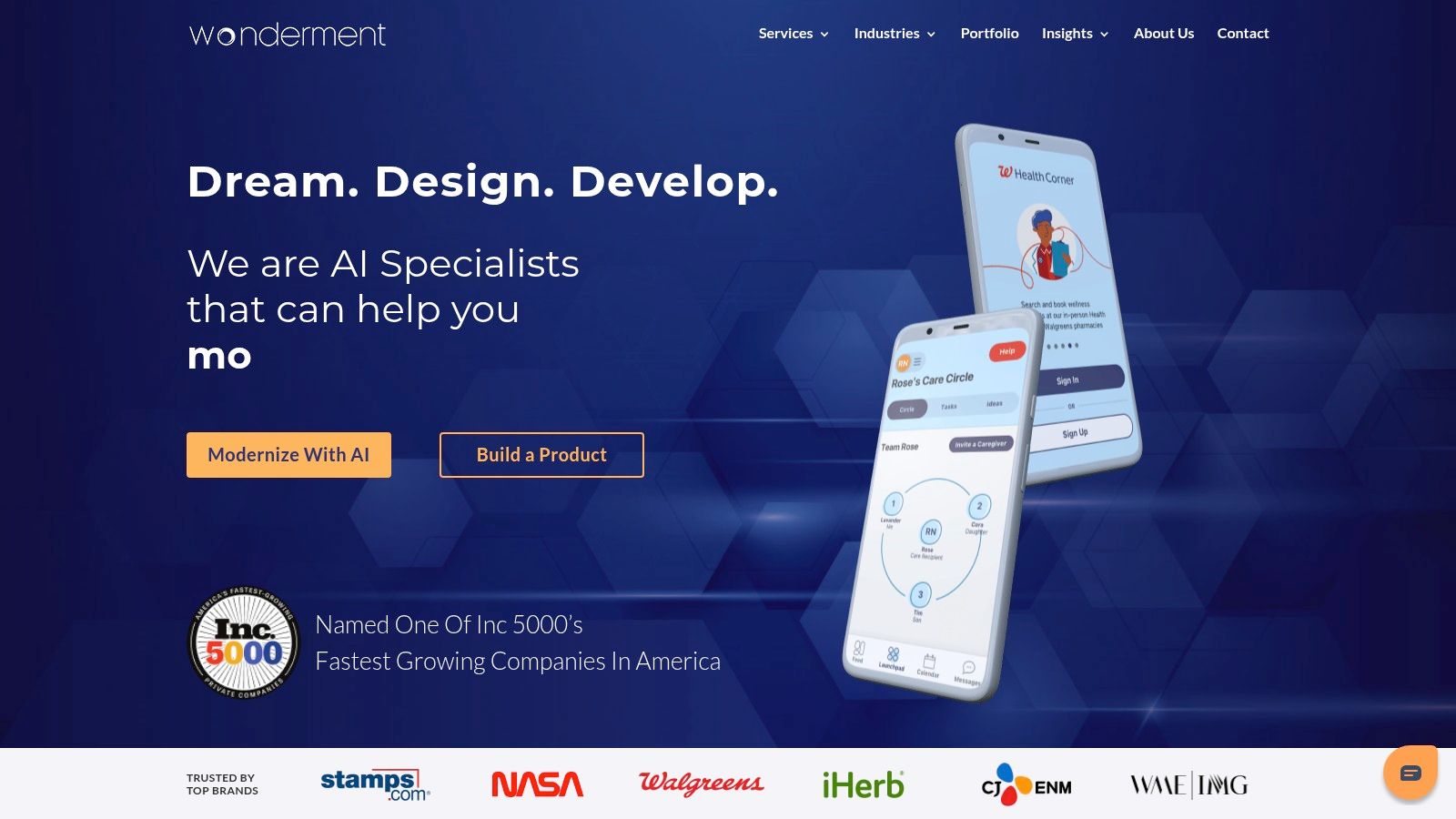
Wonderment Apps belongs on the shortlist when the project combines custom development with AI modernization. Its prompt management system is an administrative tool that can plug into an existing application, with a versioned prompt vault, a parameter manager for internal database access, logging across integrated AI models, and a cost manager that tracks cumulative spend. I'll return to how that fits an AI roadmap later. If you're comparing hiring models as well as firms, start with Hire Developers.
1. Wonderment Apps
Best fit: A company modernizing a legacy application, building a custom web or mobile product, or adding specialist skills without splitting the work across vendors.
Wonderment Apps brings product planning, UX and design, engineering, QA, and project management into one delivery model. That breadth fits work that connects an existing system with new user journeys or AI features. Its services cover web and mobile development, backend architecture, APIs, databases, cloud, and technical staffing. The company has experience in ecommerce, healthcare, media, fintech, SaaS, and the public sector.
AI modernization involves more than choosing a model. Teams also need to manage prompts, data access, logs, costs, and model updates after launch. Wonderment's administrative toolkit is designed to manage those controls within an existing application. Its supported use cases include personalization, recommendations, anomaly detection, and autoscaling.
Where the breadth helps, and where it needs scoping
A managed project can bring together engineers, designers, QA, product managers, and project managers in a team sized to the work. Wonderment also offers staffing for React, .NET, Java, iOS, Android, WordPress, automated and manual QA, product management, and UX design. That makes it an option for buyers who need either an end-to-end team or a specific capability within their existing group.
The trade-off is scope. A narrow, well-defined task may not need a broad team, so ask how the proposed roles and engagement model map to the actual work. Wonderment does not publish pricing. Expect to discuss requirements before receiving a project or staffing quote.
Pros
- One partner across disciplines: Product, design, engineering, QA, and project leadership can work within one engagement.
- AI lifecycle support: The offering includes model integration, prompt administration, cost controls, and ongoing model updates and support.
- Flexible team composition: Buyers can choose managed delivery or targeted staffing across technical and product roles.
- Credibility signal: Wonderment says it has been named to the Inc. 5000.
Cons
- No public pricing: Buyers need to share requirements to get a quote.
- Scope takes care: A clear statement of work helps keep the team and engagement suited to the project.
Ask before signing: Who owns the AI controls after launch, including prompt changes, database parameters, model logs, cost monitoring, and updates?
2. TXI
Best fit: An organization that needs to define what to build before committing to a complex product or modernization effort.
TXI is a Chicago-headquartered digital product consultancy combining product strategy, research, design, data, and software engineering. It builds custom software, mobile apps, and data products, and modernizes operational systems. This mix can suit a buyer with a business problem and a rough direction, but no settled product definition.
The strategy-led approach connects user research, workflow discovery, and technical choices. That work can be more than a narrowly scoped build needs. If your requirements are stable and the main task is implementation, ask TXI to separate discovery from delivery so you can assess the value and cost of each phase.
Read the minimum as a scope signal
Clutch lists a $50,000 minimum project size and an indicative hourly range of $200–$300 for TXI. These marketplace figures are not a proposal or a promise of your final cost. They signal that buyers should be ready to discuss the engagement's scope, team composition, and the role of strategy alongside engineering.
Clutch also lists a 4.9/5 rating across 51 reviews. Review summaries praise communication, collaboration, project management, and quality. Use those themes to guide reference checks with clients whose technical constraints resemble yours.
- Potential strength: Strategy, research, design, data, and engineering sit within one consultancy.
- Budget consideration: The listed minimum and indicative rate may not fit a smaller or tightly constrained project.
- Vetting question: What decisions will discovery settle, and what deliverables will your team receive before implementation begins?
Before signing with a strategy-led firm, use these questions to ask before hiring an outsourcing company. Clarify who owns decisions, how the team communicates, and how scope changes are handled.
3. LaunchPad Lab
Best fit: A business that needs a hands-on partner for a web or mobile application, especially when the product must connect to existing systems.
LaunchPad Lab builds and improves web and mobile applications. Its services also include product design, AI, cloud, enterprise applications, and Salesforce implementation. That mix makes it worth evaluating when an application is only one part of a larger workflow, such as connecting a customer-facing experience to Salesforce or an internal platform.
Clutch lists a $10,000 minimum project size and an indicative rate of $150–$199 per hour. It also lists a 4.8/5 rating across 44 reviews, with review themes that include communication, timeliness, project management, and technical skills. Treat those numbers as comparison signals, not a quote. The actual cost depends on the team, integrations, scope, and delivery expectations.
Match the team to the system
LaunchPad Lab may suit buyers who want a close product partner for a new application or continued product improvement. The main diligence task is to match the proposed team to the platform, industry, and compliance requirements. Ask who will own architecture, automated testing, deployment, and post-launch support, rather than assuming those responsibilities come bundled with development.
The company has experience with nonprofit, financial-services, and education-related projects. That makes it reasonable to ask for examples tied to your operating environment, but don't treat industry familiarity as proof of specific compliance capability. Have the vendor explain how it would handle your data, access controls, testing, and release process.
A published minimum tells you where a firm's listed project range begins. It doesn't tell you whether your scope fits, or whether the final proposal will land near that floor.
- Potential strength: Application development can sit alongside product design, cloud, enterprise systems, and Salesforce work.
- Budget consideration: Marketplace pricing is not a project quote, and a complex or long-running engagement can still require a substantial budget.
- Vetting question: Which people on the proposed team have delivered work on the platform and under the compliance requirements this project needs?
For early product teams, LaunchPad Lab's mix of product work and implementation can be useful, but validate the first release carefully. This guide to mobile app development for startups lays out the kind of scope and product decisions to make before committing to a build.
4. Atomic Object
Best fit: A company planning substantial custom software work that benefits from close collaboration and a deliberate product-development process.
Atomic Object is a software design and development consultancy with a Chicago office. It builds custom software products and emphasizes user-centered design, transparency, and direct client collaboration. Its published guidance says projects commonly last three to 18 or more months, so it's a stronger candidate for a significant product effort than for a quick-turnaround build.
That duration is a useful planning signal. If your board deadline is close, ask whether the firm can divide the work into a useful first release and later phases without creating a brittle foundation. A credible answer should explain what ships early, what gets deferred, and how the team will keep the architecture maintainable as the product grows.
Treat broad budgets as a starting point
Atomic Object publishes project budget guidance ranging from $50,000 to over $1 million. That span is too broad to use as a project estimate. Ask for comparable examples, then request a scoped proposal that names assumptions, deliverables, team roles, decision points, and exclusions.
Client comments describe business impact and collaborative work. The firm has served smaller organizations and established companies, including Chicago-area clients. Still, a positive account isn't a substitute for seeing how the team handles your kind of product risk, whether that means integrations, data migration, operational availability, or user research.
- Potential strength: Product design and engineering can be planned as a collaborative effort, rather than a handoff from design to coding.
- Budget consideration: The published range covers projects of very different sizes, and engagements may run for months.
- Vetting question: Can you show a comparable project and explain how its scope, schedule, team, and budget changed over time?
5. 8th Light
Best fit: A business planning a platform rebuild, architecture changes, or delivery work that goes beyond screens and features.
8th Light is a Chicago-headquartered software consultancy working across product design, engineering, data, and DevOps. Its services include architecture, APIs, mobile and ecommerce applications, enterprise software, platform modernization, engineering mentorship, and production-oriented AI work. That range may suit a team that needs application delivery alongside changes to how its engineers build and operate software.
Clutch lists a $250,000 minimum project size and one review on its 8th Light profile. The profile does not disclose hourly rates. Treat the minimum as a prompt to ask whether your planned scope justifies that level of engagement, not as a measure of quality. If your need is a narrow app build, confirm whether the firm would take on that scope.
Ask for delivery evidence, not only a portfolio
For a platform rebuild, ask the proposed team to explain how it will handle production ownership, deployments, monitoring, incident response, and knowledge transfer. A portfolio can establish relevant experience, but your decision should turn on whether the team can meet your operating requirements. Ask for examples that match your constraints and clarify who will remain accountable after launch.
- Potential strength: A multidisciplinary team can combine architecture, product engineering, DevOps, and modernization work.
- Budget consideration: The listed minimum may put a small standalone build out of range, and the profile provides no hourly rate for early comparison.
- Vetting question: Which named team members will own architecture and production readiness, and what can they show from projects with similar constraints?
Use a day rate or hourly rate only alongside a clear delivery scope. Compare team seniority, QA coverage, architecture ownership, project management, and expected capacity. A lower rate can still mean a more expensive project if key responsibilities are left uncovered.
6. SPR
Best fit: A B2B or operations-heavy organization combining application work with cloud, data, analytics, or integration needs.
SPR works across custom software and mobile development, legacy-system modernization, cloud, data, analytics, and enterprise AI. Its industry experience includes insurance, financial services, logistics, SaaS, and manufacturing. That range may suit a business replacing an operational system or connecting platforms, where application development is only part of the job.
SPR describes an approach spanning advisory work through implementation and says it chooses technology based on the problem rather than promoting one platform. For an organization with older systems, the value depends on a clear target architecture, migration path, and support plan. Ask what the team would keep, replace, and integrate before settling on a technology stack.
Make the delivery model explicit
SPR doesn't publish pricing or a project minimum, so you'll need a structured discovery conversation to compare proposals fairly. Clarify delivery-team location, staffing, and post-launch support early, especially if your internal staff will work closely with the vendor. A broad technology-consulting scope may not suit a small, design-led studio project with tightly defined app requirements.
- Potential strength: One partner may coordinate application, integration, data, and cloud work.
- Budget consideration: With no published rate or minimum, compare proposals by scope, team roles, and expected deliverables, not by headline price alone.
- Vetting question: Who will be on the delivery team, where will they work, and which people will remain responsible after launch?
Ask each vendor to separate advisory, implementation, and support work in its proposal. The guide to software development consulting services can help clarify the difference between architecture advice, hands-on delivery, and ongoing operations.
7. Codal
Best fit: A retailer or other customer-facing business rebuilding ecommerce or a digital product, where UX, analytics, and implementation need to work together.
Codal brings software development together with UX/UI design, ecommerce, product strategy, analytics, and AI. Its ecommerce work includes Shopify and BigCommerce, making the firm a potential fit for a platform rebuild that involves both the shopping experience and the systems behind it.
Codal describes a distributed team across multiple regions. Clutch lists a $75,000 minimum project size and a 4.9/5 rating across 21 reviews. Review themes include UX/UI skills, communication, project management, and timeliness. These signals can help with an initial comparison, but they don't tell you who will staff your project or how decisions will be made.
Put scope and acceptance rules in writing
For any software engagement, vague scope and acceptance rules can lead to disagreements about completed work. Set expectations in the contract: define staffing, acceptance criteria, change control, approval points, and how the team will resolve disputes. Ask for named roles and a delivery cadence before signing.
With a distributed team, clarify whether project meetings include the people doing the work, not only account leads. Find out how the team will coordinate design decisions, testing, release approvals, and urgent production issues across locations. A storefront can meet its design goals and still create operational problems if ownership is unclear when an integration fails.
- Potential strength: Ecommerce, product strategy, design, analytics, and development can be coordinated in one engagement.
- Budget consideration: The published minimum may not fit a small feature or an early product test.
- Vetting question: Who will be assigned, where will they work, and how will you approve scope changes and delivery milestones?
How the Chicago software development firms compare on specialty, published minimums, indicative rates, and public reviews
| Item | Core Specialty | Published Minimum | Indicative Rate | Clutch Rating |
|---|---|---|---|---|
| Wonderment Apps | AI modernization, custom web and mobile apps, technical staffing | Not publicly listed | Not publicly listed | Not provided |
| TXI | Product strategy, custom software, data products, modernization | $50,000 | $200–$300/hour | 4.9/5 (51 reviews) |
| LaunchPad Lab | Web and mobile apps, product development, AI, cloud, Salesforce | $10,000 | $150–$199/hour | 4.8/5 (44 reviews) |
| Atomic Object | Custom software design and development, web and mobile apps | $50,000 (published project budgets start at) | Not provided | Not provided |
| 8th Light | Product design, engineering, data, DevOps, modernization | $250,000 | Not disclosed | Profile lists one review; rating not provided |
| SPR | Custom software, modernization, cloud, data, enterprise AI | Not publicly listed | Not publicly listed | Not provided |
| Codal | UX/UI, software development, ecommerce, analytics, AI | $75,000 | Not provided | 4.9/5 (21 reviews) |
From Shortlist to Signed Scope: Turning Research Into a Decision
Start with the work, not the vendor name. A platform rebuild needs architecture, integration, migration, and production support. A product that's still being defined needs discovery, user research, and a way to test assumptions before the team commits to a large build. An AI-enabled modernization needs all of that plus controls for data access, prompts, model behavior, and ongoing costs.
Use this checklist in the first serious vendor conversation:
- Define the scope: Write down the users, business problem, required integrations, data involved, and what “done” means. Separate launch-critical features from later improvements.
- Confirm the team model: Ask who will do the work, where the team is based, which roles are dedicated, and how specialists will join. Don't assume the people in a sales meeting will deliver the project.
- Compare pricing structures: A fixed bid can work when requirements and acceptance criteria are stable. Time and materials can fit work that will evolve as the team learns. A dedicated team can make sense when you need ongoing capacity and control over priorities. Compare what each model includes, not only the headline price.
- Check relevant experience: Ask for examples that match your technical environment and operating risks. For healthcare, finance, or government work, ask how the team handles privacy, security, access, testing, and documentation.
- Agree on post-launch support: Put bug triage, security updates, monitoring, ownership, and knowledge transfer into the plan. A launch is a handover point, not the finish line.
- Set change-control terms: Define how the team estimates changes, who approves them, how they affect schedule and cost, and what happens when a requirement changes mid-sprint.
If AI is part of the project, make governance a delivery requirement. The NIST Generative AI Profile organizes risk work around Map, Measure, Manage, and Govern, including stakeholder involvement, pre-deployment and operational testing, monitoring, policies, and feedback mechanisms (NIST AI risk-management guidance for generative AI). For a legacy application, that means treating model changes, unexpected outputs, privacy issues, and incidents as ongoing operational work, not launch-day cleanup.
Wonderment Apps' prompt management system can fit into that modernization plan as an administrative layer for an existing application. The prompt vault supports versioning, the parameter manager controls internal database access, and logging spans integrated AI models. Its cost manager tracks cumulative spend, giving product and engineering teams a way to review usage as they test and expand AI features. Those capabilities don't replace sound architecture or security review. They give the team specific controls to include in the scope.
The right firm depends on the job. A large platform rebuild, an undefined product, a narrow app build, and an AI modernization each call for a different mix of strategy, engineering, and operations. Before engaging any vendor, including Wonderment Apps, request a demo of the prompt management admin tool. Bring an existing application scenario and ask to see how prompts, database parameters, cross-model logs, and spend tracking would work from the start.
Wonderment Apps combines AI modernization with web and mobile development, UX, QA, and project leadership, so teams can plan both the application and the controls that keep it maintainable. To see how its prompt vault, parameter manager, cross-model logging, and cost manager could prepare your existing software for AI integration, visit Wonderment Apps and request a demo.