

Monday morning starts with a hiring conversation, an incident update, and a roadmap review that all want the same person's attention. The team has a few Agile ceremonies on the calendar, the AI assistant is already in the editor, and someone in another time zone hasn't seen the latest decision yet. That's the shape of managing software teams in 2026, less about enforcing one neat framework and more about building an operating system that can survive delivery pressure, distributed work, and AI-assisted code.
If you're leading ecommerce, fintech, healthcare, or a mixed product org, that operating system needs guardrails. It needs a way to manage prompts, review code, keep quality visible, and stop the meeting cadence from becoming theater. It also needs enough flexibility that the team can ship without spending half its week proving that it's shipping.
What Modern Software Team Management Actually Looks Like
The job usually looks normal until it doesn't. A delivery lead walks into Monday with a hiring gap, a production issue, and a demo tied to a quarterly roadmap, then spends the afternoon explaining why one feature slipped because three people were waiting on a decision that never got made in the room. That's not a process failure in the abstract, it's a coordination failure.
Three forces changed the job
The first force is that Agile is everywhere, but not embedded everywhere. One industry synthesis reports Agile adoption in software teams rose from 37% in 2020 to 86% in 2021, and a 2026 survey still shows 71% of respondents use Agile in software development, while only 13% say it's embedded across the business and 74% use a blended, hybrid, or homegrown approach rather than pure Agile (Parabol's Agile statistics). That gap matters because managers can't just “run Scrum” and expect alignment to appear.
The second force is that the team itself is often spread out. The third is that AI tools are already inside the workflow, whether leadership approved them or not. In Microsoft's 2024 Work Trend Index, 75% of knowledge workers said they already use AI at work and 78% of users were bringing their own AI tools to work, which changes how code review, attribution, and risk boundaries need to work (Microsoft 2024 Work Trend Index summarized in AgileEngine's discussion).
Practical rule: if your management model still assumes one office, one sprint board, and one human writing every line, you're already behind the reality of the team.
That's why the best managers I've seen stop treating software leadership like calendar management and start treating it like systems design. They define ownership, shape the team structure, measure flow and reliability, and add explicit controls for AI-assisted work. The rest of this playbook is built around that reality, including the kind of prompt control plane that becomes valuable once AI is part of everyday delivery.
Team Structures and Roles That Actually Ship
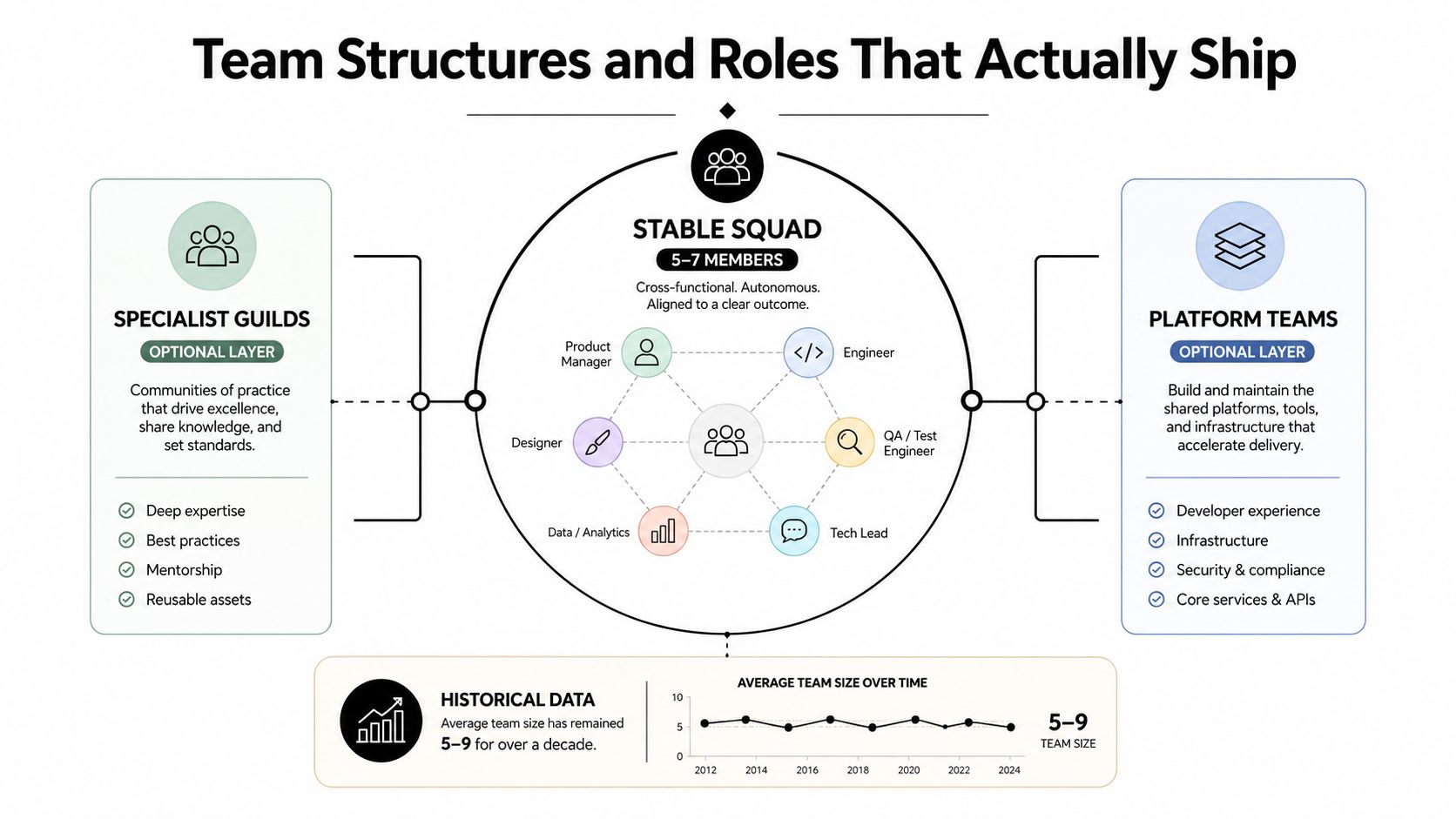
Small, stable teams are still the cleanest starting point. Empirical software engineering work citing ISBSG data says teams of nine or more are significantly less productive than smaller teams, and a long-term QSM analysis found average software team sizes have stayed between 5.5 and 6.9 full-time-equivalent staff for decades, even as schedules improved and coordination got tighter (QSM and empirical team-size analysis). The lesson isn't “never grow.” It's that size adds coordination cost faster than many managers expect.
Start with one accountable squad
A good default is a small, cross-functional squad with product, engineering, QA, and design represented, plus a clear technical lead. The point is not to create a tiny island, it's to create one group that can make decisions without waiting on five other groups to agree on every detail. If you need a helpful organizational reference for HR or ops partners, the team blueprint for HR leaders is a solid way to think about role clarity without turning the team into a matrixed mess.
Use a squad when the work shares a common product goal and the members need to stay together long enough to build context. Use a platform team when other squads depend on shared infrastructure, internal tools, or deployment systems. Use specialist guilds sparingly, because too many parallel “centers of excellence” can turn into decision traffic jams.
Assign roles by ownership, not title
Product managers should own priority, sequencing, and stakeholder trade-offs. Tech leads should own technical direction, architectural calls, and the shape of the delivery plan. QA, UX, and platform engineers should have real decision rights in their domains, not just advisory status.
The mistake I see most often is overstaffing a struggling project and hoping the extra hands will save it. More people rarely fix a broken boundary. They usually create more handoffs, more context switching, and more confusion about who is responsible.
The cleanest boundary is the one where a person can answer, without hesitation, “What am I accountable for, and what decisions can I make right now?”
When a team grows past the point where one squad can hold the whole problem in its head, split by product surface, not by political convenience. If your roadmap is mostly one user journey, keep the team intact. If the work has clearly separated concerns, such as checkout, internal admin, or platform reliability, split only where the dependency map says the split will reduce friction.
For a more detailed way to define those boundaries, the internal guide on Agile team structure pairs well with the practical question every manager eventually faces, which is not “How many people can I hire?” but “How many decisions can this team absorb before delivery starts to wobble?”
Agile Workflows, CI/CD, and Capacity Planning
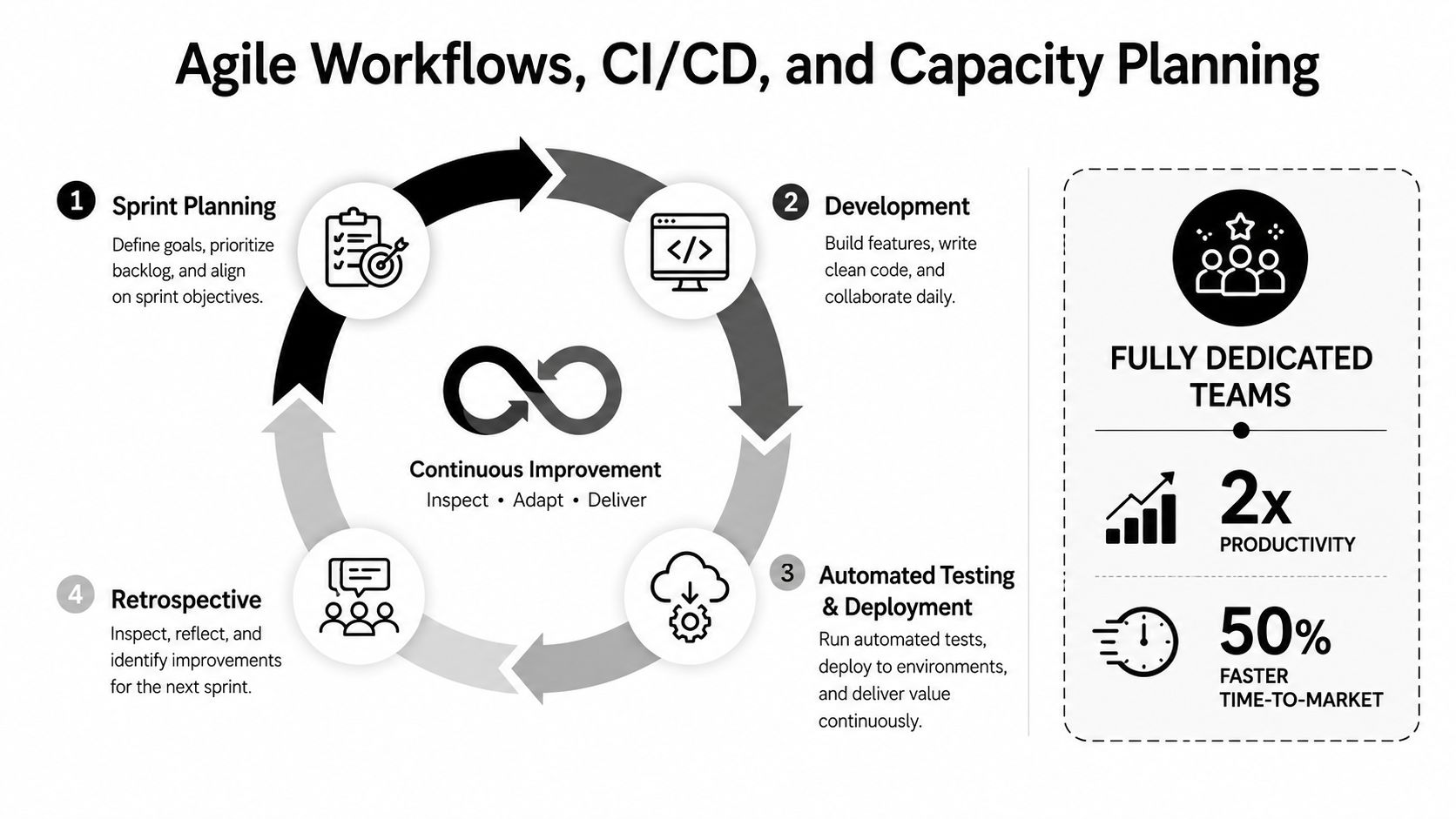
Agile rituals only help when they connect to the pipeline and the staffing math. A sprint planning meeting that doesn't match your deployment path is just a calendar event, and a CI/CD system that runs fast but isn't tied to team behavior won't improve outcomes on its own. Managers need to treat the workflow as one delivery system.
Use flow, not ceremony, as the standard
A stable, fully dedicated team can double productivity and halve time to market, and low work-in-process can cut the time spent on work items by 50% compared with high-WIP teams (ImpactAgile_Quantified material). Those numbers aren't a license to overpromise, they're a warning that splitting attention has a real cost. If work sits half-done across too many people, your sprint board starts lying.
CI/CD belongs in management conversations because it changes the size of the batch the team ships. Smaller batch sizes reduce blast radius, and faster feedback shortens the path from defect to correction. That's exactly why DORA metrics matter as the connective tissue here, because they show whether the team is moving quickly without breaking itself.
If you want a tactical reference point for pipeline decisions, the SubmitMySaas pipeline guide is useful context for how delivery tooling affects management choices, even when the stack itself differs.
Plan with utilization that leaves room for reality
Start new projects at 60% utilization, review actual velocity over 3 to 4 sprints, or roughly one quarter, and reserve a 20% to 30% buffer for discovered work (capacity-planning recommendation). That approach is far more honest than pretending every developer can stay fully loaded and still absorb production surprises, stakeholder changes, and tech debt.
A practical planning loop looks like this:
- Set the initial load low. Give the team enough work to learn the system without pinning every hour.
- Watch actual throughput for several sprints. Don't recalibrate off one lucky iteration.
- Keep a visible buffer. Discovered work is not a surprise, it's part of software delivery.
- Cut rituals that don't improve decisions. If a meeting doesn't change scope, risk, or sequencing, question why it exists.
Manager's test: if a ceremony can be skipped and nothing changes in the next release, it probably isn't doing real work.
For teams that want a more detailed look at the mechanics, the internal overview of CI/CD pipeline best practices is a sensible companion to the capacity question. In practice, the best teams are not the ones with the most rituals, they're the ones where the rituals shape what ships.
Metrics and Dashboards That Drive Better Decisions
A good dashboard changes what people do on Tuesday morning. A bad one just gives executives screenshots. The difference is whether the metrics connect to engineering behavior, delivery risk, and production stability.
Make DORA the backbone
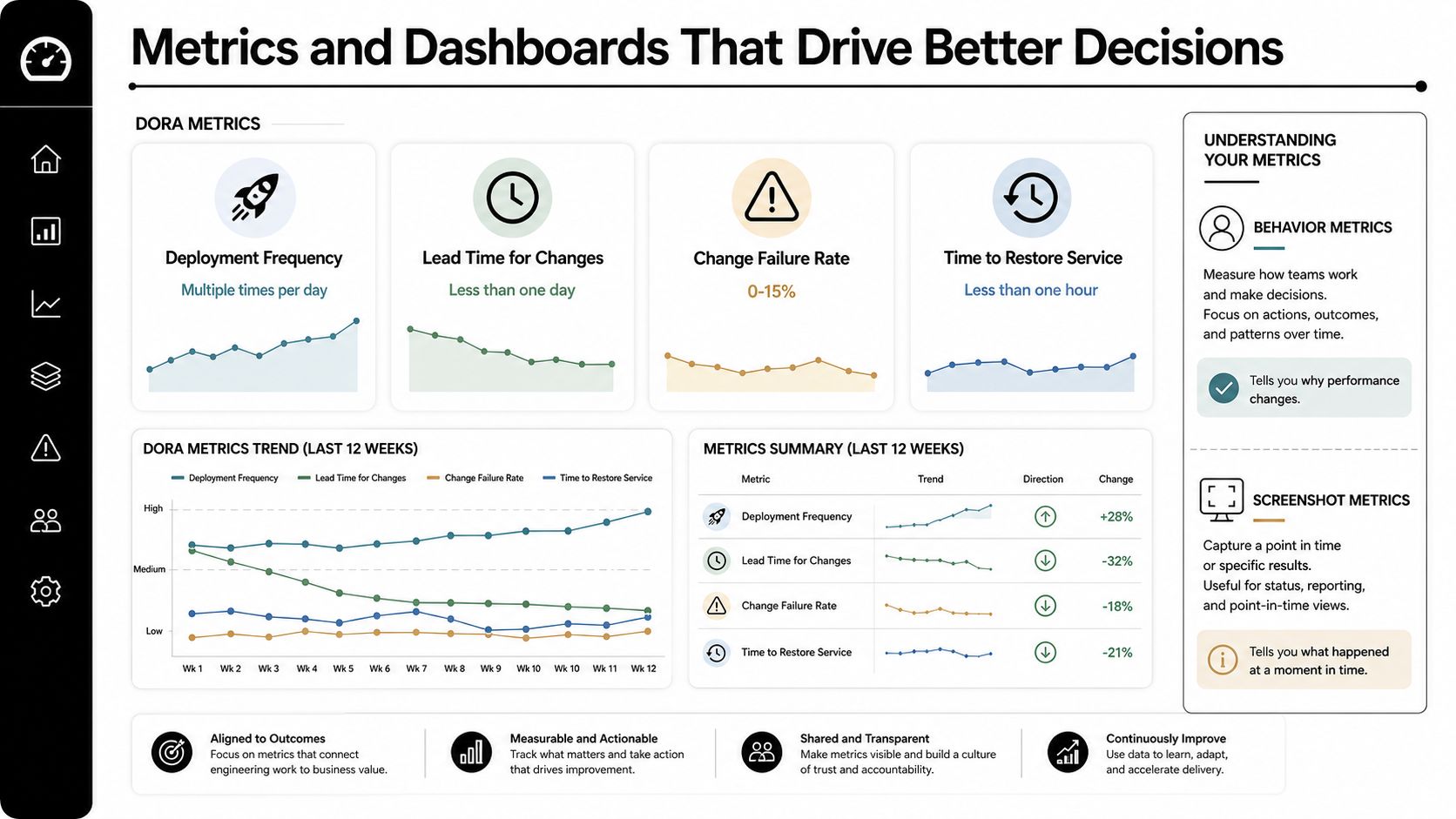
The four core DORA metrics are deployment frequency, lead time for changes, change failure rate, and time to restore service (Swarmia overview). Technical-management guidance also cites elite benchmarks of on-demand or multiple-times-daily deployments, lead time under 1 day, MTTR under 1 hour, and change failure rate below 15% (DORA benchmark summary). Those benchmarks are useful because they give managers a language for speed and safety at the same time.
I'd rather see one honest DORA view than six vanity charts. Commit counts, story points, and hours logged rarely tell you whether the team is healthy. DORA does a better job of showing whether the team can ship small, recover fast, and keep quality intact.
Automate the data collection
Technical-quality management works best when leaders build reproducible metrics systems instead of relying on intuition. Staff-engineering guidance recommends measuring every project, using sustainable automated data collection rather than manual tracking, and aligning feedback with engineering strategy; it also warns that maintaining quality datasets by hand can consume four-plus hours per week, which is a strong sign the process won't scale if people keep doing it manually (staff engineering quality guide). That's not just an ops inconvenience, it's a management smell.
A weekly dashboard that gets used should answer three questions. What changed in delivery speed. What changed in production risk. What's blocked because quality or process is drifting.
The internal guide on Agile performance metrics fits well here, especially if your current dashboard still has too many charts that nobody can act on. Retire the metrics that only look impressive in a steering committee. Keep the ones that help the team decide whether to ship, pause, or fix.
Keep this on the wall: if a metric doesn't change a decision, it belongs in an archive, not on the main dashboard.
Industry-Specific Playbooks for Ecommerce, Fintech, Healthcare, Media, and Public Sector
The same management framework behaves differently once compliance, traffic spikes, and stakeholder pressure enter the room. That's why a one-size Agile playbook usually breaks as soon as it meets a real industry.
Ecommerce and retail
Ecommerce teams need to protect checkout and merchandising flows while they modernize the platform and push personalization. The metric that matters most is usually whatever best reflects release safety on revenue-critical paths, because a tiny defect in search, cart, or payment can have outsized impact. The failure mode to design against is launching too many moving parts right before peak traffic and then discovering the rollback path wasn't tested.
Fintech
Fintech teams live inside review cycles, approvals, and tighter on-call expectations. The management habit that pays off is making security review and release readiness part of the plan, not something that gets “handled later.” The metric to watch is operational reliability tied to regulated workflows, because speed without auditability becomes a liability fast.
Healthcare
Healthcare delivery needs audit trails, careful access controls, and feedback from clinicians who don't have time for vague product language. Managers should make sure every release can be traced and every workflow matches how people work in a clinical setting. The failure mode here is shipping a technically elegant feature that creates friction for nurses, coordinators, or billing teams.
Media
Media teams care about content velocity, recommendation systems, and performance budgets. They need release habits that protect page speed while letting editorial and product move quickly. The single failure mode to prevent is letting growth targets push the app into sluggishness, because audience attention is unforgiving.
Public sector
Public-sector teams have to plan for accessibility, procurement realities, and legacy modernization that often can't happen in one clean rewrite. The strongest managers break modernization into stages that still deliver user value along the way. The main failure mode is freezing feature work while the migration is being debated, which leaves citizens with the old system and no visible progress.
A lot of this comes down to constraint management. The team doesn't need a different philosophy for every industry, it needs different guardrails, different risk tolerance, and a clear decision on what can't break.
AI Tools in the Codebase and the Wonderment Prompt Management System
The common advice to “just trust the team” stops working once AI tools become part of daily delivery. If people are already using their own tools at work, managers need explicit guardrails for code review, attribution, quality control, and risk boundaries instead of hoping the process sorts itself out (Microsoft 2024 Work Trend Index summarized in AgileEngine's discussion). That matters even more in fintech and healthcare, where a confident answer from an AI tool is not the same thing as a compliant one.
What management has to control now
AI-assisted work creates a few predictable failure modes. A prompt gets copied from one squad to another and nobody knows which version shipped. A developer queries internal data through a model and there's no clean audit trail. Token spend creeps up because no one owns the usage pattern. The team stays busy, but leadership can't explain what happened or why.
That's why a centralized prompt management system makes sense as a control plane. A prompt vault with versioning solves the “which prompt did we use?” problem. A parameter manager for internal database access helps enforce boundaries around what the model can reach. A logging system across all integrated AI models gives managers the traceability they need for review and troubleshooting. A cost manager surfaces cumulative spend so AI usage doesn't turn into a surprise line item at the end of the month.
Use the tool as governance, not decoration
I've seen teams try to manage AI through informal trust alone, and it falls apart as soon as multiple squads start shipping at once. A shared prompt system creates consistency without forcing every team to invent its own rules. It also helps product and engineering leaders review AI behavior in the same way they already review deployment risk.
Wonderment Apps offers that kind of administrative toolkit as part of its AI modernization work, including prompt management, integrations, and token cost control. In practice, that makes it a reasonable option when a team needs an operating layer for AI-assisted features rather than another one-off script hidden in a repo.
If AI is already influencing code, support tickets, or customer workflows, the management question isn't whether to adopt guardrails. It's how fast you can put them in place before the team spreads the pattern everywhere.
The strongest teams I've worked with don't ban AI and don't romanticize it either. They define where it can be used, how it gets reviewed, and who owns the traceability when something goes sideways. That's the difference between experimentation and an operational model.
Retention, Career Growth, and Inclusive Hybrid Practices
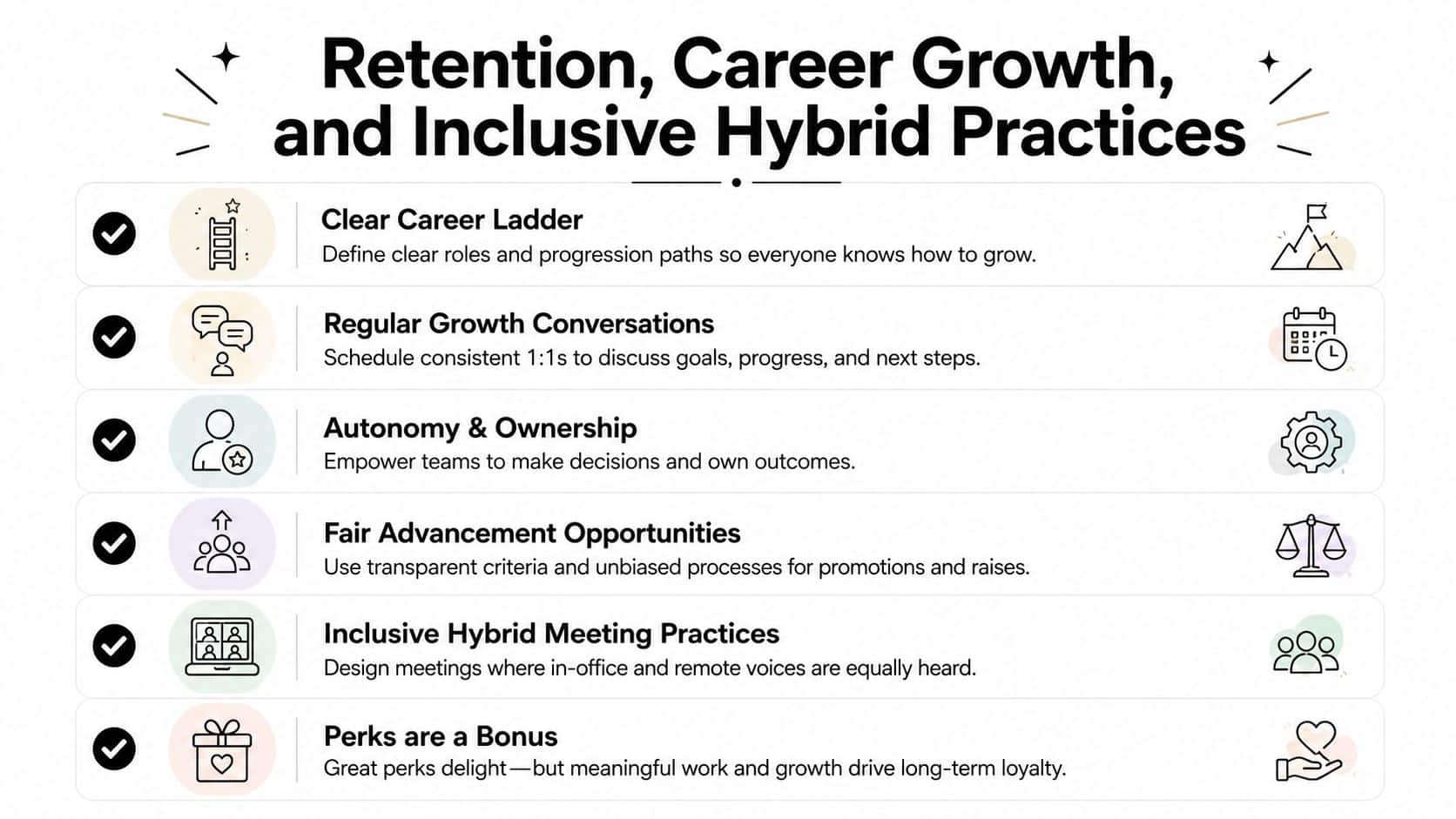
People don't stay because the snacks are better. They stay when the work is clear, the autonomy is real, and advancement feels fair. That's especially true in hybrid organizations, where the risk isn't obvious conflict, it's uneven access to context, feedback, and decision-making.
Make growth visible and repeatable
Career ladders work when they clarify what good looks like at each level. Growth conversations work when they happen often enough that no one is surprised by a review cycle. Autonomy matters because strong engineers don't want every decision escalated, they want ownership with support.
Google's research on ethnically, racially, and gender-diverse software engineering teams points to the need for deliberate inclusive practices, accountability, and technical allyship to sustain belonging and fair advancement (OSU-hosted research summary). That's the operational part many teams miss. Inclusion is not a values poster, it's a management habit.
Fix the hybrid bias before it becomes policy
The quiet failure in distributed teams is that overlapping-hours people get more context, more influence, and more chances to speak first. Remote teammates can look productive while getting less input into technical decisions and fewer stretch opportunities. The fix is procedural, not philosophical.
Use meeting notes that capture decisions, not just discussion. Rotate who leads demos and design reviews. Make feedback explicit, especially when someone isn't in the dominant time zone.
For teams also thinking about hiring and promotion mechanics, the DEI compliance insights from WorkSignal are useful context for making policies more consistent across the hiring and growth cycle. That consistency matters because fairness breaks down fastest when every manager improvises their own standard.
Scale without freezing delivery
When a team is healthy but the roadmap is getting bigger, the next move is usually platform investment, not another layer of management. Add a new squad only when the work has enough separation to justify a clean boundary. Modernization roadmaps should be staged so feature delivery keeps moving while the architecture improves underneath.
That's the operating philosophy I'd put on one page: protect team size, make ownership obvious, measure flow and reliability, build AI guardrails early, and design hybrid work so the loudest time zone doesn't become the default authority. Teams that do that don't just ship more, they keep their best people longer.
If you're trying to modernize your delivery model, Wonderment Apps builds the product, engineering, QA, and AI control layers that make that possible without turning the team into a process museum. If you want help shaping a software operating model that fits your roadmap, your compliance needs, and your AI rollout, visit Wonderment Apps and see how their managed projects and prompt tooling can support the next release.