


The popular advice is simple: choose a stronger model, add more features, and let the score decide. That advice breaks down quickly in production. A fraud model can perform impressively on a benchmark while investigators drown in alerts, legitimate customers abandon checkout, and coordinated attacks move through devices and accounts the model treats as unrelated.
Fraud detection machine learning works when the surrounding system works too. That means reliable labels, useful entity relationships, sensible thresholds, fast decisions, explainable outcomes, retraining controls, and a feedback loop that reaches the people investigating cases. It also means governing any generative AI added to the workflow, including prompts, database access, model logs, and cumulative spend.
For teams modernizing a desktop, mobile, or web application, this is a practical software problem as much as a modeling problem. The right architecture lets a fraud score support payment authorization, account protection, analyst review, and customer communication without turning every new AI feature into an unmanaged experiment.
Why Better Models Are Not the Hard Part of Fraud Detection
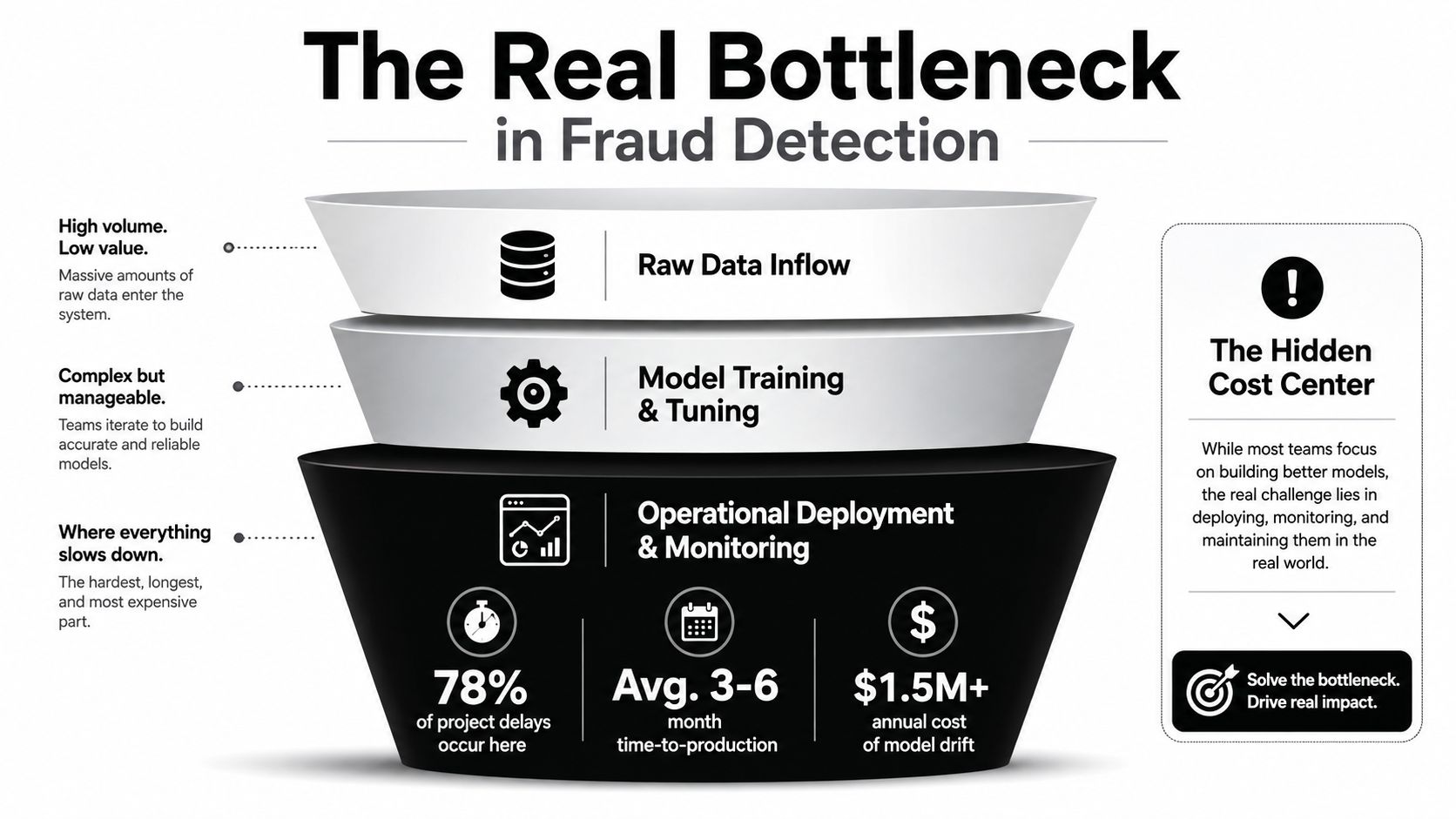
A stronger model can improve ranking, yet still fail to prevent fraud. The difficult work begins after training, when a score must trigger a decision that protects revenue without blocking legitimate customers.
Ensembles remain common because they perform well across many fraud datasets. Random Forest and XGBoost can rank risk effectively, but benchmark results do not guarantee production value. Offline data has defined fields and evaluation rules. A live system has delayed labels, missing context, shifting customer behavior, limited investigator capacity, and attackers probing its boundaries.
Attackers also change faster than most model development cycles. A campaign can alter its scripts, devices, payment routes, and social-engineering tactics while it is active. Historical transaction labels therefore describe yesterday's patterns more reliably than an evolving operation. The model is only one component of a system that must adapt while preserving an auditable decision process.
The operational gap
A production fraud system must answer more than “Is this transaction suspicious?” It must define the response, ownership, evidence, and rollback path:
- What action follows: Approve, decline, request stronger authentication, hold for review, or ask for more information?
- Who owns the decision: A payment service, fraud analyst, customer support agent, or compliance team?
- What evidence is available: Can an investigator inspect the features, related entities, model version, and decision reason?
- What happens when the model changes: Can the team compare a challenger with the current champion without exposing the full payment flow to unnecessary risk?
Logging, monitoring, and governance make those controls operable. Teams that add LLMs for analyst summaries or case triage need prompt versioning, controlled parameters, access boundaries, model logs, and spend visibility. A practical overview of enterprise fraud detection and governance connects these controls with detection, investigation, and compliance workflows.
A prompt management and cost control layer becomes more important as AI features spread across review, support, and communication. It should record which prompt and model produced an output, restrict data access, apply approved settings, and expose cumulative usage before costs or unreviewed behavior grow.
The practical conclusion is straightforward: architecture earns its value through operations. A less fashionable model with clean features, predictable latency, interpretable reasons, and an efficient review queue can prevent more fraud than a complex model the team cannot safely run.
Framing the Problem and the Data Behind It
Start with the decision, not the algorithm. “Detect fraud” is too broad to label, evaluate, or route. A card-not-present system may predict whether a transaction will later be confirmed as unauthorized. An account-takeover system may score a login or profile change. A healthcare organization may look for abnormal provider billing, duplicate activity, or relationships among patients, providers, and claims.
These targets have different units of analysis:
- Transaction-level: Predict risk for a payment, transfer, refund, or claim.
- Behavior-level: Detect a session, login sequence, or interaction pattern that departs from the user's normal behavior.
- Entity-level: Identify a suspicious account, device, merchant, provider, address, or network of related entities.
Labels rarely arrive at the moment of the event. A transaction may be reviewed later, disputed by a customer, confirmed by an investigator, or left unresolved. That delay creates a moving training window. If you label every unreviewed event as legitimate, you'll teach the model that some undiscovered fraud is safe. If you label every alert as fraud, you'll train it on the biases of your rules and review process.
Build the feature pipeline before the model
Useful features usually combine immediate transaction context with historical behavior. Examples include amount relative to a customer's prior activity, location mismatch, payment method changes, login context, device reuse, velocity, failed authentication, and recent profile edits. For a connected attack, the important signal may not be inside one transaction at all. It may be a device shared across accounts or a payment instrument appearing across seemingly unrelated identities.
Avoid leakage. A feature derived from a chargeback outcome, post-investigation note, or future account event can make offline results look excellent while remaining unavailable at decision time. Split data by time where possible, preserve the information available at scoring, and test on later periods that contain different fraud behavior.
The public European Credit Card Fraud dataset remains a common proving ground. It appears in 32 of 44 reviewed studies, or 72.7%, and reflects fraud prevalence of about 0.17%, according to this review of fraud detection benchmark practices. That imbalance is useful for teaching evaluation discipline, but it doesn't represent every product's fraud mix, customer journey, or attack surface.
Match the frame to the industry
An ecommerce team may prioritize authorization latency, checkout conversion, and device or payment relationships. A fintech team may need a lifecycle view that covers onboarding, login, account changes, transfers, and mule activity. A healthcare team may have longer feedback cycles and stricter controls around sensitive information, with claims and provider relationships carrying more meaning than a single event.
Practical rule: Define the action, label maturity, and reviewer workflow before selecting the model. If those three are vague, model tuning is mostly decorative.
For anomaly detection, establish a useful baseline rather than treating every unusual event as malicious. New customers, travel, seasonal purchases, and legitimate business growth all create outliers. The system should distinguish “unfamiliar” from “dangerous” by combining behavioral history, peer context, and entity relationships.
Algorithms That Actually Get Used in Production
Production systems rarely rely on one model family. They layer methods according to the shape of the evidence, the quality of labels, and the decision's latency budget.
Supervised tree ensembles remain a dependable starting point when you have labeled outcomes and structured features. Random Forest and gradient-boosted trees can handle nonlinear interactions, mixed feature scales, missing values with suitable preprocessing, and feature importance analysis that investigators can understand. They work well for payment risk, onboarding decisions, and account-level scoring. Their weakness is familiar: they learn yesterday's fraud and can miss a new campaign with no historical representation.
Unsupervised anomaly detection helps when labels are sparse or delayed. Isolation Forest, local outlier methods, and autoencoders can surface unusual behavior, but an anomaly isn't automatically fraud. These models are most useful as discovery and enrichment signals, especially when they feed an investigator queue or a supervised model rather than making an irreversible decline by themselves. Teams exploring this pattern can review anomaly detection systems for the wider architecture around outlier detection.
Semi-supervised methods sit between those approaches. They learn from confirmed examples while using large volumes of unlabeled activity to identify structure or prioritize review. This can help with new-account fraud and emerging attack patterns, though the feedback loop needs careful controls. Analyst decisions can reinforce existing policy, and weak labels can spread errors.
Sequence models, including LSTM-style architectures and transformer approaches, become more attractive when order matters. An account takeover may look ordinary at the event level but suspicious as a sequence of login, device change, password reset, beneficiary addition, and transfer. The trade-off is operational complexity, more demanding feature and serving pipelines, and harder explanations.
Graph methods address coordinated behavior directly. A graph can connect accounts, devices, cards, merchants, addresses, IP signals, and sessions, exposing rings that look harmless one transaction at a time. A 2026 survey reported that graph neural networks outperform XGBoost by 12% to 25% AUROC when relational structure is modeled, while production-oriented graph systems can reach under 100 milliseconds latency at 10K+ transactions per second, as described in this survey of graph-based fraud detection.
| Approach | Best Data Shape | Typical Latency | Strongest Signal |
|---|---|---|---|
| Supervised ensembles | Labeled tabular events | Low | Nonlinear transaction and customer features |
| Anomaly detection | Sparse labels and behavioral baselines | Low to moderate | Novel deviations from normal activity |
| Semi-supervised learning | A small confirmed set plus abundant unlabeled data | Moderate | Emerging patterns with limited labels |
| Sequence models | Ordered sessions and event histories | Moderate | Temporal behavior and escalation |
| Graph models | Connected entities and shared infrastructure | Low to moderate, depending on graph retrieval | Coordinated rings and reused relationships |
There's no prize for choosing the most complex option. Use an ensemble for a strong baseline, add anomaly signals when labels are incomplete, use sequence modeling when event order carries the risk, and reach for graphs when the attack is relational.
Evaluating Fraud Models Without Fooling Yourself
A high accuracy score can conceal a useless fraud system. If fraud is rare, a model that labels nearly every event legitimate may look successful while missing the attacks that matter. The European benchmark's about 0.17% fraud prevalence makes the imbalance clear, as documented in the benchmark review. Treat that figure as evaluation context, not as evidence that the benchmark represents your traffic.
Begin with the confusion matrix. Recall measures how much confirmed fraud the system catches. Precision measures how many flagged events are fraudulent. F1 combines those two views, while ROC-AUC measures ranking quality across thresholds. For rare events, precision-recall analysis usually maps more closely to operations because it shows what happens as the review queue grows.
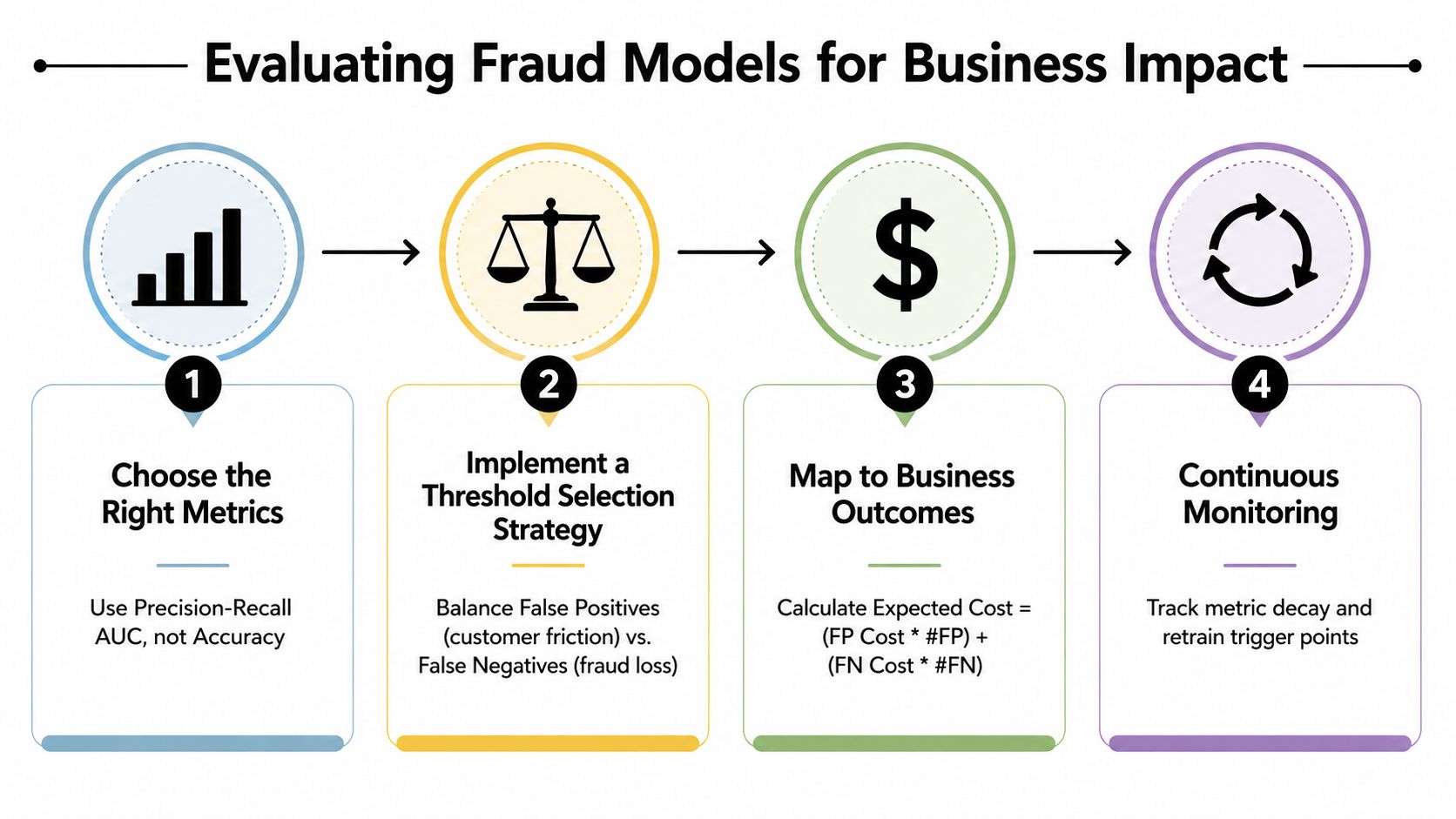
Choose the threshold with the queue in mind
One threshold may catch more confirmed fraud while sending too many legitimate transactions to investigators. Another may miss some fraud but fit team capacity and create less customer friction. The better metric value does not automatically produce the better business decision.
Map each outcome to a concrete consequence:
- False positive: A legitimate customer receives a decline, challenge, delay, or manual review.
- False negative: Fraud succeeds, creating a direct loss, remediation work, or wider compromise.
- True positive: The team prevents or contains a suspicious event, while still paying investigation and customer-handling costs.
- True negative: A legitimate event proceeds without unnecessary friction.
Tune thresholds by segment rather than applying one global cutoff. A high-value transfer, a new account, and a familiar low-risk purchase can warrant different actions. Queue capacity belongs in the objective as well. If investigators can review only a bounded number of cases, optimize ranking and intervention for that limit instead of assuming unlimited human labor.
A 2025 synthesis reported ensemble averages of 92.7% recall, 96% precision, and 92.66% F1-score. Those aggregate review results do not predict performance on your traffic or at your chosen operating point. The financial fraud machine learning synthesis also illustrates why precision matters when false positives consume investigative capacity.
Evaluation should include business impact, model behavior, and governance. A practical guide to AI model evaluation provides a broader framework. In a growing fraud stack, prompt management and cost controls should record which AI features were used, under what policy, and at what operational cost. The decisive question remains: what happens to customers, investigators, and losses at this threshold?
Production Concerns That Decide Whether It Works
A fraud model runs inside a live decision path, not inside a notebook. At authorization time, every feature lookup, graph query, model call, and fallback must fit the product's latency budget. If a feature is slow or unavailable, the system needs a defined degraded mode rather than an accidental timeout policy.
False positives also affect more than the fraud team. A declined payment can reduce conversion, trigger support contacts, and make a legitimate customer repeat an action elsewhere. That doesn't mean the model should approve everything. It means the action policy needs more nuance than a binary block. Use step-up authentication, delayed settlement, device verification, or analyst review where the risk and customer context justify it.
Make the live system observable
Instrument the complete path, not only the model endpoint. Capture the model version, feature availability, decision reason, action taken, downstream outcome, and relevant latency. Keep the records necessary for investigation and audit, while respecting retention and access requirements.
Monitor at least four kinds of change:
- Data drift: A feature's distribution changes because customer behavior, product flow, or instrumentation changed.
- Concept drift: The relationship between a feature and fraud changes because attackers adapted.
- Label drift: Confirmation rates or review practices change, altering the observed outcome.
- Operational drift: Queue volume, analyst decisions, customer complaints, or challenge completion changes.
Retraining shouldn't be a calendar ritual. Establish triggers based on meaningful deterioration, new attack patterns, feature failures, or a sustained change in review outcomes. Use a champion-challenger setup so a candidate model can score traffic in shadow mode before it controls decisions. Compare not only ranking metrics, but also queue size, action mix, latency, customer friction, and investigator agreement.
Production lesson: A model alert should tell someone what changed and what action is available. “Distribution shift detected” is observability theater if nobody can trace it to a feature, segment, or workflow.
Feature stores deserve first-class treatment. Training and serving must compute the same feature definition, with the same time boundaries and entity keys. Otherwise, the model learns one world and scores another. This is a common source of silent degradation, especially when historical aggregates accidentally include information that wasn't available at decision time.
Finally, retain rules. Rules are transparent, fast, and useful for known constraints. Machine learning can rank context and discover interactions, while rules can enforce hard policies and provide an emergency control when a campaign appears. The resilient design is layered, not ideological.
Privacy, Compliance, and Governance Across Industries
Fraud teams often want more data, while privacy and compliance teams want tighter purpose limitation, access control, retention, and explainability. Both concerns are valid. The engineering task is to collect signals that answer a defined risk question, minimize unnecessary detail, and record why each feature exists.
Ecommerce systems may use transaction context, device relationships, account history, and session behavior. Fintech systems face deeper identity, payment, onboarding, and transaction-monitoring obligations, with PCI DSS relevant to payment-card environments and GDPR relevant when personal data falls within its scope. Healthcare teams must design around HIPAA obligations when protected health information is involved, including access, disclosure, and retention controls.
Turn governance into engineering artifacts
A useful cross-industry checklist includes:
- Data sheets: Record the source, purpose, owner, quality limits, retention rule, and permitted use for every important dataset.
- Model cards: Document the model's intended decisions, exclusions, evaluation slices, known failure modes, version, and approval status.
- Reason codes: Return meaningful factors for investigators and customer-service workflows, rather than an opaque score.
- Access boundaries: Separate production data, analyst access, development environments, and external model providers.
- Audit trails: Preserve the inputs, model version, policy path, reviewer action, and final outcome needed to reconstruct a decision.
- Human escalation: Define where a person must review, especially when a decision can materially affect access to financial services or care.
Read privacy by design principles as an implementation mindset, not a document you attach at the end of a project. Privacy is easier to protect when the system separates identifiers from features, limits sensitive access, and makes deletion or retention behavior explicit from the beginning.
Synthetic identities and AI-generated fraud add another governance challenge. A face match, voice sample, or name match can be manipulated, so the system should evaluate transaction context, behavior, relationships, and provenance rather than treating one biometric or document signal as conclusive. At the same time, teams must avoid collecting invasive signals solely because a model can ingest them.
Federated learning may help where organizations can't centralize raw data, but it introduces coordination, feature consistency, validation, and governance complexity. It isn't a shortcut around privacy obligations. The right architecture depends on the purpose, legal basis, risk tolerance, and operational ability to explain a decision.
Putting It All Together with a Governed AI Layer
A durable fraud stack has four connected layers: event and entity data, predictive models, decision workflows, and operational governance. The first three are familiar. The fourth becomes critical when teams add generative AI for investigator summaries, alert explanations, support assistance, or workflow automation.
A prompt management system can give that AI layer controls similar to those used around conventional ML deployments:
- Prompt vault with versioning: Store approved prompts, compare revisions, and connect a generated output to the prompt version that produced it.
- Parameter manager: Control which internal database fields an AI feature can access, with explicit parameters instead of improvised queries.
- Unified logging: Record activity across integrated AI models so teams can review failures, investigate misuse, and compare behavior.
- Cost manager: Track cumulative spend across AI features, teams, and workflows before token usage becomes an invisible operating expense.
Wonderment Apps offers a prompt management system with those capabilities for developers and entrepreneurs plugging AI administration into an existing application. It can sit beside the fraud platform rather than replace the classifier, giving teams a governed path from a fraud score to an investigator-facing explanation or a controlled next action.

A practical rollout starts with one bounded workflow. Feed a case summary to an approved model, restrict the fields it can retrieve, log the prompt and response, and require human confirmation before any consequential action. Then compare the workflow against analyst time, explanation quality, error patterns, and spend. If it earns a place in production, version it like software and monitor it like a model.
The broader pattern is straightforward: use supervised models and graphs for risk scoring, rules for hard controls, investigators for judgment, and governed AI for bounded assistance. That combination keeps fraud detection machine learning connected to real outcomes instead of leaving it as an impressive score in a dashboard.
Wonderment Apps helps organizations modernize web and mobile software with AI integrations, governed prompt management, model logging, database parameter controls, and cumulative cost visibility. Visit Wonderment Apps to discuss a fraud-aware application architecture that can scale while keeping decisions, AI usage, and operational ownership under control.