


A VP of Engineering at a growing SaaS company has a roadmap that includes AI features, a payments rebuild, and a mobile app. Her in-house team can deliver one of those initiatives comfortably, perhaps two with painful trade-offs. The leadership team wants all three. Hiring locally is slow, a fixed-scope vendor feels too rigid, and adding a few contractors won't solve ownership or coordination.
That's where a dedicated development team enters the conversation. But treating it as a simple headcount purchase is a costly mistake. AI coding assistants have reduced the effort needed to produce a first commit, while increasing the need for prompt review, cost tracking, secure context handling, and documentation. A team can ship more code and still make the product harder to operate.
The practical question is no longer only, “How many developers can we add?” It's, “What operating system will keep this team aligned, maintainable, and accountable?” Leaders evaluating AI-led digital transformation need a working definition, disciplined sizing rules, and a governance model that survives changing priorities.
Why Engineering Leaders Are Rethinking How They Build
The dedicated development team model has moved well beyond a niche resourcing tactic. One industry source estimates the market at $98 billion in 2023 and projects 5.1% CAGR growth through 2030, while describing typical annual spending between $120,000 and $500,000. The same source places a 10-developer team in Eastern Europe at around $300,000 per year, compared with more than $600,000 in North America. Those figures show why companies use the model to balance cost, talent access, and long-term delivery capacity across markets. The dedicated team market analysis provides useful context, but the price alone doesn't determine success.
A product leader usually weighs four options: expand the internal team, add staff augmentation, outsource a defined project, or establish a dedicated product squad. Each option changes who owns decisions, how quickly context accumulates, and what happens when the roadmap shifts. The dedicated model is attractive because it can create durable capacity without forcing the company to manage every recruitment and employment process directly.
AI has changed the management burden
AI assistants make code generation easier, but they also create new control points. Who owns a prompt? Which model handled a customer request? What happens when a prompt change increases latency, token use, or unsafe output? Without answers, AI becomes another undocumented dependency inside the product.
A prompt-management system can help by giving teams a versioned prompt vault, a parameter manager for controlled internal database access, logging across integrated AI tools, and cost visibility for cumulative model spend. That's not a replacement for engineering judgment. It's administrative infrastructure that keeps an AI-enabled team from turning every feature into an untracked experiment.
Practical rule: Treat AI governance as part of the delivery team's definition of done, not as a compliance task after launch.
The strongest dedicated engagements now resemble long-lived product squads. Founders and engineering leaders use external capacity as elastic infrastructure, adding capability around a roadmap instead of handing away the product. That arrangement works when governance is explicit. Otherwise, the team amplifies legacy documentation, brittle integrations, and unclear ownership.
What a Dedicated Development Team Actually Is
A dedicated development team is a long-term, vendor-employed group reserved exclusively for one client's product. The client directs the roadmap, priorities, and product outcomes. The provider handles recruitment, employment administration, and often the operational mechanics of retaining the team. The commercial arrangement commonly follows a monthly retainer and an evolving roadmap rather than a frozen statement of work.
The team works inside the client's repositories, communication channels, issue tracker, design tools, and delivery rituals. A typical setup can include software engineers, QA engineers, a technical lead, DevOps support, and, when the product requires it, a product manager, business analyst, designer, or project manager. The important feature isn't the job-title list. It's exclusive focus and accumulated product knowledge.
The three models buyers confuse
Staff augmentation adds individual specialists to a team the client already runs. The buyer still owns prioritization, architecture, team coordination, delivery management, and accountability. It's useful when a company has a clear internal structure and needs a targeted skill, such as a mobile engineer or an automation tester.
Fixed-price project outsourcing transfers a defined deliverable to a vendor against agreed scope, acceptance criteria, and delivery conditions. It can work for a bounded integration, migration, or standalone feature. It becomes dangerous when stakeholders keep changing the roadmap while expecting the original price and schedule to remain intact.
Dedicated teams sit between those models. The buyer owns the what, the provider owns the who, and both parties share responsibility for the how. The team isn't rented by the hour as a body shop, and it isn't an opaque vendor that disappears behind a statement of work.
Why the relationship model matters
A dedicated team creates continuity. Engineers learn the domain, QA understands failure patterns, and designers make decisions with knowledge of existing user behavior. That continuity supports products that need repeated discovery, maintenance, modernization, and feature delivery.
It also creates obligations. The client must provide access, decisions, product context, and a real product owner. The provider must supply capable people, transparent performance management, and a team structure that can challenge weak assumptions. Calling the arrangement a “dedicated team” won't fix a neglected backlog or an absent decision-maker.
How to Structure and Right-Size the Team
Start with the product's constraints, ownership boundaries, and AI governance requirements. A dedicated development team commonly includes a Product Manager or Product Owner, Project Manager, Business Analyst, UI/UX designers, software engineers, QA engineers, and DevOps engineers, as described in this guide to software development team structure. Review the agile team structure guide alongside the product strategy. Market understanding, customer personas, product design principles, and engineering decisions must stay connected.
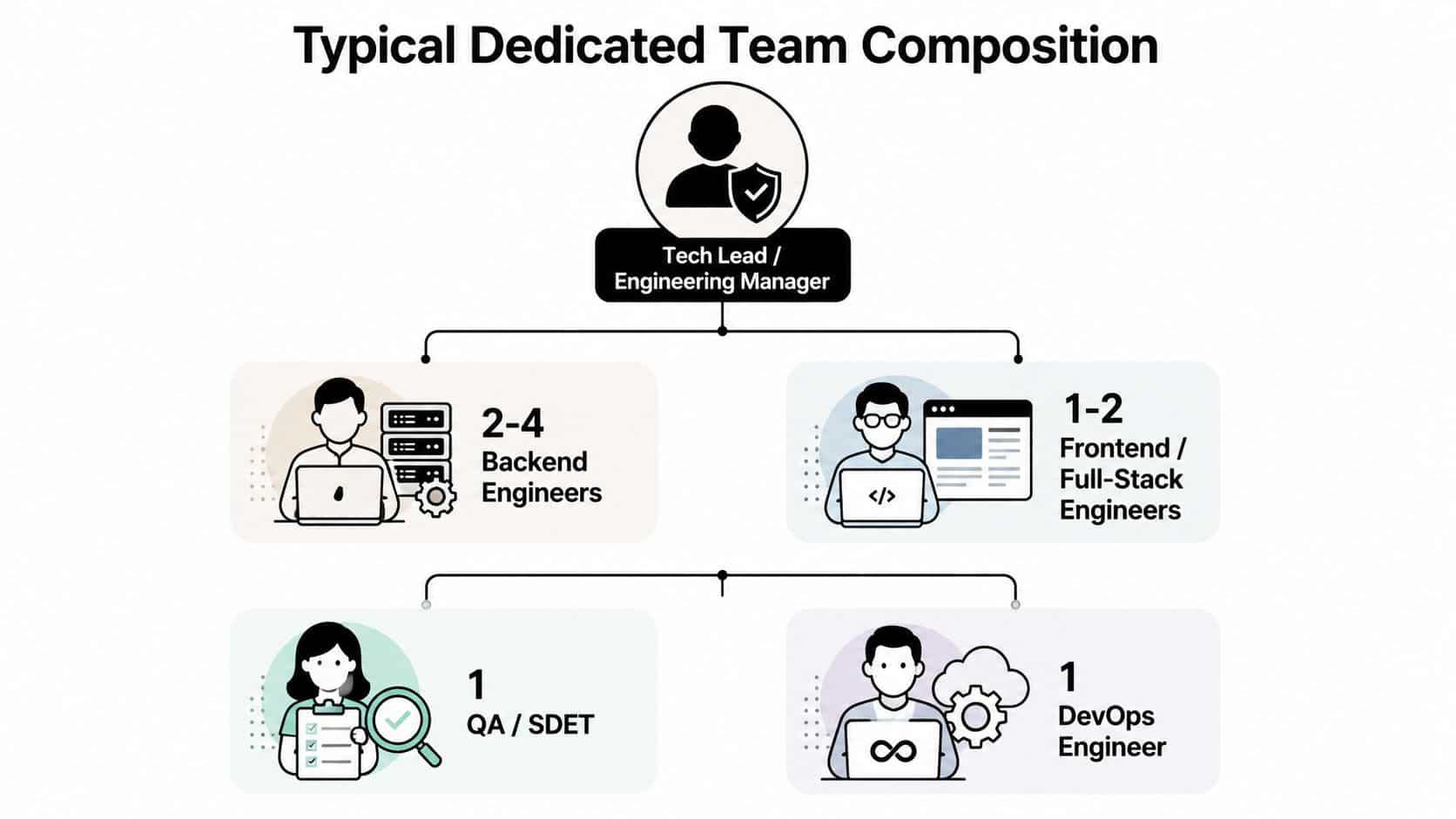
A practical starting composition is:
- Technical leadership: One tech lead or engineering manager.
- Backend delivery: Two to four backend engineers.
- Client experience: One to two frontend or full-stack engineers.
- Quality: One QA engineer or SDET.
- Platform reliability: One DevOps or platform engineer.
- Product direction: A part-time Product Owner, designer, and Scrum Master when internal staff can cover those responsibilities.
Treat this as a working hypothesis, not a hiring order. A new product needs stronger discovery and design. A mature platform usually needs more platform engineering, test automation, migration experience, and documentation ownership.
Size for ownership, not visible busyness
A large-scale study of 201 collaborative GitHub projects found that doubling team size reduced average per-developer productivity by about 22% to 30% across multiple measures, after accounting for collaboration structure. The GitHub productivity study supports a practical rule: adding people does not increase output linearly.
Independent engineering research based on field data from more than 200 projects found that projects with maximum team sizes of 1 to 4 had delivery rates about 4.1 to 6.7 hours per function point better than the overall average, after controlling for language and platform. The team-size delivery research reinforces the need to match staffing to system size and architectural complexity.
Jeff Bezos's two-pizza rule and Spotify's squad model offer guardrails, not templates. Teams under five often lack resilience when someone is unavailable. Teams over nine can lose clear ownership and create more coordination work. I recommend a thin slice of four to six people for a 90-day discovery sprint, then scaling by feature area, platform boundary, or customer workflow.
AI tools do not justify shrinking teams indiscriminately. They shift the balance toward fewer generalists, stronger reviewers, stricter test gates, and clear architectural ownership. Document decisions, approved prompts, model-use boundaries, and cost limits from the start. That administrative infrastructure keeps an AI-enabled team from turning every feature into an untracked experiment. The right team is the smallest group that can own its slice without constant handoffs or undocumented decisions.
Dedicated Team vs In-House, Staff Augmentation, and Project Outsourcing
No engagement model wins every category. The right choice depends on how stable the roadmap is, how much technical control the company requires, and whether the work belongs to the product's long-term core.
| Dimension | Dedicated Team | In-House | Staff Augmentation | Project Outsourcing |
|---|---|---|---|---|
| Cost predictability | Predictable team-based operating cost, with scope flexibility | Predictable payroll, plus hiring and employment overhead | Variable as specialists are added or removed | High predictability when scope stays fixed |
| Technical control | Client owns product direction, with shared execution decisions | Highest direct control | Client owns architecture and delivery management | Vendor typically controls implementation |
| Time to first ship | Fast once access and onboarding are ready | Slower when hiring is required | Fast for known gaps | Potentially fast for a clearly specified deliverable |
| IP and code ownership | Must be explicit in the contract and repository setup | Direct internal ownership | Usually remains with the client | Must be defined in the statement of work |
| Ramp-down risk | Team changes can affect continuity and knowledge | Permanent headcount is harder to reduce | Individual departures can create gaps | Vendor handoff can be abrupt |
| Cultural fit | Requires deliberate integration and shared rituals | Usually strongest by default | Depends on individual integration | Often weaker when collaboration is limited |
When each model makes sense
In-house teams win for long-lived core platforms, sensitive regulated secrets, and organizations that want full control over hiring, career paths, and technical culture. They also carry the full burden of recruitment, retention, management, and capacity planning.
Staff augmentation fits a short surge on a known stack. Use it when your internal team already owns the architecture and can absorb an individual contributor without creating another management layer. Don't expect an augmented developer to become the product owner by accident. This comparison of staff augmentation and managed services explains why the distinction matters.
Project outsourcing works when the deliverable has clear acceptance criteria, such as a bounded integration or defined redesign. Don't hand a vendor an open-ended product roadmap and pretend the original fixed scope will survive discovery.
Dedicated teams pull ahead for multi-quarter roadmaps, ongoing product development, modernization programs, and markets where direct hiring is slow. The model keeps product control with the buyer while creating a stable unit around the work.
Three anti-patterns deserve immediate rejection:
- Treating a dedicated team like a list of billable bodies.
- Pretending staff augmentation creates product ownership.
- Giving a fixed-scope vendor an evolving roadmap without changing the commercial model.
Choose the model that matches the uncertainty you have. Fixed scope deserves fixed-scope delivery. Continuous discovery deserves a team that can stay with the product.
Hiring, Onboarding, and Governing a Dedicated Team
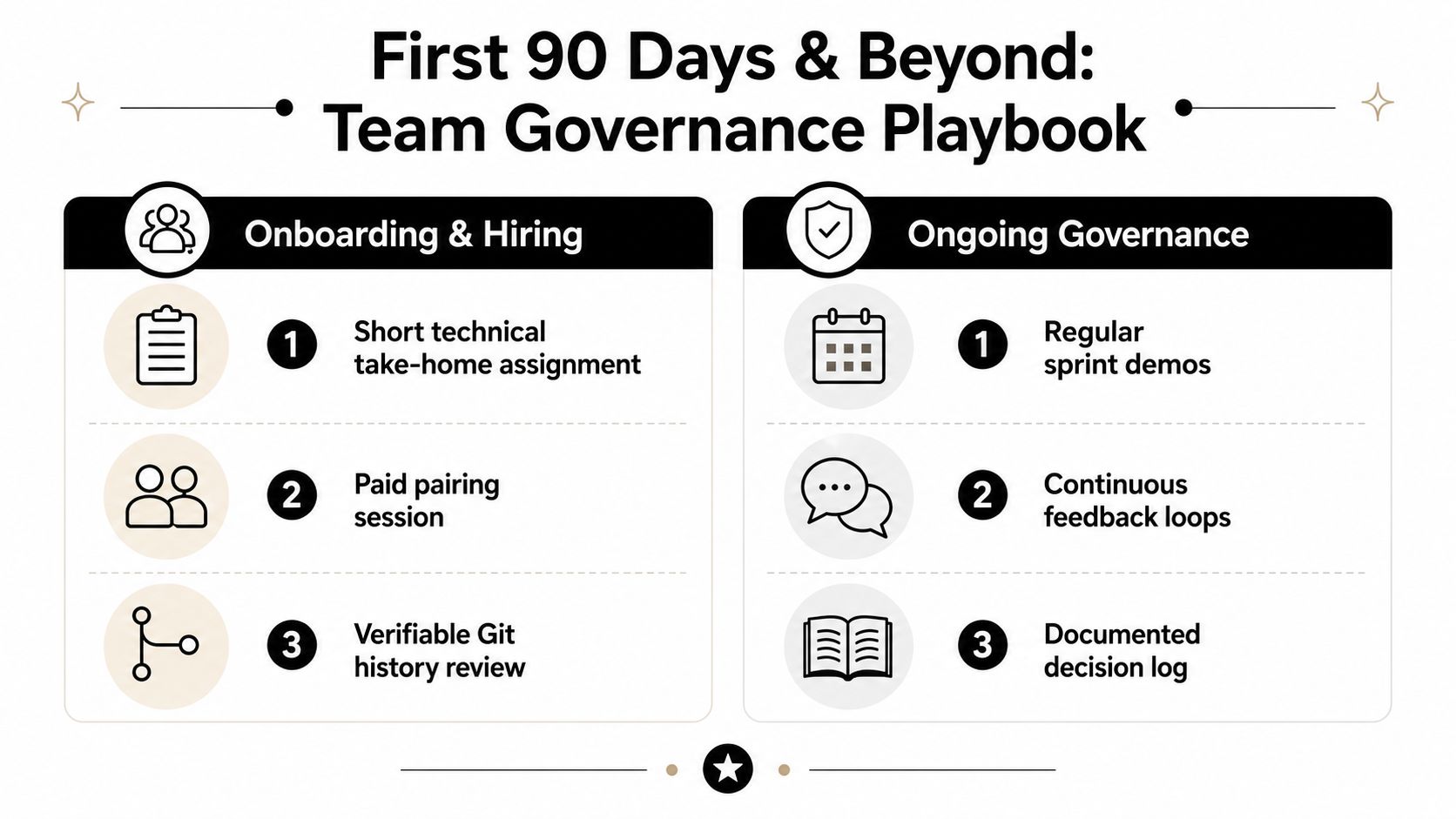
The first 90 days determine whether an external squad becomes part of the product or remains a disconnected supplier. Hire for evidence, onboard for contribution, and govern through visible decisions.
Hire people who can show their work
Skip whiteboard theatre as the primary filter. Use a short technical take-home, followed by a paid pairing session that reveals how a candidate reasons, communicates, tests, and responds to feedback. Ask for verifiable Git histories where appropriate, then conduct a system-design walkthrough focused on trade-offs rather than vocabulary.
A strong provider should explain who recruited each person, how technical capability was assessed, and how the team will handle replacement or absence. You're buying continuity, not just resumes.
Teams adding AI workflows should also make onboarding explicit for tool usage, data handling, and review expectations. A practical resource on AI-native onboarding for tech recruiters can help recruiters and delivery leaders think beyond account creation and introduce new contributors to the operating environment.
Make the first contribution concrete
Prepare access documentation, architecture decision records, a one-page glossary, repository instructions, and a clear local development path before the team starts. Target a working contributor's first merged pull request within 10 working days, assuming the client provides timely access and product decisions.
Use one backlog, not parallel vendor tickets and internal priorities. The Product Owner owns what gets built. The delivery team owns how it gets built. A weekly demo exposes reality early, while a monthly roadmap review forces stakeholders to revisit sequencing, dependencies, and capacity.
Put quality and operating metrics in the contract with reality
Require architectural review for changes involving authentication, payments, or shared services. Promote shift-left testing, contract tests across service boundaries, and a non-functional budget covering latency, error rate, and cost per request.
Instrument these measures from the beginning:
- Lead time: How long work takes from commitment to production.
- Deployment frequency: Whether delivery happens continuously or in batches.
- Change failure rate: How often releases cause operational problems.
- Mean time to recovery: How quickly the team restores service.
- Defect escape rate: How many defects reach users.
- AI spend per feature: What model usage costs as functionality expands.
Escalate when pull requests sit without ownership, documentation falls behind implementation, the backlog contains competing priorities, demos become status meetings, or the provider can't explain who made a technical decision. Those aren't minor process issues. They're early indicators that the team lacks an operating contract.
Tailored Use Cases Across Ecommerce, Fintech, Healthcare, Media, and Public Sector
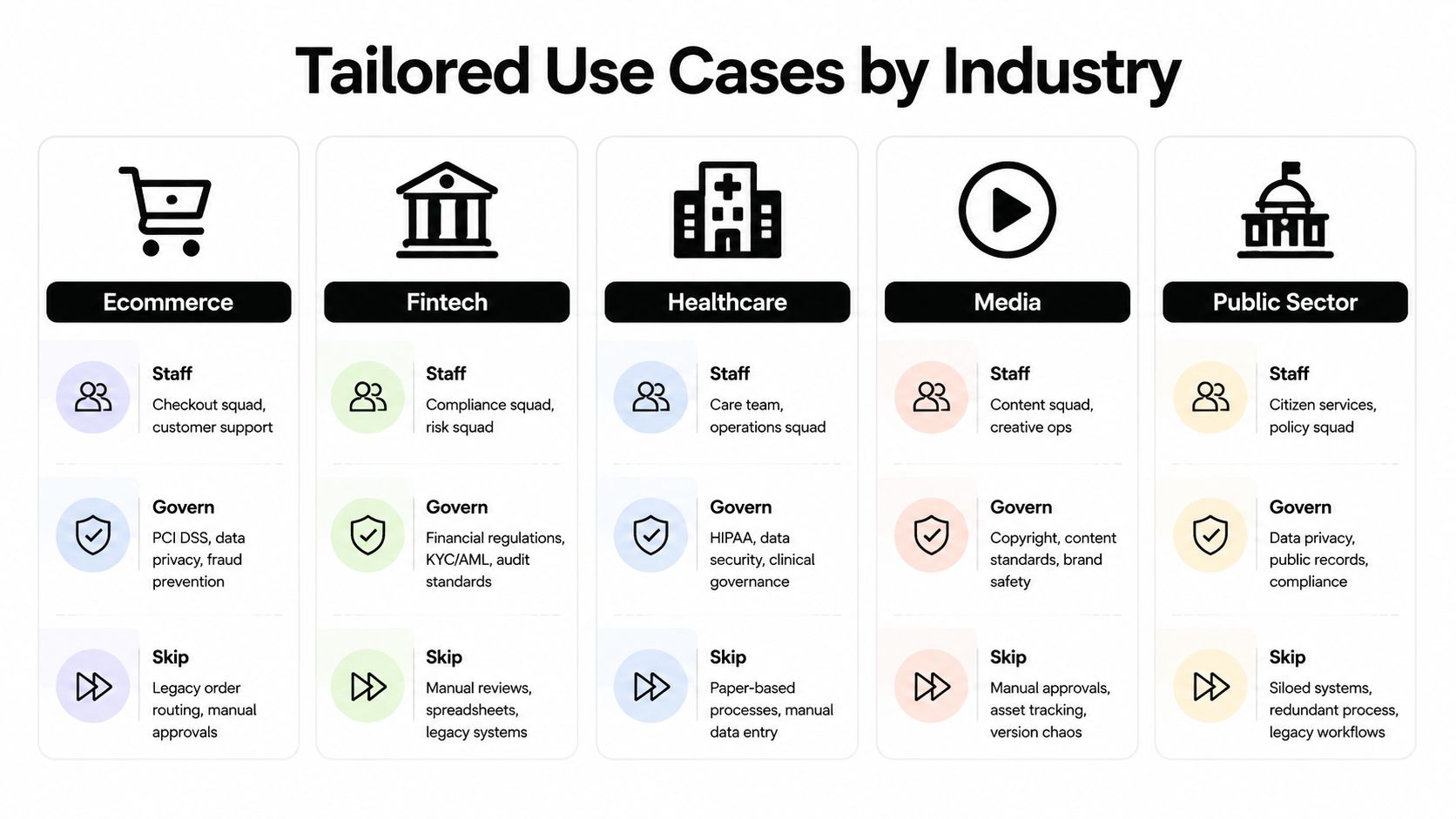
A dedicated development team should reflect the risk profile of the product. The same staffing pattern that works for a media recommendation engine can create unacceptable gaps in healthcare or public-sector delivery.
Ecommerce
A retailer is rebuilding checkout while expanding catalog integrations and personalization. Staff a cross-functional squad around checkout, catalog, payments, and external integrations, with QA and platform support available for reliability work.
Govern PCI scope, peak-season load testing, payment-provider failure behavior, analytics integrity, and SEO-safe releases. For AI features, review recommendation logic, customer-data access, fallback behavior, and the cost of repeated model calls.
Skip broad rewrites during trading-critical periods. The common mistake is optimizing the storefront while leaving checkout observability and integration failure handling weak.
Fintech
A fintech team is adding an AI assistant to a platform that already handles sensitive financial workflows. Staff backend engineers, platform specialists, DevSecOps, QA, and product ownership with enough domain knowledge to challenge unsafe shortcuts.
Govern SOX and PCI evidence, dual-control deployments, model-risk reviews, secrets management, prompt-injection testing, and audit-ready change records. AI output should never bypass authorization or human approval just because the interface feels conversational.
Skip generic “innovation” work that lacks a control owner. The recurring mistake is treating AI assistant behavior as a user-experience concern instead of a security and model-governance concern.
Healthcare
A healthcare organization is connecting clinical workflows to patient-facing applications. Staff integration engineers, workflow-focused product specialists, QA engineers, security support, and designers who understand accessibility and sensitive user contexts.
Govern HIPAA logging, PHI handling, audit trails, validated-system change control, identity boundaries, and data minimization. Every AI integration needs a clear policy for what information can enter a model context and how teams investigate unexpected output.
Skip undocumented transformations between systems. The mistake often made is assuming that a passing functional test proves a workflow is safe for clinical use.
Media
A media company is launching a high-performance content app with personalization. Staff full-stack, data, search, and personalization engineers, with QA and platform ownership close to the release process.
Govern content licensing, rights metadata, ad-policy compliance, recommendation drift, editorial controls, and model fallback behavior. A recommendation system that improves engagement but violates licensing rules is not a product win.
Skip personalization without measurement and human override. The common mistake is allowing the model to become the editorial policy by default.
Public sector
A public agency is replacing a fragmented service portal. Staff backend, integration, accessibility, and security-cleared engineers, supported by product and documentation ownership that can meet procurement expectations.
Govern FedRAMP or equivalent security posture, accessibility conformance, freedom-of-information impact assessments, data retention, and procurement-grade documentation. The team should treat records, decisions, and approvals as deliverables rather than administrative clutter.
Skip private-sector assumptions about rapid changes without formal review. A common oversight is underestimating documentation and accessibility until the product is already difficult to approve.
Making Dedicated Teams Work in an AI-First Delivery Model
AI changes the dedicated team's risk profile. The squad can generate code, prompts, tests, and migration plans faster, but undocumented context and unmanaged model usage can spread across every contributor. A 2025 SlashData survey of more than 10,500 developers across 127 countries found 31% citing unreadable or hard-to-maintain code as a top challenge, 31% citing insufficient or outdated documentation, and 27% citing insufficient test coverage or ignored test results. The survey analysis makes the contrarian point clear: a dedicated team can amplify legacy problems unless modernization is part of the engagement.
Atlassian's 2025 developer-experience report surveyed 3,500 developers and managers about productivity blockers and long-term success factors. The lesson for delivery leads is operational, not fashionable. AI adoption needs platform practices, alignment, and review discipline, not a separate assistant account for every engineer. The Atlassian developer-experience report gives leaders a useful lens for evaluating those friction points.
Install three operating layers:
- Versioned prompt and context library: Every production prompt needs an owner, version, environment, release history, and rollback plan. Track token usage, latency, errors, fallback rates, and guardrail results when prompts change, following the principles in production prompt-management guidance.
- Feature-level cost visibility: Tie model usage to features and sprint reviews. A gateway or callback should capture prompt text, token count, model, and user tags for each LLM request, as recommended in AI observability guidance.
- AI-assisted review with human control: Wire SAST, LLM-based review, and a human approver into CI. Never merge a model-generated migration without a reviewer who understands the data, rollback path, and operational impact.
Use this 10-point readiness check before scaling:
- A PRD or prompt specification exists.
- A shared model gateway is defined.
- Code-style gates are agreed.
- Test gates are enforced.
- Secrets have named owners.
- Production prompts have version control.
- AI requests are observable.
- Documentation debt has an active backlog.
- An incident commander rotation exists.
- A quarterly model-spend cap is approved.
A team that passes eight of ten is ready to scale a dedicated engagement in 2026. Teams below that threshold should fix governance before adding headcount. A prompt vault with versioning, a parameter manager for controlled internal database access, integrated AI logging, and cumulative cost management gives leaders a practical way to make those controls visible. Wonderment Apps offers that administrative toolkit as an option for teams modernizing existing web or mobile applications without scattering AI governance across disconnected scripts and dashboards.
Wonderment Apps helps product companies assemble right-sized teams across engineering, QA, design, product management, and project leadership, while also supporting AI modernization in existing applications. Visit Wonderment Apps to discuss your roadmap, team structure, and the governance controls needed before AI features reach production.