


A product team has a promising commerce idea, but the idea keeps colliding with the same old platform constraints. A checkout change needs approval from several teams, a search improvement depends on a vendor release, and a new AI recommendation feature raises uncomfortable questions about prompts, model costs, data access, and production monitoring. The work isn't blocked by a lack of ambition. It's blocked by an architecture that makes every change everyone's problem.
Composable commerce architecture offers a way to separate those concerns without requiring an overnight rebuild. It can let a team replace search while keeping its order system, introduce a headless frontend while preserving existing backend services, or add AI capabilities without scattering unmanaged prompts throughout the application. The important qualification is that composable doesn't mean “break everything apart.” It means deciding deliberately which capabilities should remain unified, which should become independent, and how the resulting system will be governed.
Why Your Monolith Is Slowing You Down
A mid-market retailer wants to launch same-day delivery. The product manager has a clear customer journey, the operations team has delivery coverage, and the frontend team has a checkout design ready. Then the architecture review begins.
The checkout change sits behind six months of vendor release notes, three dependent teams, and a custom pricing plugin that nobody clearly owns. The retailer's release train moves quarterly, the checkout and inventory data models are tightly coupled, and procurement has locked payments, promotions, and order processing behind the core commerce platform. A feature that sounds like a focused improvement becomes a coordination exercise.
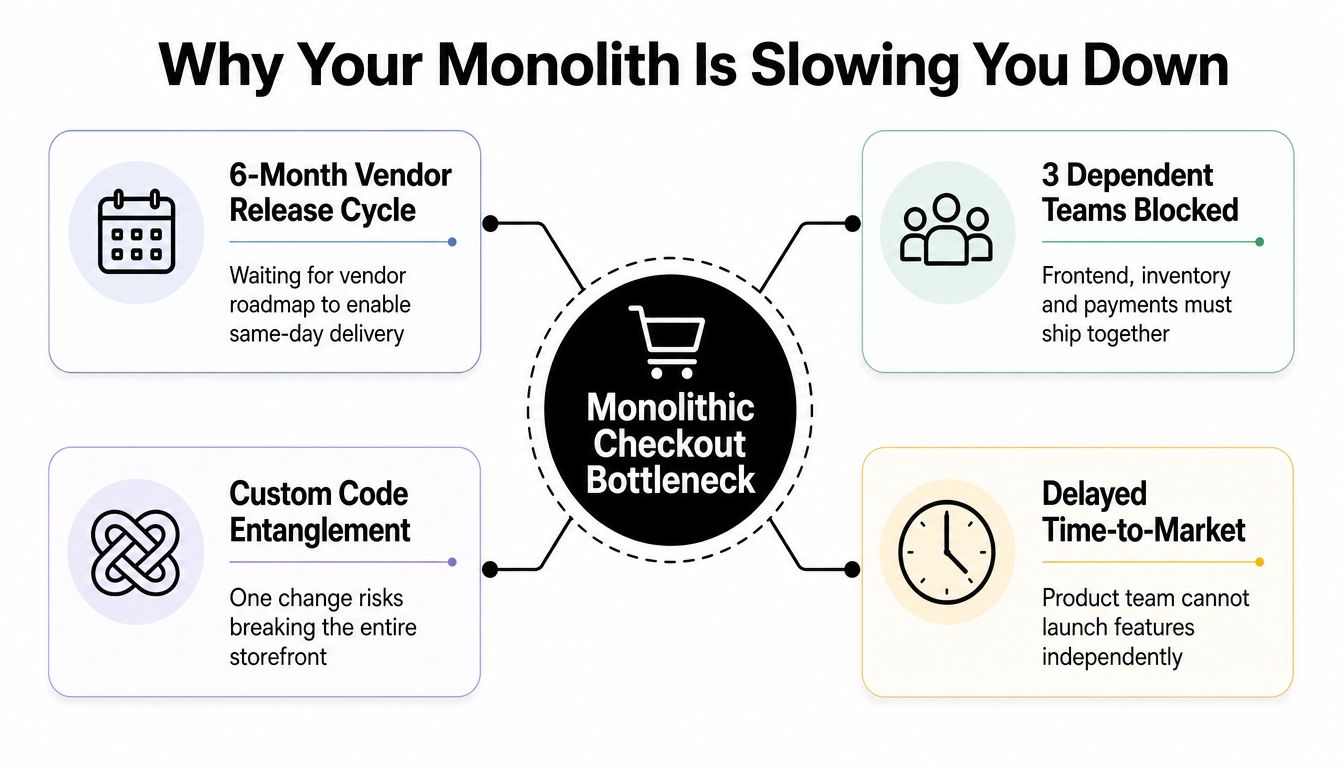
That pattern appears in B2B catalogs, subscription portals, and direct-to-consumer storefronts. Merchandising, content, personalization, pricing, and checkout often share one deployable application or one tightly integrated suite. A change to a product page can trigger testing across promotions, tax, customer accounts, order creation, and fulfillment.
The problem is a velocity tax, not a matter of old technology being unfashionable. An academic review cited in the Composable Commerce Trends 2025 Executive Report notes that monolithic systems often needed 4–6 months for major updates, while microservices systems could deliver comparable updates in 2–3 weeks. The difference explains why microservices-based commerce stacks began replacing slower release cycles around 2015.
Composable commerce responds by separating capabilities. Search can ship independently from checkout. A CMS can evolve without redeploying the order ledger. A personalization service can scale without forcing the entire storefront to scale with it.
Practical rule: If one team can't change a capability without coordinating a full-platform release, that capability is a candidate for decoupling.
The rest of the architecture comes down to choosing those boundaries carefully, operating the connections responsibly, and avoiding fragmentation for its own sake. It also means treating AI features as production software, with versioned prompts, controlled data access, logs, and cost visibility. That operational loop matters as much as the storefront design.
What Composable Commerce Architecture Really Means
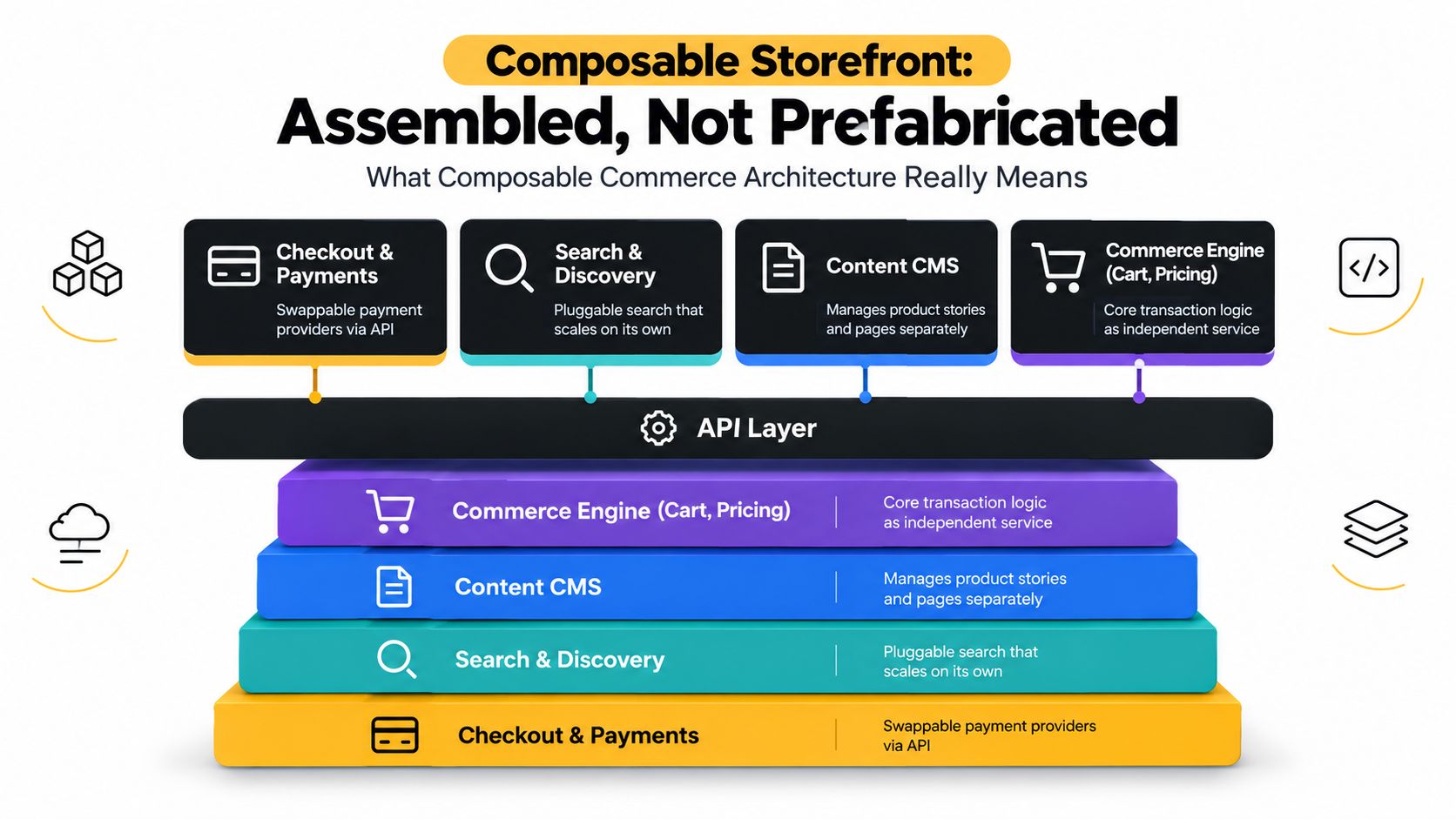
Think of a traditional commerce suite as a prefabricated building. You can decorate rooms and change some fixtures, but the plumbing, wiring, and floor plan arrive as one package. Composable commerce architecture is closer to assembling a building from independently sourced blocks. You might select one block for the commerce engine, another for the CMS, another for search, and separate services for payments, product information, order management, personalization, and experimentation.
The blocks only work together if they expose clear contracts. In a commerce system, those contracts are usually APIs, events, schemas, authentication rules, and ownership agreements. A search service shouldn't need direct access to every internal table in the commerce engine. It should receive the product information it needs through a defined interface.
The four MACH principles
Composable architectures commonly use MACH, which stands for Microservices, API-first, Cloud-native, and Headless. Each principle solves a different coupling problem.
- Microservices: A service owns a focused capability, such as catalog, inventory, cart, or recommendations. Teams can deploy or replace that capability without rewriting unrelated functions.
- API-first: APIs become the integration contract. Frontends, mobile applications, partner channels, and internal services can consume the same business capabilities through controlled interfaces.
- Cloud-native: Services are designed for cloud deployment, independent scaling, managed operations, and automated delivery rather than one large application lifecycle.
- Headless: The customer-facing presentation layer is separate from commerce logic. A web storefront, mobile app, kiosk, or other channel can use the same backend capabilities while creating its own experience.
The practical effect is reduced coupling. Catalog, inventory, search, payments, and recommendations can communicate through APIs rather than shared databases or proprietary integration layers, as described in this MACH definition of composable commerce.
Composable is a spectrum
MACH describes an architectural ideal. Real enterprise stacks frequently combine modular services with tightly integrated SaaS suites, existing ERPs, identity platforms, and native commerce features. That isn't a failure. A unified order ledger, tax engine, or identity boundary may provide valuable stability, while search, content, recommendations, or merchandising rules may benefit from specialized services.
A recent industry breakdown cited by Bemeir found that 19% of enterprise retailers using composable were running full MACH, while 31% were partial composable and 17% used a decoupled frontend only, according to its composable commerce architecture data story. Those figures reinforce a useful point: the question isn't whether a company should “go composable.” The question is which layer should stay unified and which layer deserves independent speed.
For a deeper distinction between frontend decoupling and broader modular commerce, see this guide to headless commerce architecture.
Core Components and Integration Patterns
A composable stack becomes easier to reason about when every component has two explicit properties: what it does and what data it owns. The commerce engine may own carts, pricing rules, and the canonical order record. A PIM may own product attributes, while a CMS owns editorial content. Confusion begins when multiple systems claim authority over the same field.
A practical component map
| Component | Role | Integration Pattern | Data Owned |
|---|---|---|---|
| Commerce engine | Cart, pricing, promotions, order creation | REST or GraphQL APIs, webhooks | Cart state, pricing decisions, order ledger |
| PIM | Product attributes, specifications, merchandising data | APIs and catalog events | Product information and taxonomy |
| CMS | Product stories, landing pages, editorial content | Content APIs and publish events | Pages, components, media references |
| Search service | Indexing, discovery, filters, ranking | APIs and catalog events | Search index and relevance configuration |
| Payments and tax | Authorization, capture, tax calculation | Synchronous APIs and webhooks | Payment status, tax decisions |
| OMS and fulfillment | Allocation, shipment, returns | APIs and order events | Fulfillment state and shipment data |
| Personalization engine | Recommendations, segments, experiments | APIs and customer events | Segments, recommendations, experiment assignments |
| Identity and customer data platform | Authentication, profiles, consent | APIs and identity events | Customer identity, preferences, consent records |
The integration style should match the business interaction. A product detail page and add-to-cart request usually need synchronous REST or GraphQL responses. A payment provider can notify the platform through a webhook after authorization or capture. Catalog updates and customer-segment changes often belong in an event broker such as Kafka or EventBridge, where multiple consumers can react without blocking the original transaction.
The orchestration layer matters
An API connection alone doesn't create a reliable system. A backend-for-frontend or workflow service should sequence calls, apply timeouts, handle retries, and enforce idempotency. If a customer taps “Place order” twice, the orchestrator needs a safe way to prevent duplicate order creation. If payment succeeds but fulfillment creation fails, the workflow needs a recoverable state rather than a vague error message.
Distributed systems also introduce eventual consistency. Inventory, pricing, search indexes, and content may not update at exactly the same moment. Teams need correlation IDs that follow a request across services, clear retry behavior, and a documented answer to one difficult question: which system owns the truth when two records disagree?
API contracts, event ownership, and failure handling are core parts of enterprise application integration best practices. Teams selling across regions should also account for legal entities, payments, tax, localization, and operational ownership. A practical guide to global selling in 2026 can help product leaders frame those concerns before they select services.
Real Benefits and the Trade-offs Nobody Mentions
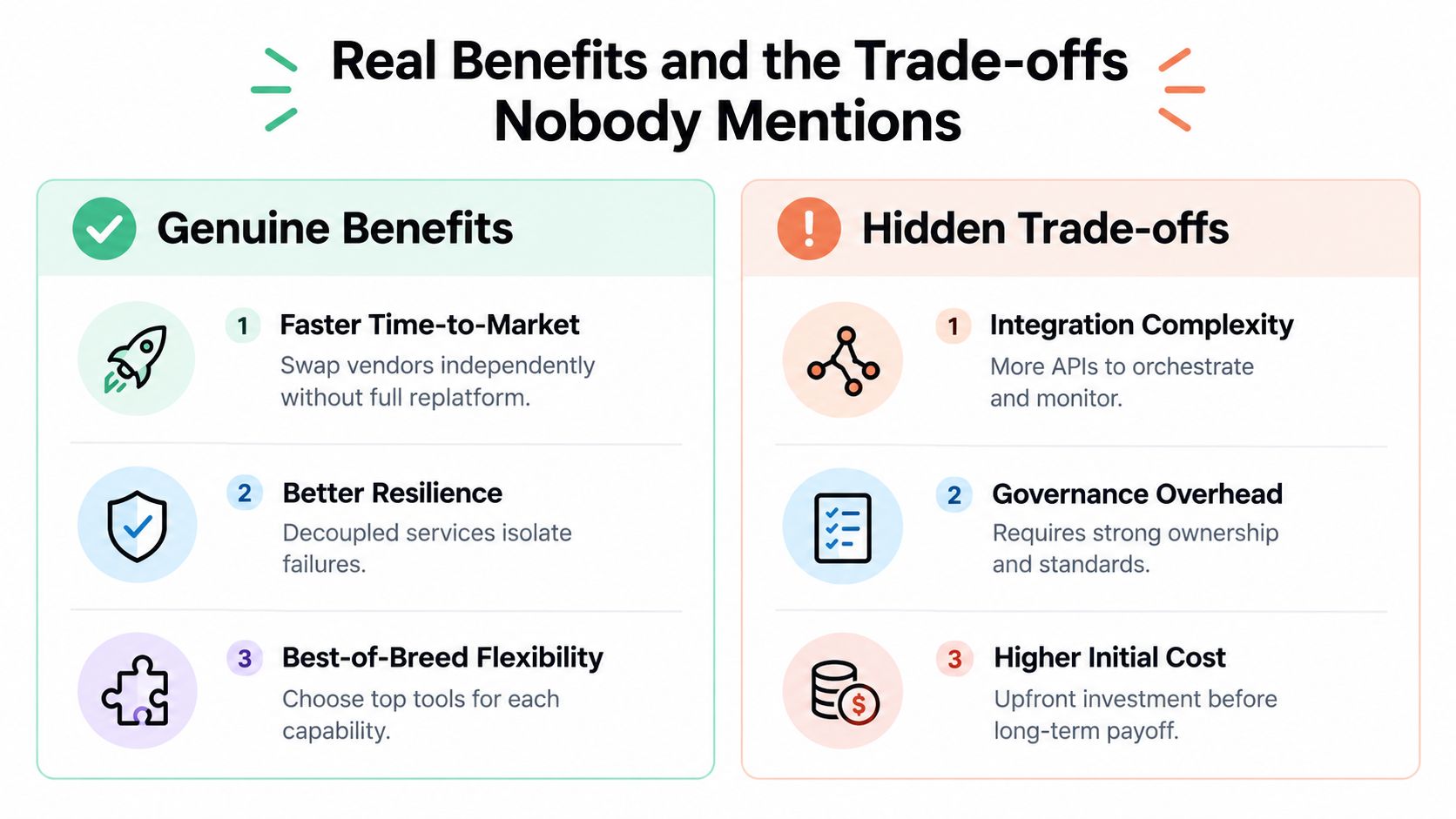
Composable commerce can improve delivery speed, but it doesn't erase complexity. It moves complexity from one vendor-controlled platform into the relationships between services, teams, vendors, and data contracts. That trade can be worthwhile when the business needs independent change, but finance and engineering should evaluate the operating model before approving the architecture.
What teams gain
A modular stack lets a product team replace a search vendor without replatforming checkout. It can isolate failures, scale services according to their own demand patterns, and support specialized customer experiences through dedicated personalization or experimentation tools. The team also avoids treating the core platform as a permanent answer to every future requirement.
The commercial case is significant. Independent market research estimated the global composable commerce market at $8.4 billion in 2025 and projected it to reach $50.7 billion by 2034, with a 22.3% CAGR, as reported in this composable commerce market analysis. A separate composable applications projection places that broader category at $6.44 billion in 2024 and $31.50 billion by 2034, with a 17.2% CAGR. These projections describe an expanding investment category, not a guarantee that every implementation will produce a return.
What teams absorb
The drawbacks show up in places architecture diagrams often leave blank:
- More subscriptions: Several specialized services can create a higher combined software bill than one suite.
- Integration work: Engineers must build and maintain adapters, workflows, schemas, retries, and monitoring.
- Distributed-systems skills: Teams need experience with asynchronous processing, failure recovery, security boundaries, and operational debugging.
- Vendor management: Security reviews, service-level agreements, release changes, and support escalation multiply across providers.
- Data coordination: Eventual consistency can create temporary mismatches in inventory, pricing, content, or customer state.
Gartner-linked reporting cited by Elastic Path predicted that organizations with mechanisms for reusing composable modules could ship digital innovation 60% faster by 2026, while also associating adoption with faster time to market, lower total cost of ownership, and stronger cross-channel consistency. That composable commerce overview is useful context, but the predicted benefit depends on reusable modules, disciplined governance, and a team capable of operating them.
The right decision isn't “composable is cheaper” or “monoliths are bad.” It's whether the value of independent change outweighs the cost of managing more moving parts.
Migration Strategies and Governance Essentials
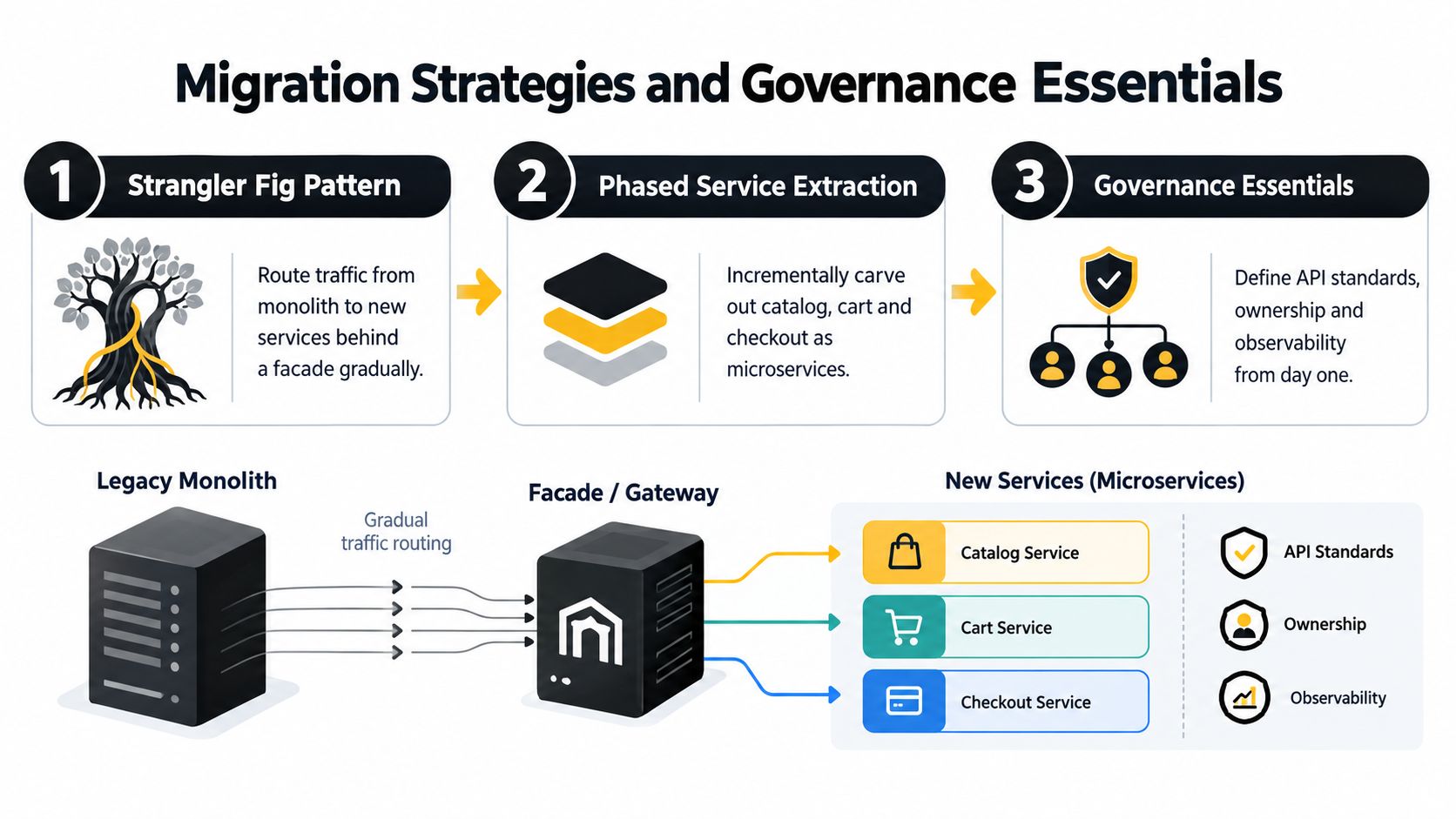
Most organizations shouldn't replace a mature commerce platform in one dramatic release. A safer path creates a façade around the existing system, moves one capability at a time, and measures whether the new boundary reduces friction.
Three routes into composable commerce
The strangler fig pattern places a gateway or façade in front of the monolith. New requests for a capability, such as search or checkout, route to a new service while the remaining traffic continues to use the old platform. Over time, the new service takes responsibility for more behavior until the legacy path can be retired.
Frontend-first modernization keeps backend systems in place while a headless storefront consumes their data through APIs or an integration layer. This approach gives the customer experience team room to improve navigation, content, and channel presentation without immediately changing the order ledger or financial systems.
Capability-by-capability extraction defines a bounded context, such as catalog, promotions, or OMS, and gives one team ownership of its service, contract, migration, and support model. Each release creates an opportunity to learn before the next boundary is chosen.
A migration should produce concrete deliverables, not only architectural diagrams:
- Capability map: List current responsibilities, data owners, dependencies, and failure consequences.
- Routing façade: Define which requests remain on the monolith and which go to the new service.
- Contract tests: Verify API schemas, error behavior, authentication, and backward compatibility.
- Ownership register: Name the team responsible for each service, event, dashboard, and incident path.
Governance is part of the product
API versioning needs a written policy. Teams should know how long an old contract remains supported, how breaking changes are announced, and who approves schema evolution. OAuth scopes and secrets management should limit each service to the data and actions it needs.
Observability needs more than application logs. Distributed tracing should connect a storefront request to downstream calls, while dashboards should track latency, errors, saturation, and traffic. An event taxonomy should define names, payload ownership, retry behavior, and retention so the broker doesn't become a junk drawer of ambiguous messages.
Ownership is the architecture. If nobody owns orchestration, schema changes, and recovery, the system is only modular on paper.
The composable architecture trend analysis highlights the operational burden of joining product data, syncing events, handling eventual consistency, and managing API versions. Those concerns should appear in the first delivery plan, not after production incidents expose them.
What Composable Looks Like in Practice
Good composable commerce architecture starts with a business constraint, not a shopping list of vendors. The following vignettes show how boundaries can differ by industry while preserving a common principle, keep stable system-of-record responsibilities close to the core and compose capabilities that need specialized speed.
| Scenario | Stays Native to Commerce Core | Composed Externally |
|---|---|---|
| B2B industrial manufacturer | Financial order record, customer account authority, ERP-connected availability | Product catalog experience, CPQ, guided selling, search |
| DTC retailer | Cart, order creation, core pricing rules | Headless frontend, search, CMS, loyalty, experimentation |
| Regulated healthcare storefront | Patient identity boundary, consent, compliant transaction workflow | Public catalog, content delivery, discovery, selected checkout integrations |
B2B manufacturing
An industrial manufacturer may keep finance, invoicing, and account authority inside its ERP-connected commerce core. The customer-facing catalog can still be composed with a specialized PIM, search service, and CPQ layer that understands configurations and quote rules.
That arrangement keeps the financial system of record stable while giving buyers a clearer path from product discovery to a configured request. The architecture succeeds when the CPQ service owns configuration decisions and the commerce core owns the resulting order or quote record. Neither system should become the other system's database.
Direct-to-consumer retail
A DTC retailer may use a headless commerce engine for carts and orders, a separate CMS for campaign pages, a search provider for discovery, and a loyalty platform for member benefits. The frontend team can evolve product detail page layouts without asking the order service to change its internal model.
The trade-off is that the storefront must present one coherent experience while several services answer questions at runtime. A backend-for-frontend can aggregate those responses, cache safe content, and return predictable fallbacks when a recommendation or loyalty call is unavailable.
Regulated healthcare
A healthcare storefront needs sharper boundaries. Patient identity, consent, and sensitive records should remain inside the controlled service responsible for those obligations. A public catalog and general educational content can use separate delivery services, while checkout APIs expose only the minimum information required for the transaction.
This model doesn't make compliance automatic. It makes the data paths visible enough to review. Product leaders should document which service receives sensitive data, which service can retain it, and how logs avoid exposing it.
Operating AI Features Inside Your Composable Stack
AI belongs in the architecture map, but it shouldn't receive a free pass because it arrived through an impressive demo. Prompts, model calls, embeddings, retrieval, and safety checks are capabilities that need contracts, owners, observability, and replacement options just like search or payments.
A product team might begin with an AI shopping assistant that explains product differences. The assistant could call catalog APIs for approved attributes, use a prompt service to shape the response, and emit structured logs tied to a session. A later feature might summarize a support conversation or classify a product question. Each capability can use a different model or prompt version without embedding model logic directly into checkout.
The operating toolkit
Wonderment Apps' prompt-management toolkit is designed as an administrative layer that developers and entrepreneurs can connect to an existing application. Its relevant controls include:
- Prompt vault: Stores prompts for reuse and versioning across AI features and storefronts.
- Parameter manager: Manages model-routing parameters and application settings, including controls such as temperature or token budgets.
- Logging system: Records integrated AI activity so teams can trace a generation back to a cart, session, or feature workflow.
- Cost manager: Shows cumulative AI spend and helps break usage down by feature, channel, or merchant.
Those functions fit directly into the integration patterns described earlier. An API gateway can call the prompt-management layer, webhooks can notify downstream systems about workflow changes, and event brokers can distribute approved catalog or customer-segment updates. Versioned prompt inputs and structured output schemas also fit the governance model used for ordinary services.
Teams exploring how AI changes commerce operations can use this overview of the future of e-commerce automation as broader context. For implementation details, AI integration for modern applications provides a useful starting point.
A controlled rollout checklist
- Inventory AI touchpoints: Find every existing model call, embedded prompt, retrieval path, and user-facing generation.
- Choose one valuable feature: Start with a bounded use case, such as product comparison or internal merchandising assistance.
- Create a managed contract: Define input fields, output schema, prompt owner, model policy, and failure response.
- Instrument production behavior: Track quality signals, latency, errors, sessions, and cost before expanding.
- Review before scaling: Keep the feature only when product, engineering, security, and finance can explain its behavior.
A composable commerce architecture can give your team room to change faster, but the architecture only stays healthy when every service has a boundary and every boundary has an owner.
Wonderment Apps helps product teams modernize web and mobile applications, connect AI capabilities to existing systems, and manage prompts, parameters, logs, and cumulative model costs through its administrative toolkit. Visit Wonderment Apps to discuss a practical composable commerce or AI modernization roadmap for your product.