

Your backlog is full of work customers want. Your internal team is already at capacity, and hiring will take too long. Now you're deciding between adding people you direct and handing a defined outcome to someone else. That's the Staff Augmentation vs Outsourcing decision. It's not about finding cheaper engineers. It's about deciding who controls priorities, architecture, quality, and accountability when plans change.
When Your Team Needs a Different Delivery Model
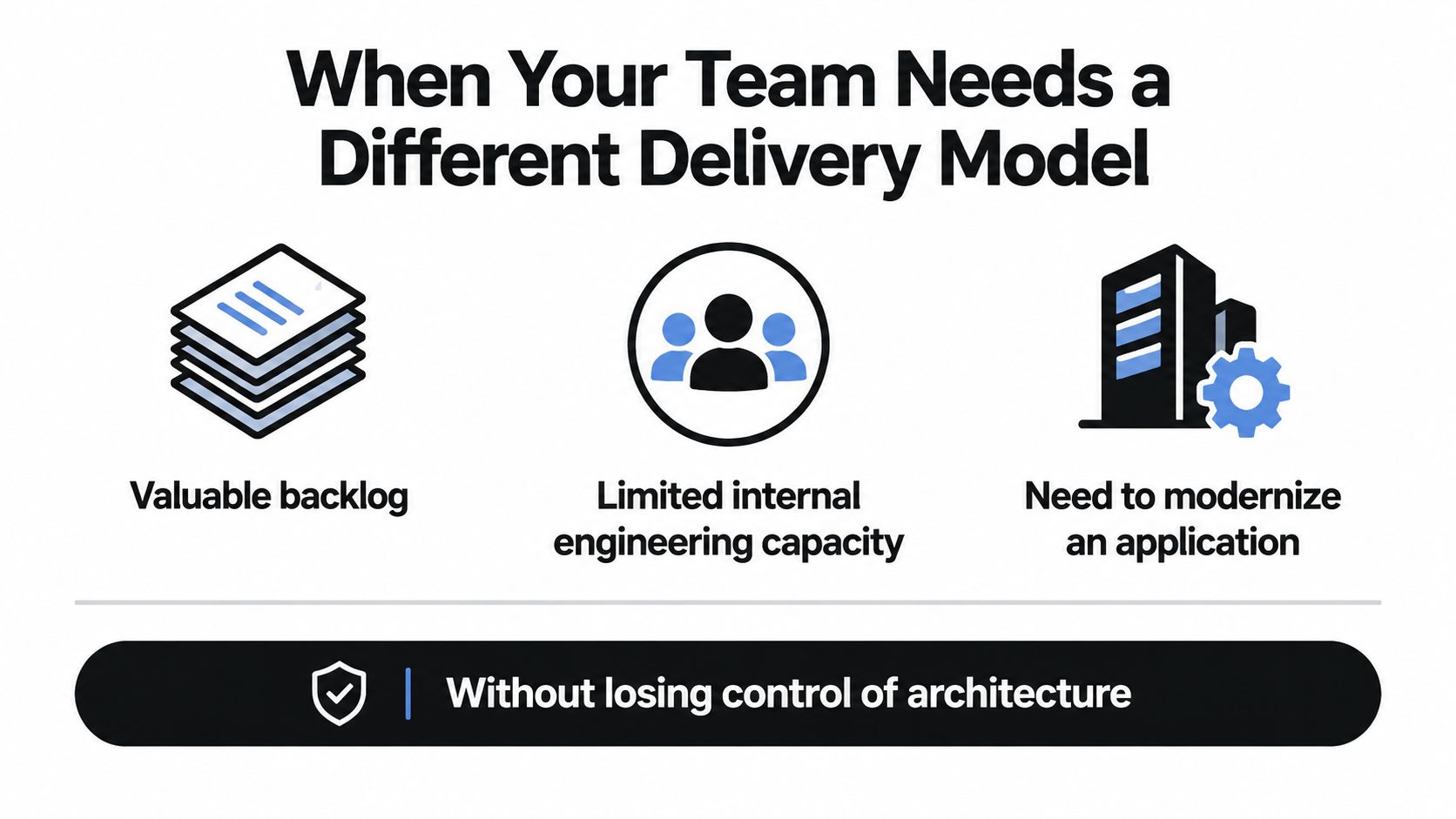
You've got a valuable backlog, limited engineering capacity, and an application that needs modernization without losing control of architecture or customer experience. Hiring permanently for every gap is slow and often wasteful. You need capacity, but you also need judgment inside the team.
Staff augmentation adds specialists to your existing team under your direction. Outsourcing delegates a bounded deliverable to a provider that manages execution. Pick augmentation when your leaders can direct work but can't fill roles fast enough. Pick outsourcing when you can define done clearly and don't want to manage daily delivery.
That boundary matters even more with AI work. A prompt management system plugged into your existing app, with versioned prompts, controlled database parameters, logging, and spend visibility, only helps if someone owns how it's governed. Tools don't replace that decision.
The First Decision
| Question | Staff Augmentation | Outsourcing |
|---|---|---|
| Who sets daily priorities? | Your product and tech leads | Vendor delivery manager |
| What are you buying? | Skilled capacity inside your process | A finished, accepted deliverable |
| What must you already have? | Leadership to direct contributors | Clear scope and acceptance criteria |
| Best starting point | Evolving roadmap | Stable, separable workstream |
Don't start with rate cards. Start with decision rights. If you can't name who owns architecture, security, and release quality, neither model will save you.
Understanding Staff Augmentation and Outsourcing
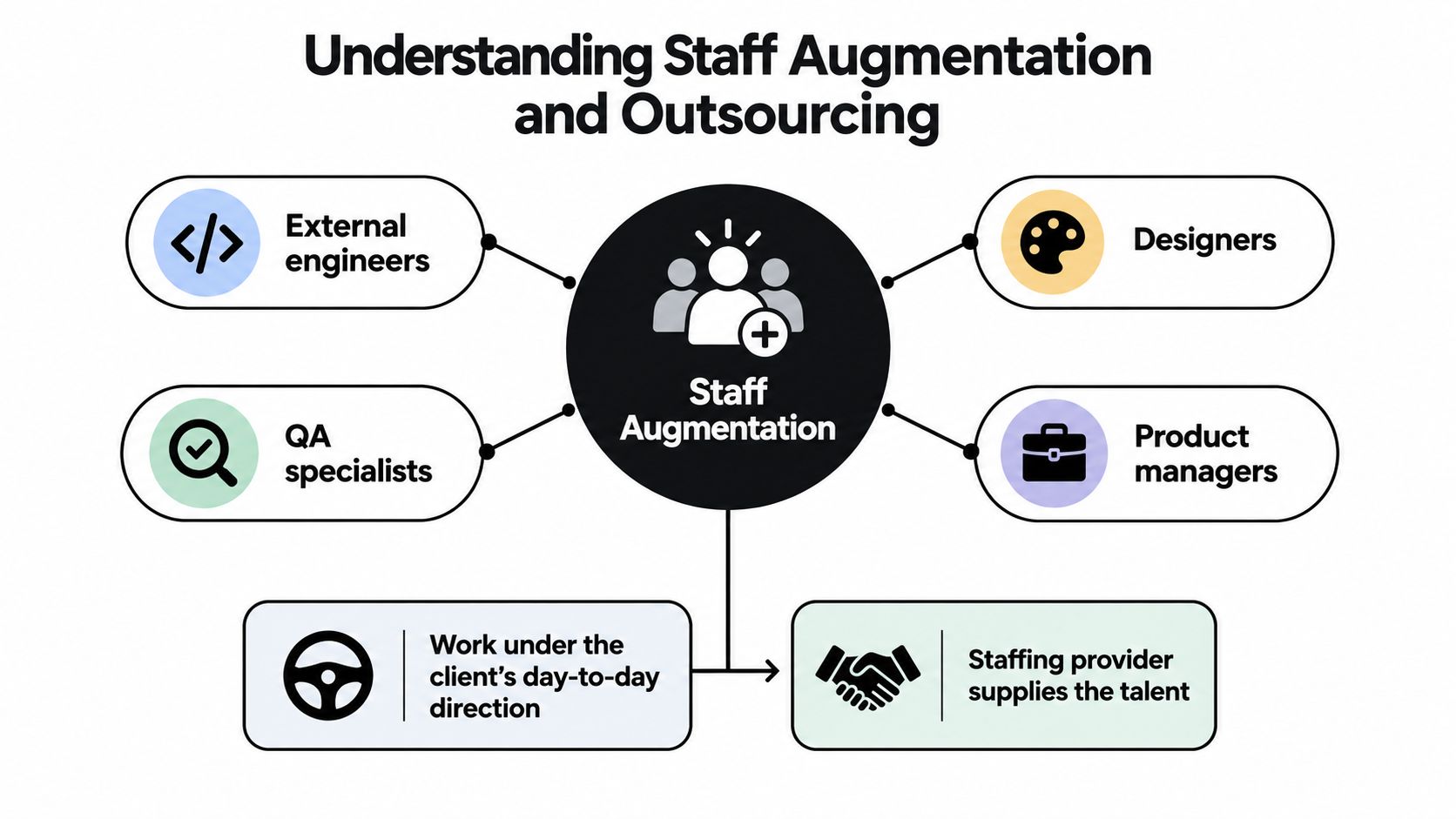
Staff augmentation means external engineers, designers, QA specialists, or product managers join your team and work under your day-to-day direction. The provider handles recruitment or employment administration. You own the backlog, code review, architecture, and definition of done.
Outsourcing means a provider assumes responsibility for a defined function, process, or deliverable. You specify requirements and acceptance criteria. The vendor chooses team composition, sequencing, and daily methods.
Staff augmentation is best understood as contingent labor rather than a separately measured industry, and the Bureau of Labor Statistics July 2023 Contingent Worker Supplement found that 4.3% of employed people in the United States held contingent jobs. That classification matters because it keeps the focus on who directs the work, not on unsupported market size claims.
Staff Augmentation Versus Outsourcing Definitions
| Dimension | Staff Augmentation | Outsourcing |
|---|---|---|
| Daily direction | Client leads | Vendor leads |
| Outcome ownership | Client | Vendor, within contract scope |
| Integration | Your standups, tools, repositories | Vendor process and checkpoints |
| Change handling | Reprioritize in your backlog | Change control and renegotiation |
| Knowledge location | Builds inside your team | Must be transferred at handover |
Location doesn't decide the model. An onshore vendor can still own delivery, and a remote engineer can still work entirely under your lead. If you're weighing related operating models, compare IT managed services vs staff augmentation for a useful adjacent distinction between adding people and delegating an ongoing function.
Outsourcing also has a broader economic history. OECD research on offshoring and tradeable services notes employment in industries associated with internationally tradeable services rose from 3.6% of total employment in 1995 to 6.3% by 2018. The lesson isn't that work should move. It's that separable work can move, if accountability moves with it.
Comparing Governance Cost Speed and Control
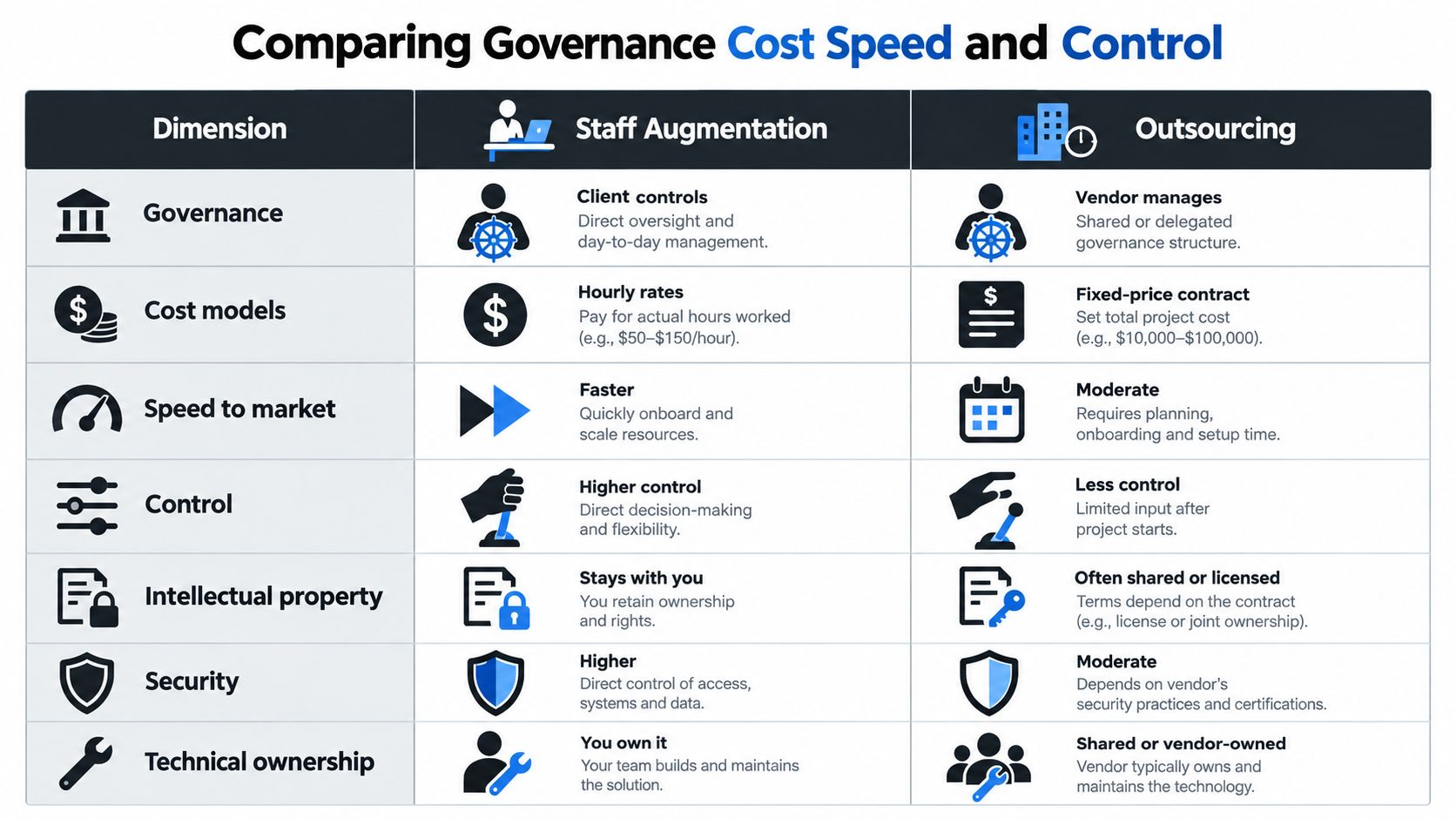
Don't compare these models with a generic pros and cons list. Compare them criterion by criterion, then decide which risks you're equipped to carry.
Governance and Technical Ownership
Augmentation works only when you have strong product, architecture, QA, and security leadership. Your leads assign work, review code, and own incidents. If those leads are already overloaded, adding engineers will slow everyone down.
Outsourcing shifts daily coordination to the vendor, but it doesn't remove governance. You still need measurable service descriptions, escalation ownership, change control, and performance reporting. A large survey-based study found detailed service level agreements improved cost and service outcomes, and ongoing benchmarking during the relationship explained approximately 10% of variance in outsourcing success.
The execution risk is often on the client side. A governance benchmark reported that 60% of staff managing outsourced projects had no prior outsourcing experience, according to research on offshore outsourcing governance failures. If you can't govern a vendor, a fixed price won't protect you.
Criterion by Criterion Delivery Comparison
| Criterion | Staff Augmentation | Outsourcing | Buyer Question |
|---|---|---|---|
| Governance | Internal leads direct work | Vendor manages, client oversees | Who can govern credibly? |
| Cost model | Rate per person plus your management time | Project or milestone price plus oversight | What is excluded? |
| Speed to start | Fast for targeted roles | Slower due to scoping and mobilization | Is scope ready? |
| Control | High daily control | Control through contract and reviews | How often will priorities change? |
| IP and security | Work stays in your environment | Access defined by contract | Who touches sensitive data? |
| Technical ownership | Your architects decide | Vendor decisions need review rights | Who maintains this later? |
Cost Speed and Control in Practice
Augmentation looks expensive per person because the labor rate is visible. It's often cheaper for evolving work because changing priorities doesn't trigger a contract discussion. Outsourcing looks predictable because the price is bundled. It becomes expensive when requirements move and every adjustment becomes a change order.
Speed has two parts. Augmentation usually starts faster because you're filling named roles inside an existing process. Outsourcing can deliver a complete team, but only after discovery, contracting, and alignment. Don't confuse a fast signature with fast production output.
Neither model is automatically safer for IP or security. Augmented contributors work inside your controls, which helps, but they still need least privilege access and code review. Outsourced work can be isolated, which helps, but you'll still share requirements, data samples, and integrations. Contract for IP assignment, security evidence, subcontractor limits, and exit access either way.
Key differentiator: Augmentation buys directed capacity. Outsourcing buys delegated accountability. If you can't specify the outcome, you can't honestly delegate it.
My recommendation is blunt. Keep core product, architecture, and customer experience under internal direction. Outsource bounded work that your team shouldn't spend scarce leadership attention managing.
Calculate the Total Operating Burden
Hourly rates and quoted project prices are the least honest numbers in this decision. They exclude the work your organization still has to do.
Outsourcing transfers execution effort. It doesn't transfer accountability for data, regulatory risk, or customer outcomes. Executives report regulatory challenges as the leading contract management problem at 84% and complex governance structures at 62%, according to KPMG survey findings on outsourcing contract management. That same source context estimates relationship governance at roughly 3% to 8% of contract value, averaging 4.2%.
Total Operating Cost Worksheet
| Cost Component | Staff Augmentation | Outsourcing | What to Estimate |
|---|---|---|---|
| Direct delivery | Rates for each role | Contract or milestone total | Duration and seniority mix |
| Management | Lead time for direction and review | Vendor governance and acceptance | Hours per week by role |
| Transition | Onboarding and access setup | Discovery and knowledge transfer | Ramp time before output |
| Change and rework | Reprioritization inside sprints | Change orders and defect correction | Expected scope volatility |
| Security and compliance | Internal reviews and controls | Vendor evidence and audits | Review cycles and remediation |
| Exit | Offboarding and documentation | Handover and possible rebid | Knowledge transfer effort |
| Opportunity cost | Leaders diverted from roadmap | Leaders diverted to oversight | Delayed internal initiatives |
Build the business case with finance, security, and product in the room. Use a grounded view of the cost of software development to challenge assumptions about discovery, design, QA, infrastructure, and maintenance before you compare vendor quotes.
Ask one hard question for every line item. Who does this work if we don't pay for it explicitly? If the answer is nobody, you've found a hidden cost. If the answer is your best architect, price that clearly.
Augmentation often wins when internal decision rights prevent expensive renegotiation. Outsourcing wins when a mature governance function can hold a vendor to measurable outcomes. Neither wins on sticker price alone.
Choosing by Industry and Product Context
Industry labels don't decide the model. Risk, change frequency, and internal leadership do. These scenarios show how the same framework lands differently.
Ecommerce and Retail
A retailer preparing for seasonal demand needs rapid changes to search, checkout, and personalization. Merchandising priorities shift weekly, so embedded engineers and designers usually fit better for conversion work. Outsource a separable piece instead, such as a bounded integration with stable acceptance tests.
Fintech
A fintech team modernizing payments should keep architecture, threat modeling, and change approval inside. Auditability matters more than raw throughput. Augmentation fits when internal security and platform leads can direct specialists. Outsourcing fits a contained reporting tool or migration where evidence, recovery targets, and defect thresholds can be audited independently.
Healthcare
Healthcare buyers can't delegate accountability for privacy sensitive workflows just because a vendor builds them. You need clear ownership of compliance evidence, access boundaries, and user centered design decisions. I'd default to augmentation for patient facing product work and use managed delivery only for narrow workstreams with explicit controls and review gates.
SaaS
A SaaS company with recurring roadmap pressure should augment for platform, AI, and reliability roles that compound internal knowledge. Once a workstream has stable requirements and repeatable releases, outsourcing that slice can free the core team. Judge it with service levels, not optimism about scale.
Industry Context Matrix
| Context | Likely Augmentation Fit | Likely Outsourcing Fit | Watch Out |
|---|---|---|---|
| Ecommerce | Customer journey and conversion work | Stable integrations | Seasonal priority churn |
| Fintech | Core platform and security engineering | Bounded noncore tools | Audit and change evidence |
| Healthcare | Patient facing product delivery | Narrow, controlled workstreams | Privacy accountability |
| SaaS | Architecture, AI, reliability | Stable modules or migrations | Knowledge walking out |
If the work touches your differentiator every sprint, keep direction internal. If it doesn't, stop spending your best leaders on it.
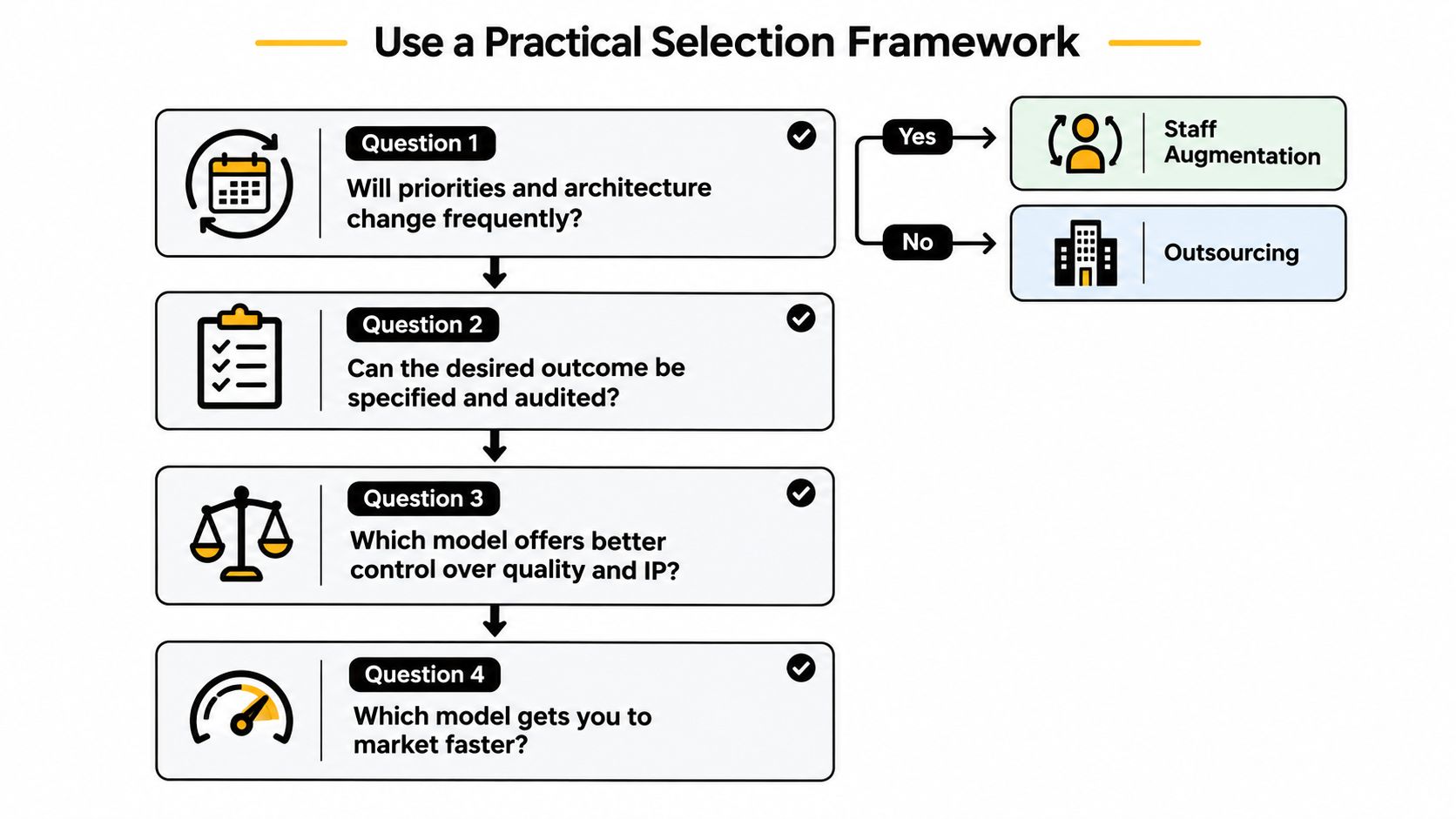
Use a Practical Selection Framework
Run this test before you talk to vendors. It takes less time than recovering from the wrong contract.
- Test change frequency: Will priorities, architecture, or user needs change during delivery? If yes, augment.
- Test measurability: Can you write acceptance criteria and service levels that an independent reviewer could verify? If yes, outsourcing becomes viable.
- Test leadership capacity: Can your product, architecture, QA, and security leads direct more contributors without becoming bottlenecks? If no, don't augment yet.
- Test governance capacity: Can you fund vendor management, benchmarking, and escalation ownership? If no, don't pretend outsourcing is hands off.
- Test knowledge value: Will the team learn things you'll need for years? If yes, keep that learning inside.
Model Selection Scorecard
| Decision Question | If Yes, Consider | Evidence to Collect |
|---|---|---|
| Will scope change frequently? | Staff augmentation | Backlog volatility and discovery unknowns |
| Can outcomes be audited independently? | Outsourcing | Acceptance tests and service levels |
| Do internal leads have capacity? | Staff augmentation | Review load and decision latency |
| Can you fund vendor governance? | Outsourcing | Named owner, reporting cadence, budget |
| Is the knowledge strategically durable? | Staff augmentation or hybrid | Maintenance horizon and IP sensitivity |
| Is the work separable from core systems? | Outsourcing | Interface and data boundaries |
Hybrid is often the strongest answer. Start with embedded specialists during discovery, architecture, legacy integration, or AI modernization. Move a workstream to managed delivery when backlog definitions, release processes, and metrics stabilize.
That shift reflects a broader contracting move. An industry survey projects FTE based contracts declining from 42% to 28% of business process outsourcing deals over three years, while outcome based arrangements rise from 20% to 39%, according to reported projections on outcome based outsourcing contracts. Treat those as projections, not guarantees. Outcome pricing only works when the vendor controls the levers that produce the outcome.
If you need a stable extended group rather than individual seats, compare that option against building a dedicated development team before defaulting to a project contract.
Build AI Modernization on the Right Delivery Boundary
AI modernization isn't a model connection. It's product, data, security, and operating discipline added to software that people already depend on.
McKinsey's 2025 global survey reported 71% of respondents said their organizations regularly used generative AI in at least one business function, according to McKinsey research on the state of AI in 2025. Usage is common. Durable production value is harder. You need workflow redesign, tracked KPIs, leadership involvement, and governance, regardless of who writes the code.
Use NIST guidance on AI risk management to document intended use, evaluate outputs, control sensitive data exposure, and assign accountability across internal staff, augmented specialists, and suppliers. That's not paperwork for its own sake. It's how you stop an AI feature from becoming an unowned risk.
Developer selection should reflect real practice. In Stack Overflow's 2025 Developer Survey, 84% of respondents said they were using or planning to use AI tools, and 51% of professional developers reported daily use. Test candidates on prompt design, code review, security validation, and testing. Access to an assistant isn't a skill.
AI Workstream Ownership
| AI Workstream | Embedded Specialist Contribution | Managed Delivery Contribution | Internal Owner |
|---|---|---|---|
| Use case and product design | Prototype with product team | Deliver bounded feature slice | Product lead |
| Legacy integration | Map data and architecture | Build tested connectors | Architect |
| Prompt and evaluation | Design prompts and eval sets | Implement approved workflows | AI or product owner |
| Reliability and cost | Tune performance in codebase | Operate against agreed targets | Platform lead |
| Risk and compliance | Flag data exposure issues | Provide delivery evidence | Security lead |
For scalable delivery, define service level objectives instead of promising unlimited scale. Google Site Reliability Engineering guidance on service level objectives defines an SLO as a target for a service level indicator and recommends tracking an error budget. That gives internal and external contributors the same trigger for choosing reliability work over new features.
Wonderment Apps offers a prompt management system that plugs into an existing desktop or mobile application. It includes a prompt vault with versioning, a parameter manager for internal database access, logging across integrated AI systems, and a cost manager for cumulative spend visibility. Treat that kind of toolkit as governance infrastructure. It supports either model, but internal ownership still matters.
Pair that discipline with a practical approach to modernize legacy systems so AI features land on maintainable architecture instead of expiring with the next vendor transition.
Verify the Decision Before You Sign
Don't sign until you can answer these without hand waving.
- Decision rights: Who can change priorities, architecture, and release timing?
- Named accountability: Who owns outcomes on your side and the provider side?
- Security and IP: What access is granted, what evidence is required, and who owns the work product?
- Measurable levels: Which service levels, acceptance tests, and escalation paths apply?
- Change control: What counts as a change, who approves it, and what does it cost?
- Knowledge ownership: What documentation and handover are contractual deliverables?
- Transition: Who handles onboarding, parallel running, and exit?
Measure both models against a pre engagement baseline. Track deployment frequency, lead time from commit to production, escaped defect rate, incident response time, and technical debt change. For outsourcing, add SLA attainment, scope change cost, dependency resolution, and outcome variance.
Choose augmentation when priorities and architecture need constant client direction. Choose outsourcing when outcomes can be specified, measured, and governed. Use a hybrid when uncertainty will fall over time. That's the decision. Everything else is procurement detail.
If you're weighing curated staffing, a managed project, or AI modernization for an existing application, Wonderment Apps can help you map the right delivery boundary before you commit. Bring your backlog, constraints, and governance questions, and ask for a practical discussion about team structure and a demo of the prompt management toolkit.