


Caching is often sold as a simple performance lever: add memory, increase the hit rate, and watch the application speed up. That advice is incomplete. A cache can serve plenty of requests while doing little for end-to-end latency, wasting infrastructure budget, or exposing private data through a poorly designed key.
The useful question isn't “How do we maximize cache hits?” It's “Which cached results reduce meaningful latency at an acceptable cost and risk?” That shift matters even more when a custom desktop or mobile application calls databases, APIs, and AI models through several layers. Teams also need administrative control over prompts, model usage, access parameters, and spend. A well-managed prompt vault and cost manager can be as important to a scalable AI feature as the cache sitting in front of it.
Rethinking Performance Beyond the Hit Rate
A high cache-hit rate is not the same thing as a fast product. Trace-based web experiments found that passive local proxy caching reduced end-user latency by at most 26%, while prefetching raised the maximum reduction to 57%. Combining caching with prefetching achieved a reduction of up to 60%, showing that cache placement and request timing can matter as much as reuse itself. These findings are documented in trace-based research on caching and latency.
The same work separated web latency into 23% internal latency, 20% external latency that couldn't be cached or prefetched, and 57% external latency potentially removable through caching and prefetching. Some traces reached cache-hit ratios of approximately 47% to 52%, yet latency reduction was only about half as large. If a team celebrates the hit ratio without measuring the user's wait, it may be optimizing the wrong outcome.
Practical rule: Treat cache hits as an input metric. Treat user-visible latency, backend load, and business-critical completion time as outcome metrics.
Mobile applications make this distinction sharper. In a mobile-web study, raising an HTTP proxy cache-hit ratio from 22% to 32% improved median page-load time by less than 2%. Even a perfect cache produced only a 13% median improvement for mobile users, compared with 34% for desktop users, because radio-network latency, connection setup, serialized subresources, and uncached dynamic requests still dominated delivery. The mobile caching performance study supports a blunt conclusion: adding cache capacity won't fix a slow request path that spends most of its time elsewhere.
A better scorecard for production
For every important endpoint, measure more than whether a key was found:
- Request hit rate: How often the application avoids the origin request.
- Byte hit rate: How much payload traffic the cache absorbs.
- Bandwidth savings: Whether the cache reduces network transfer rather than merely relocating it.
- Origin-load reduction: Whether the database, API, or model performs less work.
- Tail latency: Whether p95 and p99 users experience fewer slow responses.
- Freshness and safety: Whether the response remains valid for the requesting user.
This is the essence of risk-adjusted latency reduction. A cached response that saves a small amount of time but carries a high privacy or freshness risk is a poor trade. The same applies to a large distributed cache that costs more memory, replication, and operational attention than the origin work it replaces.
Before adding another cache, tune the database queries, indexes, payload sizes, connection reuse, and request fan-out. Teams working through those fundamentals can also use database performance tuning guidance from Wonderment Apps as a practical reference. Caching should remove repeated expensive work, not conceal an architecture that creates unnecessary work on every request.
Core Caching Strategies and Eviction Policies
Modern caching grew from basic reuse into a set of explicit policies for freshness, validation, memory, and bandwidth. HTTP/1.1 formalized core controls in 1999, including Expires, Cache-Control: max-age, and Last-Modified validation. These mechanisms still underpin browser caches, CDNs, reverse proxies, and API gateways. A response can be served immediately while fresh, or checked conditionally with the origin before the application transfers it again.
That distinction creates several practical patterns:
- Cache-aside: The application checks the cache, loads the origin on a miss, and stores the result for later requests.
- Write-through: A write updates the primary store and cache together, improving read freshness at the cost of extra write work.
- Write-behind: The cache accepts the change first and persists it asynchronously, reducing write latency while increasing consistency and durability risk.
- Refresh-ahead: A worker refreshes popular entries before they expire, reducing cold misses for predictable traffic.
A team can combine these patterns. A product catalog might use CDN caching for immutable assets, cache-aside for product objects, and event-driven invalidation when merchandising changes a product record.
Eviction depends on the workload
There isn't one universally correct eviction algorithm. Research comparing replacement policies found that, for small caches and highly skewed popularity distributions, CSP outperformed competing policies by 1.2% to 4.6%. Under more uniform workloads and larger caches, LRU performed better than some alternatives by 18.1%. Another experiment found that reducing the share of requests for common objects from 80% to 60% increased latency by 12% and network-bandwidth requirements by 11%. These results appear in research on cache replacement and workload behavior.
Use LRU when recent access predicts near-term reuse. Consider LFU when a stable group of popular keys should remain resident. Use shorter-lived, workload-specific caches when traffic is bursty or object value changes quickly. The key is to observe access distribution, object size, eviction frequency, and miss cost rather than selecting a policy from habit.
Cache technology also deserves a workload benchmark. In one tested configuration, Redis handled approximately 200,000 SETs and 200,000 GETs per second, while Memcached handled about 130,000 SETs and 150,000 GETs per second. As list or object size increased, Redis performance deteriorated and Memcached scaled better horizontally, as reported in this comparative key-value cache thesis.
Those figures aren't a universal product ranking. They show why representative tests matter. Choose Redis when atomic operations, counters, rankings, streams, or richer data structures justify its overhead. Choose a simpler horizontally scaled key-value cache for disposable, independent objects where predictable memory use and high-volume fan-out are more important. Test payload sizes, serialization, multi-key operations, failover, and p50, p95, and p99 latency before committing.
For implementation details specific to Node.js, Node.js caching guidance from Wonderment Apps provides useful context. Ecommerce teams should also separate storefront caching from live commerce operations, and Storefront API tips from Presidio can help when designing that boundary.
Architectural Patterns and Security Considerations
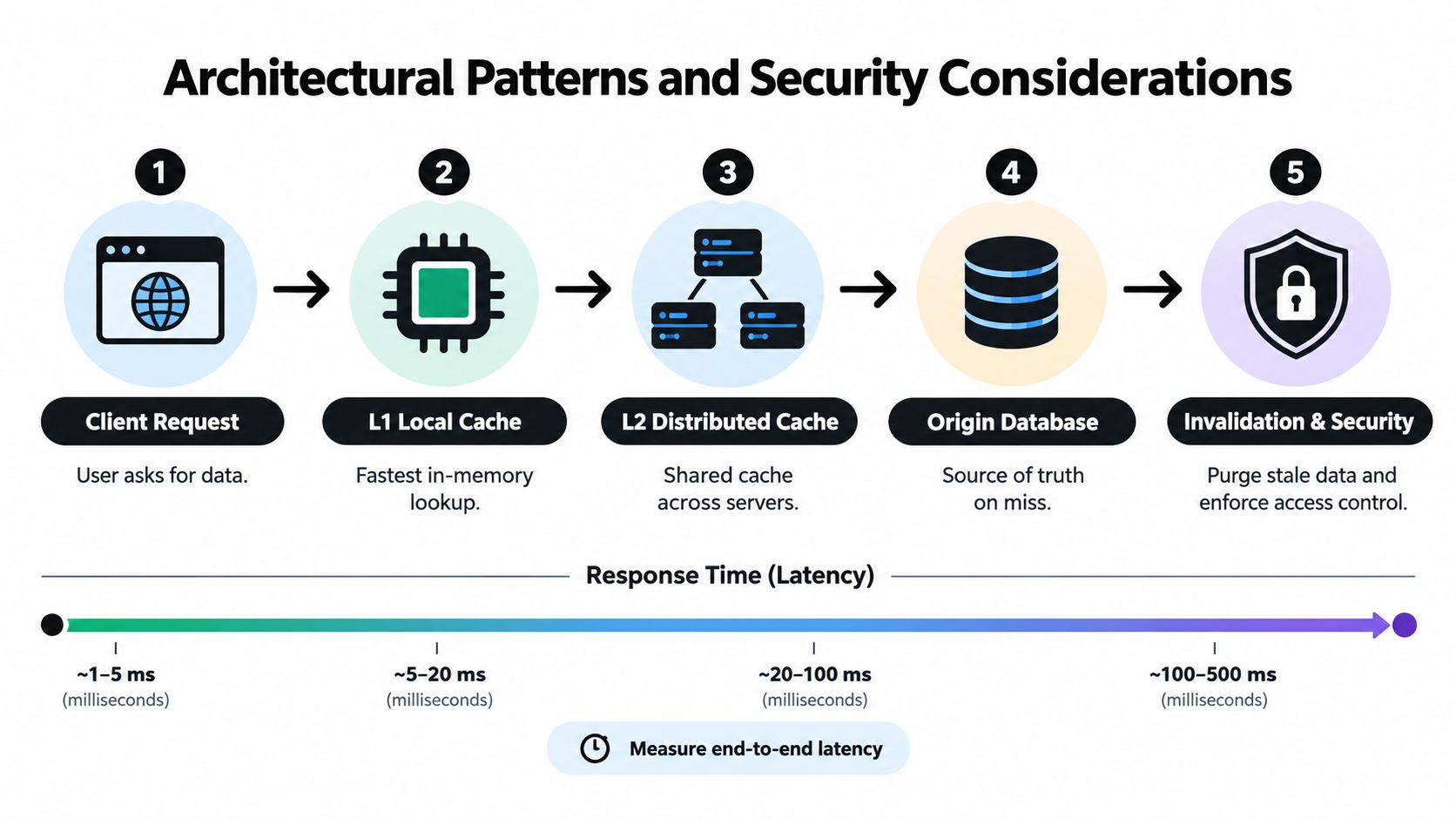
A cache hierarchy should be judged by the complete request path. Browser storage, a CDN, an edge worker, an application-local cache, a distributed cache, and the origin each remove different kinds of work. Adding a layer helps only when it reduces the delay or load that matters to the user.
Start with the critical journey, such as mobile checkout, account login, or an AI-assisted search. Trace the request from the device to the origin and record where time accumulates. If the mobile network and connection setup dominate, increasing the CDN hit rate won't solve the experience. Reduce request count, compress payloads, reuse connections, stream server-rendered content where appropriate, and improve backend latency alongside cache design.
Assign TTLs by volatility
A universal expiration period is convenient and usually wrong. AWS guidance suggests that rapidly changing information, such as comments, leaderboards, and activity streams, may need TTLs of only a few seconds, while relatively static reference information can remain cached for hours or days. Adding random jitter to expiration times prevents a large group of entries from expiring together and sending a synchronized burst of misses to a database or AI service. See the AWS caching design patterns guidance.
A useful policy records the reason for each TTL, not just the duration:
- Identify the changing input. Price, inventory, permissions, locale, and recommendation context may all affect validity.
- Set the freshness boundary. Decide how stale a response can be before it becomes misleading or unsafe.
- Add jitter. Spread expirations so workers don't create a stampede.
- Define invalidation events. A product update, role change, tenant migration, or policy edit should remove related entries immediately when necessary.
- Measure misses after deployment. A short TTL may preserve correctness but overload the origin, while a long TTL may reduce work but serve stale content.
Design keys as security boundaries
A cache key must include every input that can change the response. That may include tenant, user authorization state, locale, currency, device class, feature flags, and user-specific headers. If the key omits one of those dimensions, the cache can return a valid response for the wrong person.
This risk is not theoretical. Independent reporting on a 2024 ACM CCS study found that approximately 17% of the Tranco Top 1000 domains, covering more than 1,000 endpoints across 172 domains, were vulnerable to some form of web-cache poisoning. The figures and security discussion are summarized in security reporting on web-cache poisoning prevention.
Use these controls for authenticated and personalized systems:
- Default to exclusion: Don't cache authenticated or cookie-bearing responses unless the design explicitly proves isolation.
- Document variation: Record every request attribute that changes the body, headers, or permissions.
- Test equivalence: Send requests with different users, tenants, locales, and authorization states, then verify that keys never collide.
- Test poisoning: Attempt unexpected headers, query parameters, and content types to confirm that an attacker can't seed a response for other users.
- Verify purge behavior: Authorization changes should invalidate affected entries instead of waiting for ordinary expiration.
A clean microservices boundary helps teams assign ownership for these controls. Microservices architecture examples from Wonderment Apps offer a useful way to think about gateway, service, data, and security responsibilities without treating the cache as an isolated utility.
Industry Applications and Resilience Patterns
The right cache policy changes with the consequence of stale data. An ecommerce catalog can tolerate a slightly old description more easily than an incorrect inventory result. A healthcare reference page can be cached aggressively, while patient-specific records require stricter access controls and freshness guarantees.
| Industry | Strong caching candidates | Data requiring caution |
|---|---|---|
| Ecommerce | Product descriptions, category navigation, immutable media, recommendation inputs | Inventory, prices, promotions, account data |
| Fintech | Public reference data and carefully bounded market snapshots | Balances, transactions, authorization, risk decisions |
| Healthcare | Public education and reference content | Patient records, care plans, identity and consent data |
| Media | Images, scripts, pages, video segments, metadata | Entitlements, subscriptions, personalized feeds |
Fintech teams should favor short freshness windows and explicit invalidation for market or account data. Healthcare teams need cache keys and access controls that reflect patient, provider, organization, and consent boundaries. Media platforms can push immutable assets toward the edge, but subscription entitlements must remain separated from broadly cacheable content.
AI applications add another dimension because not every response has the same volatility. Amazon ElastiCache documentation recommends approximately 24 hours for static documentation and policies, 12 to 24 hours for product information, 1 to 4 hours for general assistant responses, 5 to 15 minutes for real-time prices or inventory, and about 30 minutes for conversation context. The AWS semantic caching guidance frames the trade-off clearly: longer TTLs reduce repeated inference but increase stale-answer risk.
Semantic matching can help when users ask the same question in different words, but it needs domain boundaries. Don't reuse an answer about a general return policy for a user-specific order, and don't reuse a market response after its underlying data changes. Store response provenance and relevant context with the cached result so the application can decide whether reuse is safe.
Separate freshness from availability
A resilient application doesn't have to choose between serving stale content and failing completely. AWS describes a soft TTL and a hard TTL pattern. After the soft TTL, the application attempts a refresh, but if the downstream service fails, it can continue serving the existing value until the hard TTL is reached. The AWS caching resilience guidance describes this stale-if-error approach.
This works well for recommendations, product descriptions, public reference answers, and other content where a slightly old response is preferable to an outage. It isn't suitable for every financial, medical, authorization, or inventory decision. Label stale responses internally, log fallback events, and make the business owner decide what “available but old” means for each endpoint.
Observability and AI Prompt Management
Distributed caching has a cost that doesn't appear in a hit-rate dashboard. Memory, replication, network transfer, invalidation traffic, failover capacity, and operational maintenance all consume resources. A 2025 HotNets paper examines these costs directly, challenging the assumption that an in-memory cache is always economically optimal. The research on distributed cache cost supports a more useful calculation: compare total cache cost with the database, compute, model, and egress work the cache actually avoids.
Track that value by endpoint and tenant. A cache that benefits a high-volume product search may be worthwhile, while one that stores rarely reused personalized objects may be wasteful. Include stampede-related miss amplification, memory fragmentation, invalidation incidents, and stale-data support work in the calculation. Sometimes the best decision is a smaller cache, request coalescing, conditional revalidation, or no cache at all.
AI makes this accounting harder because a single user interaction can invoke prompt assembly, retrieval, an embedding service, a model, post-processing, and logging. Caching one layer doesn't explain the total cost. Teams need to know which prompt version ran, which parameters accessed internal data, which model answered, and how much each workflow consumed.
Wonderment Apps' prompt management system is an administrative layer that developers and entrepreneurs can plug into an existing application during AI modernization. It includes a prompt vault with versioning, a parameter manager for controlled internal database access, a logging system across integrated AI models, and a cost manager that shows cumulative spend. Those controls complement caching because they expose whether a response was reused safely, regenerated unnecessarily, or produced with an outdated prompt or parameter set.
A prompt vault also gives teams a reliable invalidation signal. When a prompt changes, cached responses associated with the prior version shouldn't remain eligible for reuse. Version prompts and cache keys together, record model and data context, and set different lifetimes for static instructions, dynamic retrieval, and user-specific context.
Operational insight: AI observability should connect cache behavior to model behavior. A cheap cache hit that returns an unsafe or obsolete answer isn't a saving.
The same principle applies to semantic caches. Store similarity decisions, acceptance or rejection signals, source versions, and user or tenant scope. If the application can't explain why it reused a response, it can't reliably govern that reuse in a regulated or multi-tenant environment.
Migration Tips and Strategic Takeaways
A legacy application doesn't need a complete rewrite to adopt better caching strategies. Start with the slowest user journey, map every request and dependency, then introduce one cache layer with clear ownership and rollback behavior.
Use this migration sequence:
- Measure the baseline: Capture end-to-end latency, tail latency, origin load, payload size, error rate, and cost for the target journey.
- Remove avoidable work: Reduce request fan-out, compress payloads, reuse connections, and fix expensive queries before adding capacity.
- Classify data: Mark each response as immutable, slowly changing, volatile, personalized, or security-sensitive.
- Choose the pattern: Use cache-aside for read-heavy objects, write-through when read freshness matters, and stale-if-error only where the business accepts outdated content.
- Build safe keys: Include tenant, authorization, locale, and other response-varying inputs. Exclude private responses by default.
- Test failure modes: Simulate cache loss, origin errors, synchronized expiration, poisoned inputs, and authorization changes.
- Measure useful value: Compare cost per useful request, avoided origin work, freshness violations, and tail latency instead of celebrating hit percentage alone.
- Govern AI separately: Version prompts, log model calls, control internal parameters, and track cumulative spend alongside semantic or exact-match cache behavior.
The strategic shift is simple but significant. More cache utilization isn't the objective. The objective is a faster, safer, more economical application that can scale without turning stale data, private responses, or AI spend into tomorrow's incident.
Wonderment Apps helps organizations modernize web and mobile software with AI integration, scalable engineering, UX delivery, and administrative controls for prompt versioning, integrations, logging, and token cost management. Visit Wonderment Apps to discuss a caching and AI architecture that keeps performance, privacy, and operational cost visible as your product grows.