

Your software development partner looked perfect on paper. The rate was competitive, the portfolio was polished, and the contract promised a predictable launch. Then requirements moved, reviews slowed down, defects reached staging, and both teams discovered they had agreed on a vendor, not on how to work together.
That distinction matters. A software development partnership isn't just outsourced coding. It's a shared commitment to business outcomes, governed by explicit ownership, delivery cadence, decision rights, quality standards, and escalation rules. The companies that get this right choose an operating model before they negotiate a rate card. They measure delivery with evidence, design contracts around shared risk, and keep governance active after launch.
The market reflects how normal external delivery has become. One industry compilation reports that 64% of organizations outsourced at least part of their application development in 2023, compared with 56% in 2019. It also reports that 60% outsource application development and maintenance, while 59% of small and medium-sized businesses outsource app development. The same compilation links common partnership problems to communication issues affecting 42% of clients and scope creep affecting 35% of projects, with budgets sometimes rising by 20%–30%.
The question isn't whether external talent can work. It can. The question is whether you've designed a partnership that remains useful when the roadmap changes, an AI feature needs oversight, a legacy integration breaks, or production becomes everyone's problem.
When a Software Development Partnership Goes Wrong Before It Starts
A mid-stage fintech signed a 12-month fixed-price contract with a nearshore vendor to rebuild its onboarding flow. The business case looked sensible. The vendor had relevant engineers, the commercial terms were easy to approve, and the statement of work listed screens, integrations, and acceptance milestones.
By month three, the vendor was late. The product team disputed the interpretation of the specification. Internal engineers had stopped reviewing pull requests because the codebase was difficult to follow. The vendor blamed delayed decisions. The fintech blamed poor implementation. Both sides were technically busy, and neither side was confidently moving toward the outcome.
The failure wasn't caused by geography. It wasn't even primarily caused by the fixed-price contract. The contract was scoped before the teams had designed the operating model.
The first 90 days expose the real relationship
Partnerships usually fail in the opening quarter, long before renewal discussions. Early work reveals who owns product decisions, how quickly blockers are escalated, whether the partner can work inside the client's engineering standards, and whether both sides mean the same thing by “done.”
A credible model answers practical questions:
- Ownership: Who accepts product scope, approves architecture, reviews code, and owns production incidents?
- Cadence: How often do teams plan, demonstrate work, review risks, and revisit priorities?
- Accountability: Which operational and business measures determine whether the engagement is healthy?
- Continuity: What happens when requirements change, a key engineer leaves, or an AI dependency behaves differently after launch?
Without written answers, the loudest person in the room becomes the product owner, the vendor's project manager becomes the de facto decision-maker, and unresolved ambiguity turns into a change order.
Practical rule: If both parties can't describe the first release process, escalation route, and Definition of Done in the same language, the partnership isn't ready to start.
Treat the contract as one part of the system
A statement of work can define deliverables, but it can't substitute for shared engineering habits. You need a working agreement covering repository access, review expectations, environments, security checks, documentation, incident response, and decision logs.
The partnership should also establish a single source of delivery truth. Jira, Linear, GitHub, GitLab, Azure DevOps, and observability tools can all work. The tool matters less than whether the client and partner see the same backlog, risks, pull requests, pipeline results, and release status.
The rest of this guide uses that operating-model lens. Four partnership structures suit different levels of scope certainty and shared ownership. The right KPIs expose whether work is flowing or merely being reported. AI-ready governance determines whether the relationship survives modernization, compliance changes, and support obligations after launch.
The Four Partnership Models and When Each One Fits
There isn't one universally correct software development partnership model. There is, however, a wrong habit: choosing by location and hourly rate before deciding who should own delivery risk.
A side-by-side decision
| Model | Who Owns Delivery | Best Fit | Typical Failure Mode |
|---|---|---|---|
| Outsourcing | The partner owns a defined deliverable, while the client owns acceptance | Stable requirements and a discrete project | Scope shifts expose weak discovery and expensive change control |
| Managed teams | Both parties share delivery ownership, with the partner accountable for team execution | Product organizations needing capacity and operating discipline | The client lacks a strong product owner, so priorities drift |
| Staff augmentation | The client owns roadmap and delivery; the partner supplies specialists | An established team with a defined need for extra expertise | Added engineers lack integration support or a shared Definition of Done |
| Strategic alliance | Executive sponsors share platform, commercial, and long-term outcome ownership | Long-horizon products, platforms, and joint go-to-market work | Revenue, IP, and decision rights remain misaligned |
Outsourcing works when the requirements are stable, acceptance criteria are testable, and the buyer wants a bounded result. It breaks when domain knowledge becomes a competitive advantage or when discovery continues after the price is locked.
Managed teams are a better choice for product-led companies that need sustained capacity and shared accountability for delivery metrics. They still require a capable client-side product owner. No vendor can resolve internal priority conflicts by adding more engineers.
Staff augmentation is useful when your existing team knows the product and needs a specialist in React, .NET, Java, iOS, Android, cloud infrastructure, or QA. It fails when the client hires people without planning onboarding, pairing, permissions, review ownership, and team-level quality standards. This comparison of staff augmentation and managed services is useful when the boundary between supplied specialists and managed delivery is unclear.
Choose staff augmentation to add capability. Choose managed delivery to add accountability.
Geography is a constraint, not a strategy
Nearshore teams can improve overlap and collaboration, but time-zone compatibility won't repair unclear ownership. Offshore teams can offer broad access to talent, but documentation and asynchronous decision-making must be deliberate. Local teams can simplify communication, yet proximity doesn't guarantee technical judgment.
If you need regional hiring context, Hire Latin American Developers offers a practical starting point for evaluating Latin American talent. Use it to inform your search, not to outsource the operating-model decision.
A strategic alliance deserves special caution. It can make sense when a partner contributes to platform direction, innovation, or joint market development over a long horizon. It also creates the highest switching cost, so define IP ownership, customer ownership, investment responsibilities, data access, and exit assistance before enthusiasm turns into dependency.
Shortlisting Partners With Evidence, Not Resumes
A partner can present impressive logos and still struggle with an unclear requirement, a failed build, a security finding, or a production incident. Shortlist teams by examining how they operate under those conditions, not by comparing geography, day rates, or presentation quality.
Build the rubric before reviewing candidates
Define the outcomes the partner must deliver. “Build a mobile app” invites vague proposals. “Release a secure onboarding flow that integrates with the existing identity service, includes automated tests, and has an operational runbook” gives every candidate the same test.
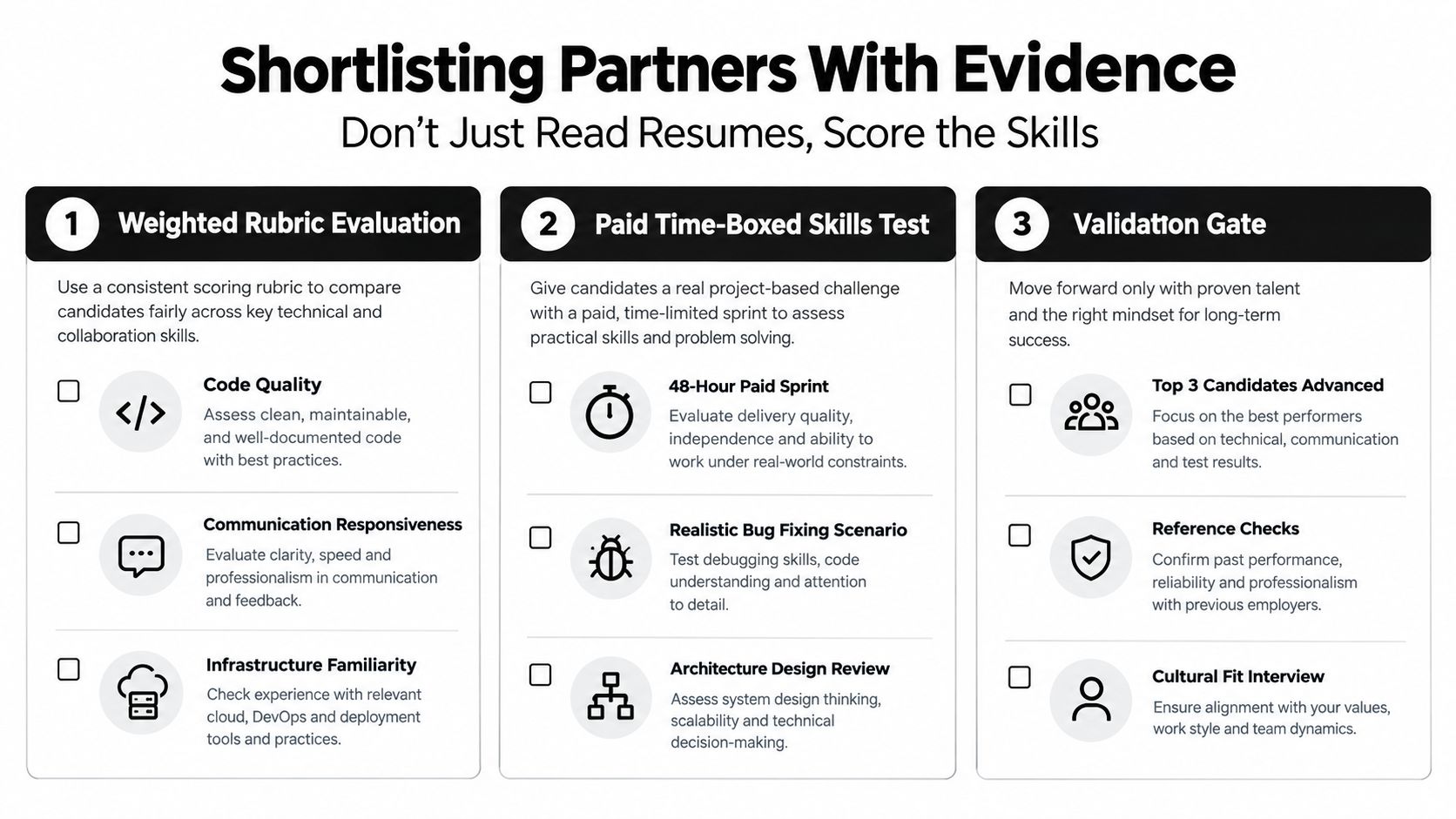
Score partners against a written rubric before reviewing applications. For teams that formalize this step, a structured RFP process can turn the rubric into a comparable, auditable request for proposal. Include criteria such as:
- Domain relevance: Have they handled comparable workflows, integrations, sensitive data, or regulatory constraints?
- Engineering hygiene: Can they show maintainable code, meaningful tests, CI checks, documentation, and clear pull requests?
- Communication under ambiguity: Do they surface assumptions, propose decisions, and explain trade-offs without waiting for perfect requirements?
- Security posture: Can they explain access control, dependency management, secrets handling, threat review, and incident response?
Testlify's structured software engineer evaluation process recommends outcome-based role definitions, a scoring rubric prepared before application review, job-relevant skills tests, practical exercises kept under two hours of candidate time, and consistent questions and criteria. Apply the same discipline to partner selection. It makes the decision auditable and exposes teams that rely on polished claims.
Test a real slice of the roadmap
Give the strongest candidates a paid, time-boxed exercise. Ask them to ship a small service with CI, tests, and a runbook, fix a realistic defect, or review an existing architecture. Publish acceptance criteria first, then assess the work against them rather than personal preference.
Make the evaluation collaborative. Hold a live engineering discussion and ask the team to defend its approach, identify trade-offs, explain what it would change with more time, and describe how it would operate the code in production. You are testing the future operating model, including decision speed, review quality, and ownership after launch.
Independent software developer assessment guidance also supports combining portfolios, live interviews, and coding assessments. Add references from current or recent engagements with similar complexity. A polished case study from an unrelated product says little about performance inside your environment.
Record the evidence and use it to set scope, staffing, governance, and the first DORA-style measures, such as deployment frequency, lead time, change failure rate, and recovery time. That gives the partnership an operating baseline and creates AI-ready governance through documented decisions, traceable reviews, and controlled access to delivery data. If a candidate resists transparent evaluation before signature, expect greater resistance once it has access to your codebase.
Pricing and Contract Structures That Share the Risk
Price is a risk-allocation mechanism. A low rate doesn't create value if the contract makes discovery impossible, rewards headcount instead of outcomes, or turns every product decision into a commercial dispute.
| Contract Type | Best When | Risk Carrier | Common Failure Mode |
|---|---|---|---|
| Fixed price | Scope is stable and acceptance criteria are precise | The partner carries delivery risk within the agreed scope | Discovery gets punished, and changing requirements create conflict |
| Time and materials | Scope is evolving and the client needs flexibility | The client carries utilization and prioritization risk | Seat count becomes the success measure |
| Target cost | Both sides can estimate a range and share variance | Client and partner share cost deviation according to agreed rules | Incentives become unclear when savings and overruns aren't defined |
| Outcome-based | Business outcomes can be measured and influenced by both parties | Both sides share performance risk | The partner gets blamed for outcomes controlled by product, market, or client operations |
A fixed-price migration sounds reassuring until the legacy system reveals undocumented dependencies. The partner protects margin by narrowing interpretation, while the client experiences every clarification as a change request. Fixed price is appropriate for a well-bounded slice of work, not for a product discovery process disguised as a delivery project.
Time and materials is more honest for evolving products, but it needs burn controls, planned capacity, and outcome reviews. Otherwise, a team can remain fully occupied while the roadmap barely advances.
Target-cost models can align incentives when the baseline, variance rules, and decision rights are explicit. Outcome-based agreements go further by connecting payment to adoption, uptime, or another measurable result. They only work when the partner can influence that result and the client supplies the product, data, and operational conditions required to achieve it.
Clauses that prevent polite chaos
Your contract should address more than rates and milestones:
- Change governance: Define how a requested change is assessed, priced, approved, and recorded.
- Acceptance criteria: Specify functional, security, performance, documentation, and operational requirements.
- IP vesting: State when code, designs, prompts, test assets, and documentation transfer to the client.
- Liability and insurance: Set reasonable caps and identify exceptions for confidentiality, security, and IP violations.
- Audit rights: Preserve the ability to inspect controls, access records, and compliance evidence.
- Exit assistance: Require practical handover, documentation, knowledge transfer, and support during transition.
A contract should make bad news visible early, not make good news sound impressive.
Pick a hybrid structure by phase. Use a discovery or target-cost arrangement while uncertainty is high, a delivery model with clear acceptance gates once scope stabilizes, and a support agreement tied to service quality after launch.
Governance and KPIs You Can Actually Instrument
“On time” is too vague to govern an engineering partnership. A feature can arrive on schedule with fragile code, slow review, untested paths, and a release process nobody trusts.
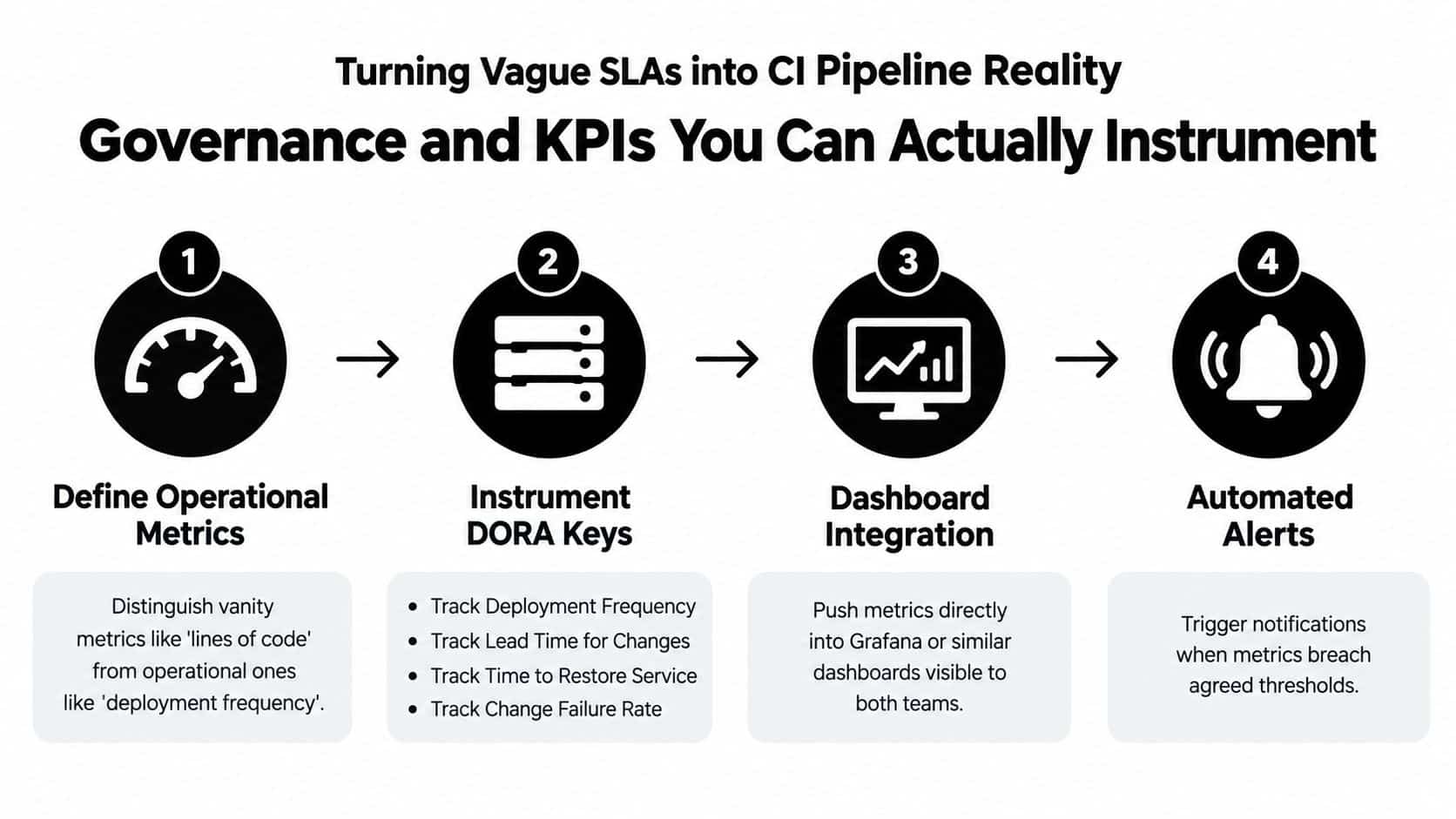
The answer is to turn SLA language into signals that appear in CI pipelines, version-control systems, incident tools, and shared dashboards. DORA-style delivery guidance points to deployment frequency, lead time for changes, time to restore service, and change failure rate, alongside sprint velocity, code review quality, defect ratios, and activation or conversion outcomes.
Measure flow, quality, and recovery
Begin by separating vanity metrics from operational metrics. Lines of code, hours logged, and ticket counts describe activity. They don't tell you whether customers receive reliable improvements.
Instrument these signals:
- Deployment frequency: How often production changes are released.
- Lead time for changes: How long an approved change takes to reach production.
- Change failure rate: How often releases cause a rollback, incident, hotfix, or failed outcome.
- Time to restore service: How quickly the teams recover from a production failure.
- Queue length and work in progress: Whether work is flowing or accumulating in review, testing, security, or deployment.
Published benchmark guidance recommends targets such as weekly-or-better deployment frequency, lead time under one week, defect escape rates below 5%, code review turnaround under 8 hours, and automated test coverage above 70%. The benchmark discussion provides useful reference points, but don't copy targets blindly. A regulated fintech and an internal dashboard shouldn't share identical release rules.
Make the dashboard a shared authority
Connect GitHub or GitLab to your CI system, incident platform, and dashboarding tool. Grafana or a comparable dashboard can show both teams the same definitions, release history, failure events, and recovery time. Assign an owner to every signal. Engineering owns pipeline integrity, the partner owns accurate delivery data, product owns acceptance outcomes, and the client executive sponsor resolves persistent trade-offs.
Use a weekly rhythm that combines standups, demos, a written risk register, and a review of metric movement. Hold a quarterly architecture review for dependency health, scaling assumptions, security findings, technical debt, and modernization priorities. A practical guide to agile performance metrics can help teams choose measures that support decisions rather than decorate a report.
Escalation rules should be explicit. For example, an agreed threshold can trigger a leadership review when change failure rate rises above 15 percent or lead time exceeds a week. Those thresholds are governance examples, not universal quality laws. The important point is that both sides agree on the trigger before a disagreement arrives.
Keeping the Partnership Productive After Launch
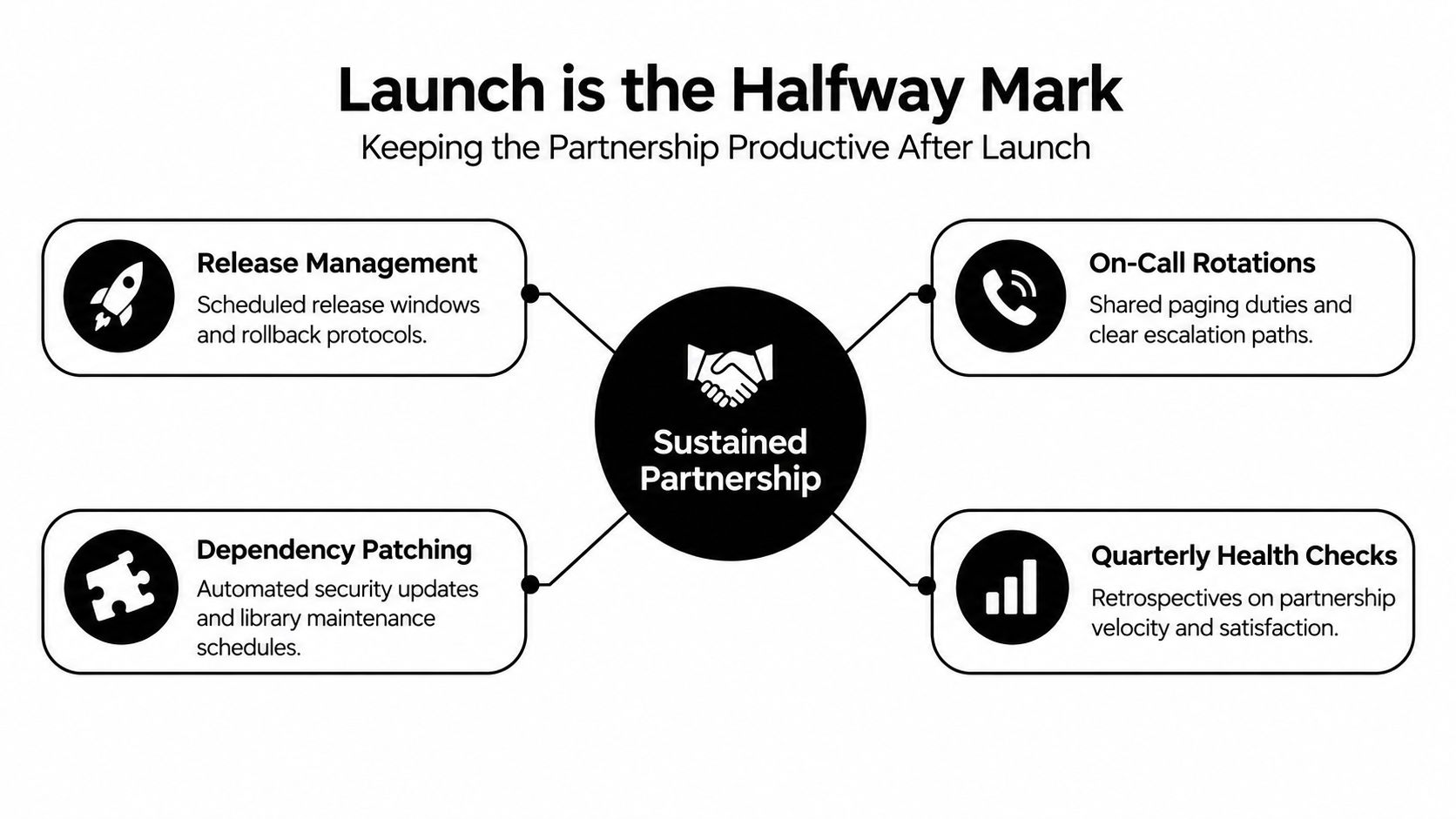
Launch isn't the finish line. It's where the partnership starts carrying operational weight.
The delivery team must hand over more than deployed code. Release management needs scheduled windows and rollback procedures. On-call rotations need named people, paging responsibilities, and escalation paths. Dependency patching needs an owner and a maintenance rhythm. Support teams need runbooks that explain not only what to do, but when to involve the partner.
AI features need release management too
AI integration adds a governance layer that ordinary feature delivery doesn't cover. A prompt can change user-facing behavior even when application code hasn't changed. Model selection, retrieval data, parameters, evaluation examples, safety rules, and token usage all need an audit trail.
A scalable AI application should include:
- Version history: Identify the active prompt version in each environment.
- Approval records: Tie edits to an author, reviewer, and approval decision.
- Evaluation: Compare prompt revisions against a fixed evaluation dataset before release.
- Deployment controls: Support staged rollout, rollback, and environment-specific configuration.
- Observability: Track quality, latency, errors, and drift.
- Cost attribution: Track input tokens, output tokens, and spend by prompt or feature.
Prompt management guidance from Wonderment Apps describes these operating details and the need to connect prompt edits with evaluation and spend visibility. Wonderment Apps offers a prompt management system with a versioned prompt vault, a parameter manager for internal database access, logging across integrated AI systems, and a cost manager for cumulative spend visibility.
Legacy and compliance work belongs in the same system
A partner that modernizes a legacy application must remain accountable for the parts that can't be replaced yet. Maintenance, integration behavior, data contracts, and rollback paths need to appear in the same change-control process as new features.
That matters for AI adoption. EY identifies ongoing maintenance and support at 29%, legacy-system integration at 28%, resistance to AI-built software at 27%, and burnout among IT and engineering teams at 24% as barriers to AI adoption in 2025. The EY evidence reinforces a practical point: technical capability isn't enough if the partner can't absorb operational drift.
SOC 2, ISO 27001, GDPR, and sector-specific requirements should be mapped to concrete approvals, evidence, access controls, retention rules, and incident procedures. At each quarterly business review, examine outcomes, cost trends, security findings, support load, and roadmap priorities. If the meeting only reviews completed tickets, the partnership is already decaying.
Your 30-60-90 Day Plan and Red Flags Checklist
The first quarter should prove the operating model, not merely consume the onboarding budget.
Days 0 to 30
Lock scope behind a working spike. Agree on a RACI for product decisions, architecture, security, QA, release approval, and incident response. Instrument CI/CD and shadow one complete release cycle, even if the release is small.
The exit artifact should be a working slice, an agreed Definition of Done, a decision log, a risk register, and a dashboard that both teams can access. The owner is the delivery lead, with the client product owner accountable for acceptance.
Days 31 to 60
Move to a two-week delivery cadence. Run a paid pilot with clear kill criteria, such as failure to meet agreed quality gates, inability to provide transparent delivery data, or repeated unresolved blockers. Bring the partner's QA and security reviewers into the same ticketing and evidence workflow as the internal team.
Don't hide the first incident. Run a blameless post-mortem and test whether escalation works in practice. The review artifact should show what happened, who owned each corrective action, and whether the operating model needs adjustment.
Days 61 to 90
Cut over to steady-state delivery. The partner should demonstrate independent feature delivery, reliable releases, current documentation, and visible ownership of operational risks. Retire the pilot price only after the agreed exit conditions are met, then finalize the master services agreement around the model that proved workable.
Use this checklist before signature and during quarterly health reviews:
- Scope creep without change orders: The partner absorbs expanding requirements without recording commercial or delivery impact.
- Ignored CI failures: Failed builds become normal rather than an escalation signal.
- Silent departures from agreement: Teams change staffing, process, or architecture without documenting the decision.
- Lack of blocker transparency: Risks appear only after a milestone slips.
- Time-zone friction: Real-time pairing and escalation are impossible when the work requires them.
- Replaceable contractor rosters: People rotate frequently, taking domain knowledge with them.
- Vague IP clauses: Ownership of source code, prompts, documentation, and generated assets is unclear.
- Refusal to share velocity data: The partner reports activity but won't expose the evidence behind delivery claims.
A healthy partnership gets easier to inspect over time. A failing one gets better at explaining why inspection is unnecessary.
Wonderment Apps helps organizations design and build AI-modernized web and mobile applications, with managed project teams, curated engineering and QA staffing, and tools for prompt versioning, AI logging, parameter control, and token-cost visibility. If your partnership needs a clearer operating model for scalable delivery and long-term modernization, visit Wonderment Apps to discuss your project.