

The most popular advice about AI in software development is also the least complete: give developers a coding assistant and expect the whole delivery process to accelerate. That approach can produce more code, but production software depends on more than code generation. Requirements still need interpretation, architecture still needs judgment, tests still need to reflect business risk, and releases still need controls that work when an AI system behaves unpredictably.
The AI software development life cycle changes how teams move from intent to production by connecting planning, implementation, evaluation, deployment, and maintenance through faster feedback loops. It also creates new work. Generated code needs provenance and review, model behavior needs evaluation, prompts need version control, and legacy systems need integration strategies that an autocomplete tool can't invent.
For teams modernizing desktop and mobile applications, the practical question isn't whether AI can write code. It can. The better question is whether your organization can govern AI features across the entire product lifecycle. A prompt management system, such as the administrative tooling available for a Wonderment Apps demo, can help teams manage prompt versions, application parameters, AI logs, and cumulative spend instead of scattering those controls across notebooks and production code.
Why AI Changes the Software Development Life Cycle
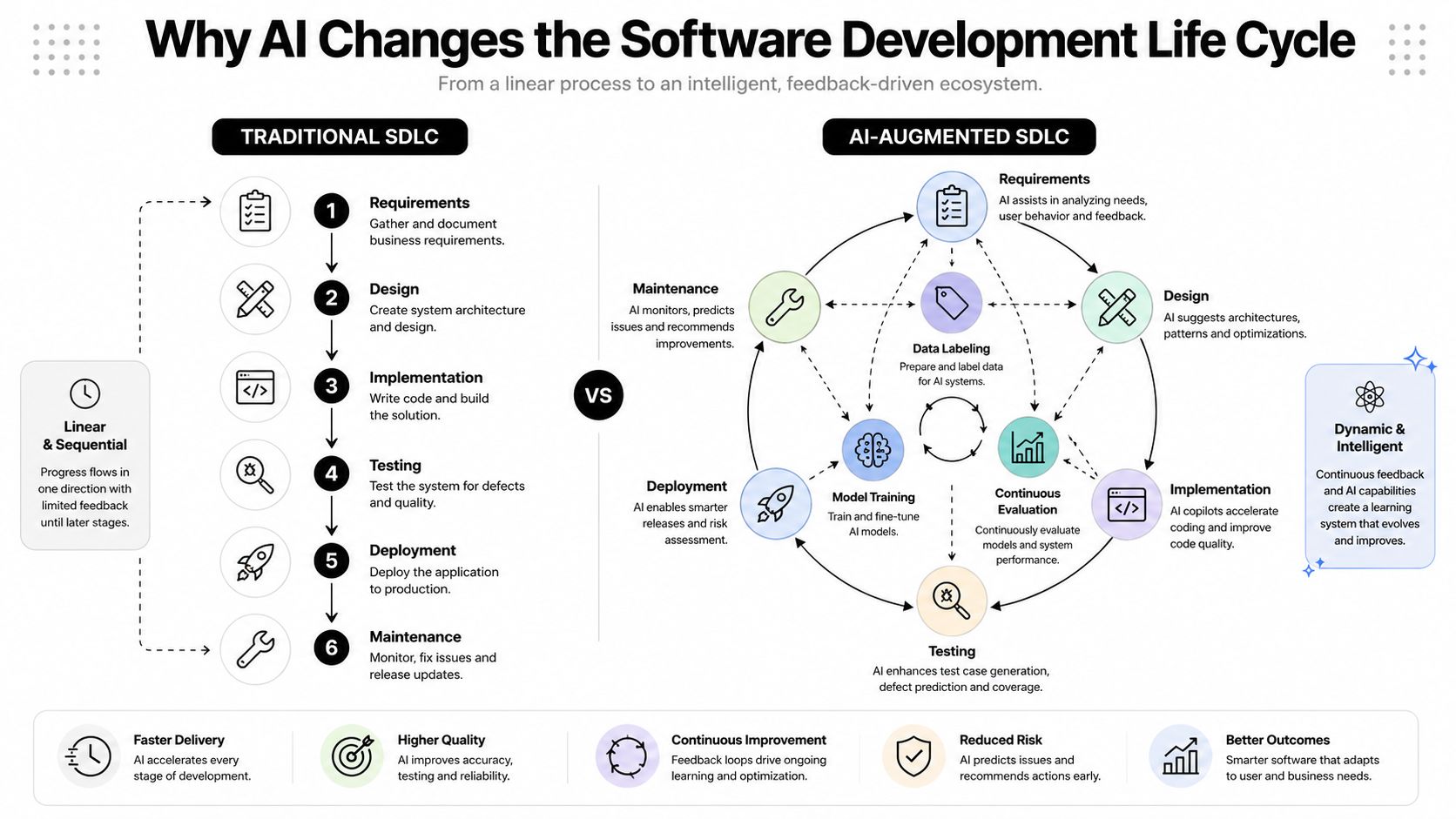
AI in the SDLC isn't mainly a faster keyboard. It changes the shape of the workflow.
A developer may use an AI assistant to draft a service, generate a test scaffold, or summarize a pull request. Those are useful accelerators, but they sit inside a larger system. AI can also synthesize product feedback into requirements, compare architecture options, generate evaluation cases, inspect operational logs, and identify likely maintenance tasks. The output arrives quickly, but speed moves pressure elsewhere. Reviewers, security engineers, product owners, and operations teams must assess more artifacts and more possible implementation paths.
The adoption pattern already reflects that shift. A 2024 IEEE Computer Society interview on generative AI in the SDLC reported that 24% of respondents used AI in at least one SDLC phase, while 20% used it across all phases. That matters because it places AI beyond isolated coding assistance. Planning, development, testing, and operations increasingly belong to the same conversation.
The bottleneck moves downstream
A coding assistant can reduce the time needed to produce an implementation. It can't decide whether the requirement is legally acceptable, whether a generated query belongs in a legacy database, or whether a probabilistic response is safe for a customer-facing mobile workflow.
That creates a familiar engineering problem in a new form. If generation accelerates while review and validation remain manual, the team creates a queue of work after coding. Recent industry data cited by Info-Tech's AI adoption impact study says only 37% of developers using AI at the build stage describe their AI maturity as formal or better. The same source identifies legacy-code breakage, AI code failing quality gates, and uneven team skills as major workflow obstacles.
Practical rule: Don't measure an AI rollout by generated lines of code. Measure whether the team can specify, test, review, release, and operate the resulting software with confidence.
Legacy-heavy organizations feel this most sharply. An AI tool can propose a modern API wrapper, but the delivery team still has to understand old authentication rules, undocumented database behavior, desktop deployment constraints, mobile release dependencies, and compliance boundaries. The most durable gains come from redesigning the feedback system around those realities, not from adding another chat window to the IDE.
Mapping AI Across Every SDLC Phase
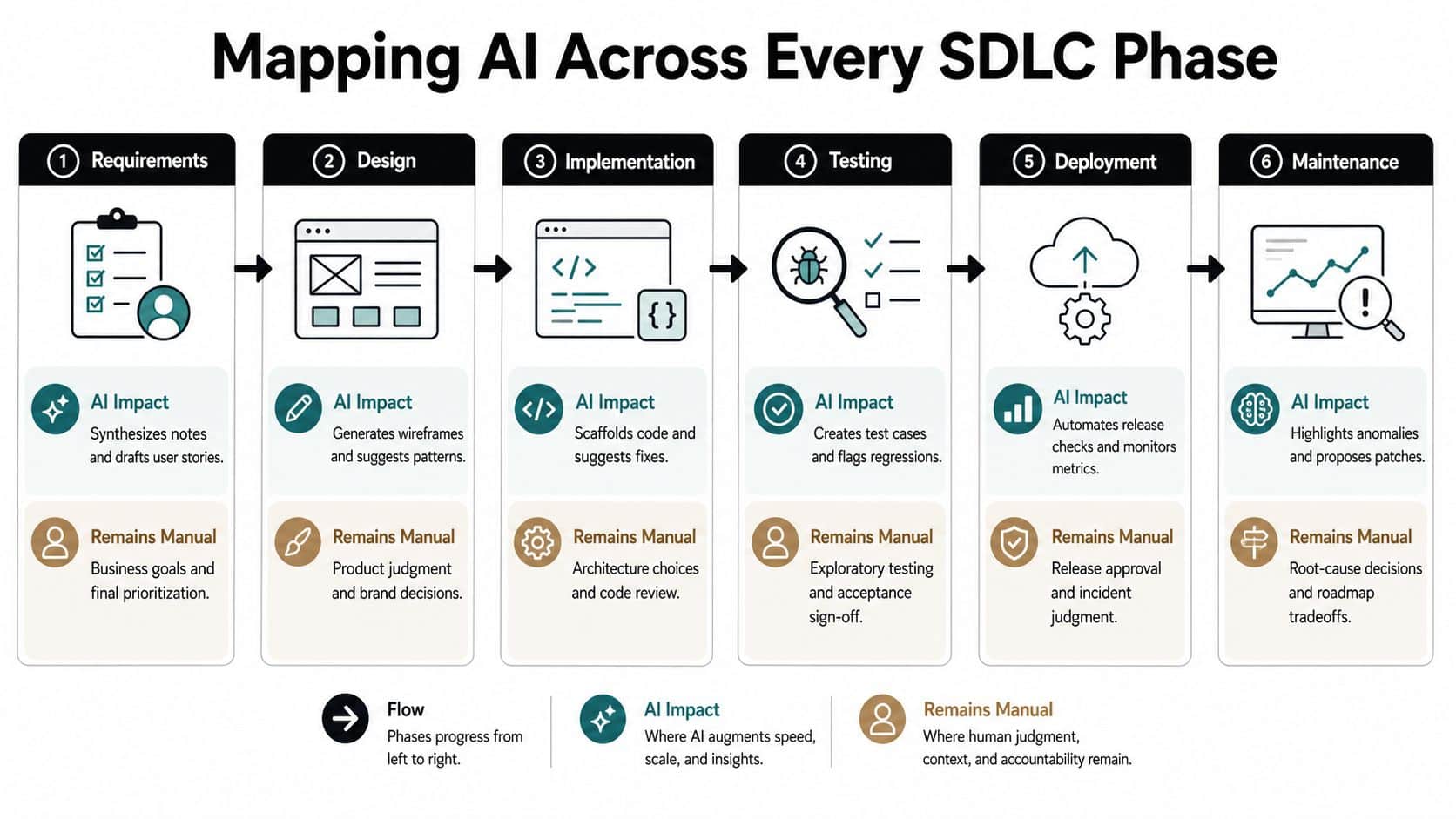
AI works best when each SDLC phase has a defined responsibility, a clear input, and an explicit human decision point. Treating the phases as interchangeable invites confusion, especially when a model's output isn't deterministic.
Requirements and design
AI can turn support tickets, meeting notes, and product requests into draft user stories, acceptance criteria, and edge-case lists. That saves time during discovery, but a generated story can sound precise while hiding an unresolved business decision. Teams still need a product owner or domain expert to approve what “correct” means, particularly for AI features whose responses can vary.
Design work changes in a more technical way. An AI-enabled application needs decisions about inference latency, model availability, context size, data boundaries, fallback behavior, and user feedback. A desktop application may need graceful behavior when a model service is unavailable. A mobile application may need to limit network-heavy interactions, protect local data, and make uncertainty visible without making the interface feel broken.
Implementation and testing
Implementation gets the most visible assistance. Tools can scaffold endpoints, refactor repetitive code, translate between languages, and draft tests. The responsibility doesn't disappear. Developers still need to confirm authorization behavior, dependency choices, error handling, accessibility, and compatibility with the existing architecture.
Testing becomes broader than checking whether a function returns an expected value. Teams need conventional unit and integration tests for deterministic code, plus evaluation harnesses for model behavior. Those harnesses should test representative inputs, unsafe inputs, boundary cases, retrieval quality, response structure, and regression behavior across prompt or model changes.
A useful split looks like this:
- Deterministic checks: Use linters, type checks, unit tests, security scanners, and contract tests for code and infrastructure.
- Probabilistic evaluation: Compare model outputs against approved criteria, test refusal behavior, and track regressions across representative examples.
- Human acceptance: Ask domain reviewers to judge whether the feature solves the intended problem and communicates uncertainty appropriately.
Deployment and maintenance
Deployment now includes more than promoting application binaries. Teams may need model version tags, prompt versions, feature flags, staged rollouts, rollback paths, and cost controls. A canary release for an AI feature should examine user outcomes and operational signals, not only whether the service starts successfully.
Maintenance also expands. Engineers monitor service health, but they may need to investigate data drift, changing user behavior, prompt regressions, retrieval failures, and model-provider changes. The traditional incident process still applies, yet the runbook must identify which model, prompt, data source, and application version produced the behavior.
Benchmark evidence shows why upstream discipline matters. A survey of 178 benchmarks from 461 papers found that about 61% of CodeLLM and agent benchmarks target software implementation, while requirements engineering accounts for 5% and software design for 3%, according to benchmark research on AI for software engineering. AI tooling is currently strongest where code is generated or modified, not where teams define architectural intent.
Data Operations and Model Development Foundations
A notebook can prove that a model works on a sample. It can't prove that the production system can reproduce the result, explain which data created it, or recover when the input distribution changes.
The handoff between data science and engineering is where many AI products become fragile. Data scientists optimize experiments, while engineers need deployable artifacts with repeatable inputs, clear ownership, and observable behavior. Both teams need a shared chain from source data to feature transformations, model checkpoints, evaluation results, and production release.
Build reproducibility into the workflow
Data versioning should connect a dataset snapshot to the code, configuration, and model artifact that used it. Without that relationship, a team may discover a regression but lack the information needed to recreate the earlier result. Lineage also supports audit work by showing where data came from, how it changed, and which service consumed the resulting model.
Feature stores can help bridge training and serving environments, but only when transformation logic stays consistent. A feature calculated one way during training and another way in production creates a form of training-serving skew that can be difficult to diagnose. The solution isn't just buying a feature platform. The team must define ownership, validation rules, freshness expectations, and fallback behavior.
Model experiments also need structured tracking. Capture the training configuration, data reference, model artifact, evaluation results, and approval status in a system that engineers and reviewers can query. A notebook can remain part of the exploration process, but it shouldn't be the only record of a model that affects customers.
Turn research into a release candidate
Production-oriented model development usually includes:
- Containerized training jobs: Package dependencies and configuration so a training run doesn't depend on one research workstation.
- Automated data validation: Check schemas, missing values, unexpected categories, and distribution changes before training or promotion.
- Evaluation gates: Require defined quality, safety, fairness, and performance checks before a model reaches a serving environment.
- Ownership boundaries: Let data engineers maintain ingestion and transformation pipelines, while ML engineers own model behavior and serving performance.
- Promotion records: Record who approved a model, which evidence supported the decision, and how to roll it back.
For generative applications, evaluation needs its own discipline. Teams can combine automated checks with expert review, especially when a response's usefulness depends on domain context. A practical starting point is to define evaluation cases before choosing a platform, then use the AI model evaluation guide to structure repeatable review around those cases.
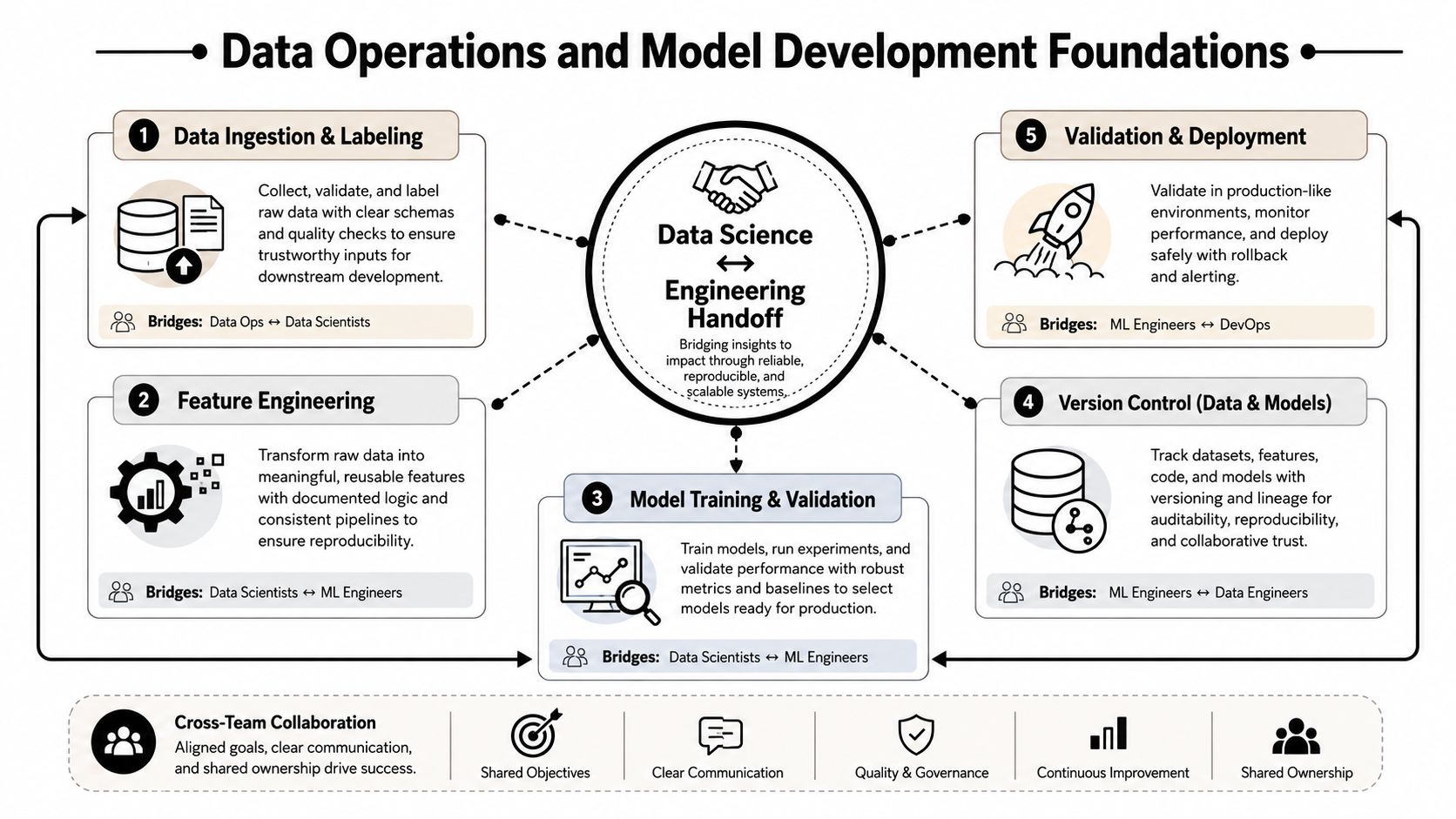
The “works on my machine” problem becomes “worked in my notebook” when teams skip these controls. Production readiness starts when the organization can reproduce a result, inspect its lineage, validate its behavior, and assign responsibility for the next change.
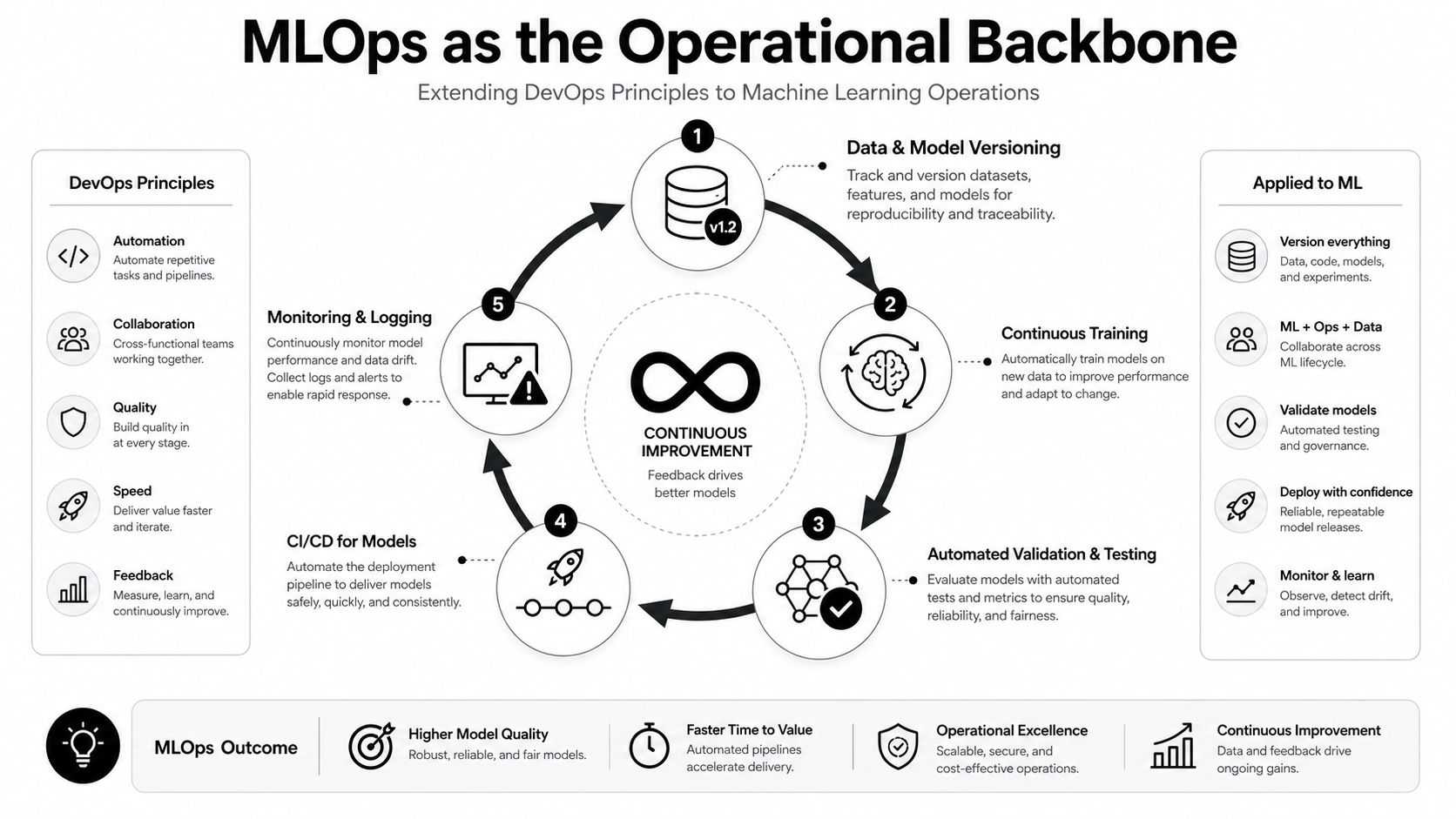
MLOps as the Operational Backbone
AI code generation can shorten implementation time without shortening the path to a safe release. In legacy-heavy environments, the harder work is connecting generated changes to existing data contracts, deployment rules, model behavior, and rollback procedures. MLOps extends DevOps to govern those dependencies instead of treating a model like an ordinary application binary.
A production model can degrade while application code remains unchanged. Input patterns may shift, label meanings may evolve, an upstream source may change, or a model provider may update its service. MLOps connects data, models, code, and configuration through shared versioning and operational records, giving engineers evidence when behavior changes.
Extend CI/CD with model controls
A conventional pipeline may compile code, run tests, scan dependencies, and deploy an artifact, following established CI/CD pipeline best practices. An MLOps pipeline adds checks for data and model artifacts, approval rules, serving compatibility, and monitoring configuration. Automated retraining can reduce manual work, but explicit triggers and guardrails must prevent an unreviewed model from replacing a working production version.
The operational backbone commonly includes:
- Versioned artifacts: Track datasets, features, prompts, models, code, and configuration as related release inputs.
- Validation gates: Block promotion when data quality, model quality, safety, or compatibility checks fail.
- Staged delivery: Use shadow traffic, canary releases, or controlled experiments when a new model carries meaningful risk.
- Continuous monitoring: Observe latency, errors, input patterns, output-quality signals, resource use, and user outcomes.
- Auditable retraining: Make retraining reproducible and reviewable, with a clear path back to the prior version.
The MLOps research overview describes MLOps as an operational backbone that adds continuous integration, deployment automation, versioning for data, models, and code, plus monitoring and retraining to the DevOps loop. Shared lineage helps engineers investigate drift-related failures without comparing disconnected dashboards.
Keep deterministic automation deterministic
AI assistance belongs around systems that require predictable execution, not inside every decision path. Infrastructure deployment, financial calculations, permission enforcement, and policy checks often need explicit rules. An AI tool can summarize a failed deployment, suggest a likely cause, or draft a remediation ticket while the pipeline retains deterministic approval and execution.
Production access requires a risk-based permission model, a durable audit trail, and a tested rollback path. Automation earns trust when operators can inspect its actions, identify the responsible change, and reverse the result without restoring an entire environment.
Governance and Human Oversight in AI Workflows
Human oversight isn't a ceremonial approval at the end of a pipeline. It belongs wherever the system can create material risk, including requirements interpretation, data access, model promotion, user-facing output, and production remediation.
Generative AI introduces several failure modes that traditional code review doesn't fully address. A model can hallucinate a plausible answer, expose information through an overly broad retrieval path, follow a malicious instruction embedded in input, reproduce bias from training data, or produce code that passes a superficial review while violating an architectural constraint.
A systematic review of 71 studies identified persistent limitations involving hallucination, security-vulnerability spread, bias, and governance, and identified ten research gaps in how generative AI is handled across SDLC phases, as reported in research on agentic AI across the software life cycle. Better model performance doesn't eliminate the need for controls. It increases the importance of placing controls where they can catch failures before customers do.
Put approval gates in the right places
A practical governance design separates low-risk assistance from high-impact decisions.
- Drafting: Let AI generate user stories, code suggestions, test cases, or documentation, provided a responsible team member reviews the output.
- Promotion: Require an identified owner to approve model, prompt, retrieval, and configuration changes before release.
- Access: Restrict tools and parameters that can query internal databases, modify records, or invoke privileged services.
- Release: Use automated security, quality, and policy checks, then reserve human approval for changes that affect sensitive workflows.
- Incident response: Preserve prompts, inputs, model identifiers, outputs, tool calls, and decisions so investigators can reconstruct the event.
For regulated applications, explainability and evidence requirements may be mandatory. Internal prototypes can use lighter controls, but the team should still define data boundaries and prevent secrets from entering prompts or logs. Governance becomes expensive when added after deployment because engineers must reconstruct decisions that should have been recorded automatically.
A useful compliance audit checklist can help teams turn broad governance goals into reviewable controls. The key is to connect each control to an owner, a test, and an action when that test fails.
Human review should be proportional to impact, not to novelty. A harmless documentation draft and an automated eligibility decision don't belong behind the same gate.
Scaling AI Integrated Applications for Production
AI features add variable latency, external dependencies, context management, and usage-based infrastructure costs to an application that may already be difficult to scale. The architecture should isolate those concerns instead of allowing a slow model call to block unrelated product functions.
Start with stateless application services. Any instance should be able to handle a request, while conversation state, job status, and user preferences live in durable stores. Stateless design makes horizontal scaling practical, as described in guidance on designing scalable systems. Monitor CPU saturation, p95 latency, queue depth, and cost behavior as traffic changes.
Use a layered scaling design
Caching can avoid repeated inference for identical or safely reusable requests. Asynchronous queues suit document processing, batch enrichment, summarization, and other work that doesn't need an immediate response. Rate limits and circuit breakers protect both your application and upstream model providers when demand spikes or a dependency fails.
For larger products, combine several layers. Guidance on scaling a software product for millions of users describes stateless horizontal scaling, multi-tier caching that can absorb 80% to 95% of read traffic before it reaches the database, CDN distribution, asynchronous processing, and database read scaling through replicas and eventual sharding.
| Strategy | Use case | Cost impact | Complexity |
|---|---|---|---|
| Response caching | Repeated, low-volatility requests | Reduces avoidable model and database calls | Moderate, because invalidation needs care |
| Queue-based processing | Document jobs and non-urgent enrichment | Smooths demand and improves resource utilization | Moderate, with retry and dead-letter handling |
| Request batching | High-volume inference workloads | Can improve utilization, but may increase wait time | Higher, because scheduling affects user experience |
| Circuit breakers and fallbacks | Provider outages or latency spikes | Limits cascading spend and service failure | Moderate, with product-specific fallback design |
| Self-hosted models | Stable workloads with infrastructure expertise | Shifts provider fees toward platform operations | High, especially for serving and model updates |
Managed AI services reduce infrastructure ownership, while self-hosted models offer more control over data, serving, and tuning. Neither choice removes the need to measure cost per request, latency by feature, cache effectiveness, failure rates, and the user experience during degraded operation.
Building Your AI Modernization Toolkit
Tool selection should follow operational maturity. Teams that buy a large MLOps platform before defining evaluation criteria often automate an unclear process and end up with more dashboards than decisions.
A minimally viable production toolkit has a few connected parts:
- Source and artifact versioning: Keep application code, prompts, configuration, data references, and model artifacts traceable to releases.
- Evaluation harnesses: Run representative quality, safety, regression, and domain tests before promotion.
- Observability: Capture latency, errors, input and output metadata, provider behavior, and user-relevant outcomes without logging sensitive content unnecessarily.
- Model and feature management: Register approved models and maintain consistent transformations between training and serving.
- Prompt operations: Treat prompts as application assets, with owners, versions, parameters, testing, and rollback paths.
For teams that are modernizing an existing web, desktop, or mobile application, prompt operations often expose the first practical gap. Developers may have prompts in source files, environment variables, notebooks, and administrative screens, while product owners need to understand which version is active and what each request costs. Wonderment Apps offers an administrative prompt management system with a versioned prompt vault, a parameter manager for internal database access, logging across integrated AI systems, and a cost manager for cumulative spend visibility. That positions prompt management between a raw AI API call and a production-ready feature.
Build-versus-buy decisions should reflect internal capability. Open-source tools such as MLflow or Kubeflow can fit teams with the expertise to operate and customize them. Managed platforms can reduce infrastructure burden when the organization needs reliable workflows sooner than it can build them. The right developer partner matters just as much. A senior hiring screen can look for 5+ years of experience in the core technology stack, such as Java, Angular, Spring, React, or .NET, while a calibrated rubric should define performance expectations before interviews begin, according to guidance on hiring software developers.
Start small, but don't start casually. Define the feature's owner, evaluation cases, data permissions, release gate, rollback path, and operating budget before putting an AI workflow in front of users. Then choose tools that make those decisions visible and repeatable.
Wonderment Apps helps organizations modernize legacy software and build AI-integrated web and mobile products with practical engineering, UX, QA, and ongoing support. Visit Wonderment Apps to discuss your AI software development life cycle, prompt governance needs, and a production architecture designed to last.