


Your app probably already has the raw ingredients for personalization. Users click, browse, save, abandon carts, replay videos, and ignore whole categories of content. The problem isn't whether useful signals exist. It's whether your product turns those signals into better decisions fast enough to matter.
That's why recommendation algorithms have moved from “nice feature” to operating layer. They shape the product feed, the next best offer, the related item carousel, the onboarding path, and the retention loop. For teams modernizing custom web or mobile software, they also create a new management burden. You're not just shipping a model. You're shipping logic that changes user experience, revenue outcomes, compliance posture, and ongoing AI operating cost.
Why Every App Needs a Recommendation Engine
Open Netflix, Amazon, Spotify, TikTok, or YouTube and the product is already making choices on your behalf. It picks what to surface first, what to hide, and what to keep one tap away. That curation layer is the product experience.
For business leaders, this matters because recommendation algorithms don't just improve discovery. They can drive commercial results. AI-powered product recommendation algorithms have demonstrated the ability to increase ecommerce revenue by up to 300%, boost conversion rates by 150%, and raise average order values by 50% according to Envive's recommendation statistics overview.
Personalization changes the economics of attention
Most apps have the same hard constraint. Users won't inspect everything you offer. They'll inspect a tiny subset. Recommendation algorithms decide which subset gets that scarce attention.
That creates advantage in places business teams care about:
- Catalog compression: A large product or content library becomes manageable.
- Better first screens: Users see something relevant sooner.
- Higher intent paths: Cross-sells, upsells, and related content feel useful instead of random.
- Retention loops: The app gets smarter as behavior accumulates.
If you're planning AI modernization, the recommendation layer is often one of the highest-return places to start. The implementation details differ, but the business logic is straightforward. Give users fewer, better choices. Then make the system improve with every interaction. Teams exploring that broader modernization path can get useful context from this guide on how to implement AI in business.
Practical rule: If users face more than a handful of meaningful choices in your app, you already have a recommendation problem, even if you haven't labeled it that way yet.
The hidden cost of “just add recommendations”
Leaders often assume the hard part is model selection. It usually isn't. The harder part is operational discipline.
A recommendation engine touches product design, tracking quality, governance, experimentation, and support workflows. Teams need to know what inputs shaped a recommendation, what changed after a model update, and whether the new logic helped revenue or just shuffled clicks around.
That's why recommendation algorithms belong in product strategy conversations, not just data science sprints. They influence growth directly, but they also introduce ongoing maintenance work that weak teams underestimate.
Exploring the Main Types of Recommendation Algorithms
A retail app with 200,000 SKUs and a streaming product with 20,000 titles can both say they "have recommendations," but they usually need different algorithm choices. The right model family depends less on what sounds advanced and more on the shape of your catalog, the quality of your behavioral data, and how much operational control your team needs after launch.
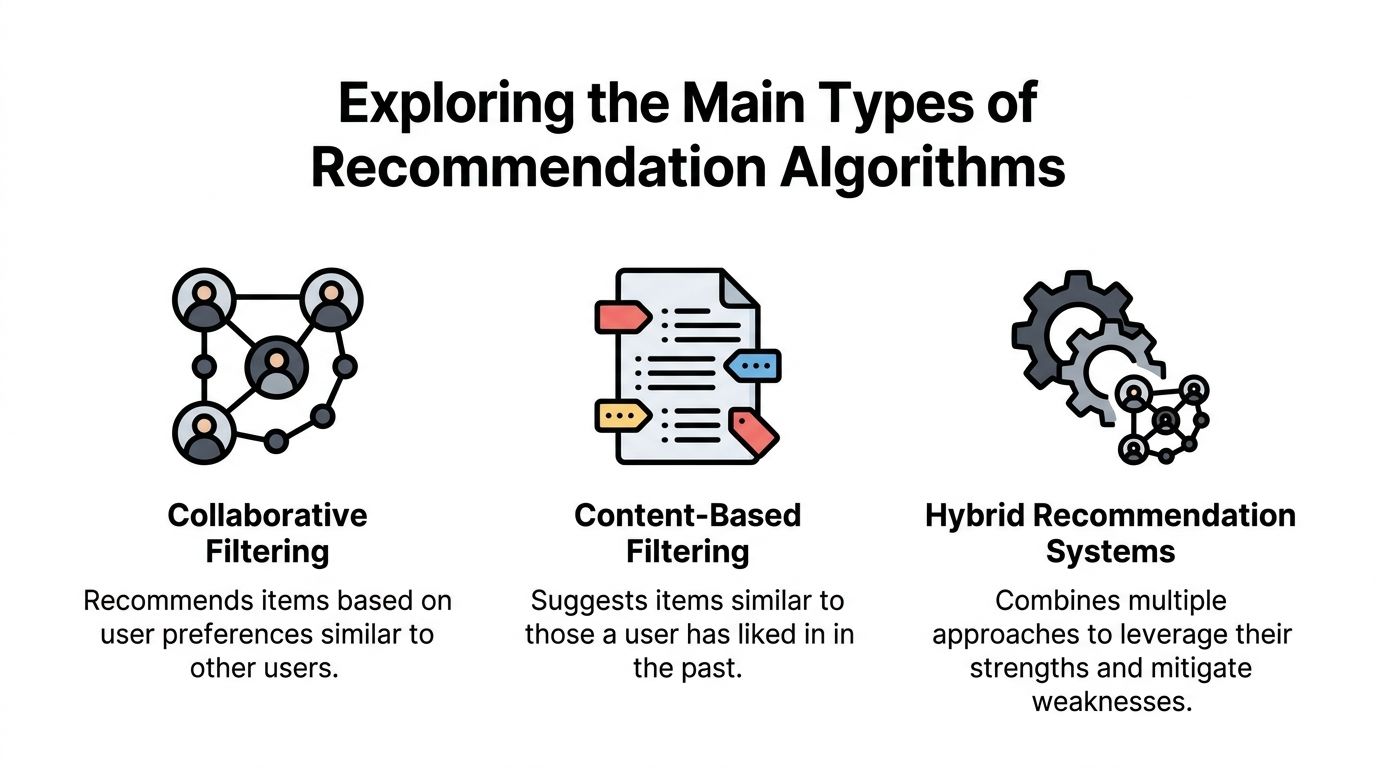
Collaborative filtering
Collaborative filtering recommends items based on shared behavior across users. If users who bought running shoes also tend to buy moisture-wicking socks, the system can learn that pattern without anyone manually defining the relationship.
Its business value is clear. It often surfaces high-converting associations that category rules miss. That makes it useful for cross-sell, bundle discovery, and long-tail engagement.
Its operational weakness is just as clear. Cold starts hurt. New users have little history, new items have little interaction data, and sparse datasets can make recommendations unstable. Teams using collaborative filtering need fallback logic, guardrails, and reporting that explains why coverage drops in certain segments. If your team is still building that foundation, this overview of machine learning for businesses is a useful starting point.
Content-based filtering
Content-based filtering recommends items with attributes similar to what a user has already engaged with. Those attributes might be product tags, article topics, descriptions, price bands, brand, genre, or technical specs.
This method is easier to steer because the recommendation logic ties back to metadata your team can inspect and improve. That matters in businesses where merchandising, compliance, or editorial teams need more transparency into why an item appeared.
The trade-off is narrower discovery. If the system keeps serving near-duplicates, users see less variety and the product feels repetitive. In practice, content-based systems work best when teams maintain clean metadata and actively tune for exploration instead of similarity alone.
Hybrid systems
Hybrid systems combine multiple signals, usually behavioral patterns, item attributes, and context such as recency, session intent, or device state. For production teams, this is often the practical choice because real products rarely have one clean data source.
A hybrid setup can cover more cases. It can recommend established items using behavioral evidence, support newer inventory with metadata, and adapt rankings based on session context. The cost is complexity. More inputs mean more tuning, more failure points, and more need for admin tooling that shows which signals drove a recommendation, what changed after a release, and whether the system is improving revenue, retention, or just click volume.
Many teams also pair hybrid recommenders with exploration strategies so the system keeps learning instead of repeating yesterday's winners. Otter A/B's multi-armed bandit guide gives a practical view of that trade-off.
Recommendation algorithm types compared
| Algorithm Type | How It Works | Pros | Cons | Best For |
|---|---|---|---|---|
| Collaborative Filtering | Learns from overlap in user behavior and item interactions | Strong personalization from crowd behavior, can uncover non-obvious patterns | Struggles with cold starts and sparse data | Mature products with meaningful interaction history |
| Content-Based Filtering | Recommends items similar to what a user liked before based on item attributes | Works well for newer items, easier to control with metadata | Can become repetitive and limit discovery | Catalogs with rich product or content metadata |
| Hybrid | Combines multiple methods plus context signals | Better coverage across different scenarios, stronger cold-start handling, more adaptable ranking | More moving parts to build, tune, monitor, and audit | Apps that need quality, scale, and tighter operational control |
A strong production system rarely depends on one signal. It combines several and gives product, merchandising, and growth teams enough visibility to adjust the mix without guessing.
Which one should you choose
Choose based on business constraints, not algorithm fashion.
- Use collaborative filtering when you have dense interaction history and enough volume to learn from user overlap.
- Use content-based filtering when metadata quality is high, new inventory appears often, or teams need clearer recommendation logic.
- Use hybrid models when you need broad coverage across cold starts, mature users, changing sessions, and multiple commercial goals.
For most businesses, hybrid wins because it matches operational reality. Data is uneven. Catalogs change. Leaders need to control cost, explain outputs, and audit what the system is doing after it goes live.
Under the Hood of Modern Recommendation Systems
A customer opens your app, scrolls for a few seconds, and expects the feed to make sense immediately. The system has milliseconds to choose from a huge catalog, respect inventory and policy constraints, avoid repetition, and still surface something commercially useful. That is why modern recommendation systems are built as operating systems for decisions, not just prediction models.
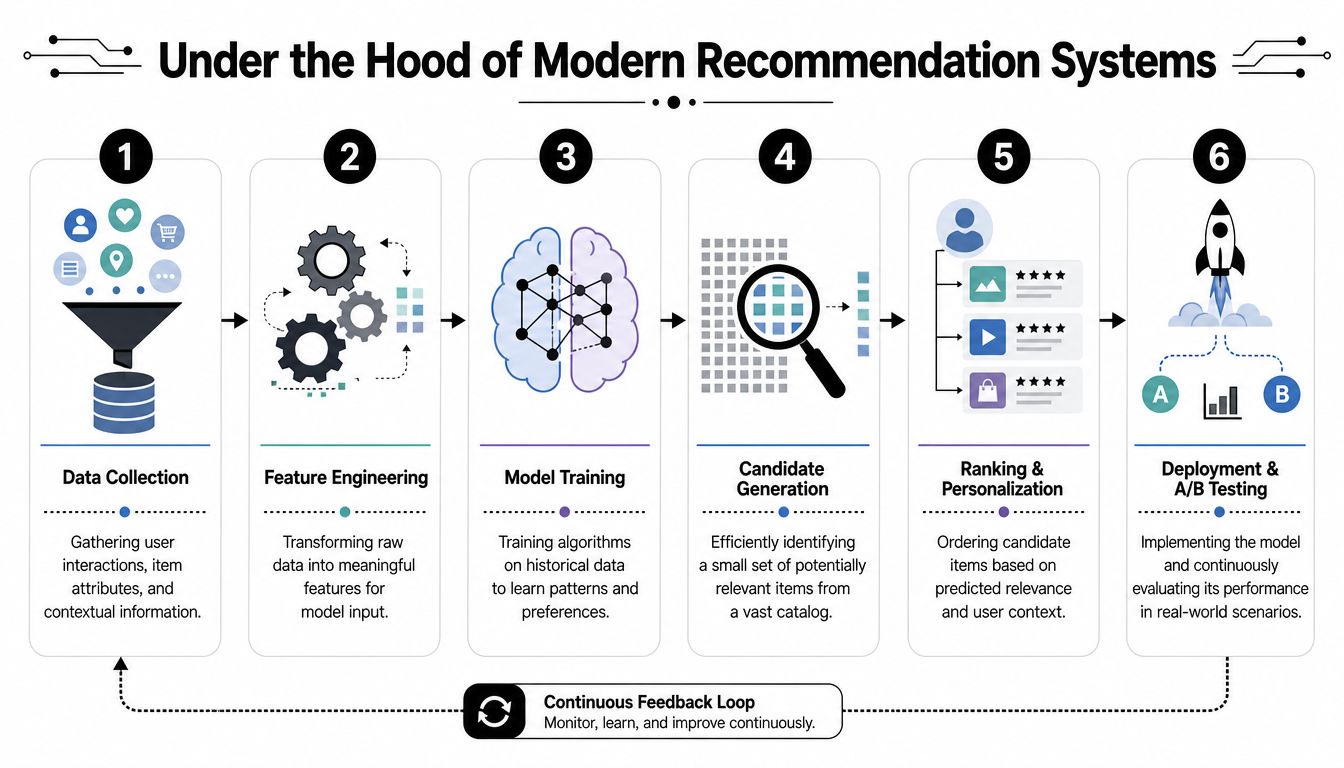
Candidate generation first, ranking second
Production systems usually separate retrieval from ranking because cost and latency force that choice. A model that tries to score every item for every user is expensive to run, hard to maintain, and often unnecessary. The practical pattern is to pull a small candidate set quickly, then spend more compute on ranking only those options well.
A working pipeline usually looks like this:
- Collect interaction and catalog data such as views, clicks, purchases, saves, skips, availability, and metadata.
- Retrieve candidates from a few fast sources, such as similar users, similar items, recent trends, session behavior, or business-curated pools.
- Rank candidates with a model that uses user history, item features, context, and intent signals.
- Apply controls for stock, policy, diversity, freshness, sponsored placement, or margin priorities.
- Log the decision so teams can review what was shown, why it was eligible, and how the user responded.
That last step matters more than many teams expect. Once recommendations affect revenue, merchandising exposure, or regulated content, leaders need an audit trail. If a stakeholder asks why a low-margin item dominated a feed or why a restricted product appeared in a region where it should not, “the model chose it” is not an acceptable answer.
Embeddings help the system model similarity at scale
Many modern systems represent users and items as vectors, then use distance or learned relationships between those vectors to find relevant matches. Knight Columbia's explainer on social media recommendation algorithms gives a useful overview of how platforms use these representations to connect behavior patterns with ranking decisions.
For a business leader, the important point is simpler. Embeddings help the system catch patterns that manual rules miss, such as users who look different on the surface but respond to similar products, creators, or topics. They also introduce trade-offs. Similarity can drift into sameness, popular items can crowd out newer inventory, and model behavior gets harder to explain without good monitoring and admin tooling.
That is why strong teams pair model quality with controls. They give operators ways to inspect candidate sources, cap repetition, suppress exhausted content, and review how ranking changes affect both engagement and business goals.
Real performance work starts after the model ships
Getting a recommendation engine live is the start of the work, not the finish. Most of the gains come from tuning retrieval sources, adjusting feature weights, setting freshness windows, adding negative signals, and deciding where business rules should override model output.
Those choices are not purely technical. A media app may want more discovery even if short-term click-through drops. A commerce team may accept slightly lower engagement to improve margin, inventory turnover, or category coverage. A marketplace may need stricter controls to prevent one seller from dominating results. Recommendation quality is always tied to policy, economics, and operational discipline.
Experimentation helps, but fixed A/B splits are not always the best fit for ranking changes that need faster adaptation. Otter A/B's multi-armed bandit guide is a useful reference for teams deciding when adaptive traffic allocation makes sense.
Teams also need to decide how much of this stack they should build themselves. That decision depends on data maturity, staffing, latency requirements, and how much transparency the business needs from day one. For a practical view of where machine learning fits into company operations, this guide to machine learning adoption for businesses is a helpful companion read.
Key Steps for Implementing a Recommendation Engine
Building a recommendation engine is rarely a single project ticket. It's a product capability made of data, business rules, feedback loops, and system design choices. The strongest implementations usually start smaller than expected, but they start with better discipline.
Start with the behavior you can trust
Recommendation algorithms are only as good as the interaction data behind them. That means you need reliable events before you need a fancy model.
Good starting signals often include:
- Views and clicks: Useful for learning interest, but noisy on their own.
- Purchases or saves: Higher-intent actions that often deserve more weight.
- Skips, hides, or bounces: Negative signals matter. They prevent the system from becoming stubborn.
- Contextual state: Session flow, device type, or page location can shape what “relevant” means.
If event tracking is inconsistent, the model will learn fiction. Teams that underestimate this step usually spend weeks tuning the wrong thing. This breakdown of data quality issues from SigOS is worth reading because it mirrors what happens in recommendation projects. Model problems often begin as instrumentation problems.
Make the data useful before you make it intelligent
Raw events don't automatically become model features. Teams need to decide what behaviors count, how much they count, and how long they should influence ranking.
A healthy implementation process asks questions like these:
- Should a product page view and a completed purchase carry the same importance?
- Does a click from six months ago matter as much as a click from this week?
- Should the system prioritize long-term taste or current session intent?
- Do you need business constraints such as stock status, excluded categories, or compliance filters?
This stage is where product and engineering need to work closely. Left alone, a model will optimize for the easiest measurable outcome. That may not be the outcome the business wants.
Match the model to the maturity of the business
A common mistake is overbuilding early. Many teams don't need a complex deep learning stack on day one. They need a dependable recommendation service that can improve over time.
A pragmatic rollout often looks like this:
- Phase one uses simple logic such as related items, recent behavior, or popularity blended with basic user history.
- Phase two adds personalization layers using collaborative, content-based, or hybrid approaches.
- Phase three introduces richer ranking with context, freshness, and business-aware re-ranking.
Implementation shortcut: Start with one high-value placement. Product detail pages, “next up” modules, and onboarding suggestions usually teach you more than a sitewide rollout.
Plan for operations, not just launch
The recommendation engine isn't done when results appear in the UI. It needs ownership.
That means deciding:
- Who monitors quality drift
- Who approves logic changes
- Who reviews failed experiments
- Who documents what the model is allowed to optimize
Many internal projects stall because, while the prototype works, nobody designed the operating model around it. Recommendation algorithms reward teams that treat them as living product infrastructure.
Evaluating and Testing Your Recommendation Algorithms
A recommendation model can look smart in a notebook and still underperform in production. That's why evaluation has two layers. First, you need to know whether the ranking logic is technically sound. Then you need to know whether it improves business outcomes.
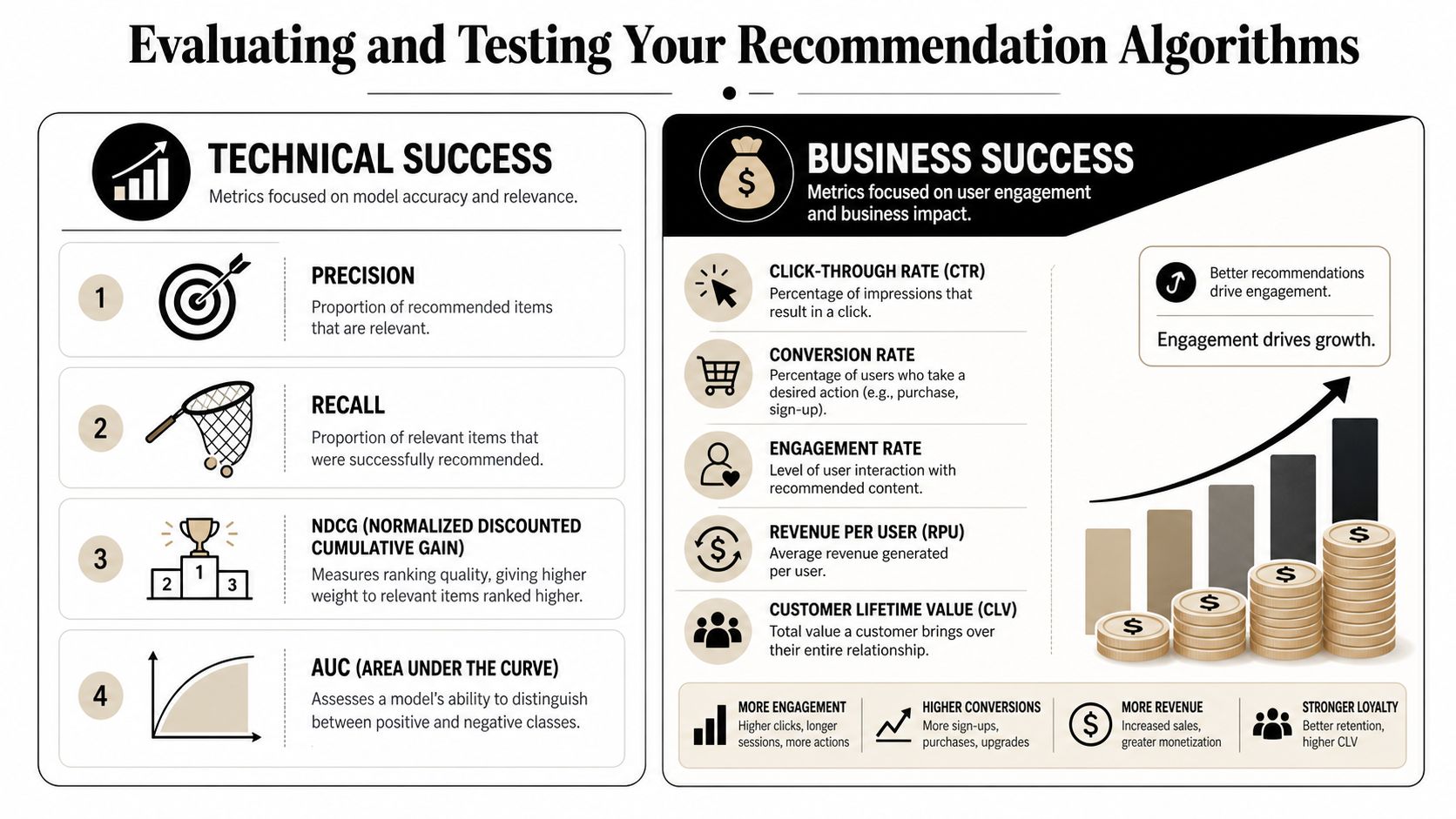
Offline metrics tell you whether the list makes sense
When teams evaluate recommender systems offline, they compare model predictions against known relevance outcomes. Evaluating recommender systems requires precise alignment between model predictions (ranked user-item lists) and ground truth (binary or graded relevance scores), with key metrics including Precision at K, NDCG, MRR, and MAP at K for ranking quality, according to Evidently AI's guide to recommender evaluation.
Those metrics matter because recommendation algorithms don't just answer “yes or no.” They produce an ordered list, and rank order is the whole point.
A simple way to think about the core metrics:
- Precision at K asks whether the top results are relevant.
- NDCG rewards putting the best items higher in the list.
- MRR focuses on how quickly a strong match appears.
- MAP at K evaluates ranking quality across multiple relevant items.
Online tests tell you whether the business should care
Offline metrics are necessary, but they're not enough. A model can improve ranking quality and still hurt the product if it reduces discovery, overfits to clicks, or creates repetitive experiences.
That's why live testing matters. In production, you care about outcomes such as conversion quality, retention, downstream purchases, content completion, or successful task flow completion. Sometimes a technically weaker model wins because it creates a healthier product experience.
A recommendation engine should be judged by what users do next, not only by how elegant the ranking model looks.
What teams should test in practice
Don't limit experiments to model versions. Test the surrounding system too.
| Test Area | What to Look For |
|---|---|
| Candidate sources | Whether new sources improve variety or just add noise |
| Ranking weights | How different objectives change user behavior |
| Placement | Whether recommendations work better on home screens, PDPs, or post-action moments |
| Diversity rules | Whether broader exposure improves satisfaction without hurting core goals |
If your team needs a broader framework for this discipline, this guide to AI model evaluation is a strong starting point.
Recommendation Algorithms in Action Across Industries
The same recommendation logic solves very different business problems depending on the industry. The pattern stays consistent. Users face too many choices, and the app needs to narrow those choices intelligently.
Ecommerce and retail
In ecommerce, recommendation algorithms help customers move from intent to basket. That can mean showing complementary products, surfacing substitutes when an item doesn't fit, or ranking promotions based on browsing behavior and purchase history.
A retailer might use one recommendation service on product detail pages, another inside cart flows, and a third in lifecycle messaging. The logic behind those surfaces won't be identical. Cart recommendations should be practical and conversion-oriented. Home page recommendations can be broader and more exploratory. For teams thinking through that split, this article on understanding AI ecommerce personalization gives useful framing.
Media and entertainment
Media products use recommendation algorithms to solve a speed problem. Users open the app and decide quickly whether there's anything worth watching, reading, or listening to.
A streaming app may recommend the next episode, a related title, and a personalized home shelf. A news product may rank stories based on recency, topic preference, and session context. A short-form video app may continuously adapt the feed using rapid feedback signals like watch completion, skips, and repeats.
Fintech
In fintech, recommendations have to feel helpful without feeling reckless. Banks, lenders, and financial platforms can use them to surface relevant products, educational content, account actions, or onboarding steps.
A practical example is product fit. A customer with established savings behavior may see different card or investment education than a customer who's struggling with budgeting basics. The challenge isn't only relevance. It's governance, fairness, and explainability.
In regulated products, “most likely to click” is often the wrong optimization target.
Healthcare and wellness
Healthcare apps and patient platforms can use recommendation algorithms to personalize education pathways, follow-up content, reminders, and support resources.
A wellness app may recommend the next program based on adherence patterns. A patient portal may surface educational material tied to care stage or prior engagement. In this category, usability matters as much as intelligence. If recommendations create confusion, they've failed even if the model score was high.
The cross-industry lesson is straightforward. Recommendation algorithms aren't one product feature. They're a decision layer that can be adapted to commerce, content, finance, and care delivery.
The Future Challenges of AI Recommendations
As recommendation systems get more powerful, the hard questions shift. Accuracy still matters, but it's no longer the only concern. Leaders now have to ask whether the system is fair, whether the data use is defensible, and whether anyone can explain the output when customers, auditors, or regulators ask.
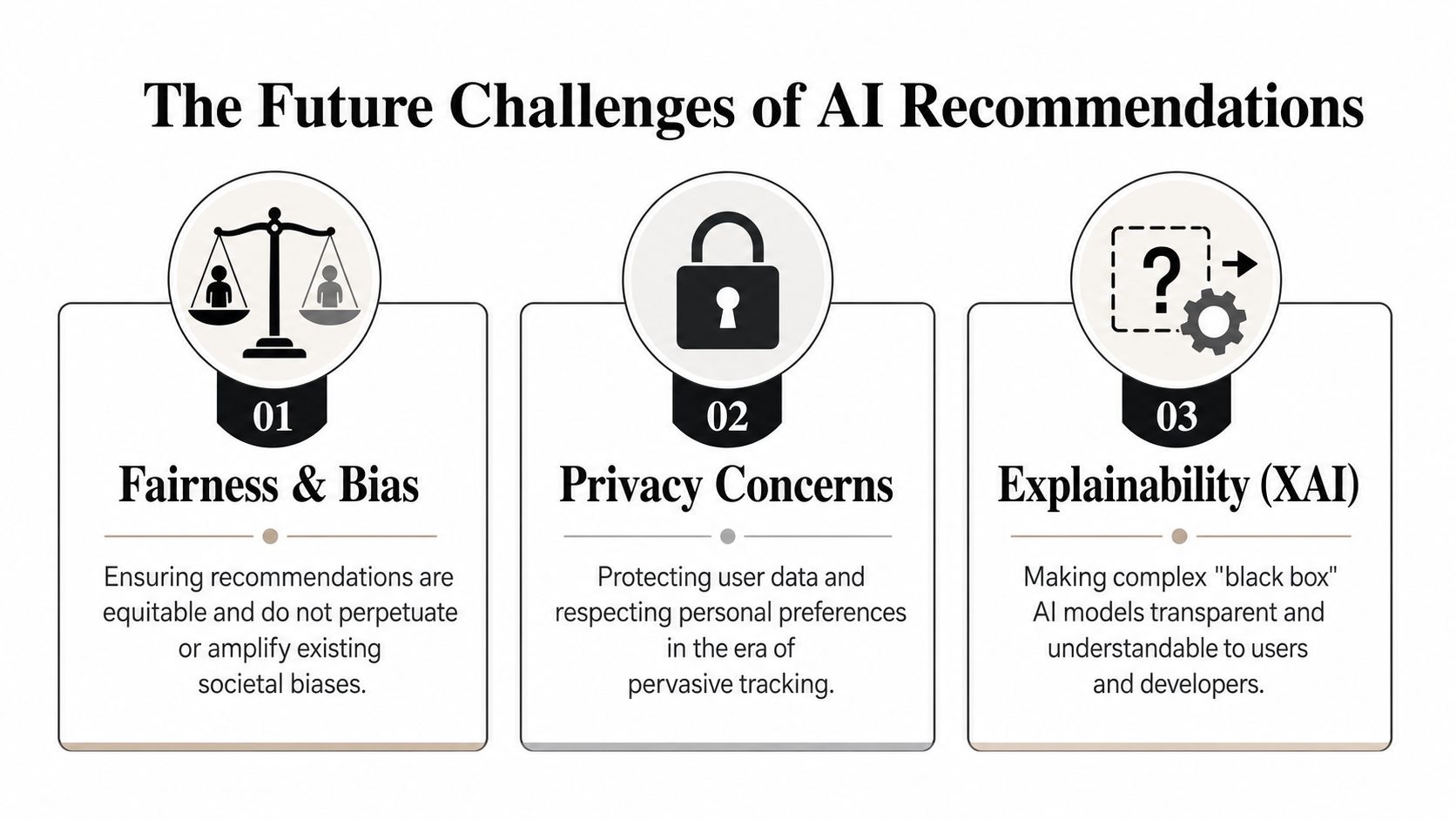
Explainability is becoming an operating requirement
This is especially difficult with large black-box systems. A frequently asked but poorly answered question is how to explain recommendations made by 12-trillion-parameter models to regulators and end-users, given that current architecture makes it impossible to reliably identify why a specific recommendation was generated, according to Brookings on how recommender systems work on digital platforms.
That single problem changes the implementation conversation. It means the future of recommendation algorithms isn't just better ranking. It's better administration.
Fairness, privacy, and control
Recommendation systems can over-amplify what already performs well. That can narrow exposure, bury smaller creators or products, and reinforce existing bias in sensitive categories. Privacy creates a separate challenge. Users want relevance, but they also want boundaries and trust.
Some teams are responding by treating recommendation governance as a configurable system, not an afterthought. That includes clearer policy controls, stronger logging, human review paths, and more explicit rules around what signals can influence which surfaces.
The next frontier is operational tooling
As AI becomes part of core product infrastructure, teams need tools that help them manage prompts, model inputs, parameter changes, logs, and spend across integrated AI systems. This matters even more when recommendation experiences rely on conversational interfaces, retrieval layers, or multiple model providers behind the scenes.
Administrative tooling is quickly becoming part of responsible modernization. Teams need versioning for prompt logic, a parameter manager that controls internal database access, logging across integrated AIs for auditability, and a cost manager that shows cumulative spend in a way operators can use.
That's the less glamorous side of AI, but it's the part that keeps recommendation systems maintainable once they move from pilot to production.
If you're modernizing an app and want recommendation algorithms that are easier to manage in practice, Wonderment Apps is worth a look. Their team helps organizations integrate AI into existing software, build scalable web and mobile experiences, and support long-term operations after launch. They've also developed an administrative prompt management system with a prompt vault for versioning, a parameter manager for internal database access, logging across integrated AIs, and a cost manager that helps entrepreneurs and product teams track cumulative AI spend. If your challenge isn't just building AI, but governing it well, a demo is a practical next step.