

A lot of leaders run into digital engineering before they ever hear the term. A release slips because product approved one requirement, QA tested another, and engineering built from a third version buried in a spreadsheet. The problem doesn't look dramatic at first. It looks like status meetings, rework, and a growing stack of “final_v6” files.
That mess gets more expensive when AI enters the picture. Prompts, model settings, internal data access, logs, and usage costs all become part of the system you're managing, not side notes. That matters because approximately 80% of software solutions are projected to incorporate AI components by 2026, according to Gartner as cited by Digital Aptech's summary of AI in custom software development. If your desktop or mobile product is modernizing for AI, you need tighter control over how information moves through the product.
Digital engineering is the discipline that brings that control. It gives teams a shared, living representation of the system so they can make decisions from the same reality instead of arguing over documents.
Beyond Blueprints and Spreadsheets
A simple way to answer what is digital engineering is this: it's a way to build complex products from connected models and authoritative data instead of disconnected documents.
That sounds abstract until you compare it with the old routine. In a document-heavy setup, hardware, software, QA, operations, and leadership often work from separate artifacts. Each one may be accurate at one moment, but nobody can guarantee they still match by the time a decision gets made.
Why documents break down
Documents are snapshots. Complex systems change constantly.
An app feature might depend on an API change, a device capability, a security rule, and a compliance requirement. If each team updates its own file, you don't have one system definition. You have several partial interpretations of the system.
Practical rule: If two teams can answer the same product question differently and both cite “the latest spec,” you don't have a process problem alone. You have a system-definition problem.
Digital engineering addresses that by treating the product as a connected digital environment. Instead of asking, “Which document is current?” teams ask, “What does the model say right now?”
What changes in practice
The shift is bigger than swapping PDFs for diagrams. Teams start building a living digital blueprint that ties requirements, design logic, testing, behavior, and lifecycle decisions together.
That matters in both software-only and mixed hardware-software businesses. A fintech platform can use the approach to trace compliance logic through workflows and testing. A medical device team can connect software behavior to physical system constraints. A retail platform can model customer-facing behavior and backend dependencies before high-risk launches.
Three business outcomes usually follow:
- Fewer interpretation gaps: Teams stop translating the same requirement into separate local versions.
- Earlier issue discovery: People can inspect behavior before physical build or full release.
- Stronger change control: A decision in one part of the system can be traced to the others it affects.
For leaders, the benefit isn't the model itself. It's confidence. You can ask what changed, why it changed, what it touches, and who approved it, then get an answer grounded in shared data rather than memory.
The Core Components of Digital Engineering
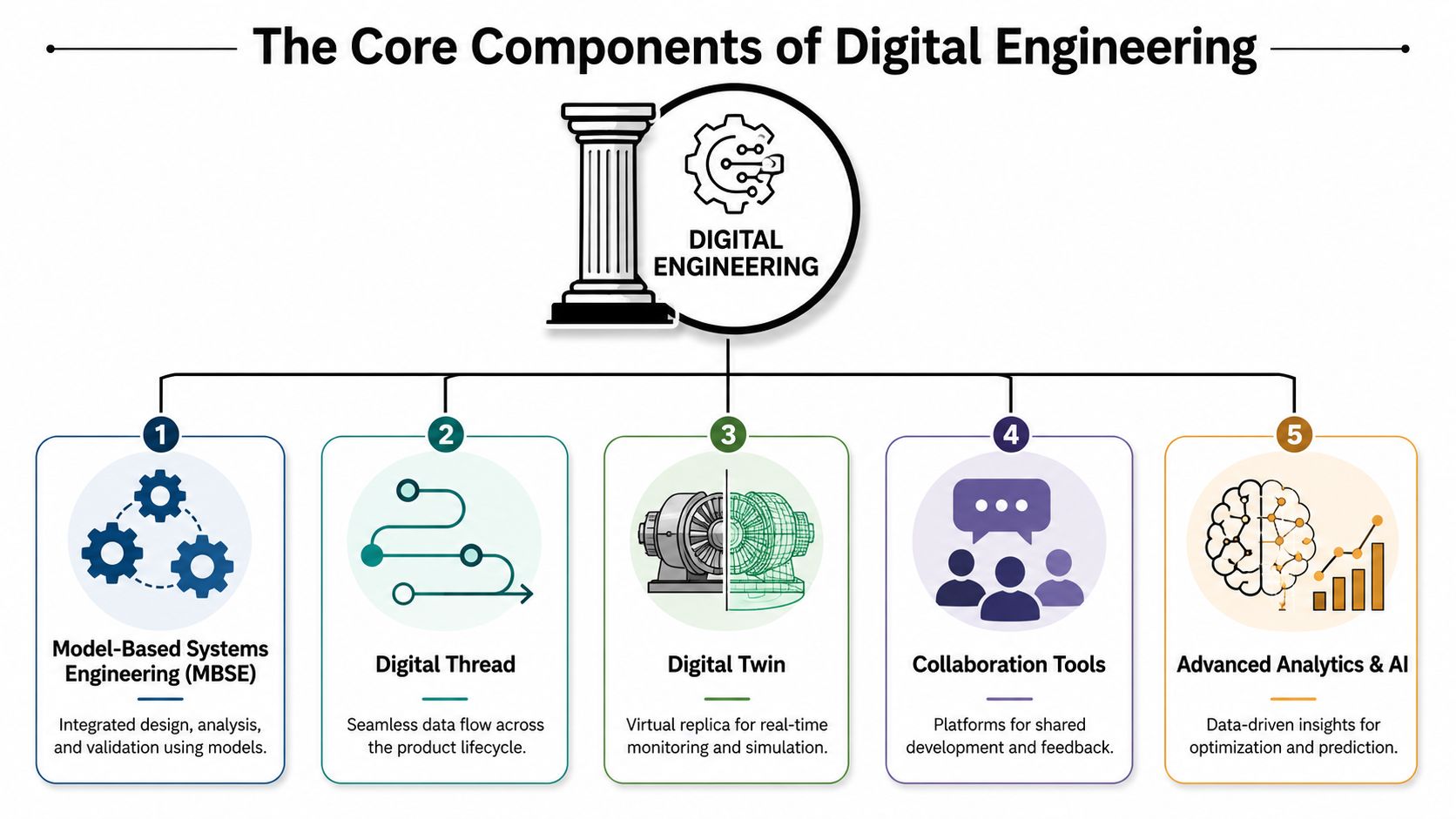
Digital engineering isn't one tool. It's a connected operating model built from a few core pieces that work together. The U.S. Department of Defense formally codified digital engineering into strategy in 2018, defining it as an integrated approach using authoritative system data and models as a continuum across disciplines to support lifecycle activities from concept through disposal, as described in this ScienceDirect article on digital engineering.
MBSE is the system map
Model-Based Systems Engineering, or MBSE, is the discipline of describing the system through connected models rather than relying mainly on static documents.
Think of MBSE as the architectural model for a whole business system. It doesn't just show what exists. It shows relationships. Requirement A affects workflow B, which triggers interface C, which must pass validation D.
That matters because most failures in complex programs don't come from one team being careless. They come from interactions between parts. MBSE makes those interactions visible sooner.
A practical analogy helps. A blueprint for a building is useful, but a modern building information model is more powerful because it lets teams understand how structure, electrical, plumbing, and space planning intersect. MBSE plays a similar role for digital and engineered systems.
The digital thread connects the whole lifecycle
If MBSE is the system map, the digital thread is the connective tissue.
It links information across tools, teams, and lifecycle stages so a requirement can be traced into design, testing, operations, and change management. I often describe it as the system's digital DNA. It carries the identity of decisions across time.
Without that thread, teams still build local truths. With it, a change is easier to track. If a mobile app workflow changes, the thread can connect that update to test cases, user experience implications, backend services, and release planning.
Cloud delivery helps make this practical at scale. Shared platforms, version control, and automated environments make it easier to maintain a current operating picture, especially in distributed teams. If you're thinking about the infrastructure side, this guide to cloud-native architecture from Wonderment Apps is a useful companion.
The digital twin lets you test reality before reality
A digital twin is a dynamic digital representation of a real system. It mirrors how that system behaves so teams can simulate, test, and learn before or alongside physical operation.
For software leaders, this doesn't need to mean a factory robot or aircraft component. A digital twin can represent a payment flow, a patient scheduling process, a recommendation engine's decision path, or an app's production environment under stress.
Here's the useful distinction:
| Component | Best simple question |
|---|---|
| MBSE | How is the system defined? |
| Digital thread | How does information stay connected? |
| Digital twin | How can we test or observe behavior safely? |
AI and collaboration make the system usable
The final layer is what turns models into action. Collaboration tools keep teams aligned around the same artifacts. Advanced analytics and AI help teams inspect model data, simulate outcomes, identify conflicts, and explore what-if scenarios.
That's why digital engineering isn't just an engineering concept anymore. It's becoming a management concept. The organization that can see the whole system clearly can make better bets faster.
How Digital Engineering Transforms Development
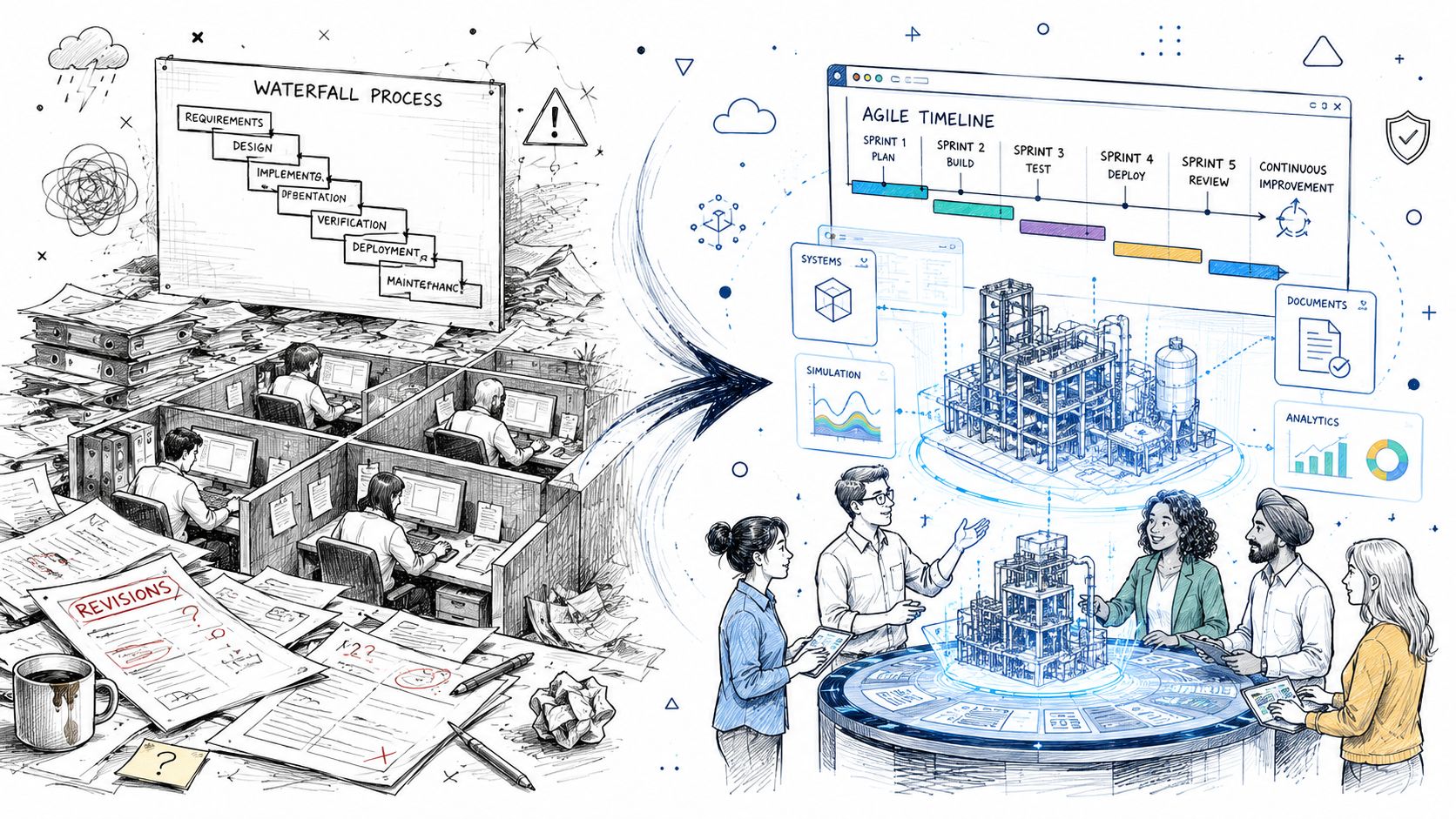
Traditional development usually works like a relay race. One team finishes its part, throws the baton to the next group, and waits for feedback later. That model can still produce good work, but it's slow to expose misunderstandings.
Digital engineering changes the motion of the work. Instead of passing documents downstream, teams work from shared digital artifacts that update the picture for everyone.
Before and after
Here's the contrast in plain terms:
| Approach | How work usually feels |
|---|---|
| Document-centric | Teams wait, translate requirements manually, and discover mismatch later |
| Model-centric | Teams inspect shared definitions, work in parallel, and catch conflicts earlier |
Digital engineering replaces traditional document-based processes with an authoritative single source of truth made up of model-based systems engineering and digital artifacts, enabling engineers to validate complex system behaviors before physical prototyping, as explained in Spec Innovations' digital engineering guide.
Why velocity improves
The biggest gain isn't just speed. It's reduced friction.
When teams use the same live system definition, they spend less time reconciling conflicting versions and more time solving real problems. Product can review intent. Engineering can evaluate feasibility. QA can validate against the current state instead of a stale requirement set. Operations can prepare for deployment earlier.
That's also why digital engineering pairs naturally with modern release practices. Mobile teams, for example, benefit when model-driven clarity feeds directly into faster delivery discipline. If you want a clean explanation of that deployment side, Capgo explains CD for mobile teams.
A strong digital process doesn't remove human judgment. It removes preventable ambiguity.
Parallel work becomes realistic
A model-centric environment supports concurrent engineering. Teams don't need to wait for every upstream document to settle before they begin useful work. They can work from shared structures, trace changes quickly, and adapt with less waste.
That pattern is one reason digital engineering aligns so well with modern software organizations already moving toward integrated delivery. This overview of agile with DevOps from Wonderment Apps fits that broader transition well.
For business leaders, the shift is practical. Fewer surprise dependencies. Shorter feedback loops. Less money spent discovering late that everyone built the “right” thing from different assumptions.
The Real World Benefits and Common Hurdles
Digital engineering earns attention because it improves how teams make decisions. It also frustrates organizations that treat it as a software purchase instead of an operating change.
The upside is real. So are the obstacles.
Where the benefits show up first
Teams often feel the impact in day-to-day development before they describe it in strategic language.
Digital engineering reduces reliance on physical testing by enabling simulation and model-based validation earlier in the lifecycle. It also improves iteration because engineers can work from updated information instead of waiting for manual reconciliation across teams and tools. In practice, that supports better efficiency, agility, throughput, and quality across development and manufacturing-related functions, as summarized in this discussion of digital engineering, MBSE, and digital twins.
The practical gains usually look like this:
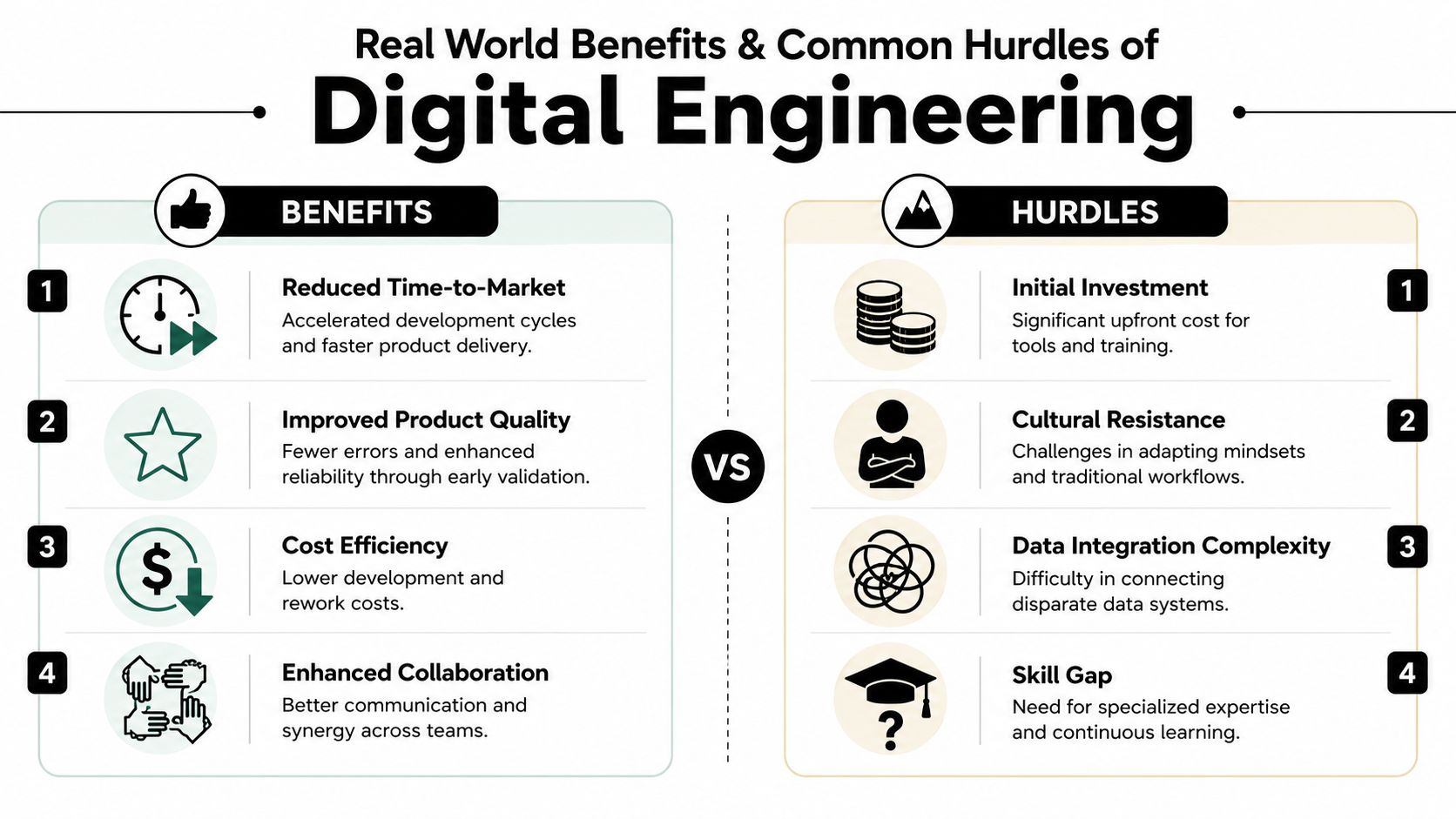
- Earlier validation: Teams can inspect behavior before expensive build, integration, or release steps.
- Less rework: Shared definitions reduce the odds that one team solves the wrong problem well.
- Clearer traceability: Leaders can follow decisions from requirement to test to operational impact.
- Better collaboration: Software, hardware, operations, and business stakeholders can work from a more coherent picture.
The biggest hurdle is cultural, not technical
This is the part many explainers skip. Teams don't fail digital engineering only because tools are hard to integrate. They fail because people keep treating old documents as authority.
BAE Systems explicitly says digital engineering has both a “technical aspect and a cultural behaviors aspect, both of which are equally important to its success,” yet fewer than 15% of industry articles address that behavioral shift, a gap that can lead to project delays.
That insight matters because a single source of truth isn't just a repository. It's a shared habit. People have to trust the digital thread enough to stop maintaining private parallel systems.
Leadership test: When conflict appears, which artifact wins? The answer tells you whether your organization has adopted digital engineering or only purchased software around it.
Common hurdles leaders should expect
A realistic rollout usually runs into four categories of friction:
- Initial investment: Tools, integration work, and training require patience before the process feels smoother.
- Skill gaps: Some teams understand modeling thoroughly. Others need coaching to use it well in day-to-day decisions.
- Data integration complexity: Legacy systems often store critical information in formats that don't connect cleanly.
- Behavioral resistance: People may nod at “single source of truth” while still saving local spreadsheets as insurance.
That doesn't mean the method is overhyped. It means the method is organizational. The firms that do well with digital engineering treat governance, trust, and cross-functional habits as first-class work.
Digital Engineering in Action Across Industries
Digital engineering gets easier to understand when you stop picturing abstract diagrams and start looking at business situations where failure is expensive.
In each case, the point is similar. Teams use digital models to test, learn, and reduce risk before a bad outcome reaches customers, regulators, patients, or operations.
Ecommerce and retail
A retailer preparing for a major seasonal launch can model the relationship between traffic surges, search behavior, inventory logic, promotions, and checkout dependencies. That doesn't predict the future perfectly, but it gives the team a safer place to stress the system before shoppers arrive.
A digital twin in this context might represent the platform's behavior under heavy demand. Product managers can explore how recommendation changes affect performance. Engineers can inspect bottlenecks. Operations can rehearse failure scenarios instead of waiting for them in production.
Fintech and SaaS
In fintech, the value often shows up in traceability and control. A team can model how transaction rules, identity checks, compliance logic, alerts, and customer messaging interact before release.
That helps leaders answer hard questions earlier. If a rule changes, which systems are affected? Which tests need review? Which user journeys could break? A digital engineering approach makes those links easier to see.
In regulated products, confidence comes from being able to explain why the system behaves the way it does, not just from hoping the code passes.
Healthcare and wellness
Healthcare organizations can use digital models to represent workflows such as intake, triage, scheduling, follow-up, and patient communication. That creates a safer environment for redesigning processes that touch real people.
Instead of changing operational workflows by trial and error, teams can simulate the impact of a new sequence, role handoff, or application behavior. That lowers the odds of introducing confusion into already sensitive environments.
Media, public sector, and high-stakes systems
Media platforms can model content delivery behavior, user demand patterns, and release coordination across devices and regions. Public sector teams can model service flows before digitizing citizen-facing processes.
This risk-mitigation angle is especially important in high-stakes domains. Amentum notes that digital models reduce acquisition risks by enabling systems to be “designed, assembled, tested and sustained” digitally, shortening learning curves and cutting failure rates by up to 45% in defense acquisition programs.
That statement is about defense, but the management lesson carries over broadly. Virtual development gives leaders a safer place to learn. When systems are complex, learning late is expensive.
Your Roadmap to Digital Engineering Adoption
Most organizations shouldn't start with a giant transformation deck. They should start with one meaningful system, one cross-functional team, and one decision-making problem worth fixing.
A practical roadmap has three stages: assess, pilot, and scale.
Assess where decisions break down
Start by locating friction, not by shopping for terminology.
Look for places where teams lose confidence because information fragments. Common signs include duplicate specs, manual handoffs, surprise dependencies, release delays caused by re-interpretation, or repeated arguments about what the current requirement is.
Good candidates for early work include:
- A product area with recurring rework: That gives you a visible pain point and a baseline for improvement.
- A workflow that crosses several teams: Digital engineering pays off most where coordination is hard.
- A system with moderate risk: Important enough to matter, contained enough to learn from.
Pilot with one connected model and clear governance
The first pilot should prove behavior, not ideology.
Define a limited scope. Build the shared model. Decide which artifacts are authoritative. Make change ownership explicit. Then run the project with discipline long enough for the organization to feel the difference.
A useful pilot often includes these ingredients:
- Cross-functional ownership so product, engineering, QA, and operations all participate.
- A defined digital thread connecting requirements, design logic, testing, and release readiness.
- Working review rituals that force decisions to come from the shared model rather than side documents.
If your broader goal includes AI modernization, this is also where administrative control matters. Teams need a reliable way to manage prompts, model settings, logs, data access parameters, and usage oversight as part of the system, not as scattered notes.

Scale without recreating old silos
Once the pilot works, scale by standardizing habits, not just templates.
That means documenting governance, training teams on model-based decision-making, and extending the digital thread into adjacent systems. It also means connecting modernization work to the larger application stack. If you're mapping that broader path, this application modernization roadmap from Wonderment Apps is a practical reference.
For AI-enabled products, operational discipline becomes part of digital engineering maturity. A prompt management system can help centralize a prompt vault with versioning, a parameter manager for internal database access, a unified logging system across integrated AIs, and a cost manager that shows cumulative spend. Those controls help teams treat AI behavior as a managed system component, which is exactly the mindset digital engineering requires.
Building the Future with an Intelligent Blueprint
Digital engineering isn't just a better way to organize technical files. It's a better way to run decisions in complex environments.
When leaders ask what digital engineering is, the strongest answer isn't “models instead of documents.” It's “a system for building with shared reality.” Teams can see more, test earlier, connect decisions across the lifecycle, and reduce the risk of learning too late.
The overlooked part is culture. The strategic part is virtual development. Put those together and digital engineering becomes more than an engineering upgrade. It becomes a business capability.
Companies that adopt this well don't build in the dark. They build with an intelligent blueprint that keeps evolving as the product, the market, and the technology change.
If you're modernizing a product, adding AI, or trying to replace scattered delivery habits with a more reliable engineering system, Wonderment Apps can help. Their team works across AI modernization, app development, scalable product delivery, and the operational tooling needed to manage prompts, integrations, logging, and AI cost control. Book a demo to see how a modern digital engineering approach can support your next release.