

Every growing company hits the same wall. Revenue moves up, customer volume rises, and suddenly smart people spend their week copying data between systems, reconciling spreadsheets, checking portal updates, and fixing avoidable mistakes. The work is necessary, but it isn't strategic.
That's usually the moment executives start hearing about RPA. The term can sound more futuristic than it is. In practice, it's a disciplined way to hand repetitive, rule-based work to software bots so your team can stop acting like glue between applications.
The bigger opportunity is what comes next. If you automate the predictable work first, you create a cleaner base for AI-enabled workflows later. And once AI enters the picture, governance becomes as important as the model itself. Teams need control over prompts, parameters, logs, and spend if they want automation that lasts instead of a pile of disconnected experiments.
Is Your Team Drowning in Repetitive Tasks?
A lot of operational pain hides in plain sight. Nobody complains about one invoice entry, one inventory update, or one compliance check. The problem is the repetition. By the time those tiny tasks multiply across finance, support, operations, and customer service, they start consuming attention that should be spent on growth.
You can usually spot the pattern quickly. Staff swivel between a CRM, an ERP, email, spreadsheets, and a vendor portal. They rekey the same information more than once. They wait on manual approvals. Customers feel the lag before leadership sees the root cause.
The hidden cost isn't only time
Manual repetition creates three business problems at once:
- Error accumulation: People make mistakes when they repeat the same clicks all day.
- Slow service: Work sits in queues because it depends on someone being available.
- Morale drag: Strong employees get stuck doing machine work instead of judgment work.
That's where RPA development services come in. Think of them as the professional services required to design, build, test, deploy, and maintain software bots that handle repeatable business workflows. The software matters, but the service layer is what turns a demo into something reliable inside a live operation.
Practical rule: If a process is high-volume, rules-based, and spread across multiple systems, it's usually worth evaluating for RPA before hiring more people to absorb the load.
This isn't a fringe category anymore. One market analysis of global RPA revenue reports growth from USD 1.4111 billion in 2019 to a projected USD 7.01 billion in 2025, with a 27.7% long-run CAGR. That tells you something important. Companies aren't treating RPA as a novelty. They're funding multiple waves of automation and scaling it across operations.
Where executives often misjudge the opportunity
RPA is not magic, and it's not a substitute for process discipline. If your workflow changes every week, a bot will struggle. But if your team follows the same playbook repeatedly, a bot can become the quiet, dependable operator in the background.
The strategic move is to use RPA for the stable work, then add AI where ambiguity begins. That's the path from task automation to intelligent automation.
What Exactly Are RPA Development Services?
An RPA bot is best understood as a digital employee with a very specific job description. It logs into systems, follows a defined sequence of steps, moves data, triggers actions, and records outcomes. It doesn't improvise well, but it doesn't get distracted either.
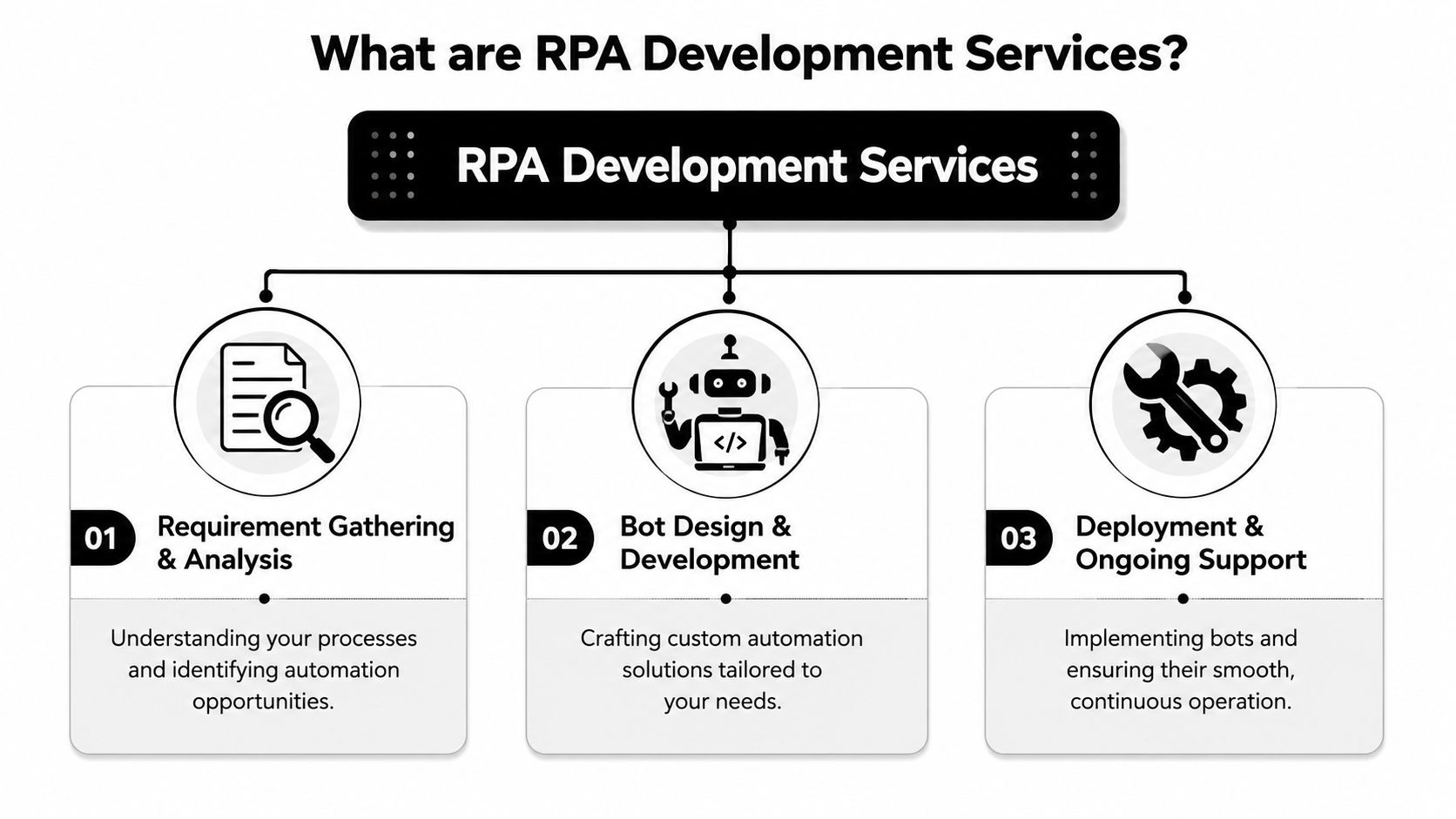
RPA development services are everything required to make that digital employee useful in practice. You're not just buying a bot builder. You're buying process analysis, workflow design, exception handling, testing discipline, deployment planning, monitoring, and support.
What the service usually includes
A credible RPA engagement tends to cover several layers:
- Process discovery: Teams identify the actual location of repetitive work, not just where leaders assume it lives.
- Solution design: Architects define how the bot will behave, what systems it touches, and how exceptions are handled.
- Development: Engineers build the automation logic and configure integrations.
- Testing and release: The bot is validated before it touches live operations.
- Run support: Someone watches performance, updates workflows, and fixes issues when applications change.
If a vendor only talks about “building bots fast,” that's a warning sign. Fast scripting is easy. Stable automation is the hard part.
Attended, unattended, and hybrid bots
Not every bot works the same way.
| Bot type | How it works | Best fit |
|---|---|---|
| Attended bot | Runs alongside an employee and helps with parts of a task | Service desks, call centers, internal operations |
| Unattended bot | Runs autonomously in the background on a schedule or trigger | Finance ops, reporting, reconciliations, back-office processing |
| Hybrid bot | Combines autonomous steps with human approvals or interventions | Compliance-heavy workflows, exception-driven processes |
That mix matters because modern automation programs rarely rely on one model. Enterprise RPA platforms are expected to support centralized management, rapid bot design and testing, monitoring, analytics, and combinations of attended, unattended, and hybrid bots with AI add-ons. In plain English, serious programs need one control tower, not a mess of isolated scripts.
A good bot behaves less like a hack and more like a trained operator with a documented playbook, clear permissions, and supervision.
Why this matters to non-technical leaders
Executives shouldn't think of RPA as “software that clicks buttons.” They should think of it as an operating capability. Done well, it removes friction between systems you already own. Done poorly, it creates brittle shortcuts no one trusts.
That difference comes from the services around the technology, not the license alone.
The RPA Delivery Lifecycle from Start to Finish
RPA projects fail when teams treat them like a quick scripting exercise. They work when teams treat them like software delivery with clear inputs, controls, and ownership.
That delivery discipline has a standard shape. Cleveroad's description of the RPA engineering flow aligns with what experienced teams already know: process analysis, solution design with a Process Definition Document (PDD), bot development, testing, deployment, and ongoing maintenance are what reduce production failures.
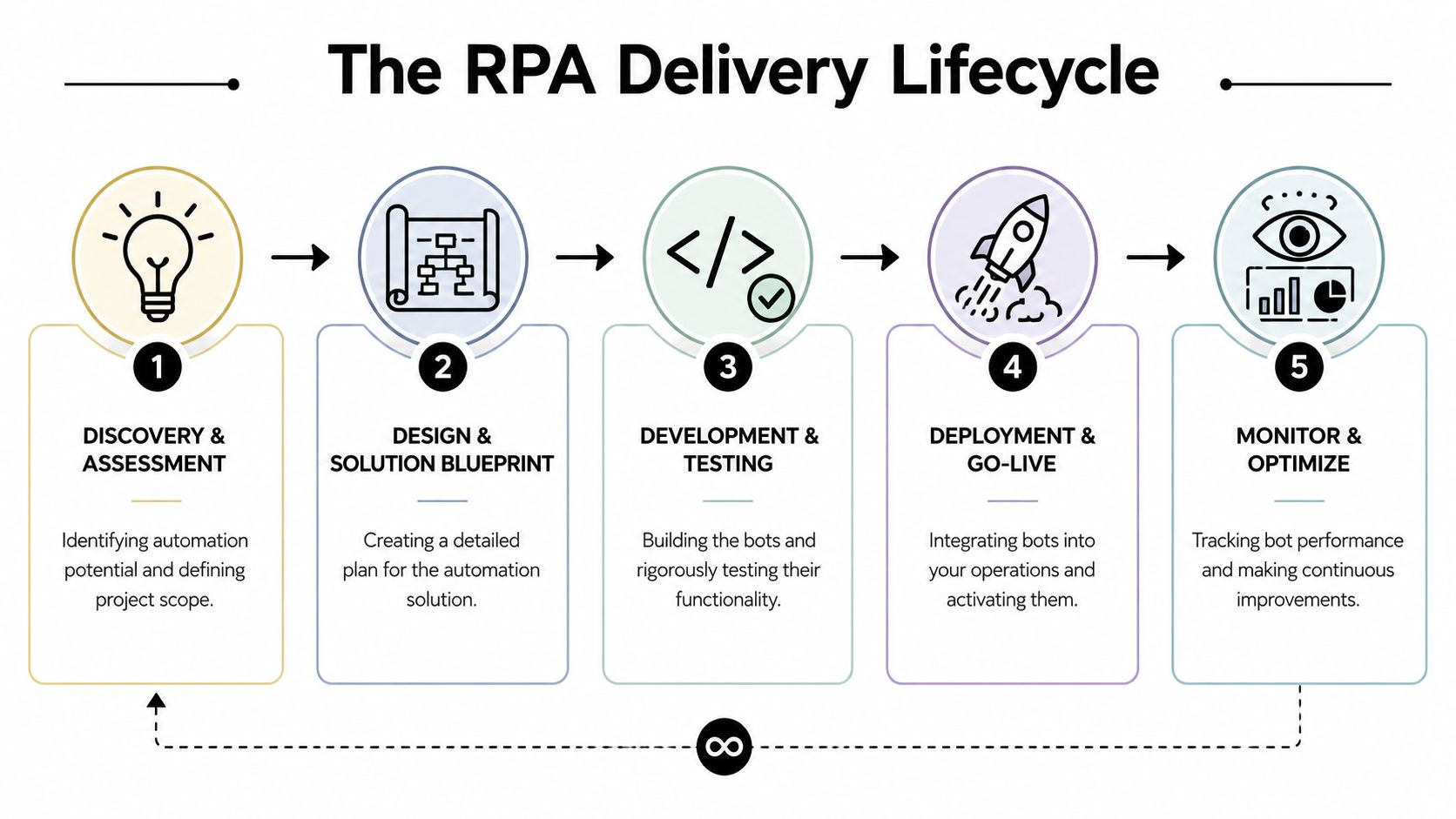
Discovery and assessment
At this point, teams decide what should be automated first. The best candidates are repetitive, rules-based, and painful enough to matter.
Leaders often want to start with the most visible process. That isn't always the right call. The better first target is usually the process with clear rules, stable inputs, and obvious operational friction.
Design and the PDD
The Process Definition Document is the bot's blueprint. It describes every step, decision rule, exception path, system touchpoint, and expected output.
Skip this, and the project turns into tribal knowledge. Write it well, and you create alignment between operations, engineering, QA, and support.
Build and test
Development is where the bot logic gets assembled, but testing is where confidence gets earned. A mature team tests in a pre-production environment and loops defects back into development before go-live.
That's not bureaucracy. It's quality control. If the bot mishandles an edge case in production, the cost shows up in rework, service failures, or compliance risk.
The fastest route to a broken automation program is deploying bots before the team agrees on the exceptions.
Deployment and operational handoff
Go-live should be quiet. If deployment feels dramatic, the project probably wasn't ready.
A professional release includes access controls, scheduling, monitoring, alerting, and clear ownership. This is also where integration discipline matters. If your automation touches several business systems, it helps to use the same coordination mindset described in enterprise application integration best practices for modern AI systems. The systems may differ, but the architectural principle is the same: connected workflows need dependable contracts and visibility.
Maintenance and optimization
Bots don't stay finished. User interfaces change. Business rules evolve. A report field moves. A portal login flow gets updated. Someone has to keep the automation current.
Here's the simplest way to think about the lifecycle:
- Find the right process: High repetition and low ambiguity win.
- Document the rules: If the team can't explain it clearly, the bot can't execute it reliably.
- Build for exceptions: Normal paths are easy. Edge cases determine whether automation survives contact with reality.
- Test before trust: Pre-production validation is not optional.
- Monitor after launch: Production tells you whether the design assumptions were correct.
This is why strong RPA programs feel predictable. They aren't improvised.
RPA Use Cases Across Key Industries
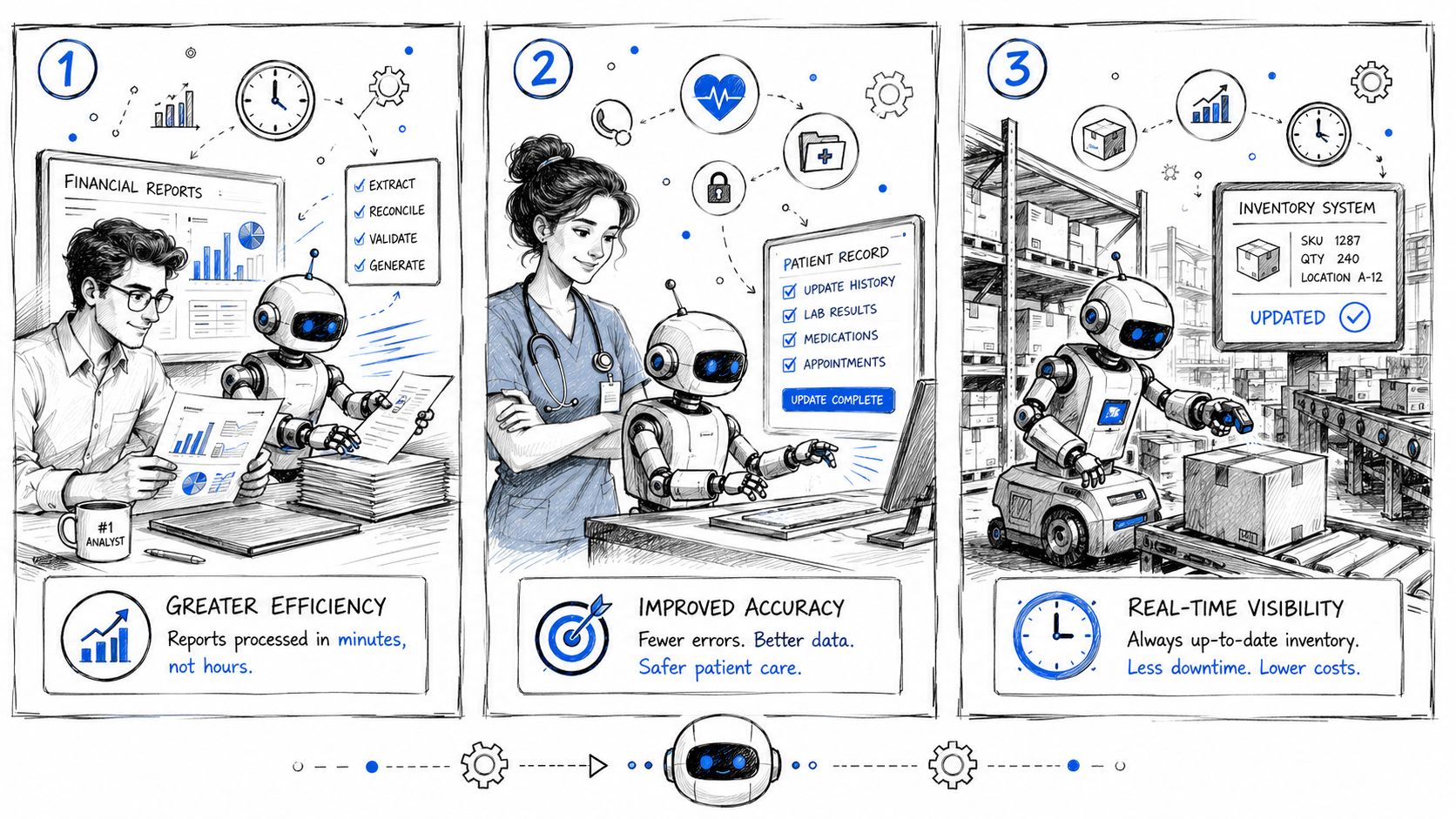
The most useful way to judge RPA is to look at where work gets stuck. Every industry has its own version of the same problem. People spend too much time acting as translators between systems.
Ecommerce and retail
An operations team receives orders from one platform, verifies inventory in another, updates shipping status in a third, and handles exception emails manually. During a sales spike, delays stack up fast.
RPA can take over the repeatable steps. A bot can move order data, update records, trigger fulfillment actions, and flag exceptions for a human when something doesn't match. The result isn't flashy. It's smoother order flow, fewer avoidable handoffs, and less chaos during peak demand.
Fintech and SaaS
A compliance or finance team often deals with high volumes of structured checks. Account verification, report preparation, reconciliations, and status updates all involve clear rules, but they still absorb skilled staff time.
RPA fits well when the process has stable logic and audit sensitivity. The bot follows the same sequence every time, and the human team focuses on judgment calls, escalations, and policy changes instead of repetitive review steps.
Healthcare and wellness
Administrative teams in healthcare handle scheduling coordination, claims workflows, patient intake data movement, and follow-up tasks across disconnected systems. Staff burnout usually has as much to do with process friction as workload itself.
Bots can support those back-office routines while leaving patient-facing decisions with people. That's the right split. Use automation for structured administration, not for replacing clinical judgment.
In healthcare, the win usually isn't “fewer people.” It's giving staff more room for the work only humans should do.
Media and entertainment
Media teams live inside deadlines. Content operations often involve repetitive tagging, publishing steps, asset organization, metadata updates, and distribution coordination.
RPA helps when the content workflow follows a known pattern. If an asset needs to be renamed, categorized, pushed to a CMS, and routed for approval the same way each time, that's bot territory.
Public sector and nonprofits
Government agencies and mission-driven organizations often rely on legacy systems, strict process requirements, and limited staff capacity. Permit handling, intake workflows, record movement, and data migration can be painfully manual.
RPA is especially useful here because it can work across existing interfaces without forcing an immediate platform rebuild. That doesn't remove the need for modernization, but it buys operational relief while longer-term transformation moves forward.
Choosing Your RPA Delivery Model
Once an organization decides to automate, the next question is who should build and run it. There are three common models, and each works in the right context.
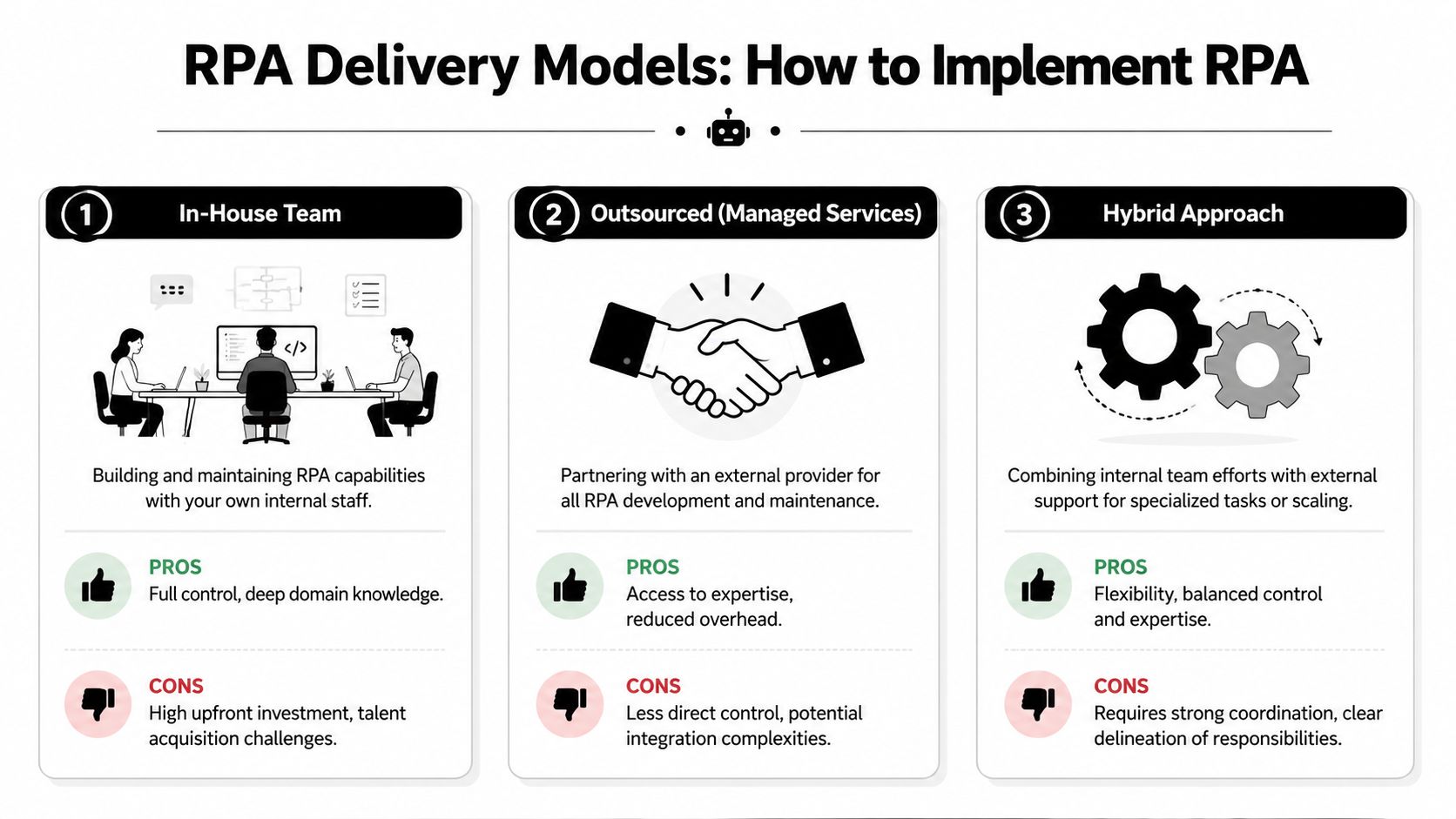
The quick comparison
| Model | What you get | Best when | Main trade-off |
|---|---|---|---|
| In-house team | Internal ownership of architecture, development, and support | Automation is strategic and ongoing | Hiring and ramp-up take time |
| Managed services | A partner handles delivery and maintenance | You need speed and proven execution | Less day-to-day control |
| Hybrid approach | Internal leadership with external specialists | You want control without building everything yourself | Coordination must be strong |
In-house team
This model gives you the most control. Your team owns the roadmap, standards, priorities, and platform knowledge. That's attractive if automation will become a long-term internal capability.
The catch is talent. You need more than a bot builder. You need solution design, QA, support, governance, and someone who can translate operations into automation-ready requirements.
Managed services
Managed delivery works well when you need momentum and don't want to assemble a full internal function first. A strong partner brings patterns, tooling discipline, and implementation experience from earlier projects.
This model is often the cleanest path for organizations that want business outcomes quickly. It's also useful when internal teams are already overloaded.
Hybrid approach
Hybrid is the most common mature setup. Internal leaders define priorities and own business context. External experts provide platform skill, delivery bandwidth, and specialist support.
That balance can work extremely well, but only if roles are explicit. If both sides assume the other owns governance, testing, or support, the gaps show up fast. A practical framing of these trade-offs appears in this comparison of staff augmentation vs. managed services, especially for teams deciding how much execution they want to own directly.
How to choose without overcomplicating it
Use these decision signals:
- Choose in-house if automation is central to your operating model and you can support a real internal function.
- Choose managed services if you need faster execution, outside expertise, and lower setup friction.
- Choose hybrid if you want strategic ownership internally but don't want to build every role from scratch.
The wrong model usually isn't “bad.” It's just mismatched to your current maturity.
How to Select an RPA Partner and Measure ROI
Most executives don't need another vendor promising to “streamline processes.” They need a partner who can make automation reliable, governable, and worth expanding.
That distinction matters because the service side of the market is growing quickly. One 2025 market report projects the RPA services segment to grow at a 23.9% CAGR through 2032, which reflects strong demand for consulting, implementation, orchestration, and managed support, not just software licenses. Buyers know the platform alone doesn't deliver the outcome.
What to ask before you sign
A strong RPA partner should answer these questions clearly:
- How do you choose candidates for automation? You want prioritization logic, not enthusiasm for automating everything.
- How do you document process rules and exceptions? If the answer is vague, support will be painful later.
- How do you test before release? Pre-production discipline is a marker of maturity.
- How do you handle governance and change? Bots break when source systems evolve.
- How do you measure value after launch? If they only talk about bot deployment, they're stopping too early.
If you're building a shortlist, Applied's analysis of RPA vendors is a useful outside reference because it helps frame the vendor ecosystem beyond a single platform pitch.
Don't hire the team that can build a bot. Hire the team that can keep an automation program healthy after the pilot glow wears off.
ROI should be broader than labor savings
A weak ROI conversation focuses only on hours removed. That's too narrow for executive decision-making.
A better ROI lens includes:
- Cycle-time improvement: Does work move faster from request to completion?
- Error reduction: Are fewer records, forms, or transactions being corrected later?
- Compliance support: Is the workflow easier to monitor and audit?
- Capacity creation: Can skilled staff spend more time on exception handling, service, or analysis?
- Durability: Does the bot still perform well when business conditions change?
Governance is part of ROI
Automation value fades when no one owns standards, intake, support, and benefit tracking. That's why mature buyers now evaluate partners on operating model strength, not just development speed.
If the partner can't discuss governance in business terms, they're probably selling a project when you need a capability.
Beyond Bots The Future Is Intelligent Automation
Traditional RPA is excellent at stable, rules-based work. That's also its limit. The moment a workflow depends on messy emails, inconsistent documents, ambiguous language, or judgment-heavy exceptions, classic bots start to struggle.
That's where the next layer comes in. Itransition's framing of traditional RPA versus agentic automation points to the most useful strategic question: not “Can this be automated?” but “Should this process be automated with RPA, AI, or a hybrid model?” That's the right lens for modern operations.
A simple decision framework
Use RPA when the task is structured, repetitive, and predictable.
Use AI-driven automation when the workflow involves interpretation, unstructured inputs, or more fluid decision paths. Teams exploring tailored AI automation solutions are usually trying to solve exactly that problem: how to blend deterministic automation with systems that can classify, extract, summarize, or route less predictable work.
Use a hybrid model when both are true. The AI interprets the messy input. The bot handles the deterministic execution steps that follow.
Why governance becomes harder with AI
Once AI enters the workflow, the challenge shifts. It's no longer enough to ask whether the automation runs. You also need to know which prompts are in use, how parameters are managed, what each model interaction costs, and whether the outputs are being logged safely and consistently.
That governance layer is what separates sustainable modernization from scattered automation experiments. It's also why digital leaders increasingly think about RPA as one piece of a broader digital transformation with AI effort, not as an isolated tool category.
The companies that get the most long-term value won't be the ones with the most bots. They'll be the ones with the clearest decision framework for when to use bots, when to use AI, and how to manage both without losing control.
If your team is ready to move from repetitive manual work to a more durable automation strategy, Wonderment Apps can help. Beyond product engineering and AI modernization, Wonderment has built an administrative toolkit for managing AI-enabled automation with more control: a prompt vault with versioning, a parameter manager for internal database access, centralized logging across integrated AI systems, and cost management to track cumulative model spend. If you're planning automation that needs to scale cleanly across apps, workflows, and teams, schedule a demo and see how the right governance layer makes that transition much safer.