

Healthcare compliance sounds like a legal department topic. In practice, it's a product design topic, an engineering topic, an operations topic, and, if you're building with AI, a governance topic too.
Business leaders usually ask the question in a simple form: what is healthcare compliance? The practical answer is just as simple. It's the discipline of making sure your organization, your software, and your workflows handle health data and healthcare operations in ways the law requires and users can trust.
If your team builds patient portals, wellness apps, care coordination tools, billing workflows, internal clinician software, or AI features that touch health-related data, compliance isn't background noise. It affects database structure, permissions, logging, API choices, vendor contracts, model prompts, and even how your support team views user records.
Why Healthcare Compliance Is Your App's Foundation
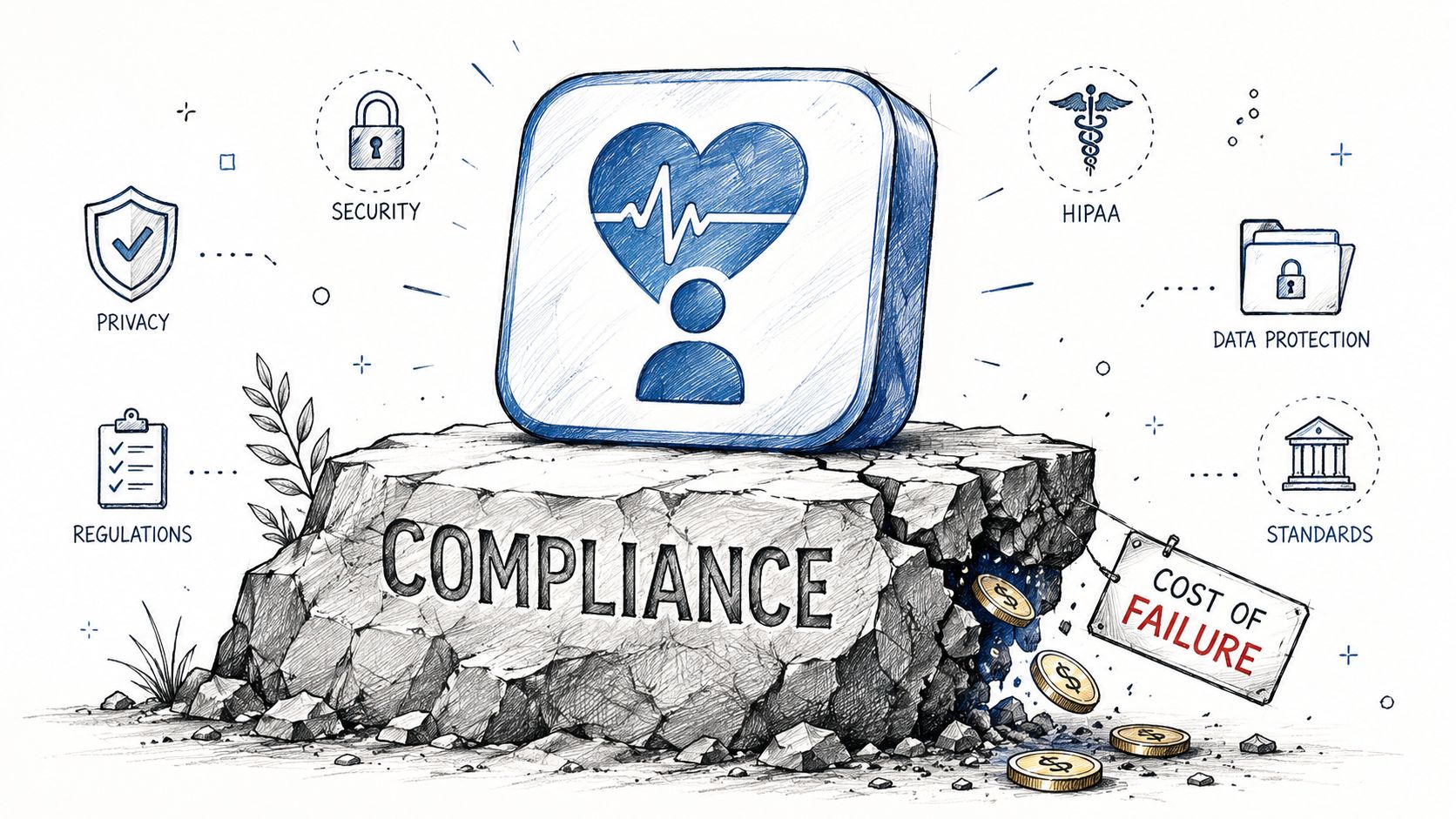
The stakes get expensive fast. The average cost of healthcare data breaches has risen 53% since 2020, a single HIPAA violation can trigger fines nearing $2 million per year, and penalties tied to multiple violations can surpass $25 million according to Sprinto's healthcare compliance overview.
That's the scary part. The useful part is this: compliance gives your app structure.
What compliance means in software terms
For a software team, healthcare compliance means building systems that protect patient data, limit access to the right people, track who did what, and keep sensitive workflows consistent across web, mobile, admin tools, and third-party integrations.
That definition matters because leaders often treat compliance as a checklist they can apply after launch. That's where products get messy. A non-compliant app usually doesn't fail in one dramatic moment. It fails in small places:
- An admin role sees too much: a customer support rep can open records they don't need.
- An integration leaks context: an AI feature receives raw patient information without proper controls.
- A log tells the wrong story: the team can't reconstruct which user accessed which record.
- A workflow skips consent logic: the product captures data but doesn't govern how it's reused.
Practical rule: If your architecture can't explain where health data lives, who can access it, and how it moves, you don't have a compliance program. You have hope.
Why AI raises the bar
AI adds another layer. Prompts, model outputs, context windows, retrieval pipelines, and vendor APIs create new surfaces where sensitive information can travel. That doesn't mean you should avoid AI. It means you should manage it like any other regulated subsystem.
Teams modernizing older platforms often need administrative controls that sit above the model itself. They need prompt versioning, parameter control for database access, unified logs across AI interactions, and visibility into ongoing usage costs. Those aren't “nice to have” features. They're part of operating responsibly at scale.
If your team is still sorting out the basics of protecting health care information, start there. It helps frame why security design and compliance design are closely linked, but not identical.
The Core Regulations You Must Know
Healthcare compliance works like a layered rulebook. One rule governs privacy. Another governs security controls. Another affects referrals and financial relationships. Another appears when your app serves users across borders.
For app builders, the trick isn't memorizing every statute. It's understanding what each rule changes in the product.
The four regulations that shape most product decisions
HIPAA is often the first rule organizations encounter. In plain language, it governs how protected health information is handled. If your app stores, transmits, or exposes patient-related data, HIPAA changes how you think about access, storage, logging, and vendor relationships.
HITECH matters because it pushed healthcare deeper into digital operations and strengthened the practical importance of secure electronic records. For software leaders, that usually translates into tighter expectations around breach readiness, electronic workflows, and how systems exchange regulated information.
GDPR enters the picture when your company handles data connected to people in Europe. Even if your main product is U.S.-focused, international users, employees, partners, or datasets can create overlap. That's why teams building AI-enabled support and workflow tools often study solutions for GDPR compliant AI support before they expand data use cases.
The Anti-Kickback Statute and Stark Law are less about encryption and more about business behavior. They matter when physicians, provider networks, referral programs, and financial incentives intersect with software-enabled workflows.
Key Healthcare Compliance Regulations at a Glance
| Regulation | What It Governs | Key Takeaway for App Builders |
|---|---|---|
| HIPAA | Privacy and security of protected health information | Your product must control access, protect sensitive data, and support auditable workflows |
| HITECH | Digital handling of health information and stronger enforcement context | Electronic systems need mature governance, not just digital convenience |
| GDPR | Personal data rights and processing obligations across relevant jurisdictions | Data use, retention, and AI workflows need regional rules mapped early |
| Anti-Kickback Statute | Financial incentives tied to patient referrals | Partnership and referral features can create legal risk if incentives are structured poorly |
| Stark Law | Physician referrals involving financial relationships | Product workflows tied to referral or billing logic need legal review |
The practical implications leaders usually miss
A lot of confusion comes from treating regulations as abstract legal labels. They're not. They become product requirements.
PHI in your database means fields, tables, exports, backups, analytics tools, and AI connectors need controls.
Referral rules mean your marketplace, partner dashboard, or incentive engine might need legal review before launch.
Cross-border data handling means one user segment can change how your whole architecture is governed.
According to NAVEX's overview of key healthcare laws, the Anti-Kickback Statute and Stark Law forbid physicians from referring Medicare or Medicaid patients to entities where they have a financial relationship, with penalties up to $15,000 per claim, and a Chief Compliance Officer should oversee risk assessments that map data across overlapping regimes such as HIPAA and GDPR.
For a deeper product-specific view, this guide to HIPAA compliant software requirements is useful because it translates the legal language into software delivery concerns.
Compliance law doesn't stay in the legal binder. It shows up in user roles, feature flags, exports, billing flows, and admin dashboards.
Building Your Effective Compliance Program
A compliant product doesn't come from one policy. It comes from a repeatable operating system inside the company.
Leaders often ask for a checklist, but a strong program behaves more like a loop. You set policy, train people, monitor behavior, investigate issues, and improve the system before the next problem appears.
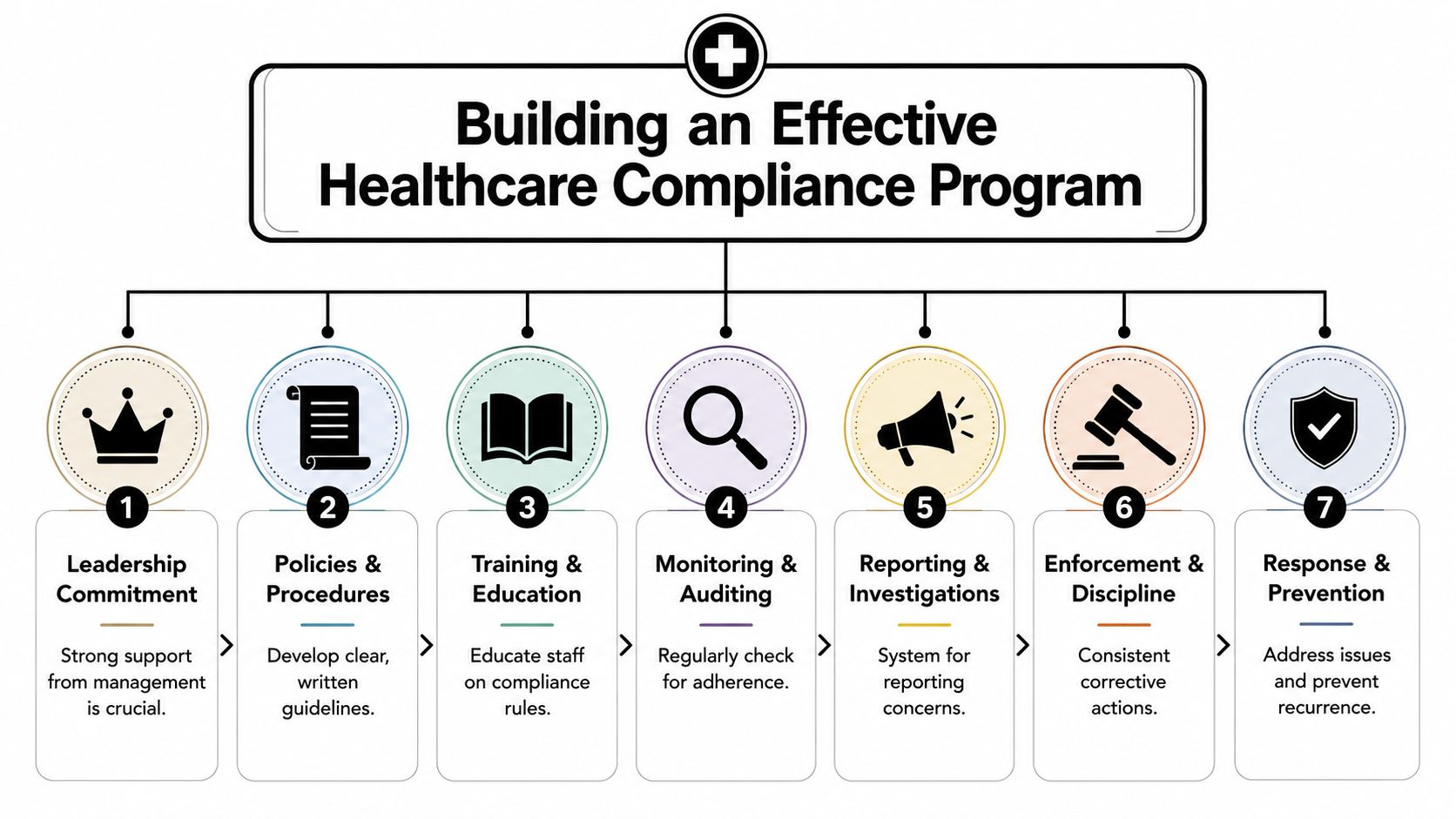
The seven elements that keep the program alive
Leadership commitment
Compliance weakens fast when leadership delegates it without staying involved. Executives set priorities, budgets, and escalation norms.Written policies and procedures
Your team needs documented rules for data handling, access requests, incident response, vendor use, and AI-related workflows.Training and education
Policy that nobody understands is decoration. Product managers, engineers, QA, support, and operations staff all need role-specific guidance.Monitoring and auditing
Organizations move from assumptions to evidence at this point.Reporting and investigations
Teams need a way to raise concerns without drama, confusion, or fear of retaliation.Enforcement and discipline
If rules aren't enforced consistently, people learn that convenience beats policy.Response and prevention
Every incident should end with a fix, not just a memo.
Audit rhythm matters more than audit theater
The Office of Inspector General requires annual audits on high-risk areas such as upcoding, duplicate billing, and billing for services not rendered, and organizations may audit more frequently, including quarterly or monthly, to monitor performance closely according to Symplr's healthcare compliance guidance.
That matters because many organizations perform audits like a tax-season ritual. They gather documents, breathe into a paper bag, and then go back to normal. A healthier pattern is to build recurring reviews into operations.
Consider how that plays out in software:
- Engineering teams review access logs, data flows, and integration changes.
- Product teams examine whether new features alter consent, retention, or visibility rules.
- Operations teams inspect billing workflows and exception handling.
- Compliance leaders connect all of it into a documented review cycle.
A workable blueprint for growing teams
Here's what a practical program often looks like in motion:
- Start with ownership: appoint a compliance lead who can coordinate legal, product, engineering, and operations.
- Map your data: identify where PHI enters, where it's stored, and where it leaves.
- Train by role: don't give the mobile team the same examples you give billing staff.
- Review after change: a new AI assistant, CRM connection, or analytics tool can alter your risk posture overnight.
Operator's note: The best compliance programs don't slow teams down. They remove ambiguity so teams can move faster without guessing.
Technical Guardrails for Compliant Digital Products
At this stage, healthcare compliance stops being a policy slide deck and turns into actual system behavior.
The HIPAA Security Rule requires authentication procedures to verify user identity and transmission security measures to protect data over networks, which makes compliance a technical mandate to ensure electronic protected health information isn't improperly altered or destroyed, as explained by the HIPAA Security Rule summary from HHS.
Translate the law into product requirements
If you're a business leader, here's the plain-English version. Your app should prove who a user is, limit what that user can do, protect data while it moves, and preserve trustworthy records of access and change.
That turns into technical work such as:
- Authentication controls: strong login flows, session management, and identity verification.
- Authorization design: role-based access controls so users only see the records and actions they need.
- Transmission security: data protection across APIs, mobile traffic, browser sessions, and third-party service calls.
- Integrity protections: controls that help your team detect unauthorized modification or destruction of sensitive records.
Privacy by design beats patching later
A common mistake is building the “real” product first and adding compliance controls later. That creates brittle architecture. Permissions get bolted on. Logging becomes inconsistent. AI integrations bypass normal review because they're labeled experimental.
A better approach is privacy by design. That means teams ask certain questions before a feature ships:
| Design Question | Why It Matters |
|---|---|
| Who should access this data? | Prevents overly broad permissions |
| Does this feature move ePHI across systems? | Triggers review of integrations and network protections |
| Can we reconstruct user actions later? | Supports audits and investigations |
| Are we sending sensitive context into AI workflows? | Reduces avoidable exposure in prompts and outputs |
AI integration needs its own guardrails
AI features create special pressure points. Retrieval systems may pull in records that a user shouldn't see. Prompt templates may include fields that never should have left the source system. Model logs can become shadow records if nobody governs them.
That's why teams often add extra review around prompt construction, redaction, output handling, and log retention. Security testing matters here too. If you're evaluating the application layer and integrated services, this overview of pentesting for HIPAA is a solid reference point.
Build your audit trail like you'll need it on a stressful Tuesday, not like you'll never read it again.
Overcoming Common Compliance Challenges
Most compliance failures don't begin with cartoon-villain intent. They begin with ordinary people moving too quickly, working around confusing systems, or assuming someone else handled the policy details.
That's why one of the most important facts in this space is also one of the least glamorous. Accidental negligence is twice as likely to cause a compliance breach as malicious action, and poor documentation affects revenue too. A 2025 OIG report found that 41% of denied claims were due to inconsistent documentation, according to the verified data summarized in Compliancy Group's HIPAA statistics page.
Human error is a product problem
Leaders often respond to compliance trouble by writing stricter rules. Sometimes that helps. Often it doesn't.
If a nurse, support rep, biller, or administrator has to jump across five screens to complete a routine task, the workflow itself invites mistakes. If your internal app labels fields poorly, users will enter inconsistent data. If your AI assistant surfaces the wrong record or drafts a note with missing context, your team will spend time fixing output instead of trusting the system.
Here are the usual trouble spots:
- Confusing permissions: users get broad access because granular roles were never designed.
- Weak documentation habits: staff can't tell which entries are required, optional, or reviewable later.
- Third-party blind spots: vendors process sensitive data, but nobody verifies their controls match yours.
- AI workflow drift: prompts, templates, and retrieval settings change over time without governance.
Documentation has business consequences
A lot of executives still treat compliance as a defensive expense. In healthcare operations, that view is too narrow.
When documentation is inconsistent, billing teams can't support claims cleanly. When audit trails are incomplete, disputes take longer to resolve. When data lineage is fuzzy, engineers slow down because every feature launch triggers uncertainty.
That's why compliance can act like a conversion and reimbursement enabler, not just a legal shield. Clean records support cleaner operations. Cleaner operations support faster decisions.
How smart teams reduce friction
The strongest organizations simplify the work that people do every day.
- Standardize critical workflows: make the correct path the shortest path.
- Review vendors like product components: if a partner touches PHI, evaluate them like part of your stack.
- Tighten admin tooling: give managers visibility into exceptions, overrides, and unusual access patterns.
- Train with real scenarios: abstract policy language won't fix a messy intake workflow.
Good compliance design reduces the number of judgment calls people need to make under pressure.
Modernize Your App with AI Compliance Tools
AI can make healthcare software more useful. It can summarize records, support intake, improve search, assist staff, and modernize old workflows. It can also create a new compliance mess if teams treat prompts and model behavior like informal experiments.
That's why AI governance needs operational tooling, not just policy documents.
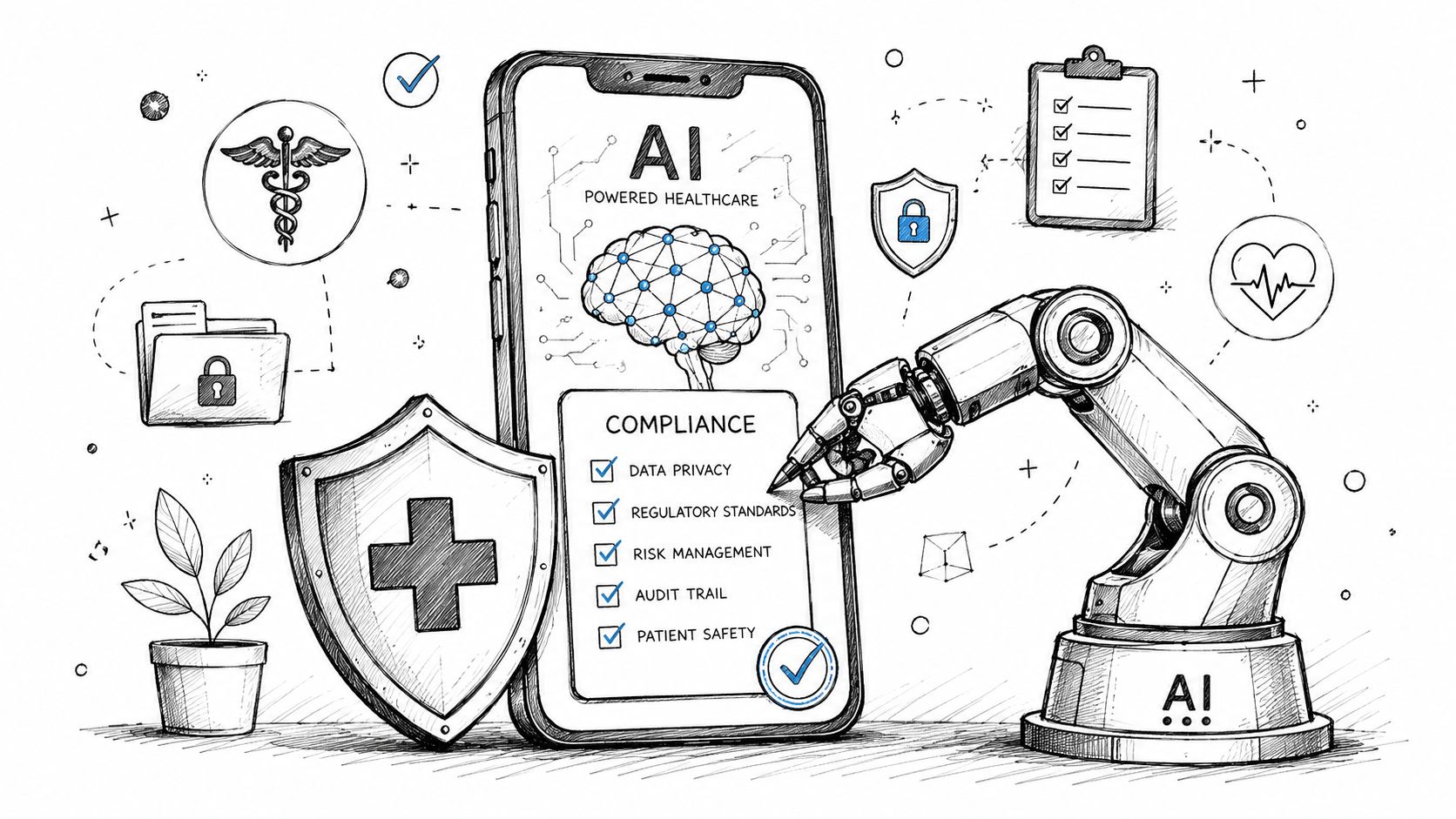
What an AI compliance layer should do
A useful admin layer for AI-enabled healthcare apps usually needs four capabilities.
First, prompt versioning. If a prompt changes the way a system summarizes, classifies, or responds, your team should know what changed and when. That's essential for auditability and debugging.
Second, parameter control for internal database access. Retrieval settings, filters, and data connectors can expose too much if they aren't governed centrally.
Third, unified logging across AI interactions. Teams need visibility into prompts, outputs, context patterns, and user actions tied to AI-assisted flows.
Fourth, cost tracking. AI usage often expands unnoticed. If nobody monitors cumulative spend, a helpful feature can turn into an expensive surprise.
One example in this category is the prompt management approach described by Wonderment Apps in its healthcare AI solutions content. Their administrative tool is designed for teams plugging AI into existing products and includes a prompt vault with versioning, a parameter manager for internal database access, a logging system across integrated AIs, and a cost manager for cumulative spend visibility.
Why this matters for long-term software health
These controls do more than reduce legal risk. They make AI features maintainable.
Without them, every prompt tweak becomes tribal knowledge. Every model integration becomes harder to review. Every incident turns into a scavenger hunt across disconnected logs and vendor dashboards.
With them, product leaders can ask better questions: Which prompts changed behavior? Which workflows touched sensitive data? Which models are costing more than expected? Which outputs need additional review?
If you're modernizing a legacy application, that kind of visibility is what turns AI from a clever demo into a manageable product capability.
Your Healthcare Compliance Action Checklist
Many teams don't need more awareness. They need a starting sequence.
Use this checklist to turn the idea of healthcare compliance into action.
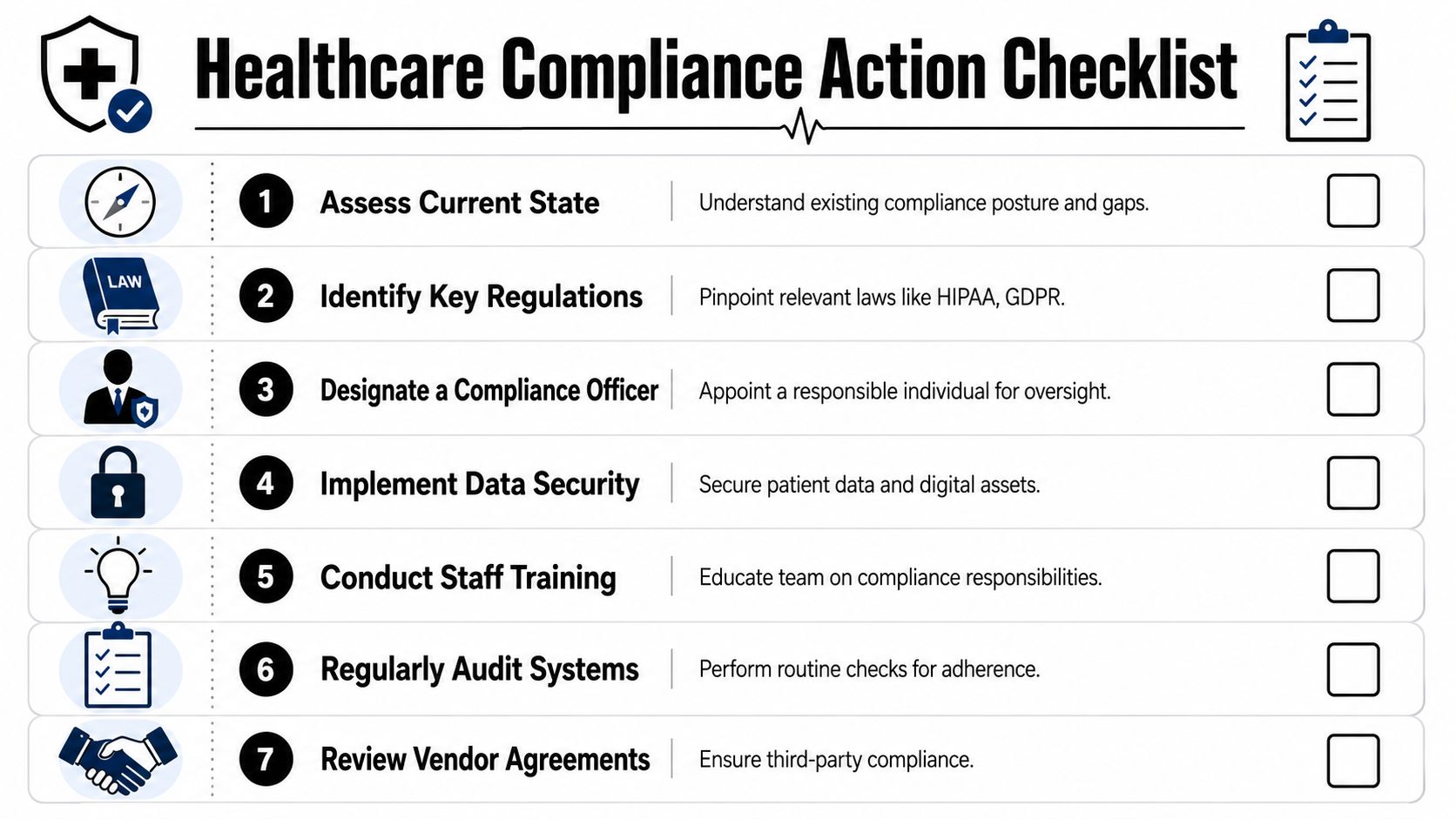
Seven steps to take now
- Assess your current state: document where your app stores, transmits, and exposes health-related data. Include web, mobile, admin tools, exports, and AI features.
- Identify applicable regulations: determine whether HIPAA is your main driver or whether other rules such as GDPR also apply to parts of your business.
- Designate a compliance owner: one person should coordinate engineering, product, legal, operations, and vendor review.
- Map user access: list every user type and confirm what each role should and shouldn't see.
- Implement technical safeguards: review authentication, authorization, transmission security, audit logging, and data integrity protections.
- Train teams by workflow: teach developers, support staff, operations teams, and managers using real tasks, not generic policy language.
- Review vendor agreements: if another company stores, processes, analyzes, or receives regulated data, examine the relationship carefully.
One final reality check
If you can't answer these questions quickly, your next step is obvious.
| Question | Why It Matters |
|---|---|
| Where does PHI enter our systems? | You can't govern what you haven't mapped |
| Which vendors touch that data? | Third parties extend your risk surface |
| Can we reconstruct user and AI actions? | Audits and incidents depend on evidence |
| Who owns the program internally? | Shared responsibility still needs clear accountability |
If you want a product-focused next step, this software-oriented HIPAA compliance checklist is a practical companion to internal planning.
If your team is modernizing a healthcare product, adding AI to an existing app, or trying to build a compliant platform without crushing usability, Wonderment Apps is worth a look. They work across web, mobile, AI modernization, and product delivery, and they can help teams connect compliance requirements to actual engineering decisions instead of leaving them trapped in policy documents.