

A launch can look healthy right up to the moment it breaks. The campaign lands, downloads spike, checkout volume climbs, and then support tickets start piling up. In ecommerce, that might mean carts freezing during payment. In fintech, it can mean failed transfers, duplicate entries, or user balances that suddenly look wrong.
Most leaders blame a bug. Mature teams look one layer deeper. The problem is usually the methodology in software testing behind the release. If testing is treated as a late QA checkpoint instead of a business system, defects slip through in exactly the places that hurt revenue, trust, and modernization efforts.
That matters even more when teams are adding AI to desktop and mobile applications. Once you introduce AI-driven flows, prompt orchestration, model switching, token costs, and logging requirements, quality gets harder to manage with spreadsheets and scattered scripts. Teams need stronger operating discipline, plus administrative infrastructure that can control prompts, parameters, logs, and spend across AI integrations. That's becoming part of the quality conversation now, not an afterthought.
Why Your Testing Methodology Defines Product Success
A product succeeds or fails long before release day. It happens in the habits a team builds around quality.
A familiar example. A fintech company ships a new transfer feature. Product signs off because the happy path works in staging. Engineering hits the date. Marketing drives adoption. Then production traffic exposes edge cases no one modeled properly. Retries duplicate actions. Timeout handling confuses users. Support spends the week apologizing while leadership asks why QA missed it.
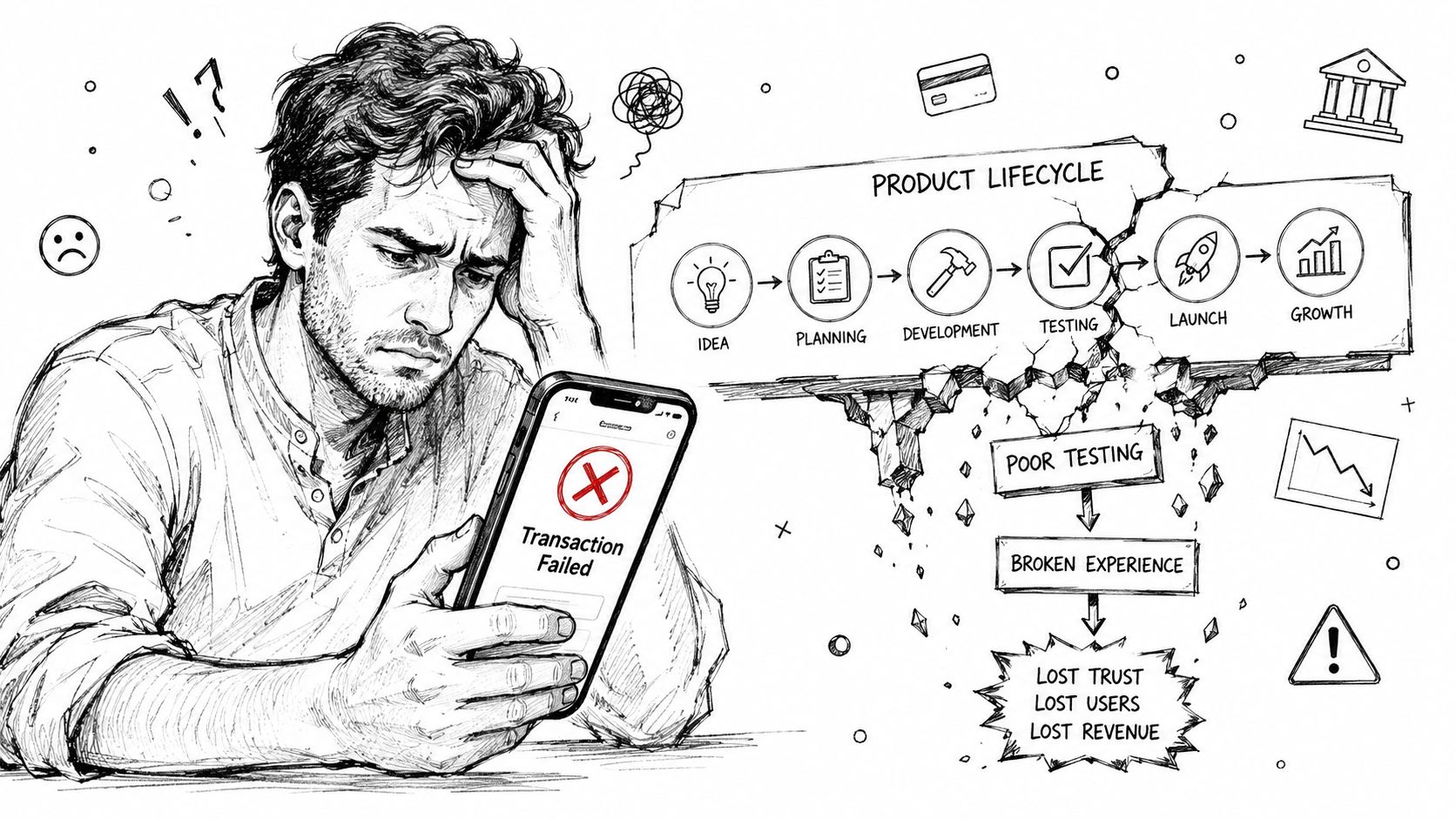
That failure usually isn't about one careless developer. It's about a weak system for deciding what gets tested, when it gets tested, who owns quality, and what risks deserve the deepest scrutiny. In other words, it's a methodology failure.
The business cost of loose testing habits
A poor testing approach creates predictable damage:
- Revenue damage: Checkout failures, billing mistakes, and broken subscriptions block transactions directly.
- Brand damage: Users forgive a missing feature faster than they forgive lost money or corrupted data.
- Scale damage: A brittle release process slows every future launch because teams start working defensively.
- Modernization damage: AI features, recommendation engines, and workflow automation become harder to trust when test coverage is inconsistent.
In fast-moving companies, leaders often push for speed and assume testing will “catch up.” It won't. Speed without method produces rework, emergency patches, and defensive roadmaps.
Practical rule: If a release changes customer money, customer identity, or customer trust, the testing approach is a board-level concern, not a QA detail.
Why CEOs should care
Testing methodology defines how confidently a company can ship. It shapes release cadence, incident frequency, team accountability, and how safely the business can adopt AI.
That last point matters. As teams modernize apps with AI, they need reliable controls around prompt behavior, model inputs, outputs, auditing, and cost visibility. If those controls aren't built into the quality system, the organization scales risk right alongside innovation.
The companies that modernize well don't just write better tests. They build a better operating model for quality.
What Is a Software Testing Methodology
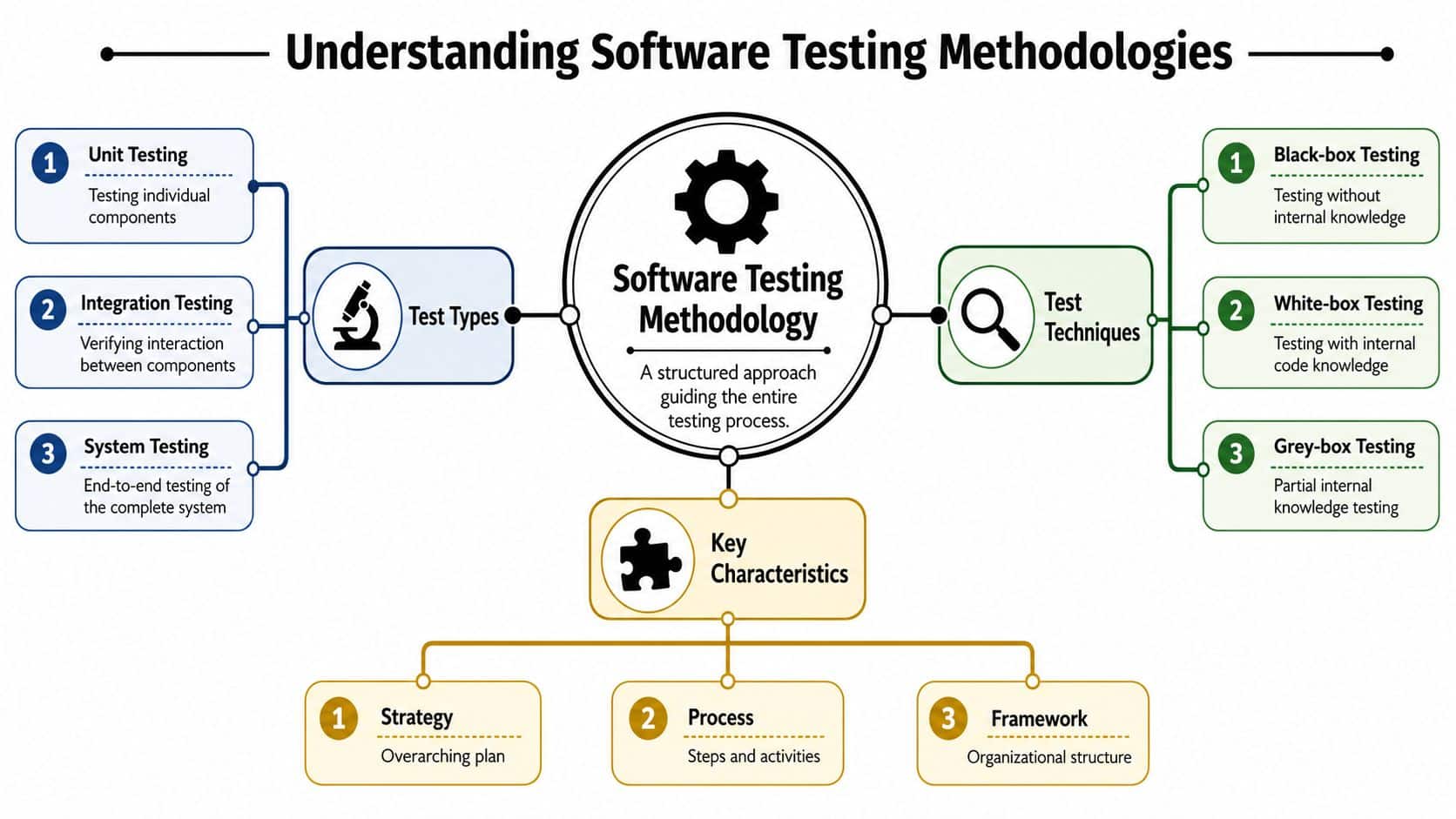
A software testing methodology is the operating system for quality. It's not a single test case, a test automation tool, or a checklist someone runs before release. It's the framework that tells a team how testing fits into delivery from requirements through production.
In construction, a pile of bricks, wiring, and lumber doesn't produce a safe building on its own. The blueprint, schedule, inspection sequence, and accountable roles do. Testing works the same way. Unit tests, integration tests, and exploratory sessions are the materials. The methodology is the plan that makes them useful.
What a methodology includes
A real methodology answers four practical questions.
- Who owns quality: Only QA, or developers, DevOps, product, and compliance too?
- When testing happens: At the end, during every sprint, or continuously in CI/CD?
- How risk is managed: Does every feature get equal effort, or do teams test according to business impact?
- What evidence counts: Bug counts alone, or traceability, release gates, incident trends, and production confidence?
Without those answers, teams default to chaos. One squad writes extensive automation. Another relies on manual smoke tests. A third ships based on intuition and deadline pressure. Leaders then wonder why product quality feels inconsistent across the same organization.
What a methodology is not
It helps to separate three terms that people often blur together.
| Term | What it means | Example |
|---|---|---|
| Methodology | The governing approach for testing work | Agile, V-Model, DevOps-oriented continuous testing |
| Test type | The level or purpose of a test | Unit, integration, system, acceptance |
| Technique | The way a test is designed or executed | Black-box, white-box, exploratory |
If someone says, “Our methodology is regression testing,” that's a warning sign. Regression testing is important, but it isn't a methodology. It's one activity inside a larger quality system.
A mature team doesn't ask only, “Did we test it?” It asks, “Did we use the right method for the risk, the product, and the business model?”
Why formal structure matters
A defined methodology creates predictability. New engineers know the release standards. Product managers know what evidence is needed for launch. Executives get a clearer line of sight into risk.
It also improves app experience design. That's often missed. Better methodology doesn't just catch defects. It supports scalability, usability, and modernization by ensuring teams validate workflows that matter to real users on web, desktop, and mobile.
When a company wants software that lasts for years, methodology matters more than any one tool in the stack.
Comparing Major Software Testing Methodologies
Different products need different discipline. A media platform optimizing release speed won't test like a fintech platform handling payments and identity. That's why leaders should stop asking for the “best” methodology and start asking for the best fit.
Agile testing is the most widely adopted software testing methodology globally, utilized by the majority of commercial software teams. This methodology has reshaped the definition of the testing team, expanding it beyond traditional QA groups to include DevOps engineers, developers, and product roles according to SHIFT ASIA's guide to software testing methodologies.
Side-by-side comparison
| Methodology | Core Principle | Best For | Key Challenge |
|---|---|---|---|
| Waterfall | Test after sequential development phases | Stable requirements, formal procurement environments | Defects surface late and changes are expensive |
| V-Model | Pair each development phase with a matching validation phase | Fintech, medical, government, compliance-heavy systems | Documentation burden can slow adaptation |
| Agile | Test continuously within short iterations | Ecommerce, SaaS, mobile products, evolving roadmaps | Teams can mistake activity for discipline |
| DevOps continuous testing | Embed testing in delivery pipelines and deployment flow | High-frequency releases, platform teams, cloud products | Requires strong automation and operational maturity |
| TDD | Write tests before writing code | Engineering cultures focused on code quality | Hard to sustain if teams don't protect the habit |
| BDD | Define behavior in shared business language before implementation | Cross-functional teams aligning product and engineering | Scenarios can become theater if they aren't tied to real risk |
Waterfall and V-Model
Waterfall's philosophy is simple. Finish one phase before starting the next.
That still works in some contexts. If requirements are fixed and governance is strict, a sequential model can create clarity. The problem is that it's unforgiving when assumptions change.
The V-Model adds stronger discipline by tying verification and validation to each development phase. For regulated sectors, that matters. A fintech leader dealing with auditability, payment integrity, and formal sign-off may prefer this structure because it supports traceability better than a loose sprint routine.
Agile and DevOps
Agile assumes learning will happen during delivery. Teams work in short cycles, gather feedback fast, and test throughout the sprint.
For digital commerce, content platforms, and fast-moving SaaS, that usually fits reality better than heavyweight phase gates. The catch is that some organizations say they're Agile when they've really created mini-Waterfalls inside two-week sprints. Testing still gets squeezed to the end. Bugs still pile up right before release.
DevOps pushes quality even further left and deeper into operations. Testing isn't a separate activity anymore. It becomes part of build, integration, release, and monitoring. That's especially useful when your app changes often and your infrastructure is part of the product experience.
If your leadership team still confuses Agile, Scrum, and Kanban, this breakdown of Agile vs Scrum vs Kanban helps clarify the delivery side of the equation.
Continuous testing only works when engineering, QA, and operations agree on what “safe to ship” actually means.
TDD and BDD
TDD is developer-centric. Write the test first, then write the code to satisfy it. Done well, it sharpens design and catches defects early at the code level.
BDD is communication-centric. Teams define expected behaviors in business-readable language, then automate around those scenarios. It's useful when product, engineering, and QA need shared clarity, especially in user-facing flows like onboarding, checkout, or subscription management.
Both are powerful. Neither fixes weak product decisions, poor risk analysis, or broken governance. That's the gotcha leaders need to remember.
Choosing the Right Methodology for Your Enterprise
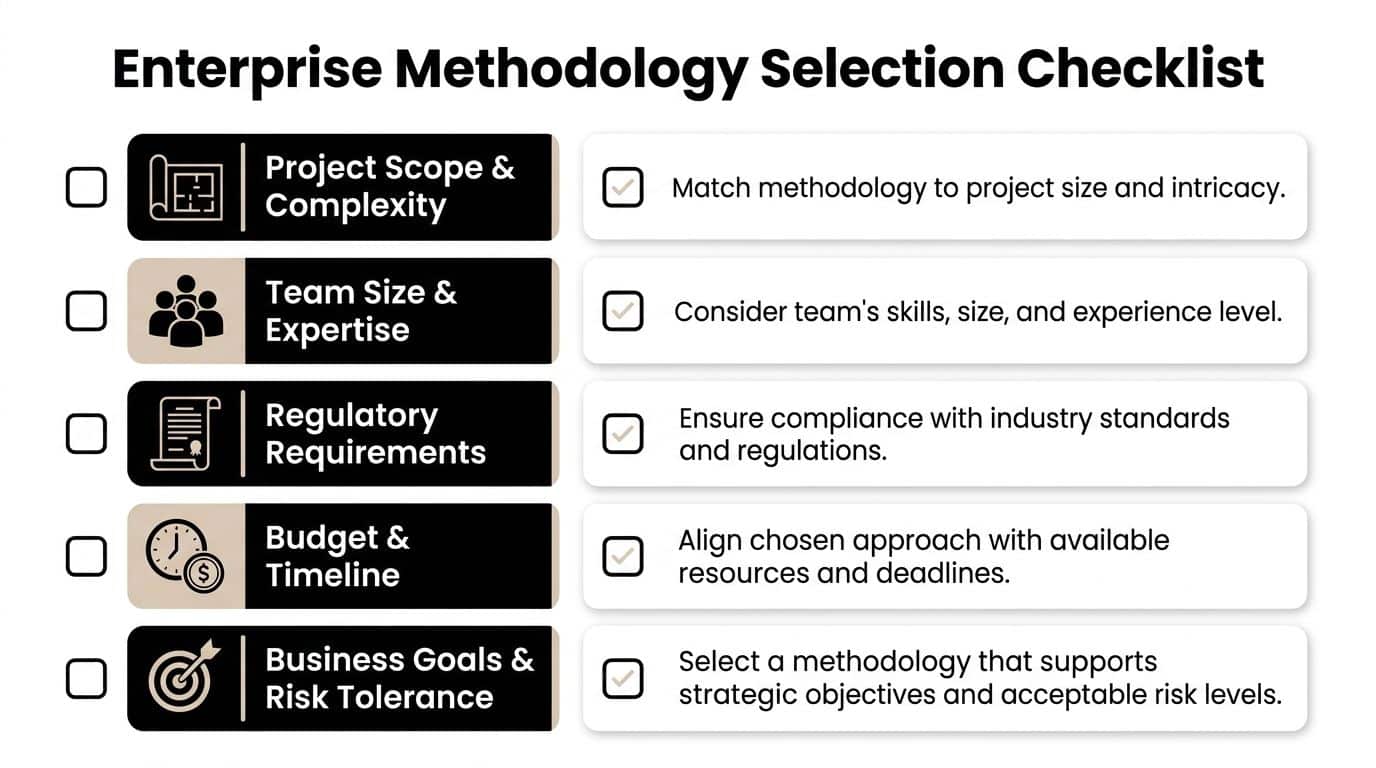
A one-size-fits-all methodology is a myth. Leaders who copy the most fashionable process usually inherit its weaknesses without gaining its advantages.
The right choice starts with business reality. A fintech platform processing sensitive transactions should optimize for traceability, control, and evidence. A media app chasing engagement and release velocity should optimize for fast feedback, selective automation, and resilient production monitoring. Both can be disciplined. They just shouldn't be identical.
Start with your risk profile
The fastest way to choose well is to map testing to consequence.
Ask these questions in the executive room, not just in engineering:
- What happens if this feature fails? Mild annoyance, lost sale, compliance issue, or financial harm?
- How stable are requirements? If they change weekly, rigid phase gates will become drag.
- What level of auditability is required? Some industries need a documented chain of evidence.
- Where does customer trust break first? Login, payment, identity, recommendations, reporting?
- What can the team realistically maintain? An elegant process no one follows is worse than a simpler one people respect.
Fintech and media don't need the same answer
A fintech organization often benefits from V-Model discipline around high-risk functions. Payment rails, KYC steps, statements, and ledger-related changes need explicit validation paths and cleaner sign-off.
A media business usually gains more from Agile plus DevOps-style continuous testing. Recommendation widgets, content feeds, ad placements, and subscription UX all change rapidly. The team needs room to learn from usage patterns without turning every release into a compliance ceremony.
That doesn't mean “regulated equals slow” and “consumer equals loose.” It means match rigor to risk.
Use risk-based depth, not blanket effort
Many teams struggle because they lack a framework for balancing time constraints with risk-focused testing depth. The Rapid Software Testing method explicitly focuses on product risk, doing deep testing where needed and shallow or no testing where risk is low, but this adaptive approach is often missing from mainstream methodology overviews, as discussed in Geeks Ltd's overview of software testing methodologies.
That idea is practical for enterprise leaders. Not every feature deserves the same testing depth.
- Test deepest where failure is expensive: payments, permissions, identity, health data, pricing rules
- Test broadly but lightly where change is frequent and reversible: content presentation, low-risk UI tweaks, non-critical workflows
- Escalate depth when uncertainty rises: new integrations, non-deterministic outputs, unfamiliar vendors, major refactors
If your team says everything is critical, they haven't prioritized risk. If they say nothing is critical, they haven't understood the business.
The strongest enterprise setup is usually hybrid. Use formal controls where the business needs proof, and use adaptive iterative methods where the business needs speed.
Supercharging Your Testing with Automation and AI
Methodology sets the rules. Automation and AI increase the range and speed of what those rules can accomplish.
That distinction matters because a lot of teams treat AI as a replacement strategy. It isn't. AI won't rescue a weak methodology in software testing. What it can do is make a strong methodology far more effective, especially when you're building custom applications that need to scale across desktop, mobile, and complex backend services.
Where AI actually helps
Start with test creation. AI-powered tools can turn user stories into draft scenarios, acceptance criteria, and regression candidates. That's useful in Agile and BDD environments where teams already work from behavior-focused requirements.
Generative AI also helps with edge cases, which is where many expensive failures hide. PractiTest notes that generative AI in software testing can identify edge cases and generate edge-case variations at scale by analyzing user stories and system logs, broadening test coverage by 30–50% and reducing the risk of missed defects in safety-critical applications in its write-up on the benefits of AI in software testing.
Methodology plus AI is stronger than AI alone
Here's where leaders should be specific.
- In Agile teams: AI can draft test cases from stories before sprint execution starts.
- In DevOps pipelines: self-healing automation can reduce brittle script maintenance when UI details shift.
- In BDD workflows: AI can expand behavior scenarios into richer permutations than humans usually have time to write.
- In enterprise integration testing: anomaly detection can flag strange service interactions that scripted assertions might miss.
AI is especially valuable when software behavior is too wide, too interconnected, or too dynamic for manual enumeration alone. That's common in ecommerce personalization, recommendation flows, fraud detection layers, support copilots, and AI-assisted internal tools.
A useful primer for leadership teams trying to separate product hype from engineering reality is this explanation of Nexus IT Group on AI engineering. It frames the discipline behind building and operating AI-enabled systems, which is exactly the mindset QA modernization needs.
What still needs human judgment
AI can generate options. Humans still need to judge risk.
Good QA leaders don't ask AI to decide quality. They use AI to widen coverage, accelerate feedback, and free skilled testers to examine the cases that actually threaten the business.
That's why manual testing still matters for usability, exploratory work, and ambiguous workflows. It's also why regression strategy still matters. If you're tightening release discipline, this guide to automating regression testing is a practical place to start.
The winning model isn't manual versus AI. It's a layered system where automation handles repetition, AI expands possibility, and experienced testers focus on consequence.
Implementing and Modernizing Your QA Process
Choosing a methodology is easy compared with operationalizing one. Many organizations stall at this stage. They rename ceremonies, buy a few tools, and assume quality has been modernized. It hasn't.
Modern QA needs process discipline, measurable outcomes, and governance that can handle both conventional software changes and AI-driven functionality.
A practical rollout sequence
Start small, but make it formal.
Assess current failure patterns
Look at escaped defects, recurring regressions, release delays, and areas where support sees avoidable pain. The goal isn't blame. It's visibility.Define ownership clearly
Decide what belongs to developers, what belongs to QA, what belongs to product, and what release managers can block. Shared ownership works only when individual accountability is still explicit.Set KPIs that reflect business risk
Defect escape rate and mean time to resolution are useful because they show whether the system catches issues early and recovers quickly. Pair those with release readiness standards your team implements.Build your test stack intentionally
Use automation where repeatability pays off. Keep manual effort where human judgment is the asset.
The market direction is clear. The automation testing market is projected to scale from $25.4 billion in 2024 to $29.29 billion in 2025, a CAGR of 15.3%, driven by the expanding adoption of Agile and DevOps practices that integrate testing throughout the development lifecycle, according to TestGrid's software testing statistics roundup.
Modernization gets harder when AI enters the stack
Traditional QA governance already has enough moving parts. AI adds a new layer of operational complexity.
Teams now need to manage prompt versions, model-specific parameters, internal data access rules, output logging, and cumulative spend across integrated AI services. If those controls live in chat threads and scattered files, testing quality degrades fast. You lose traceability. You lose repeatability. You lose cost visibility.
That's why AI modernization needs an administrative layer, not just a model endpoint. A strong setup includes a versioned prompt vault, a parameter manager for secure internal database access, centralized logging across integrated AI systems, and a cost manager so leaders can monitor cumulative spend before it turns into a surprise budget issue.
The team model matters too
The implementation challenge is organizational as much as technical. Enterprises often need a stronger QA leadership bench, especially when testing spans automation, release governance, and AI-enabled systems. For a sense of how the market now defines that role, this example of a fully remote QA Manager career shows the growing overlap between enterprise QA and AI operations.
If your current process still looks fragmented, a practical starting point is to document the flow end to end. This walkthrough of the QA testing process is useful for pressure-testing gaps in governance, execution, and release criteria.
Building a Culture of Quality That Lasts
Quality culture is what remains when deadlines get tight. If teams still protect testing discipline under pressure, the culture is real. If testing gets cut first, the methodology was never embedded.
The best organizations treat quality as shared product stewardship. Developers own code behavior. QA owns risk visibility. Product owns decision clarity. Leadership owns the standards that no one is allowed to trade away for a date.
That culture becomes even more important as companies modernize with AI. New capabilities are exciting, but they also introduce new failure modes, new governance needs, and new cost controls. Teams that last don't bolt AI on and hope. They design for scale, instrument for visibility, and test for consequence.
A strong methodology in software testing gives the business more than defect reduction. It creates safer releases, better app experiences, cleaner modernization paths, and more confidence when growth arrives.
If you're upgrading software quality while adding AI to web, mobile, or desktop products, Wonderment Apps can help you do both without creating operational chaos. Their team works with organizations that need scalable product engineering, UX-driven delivery, and AI modernization supported by practical controls, including a prompt management system with a versioned prompt vault, parameter management for internal data access, unified logging across integrated AI tools, and cost tracking for cumulative spend. If you want a clearer path to a quality-first engineering culture, it's worth booking a demo and seeing how that administrative layer supports long-term software reliability.