

A lot of online stores still behave like vending machines. Every visitor sees the same homepage, the same featured products, the same offers, and the same follow-up emails.
That worked when digital shelves were smaller and customer expectations were lower. It doesn't work as well when shoppers expect relevance, speed, and continuity across web, app, email, and support. If you're asking what is ecommerce personalization, the useful answer isn't “put their first name in an email.” It's “build a store that can respond to each customer more like a skilled sales associate would.”
The Difference Between a Store and Your Store
A generic store treats traffic as a crowd. A personalized store treats traffic as a series of individual sessions with context.
One shopper lands on a homepage and sees broad promotions for categories they don't care about. Another shopper arrives after browsing hiking boots last night and now sees trail gear, weatherproof layers, and a banner that matches that intent. Same catalog. Very different experience.
That's the practical meaning of ecommerce personalization. Your application changes what it shows, recommends, and emphasizes based on signals from the customer.
What personalization actually means
At a basic level, personalization uses customer data to tailor parts of the experience. That can include:
- Content choices like banners, hero images, or article modules
- Product discovery such as search results and recommendation carousels
- Messaging timing through email, SMS, or app notifications
- Journey decisions like what offer appears, when it appears, and to whom
The important shift is this. Personalization is no longer just a campaign idea owned by marketing. It has become a product, data, and engineering capability.
In 2023, nearly 7 in 10 businesses planned to increase personalization investment despite economic uncertainty, and over 50% were already integrating generative AI into applications to improve user experiences, according to Statista's personalization in e-commerce overview.
Why business leaders get tripped up
Many teams think personalization starts with content and ends with templates. In reality, it starts with system design.
Your store needs a decision-making layer. Something has to collect signals, interpret them, choose the next best experience, and deliver it fast enough that the customer feels the site is responsive rather than laggy or random.
Practical rule: If your team can describe the message but can't explain how the app decides who sees it, when, and why, you don't yet have a personalization system. You have creative assets waiting for a brain.
That's why the conversation has shifted from “should we personalize?” to software questions like identity resolution, event collection, model orchestration, and prompt governance for AI-assisted decisions. If you're looking for a plain-English outside perspective on personalization as a growth lever, this guide on unlocking ecommerce growth gives a useful complementary view.
A business leader doesn't need to become a machine learning engineer. But you do need to recognize that your “your store” experience depends on infrastructure, not just intent.
The Spectrum of Personalization Techniques
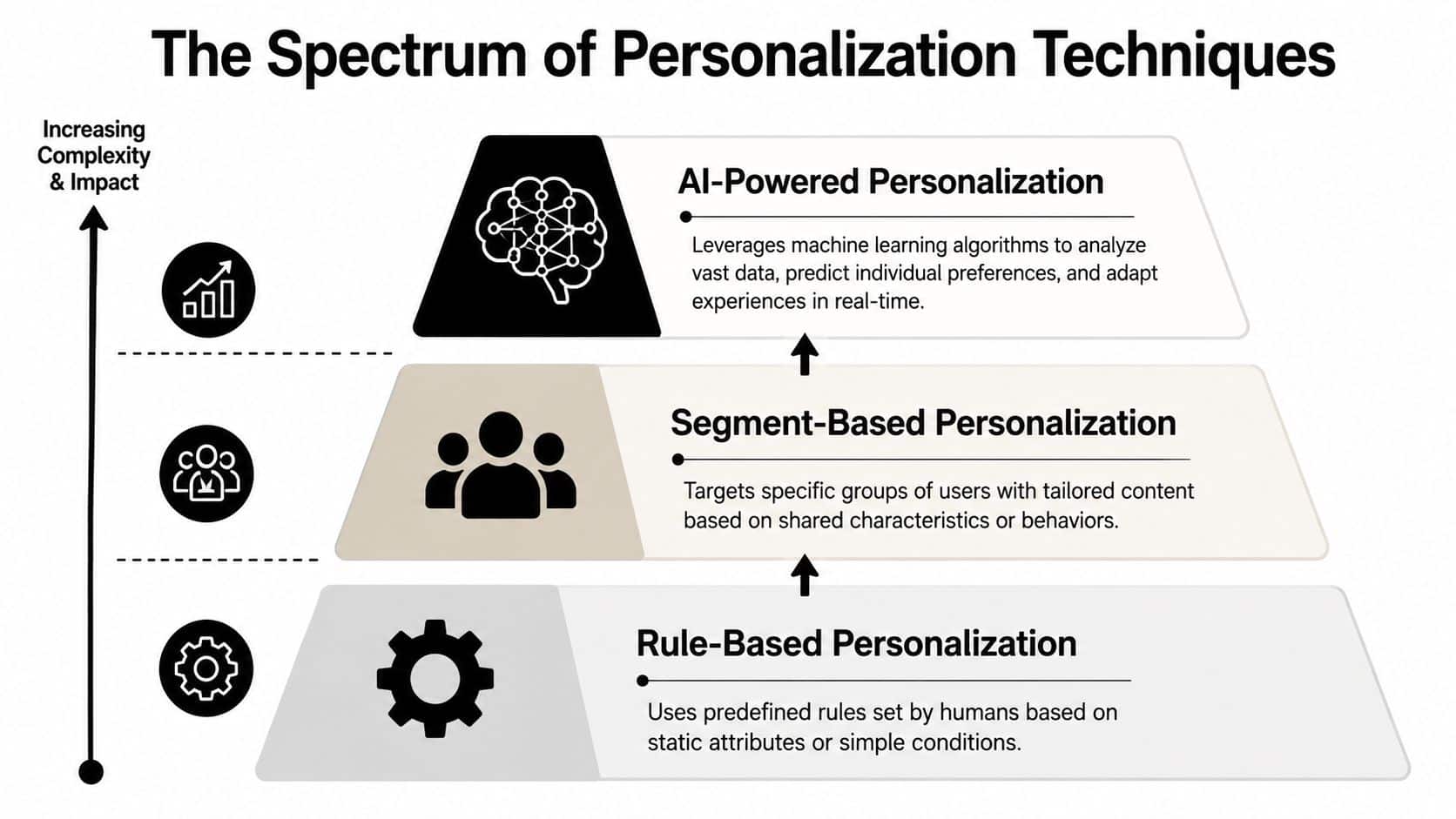
Not all personalization is equally smart. Some systems follow scripts. Some react to behavior. The most advanced ones predict intent.
A simple way to understand the spectrum is to think about a retail associate.
- A new associate follows a checklist.
- An experienced associate remembers patterns.
- A great associate anticipates what the customer is likely to need next.
That's roughly how personalization evolves in software.
Rule-based personalization
This is the oldest and easiest form to launch. A team writes explicit conditions and the app follows them.
Examples are straightforward:
- Geography rules where shoppers in colder regions see outerwear first
- Traffic source rules where paid social visitors land on a campaign-specific version of the homepage
- Device rules where mobile users see shorter layouts and simplified calls to action
Rule-based logic is useful because it's easy to understand and easy to QA. The downside is fragility. Rules multiply fast. They conflict. They age badly. And they don't adapt on their own.
Segment and behavior-based personalization
This layer uses observed actions rather than only fixed attributes. The app starts responding to what a person has done.
For instance:
| Technique | What it uses | Example |
|---|---|---|
| Viewed history | Pages and products seen | A customer revisits and sees recently viewed items first |
| Cart activity | Add-to-cart and abandonment signals | The store highlights accessories tied to items left in cart |
| Engagement patterns | Clicks and email interaction | Customers who respond to education get guides, not discounts |
At this point, many teams first feel real traction. The experience becomes more relevant because it reflects customer behavior, not just broad assumptions.
Still, behavior-based systems can remain reactive. They often answer “what happened?” better than “what should happen next?”
AI and machine learning-driven personalization
The system starts making predictions from many signals at once. Advanced personalization applies real-time machine learning to unified customer data, ingesting vectors like browsing behavior, purchase history, and product interactions to predict likely next actions. Deploying this architecture correlates with an 18 to 35% increase in conversion rates.
The leap isn't that AI makes the site feel futuristic. The leap is that AI can evaluate more signals than a human rule set can manage and do it fast enough to shape the session while it's happening.
A useful comparison:
- Rules say, “if from Canada, show winter coats.”
- Behavioral logic says, “this shopper keeps exploring cold-weather gear.”
- AI models say, “this shopper is likely comparing technical products, may value durability over price, and should probably see this collection, these filters, and this offer sequence next.”
Most mature systems blend all three. Rules still matter for compliance, promotions, and merchandising controls. Behavioral logic captures obvious intent. AI handles scale, pattern detection, and prediction.
The Business Benefits and How to Measure Them
Personalization isn't valuable because it feels modern. It's valuable when it improves business outcomes you already report on.
That means fewer abstract claims and more operational discipline. If a personalization effort can't be tied to metrics your leadership team cares about, it turns into an expensive design exercise.
Start with the four KPIs that matter most
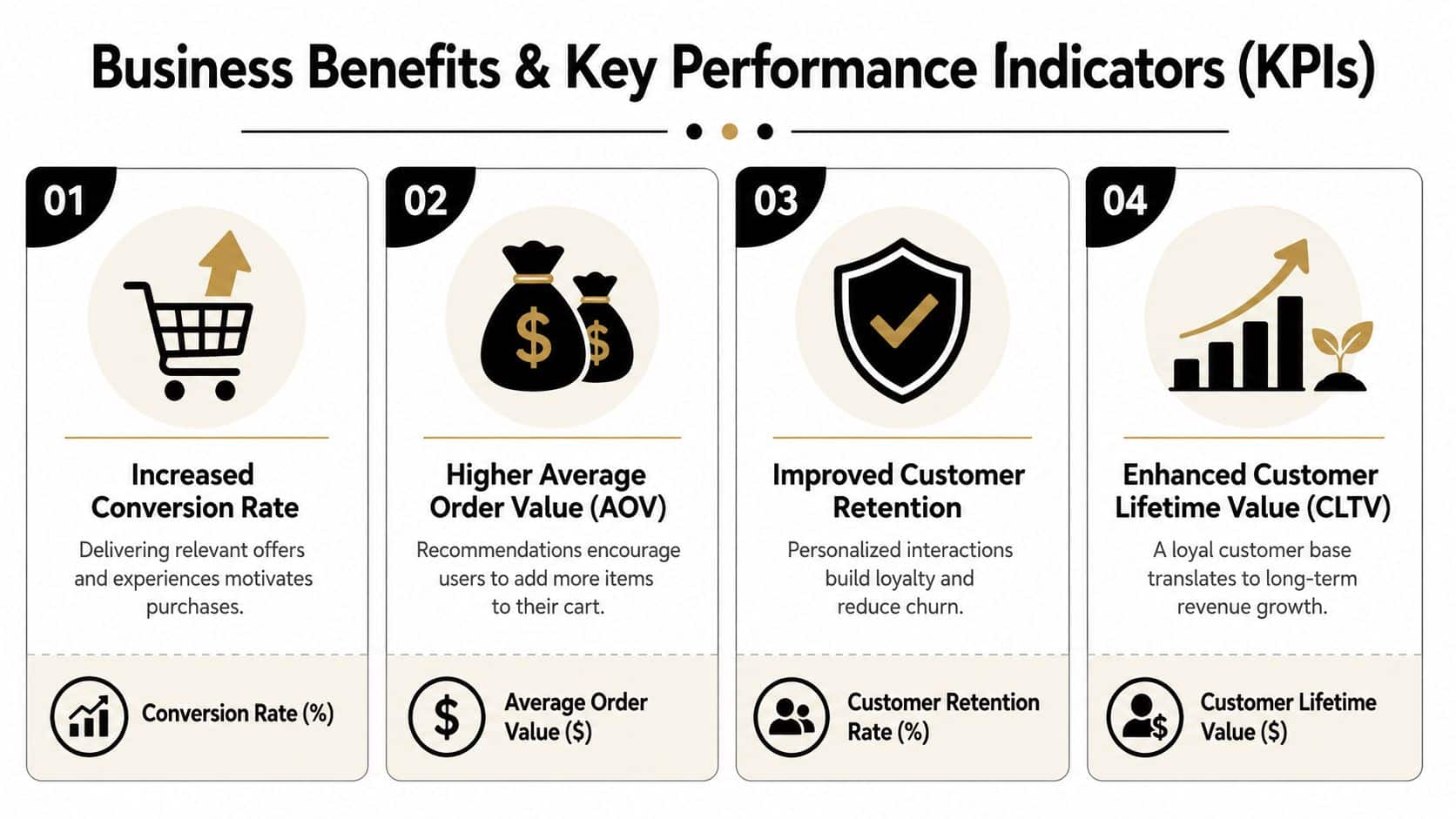
For most ecommerce teams, the scorecard looks like this:
- Conversion rate. Did more visitors buy?
- Average order value. Did customers add more or higher-value items?
- Retention and repeat purchase. Did buyers come back?
- Customer lifetime value. Did the relationship become more valuable over time?
The reason personalization helps is simple. It reduces friction in discovery and increases relevance at key decision points.
What the benchmarks show
The strongest benchmark data in the source set is hard to ignore. Instapage's personalization statistics roundup reports that personalized product recommendations can increase conversion rates by up to 320%, and 49% of consumers are likely to become repeat buyers after a personalized online shopping experience.
The same source also notes that personalized emails deliver 29% higher open rates and 41% higher click-through rates than non-personalized emails. That matters because personalization usually spans both onsite and offsite experiences.
If you're building the business case internally, these numbers help frame the discussion. Personalization affects acquisition efficiency, merchandising performance, and retention, not just homepage aesthetics. For a broader look at adjacent gains from AI-enabled commerce systems, Wonderment Apps also has a practical piece on the benefits of AI in ecommerce.
How to measure without fooling yourself
A common mistake is to launch three personalization features at once and then declare victory because revenue went up. That's not measurement. That's wishful thinking.
Use a tighter approach:
- Pick one surface such as homepage hero content, product recommendations, or abandoned-cart email logic.
- Define one primary KPI and one guardrail metric. For example, conversion rate plus bounce rate.
- Compare against a control so you know the uplift came from the new logic, not seasonality or traffic changes.
- Review by audience segment because personalization often helps some cohorts more than others.
Measurement test: If the team can't explain which variant won, for which audience, and on which KPI, the learning is incomplete even if revenue rose.
The business payoff is real, but only when teams treat personalization like an ongoing optimization program rather than a one-time feature launch.
Real World Personalization Examples in Action
The easiest way to understand personalization is to look beyond the standard “recommended for you” carousel.
Good personalization often feels invisible. The customer doesn't think, “this system is personalizing me.” They think, “this was easy.”
A media site that reorders the front page
A publisher doesn't need to change the articles themselves. It can change the order in which stories appear.
A reader who keeps clicking analysis pieces can see more long-form coverage near the top. Another reader who favors live updates can get short, timely pieces first. The homepage becomes an adaptive front door rather than a static billboard.
That changes the product experience without asking editorial teams to write separate versions of every story.
A travel app that shifts the trip you see
Travel is full of intent signals. Search dates, destination types, budget ranges, and travel party all hint at what matters.
A family traveler who repeatedly searches school-holiday windows and beach resorts shouldn't land on the same package grid shown to a solo traveler browsing adventure trips. A better app adjusts package order, featured imagery, filters, and reminder messages around that context.
A B2B SaaS product that personalizes onboarding
This one surprises people because it isn't retail, but the logic is the same.
A finance leader signing up for a SaaS platform doesn't need the same first-run checklist as a technical admin. One person needs reporting and controls. The other needs integrations and permissions. If the product adapts onboarding by role, company size, or selected goal, activation gets easier.
An online store with a homepage that changes by intent
This is the ecommerce version most leaders recognize, but it's broader than recommendations.
A first-time visitor might see trust-building content, category education, and broad bestsellers. A returning customer who has been comparing premium items might see deeper product detail, comparison tools, and accessories. A loyal buyer might see replenishment reminders or products that complement previous purchases.
If your current site treats all three of those customers the same, you're leaving relevance on the table. Many of the practical tactics that lift performance live in this gap, and this overview of how to increase ecommerce conversion rates is useful because it connects experience design decisions to measurable buying behavior.
The wider point is that personalization isn't one widget. It's a pattern. Any screen that can change based on user context can become more helpful.
The Modern Tech Stack for AI Powered Personalization
Personalization sounds simple from the outside. Show better products. Send smarter messages. Reorder content.
Under the hood, it's closer to a nervous system. Signals arrive constantly. Some layer has to process them, interpret them, decide what matters, and send instructions back to the experience in time to influence behavior.
The five layers that do the work
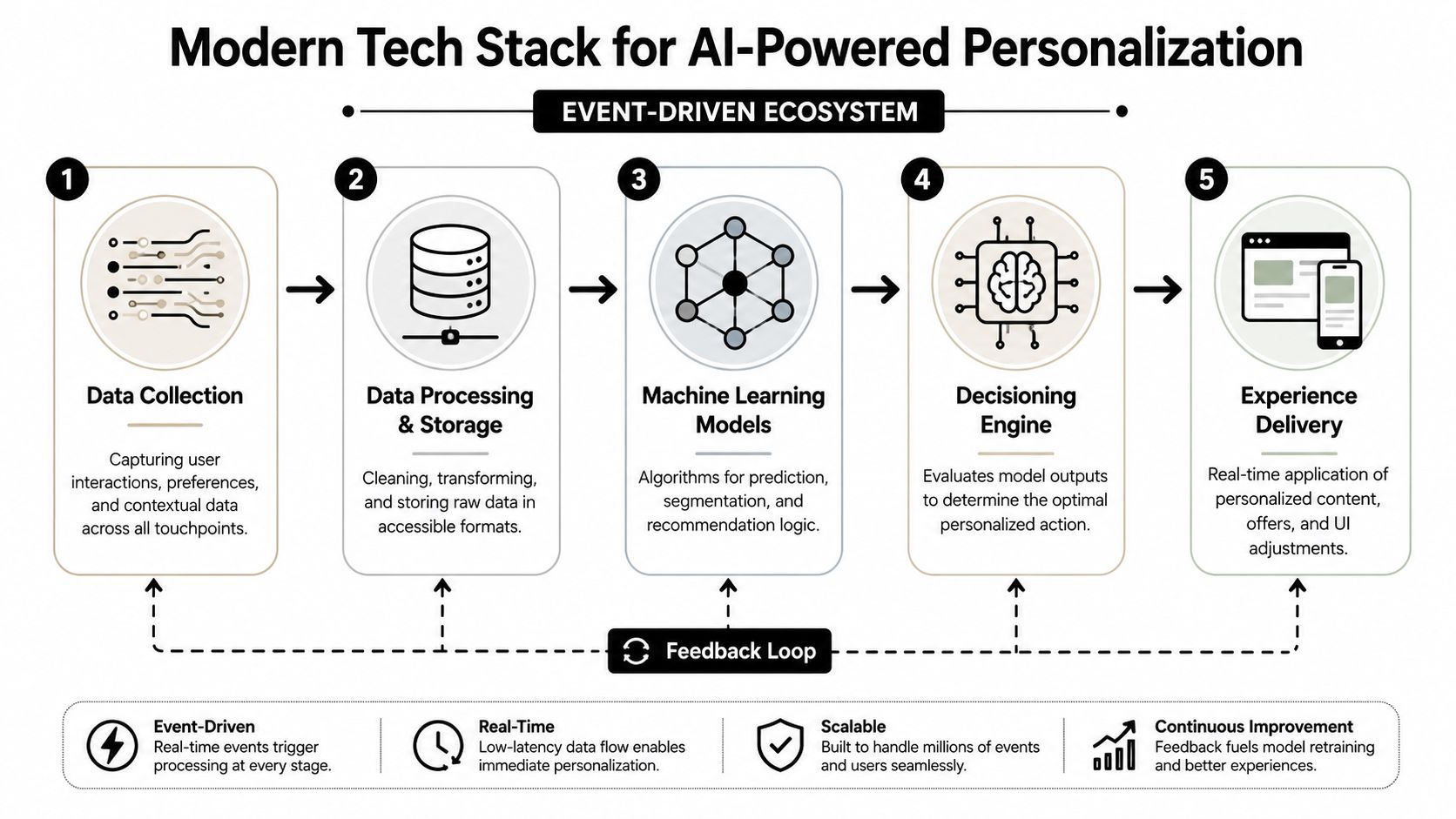
A modern stack usually includes these parts:
Data collection
Your web app, mobile app, email platform, and commerce backend emit events. Page views, searches, clicks, cart adds, purchases, and message engagement all become signals.Data processing and storage
Raw events need cleaning, formatting, and joining. At this stage, separate identifiers start getting connected into a usable customer profile.Machine learning models
Models score likelihoods. Which product is most relevant? Which user is likely to buy? Which message should wait?Decisioning engine
This is the operational brain. It takes model outputs, business rules, inventory constraints, and channel context, then picks the action.Experience delivery
APIs or front-end components apply the result in real time. That might mean swapping a homepage banner, changing recommendation order, or triggering a message.
Why this is an engineering function
A modern personalization engine functions as a distributed event-driven ecosystem. When that architecture is paired with large-scale A/B testing, it yields a measurable 15 to 20% improvement in revenue per visitor by enabling real-time content and offer adjustments.
That's why personalization projects often stall when they're treated as add-ons to the CMS or ESP. Those tools matter, but they don't replace the need for joined data flows and real-time decisioning.
A concise way to think about it is this:
| Layer | Business question | Technical job |
|---|---|---|
| Events | What is the customer doing right now? | Capture behavior across channels |
| Profiles | What do we know about this customer? | Unify attributes and history |
| Models | What is likely to happen next? | Predict intent and relevance |
| Decisioning | What should we show or send? | Apply logic and choose action |
| Delivery | How does the customer experience it? | Render content in app, site, or message |
The customer only sees the final screen. Your team has to manage everything upstream that made that screen possible.
If you're evaluating how AI fits into a broader digital growth strategy, this resource to explore AI marketing with Netco Design adds useful context from a smaller-business angle.
For ecommerce teams specifically, it's also worth reviewing what qualifies as real ecommerce personalization software versus a lighter plugin that handles only one touchpoint. The distinction matters. A true platform helps coordinate decisions across systems. A narrow tool may only personalize one surface and leave the rest of the journey disconnected.
Your Implementation Roadmap to Personalization
Most personalization programs fail for boring reasons, not exciting ones. The strategy sounds good, but the customer data is fragmented, the decision logic lives in five tools, and nobody knows which system has final say.
That's why implementation should be phased. The architecture has to grow in a controlled way.
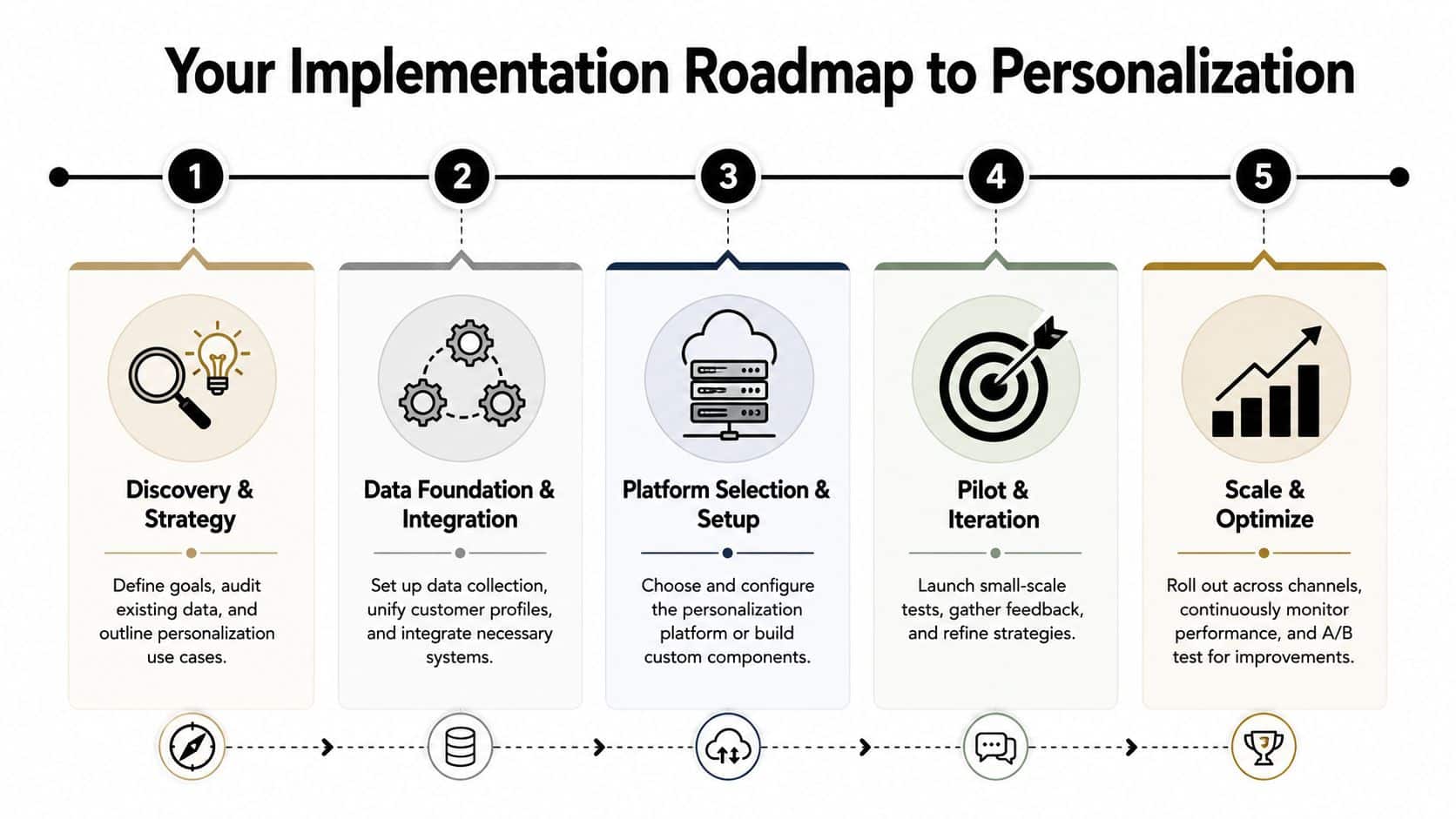
Phase one through three
Dotdigital's guide to ecommerce personalization frames the foundations clearly. Effective personalization depends on joined-up data, real-time content, and decision logic, and the harder question now is what architecture supports that at scale across channels.
Use that as the backbone of your roadmap.
Discovery and strategy
Start with business questions, not tooling.
- Choose one or two use cases that matter to revenue or retention
- Audit your current signals across site, app, email, CRM, and commerce systems
- Clarify ownership so product, marketing, engineering, and analytics don't work in parallel silos
A weak start here creates months of cleanup later.
Data foundation and integration
This phase is less glamorous and more important.
You need a usable customer profile, event tracking you trust, and a plan for identity across channels. Personalization gets messy when a shopper is “guest user” on web, one ID in email, and someone else in the loyalty system.
Clean data beats clever models. If the profile is wrong or late, the experience will also be wrong or late.
Platform selection and setup
At this point, decide what you can buy, what you should build, and where orchestration should live. Some teams use a customer data platform, a recommendation engine, and a messaging system. Others build custom services around a data warehouse and application APIs.
This is also where AI governance becomes practical, not theoretical. If you're using prompts, retrieval layers, or model-based decisioning, you need administration around them. Wonderment Apps offers one example of that kind of operational layer through a prompt management system that includes a versioned prompt vault, a parameter manager for internal database access, unified logging across integrated AI systems, and cost tracking for cumulative AI spend. That kind of tooling helps teams manage changes without hiding decision logic inside scattered prompts and ad hoc scripts.
Phase four and five
Pilot and iteration
Don't launch everywhere at once. Pick one journey where intent is strong and measurement is clean.
Good pilot candidates include:
- Homepage personalization for returning visitors
- Recommendation modules on product detail pages
- Behavior-triggered messaging after product views or cart activity
Then test, review, and tighten the rules or model behavior.
Scale and optimization
Scale only after you've learned where personalization helps and where it doesn't.
Some experiences improve with more automation. Others need stronger merchandising controls or clearer consent boundaries. Personalization can backfire when it feels invasive, repetitive, or entirely off-base.
A durable operating model usually includes:
| Capability | Why it matters |
|---|---|
| Governance | Keeps AI and rules aligned with brand, privacy, and compliance needs |
| Experimentation | Prevents teams from treating guesses as results |
| Cross-channel logic | Stops web, email, app, and support from acting like separate companies |
| Feedback loops | Helps the system improve as customer behavior changes |
The winning roadmap isn't the one with the most features. It's the one your team can explain, measure, and maintain.
Conclusion The Future Is Autonomous
The answer to what is ecommerce personalization starts simple and ends technical.
It starts with relevance. Show people what fits them better. Remove friction. Make the store feel less generic. But once you move past that surface definition, personalization becomes an architecture problem. You need data that connects, systems that decide, and delivery layers that can react in real time.
The next shift is toward more autonomous decisioning. Recent industry coverage describes personalization becoming more predictive and more agentic, which means software will increasingly test, adjust, and orchestrate experiences with less manual intervention. That raises the bar for governance as much as it raises the ceiling for performance.
Business leaders don't need every team to become AI researchers. They do need a platform strategy that can support intelligent behavior safely, measurably, and at scale.
If you're modernizing a commerce platform or trying to connect AI to real product outcomes, Wonderment Apps can help you evaluate the architecture, delivery model, and operational tooling needed to build personalization that lasts beyond a single campaign.