

87% of software proof-of-concept initiatives never reach production (Appinventiv). That number changes how proof of concept development should be run. A PoC isn't a mini-product and it isn't a polished demo, it's a pre-development feasibility gate that helps teams decide whether an idea deserves real engineering time, real budget, and real organizational attention.
That framing matters most in AI-heavy software work, where teams can burn weeks building something impressive that still can't survive production constraints. A better PoC is narrow, testable, and honest about risk. It's also the right moment to evaluate whether an existing app can be modernized for AI without ripping out the whole stack, which is exactly where a prompt management system becomes useful as part of the operational toolbox.
Why Most Proof of Concept Development Efforts Stall
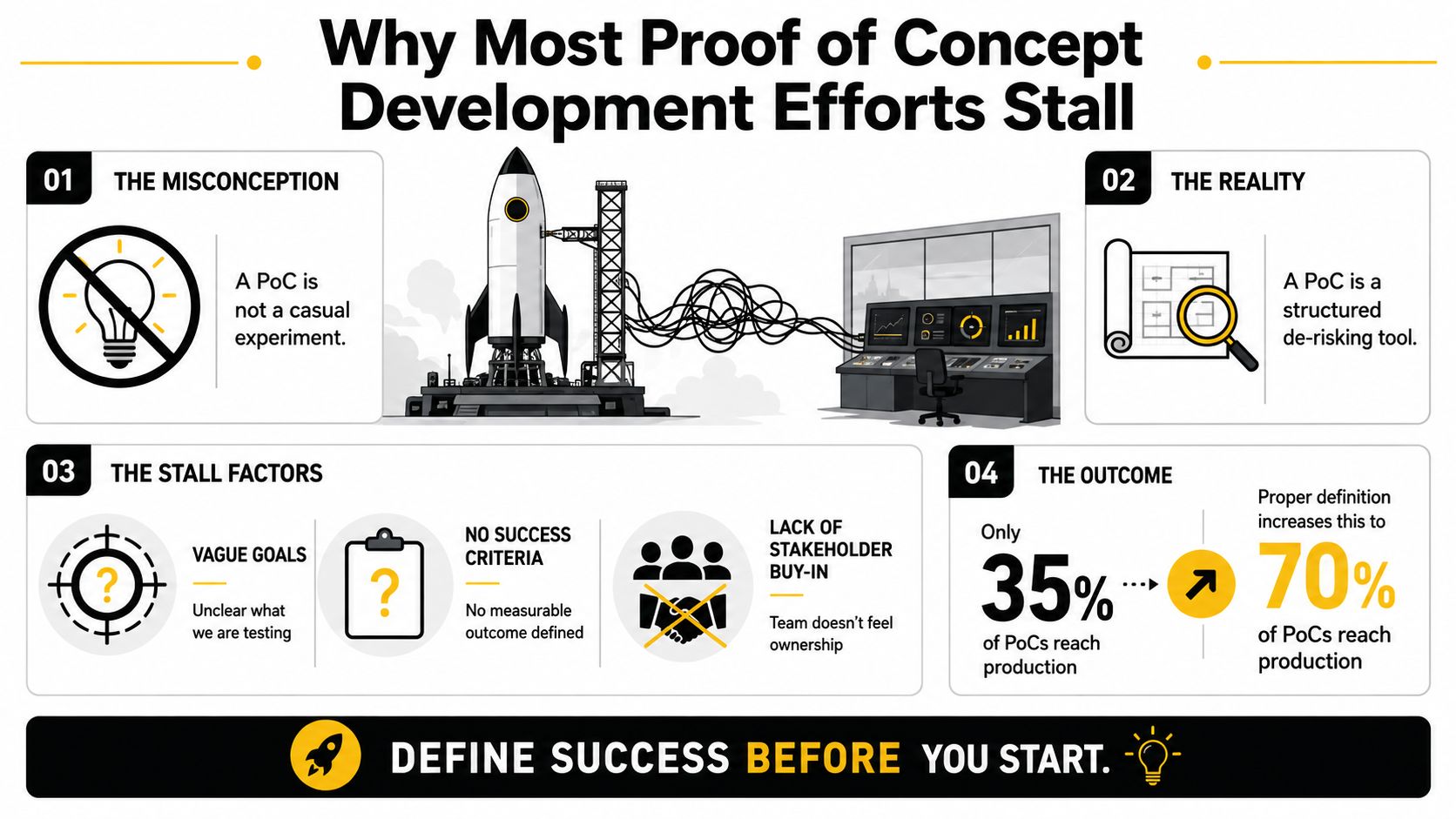
A PoC stalls when the team treats it like a safer version of production instead of a decision artifact. That mistake is expensive because the work expands, confidence rises, and the evidence stays thin. Industry writeups from Appinventiv still point to a pattern where many PoCs fail to move forward, and enterprise PoCs can consume serious time and budget once integrations, compliance checks, and stakeholder reviews enter the mix.
The root problem is usually conceptual confusion. A PoC proves feasibility, a prototype shows how something might work in practice, and an MVP is the smallest usable product. The line matters because teams start adding interface polish, edge-case handling, and extra features long before they have answered the only question that matters, can this work under real constraints?
Practical rule: if the team cannot clearly say what would make the PoC fail, the scope is already too loose.
That is why I treat proof of concept development as a bounded investment. The work should reduce uncertainty before larger capital is committed, not absorb it. Atlassian's PoC workflow, defining the idea, setting benchmarks, identifying resources, setting a timeline, testing a prototype, and refining it, works because it forces that discipline early (Atlassian).
For mobile teams, the distinction between a PoC and a prototype gets especially slippery. A useful reference is this guide on PoC or prototype for mobile apps, which separates feasibility testing from presentation-ready work. That separation keeps product leaders from approving a demo when they really need evidence.
A credible PoC earns approval by showing that a technical risk can be contained. A weak one asks stakeholders to trust enthusiasm. In AI modernization projects, that difference is sharper because integrations, data quality, and operational controls can all look fine in a sandbox and fail fast once they meet production reality. Wonderment Apps' prompt management system fits naturally into that gap because it helps teams treat AI integration as something governed, logged, and costed rather than improvised.
Defining Your Hypothesis and Success Criteria
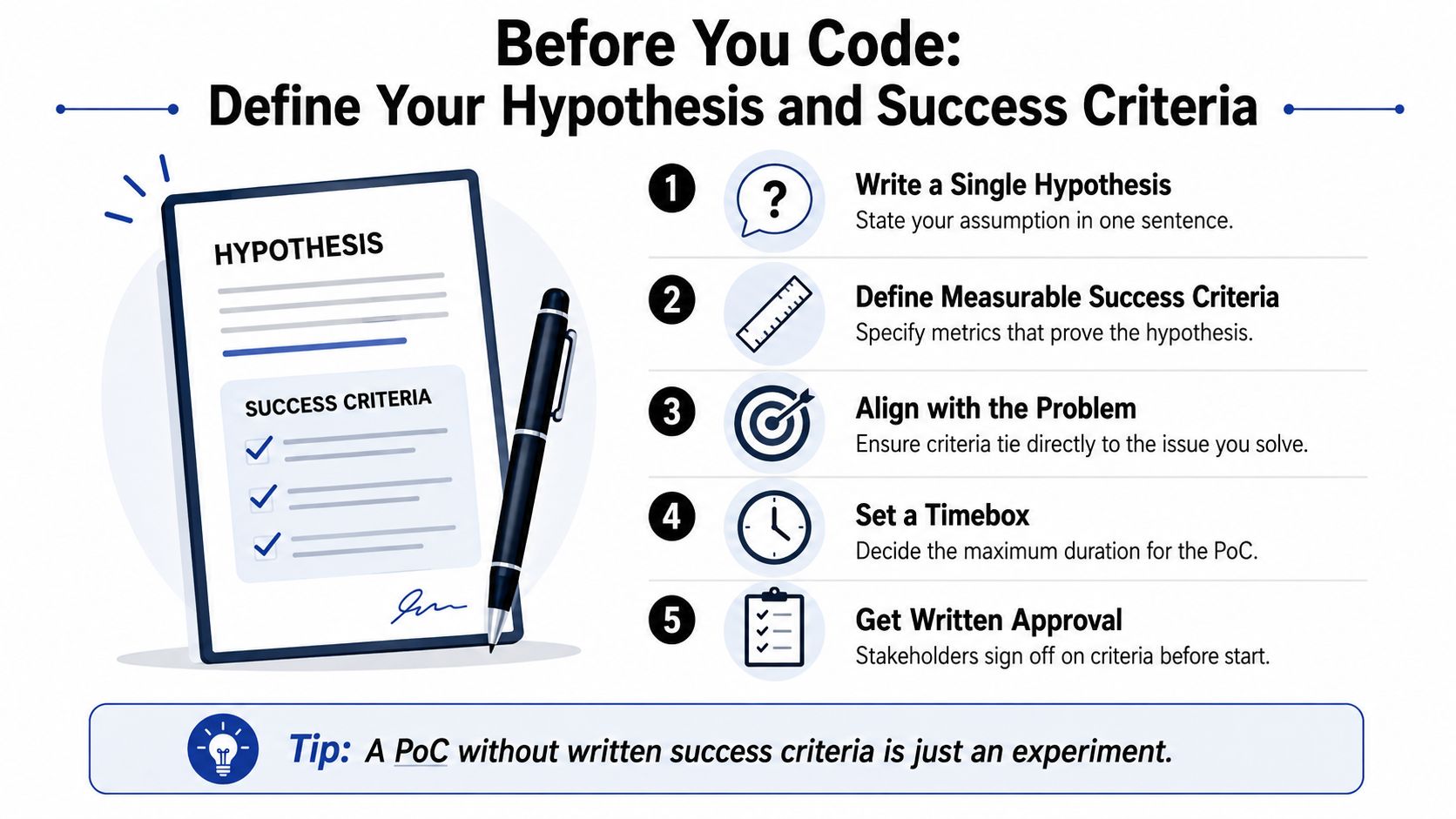
A PoC starts with a written hypothesis and a clear pass or fail line. Without that, the team can keep building while the actual question stays unanswered, and that is how proofs of concept drift into small products with no decision attached. The PoC should isolate the riskiest assumption and test it directly. If the uncertainty is model accuracy, say that. If it is integration reliability, say that. If it is response time under load, say that too.
Write the hypothesis before the code
The strongest PoCs use a sentence that can be proven wrong. A team might test whether a third-party recommendation API can return usable results within an acceptable performance envelope, or whether an AI assistant can reach a defined accuracy target on real data. That framing matters because it turns the work into a decision, not a discussion.
Measurable success criteria come next. Asana's guidance is clear, the PoC needs performance thresholds, cost targets, or user satisfaction scores, along with a defined scope for what is included and excluded (Asana). If the team says “it feels fast enough,” that is not a metric. It is a guess with a UI attached.
A practical way to write the criteria is to separate the test into three parts:
- The assumption: what has to be true for the idea to work.
- The threshold: what counts as passing.
- The exclusion list: what stays out of scope so the experiment does not turn into a product build.
A PoC without written success criteria is just a noisy experiment.
That exclusion list matters more than people expect. Industry guidance recommends leaving out UI polish and secondary features so the test stays focused on feasibility (AppMaisters). Teams get tripped up here because a polished interface can hide a broken flow, and a broken flow can waste weeks if nobody named the failure condition up front.
When product, design, and engineering need a shared frame of reference, the distinction between early artifacts should stay visible. A practical comparison is the difference between proof of concept and prototype, because the two serve different decisions. The PoC answers whether the idea can work. The prototype shows how it might feel or behave.
A useful way to pressure-test the hypothesis is to tie it to the next business decision. If the result will inform a launch, a rebuild, or a small investment, write that into the criterion so nobody reinterprets the outcome later. For teams that also need a broader product framing, the 925 studios startup MVP guide is a helpful companion, since it keeps the discussion anchored on what to validate before scope expands.
Scoping Timelines Budgets and Team Roles
A PoC works best when the budget and calendar are treated as a gate, not a wish list. If the team cannot explain what it expects to learn, what it is willing to spend to learn it, and who is accountable for the decision, the work usually drifts into a slow prototype that never earns a production review.
The cost and duration should be sized to the risk, not the optimism of the roadmap. As a reference point, cost of software development discussions often separate low-risk validation from higher-complexity builds by showing how integrations, compliance, and legacy dependencies push effort upward. The point is not to find the cheapest path, it is to set a budget that matches the uncertainty being removed.
Match scope to the riskiest constraint
The team size should follow the risk being tested. A lightweight validation may only need a product lead and a small engineering group. Regulated work, integrations, or AI experiments that touch production data usually need design, QA, and a project manager in the room so no one assumes another function is covering the gap. Too many people add meeting overhead. Too few people hide risk until the PoC is already too far along.
Scope also has to fit the environment. It should mirror production constraints closely enough to surface failures, but not so closely that the PoC turns into a release candidate by accident. If the target system depends on authentication, rate limits, or old services, the PoC needs to feel those limits early. That is how teams expose sharp edges before launch day instead of discovering them after the first serious handoff.
| Project Type | Typical Duration | Estimated Cost Range | Key Complexity Drivers |
|---|---|---|---|
| Simple validation | 3 to 4 weeks | Qualitatively lower than enterprise PoCs | Narrow scope, few integrations, limited compliance |
| Standard integration PoC | 3 to 8 weeks | Mid-range | API connectivity, data mapping, workflow fit |
| AI or legacy-system PoC | 8 to 12 weeks | Higher end of enterprise PoC work | Model behavior, old systems, security, compliance |
| Regulated enterprise PoC | 3 to 12 weeks | Often at the upper end | HIPAA, PCI DSS, KYC/AML readiness, audit needs |
Budgeting should also include the people needed to push the work through product review and technical review. That usually means someone who can make scope calls quickly, someone who can build, and someone who can judge whether the result is good enough to proceed. If your team also needs outside delivery support, you can build and scale with TekRecruiter without turning the PoC into a staffing exercise. The practical rule is simple. Choose the team for the technical risk under test, not for the size of the product you hope to ship.
Running Targeted Tests Against Real Constraints
A PoC gets misleading fast when it only sees sanitized data and relaxed assumptions. That can produce a clean demo, but it does not tell you how the system behaves under real API limits, real traffic, or the friction of production-like environments. The safer pattern is to test the riskiest behavior under the constraints that are most likely to break it.
Test the thing that can break you
In ecommerce, that usually means performance and integration stability. In fintech, it often means security and auditability. In healthcare, the pressure is usually compliance and data handling. The test plan should follow the operating reality of the domain, not the pitch deck.
For performance, push enough load through the environment to see where latency starts to climb and where the system fails. For resilience, run failure-mode tests that force auto-scaling and redundancy to do real work. For security, use penetration testing and keep mock audits ready for standards like HIPAA, PCI DSS, or KYC/AML. GeekyAnts recommends production-like environments, stress testing, chaos testing, penetration testing, and mock audits as part of PoC validation (GeekyAnts).
Real constraints do not hide weak architecture, they expose it early.
A fintech team validating an AI-assisted support workflow will see the difference immediately. If the team only tests canned inputs, the assistant may appear accurate and safe. Once real customer edge cases, identity checks, and logging requirements enter the flow, the gaps become obvious. The PoC should surface those gaps before anyone starts talking about rollout.
QA structure matters here, especially when the team needs a test matrix that ties each scenario to a clear pass or fail outcome. A useful reference point is quality assurance tips for test case planning processes, which maps well to PoC planning because the goal is a documented go/no-go decision against predefined criteria. If the experiment is meant to support a real release decision, that structure has to be visible to product, engineering, and whoever signs off on the risk.
For teams evaluating AI integration in a custom app, a prompt vault, parameter controls, centralized logging, and cost visibility help keep the test honest. They show what the model saw, what it returned, and what the experiment cost to run. That is the kind of evidence leaders can use when they decide whether the concept deserves more investment, and it is also the point where outside delivery support can help a team build and scale with TekRecruiter without turning the PoC into a staffing exercise.
The right outcome is a decision with a paper trail.
Common PoC Mistakes That Kill Momentum
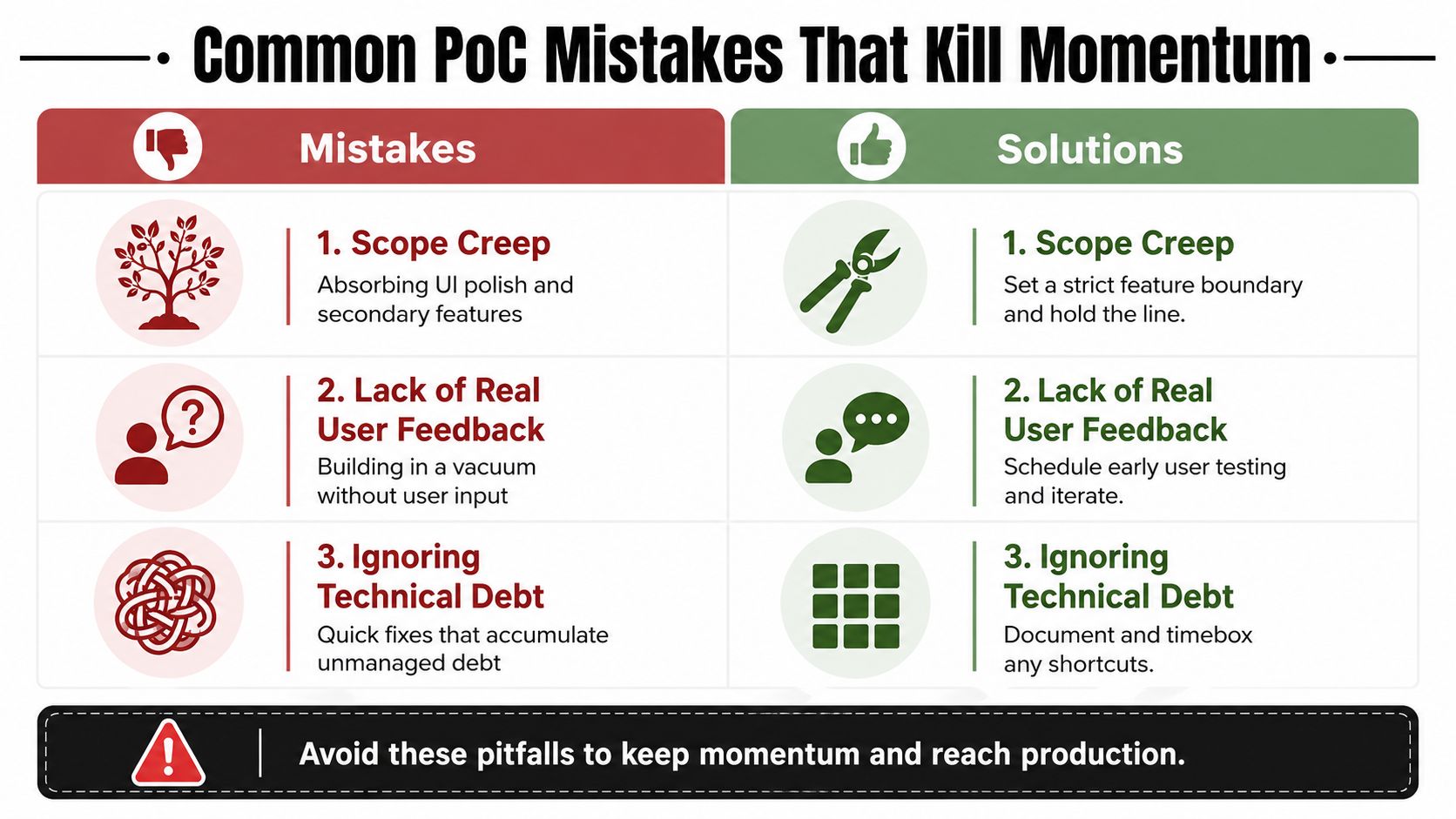
Scope creep kills more PoCs than bad ideas do. A focused experiment starts absorbing UI polish, secondary features, and one more integration “just to be safe,” and suddenly the team has built a fragile half-product that still hasn't proven the core assumption. The fix is simple in theory and hard in practice, write down what's included and make a visible list of what isn't.
The mistakes that create false confidence
The second mistake is testing in a vacuum. Teams build against mocked responses, cleaned-up samples, or friendly internal users, then get surprised when real data, real latency, and real operational rules show up. That's not a PoC failure, that's a testing mistake.
The third mistake is treating the PoC like a throwaway artifact. If nobody documents what happened, stakeholders end up judging the concept by a live demo and memory. That's a weak basis for investment, especially when the PoC uncovered important trade-offs that never made it into the presentation.
A useful prevention pattern looks like this:
- Set a feature boundary early: exclude anything that doesn't prove feasibility.
- Test with real users or realistic users: don't wait for final validation to hear feedback.
- Record the trade-offs: short-term shortcuts should be documented and timeboxed, not hidden.
- Keep architecture honest: if the PoC can't inform production choices, it's too detached from reality.
The best teams also preserve evidence in a way decision-makers can scan quickly. That can be a short findings memo, annotated test results, or a stakeholder readout with clear pass/fail language. Formlabs describes the PoC as a stakeholder-facing step that should end with feedback, timeline, cost, success criteria, required resources, and an execution plan, which is exactly the kind of package leaders can review without guessing (Formlabs).
This is also where teams modernizing an older application for AI should think carefully about control surfaces. A prompt management layer can reduce chaos by keeping versions, parameters, logs, and cost data visible while the PoC is still small. That's a lot easier than trying to reconstruct why the system behaved a certain way after the experiment has already moved on.
Packaging Results and Transitioning to Production
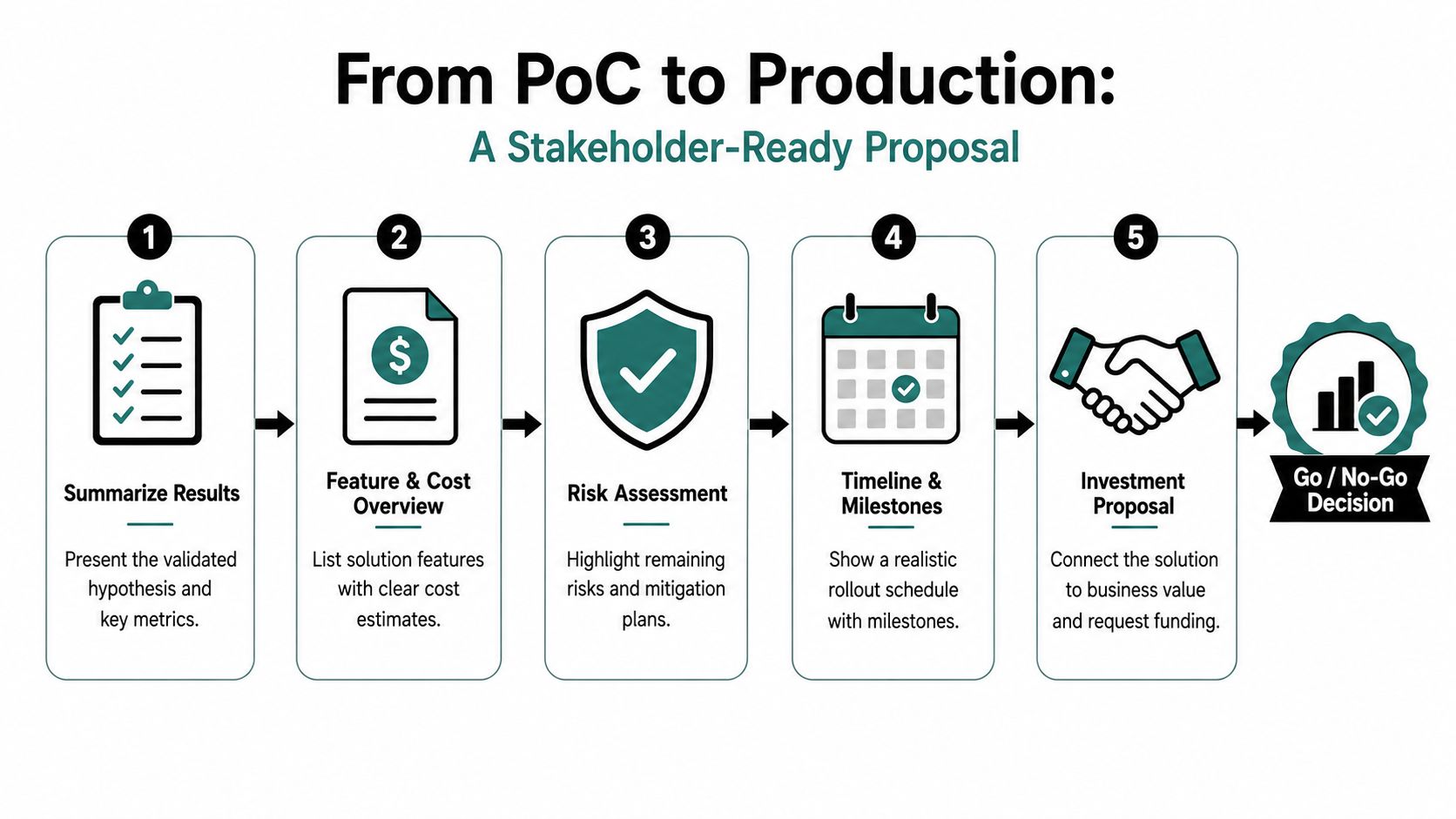
A PoC becomes valuable when it leaves behind a decision package, not a memory. That package should summarize the validated hypothesis, the key metrics, the remaining risks, and the next recommended step. It should also show the solution's features and benefits, feedback from test users, and a realistic execution plan that includes timeline, cost, required resources, and what still needs to be solved before release.
Turn evidence into an investment case
The transition to prototype or MVP should follow the evidence, not optimism. If the PoC validated feasibility but exposed UX friction, the next phase may need design refinement. If the core architecture proved sound but the implementation path looks expensive, a refactor might be enough. If the underlying approach is wrong, a rebuild is cleaner than dragging weak assumptions into production.
The stakeholder-facing proposal should answer a few simple questions:
- What was proven?
- What still carries risk?
- What does the next phase require?
- Why is this worth funding now?
That format works because it turns proof of concept development into a business artifact. It doesn't just ask for approval, it earns it by showing evidence in a form leadership can act on.
For AI modernization efforts, Wonderment Apps' prompt management system is relevant here as an administrative layer. Its prompt vault with versioning helps teams track prompt changes, the parameter manager supports internal database access, the logging system gives visibility across integrated AI models, and the cost manager shows cumulative spend as the work moves from PoC into production. Those controls matter because AI features get messy fast when no one can explain what changed, where the data came from, or what the experiment is costing.
The clean handoff is simple. The PoC proves that the idea deserves more investment. The next build proves the product can scale.
If you're planning proof of concept development for an app, an AI feature, or a legacy modernization effort, Wonderment Apps can help you scope the risk, build the validation path, and carry the right lessons into production. Visit Wonderment Apps to talk through a PoC, a prototype, or the AI controls your product needs before the build gets expensive.