


You have a product deadline, an impatient stakeholder, and a Python problem tied to revenue, cost, or delivery risk. Maybe a backend service fails when traffic spikes. Maybe reporting is slow enough that teams stop trusting it. Maybe an AI feature worked in a prototype, then ran into prompt drift, latency, and token spend once real users touched it.
Hiring usually breaks down at that point because teams look for python coders for hire as if they are filling a narrow technical seat. In practice, the job is larger. You need someone, or a delivery team, that can connect business goals to architecture, execution, and maintenance, then make sound trade-offs when scope, timelines, and budgets collide.
Python gives you plenty of options. That helps, but it also raises the odds of hiring for syntax instead of outcomes.
The better question now is who can ship the result you need with Python as one part of the solution. For many companies, that also means judging whether a candidate can work with APIs, cloud infrastructure, data workflows, and modern AI tooling without creating a fragile system your internal team has to rescue later. Strong hires do more than write clean code. They reduce delivery risk, keep the codebase maintainable, and make product decisions easier. That is why some teams hire an individual contributor, while others bring in a managed partner such as Wonderment Apps when the work spans product, engineering, AI integration, and ongoing support.
Beyond the Job Description Defining Your Real Python Needs
Most hiring briefs are too shallow. They ask for Django, Flask, FastAPI, Pandas, maybe AWS, and call it a day. That tells you what might be in the toolbox. It doesn't tell you what kind of builder you need.
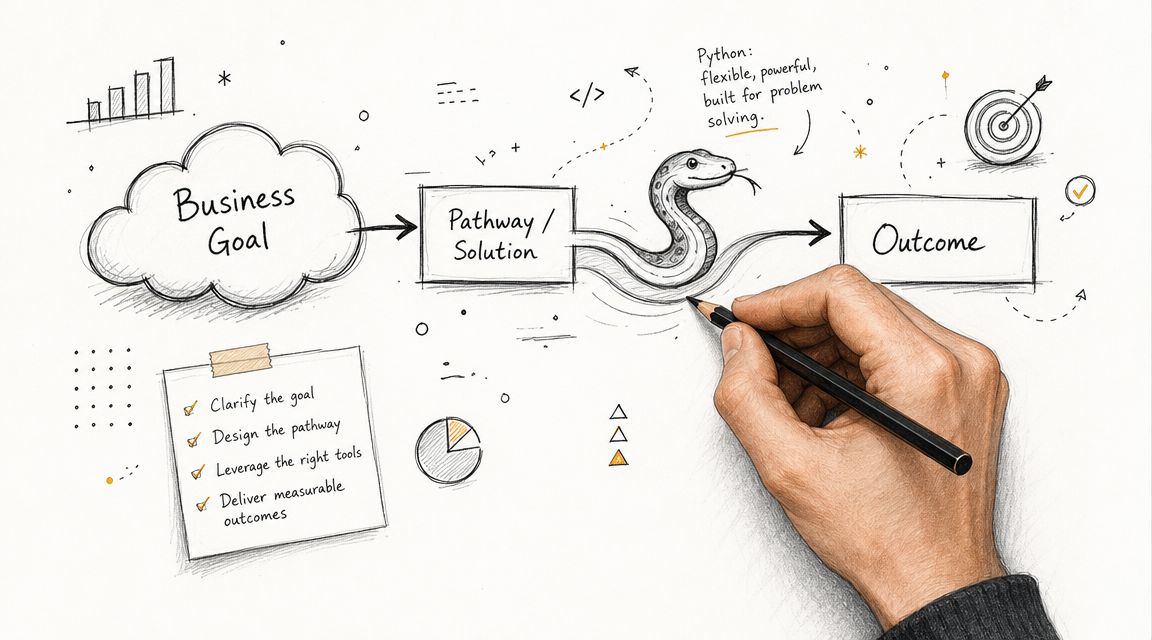
A recurring problem in this market is that hiring content tends to focus on marketplaces, vetting, or generic skill lists, while skipping the harder question of whether you need a solo coder, a dedicated developer, or a managed team to deliver APIs, ML pipelines, or full applications. That gap is especially important for teams that need cross-functional delivery and long-term maintainability, as reflected in this hiring marketplace overview for Python talent.
Start with the outcome, not the stack
A useful hiring brief begins with one sentence:
“We need Python because we need this business result.”
That result usually falls into one of a few buckets:
- Feature delivery: You already have a product and need a defined capability built, such as a checkout integration, internal admin workflow, or reporting API.
- Platform modernization: You've got legacy services, brittle scripts, or old data jobs that need to be cleaned up without breaking the business.
- Data and automation: You need reliable ingestion, transformation, scheduling, reconciliation, or internal tooling.
- AI integration: You're connecting models, prompts, retrieval, permissions, logs, and billing into an app people will use.
Those are different jobs. A freelancer can be excellent for a narrow task with clear boundaries. A product-minded developer is better when requirements are still moving. A managed team makes more sense when Python is only one part of the delivery picture.
A coder writes code. A delivery partner reduces risk.
The phrase Python coders for hire can hide a serious mismatch. If the work includes architecture choices, API contracts, QA handoff, release planning, analytics, and support after launch, you're not hiring for typing speed. You're hiring for judgment.
Practical rule: If success depends on more than one discipline, engineering alone won't carry the project.
That becomes even more obvious with AI-enabled products. The emerging need isn't just “can they code Python?” It's whether they can supervise AI-assisted workflows, integrate models safely, control prompts and tools, and keep spending visible. Teams modernizing software often discover they need operational controls around AI long before they need another clever script.
A lot of product managers now need developers who can think about prompt versioning, parameter access, model logs, and cost tracking as product infrastructure, not side tasks. Administrative tooling in that layer is becoming part of the core architecture for modern apps, especially if you're adding AI into customer-facing or operations-heavy workflows.
Questions that change who you should hire
Before you open a role, answer these:
- What has to be true in production? Fast response times, auditability, admin controls, uptime, or secure data access all change the profile.
- Where can the work fail? Async jobs, payment flows, data quality, and AI outputs each fail in different ways.
- Who owns the result after launch? If nobody internal can maintain it, favor people who document, hand off cleanly, and think in systems.
- Is this software capacity or product delivery? Those are not the same purchase.
If you answer those truthfully, your hiring path gets much clearer.
Choosing Your Hiring Path Freelancers Agencies and In-House Teams
Once the outcome is clear, the next question is sourcing. In this stage, teams often default to habit. Some post on a freelance platform because it's familiar. Some try to hire full-time because it feels safer. Neither is automatically right.
The practical difference usually comes down to speed, oversight, and how much ambiguity the work contains. Direct hire can take time. One hiring guide notes that direct-hire timelines commonly run 5–9 weeks, while staff-augmentation shortlists can arrive in 5–10 business days, according to this Python hiring methodology.
Comparison of Python Hiring Models
| Hiring Model | Best For | Speed to Hire | Cost Structure | Management Overhead |
|---|---|---|---|---|
| Freelancer marketplace | Small, defined tasks with clear acceptance criteria | Usually fast once scope is written | Hourly or project-based | High, because your team manages direction and quality |
| Specialized agency | Projects needing screening, delivery support, and less randomness | Faster than direct hiring in many cases | Higher blended rate, more packaged support | Moderate |
| In-house team member | Long-term product ownership and internal capability | Slower | Salary, benefits, recruiting costs, onboarding time | Lower after ramp-up, higher upfront |
| Staff augmentation or managed team | Product roadmaps, modernization, AI integration, or work spanning roles | Fast shortlist or team assembly through a partner | Monthly or scoped engagement | Lower if the partner provides leadership and process |
Match the model to the problem
If your work is bounded and testable, a freelancer can be a very good fit. “Build this internal export job,” “fix this API bug,” or “refactor these scripts into a scheduled service” are reasonable marketplace buys. You need a crisp brief, fast feedback, and someone internally who can review the result.
If the work is messy or strategic, marketplaces start to wobble. Requirements shift. Security questions appear. Stakeholders disagree on edge cases. Work becomes alignment, not coding.
That's where agencies and managed teams earn their keep. They don't just provide labor. They reduce uncertainty by adding process, senior review, and often QA or project oversight. If you're weighing staffing options at the finance and operating-model level, this guide for HR directors and CFOs is a useful reference for thinking through services-based staffing decisions.
The hidden cost is management drag
A cheap hourly rate can become an expensive project if your PM, tech lead, and designer are all spending time rewriting tickets, reviewing weak code, and clarifying basics. I've seen capable internal teams create their own bottleneck this way. They thought they were buying execution. They were really signing up to supervise every move.
You don't save money when your senior team becomes the missing project manager, architect, and QA department.
For teams comparing partner models, this breakdown of staff augmentation vs managed services is useful because it frames the decision around ownership and delivery responsibility, not just headcount.
A simple selection filter
Use this shorthand:
- Choose freelance when scope is stable and internal leadership is available.
- Choose in-house when the capability is core and ongoing.
- Choose augmentation when your roadmap is blocked by capacity.
- Choose a managed team when the outcome spans multiple functions and you care about shipping without building a temporary org chart.
That last category is where many AI and modernization efforts land. The code matters, but coordination matters more.
How to Screen for More Than Just Code
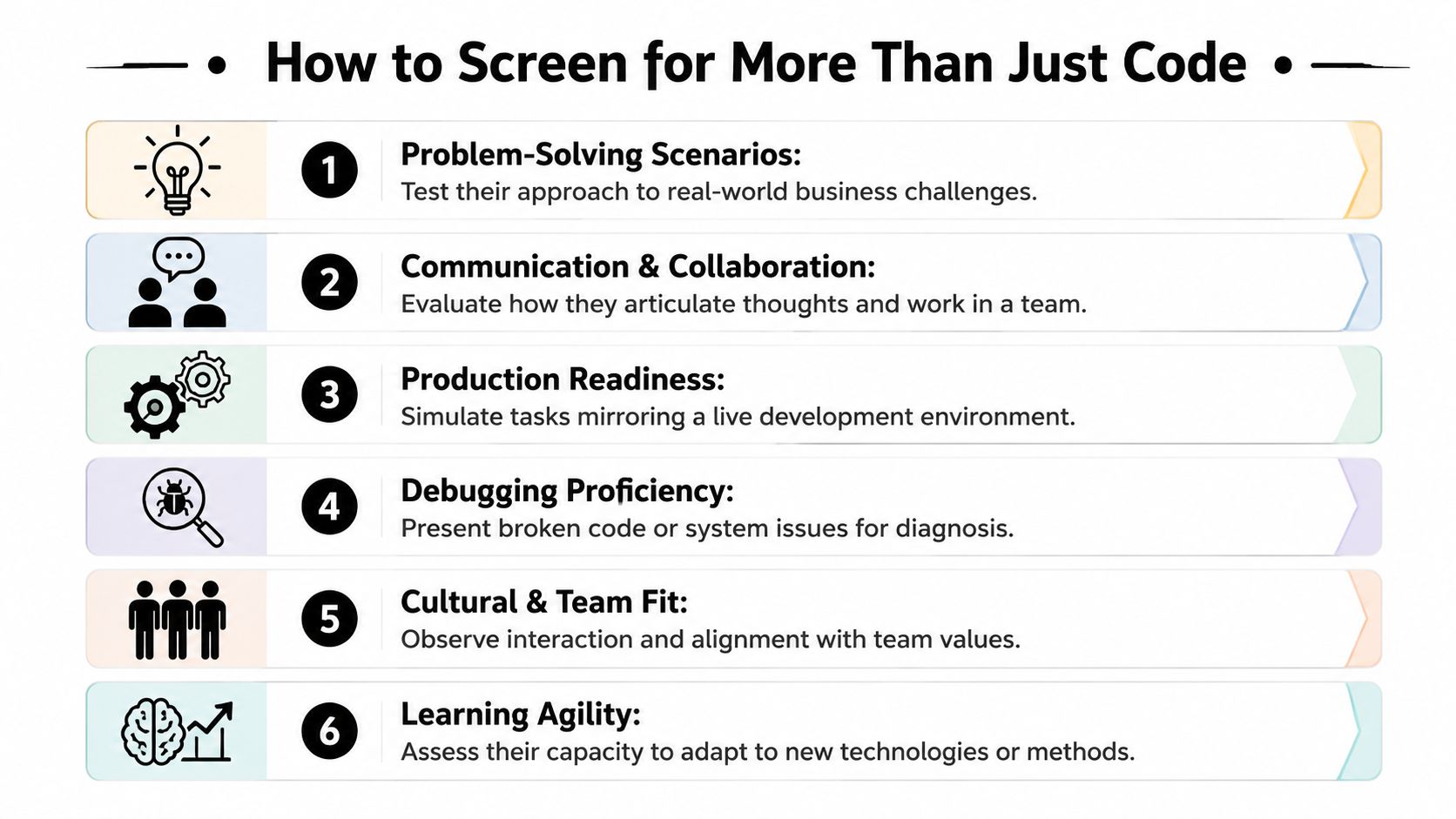
Most technical screens are too abstract. They reward trivia, speed, or polished interview habits. Production software doesn't care about any of that. It cares whether someone can make a sensible decision with incomplete information, leave the system better than they found it, and communicate clearly when things go wrong.
One analysis warns that a bad Python hire can cost up to $240,000, and that a 95-day hiring process is especially risky because strong candidates are often gone in about 10 days, according to this analysis of Python hiring mistakes.
Review proof of work, not just the résumé
Start with evidence that the person has built and maintained something real.
Look for:
- GitHub history: Not just a polished pinned repo. Check commit patterns, issue discussions, tests, readme quality, and whether the code looks maintained.
- System context: Ask what the code did in production, who used it, what broke, and what they changed after launch.
- Reference quality: Ask references about reliability, trade-offs, and ownership. “They're great” isn't enough.
If you're refining role descriptions or trying to understand how candidates shape their resumes for technical filters, this list of Key ATS terms for engineers helps decode what candidates optimize for before a human ever reviews the application.
Use a paid test that mirrors the actual work
Generic coding puzzles miss the point. A better screen is a small paid exercise tied to your stack and business context. Keep it limited. You're testing how they think, not how much free labor they'll donate.
Good paid tests include tasks like:
Debug a realistic issue
Give them a failing background job, flaky endpoint, or malformed data import. Ask how they'd isolate the cause and what instrumentation they'd add.Design a thin slice
Ask for a basic API endpoint, validation flow, or scheduled worker. Require a short explanation of data model choices, error handling, and test strategy.Review existing code
Show them a small code sample from your world and ask what they'd keep, change, and postpone.
What matters is the reasoning. Strong candidates usually explain trade-offs clearly. Weak ones either overengineer immediately or miss operational concerns entirely.
Ask questions that surface judgment
In live interviews, skip brainteasers. Ask things like:
- How would you make this service easier to observe in production?
- What would you log, and what would you avoid logging?
- When would you choose a queue over synchronous processing?
- How do you approach migrations when uptime matters?
- What would make you push back on a product requirement?
Hiring signal: Good Python developers don't just answer with libraries. They answer with failure modes, constraints, and rollback plans.
One more point matters. Keep the process short and decisive. If a candidate completes a strong paid exercise and communicates well, move. The perfect panel sequence is often the enemy of an actual hire.
For teams building a more disciplined hiring loop, these tips on recruiting top tech talent are helpful because they focus on screening structure, not résumé theater.
Setting Compensation Contracts and Clear Expectations
A lot of Python hires go sideways before the first sprint starts. The team says they need a developer. What they need is someone who can own a backlog, make sound architecture calls, work with AI services, and keep delivery moving when requirements change. If the budget only covers ticket execution, expect friction.
Rates vary because the job varies. Basic implementation work costs less than work that includes system design, production judgment, model integration, or cleanup of a fragile codebase. As noted earlier, AI-heavy Python work usually sits at the higher end of the market because the risk is higher and the cost of poor decisions shows up later in outages, rework, and missed release dates.

Price for outcomes, not just hours
Paying for senior talent only makes sense if the work needs senior judgment. A well-scoped internal tool, a predictable API build, or backlog support often fits a mid-level contractor.
The math changes fast when the hire needs to choose frameworks, shape data flows, connect to LLM APIs, control cloud costs, or stabilize an inherited system. In those cases, lower hourly rates often produce a higher total project cost. I have seen teams save on rate and lose months in rework.
That is why many product teams do better with a delivery partner than a standalone coder. An individual can be a strong fit. A managed team, including groups like Wonderment Apps, becomes more attractive when the work spans product thinking, backend engineering, AI integration, QA, and release ownership.
Put the real deal terms in writing
A kickoff call can create alignment. It cannot replace a useful statement of work.
The agreement should answer a simple question. What are you buying, how will you judge it, and what happens when reality changes?
Include:
- Deliverables and acceptance criteria: Define what ships and what must be true for approval.
- Decision rights: State who can change scope, approve trade-offs, and set priority when time or budget gets tight.
- Out-of-scope examples: Name a few common requests that are excluded so the project does not expand by accident.
- Dependencies: List access, environments, data, stakeholder input, and internal approvals your side must provide.
- Communication rhythm: Weekly demos, written status updates, and escalation paths work well for remote delivery.
- IP, security, and confidentiality terms: Spell this out early, especially for customer data, prompts, fine-tuned models, or proprietary workflows.
- Post-launch support: Set the bug-fix window, handoff documents, and response expectations before work begins.
A good SOW reduces argument. It also makes underperformance easier to spot.
Match the contract model to the kind of uncertainty
Contract structure should reflect delivery risk.
| Contract Type | Works Best When | Watch Out For |
|---|---|---|
| Hourly | Priorities may shift and discovery is still happening | Weak backlog discipline, unclear approval paths, and open-ended spending |
| Fixed project fee | Scope is stable and acceptance criteria are specific | Hidden edge cases, slow client feedback, and change requests that break the economics |
| Monthly retainer | You need ongoing capacity across a roadmap | Retainers drift when no one owns prioritization |
| Managed delivery SOW | You need multiple roles and shared accountability for delivery | Confusion about who makes product decisions and who owns final sign-off |
One practical rule helps here. The more unknowns in the work, the less useful a fixed bid becomes.
If you are hiring an individual freelancer, keep invoicing terms, response expectations, availability, and handoff requirements explicit. If you are hiring a firm, ask who is assigned, how continuity works if someone rolls off, and how delivery is handled when priorities change. Those operational details matter as much as the headline rate.
Teams that want hiring and onboarding terms to line up cleanly should also review these comprehensive HR onboarding steps. The useful part is the coverage around access, expectations, documentation, and accountability, which should be reflected in the contract long before day one.
The First 90 Days Onboarding and Managing for Success
Good hiring can still fail in the first month. The usual cause isn't incompetence. It's a fuzzy environment. No one explains the architecture well, priorities change daily, and access arrives in the wrong order. Then everyone wonders why velocity is low.
The first stretch should feel operational, not ceremonial. A new Python hire needs a working environment, decision context, and fast feedback loops. If your team wants a broader people-ops checklist for the surrounding process, these comprehensive HR onboarding steps are a useful companion.
Week one should remove friction
Make day one boring in the best possible way.
Provide:
- Access that works: Repository, cloud environment, ticketing, documentation, logs, and communication tools.
- A system walkthrough: Show the architecture, known pain points, release process, and who owns what.
- One sensible starter task: Not a toy ticket. Give something small but meaningful so they touch the live system early.
Month one should build confidence
By the end of the first month, your hire should understand how work moves from idea to production. They should know where requirements come from, how code gets reviewed, and how incidents get handled.
Set a rhythm:
- Short check-ins: Keep blockers visible.
- Written updates: Useful for remote teams and async review.
- Review standards: Clarify what “good enough to merge” means.
New hires struggle when teams assume context transfers automatically. It doesn't. Someone has to teach the map.
The rest of the quarter should shift from supervision to ownership
By the latter part of the quarter, the goal is simple. They should own a meaningful area with less hand-holding. That doesn't mean leaving them alone. It means asking them for recommendations, not just task completion.
For contract hires, this is also when you evaluate whether they're improving the system or just moving tickets. The difference shows up in documentation, edge-case thinking, communication quality, and whether teammates trust them with messy work.
A strong onboarding process makes that visible fast.
When to Partner for AI Modernization and Managed Teams
Some projects don't need a lone developer. They need a system around the developer. That's especially true when Python sits inside a bigger modernization effort involving AI, APIs, admin workflows, security, and long-term support.
The market is shifting in a specific direction. Python developers increasingly need to manage AI workflows, model integration, prompt and tooling governance, and cost control, a skill gap that many hiring guides still gloss over, according to this overview of hiring Python developers for modern systems.
Signals that direct hiring is the wrong tool
You should strongly consider a partner model when several of these are true:
- The outcome spans disciplines: Backend engineering, QA, product thinking, and design all affect success.
- The AI layer needs control: Prompts, logs, permissions, model selection, and spending need governance.
- Your internal team is already overloaded: Adding one contractor won't fix prioritization or release management.
- The business can't absorb a lot of hiring risk: You need delivery confidence more than résumé volume.
In this scenario, managed teams make practical sense. You're not just renting Python hours. You're buying coordination, senior review, and an operating model that can carry ambiguity.
What to look for in an AI modernization partner
A useful partner for AI-heavy Python work should be able to do three things well.
First, they should connect AI to the application stack. That includes backend services, data access, observability, auth boundaries, and user-facing workflows.
Second, providing controls around prompts and model behavior often leads many teams to discover they need administrative tooling, not just code generation.
Third, they should help the business see what's happening after launch. Logging, spend visibility, prompt changes, and support workflows matter because AI features don't stay static.
One option in this category is Wonderment Apps, which works as a digital product and engineering partner for AI modernization and managed delivery. Its administrative toolkit includes a prompt vault with versioning, a parameter manager for internal database access, unified logging across integrated AI services, and cost management for tracking cumulative AI spend. For companies moving from experimentation to production, those controls are often more important than another isolated developer profile.
If you're evaluating whether to outsource the work instead of assembling it role by role, this guide to outsourcing Python development is a practical place to start because it frames the decision around delivery ownership and long-term maintainability.
The hiring question has changed
The old question was, “Can this person write Python?”
The better question now is, “Can this person, or this team, ship and govern a Python-based product that will still make sense six months from now?”
That change matters. AI-assisted coding can speed up implementation, but it also increases the need for review, architecture judgment, prompt discipline, and operational controls. If your roadmap includes customer-facing AI, internal copilots, workflow automation, or modernized legacy systems, hiring only for syntax is too narrow.
The strongest teams now combine Python skill with product sense, systems thinking, and the ability to manage AI as part of the software lifecycle.
If your team is sorting through Python hiring, AI integration, or the build-versus-partner decision, Wonderment Apps is worth a look. They work with organizations that need more than a coder, especially when the core task is modernizing software, adding AI responsibly, and shipping a product that can be maintained long after launch.