


Your team probably isn't asking for “IoT” in the abstract. You're trying to solve a concrete operational problem.
A shelf sensor should update inventory without staff scanning every item. A payment terminal should report health issues before a store loses transactions. A medical device should move data into the right workflow without creating a compliance mess. And increasingly, someone in the room is asking the next question: can AI interpret the data, automate decisions, or personalize the experience in real time?
That's where many IoT projects split in two. One path produces a connected demo. The other produces a working system with device management, security, software integrations, analytics, and an intelligent application layer that business teams can operate. Modern teams also need controls around AI behavior itself, including prompt versioning, logging, parameter handling, and cost visibility. If that layer is unmanaged, the “smart” part of the system becomes the least governable part.
What Is an IoT Development Service and Why It Matters Now
An IoT development service is the engineering work required to turn connected hardware into a usable product or business system. That includes device firmware, connectivity, gateway logic, cloud services, APIs, dashboards, mobile apps, data pipelines, security architecture, and support for the lifecycle after launch.
That's a wider scope than many buyers expect. Connecting a sensor to the internet is the easy part. Building a system that provisions devices securely, stores data cleanly, survives bad network conditions, and gives operators useful actions is the hard part.
The market reflects that shift. The global IoT Solutions and Services market was valued at US$243.1 billion in 2022 and is projected to exceed US$575.0 billion by 2027, with an 18.8% CAGR, according to MarketsandMarkets on the IoT solutions and services market. That matters because demand is moving beyond hardware into software, integration, device management, application management, and the service layers that make connected systems usable.
What clients usually mean when they ask for IoT
Most buyers are really asking for one of these outcomes:
- Operational visibility: They want live status from assets, equipment, products, or environments.
- Process automation: They want the system to trigger actions instead of just collecting readings.
- Customer experience improvements: They want mobile apps, alerts, personalization, or connected product features.
- AI-assisted decisioning: They want models to classify events, summarize anomalies, or guide users and staff.
If your use case includes the last item, the application layer changes significantly. You're no longer just moving telemetry into a dashboard. You're managing prompts, model outputs, retrieval context, internal data access, logs, and spend controls.
A device that sends data is not yet a product capability. It becomes one when the software can interpret that data, route it to the right user, and support an action.
Why this matters now
In practice, the buyers who get value from IoT treat it as a software program with hardware attached. They budget for backend systems, lifecycle tooling, QA, analytics, and support. They don't stop at “the device connects.”
If you're sorting through use cases and trying to understand what belongs in scope, this guide to IoT applications development is a useful companion read. It helps frame where connected products become real business applications.
A capable IoT partner should also be able to explain how AI will be governed inside the product, not just added as a flashy feature. If prompts change results, someone needs version control. If models call internal systems, someone needs parameter safeguards. If multiple AI services are involved, someone needs unified logs and cost tracking. Those controls are now part of serious delivery.
Deconstructing Your IoT System Architecture
A solid IoT system behaves like a nervous system. Devices sense. Networks carry signals. Platforms process them. Applications decide what humans or machines should do next.
When leaders skip this architecture view, projects get scoped as “build an app for our devices.” That usually fails because the app is only the visible layer. The actual work sits underneath.
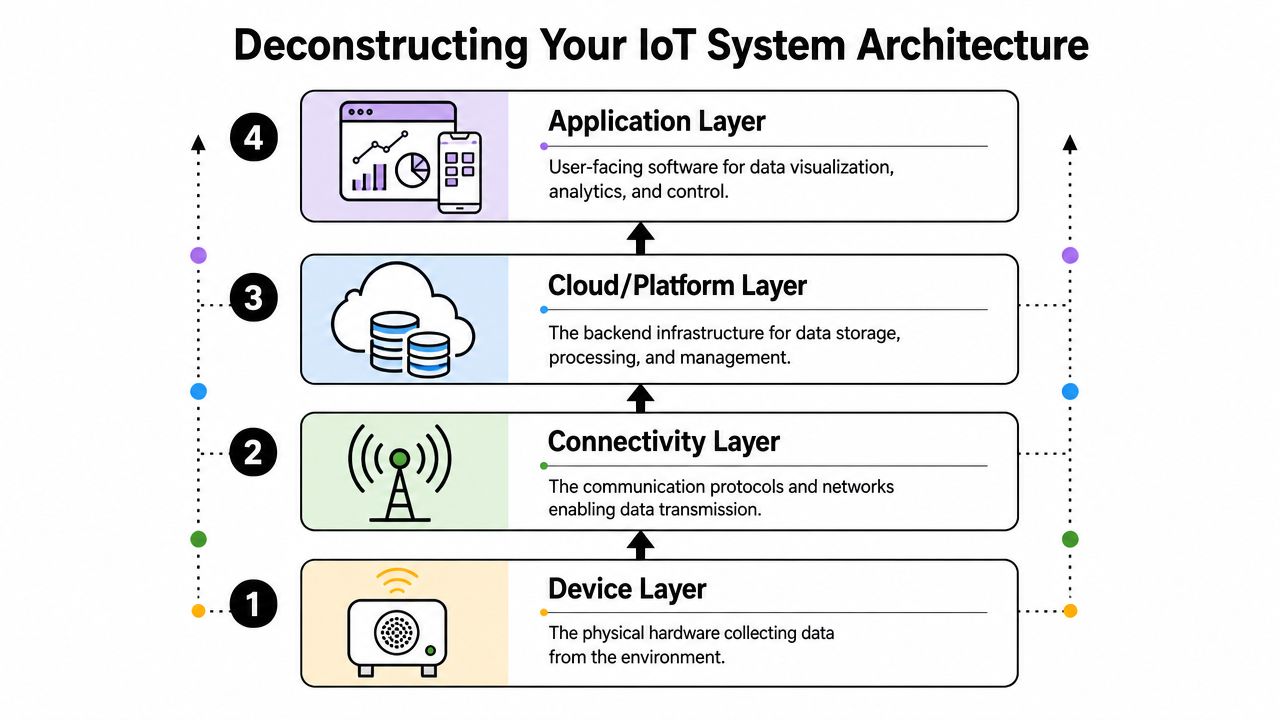
IoT systems also need to scale in layers. Connected IoT deployment reached 16.6 billion devices in 2023, with projections of about 39 billion by 2030, according to IoT Analytics on connected IoT devices. That's why layered architecture isn't technical vanity. It's operational survival.
Device layer
This is the physical edge. Sensors collect readings. Actuators change states. Embedded software decides what the device samples, stores, transmits, and ignores.
Common trade-offs happen here first:
- Battery vs responsiveness: More frequent sampling gives faster insight but shortens device life.
- Cheaper hardware vs future flexibility: Saving on memory or compute often blocks later firmware features.
- Local processing vs raw transmission: Sending everything upstream sounds safe until bandwidth, latency, or cloud costs become painful.
For teams comparing hardware-facing build work, this overview of embedded software development services helps clarify where firmware and device behavior fit into the larger system.
Connectivity layer
This layer carries data between devices, gateways, and services. It includes local protocols, network choices, and the message patterns that determine reliability.
A few hard truths show up here:
- Retail stores have dead zones.
- Hospitals have network restrictions.
- Mobile assets go offline.
- Industrial environments interfere with signals.
That means the connectivity layer must support retries, buffering, secure handoff, and clear failure states. “Real-time” often turns into “eventually synchronized under normal operating conditions,” and that's fine if the product is designed appropriately.
Systems fail in the seams. A sensor can be accurate, and a dashboard can be beautiful, while the connection logic between them quietly drops the data that matters.
Cloud and platform layer
The environment hosts ingestion, storage, rules, identity, device management, and analytics. It's also where many cost problems begin.
A platform should answer practical questions fast:
| Platform concern | What good looks like |
|---|---|
| Data ingestion | Handles bursts, duplicates, and offline replay |
| Device registry | Tracks identity, state, and provisioning history |
| Rules engine | Supports alerts and workflows without brittle rewrites |
| Storage design | Separates hot operational data from long-term analytics |
| Fleet operations | Supports updates, monitoring, and device health at scale |
Application layer
User value is realized through dashboards, operator consoles, mobile apps, admin panels, and AI features.
This layer often gets oversimplified into “build a UI.” It's more accurate to call it the decision layer. It determines whether data becomes action, whether alerts are useful, and whether AI adds clarity or confusion.
If you plan to use LLMs or other prompt-driven models here, treat them like governed product components. They need managed prompts, controlled parameters for internal data access, centralized logs, and budget visibility across services. Otherwise, your smartest feature will be the hardest one to audit.
Bringing IoT to Life with Real World Examples
A good IoT program doesn't start with sensors. It starts with friction in the business. Something is slow, manual, expensive, opaque, or too easy to get wrong.
The strongest projects pick one of those pains and build a closed loop around it. Capture the event. Move the data. Apply logic. Trigger the right action. Let's look at how that works in practice.
Retail and ecommerce
A retailer wants better inventory accuracy, but the root issue isn't “we need connected shelves.” The root issue is that store staff and digital channels are operating from different assumptions.
Smart shelf sensors, stockroom tags, or connected freezers can push environmental or inventory signals into a store operations platform. The application layer can then do more than display counts. It can trigger replenishment tasks, warn store staff about shelf gaps, or feed availability into the ecommerce experience so customers don't buy what isn't on hand.
The common mistake is overbuilding the dashboard and underbuilding the workflow. If a shelf event creates noise without routing the task to the right employee system, you've created a live status board that no one uses.
Fintech and payments
Connected payment terminals are a classic example of why IoT has to be treated as software infrastructure, not just endpoint hardware.
A payments team may need to monitor terminal health, configuration drift, security posture, and transaction anomalies across many locations. The value isn't just “the terminal is online.” The value is knowing whether it's running the right software, whether it's behaving normally, and whether support teams can intervene before merchants lose revenue.
AI can help at the application layer by summarizing fault patterns, clustering repeated field issues, or assisting support teams with guided troubleshooting. But in fintech, the wrong architecture choice becomes expensive fast. If device telemetry, merchant metadata, and model outputs are stitched together loosely, you create support friction and audit problems at the same time.
The most useful connected payment systems don't just report failures. They help operations teams understand which failures need action now, which can wait, and which are symptoms of a deeper rollout problem.
Healthcare and wellness
Remote monitoring gets a lot of attention because the use case is easy to understand. A connected device captures data at home and routes it into a clinical workflow.
The hard part is not the sensor. It's designing a trustworthy path from device to patient-facing app, clinician-facing view, notifications, escalation logic, and compliant storage. If one of those pieces is weak, the entire experience feels unreliable.
For healthcare teams, the best IoT development service usually focuses on a narrow, high-value workflow first. Examples include adherence reminders, at-home measurement capture, or device-backed symptom tracking. Then it expands only after identity, consent handling, alert thresholds, and escalation paths work in practice.
SaaS and smart products
Some companies don't sell “IoT projects” at all. They sell products that happen to include connected hardware.
In those cases, the application layer becomes the business. Usage history, recommendations, maintenance prompts, anomaly summaries, and AI-assisted support all live above the device layer. Customers don't care how elegant the telemetry pipeline is. They care whether the product feels intelligent, reliable, and easy to use.
That's why teams should think in loops, not components:
- Detect: Capture the device event or state.
- Interpret: Add context from business systems or AI models.
- Respond: Trigger an action, suggestion, or workflow.
- Learn: Use logs and outcomes to improve rules, prompts, and UX.
That loop is where connected products start producing durable value.
Navigating Your IoT Project from Prototype to Production
Most IoT failures aren't dramatic. They stall. The proof of concept works on a bench, the pilot behaves strangely in the field, and nobody can agree whether the issue sits in hardware, firmware, connectivity, cloud logic, or the app.
That's why experienced teams use a staged rollout. Very Technology describes a path from rough prototype, to full prototype, to a first manufacturing run of roughly 100 devices, and then to a real manufacturing run of 1,000 or more devices in its guide to IoT development frameworks and best practices. That model matters because pilot-scale failures are much cheaper to fix than field-scale failures.
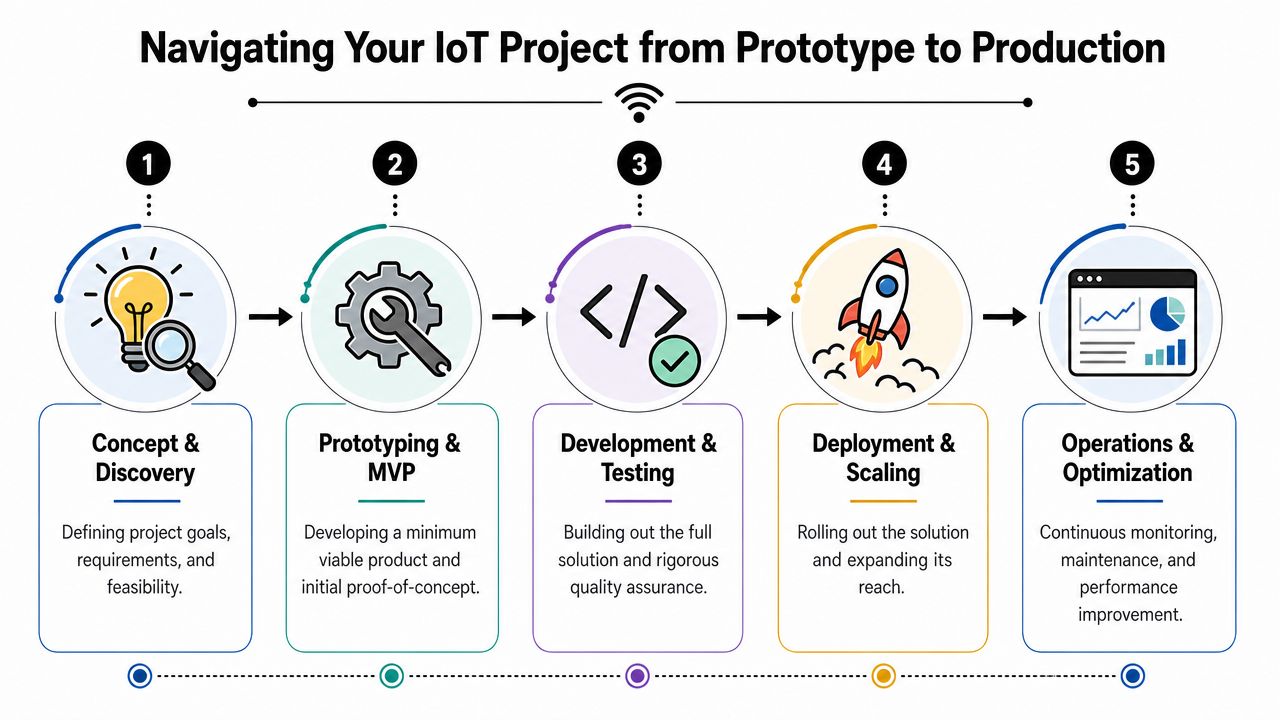
Discovery and architecture
Start with the operating problem, not the device.
A useful discovery phase answers questions like these:
- What action should this system enable? A notification, an automation, a diagnosis, a recommendation?
- Who owns the workflow after the signal appears? Store staff, clinicians, ops teams, customers?
- What breaks if the device is offline? Some use cases can tolerate delayed sync. Others can't.
- Which systems must integrate from day one? ERP, CRM, EHR, billing, identity, analytics, support tools?
If AI is part of the roadmap, define where it fits early. Prompt-driven features affect data design, logging requirements, and admin tooling. They shouldn't be bolted on after the product architecture is frozen.
Prototype and pilot
A prototype should answer one question clearly: can the core signal move through the system reliably enough to justify the next stage?
That means prototypes should include more than basic connectivity. They should test:
- Provisioning: Can devices be onboarded repeatably?
- Authentication: Can the device and service trust each other?
- Message handling: Can the system tolerate retries, duplicates, and dropped connections?
- Update path: Can firmware or edge logic be patched safely?
- Application usefulness: Can a user take the right action from the data received?
Teams often skip update strategy at this stage because it feels premature. It isn't. A pilot that can't be updated cleanly is a warning, not progress.
Build the boring parts early. Provisioning, identity, and updates decide whether a pilot can grow up.
Full development and field readiness
Once pilot behavior is stable, the work shifts from “does it work” to “can people operate it.”
That's the point where delivery usually expands to include:
| Phase area | What needs to mature |
|---|---|
| Backend services | Durable ingestion, monitoring, error handling, integration flows |
| User applications | Role-based views, alerts, workflows, admin controls |
| Fleet management | Device status, rollout controls, update orchestration |
| AI layer | Prompt governance, logging, fallback behavior, human review paths |
Field readiness also means testing ugly conditions on purpose. Weak connectivity. Partial outages. Duplicate events. Misconfigured devices. Expired credentials. If the team only tests success paths, production will do the rest of the testing for you.
Securing and Scaling Your Connected Ecosystem
Security problems in IoT are rarely isolated. A weak device identity model becomes an integration problem. A loose update path becomes an operations problem. A missing audit trail becomes a compliance problem.
GSMA's guidance is clear that data sent from the IoT device application to the IoT service platform should be end-to-end encrypted to a security strength appropriate to the service, as outlined in the GSMA IoT device application requirements. For buyers, the practical takeaway is simple: encryption isn't a feature to add later. It's part of the architecture from the beginning.
Security starts before hardware selection
If the hardware, firmware, gateway software, APIs, and client apps can't support the same security posture, you'll spend the project compensating for mismatches.
Ask your IoT partner how they handle:
- Device identity: Unique identities, secure onboarding, credential rotation
- Transport protection: End-to-end encryption across device, gateway, and platform paths
- Update integrity: Signed firmware, staged rollout controls, rollback strategy
- Operational verification: Logging, anomaly detection, and incident response workflows
A lot of teams say they take security seriously. Fewer can explain how they validate it. If you want a practical outside perspective on choosing effective penetration testing, Zephony's overview is a useful way to sharpen your questions before launch.
Compliance follows architecture
Compliance isn't paperwork layered onto a finished system. It's a byproduct of technical choices.
Healthcare teams need architectures that support patient privacy, access controls, and traceability. Fintech teams need strong auditability and tightly controlled integrations. Government and public-sector teams often need additional operational rigor around continuity, authorization, and vendor boundaries.
For data-heavy deployments, data analytics and IoT becomes more than a reporting topic. Analytics pipelines must preserve context, permissions, and trustworthy lineage if the outputs are going to drive decisions.
Scaling is mostly about operational discipline
Scaling doesn't just mean “more devices.” It means more versions in the field, more support edge cases, more data bursts, and more ways for systems to drift.
Three design habits help a lot:
- Prefer layered rollouts: Release firmware, rules, and AI behaviors gradually instead of flipping everything at once.
- Separate hot-path processing from deep analysis: Keep operational workflows fast, and move heavier analytics where they won't block user actions.
- Design for multi-vendor reality: Gateways, devices, and software stacks will change over time. Interoperability matters.
The underrated challenge is edge intelligence. When some logic moves closer to devices, teams gain responsiveness but also inherit more responsibility for patching, monitoring, and policy consistency. That trade-off is worth it in many environments, but only if someone owns it explicitly.
Understanding IoT Development Pricing and Measuring ROI
The first pricing question clients ask is usually “how much will it cost?” The better question is “what are we paying to reduce, and what are we paying to learn?”
IoT budgets spread across hardware, firmware, cloud infrastructure, application development, QA, integrations, support tooling, and ongoing fleet operations. If AI sits in the product, add model usage, prompt management, logging, and governance. That's why pricing varies so much between a pilot app and a production system.
NIST's IoT Advisory Board has emphasized that mature IoT programs need clearer success metrics and governance, as discussed in The IoT of Things report from NIST. In plain terms, many organizations can connect devices but still struggle to define whether the program is creating real business value.
Comparing IoT Development Pricing Models
| Model | Best For | Pros | Cons |
|---|---|---|---|
| Fixed Price | Narrow, well-defined projects with stable scope | Clear budget expectations, easier procurement approval | Rigid when hardware findings or integration realities change |
| Time and Materials | Discovery-heavy builds, pilots, evolving product requirements | Flexible, supports learning and iteration | Needs active client involvement and tighter governance |
| Dedicated Team | Long-term platform builds and ongoing product ownership | Strong continuity, shared context, better lifecycle support | Requires trust, planning maturity, and sustained budget |
There isn't a universally right model. Fixed price works when scope is genuinely stable. That's less common in IoT than in plain web development because device behavior and field conditions often reveal unknowns. Time and materials works well during exploration. Dedicated teams make sense when IoT is becoming a core product capability rather than a one-off initiative.
What to measure beyond pilot success
Pilot metrics often flatter weak programs. Devices connected. Data arrived. Dashboard worked. None of that guarantees business value.
Better ROI conversations usually include a mix of these outcomes:
- Operational efficiency: Fewer manual checks, fewer support escalations, less downtime investigation
- Revenue support: Better inventory availability, stronger service quality, improved product retention
- Risk reduction: Earlier detection of failures, stronger auditability, fewer configuration issues
- Product intelligence: Better recommendations, smarter support workflows, better decision context
A pilot proves a technical path. ROI proves that the path matters to the business.
For AI-enabled IoT, add one more layer: governance cost. If your team can't track prompt changes, model logs, and usage spend, then your margin assumptions are soft. The AI feature may still be worth building, but it needs the same financial discipline as any other production dependency.
How to Choose the Right IoT Development Partner
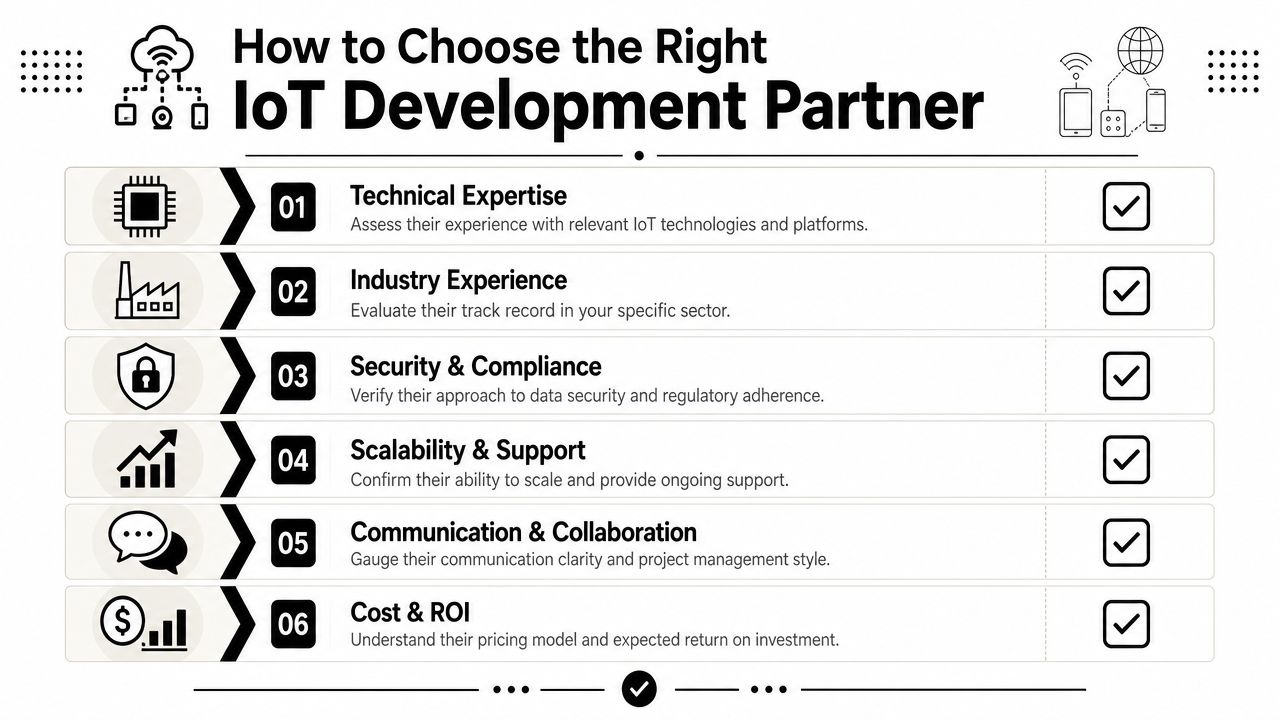
Most companies don't need a vendor that can “build IoT.” They need a partner that can make the messy parts legible. Trade-offs around hardware constraints, network reliability, device lifecycle, cloud architecture, user experience, and AI governance all have to be translated into business decisions.
That's why partner selection should feel more like technical due diligence than creative pitch review.
The shortlist checklist
Use this list when comparing firms:
- Technical depth: Can they discuss firmware, gateways, APIs, mobile and web apps, cloud services, and security without hand-waving?
- Production discipline: Do they talk about provisioning, updates, monitoring, rollout controls, and support workflows?
- Integration maturity: Can they connect the IoT system to your ERP, CRM, EHR, support tools, or internal platforms?
- Industry fluency: Do they understand what “failure” means in your environment, whether that's a lost sale, a compliance issue, or a service interruption?
- AI management capability: Can they govern prompts, logs, parameters, and usage costs if intelligence is part of the product?
- Operating model fit: Do they offer a delivery structure that matches your team's decision-making speed and internal ownership model?
The question many buyers forget to ask
Ask how the partner manages the intelligent application layer after launch.
That question matters because AI-enabled product behavior changes over time. Prompts evolve. Retrieval logic changes. Internal parameters need controls. Teams need logs across integrated AI services. Finance teams eventually ask where the spend went.
One option in this category is Wonderment Apps, which offers an administrative toolkit for AI modernization that includes a prompt vault with versioning, a parameter manager for internal database access, logging across integrated AI systems, and cost management for cumulative usage visibility. In an IoT context, that kind of tooling fits above the data and device layers. It helps teams manage AI behavior as an operational product surface, not as hidden implementation detail.
What good partner behavior looks like
A reliable partner will usually do three things early:
- Challenge fuzzy scope. If your team says “we need a dashboard,” they'll ask which user, which decision, and which action.
- Surface ugly constraints fast. They won't wait until late QA to mention battery limits, offline behavior, or provisioning complexity.
- Separate demo goals from production needs. They'll tell you which shortcuts are acceptable in a pilot and which will become expensive later.
That's the right posture. IoT projects don't need more optimism. They need disciplined optimism.
If you're planning a connected product, modernizing an existing platform, or adding governed AI to an IoT application, Wonderment Apps can help you scope the system end to end. That includes product strategy, mobile and web delivery, backend architecture, and practical controls for prompt management, AI logging, parameter access, and usage cost visibility so the system stays operable after launch.