

Your team is probably living this already. Product wants a smarter search experience. Engineering is testing an AI assistant inside the app. Leadership wants faster releases, lower operating cost, and fewer surprises when customers scale up. At the same time, sustainability goals, reporting pressure, and infrastructure bills keep creeping into planning conversations.
That mix can feel messy because innovation and sustainability are often treated like two separate jobs. One belongs to product roadmaps. The other gets pushed into compliance decks or annual reports. In digital products, that split stops working fast. Every model call, deployment choice, caching rule, and recommendation workflow affects both user value and resource use.
A practical way to think about it is this. A modern app is like a city utility grid. You don't just ask whether it works. You ask whether it works efficiently, whether it can scale under pressure, and whether the cost of running it stays under control. Teams that build AI into desktop and mobile applications now need that same operational mindset for prompts, token spend, logging, model selection, and usage policies.
If you're trying to connect software modernization with long-term resilience, Wonderment Apps has a useful perspective in its piece on sustainable business continuity. It frames a reality many teams feel every week. Reliability, adaptability, and sustainability aren't side quests. They're part of product quality.
Introduction to Sustainable Innovation in Digital Products
On Monday, a product manager approves an AI-powered support feature for a mobile app. By Wednesday, the engineering lead notices model calls are climbing faster than expected. On Friday, finance asks why compute costs jumped, and compliance asks how the team plans to document model behavior. Nobody on that team set out to create a sustainability problem. They were just trying to ship something useful.
That scenario is why sustainable innovation matters in digital products. It means building new capabilities in a way that also respects energy use, operating cost, resilience, and the practical limits of your architecture. In plain language, it is not just about making software smarter. It's about making software smarter without making your system harder to run, harder to explain, or more expensive to maintain.
Why this gets confusing
Many teams assume sustainability only matters in factories, logistics, or hardware. Software feels lightweight by comparison. But AI changes the picture because modern apps now rely on constant inference, prompt orchestration, background jobs, search indexes, recommendation engines, and deployment pipelines that all consume infrastructure resources.
The confusion usually comes from three myths:
- Myth one: Faster innovation always means more waste. It doesn't. Better workflows can reduce rework, unnecessary compute, and bloated feature sets.
- Myth two: Sustainability is only a reporting exercise. It isn't. It changes architecture decisions, testing habits, and product priorities.
- Myth three: AI modernization starts with a huge platform rewrite. Often it starts smaller, with better controls around prompts, logging, parameters, and usage visibility.
Practical rule: If your team can't see how AI behavior changes cost and operational load, it can't manage sustainability in any meaningful way.
What balanced teams do differently
Teams that handle this well don't treat innovation and sustainability as opponents. They treat them like two acceptance criteria for the same feature. A good release should help the user, fit the business model, and stay manageable over time.
That mindset is especially important when you're choosing developers or modernization partners. Good builders don't just ask, "Can we add AI?" They ask, "Which model fits the job, how will we track usage, and what controls help this app age well?"
Understanding the Relationship between Innovation and Sustainability
Innovation and sustainability work more like an ecosystem than a tug-of-war. When one part improves, the others often become healthier too. A better search model can reduce wasted support effort. Cleaner data pipelines can reduce duplicate processing. Thoughtful UX can lower abandonment and unnecessary retries. In each case, the product becomes stronger while resource use becomes more disciplined.
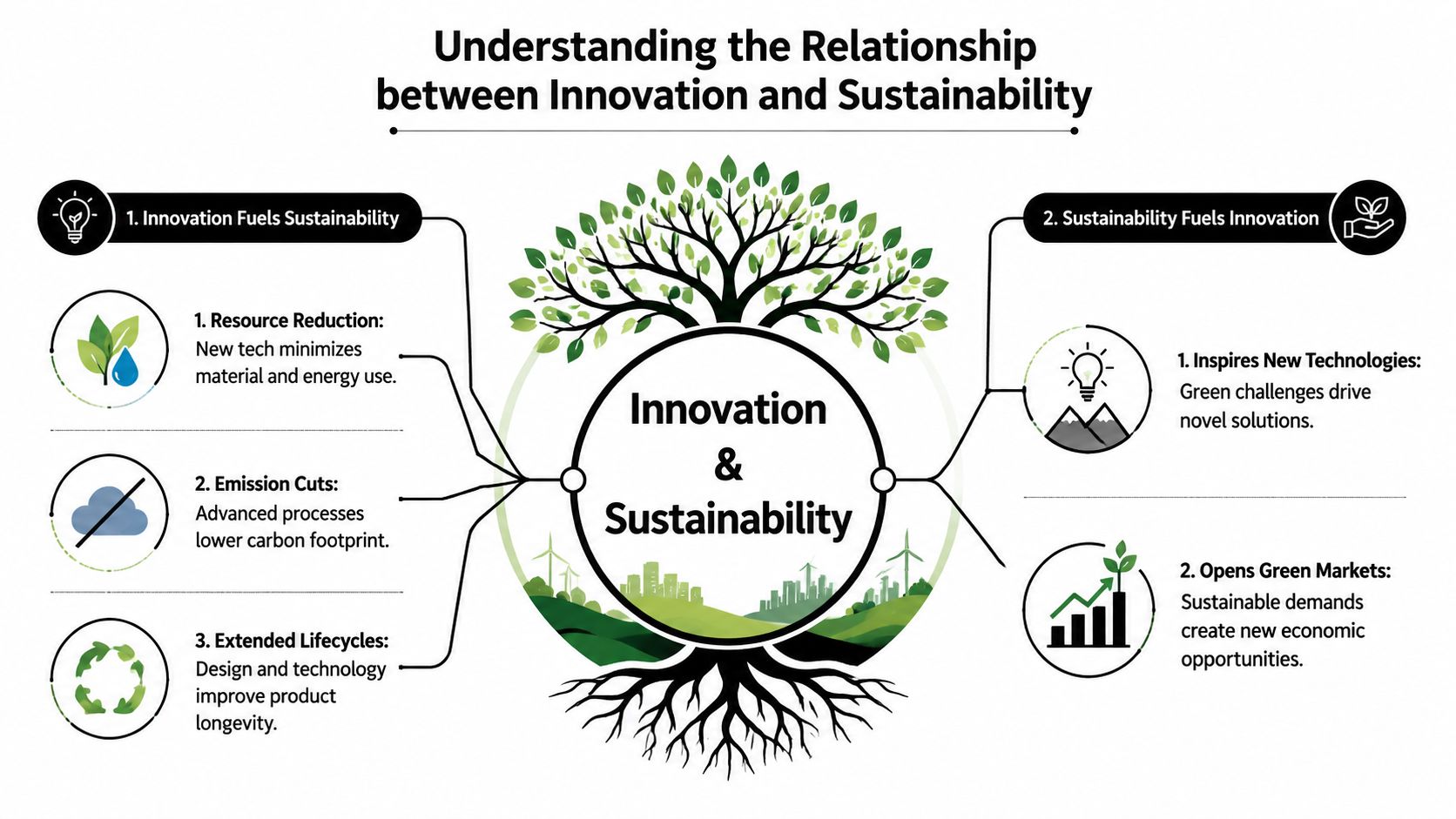
The broader policy picture points in the same direction. From 2014 to 2024, eco-innovation in the European Union grew by 27.5%, with sustainability-driven innovation embedded in internal processes to cut costs and manage climate risks, according to the European Environment Agency's work on transformative innovation in Europe.
Innovation helps sustainability
Think about a recommendation engine in ecommerce. If it helps shoppers find a better-fit product sooner, the app feels smarter. At the same time, the business may reduce wasteful browsing loops, unnecessary support contacts, and poor decision paths that lead to avoidable downstream friction. The feature isn't "green" because it has AI in it. It's sustainable when it does the job with less waste in the system.
The same pattern appears outside software. If you want a simple physical-world analogy, the shift toward e-bikes and urban mobility is useful. Better design doesn't just create a new product category. It changes how people use energy, space, and infrastructure. Good digital innovation does something similar. It redesigns the flow, not just the surface.
Sustainability helps innovation
Constraints often make teams more inventive. If an engineering team decides to reduce heavy model calls, it may build a smarter routing layer, better caching, or a tighter prompt strategy. If compliance requires clearer auditability, the team may create cleaner event logs and more reliable rollback processes. Sustainability pressure can sharpen engineering discipline.
That matters because many people still hear the word sustainability and think "limitation." In practice, it often acts like a design brief. It forces clearer trade-offs, better architecture, and more intentional product thinking.
Sustainability doesn't kill creativity. It gives creativity a harder and more useful problem to solve.
Where teams get stuck
The biggest misunderstanding is binary thinking. Teams ask whether they should optimize for innovation or sustainability, as if one must wait for the other. A better question is, "Which product choices improve both?"
Here are common examples:
- Prompt design: A tighter prompt can reduce unnecessary output and improve consistency.
- Feature scope: A focused AI use case often beats a broad assistant no one uses well.
- Lifecycle thinking: Durable systems matter more than flashy prototypes that create long-term maintenance drag.
When teams see innovation and sustainability as linked, planning gets better. Product starts defining value more carefully. Engineering starts noticing waste patterns sooner. Leadership gets a clearer story about why modernization is worth doing.
The Business Value of Sustainable Innovation
CFOs usually don't fund "interesting." They fund results that improve margin, reduce risk, and support growth. CTOs don't keep systems alive with slogans either. They need architectures that scale without becoming fragile. That's why sustainable innovation becomes much easier to support when it is framed as a business discipline, not a branding exercise.
One strong example is AI-driven personalization. Apps utilizing AI-powered personalization report engagement increases of 62% and conversion improvements of 80% compared to non-AI counterparts, based on AI in app development statistics. That gets attention quickly because it ties software choices to user behavior and revenue outcomes.
Better user experience can also mean less waste
A clumsy app burns resources in ways teams don't always count. Users repeat searches. They abandon forms and restart. Support teams handle issues that better onboarding could have prevented. Infrastructure scales to serve friction instead of value.
When personalization is done well, it can help in several ways:
- Relevance improves: Users see content, products, or actions that match their intent sooner.
- Journeys shorten: Fewer dead ends mean fewer unnecessary interactions and retries.
- Operational load drops: Support and manual intervention can shift away from repetitive recovery work.
That's the important distinction. Sustainable innovation isn't just about power consumption in a server environment. It's also about reducing the total amount of avoidable effort your business creates.
Why finance and engineering should look at the same dashboard
Product teams often measure adoption. Finance looks at cost. Engineering looks at latency and reliability. Sustainability teams, if they exist, look at reporting. Those views are connected, but many organizations still manage them in separate tools and meetings.
A better approach is to review features through a shared lens:
| Business question | Product lens | Engineering lens | Sustainability lens |
|---|---|---|---|
| Does the feature help users faster? | Completion and engagement quality | Response path efficiency | Reduced unnecessary compute and retries |
| Can the system scale cleanly? | Stable experience across channels | Architecture and deployment resilience | Lower resource waste from poor scaling choices |
| Is the feature worth operating? | Retention and customer usefulness | Maintainability and observability | Ongoing cost and resource discipline |
Sustainable innovation protects the downside too
The upside story is easy to like. Better engagement, stronger conversion, smarter recommendations. The downside protection matters just as much. Sustainable product practices help teams avoid overbuilding, overcalling models, and introducing AI features that are expensive to run but weak in user value.
Boardroom test: If a feature raises usage but no one can explain its operating footprint, the business case isn't finished.
This is also where picking the right developers matters. A strong partner won't just promise speed. They should know how to build desktop and mobile experiences that scale, how to modernize legacy software carefully, and how to avoid turning AI integration into a runaway cost center.
The healthiest product teams make one subtle shift. They stop asking whether sustainability is "worth it" and start asking whether undisciplined innovation is worth the risk. That question usually changes the conversation fast.
Frameworks and Metrics for Embedding Sustainability in Development
The need isn't another slogan; it's a way to bake sustainability into work that already happens during discovery, sprint planning, design reviews, releases, and post-launch monitoring. Frameworks help because they give people a shared language. Metrics help because they turn vague intent into decisions.
A useful example is the Innovability Index, which combines scores on technological innovation, environmental sustainability, social inclusiveness, and sustainable business practices into a 0 to 100 benchmark for digital transformation maturity, as described in the introduction to the Innovability Index. That kind of model is valuable because it reminds teams that modern products aren't judged on technical novelty alone.
Start with the workflow you already have
You don't need to throw away Agile or DevOps to make room for innovation and sustainability. You need to add a few better checkpoints.
If your team already works in sprints, insert sustainability questions into the same rituals you use for quality and scope. If you already track release health, add a small set of operating-efficiency signals. If you already run retrospectives, review where AI usage created avoidable cost or complexity.
For a useful companion to that mindset, Wonderment's article on agile performance metrics is a practical reminder that what teams measure shapes what they improve.
Four places to add sustainability checks
- Discovery
Ask whether the AI feature requires a large model, or whether rules, retrieval, or smaller scoped interactions can solve the problem. By doing so, many teams save the most future effort.
Design
Review how the user flow affects compute behavior. Long conversational loops, unclear choices, and unnecessary regeneration options can multiply usage without improving experience.
Delivery
Add observability around prompts, response quality, failure modes, and usage patterns. If the team can't inspect those behaviors, it can't improve them.
Operations
Monitor how the feature behaves after launch. Some of the worst sustainability issues don't appear in staging. They show up when real users push edge cases at scale.
Useful habit: Treat AI usage policies the same way you treat performance budgets. Both shape product quality long after launch day.
Sustainability Frameworks for Digital Development
| Framework | Key Metrics | Focus Area |
|---|---|---|
| Innovability Index | Technological innovation, environmental sustainability, social inclusiveness, sustainable business practices | Maturity benchmarking for digital transformation |
| Agile sustainability checkpoints | Sprint-level acceptance criteria, observability notes, operating-efficiency reviews | Embedding sustainability into team rituals |
| AI usage governance | Prompt behavior, model selection, logging quality, cost visibility | Responsible day-to-day AI operations |
| Architecture review lens | Service boundaries, caching strategy, autoscaling behavior, resilience trade-offs | Long-term maintainability and resource discipline |
Metrics that actually help teams decide
Not every metric deserves dashboard space. A useful metric changes behavior. A vanity metric creates noise.
For digital product teams, the strongest sustainability metrics are usually decision-facing:
- Prompt efficiency: Are prompts scoped well enough to avoid unnecessary output?
- Model fit: Is the selected model appropriate for the task, or oversized by habit?
- Cost visibility: Can product owners connect user flows to operating spend?
- User-path efficiency: Are people completing tasks cleanly, or wandering through expensive loops?
- Operational resilience: Can the system handle load spikes without wasteful overprovisioning?
Some teams also track more specific technical indicators, such as carbon intensity per token or energy use per user session. Those can be useful when the organization has the tooling and discipline to interpret them. The mistake is treating advanced metrics as a substitute for basic operational clarity.
Choosing the right framework for your context
A startup shipping its first AI feature doesn't need the same governance apparatus as a regulated healthcare platform. A media app with heavy traffic spikes won't evaluate architecture the same way as an internal enterprise dashboard. The framework should match the stakes.
A simple way to choose:
- If the challenge is strategic alignment, use a maturity model such as the Innovability Index.
- If the challenge is delivery discipline, add sprint-level checkpoints and review habits.
- If the challenge is AI sprawl, prioritize prompt governance, logging, and cost controls.
- If the challenge is scale, focus on architecture review and operational observability.
What matters is consistency. Teams make better decisions when sustainability is part of normal product work, not a special initiative that only appears before executive reviews.
Integrating AI Modernization and Architecture Practices
Architecture decisions quietly shape both product quality and sustainability. A team can add the same AI capability in several ways and end up with very different operating profiles. One design may route requests intelligently, cache responses, and contain failure domains. Another may spray model calls across services, duplicate work, and make debugging painful.
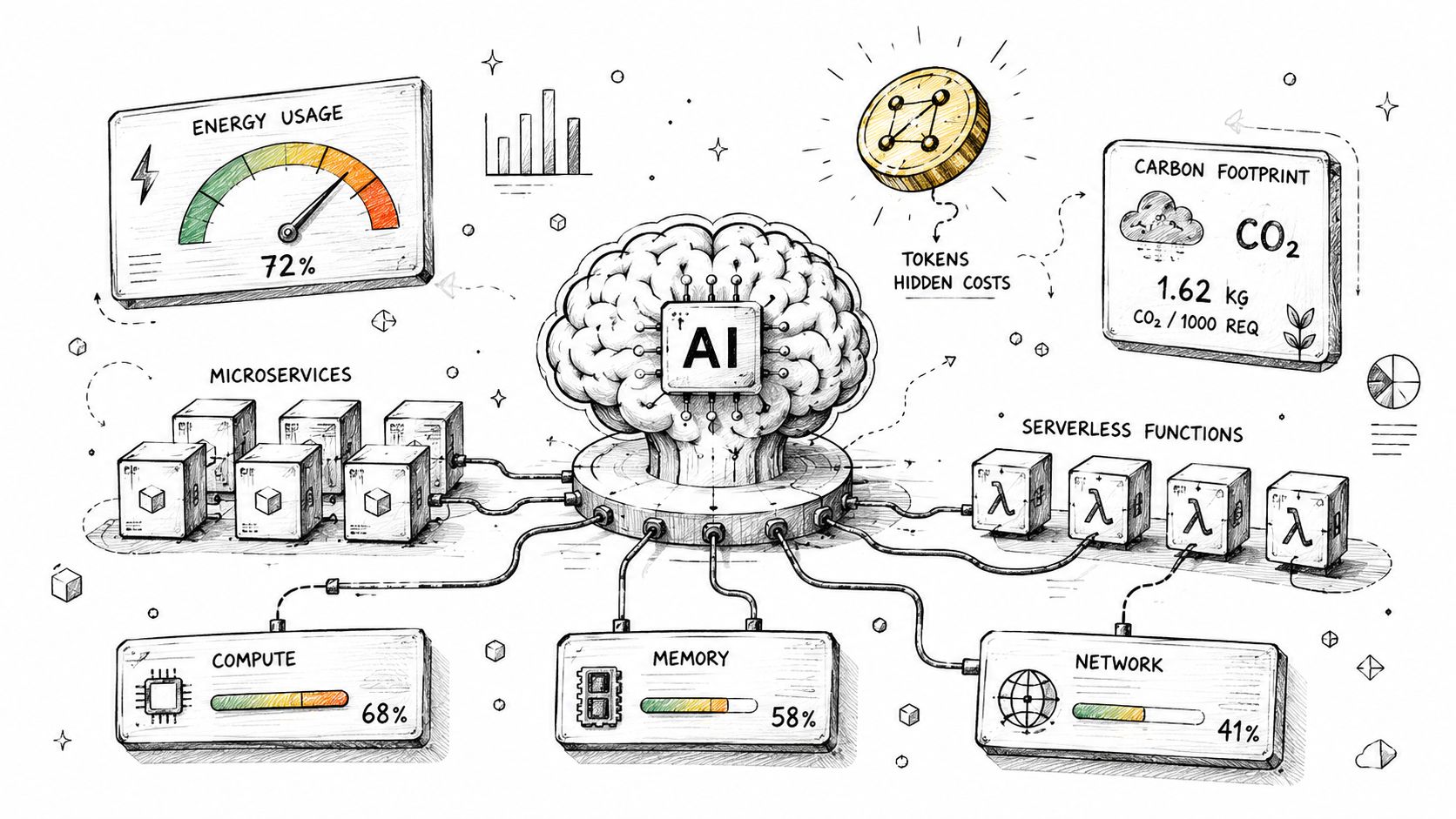
This is why AI modernization shouldn't mean "bolt on a chatbot and hope for the best." It should mean reviewing how prompts, models, services, data access, and deployment workflows interact.
The hidden costs sit in the plumbing
Teams usually notice infrastructure invoices before they notice architectural waste. But by then, the waste has already become part of the system.
A better way to analyze AI modernization is to look for hidden multipliers:
- Prompt sprawl: Different teams create overlapping prompts with no version control.
- Model mismatch: Heavy models get used for lightweight tasks.
- Loose parameter access: Services fetch more context than they need.
- Weak logging: No one can trace which prompt or setting caused bad output.
- Blind cost growth: Usage rises, but ownership stays fuzzy.
The sustainability case for improving this discipline is backed by broader evidence. In APEC nations, a 1% increase in technological innovation reduces CO2 emissions by up to 0.235%, according to research published by Frontiers in Environmental Science. That doesn't mean every AI feature is automatically efficient. It does support the idea that targeted technical innovation can lower environmental impact when it improves how systems operate.
Responsible modernization patterns
For product and engineering teams, a few patterns tend to age well:
- Version prompts like code. Prompt changes can alter cost, quality, and compliance posture. Treat them as controlled assets.
- Separate parameters from prompt text. This makes reuse easier and reduces accidental data bloat.
- Log across integrated AI services. You need a clear history of what ran, where, and why.
- Track cumulative spend by feature or workflow. Cost visibility changes product decisions faster than abstract guidance does.
If you're mapping AI adoption inside a specific vertical, it can help to see how domain professionals think about the shift. For example, this piece on understanding AI for real estate professionals shows how industry context changes what "useful AI" really means.
For broader implementation thinking, Wonderment's guide to how to implement AI in business is a practical read on fitting AI into real operating environments rather than treating it as a novelty layer.
Good AI architecture isn't the one with the most model calls. It's the one that solves the problem cleanly, visibly, and with enough control that the team can keep improving it.
Sector Specific Examples of Sustainable Innovation
The easiest way to understand innovation and sustainability is to watch how it shows up in different product environments. The principle stays the same. The pressure points change.
One trend cuts across nearly every sector. As of Q1 2026, 80% of enterprise applications embed at least one AI agent by default, according to reporting on enterprise AI agent adoption. Treated as a projection in fast-moving software markets, that points to something important. AI isn't becoming a niche add-on. It's becoming part of standard product architecture.
Ecommerce and retail
An ecommerce team might use recommendation logic, search ranking, and guided shopping flows to help people find the right item faster. The sustainability angle is not just abstract infrastructure efficiency. It also lives in cleaner buying journeys, fewer confusing paths, and less operational drag from poor discovery experiences.
Good retail teams usually learn one lesson quickly. If they personalize everything without guardrails, the experience gets noisy. The best systems stay selective and context-aware.
Fintech and SaaS
In fintech, trust and reliability matter as much as speed. Teams often use AI for anomaly detection, workflow prioritization, and support automation. Sustainable innovation here means reducing wasted processing, surfacing risk earlier, and building product behavior that doesn't force manual cleanup later.
SaaS teams face a related challenge. Their customers expect constant improvement, but sprawling features can turn every release into a maintenance burden. The more disciplined the architecture, the easier it is to modernize without constant reinvention.
Healthcare and wellness
Healthcare products sit under stricter constraints. UX has to be understandable, accessible, and careful about how information is presented. AI can support navigation, intake, summaries, and internal workflows, but sustainable innovation means keeping systems auditable and calm for users who may already feel stressed.
"Smart" design often means less, not more. Fewer confusing choices. Better handoffs. Cleaner escalation paths.
Media and content platforms
Media apps deal with fluctuating traffic, heavy content delivery, and user expectations for instant access. Sustainable innovation often shows up through better content routing, smarter scaling, and recommendation systems that improve discovery without overwhelming users.
The broader energy story matters here too. If you're interested in how infrastructure shifts are changing distributed energy strategy, this discussion of the importance of sodium ion for VPPs is a useful example of how technical design choices affect resilience and sustainability at system scale.
The shared lesson
Across sectors, the pattern repeats. Teams get the best long-term results when they define success beyond launch. They ask whether the feature remains useful, explainable, maintainable, and efficient after the excitement wears off.
Actionable Next Steps for Engineering and Product Teams
A lot of teams already know what they should improve. The challenge is choosing where to start without turning sustainability into a giant side program. Start small, but make the work visible.
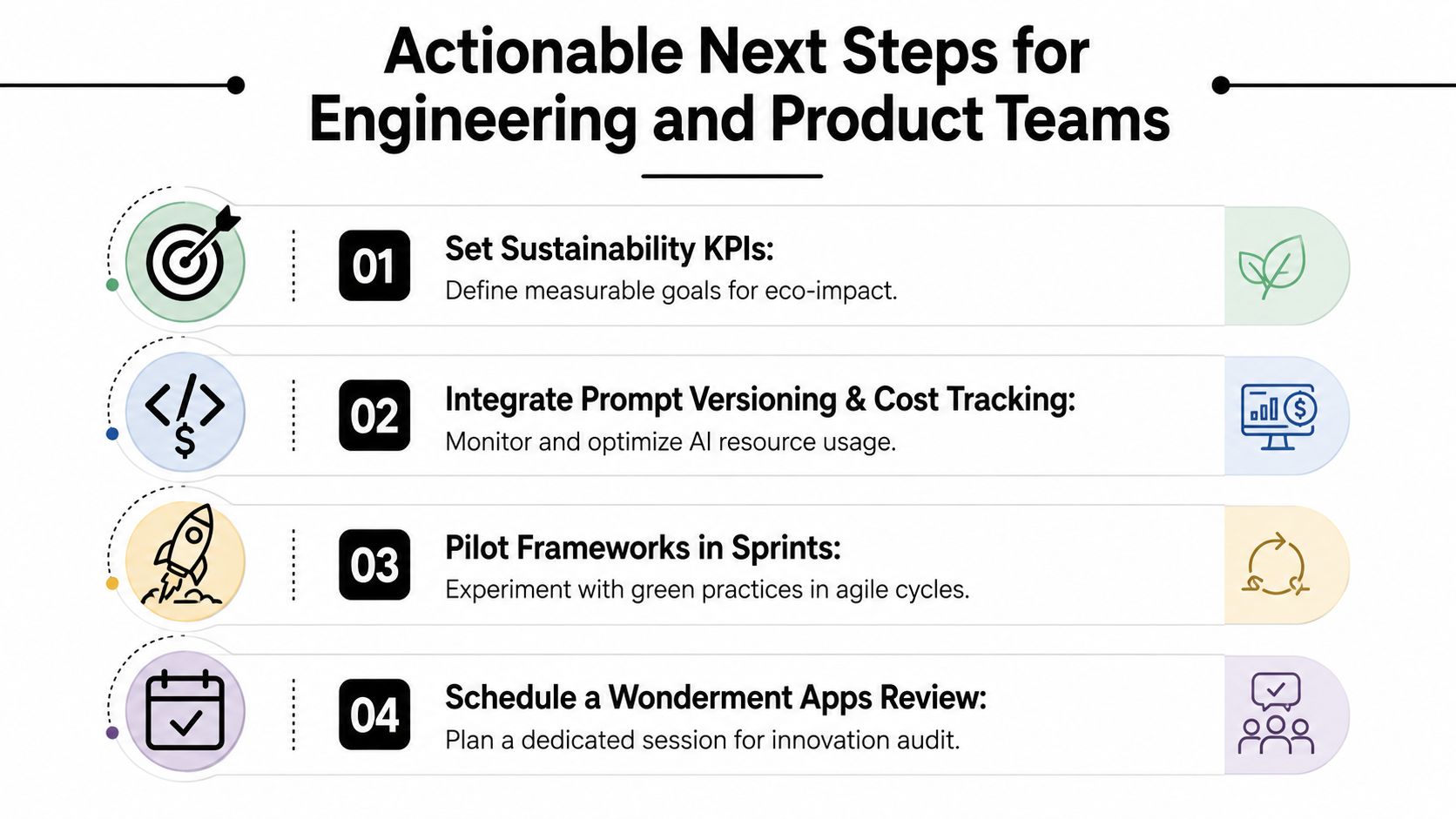
A practical checklist
- Set sustainability KPIs first. Pick a small set of measures your team can influence, such as AI usage visibility, operating cost by feature, or user-path efficiency.
- Add prompt controls to delivery workflows. Version prompts, separate parameters cleanly, and log AI activity so product and engineering can review changes with context.
- Pilot in one sprint. Choose a single feature, preferably one with meaningful traffic or support impact, and test a sustainability review inside the normal sprint cycle.
- Review architecture choices early. Before expanding AI features, check whether routing, caching, and service boundaries are helping or hurting long-term maintainability.
- Create one shared dashboard. Product, engineering, and leadership should look at the same signals, even if each group uses them differently.
Next move: Don't wait for a company-wide transformation plan. Pick one AI-powered workflow, measure it properly, and improve it with intention.
The teams that get ahead aren't the ones with the loudest innovation language. They're the ones that connect product value, engineering quality, and sustainability discipline in the same operating model.
If you're modernizing a web, desktop, or mobile product and want tighter control over AI behavior, Wonderment Apps can help. Their team builds scalable digital products and offers a prompt management system that plugs into existing software to support AI integration with a prompt vault and versioning, parameter management for internal database access, logging across integrated AI systems, and cumulative cost tracking. If you want a practical starting point, schedule a demo and review how your current product workflow could become smarter, more maintainable, and easier to govern over time.