

$80,000 to $250,000 is the realistic starting range for most funded fintech mobile products in the US and Europe. If your product has heavier compliance, deeper integrations, and a longer roadmap, the budget can move into $150,000 to $320,000+, and serious custom apps often land far above generic consumer app pricing.
That's the part most founders already suspect. The harder part is figuring out why one quote comes back looking like a scrappy MVP and another looks like a down payment on a small house.
A founder usually starts with a reasonable question: “We're not building a bank from scratch, so why is this so expensive?” Then the estimates arrive and the spread is huge. One team says they can do it lean. Another insists security, integrations, QA, and compliance will reshape the entire architecture. Both may be partly right.
That's why fintech app development cost is less about a single sticker price and more about cost levers. The big ones are compliance scope, security depth, integration count, delivery model, and whether you're adding AI. AI is where budgeting gets slippery fast, because the feature itself is only part of the spend. Prompt versioning, model controls, logs, and usage visibility suddenly become operating concerns, not just engineering details. Founders who treat that as “just an API call” usually learn the expensive way.
The Billion Dollar Question How Much Will My Fintech App Cost
A common founder moment goes like this. You've validated the problem, sketched the core flow, maybe even talked to a payment partner or banking data provider. Then you ask three shops for estimates and get answers that seem to describe three different planets.
One quote sounds suspiciously low. One sounds painful but plausible. One sounds like they're pricing for every possible audit, outage, and regulator question before you've even built onboarding.
The realistic starting range
The cleanest benchmark I've seen is this: a widely cited 2026 market guide puts FinTech app development at $80,000 to $250,000 for most funded mobile products in the US/EU, while more complex builds can reach $150,000 to $320,000+ with delivery cycles of 7 to 14+ months. The same guide notes that simple apps may still fall into the $5,000 to $50,000 range, but “serious” apps with custom backends, integrations, analytics, and proper QA commonly land at $100,000 to $500,000+ in the market according to Topflight's 2026 app development cost benchmark.
That gap matters.
A budgeting app that mostly organizes user data is not priced like a product that moves money, reconciles transactions, depends on third-party rails, and must survive compliance reviews. Fintech teams don't just build features. They build trust into the product.
Most low fintech estimates leave out the ugly work. Error handling, edge cases, reconciliation, audit trails, and post-launch hardening.
Why founders struggle to get a straight answer
The phrase “fintech app” hides too much complexity. A product can look simple in Figma and still be expensive in production because the underlying work sits behind the interface.
Here are the choices that usually decide the number:
- What money movement exists: Viewing balances is one thing. Initiating transfers is another.
- How regulated the flow is: Compliance changes architecture early, not late.
- Which external systems you depend on: Banking APIs, card processors, KYC vendors, and analytics platforms all add coordination work.
- How much intelligence you want in the product: AI can improve support, risk handling, and personalization, but it also adds another layer to manage.
That last point deserves attention. If you're adding AI to underwriting support, fraud review, search, chat, or internal operations, you'll need more than model access. You'll need control over prompts, parameters, logs, and spend. That's why founders increasingly look for admin tooling around AI integrations instead of letting prompt logic scatter across the codebase.
Decoding the Price Tag Key Fintech Cost Drivers
A founder approves a modest fintech budget based on the screens. Then the actual estimate arrives after the team maps onboarding rules, money movement logic, vendor dependencies, audit requirements, and failure handling. The gap usually comes from a few cost levers that were not priced clearly at the start.
Those levers matter more than the headline number. Change one decision around compliance scope, security posture, or AI-assisted workflows, and the budget can move fast.
Compliance changes the architecture early
Compliance work affects the product at the system level. It shapes how data is collected, where it is stored, who can access it, how actions are logged, and what must happen when something fails.
That is why a “light MVP” can get expensive quickly if it also needs enterprise procurement readiness, detailed audit trails, or controls for regulated workflows. Founders do better when they decide which controls are required for launch, which are needed for sales, and which can wait until traction is proven.
A practical trade-off helps here. Building for a narrow launch market with a limited compliance scope usually lowers early spend. Building for multiple jurisdictions, institutional customers, or complex reporting requirements raises cost because engineering, QA, and documentation all expand.
Integrations create hidden build and testing work
Integrations look cheap on a roadmap and expensive in delivery. A banking API is not just an API connection. It is auth setup, sandbox inconsistencies, webhooks, retries, reconciliation, edge cases, vendor support tickets, and monitoring after launch.
The same pattern shows up with KYC providers, payment processors, card issuing platforms, accounting tools, and fraud services. Each dependency adds another system that can fail, timeout, change behavior, or return incomplete data. That work lands on your team.
The budget question is not “Do we need integrations?” It is “Which integrations must be live for the first version, and which can stay manual for 90 days?” That choice often saves more money than arguing over hourly rates.
Security is part of the product, not a separate line item
Security work changes user flows, admin tools, backend services, and QA scope. Secure onboarding, session controls, role-based permissions, encryption, device verification, suspicious activity review, and incident logging all affect how the product behaves day to day.
In practice, stronger security usually increases upfront cost and lowers downstream risk. Weak security can look cheaper in the estimate and become expensive later through rework, delayed enterprise deals, or exposure during audits and penetration tests.
For a broader view of how reliability, testing, and integration complexity affect software budgets, Wonderment's guide to software development cost planning is useful context.
AI features can raise cost in smart or wasteful ways
AI is now one of the clearest budget levers in fintech. A narrow use case, such as support deflection, document classification, or internal analyst assistance, can add value without changing the whole architecture. A broad AI mandate usually creates extra cost in prompt management, usage controls, observability, human review, and model spend.
I usually advise founders to price AI in layers. Start with the use case. Then price the controls around it. In fintech, the model call is rarely the expensive part. The expensive part is making the output safe, reviewable, and usable inside a regulated product.
The highest-cost decisions usually come from scope discipline, not code volume
The biggest budget drivers in fintech are usually choices like these:
- Compliance depth: Broader controls and reporting requirements increase architecture and QA effort.
- Integration count: Every vendor adds setup, testing, fallback logic, and support overhead.
- Security posture: Better controls cost more upfront and reduce expensive rework later.
- AI governance: Useful AI features need logs, permissions, review paths, and spend controls.
- Operational realism: Reconciliation, exception handling, and admin workflows add real product cost.
A good estimate explains these levers directly. A weak estimate hides them inside a generic feature list and leaves the expensive parts to change orders later.
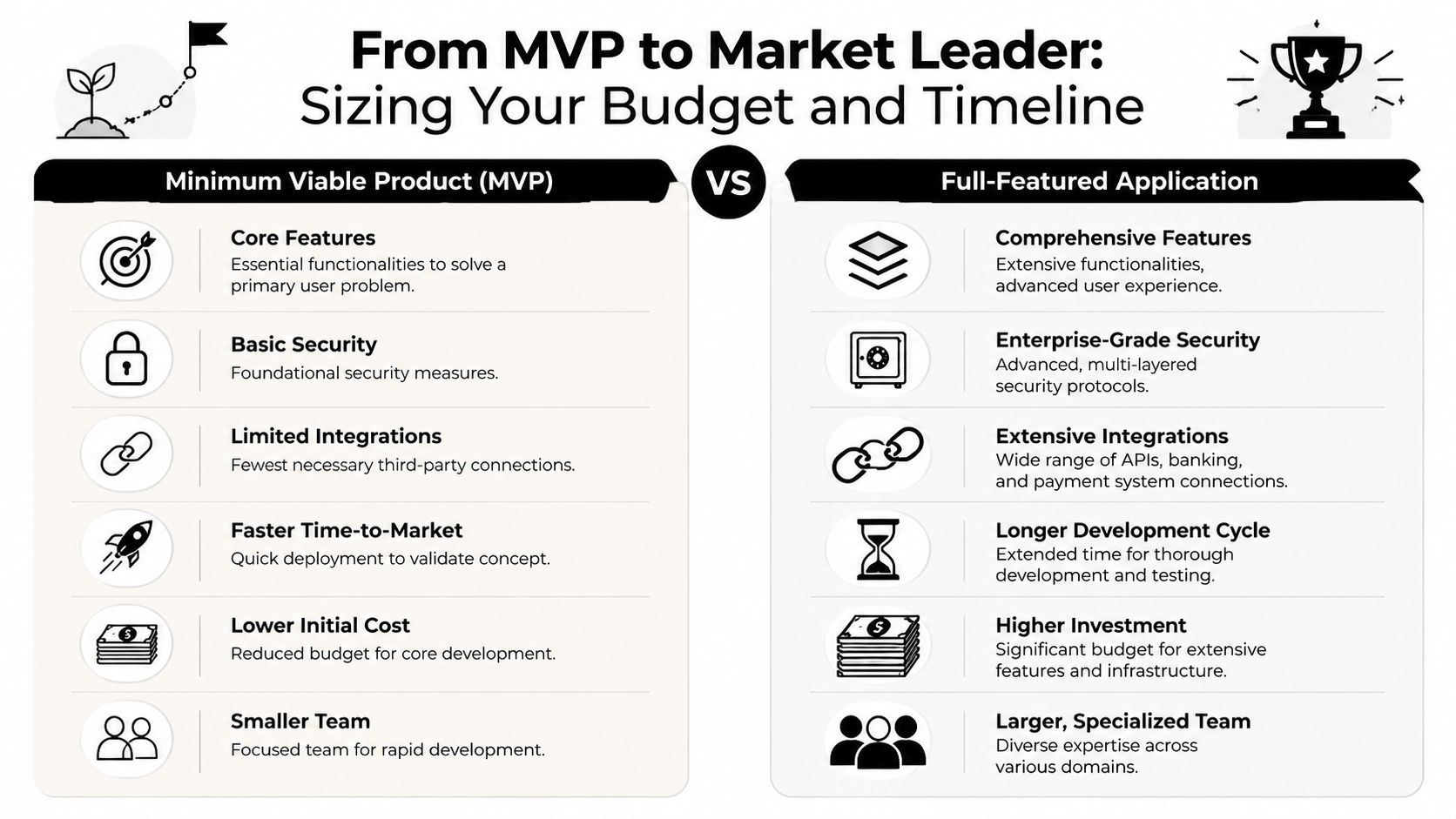
From MVP to Market Leader Sizing Your Budget and Timeline
A real fintech MVP is narrow. It tests one important assumption with real users and a defensible technical foundation. It is not a half-built “full product” with all the expensive parts delayed until later.
That distinction saves money.
What an MVP actually includes
A useful MVP has one core workflow, a small number of integrations, and enough security to avoid embarrassing mistakes. It proves that users want the experience and that the business model can work.
A weak MVP tries to imitate a category leader too early. It adds admin complexity, role sprawl, advanced reporting, and support edge cases before the team has learned anything from users.
MVP versus full product
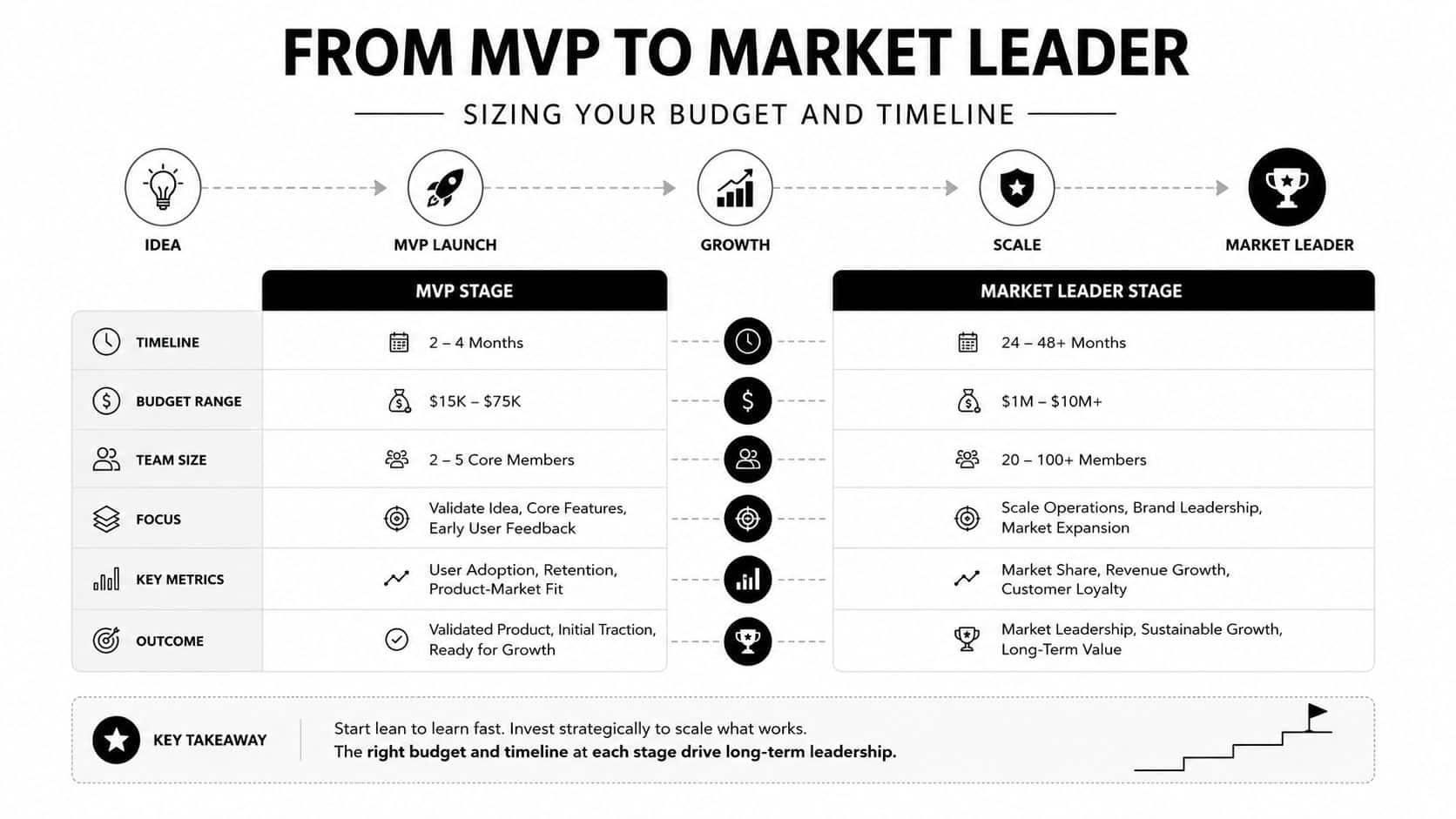
Here's the practical difference:
| Product stage | What you're buying | Budget reality | Timeline reality |
|---|---|---|---|
| MVP | A focused product to validate a core use case | Lower initial spend because scope is constrained | Faster because fewer systems must be coordinated |
| Market-ready platform | A broader product built for scale, operations, support, and resilience | Higher spend because architecture and testing expand | Longer because integrations, QA, and release rigor increase |
The mistake I see most often is calling something an MVP when it already includes the expectations of a scale-stage product. Multi-role permissions, deep analytics, support tooling, complex admin workflows, and extensive integrations all sound reasonable in planning meetings. Together, they move the budget and the delivery schedule.
When to stop keeping it lean
There's a point when “keep it simple” becomes the wrong advice. If your product depends on trust-heavy flows, partner requirements, or operational controls from day one, underbuilding the foundation can cost more than building it right the first time.
Use this decision frame:
- Choose MVP mode when you need to validate demand, onboarding behavior, or one core transaction flow.
- Choose broader product investment when partnership requirements, audit readiness, or transaction reliability are already part of market entry.
- Avoid fake staging when you know a feature is foundational but keep postponing it to hit an arbitrary launch date.
The cheapest first release isn't always the cheapest path. Some “lean” launches simply delay expensive work until it becomes urgent.
Assembling Your A-Team How Talent and Geography Shape Your Spend
A founder gets two proposals for the same fintech product. One is half the price of the other. Six months later, the cheaper team is still debating architecture, QA is thin, and compliance work is getting pushed into later sprints. The original quote was lower. The actual cost is not.

Geography affects rates, but communication and ownership affect total spend
Location changes hourly cost fast. It also changes overlap hours, documentation standards, hiring depth, and how much founder time gets pulled into decisions. A lower rate can still produce a higher final bill if the team needs more rounds to clarify requirements, misses edge cases in regulated flows, or lacks enough senior people to make security and data decisions early.
That is why geography should be treated as one cost lever, not the whole strategy.
For founders weighing distributed delivery options, this comparison of nearshore and offshore development models helps frame the trade-offs beyond hourly rate alone.
The team model changes risk just as much as price
Fintech products rarely succeed with coding talent alone. You need coordinated ownership across product, design, frontend, backend, QA, DevOps, and security review. If the roadmap includes AI, someone also has to own model behavior, access controls, and monitoring.
The common team models each come with a different budget profile:
- In-house hiring: Strong control and direct access to the team. Higher upfront cost, slower hiring, and more exposure to recruiting delays.
- Freelancers: Useful for contained tasks or short bursts of specialist work. Coordination gets expensive when architecture, compliance, and release management are split across individuals.
- Managed agency team: Faster to stand up and easier to scale by phase. The return depends on whether the agency brings senior product and technical leadership, not just capacity.
If you are comparing internal hiring with an external partner, salary context matters. Underdog's tech startup salary benchmarks are a practical reference point before you add recruiter fees, benefits, onboarding time, and management overhead.
The expensive mistake is underbuying senior judgment
Founders often focus on blended hourly rate. In fintech, the bigger question is who is making the hard calls.
A senior engineer who has shipped payment flows, audit logging, role-based access, or identity verification can prevent weeks of rework. A strong product lead can stop scope creep before it hits design, QA, and backend at the same time. A disciplined QA function catches the issues that damage trust, such as failed edge-case transfers, broken notifications, and inconsistent balances.
Cheap delivery usually gets expensive in predictable ways:
- Thin QA coverage: Money movement, permissions, and edge cases do not forgive light testing.
- No product owner: Engineers spend paid time resolving priority conflicts and writing around unclear requirements.
- Fragmented freelancers: Handoffs increase. Ownership gets blurry. Release quality drops.
- Weak security input: Teams defer audit trails, encryption choices, and access rules until late in the build, when changes cost more.
- AI added without clear ownership: The feature may ship, but prompt changes, usage costs, and review workflows remain unmanaged.
Build the team around your real cost drivers
This is the part founders miss. Team design should follow the parts of the product that create budget pressure.
If compliance is a major factor, pay for people who have handled regulated flows before. If security is a board-level concern, bring in senior backend and infrastructure oversight early. If AI is part of the product thesis, budget for the people who will manage behavior, guardrails, and ongoing tuning after launch.
The right team costs more on paper than a loosely assembled one. It often costs less by the time the product is stable, audit-ready, and fit to scale.
The AI Advantage Budgeting for Intelligent Fintech Features
AI can make a fintech product feel sharp instead of static. It can help users search transactions, surface anomalies, answer support questions, assist operations teams, and turn dense financial workflows into something easier to manage.
It can also subtly become the messiest part of your budget.
Where AI adds value
In fintech, the strongest AI use cases are usually the ones that reduce friction or improve judgment around existing workflows. That could mean support copilots, transaction explanations, internal review tools, or personalization that helps users understand what's happening in their money life.
The trap is assuming the feature cost ends at model access. It doesn't.
What founders forget to budget for
Adding AI means the team now has to manage behavior, not just code. Prompts evolve. Parameters need guardrails. Logs matter. You need visibility into what different models are doing and how usage is accumulating.
This is especially important in fintech because teams often connect AI to sensitive workflows. Even if the AI isn't making formal financial decisions, it may still influence how users act or how teams review data.
A practical budgeting conversation should include:
- Prompt management: Prompts change over time, and teams need version control.
- Parameter controls: Access rules and data boundaries can't live in scattered notes.
- Unified logging: Teams need to inspect AI output across services and workflows.
- Spend visibility: Without cost monitoring, usage drifts before anyone notices.
For a grounded look at how businesses approach this work, Wonderment's guide on implementing AI in business applications is a helpful starting point.
AI features are easiest to justify when they improve a workflow you already understand. They're hardest to budget when they're added because competitors have a chatbot.
The most disciplined fintech teams treat AI as part product feature, part operating system. That's the only way to keep it useful after launch.
Beyond the Build The Hidden Costs of Running a Fintech App
Launch day is not the end of the budget. It's the point where a one-time project turns into an operating system you now have to maintain, secure, and improve.
That's where many early estimates become misleading.
The post-launch reality
One 2026 mobile app cost guide says maintenance alone commonly runs 15% to 25% annually, and that hosting, QA, and post-launch fixes can add 30% to 50% on top of the original build budget, according to Cynoteck's mobile app cost guide.
That's not just a line item. It changes how founders should think about fintech app development cost from day one.
What keeps the meter running
After launch, the team still has real work to do:
- Security patching: Mobile platforms, frameworks, and dependencies keep changing.
- Infrastructure tuning: As usage patterns change, hosting and performance work follows.
- QA and bug fixing: Live systems expose edge cases that staging never perfectly reproduces.
- Compliance maintenance: Policies, controls, and documentation require upkeep.
A cheap build can become expensive if the architecture forces constant rework. A slightly higher upfront investment can lower operating pain if it reduces instability, rushed fixes, or recurring audit cleanup.
Why the lowest quote is often misleading
Founders often compare build proposals as if the launch budget tells the whole story. It doesn't. A lower estimate may defer testing depth, operational tooling, or maintainability decisions that you'll pay for later anyway.
The right question isn't “What will it cost to launch?” It's “What will it cost to run well for the next two years?”
That shift in thinking changes vendor selection, roadmap staging, and technical priorities. It also explains why the cheapest proposal can end up being the most expensive decision.
Smarter Spending A Sample Budget and The Wonderment Solution
A founder comes in with a $150,000 budget and asks the usual question: can this cover a fintech MVP? The better question is what that budget needs to protect first. In fintech, every major cost lever, compliance scope, security depth, integrations, and AI control, changes both the launch price and the cost of operating the product after release.
That is why I break the budget into decisions, not just phases. If trust, auditability, and one core user journey are solid, the MVP has a real chance. If the money gets spread across too many features, founders often end up with a product that looks complete in a demo and becomes expensive in production.
Sample Budget for a $150,000 Fintech MVP
| Phase / Expense Category | Description | Estimated Cost |
|---|---|---|
| Discovery and product definition | Scope control, user flows, technical planning, compliance-aware requirements | Portion of total MVP budget |
| UX and UI design | Core onboarding, transaction flows, error states, trust-building interface work | Portion of total MVP budget |
| Core application development | Mobile app and backend for the primary use case | Portion of total MVP budget |
| Security implementation | Foundational protections, secure auth patterns, data handling safeguards | Portion of total MVP budget |
| One critical integration set | The smallest viable set of payment, banking, or verification connections | Portion of total MVP budget |
| QA and release prep | Functional testing, device coverage, regression checks, launch hardening | Portion of total MVP budget |
| Contingency and post-launch buffer | Early fixes, small refinements, infrastructure adjustments | Portion of total MVP budget |
The point is not to pretend every fintech MVP should cost the same. It is to show where founders still have control.
For example, adding a second banking integration may improve redundancy, but it also increases implementation, testing, and support overhead. Tightening KYC and fraud controls early can raise upfront spend, yet it often prevents painful rework later. AI features follow the same pattern. A basic assistant can be cheap to prototype. A finance-facing AI feature with logging, permissions, prompt versioning, and cost oversight is a different budget category.
Where AI needs tighter control
AI adds another cost lever, and it is one that founders often underestimate. The model bill is only one part of it. Teams also need a way to control prompt updates, monitor outputs, track usage, and understand who changed what.
That need for an administrative layer is why we developed our own prompt management system at Wonderment Apps. It gives product and operations teams a prompt vault with versioning, parameter controls for internal database access, service-level logging across connected AI tools, and cost tracking for cumulative usage. In a fintech product, that helps keep AI features governable instead of burying key decisions inside code and scattered admin settings.
What works and what doesn't
What works:
- Cutting scope before cutting quality
- Funding the controls that reduce future rework
- Starting with the minimum integration footprint
- Treating AI as an operational system that needs governance
- Holding a reserve for post-launch fixes and tuning
What doesn't:
- Choosing the cheapest quote without checking what testing, security work, or tooling was removed
- Packing a marketplace, lending engine, admin suite, and analytics layer into an MVP
- Adding AI features without logging, access controls, and spend visibility
- Assuming launch-day architecture will hold up without ongoing investment
Founders do not need a huge first release. They need a version of the product that users can trust, the team can maintain, and the business can afford to improve.
If you're planning a fintech product or modernizing an existing app with AI, Wonderment Apps can help you map cost levers, shape a right-sized delivery plan, and show you how prompt governance, logging, and spend controls work in practice. Request a demo if you want to see what an AI-ready fintech stack looks like before those costs disappear into the codebase.