


You're probably looking at a pricing page, a promo calendar, or a product catalog that feels a little too rigid for how buyers behave. One week demand spikes, the next week inventory lingers, and a static price tag just sits there pretending the market is stable. That's why dynamic pricing strategies matter, not as a gimmick, but as a way to connect price to demand, segmentation, and operational reality.
The strongest pricing programs don't just change prices more often. They change prices with purpose, using clean data, guardrails, and systems that let teams act without creating chaos. That's also where software architecture starts to matter. If your business is going to run AI-assisted pricing, you need more than a model. You need a way to manage prompts, track decisions, control access to data, and keep an eye on cumulative AI cost before the experiment becomes a budget leak.
A large airline pricing study found that over 90% of prices changed during the observation period, and the pattern wasn't random. Prices moved by customer type, such as leisure versus business travelers, and by star rating, which shows that successful dynamic pricing is really about matching price changes to measurable demand drivers and product signals, not just turning a knob faster. That's a useful template for ecommerce, retail, travel, and any business selling perishable inventory. The practical lesson is simple, pricing works better when the software behind it understands who is buying, what they're buying, and how sensitive that buyer is to change, as described in the airline pricing study from Virginia Tech dynamic pricing research.
For leaders focused on ROI, pricing deserves the same seriousness as product or infrastructure. Research cited by Revology Analytics across 2,000 global companies found that a 1% improvement in price realization can produce a 6–7% lift in operating profit. That's why pricing teams care so much about the gap between list price and realized price, because even a small gain can have an outsized effect on profit. If you can improve realized price with automation, segmentation, and better guardrails, the upside is often larger than the team expects, as summarized in Revology Analytics' pricing research pricing strategy analysis.
1. Demand-Based Pricing
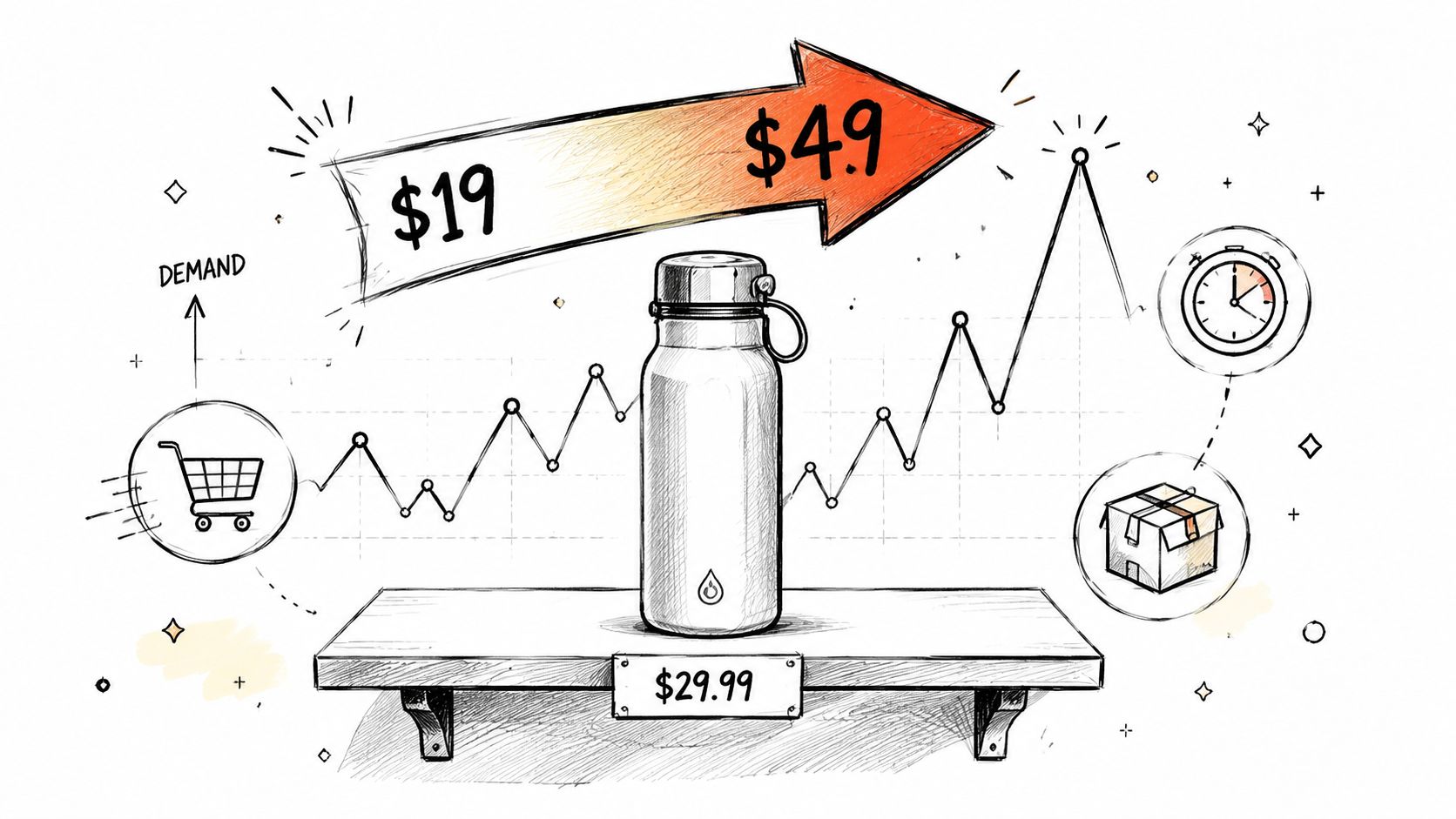
Demand-based pricing works because buyers don't behave like a spreadsheet. They show up in bursts, they hesitate, they abandon carts, and then they come back when supply tightens or urgency rises. The best systems watch current demand relative to supply and adjust prices gradually enough to protect margin without making the experience feel erratic.
The airline study above is a good reminder that demand is rarely one-dimensional. Business travelers, leisure travelers, and different product tiers don't respond the same way, so a pricing model that treats all demand signals equally usually leaves money on the table. In ecommerce, that means connecting browsing behavior, cart activity, inventory, and historical demand into one pricing layer, not a pile of disconnected rules.
What works in practice
Practical rule: raise prices in steps, not jumps. A slower ramp gives customers less reason to think they're being punished for looking at a product at the wrong time.
For teams building this into custom software, the data layer matters as much as the pricing rule. If your app can't reliably see inventory, purchase velocity, and competitor signals together, the model will only be as good as its blind spots. That's why machine-learning-based pricing in retail is so often tied to real-time systems, not offline reports.
A few implementation habits help a lot:
- Use floor and ceiling limits so automated adjustments can't wander into absurd territory.
- Tie changes to demand thresholds rather than changing prices every time a dashboard flickers.
- Keep competitor monitoring active so your offers don't drift far outside market norms.
- Train on historical demand patterns so the system learns seasonal and event-driven spikes.
- Expose the logic to operators so merchandisers can override bad recommendations fast.
If you're building the analytics stack behind that logic, the internal tooling in Wonderment Apps' machine learning for retail is the kind of foundation that makes demand-based pricing less fragile.
2. Time-Based Pricing
A hotel that charges more on Friday night than on Tuesday is using time-based pricing in a form customers usually accept without much debate. The same logic appears in utilities, where peak usage costs more and off-peak usage costs less. The schedule becomes part of the offer, so buyers can understand why the price changes.
That predictability is what makes the model practical for businesses with limited capacity, repeating demand cycles, or seasonal swings. Movie theaters, gyms, hotels, SaaS plans, and utilities all use this approach because they need to pull demand into slower periods without putting pressure on operations. The business gets a clearer way to manage load, and customers get a pricing rule they can plan around.
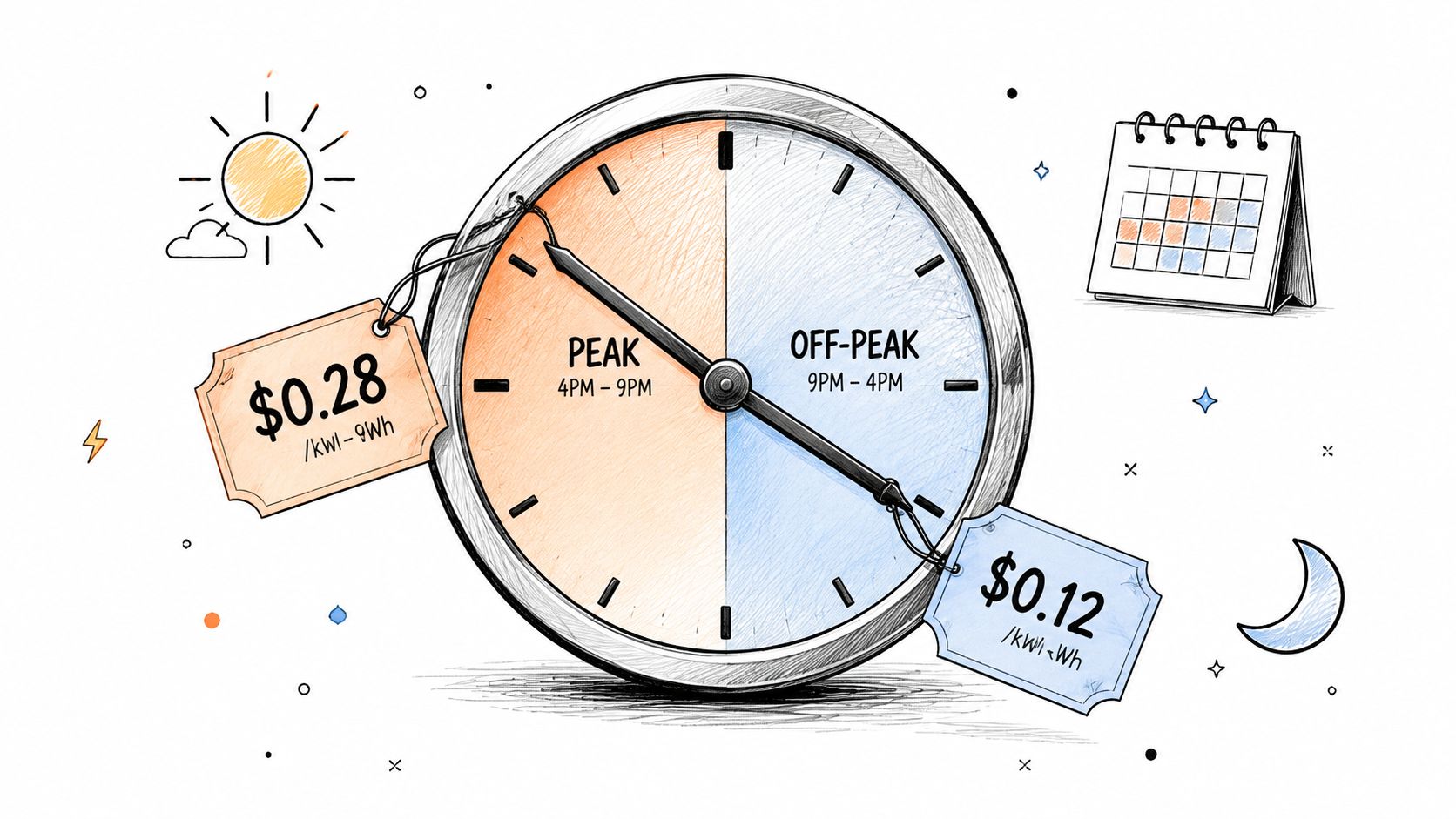
The schedule itself is rarely the problem. Confusing communication is. If an app changes prices without stating the time window, buyers usually assume the business is being opportunistic. If the rules are published clearly, the rate looks like a managed pricing policy instead of a bait-and-switch.
Where teams get this wrong
The most common mistake is setting peak and off-peak windows around internal convenience instead of customer behavior. Pricing software should learn from usage patterns, booking trends, or session timing, then help the business shape the schedule around real demand. Special events and holidays also need overrides, because a fixed calendar cannot handle every spike in activity.
A practical setup usually includes clear operational controls, not just a pricing rule:
- Match windows to real behavior, not finance team preferences.
- Explain the schedule clearly in checkout, plan pages, or booking flows.
- Use off-peak offers to make slower periods more attractive.
- Watch demand shift, because the schedule only matters if customers change when they buy.
- Build exceptions for holidays and events, since they distort normal patterns.
Time-based pricing also works well with software products that use usage tiers. A SaaS platform can keep the rules visible while the backend adjusts eligibility or usage thresholds automatically. That gives customers a model they can understand and gives operators a system they can run without constant manual intervention.
3. Competitor-Based Pricing
A shopper comparing similar products across several tabs rarely cares about your internal cost structure. They care about whether your offer looks fair next to the alternatives in front of them. Competitor-based pricing keeps your product positioned within that comparison set, so you stay relevant without guessing where the market is headed.
The point is not to copy the lowest number you can find. It is to monitor rival pricing continuously and decide how your offer should sit relative to shipping, guarantees, support, bundles, and brand trust. Strong teams treat competitor pricing as a live reference point, then pair it with rules that protect margin and preserve room for differentiation.
For ecommerce and retail software, that usually means automated price monitoring tied to fast decisioning. Manual tracking can work in a narrow category, but once the market gets noisy, it breaks down quickly. A better setup feeds competitor data into the pricing engine, then lets business rules decide whether to match, beat, or hold firm based on the commercial goal.
Pricing wars start when teams confuse competitiveness with surrender.
That warning matters most in commoditized categories. If every move triggers a counter-move, both sides lose margin while buyers learn to wait for the next discount. Competitor-based pricing works best when minimum margin floors and a clear differentiation strategy are already built into the system, so the brand can stay competitive without racing to the bottom.
Real trade-offs to manage
The hardest decision is knowing when competitor data should drive the price and when it should stay in the background. A product with faster delivery, stronger warranty terms, or better support should not be priced as if it were identical to a weaker rival. The pricing application needs enough flexibility to protect value, while still reacting to market pressure where it affects conversion.
That flexibility becomes far more useful when the software stack supports it. A pricing engine needs live market feeds, rule-based overrides, and a governance layer that lets product and revenue teams set the boundaries for each category. In practice, that means the logic can be automated without becoming blind to context.
Teams usually get better results when they:
- Track value-adds alongside price, including shipping, bundles, and service terms.
- Set margin floors before launching any price-match logic.
- Watch competitor patterns, because some rivals move predictably.
- Differentiate when possible, rather than competing only on price.
- Use brand position as a constraint, especially in premium categories.
The software architecture matters as much as the pricing idea. If a company is building AI-driven pricing rules, a prompt management system can help govern how the model interprets competitor changes, when it is allowed to react, and where human review is required. That keeps automated pricing aligned with commercial strategy instead of letting every market move trigger the same response.
This strategy fits best when the catalog is large, competitors are active, and customers can switch easily. It is less useful when the product has a clear moat, because in that case the cheapest price often reflects market noise more than real buying intent.
4. Customer Segment-Based Pricing
A first-time shopper, a loyal subscriber, and a business buyer can all want the same product, yet they rarely value it the same way. Customer segment-based pricing reflects that difference by tying offers to willingness to pay, purchase history, and buying context instead of pushing one generic price across the board.
Airlines have used this logic for years, and the split between leisure and business travelers shows why it works. Those groups buy for different reasons and accept different price points, so a single rate leaves money on the table. The same pattern shows up in SaaS, ecommerce, and subscription products through tiers, member pricing, and account-based offers.
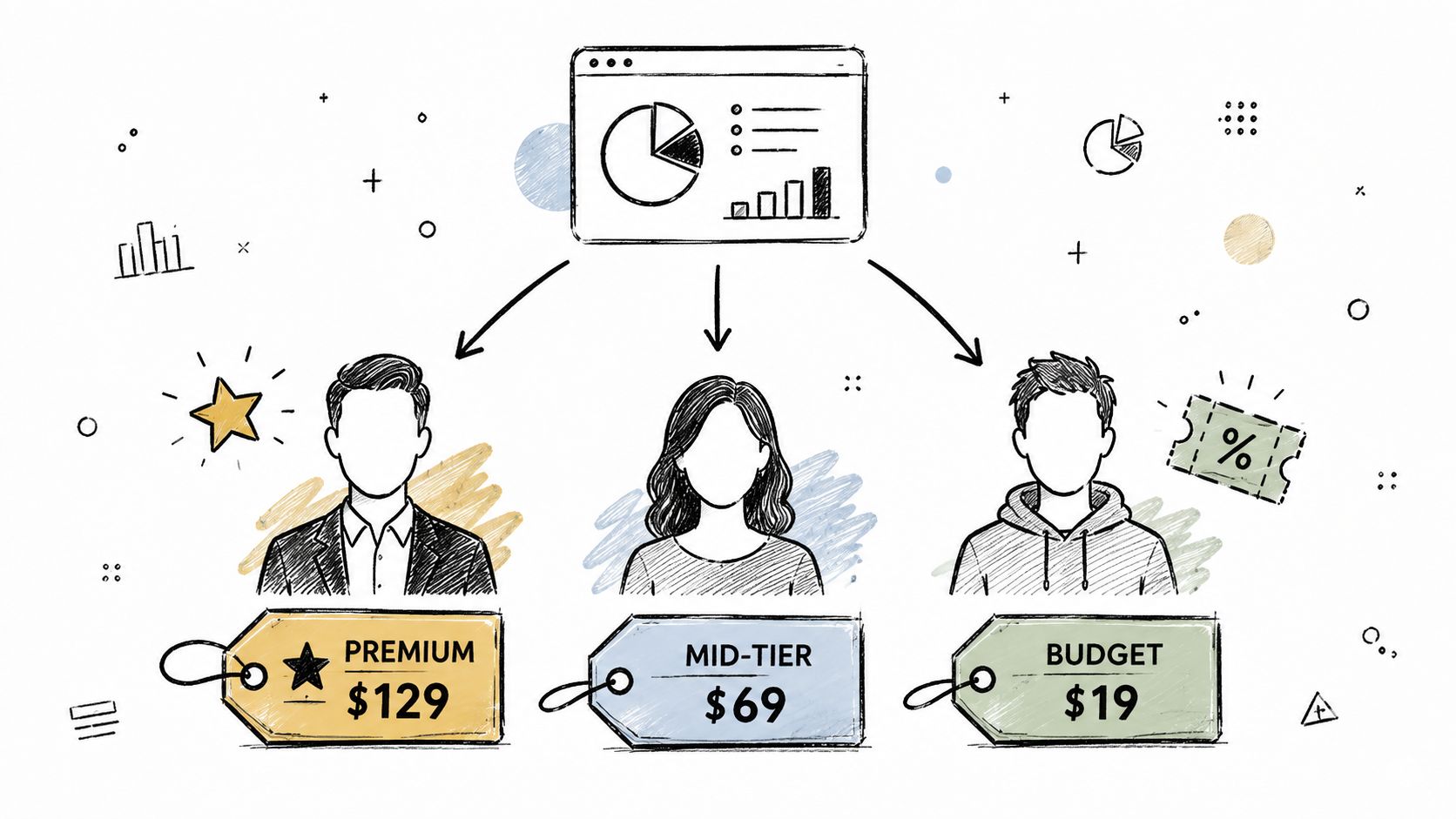
The software layer decides whether this approach is useful or messy. If your app cannot recognize behavior across sessions, channels, and devices, segment-based pricing turns into guesswork. A solid identity layer and a pricing service that applies the same rule set everywhere keep the offer consistent across the product experience.
For teams building that stack, Wonderment Apps' ecommerce personalization software shows why pricing and personalization usually depend on the same customer data backbone.
Use data before demographics
Behavioral and transactional data should lead the design. Demographics can help, but they are rarely enough on their own, and careless use can raise fairness concerns. A better approach is to start with observed behavior, then test whether the segment justifies a different price.
A practical rollout usually starts with a few clear rules.
- Behavior-first grouping, such as repeat buyers, high-intent shoppers, or enterprise prospects.
- Value alignment, so the price difference still makes commercial sense.
- Controlled testing, before segment rules reach the full customer base.
- Clear value communication, so the gap between prices feels justified.
- Dynamic updates, because customers move between segments over time.
The strongest segment pricing feels like fit, not favoritism. If buyers can see why a tier or discount exists, they are more likely to accept it. If the logic is hidden, trust drops fast, especially in consumer-facing apps.
5. Psychological Pricing
Psychological pricing works because buyers react to how a price looks, not just what it adds up to. A number like $9.99 often feels lighter than $10, even though the difference is small. A higher anchor can make a mid-tier plan look more reasonable, and a decoy option can steer attention toward the package you want buyers to choose.
That effect is useful, but only when the presentation is clear. In software, ecommerce, and subscription products, buyers are already comparing features, usage limits, support levels, and renewal terms. Pricing psychology should help them make that comparison faster, not hide the underlying trade-offs.
The practical goal is straightforward. Shape perception without breaking trust.
Make the choice feel easier, not forced
A decoy tier only works when each option has a clear job. If the plans are muddy or too similar, buyers do not feel guided, they feel trapped. That is a real risk in SaaS pricing, where the decision is rarely about a single number and more often about fit, scope, and expected ROI.
A pricing page usually benefits from a few specific patterns:
- Charm pricing for consumer-facing offers where the ending digit affects how the price is read.
- Decoy tiers when the goal is to make a preferred middle plan look like the most sensible choice.
- Bundling when the business wants to raise the perceived breadth of the offer.
- Prestige pricing when the price itself needs to signal quality or exclusivity.
- Anchoring when a higher reference price helps the target plan look justified.
The strongest psychological pricing respects the customer's judgment. It gives buyers a cleaner way to compare, which often improves conversion without creating regret after the sale. If the framing feels manipulative, trust erodes fast, and that shows up later in support requests, refund pressure, or negative reviews.
6. Cost-Plus Pricing With AI Optimization
Cost-plus pricing is the old reliable. Add a margin to known cost, and you've got a price you can defend. It's simple, auditable, and easy to explain to finance. The problem is that static markup leaves money on the table when demand shifts or when one category can bear a better margin than another.
AI makes cost-plus pricing smarter without throwing away its discipline. Instead of applying the same markup everywhere, the system can adjust within cost thresholds based on demand, competition, seasonality, and product velocity. That creates a hybrid model that keeps the floor safe while still letting the business optimize.
This is especially useful in retail and ecommerce, where cost data already exists but the margin opportunity varies widely. A fast-moving item may tolerate a different markup than a slow mover. A department with tight inventory can use pricing to protect profitability, while another category may need a softer approach to stay competitive.
Practical rule: cost-plus should define the guardrail, not the final answer.
The implementation challenge is data hygiene. If cost accounting is stale or inconsistent, the model will optimize the wrong inputs and scale the mistake faster than a spreadsheet ever could. That's why the finance and pricing teams need the same source of truth.
A solid AI-assisted cost-plus system usually includes:
- Regular cost refreshes, so the base is accurate.
- Category-specific margin targets, rather than one flat markup.
- AI alerts on high-sustaining products, where the business can push harder.
- Margin realization tracking, so list assumptions get tested against actuals.
- Inventory-turnover inputs, because slow movers and hot sellers need different treatment.
This model isn't flashy, but it's one of the easiest ways to bring AI into pricing without losing control. For many leaders, that's exactly the right starting point.
7. Subscription and Tiered Pricing Models
Subscription pricing is where dynamic pricing and product design start to overlap. You're not just charging for access, you're shaping how customers move through value over time. Tiered models let you serve budget-conscious users, mid-market accounts, and enterprise buyers with one commercial structure.
That flexibility matters because recurring businesses need predictable revenue and room for expansion. A free or low-friction tier can reduce acquisition resistance, while premium tiers capture more value from high-intent customers. Streaming platforms, SaaS tools, membership programs, and subscription boxes all use this logic because the lifetime relationship matters more than one isolated transaction.
The hard part is tier design. If every tier looks too similar, buyers stall. If the leap between tiers is too aggressive, they churn or never upgrade. The middle tier often carries the most conversion pressure, so it needs to feel like the obvious practical choice.
Tiering should map to value, not just features
The strongest tier structures line up with actual customer needs. A startup doesn't need the same controls as an enterprise account, and a casual user doesn't need every advanced feature packaged into the entry plan. That makes the commercial ladder feel coherent instead of arbitrary.
A few useful habits:
- Keep tiers distinct, with clear feature boundaries.
- Make the middle tier attractive, because it often drives the best mix of adoption and revenue.
- Use freemium carefully, so acquisition friction drops without creating dead-end users.
- Watch tier migration, because upgrade behavior tells you whether the structure works.
- Test new pricing on new customers first, before changing the base.
This model also rewards good engineering. Billing logic, entitlement handling, and plan migration all need to be reliable, or customers will feel the friction long before finance sees the data.
8. Geolocation-Based Pricing
A customer in one market may see a fair price, while a customer in another market sees a number that feels out of step with local conditions. That is the core reason geolocation-based pricing exists. SaaS products, streaming plans, and digital services often cannot rely on one global price without creating obvious misalignment, so regional pricing tries to reflect the market as it is, not as a headquarters spreadsheet assumes it to be.
The harder problem is implementation. Teams need location detection, billing rules, and guardrails that distinguish between countries instead of leaning on rough IP guesses. If the system is sloppy, customers notice fast, and any sense of unfairness becomes a product and brand problem, not just a pricing problem.
Spotify's country-specific subscription pricing shows how this works in practice, with different plans for India and the U.S. The difference is not only about currency. It reflects local market conditions and purchasing power, the same logic used in regional software licensing, gaming platforms, and international marketplaces.
Fairness depends on explanation
Geolocation pricing often triggers pushback because buyers see it as arbitrary unless the business makes the logic visible. Good teams explain the rationale where they can, and they ground the price difference in local market reality instead of hidden experiments that customers may eventually uncover.
The operating checklist is practical:
- Fraud detection keeps buyers from gaming regional pricing.
- Local competition checks help the company set prices against the conditions in each market.
- Purchasing power alignment keeps the price credible for the region.
- Transparent messaging gives support teams and product pages a clear explanation when one is appropriate.
- Regional monitoring catches arbitrage attempts and unusual behavior before they spread.
For global software products, this model can create real revenue lift without forcing one price onto every market. It also requires governance. Once buyers believe geography is being used to overcharge them, trust is much harder to rebuild.
9. Bundle Pricing and Cross-Sell Pricing
A customer is ready to buy, but the cart still feels incomplete. A bundle can turn that hesitation into a clearer decision by grouping related items under one price, while cross-sell pricing adds a complementary item at the point where the buyer is already evaluating value. Both approaches can lift average transaction value, move slower inventory, and reduce the number of price comparisons a buyer has to make.
The strongest use cases show up in ecommerce, SaaS, retail, hospitality, and telecom, where products naturally travel together. Microsoft Office bundles are the obvious reference point, but the same logic appears in combo meals, hotel packages, and product-page recommendations that pair one item with another. The commercial result is straightforward, the customer spends more because the offer feels coordinated and the decision feels easier.
The difference between a smart bundle and a weak one is relevance. Good teams build offers from purchase history, browsing behavior, and product affinity, so the package reads like a useful shortcut instead of a random discount stack. That matters for margin and for trust. If the mix feels forced, buyers ignore it or assume the business is padding prices elsewhere.
For teams evaluating package pricing, boost AOV with bundle pricing is a useful reference for how bundles can raise order value without asking the customer to do more work.
Make the bundle feel like a deal
The savings story has to be legible. If the discount is too small, the bundle looks cosmetic. If it is too deep, buyers start questioning the standalone price of every item in the package. The practical target is a discount that feels meaningful while still leaving room for margin and future testing.
Bundle design usually works better with a clear operating rule set:
- Behavior-based product pairing, so the offer matches what buyers already do.
- A few strong combinations, instead of a long list of package variations.
- Visible savings, so the value is easy to evaluate quickly.
- Checkout placement, where the buyer has already committed attention.
- Ongoing performance tracking, because bundle appeal changes as inventory and demand shift.
Cross-sell pricing depends on timing as much as offer design. A recommendation engine can surface the right add-on at the moment of highest intent, and the product experience can present it without making the buyer feel cornered. That is also where software architecture starts to matter. Teams need rules for which products can be paired, how pricing logic is approved, and how prompts or AI-generated recommendations are governed inside the system. A practical approach to prompt management for pricing systems helps keep those recommendations consistent as the catalog, the model, and the business rules change.
10. AI-Driven Predictive Pricing With Prompt Management and Cost Optimization
A pricing team sees demand start shifting before the revenue report catches up. That is the practical value of predictive pricing. The model looks at historical sales, market movement, customer behavior, seasonality, events, and other signals, then suggests prices that are more likely to perform well under the next wave of demand.
The hard part is not the forecast itself. It is the system around it. Once a model produces a recommendation, the business still needs prompt control, versioned logic, access rules for sensitive data, decision logs, and a clear view of cloud usage. Without that governance layer, pricing decisions become difficult to audit and expensive to operate.
Wonderment's prompt management system fits that operational gap. It gives teams a version-controlled prompt vault, a parameter manager for internal database access, a logging system across all integrated AIs, and a cost manager that helps entrepreneurs see cumulative spend before it gets out of hand. For pricing teams, those controls matter because model behavior, data access, and budget discipline all sit in the same workflow. A pricing engine can only be trusted when the prompts, data inputs, and approval paths are controlled with the same care as the pricing logic itself.
The market has already moved in that direction. A 2025 industry synthesis reports that 53% of ecommerce companies use some form of dynamic pricing, 58% of large retailers use AI pricing tools, and 72% of airlines/hotel chains use AI revenue-management systems. It also reports that 72.8% of implementations are cloud-based because they support real-time data ingestion and continuous model updates. Those figures show that AI pricing is no longer a side experiment, it is part of the operating model. Teams comparing tools often start with predictive analytics software for 2025, then narrow the stack based on governance, integration depth, and cost control.
Execution patterns are shifting too. Industry research says machine-learning-based pricing holds 34.7% of the AI-powered dynamic pricing retail market, ahead of rule-based pricing at 24.2%, real-time pricing at 19.3%, and personalized pricing at 14.1%. The report connects that shift to stronger CDP integration, loyalty-data activation, and electronic shelf labels that can update prices in seconds AI-powered dynamic pricing retail market research.
A practical pricing engine should behave like software, not a spreadsheet.
It needs a clear objective, guardrails around the output, and an audit trail that explains why a price changed. It also needs people who can review model behavior and decide whether the system is helping margin, conversion, or revenue, because pricing changes affect both customer trust and compliance.
Useful implementation habits include:
- Start with one objective, such as revenue, margin, or conversion.
- Validate data quality early, before model training begins.
- Constrain outputs with guardrails, so the AI cannot make reckless moves.
- Run A/B tests, before broad rollout.
- Log every pricing decision, so the team can review model behavior.
- Version prompts and parameters, so the process is reproducible.
- Track API and cloud usage, because pricing intelligence can get expensive fast.
For teams modernizing their AI stack, Wonderment Apps' prompt management tools are a useful reference point because pricing systems need governance as much as they need intelligence.
Top 10 Dynamic Pricing Strategies Comparison
| Strategy | Implementation complexity | Resource requirements | Expected outcomes | Ideal use cases | Key advantages |
|---|---|---|---|---|---|
| Demand-Based Pricing | High, real-time algorithms and integrations | Robust data infrastructure, inventory integration, ML models, monitoring | Maximize revenue during peaks; better inventory turnover | Ecommerce, ticketing, ride-hailing, retail with volatile demand | Revenue uplift in peaks; responsive inventory management |
| Time-Based Pricing (Peak vs. Off-Peak) | Low–Medium, scheduled rules and automation | Scheduling/calendar systems, basic automation, clear customer communication | Smoothed demand across time; improved capacity utilization | Utilities, theaters, hotels, gyms, seasonal services | Predictable pricing; easy customer understanding and planning |
| Competitor-Based Pricing | Medium, continuous market monitoring and triggers | Price scraping/feeds, pricing engine, dashboards | Maintain competitiveness; reduce lost sales to cheaper rivals | Highly competitive retail, gas stations, online marketplaces | Quick market alignment; clear benchmark-driven decisions |
| Customer Segment-Based Pricing | High, segmentation and personalized delivery | Customer data platform, analytics, personalization engine | Capture more willingness-to-pay; improved retention and conversion | SaaS, subscriptions, ecommerce with rich customer data | Tailored pricing; higher conversion and customer lifetime value |
| Psychological Pricing | Low, pricing tactics and tests | A/B testing, UX/copy updates, pricing experiments | Improved conversion rates and perceived value | Retail, ecommerce, consumer subscriptions, restaurants | Boosts conversions without cost change; positions perceived value |
| Cost-Plus Pricing with AI Optimization | Medium–High, cost systems plus AI markup tuning | Accurate cost accounting, AI for markup optimization, ERP integration | Ensured margins with optimized markups; predictable profitability | Retail, grocery, manufacturing, businesses with known costs | Profitability controls; simple-to-audit methodology with optimization |
| Subscription and Tiered Pricing Models | Medium, tier design and recurring billing | Subscription management, billing systems, product and support ops | Predictable recurring revenue; higher customer lifetime value | SaaS, streaming, membership services, subscription ecommerce | Recurring revenue; clear value segmentation and expansion paths |
| Geolocation-Based Pricing | High, localization and compliance complexity | Geolocation detection, localization, tax/shipping integration | Region-optimized pricing; improved conversions by market | International ecommerce, global SaaS, digital content platforms | Captures local purchasing power; localized market penetration |
| Bundle Pricing and Cross-Sell Pricing | Medium, bundle logic and recommendation systems | Recommendation engine, inventory coordination, UI/checkout changes | Increased average order value; faster clearance of slow SKUs | Ecommerce, retail, telecom bundles, quick-service restaurants | Higher AOV; efficient inventory clearance and cross-sell lift |
| AI-Driven Predictive Pricing with Prompt Management and Cost Optimization | Very high, advanced ML, governance and prompt/version control | Large data infrastructure, ML/data science teams, prompt management, cost monitoring | Proactive, multi-factor price optimization; continuous revenue improvement | Large marketplaces, enterprise ecommerce, airlines, hospitality at scale | Holistic, proactive optimization with auditability and scenario modeling |
From Strategy to System Building Your AI Pricing Engine
Dynamic pricing isn't a “set it and forget it” strategy. It's a living system that has to be built, monitored, and improved as market conditions change. The more AI you introduce, the more important it becomes to control the logic, track performance, and keep the operating cost visible. That's where many teams get stuck. They can describe the pricing idea, but they don't yet have the software discipline to run it safely at scale.
The strongest pricing programs treat pricing as a product capability, not a one-off campaign. They define rules, test outcomes, document changes, and give operators a way to intervene when the model drifts. They also make sure the AI layer is governed, because once pricing recommendations start touching revenue, inventory, and customer trust, loose process turns into expensive noise.
That is exactly the problem Wonderment's AI prompt management system is built to solve. The platform gives teams a version-controlled prompt vault for keeping pricing logic organized, a parameter manager for secure internal data access, a unified logging system for auditability across integrated AI tools, and a cost manager so leaders can see cumulative spend instead of discovering it after the fact. For business leaders, that means the pricing engine can stay intelligent without becoming opaque.
This matters most when pricing logic spans multiple channels, regions, or customer segments. An ecommerce team may need one set of rules for flash sales, another for subscriptions, and another for premium bundles. A SaaS company may need pricing prompts that interact with usage data, entitlement data, and sales-led exceptions. A retail platform may need to balance demand spikes with inventory protection. The more moving parts you add, the more you need a governance layer that keeps the whole system coherent.
There's also a practical ROI angle here. If a small improvement in price realization can have a material impact on operating profit, then the software controlling that improvement deserves serious engineering attention. Clean data pipelines, clear prompt versioning, and strong monitoring aren't overhead. They're part of the pricing margin.
If you're modernizing an app, storefront, or internal revenue workflow, this is the moment to treat pricing infrastructure as a strategic asset. Wonderment Apps helps teams build AI-ready software, integrate the right models, and add the administrative controls that keep complex systems manageable over time. Visit Wonderment Apps to see how a governed AI pricing foundation can help your team move faster without losing control.