

Your software product is doing well. A few customers have become many, each with its own users, settings, permissions, integrations, and expectations. The uncomfortable question arrives when the original deployment model starts to strain: should every customer receive a separate environment, or should one carefully designed platform serve everyone?
That question defines multi-tenant architecture. It affects operating cost, release speed, customization, security, recovery, and the amount of evidence you can provide when a customer asks how their data stays separate. It also matters when you modernize an existing application with AI. A shared application can gain prompt management, model integrations, logging, and spend controls without requiring a complete rebuild, provided its tenant boundaries remain clear.
Why Shared Architecture Matters for Growing Products
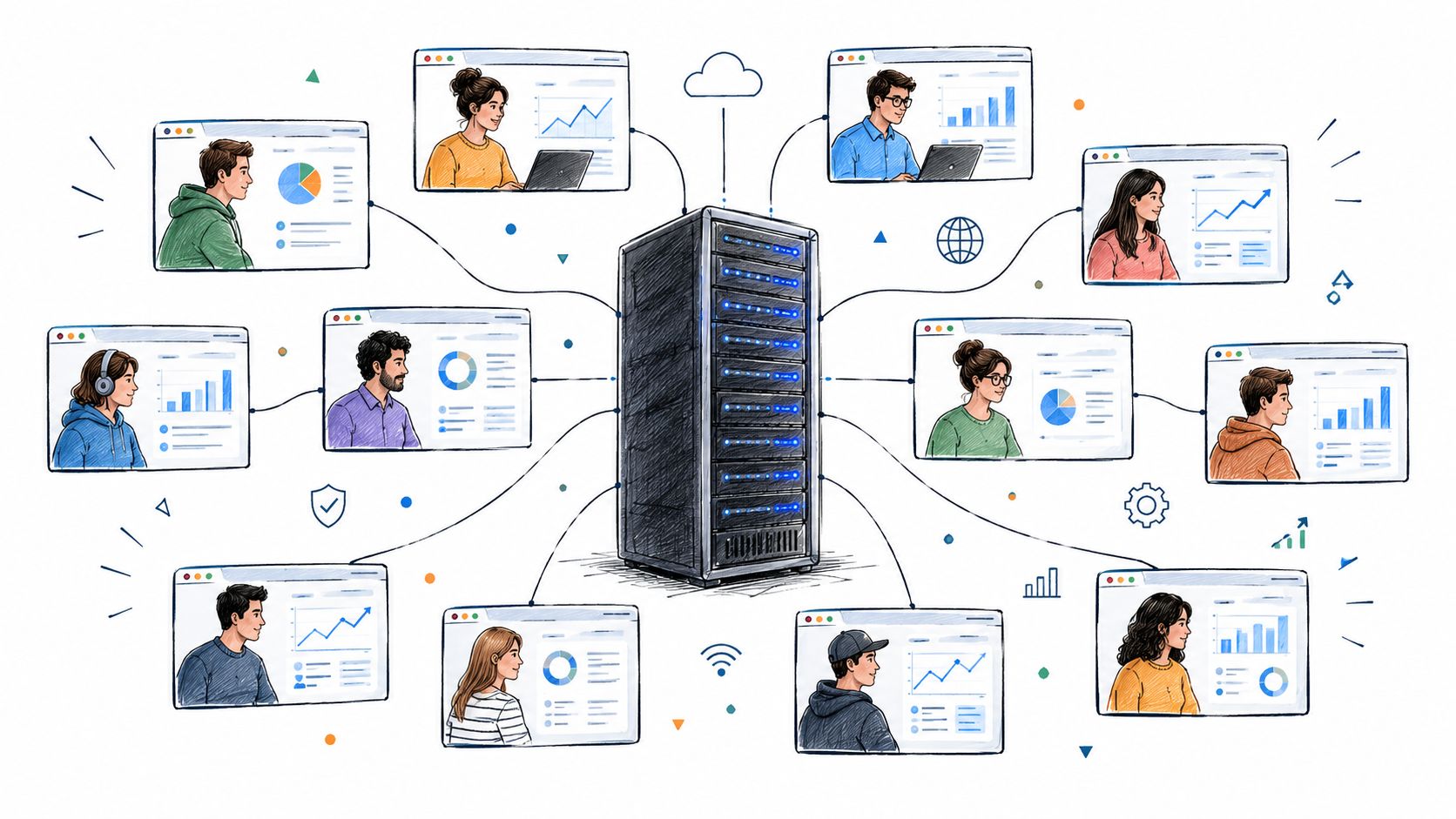
A retail platform may begin with one merchant, one database, and one operations team. Then other merchants arrive. They need separate catalogs, staff permissions, customer records, promotions, reports, and integrations, but they still expect the same polished product. If the engineering team copies the entire application for every merchant, each new customer creates another deployment to patch, monitor, scale, back up, and troubleshoot.
That model can work when customers require deep customization or strict physical separation. It becomes awkward when the product has a common core and customers mainly need their own configuration and data. A multi-tenant platform keeps the shared application capabilities in one operating model while assigning every customer a logical boundary inside that platform.
The business problem behind the pattern
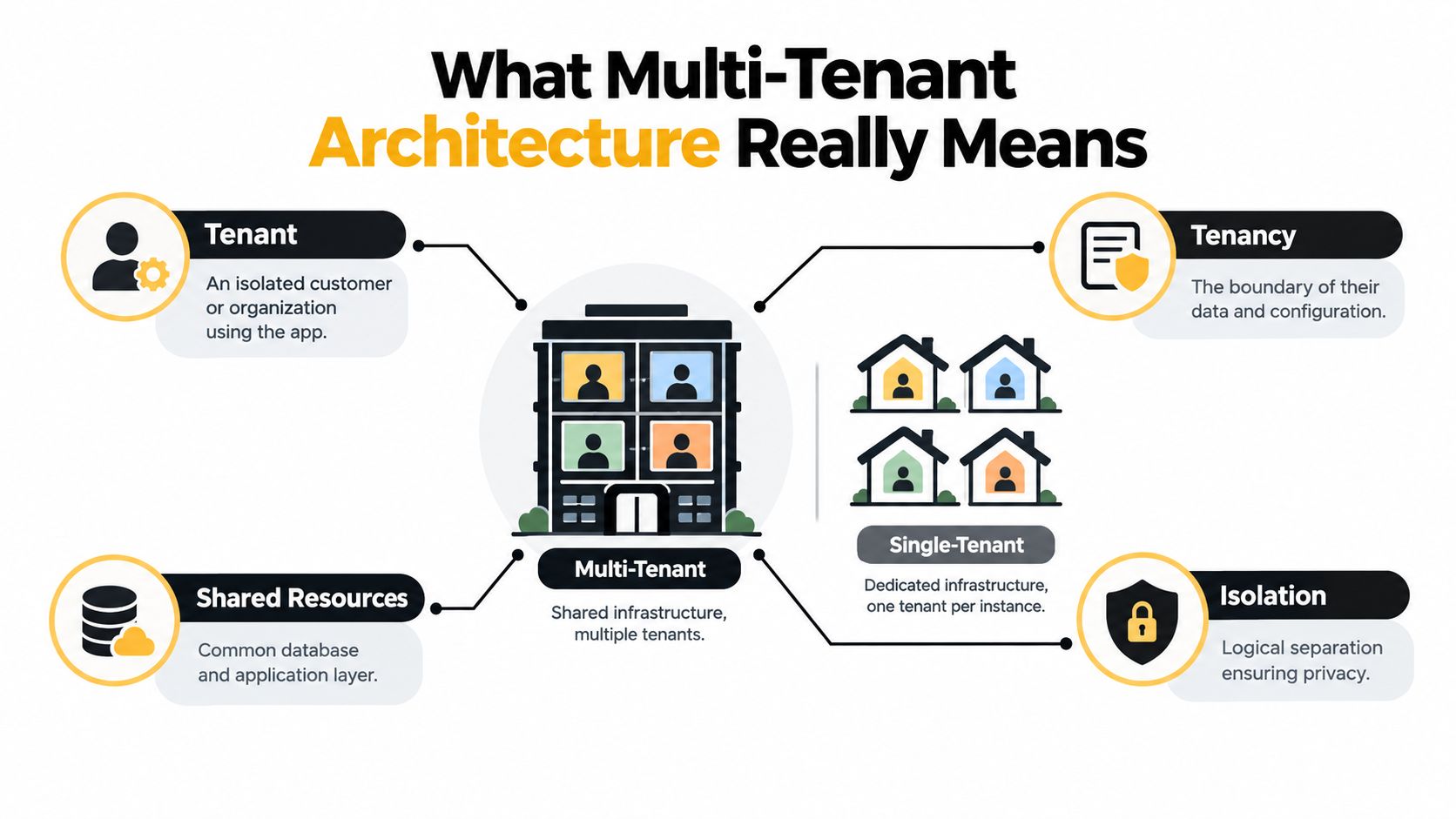
Separate environments give each customer a private house. The arrangement is easy to explain, but the provider must maintain every house independently. Shared architecture resembles a professionally managed building. Residents have private apartments, while the building's elevators, utilities, security desk, and maintenance systems serve everyone.
The analogy has limits, because software isolation depends on engineering controls rather than walls. Still, it captures the central promise:
- One product foundation: Teams can develop and release common functionality through a coordinated platform.
- Shared operating effort: Infrastructure and core services can support multiple customers instead of being duplicated for every account.
- Tenant-specific experience: Each organization can retain its own records, users, settings, and permissions.
- Centralized modernization: Existing applications can add capabilities such as AI-assisted workflows without creating a separate modernization project for every customer.
Wonderment Apps works in this broader space of scalable web and mobile product development, including modernization of established software for AI integration. Its prompt management system is one example of the kind of administrative layer a shared application may need, with controls for prompts, integrations, logging, and AI-related spending. The architecture decision still comes first. If tenant context is unreliable, adding more features only gives the failure more places to hide.
Practical rule: Treat tenancy as a product decision, not just a database decision. It determines what customers can trust, what operators can change, and how quickly the platform can recover.
The useful questions go beyond “Can we share infrastructure?” You also need to ask what happens when a request loses its tenant identity, whether a background job can cross a boundary, how a noisy customer affects others, and whether you can restore one organization without disrupting the rest.
What Multi-Tenant Architecture Really Means
A tenant is an independent customer, organization, team, or account using the same software product. Tenancy describes the boundary around that customer's data, configuration, permissions, and activity. Isolation means the platform prevents one tenant from reading, changing, or improperly affecting another tenant's resources.
An apartment building provides a useful starting analogy. The building, plumbing, reception desk, and maintenance systems are shared. Each apartment has its own occupants and belongings. In software, the application code and some infrastructure may be shared, while the platform still needs to keep each tenant's records and configuration separate.
How the idea developed
The roots of multi-tenancy reach back to 1960s time-sharing systems, when organizations rented shared mainframe computing time to reduce costs. In the 1990s, application service providers hosted traditional applications for multiple customers. The model became more mature in the early 2000s alongside SaaS and cloud computing. Salesforce, founded in 1999 and launched in 2000, is widely cited as an early enterprise-scale multi-tenant platform because it served many customers from shared infrastructure rather than separate deployments. These historical details are summarized in the history of multitenancy.
The key distinction isn't whether customers share a physical machine. They may share application code, databases, compute, or network services. The distinction is whether the platform can serve multiple independent tenants while maintaining a dependable boundary between them.
Multi-tenant versus single-tenant
In a single-tenant model, each customer receives a dedicated application environment, and sometimes dedicated databases or infrastructure. That arrangement can simplify isolation and customer-specific changes, but it creates more environments for teams to operate.
In a multi-tenant model, customers use a common platform. Their data can be separated through tenant identifiers, schemas, databases, runtime policies, or a combination of these controls. Shared does not mean public, and dedicated does not automatically mean secure. A dedicated deployment can still have weak identity controls, while a shared platform can enforce strong boundaries at several layers.
For leaders evaluating an architecture, cloud-native architecture guidance provides useful context because tenancy choices affect deployment, scaling, observability, and service boundaries. For a broader discussion of the trade-offs, review these cost and security insights for CEFs. The plain-English explanation is simple: one product serves many customers, and the architecture decides how their resources are separated.
Comparing Tenancy Models From Shared Schema to Isolated Resources
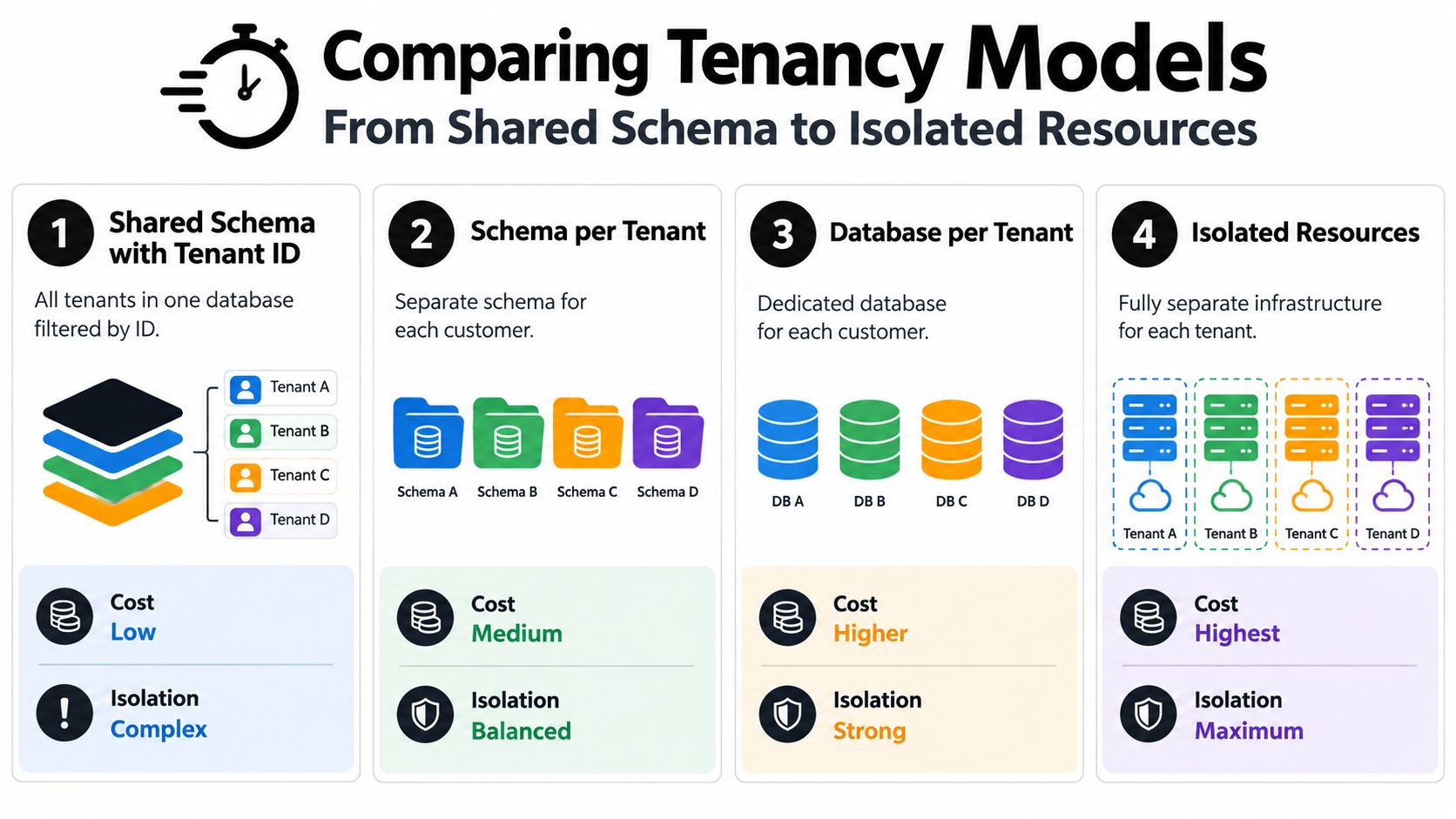
Teams don't choose between “shared” and “separate” as if those were the only two settings. Multi-tenancy is a spectrum. At one end, every tenant shares application services and database tables. At the other, every tenant receives isolated infrastructure. Between those points sit schema-per-tenant, database-per-tenant, and hybrid arrangements.
A shared schema commonly places all tenant records in the same tables, with one or more tenant-identifier columns used to retrieve the correct rows. Static code and reference data can be stored once for everyone. Microsoft's Azure SQL SaaS tenancy design guidance describes this pattern and its central trade-off, multiple tenants' data is stored together, so the platform gives up some tenant isolation in exchange for efficiency.
The main implementation choices
Shared schema keeps tenant data in common tables and filters records by tenant identity. It usually offers the simplest centralized operations and efficient resource use, but the application and database must enforce every boundary consistently.
Schema per tenant gives each customer a separate schema inside a shared database. It provides a clearer organizational boundary than shared tables, while still requiring teams to manage schema creation, migrations, connection behavior, and reporting across tenants.
Database per tenant assigns each customer a dedicated database. Isolation and tenant-level recovery become more straightforward, but provisioning, upgrades, backups, monitoring, and connection management become heavier.
Isolated resources per tenant extends separation to application deployments, compute, networking, or cloud accounts. Azure's multitenant checklist describes a spectrum that reaches from shared infrastructure to isolated resources for every tenant. AWS likewise explains that shared-resource environments can enforce boundaries through runtime policies, IAM, VPCs, accounts, service decomposition, and application controls, so full infrastructure silos aren't the only route to isolation. See the AWS tenant-isolation strategies for that perspective.
Tenancy Model Comparison for SaaS Teams
| Tenancy Model | Isolation Level | Cost Efficiency | Best Fit |
|---|---|---|---|
| Shared schema | Logical isolation enforced through identifiers and policies | Strong | Broad SaaS products with common data structures |
| Schema per tenant | Clearer database organization within shared infrastructure | Balanced | Products needing stronger organization without full database duplication |
| Database per tenant | Stronger database boundary | Lower | Customers with demanding isolation, recovery, or customization needs |
| Isolated resources | Maximum infrastructure separation | Lowest | High-sensitivity workloads or customers requiring dedicated environments |
A hybrid model often makes practical sense. Most tenants can use pooled infrastructure, while customers with special regulatory, contractual, or workload requirements receive a separate schema, database, or deployment. Teams designing multiple organizations in one platform should define the organization boundary early, because later changes affect identity, authorization, data access, reporting, and support tooling.
Security Compliance and Performance in Shared Environments
Shared architecture becomes risky when teams treat isolation as a convention instead of an enforced control. In a shared schema, the tenant boundary often moves from physical separation into query filters, access policies, session identity, cache design, and job execution. That shift can produce excellent efficiency, but it also means a small omission may expose data across customers.
The most dangerous production failure is often ambiguous tenant context. A request may authenticate a user but fail to carry the correct tenant identity into a query. A cache may use a user key without an organization key. A background job may run after the original request has ended and lose the tenant context it needed. Connection poolers, asynchronous workers, administrative tools, and reporting scripts can create similar bypasses.
The practical 2026 guide to multi-tenant architecture emphasizes this failure mode because introductory explanations often focus on shared cost and infrastructure while overlooking what breaks in production.
Controls that should work together
- Identity controls: Derive tenant identity from a verified session or token, not from an unchecked request value.
- Database controls: Apply row filtering and strict access policies so a missing application filter doesn't become the only barrier.
- Application controls: Require tenant context in repositories, services, cache keys, event payloads, and background jobs.
- Operational controls: Record tenant-aware audit events and inspect administrative access separately from ordinary customer activity.
- Testing controls: Run cross-tenant isolation tests in CI/CD and repeat them after schema, authorization, and infrastructure changes.
Microsoft's multitenancy checklist stresses that teams should design for tenant isolation, continuously test the isolation model, and ensure application code prevents cross-tenant access or leakage. Isolation therefore isn't a one-time schema choice. It's an ongoing engineering control, reinforced by the database, application, identity, and operations layers. Teams can also use SaaS security best practices to strengthen the surrounding controls.
Performance has a boundary too
Security isn't the only concern. A tenant that generates unusually heavy queries, uploads large objects, or triggers expensive workflows can become a noisy neighbor. Shared capacity makes that tenant's activity relevant to everyone else.
Use tenant-aware quotas, workload limits, queue policies, indexes, and monitoring. Track latency and resource consumption by tenant, not only by service, so operators can tell whether a platform-wide issue affects everyone or begins with one organization. The right design preserves the efficiency of pooling without allowing one customer to dominate shared resources.
How Data Partitioning Provisioning and Cost Control Work Together
Reliable multi-tenancy is an operational loop. First, the platform partitions data correctly. Then it provisions each tenant with the right configuration. After that, it observes tenant activity and controls resource use. If any link is missing, the architecture may look tidy in a diagram while behaving unpredictably in production.
Start with a durable tenant identity
Every tenant needs a stable identifier that travels through the request lifecycle. The identifier should connect authentication, authorization, database queries, cache entries, events, files, analytics, and support tooling. In the shared schema pattern, each tenant row carries that identifier, while shared reference data remains available to all tenants. The shared-schema data architecture guidance explains why this approach simplifies centralized operations while making enforcement logic the isolation boundary.
Don't let individual developers remember to add a filter manually. Encapsulate tenant-scoped access in repositories, database policies, middleware, or service boundaries. Make an unscoped operation difficult to write and easy to detect in review.
Provision before the first user arrives
A tenant onboarding flow should create the complete operating context, not just a row in an organizations table. Depending on the model, provisioning may create a schema, database, storage prefix, default roles, feature configuration, queue settings, and audit metadata.
Feature flags help teams activate capabilities for selected tenants without forking the application. They also support gradual migrations, provided the flag evaluation itself is tenant-aware. A support administrator should be able to identify which tenant owns a resource, while the system should still prevent that administrator from accidentally operating across boundaries.
Observe and control shared spend
Monitoring should answer practical questions. Which tenant generated a failed job? Which organization owns the largest queue? Which account is using a costly AI workflow? Which model, prompt version, or integration produced the charge?
AI modernization adds another layer of cost governance. A shared application may call several AI systems, so teams need logs that connect requests to tenants and workflows. They can then review cumulative spend, investigate unusual usage, and set internal policies before an experiment becomes an uncontrolled production expense.
A scalable platform doesn't merely share resources. It knows who used them, what they did, and how to recover when something goes wrong.
Choosing Your Path With Migration Patterns and Industry Playbooks
Migration rarely needs to happen as one dramatic rewrite. A product can begin with separate customer deployments, introduce common services, and gradually move selected workloads into a pooled environment. Another path starts with a shared schema and later gives high-sensitivity tenants dedicated databases or infrastructure.
A strangler approach can isolate one domain at a time. Identity, billing, reporting, search, or AI workflows may move behind tenant-aware services while the legacy core continues running. The migration team can validate boundaries around each new capability before changing the rest of the platform.
A decision matrix for three industries
| Industry | Primary concern | Practical starting point | Evidence to require |
|---|---|---|---|
| Ecommerce | Catalog separation, personalization, promotions, and traffic variation | Shared application with carefully scoped tenant data, plus hybrid options for exceptional workloads | Tenant-aware performance monitoring, authorization tests, and reliable rollback |
| Fintech | Strong access control, auditability, customer-specific policies, and recovery | Database-per-tenant or a hybrid design when contractual or risk requirements demand clearer boundaries | Verified identity, detailed audit trails, isolation tests, and tenant-level recovery exercises |
| Healthcare | Confidentiality, controlled access, operational reliability, and documented recovery | Hybrid or more isolated resources where the data classification and obligations require them | Evidence of access enforcement, audit coverage, recovery behavior, and repeatable testing |
The table isn't a substitute for legal or security review. It gives leaders a way to connect business risk with architecture instead of choosing a model because it appears cheaper or more familiar.
Prove isolation and recovery
Compliance-grade isolation requires more than a diagram. Recent guidance highlights verified tenant identity from session tokens, row-level security, tenant-aware audit logs, and logical point-in-time restores for an individual tenant without affecting others. The shared SaaS isolation and recovery discussion also points to logical export-and-apply workflows for shared Postgres environments and cross-tenant isolation tests in CI/CD.
Before migrating, document the answers to these questions:
- Can a user ever select a tenant they don't belong to?
- Does every data access path enforce tenant scope?
- Do caches, jobs, exports, and admin tools preserve context?
- Can operators identify all records and events belonging to one tenant?
- Can the team restore one tenant without restoring everyone?
Use database migration best practices to plan reversible changes, validation checks, and staged cutovers. The strongest migration plan makes isolation measurable before it makes pooling permanent.
Building Multi-Tenant Apps That Last With Wonderment Apps
The answer to what is multi-tenant architecture isn't “many customers share one application.” It's a deliberate system for sharing resources while preserving tenant-specific data, configuration, access, performance, and recovery. The architecture exists on a spectrum, and the right point depends on the product, the customer, and the consequences of failure.
The durable principles are straightforward:
- Isolation is continuous: Policies, tests, logs, and reviews must keep tenant boundaries intact as the product changes.
- Pooling is flexible: Shared schemas, separate schemas, dedicated databases, and isolated resources can coexist in a hybrid platform.
- Proof matters: Teams should demonstrate who can access what, how activity is recorded, and how a single tenant can be recovered.
- Modernization should respect context: AI features need tenant-aware prompts, data access, logs, and spend controls just like other application capabilities.
For teams adding AI to an existing shared product, Wonderment Apps offers a prompt management system with a prompt vault and versioning, a parameter manager for internal database access, a logging system across integrated AI systems, and a cost manager that shows cumulative spend. Those capabilities give product and engineering teams a clearer administrative layer for AI workflows, especially when multiple organizations use the same application.
Wonderment Apps helps organizations design, modernize, and scale web and mobile products with tenant-aware architecture and practical AI integration. Visit Wonderment Apps to discuss your current platform, evaluate a migration path, and book a demo of the prompt management system.