

Your Drupal site probably isn’t failing in one dramatic way. It’s failing in five small ones.
Content teams complain that updates are clunky. Marketing wants better personalization. Product wants API access for a mobile app. Security wants fewer surprises. Leadership wants to add AI features without rebuilding everything from scratch. Then someone types “drupal developer for hire” into Google and hopes the right candidate will somehow solve all of it.
That’s where most hiring efforts go sideways.
A Drupal hire isn’t just a staffing choice. It’s an architecture choice, a delivery choice, and increasingly an AI-readiness choice. If your next developer only knows how to keep a legacy site limping along, you may fill the role and still miss the business need. If they understand modern Drupal, decoupled builds, integrations, performance, and how AI features fit into a production workflow, you’re hiring for the next few years instead of the next few tickets.
Teams that are modernizing also need to think beyond code. AI features introduce prompts, model configuration, logging, spend visibility, and governance. Those operational pieces matter just as much as the integration itself. That’s why strong Drupal hiring conversations now overlap with platform modernization and tooling, not just module lists and hourly rates.
Why Hiring a Drupal Developer Is More Than Just a Job Post
A weak hiring process usually starts with a weak brief.
The company knows the site needs help, so it posts for a “senior Drupal developer” and lists every technology anyone has ever mentioned in a meeting. Candidates apply. Resumes look decent. Interviews sound fine. A few months later, the project is still slow, the migration plan is fuzzy, and nobody agrees on what the priority is: technical debt, UX, or integration work.
That happens because Drupal projects sit at the intersection of content architecture, backend engineering, frontend delivery, compliance, and scale. A developer who’s excellent at maintaining a traditional Drupal site may not be the right person for a headless build, an ecommerce replatform, or a modernization effort that includes AI-assisted workflows.
Practical rule: If you can’t explain what success looks like in business terms, you’re not ready to hire well in technical terms.
There’s also the cost of getting this wrong. A bad hire doesn’t only affect payroll. It creates rework, delays, handoff pain, and internal mistrust between stakeholders. If you need a useful framing for leadership, this breakdown of the true cost of a bad hire is worth reading before you approve a hiring plan.
What makes Drupal hiring different
A strong Drupal hire needs to match the shape of the problem. That often includes questions like:
- Version reality: Are you maintaining an older build, moving to Drupal 10 or 11, or starting clean?
- Architecture direction: Are you using traditional Drupal rendering, a decoupled frontend, or a hybrid approach?
- Integration depth: Do you need clean REST endpoints, CRM sync, commerce workflows, or internal system connections?
- Operational maturity: Will this person work inside an existing engineering process, or will they need to create one?
- Future readiness: Can they support features tied to AI enrichment, search, recommendations, or admin automation?
What actually works
The strongest hiring outcomes usually come from treating Drupal hiring like product planning.
That means defining the business objective, identifying the architectural constraints, setting boundaries around the role, and testing candidates against real work. When companies do that, they stop looking for a generic “Drupal person” and start looking for the right specialist.
Defining Your Drupal Project and Developer Needs
Before you evaluate candidates, define the project in language your engineering lead, product owner, and recruiter can all use consistently.
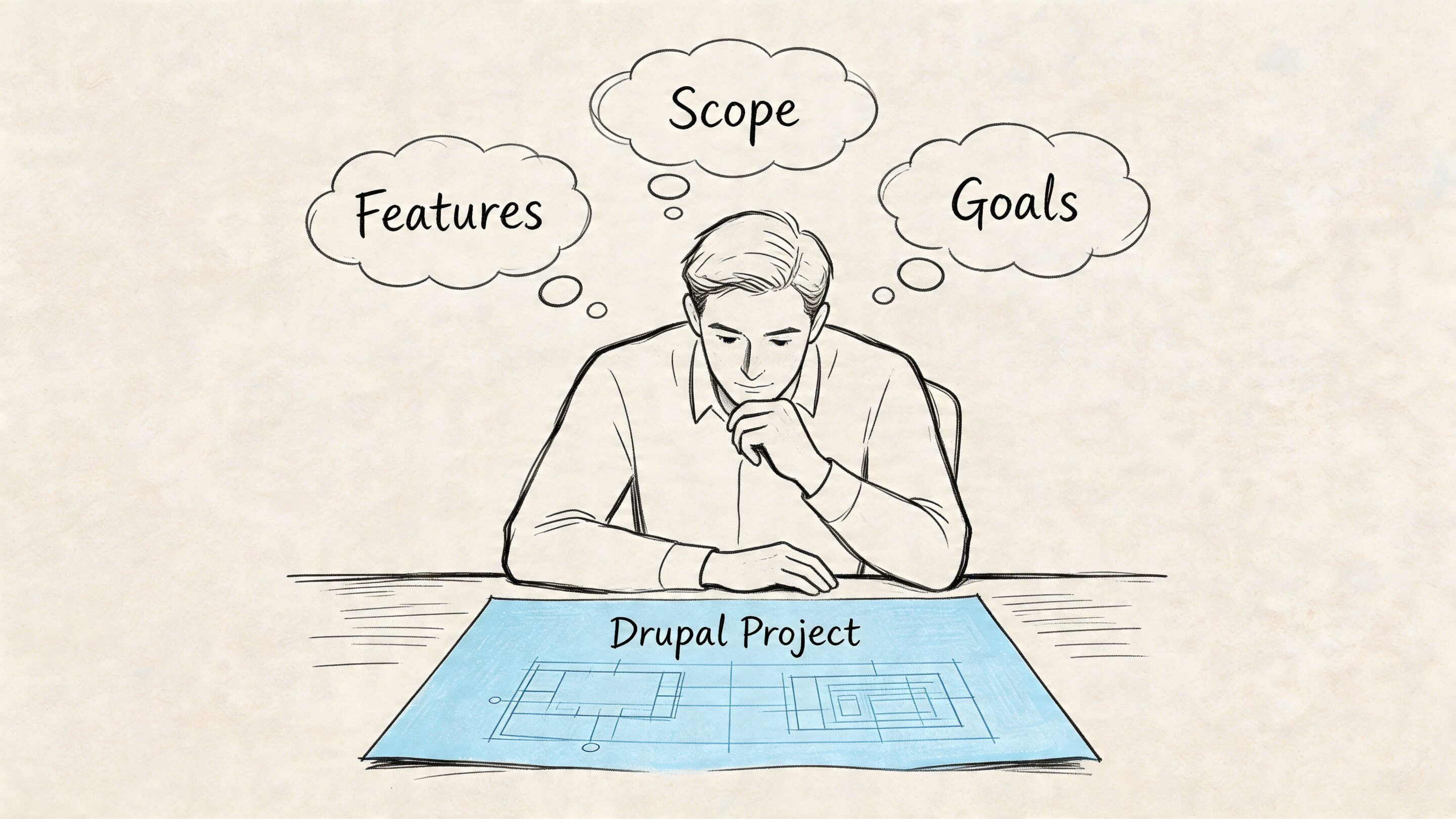
Most hiring mistakes happen before the first interview. The brief is vague. The scope is overloaded. The role mixes platform migration, UX cleanup, API design, and DevOps work into one impossible checklist. Good candidates self-select out. Weak matches apply anyway.
A better approach is to define the work by project type, then map the required Drupal skills to that type.
Start with the project you actually have
These are very different hiring situations:
A site rebuild is not a migration.
A migration is not a headless implementation.
A headless implementation is not an AI modernization project.
That sounds obvious, but job descriptions often blur them together.
If you’re rebuilding a legacy Drupal site
Focus on candidates who can audit what exists, identify what should be preserved, and simplify the future state. You want someone who’s opinionated about content types, views, permissions, and module sprawl.
Look for experience in:
- Content modeling: Candidates should explain how they structure entities, fields, taxonomies, and editorial workflows.
- Module decisions: They should know when to use contributed modules and when custom code is safer.
- Upgrade path thinking: Even if this isn’t an immediate migration, they should design with future upgrades in mind.
If you’re planning a migration
Migration work punishes guesswork. The right developer should ask about source data quality, custom modules, URL structure, redirects, editorial workflows, and staging strategy before talking about timelines.
Ask whether the candidate has handled:
- Drupal version jumps
- Data mapping across content models
- Theme replacement
- Module compatibility issues
- Post-migration QA
Don’t skip modern Drupal requirements
Many hiring guides still speak as if all Drupal experience is interchangeable. It isn’t.
Existing hiring guidance often misses the gap around Drupal 10 and 11 compatibility and headless architectures. That gap matters because headless setups have grown 60% year over year according to the supporting material in Upwork’s Drupal hiring page, and businesses hiring for modern platforms can run into migration and scalability risks when freelancers only advertise generic Drupal experience.
That single point changes how you write the brief. If your project needs modern architecture, then “Drupal experience” is too broad to be useful.
Define the stack around Drupal, not just Drupal itself
A Drupal developer for hire may need adjacent skills depending on the product shape. That’s where many job posts under-specify the role.
Use a practical checklist:
- For headless or decoupled builds: Require experience with JSON:API, GraphQL if relevant, frontend collaboration, and clear API contract thinking.
- For editorial-heavy implementations: Ask about Layout Builder, workflow configuration, moderation, and media handling.
- For integration-heavy systems: Prioritize RESTful APIs, authentication flows, data transformation, and reliability in external system syncs.
- For AI modernization efforts: Look for developers who understand where AI belongs in the workflow, how prompts are managed, and how logging and cost visibility fit into production operations.
- For high-scale applications: Ask about caching, infrastructure coordination, deployment discipline, and failure recovery.
A useful early exercise is comparing your requirements against the broader product stack choices in this guide to choosing the right technology stack for your project. It helps prevent hiring a Drupal specialist into a product problem that requires a broader architecture decision first.
Write a brief that filters in the right people
A good brief doesn’t try to impress candidates. It filters them.
Include these specifics:
| What to define | What good looks like |
|---|---|
| Business objective | “Unify content across web and app” is better than “improve site” |
| Drupal version target | Name the version you’re on and the version you need |
| Delivery model | Clarify whether this is staff augmentation, project ownership, or maintenance |
| Frontend approach | Traditional theming, decoupled frontend, or hybrid |
| Integration scope | CRM, commerce, identity, search, internal tools, or AI services |
| Success criteria | Faster publishing, cleaner architecture, migration completion, or scalable feature delivery |
If the role still feels hard to define after this exercise, that’s usually a sign the business needs discovery before recruitment.
Decoding Drupal Developer Roles and Key Skills
Not every Drupal developer should be asked to do everything. Some can. Most shouldn’t.
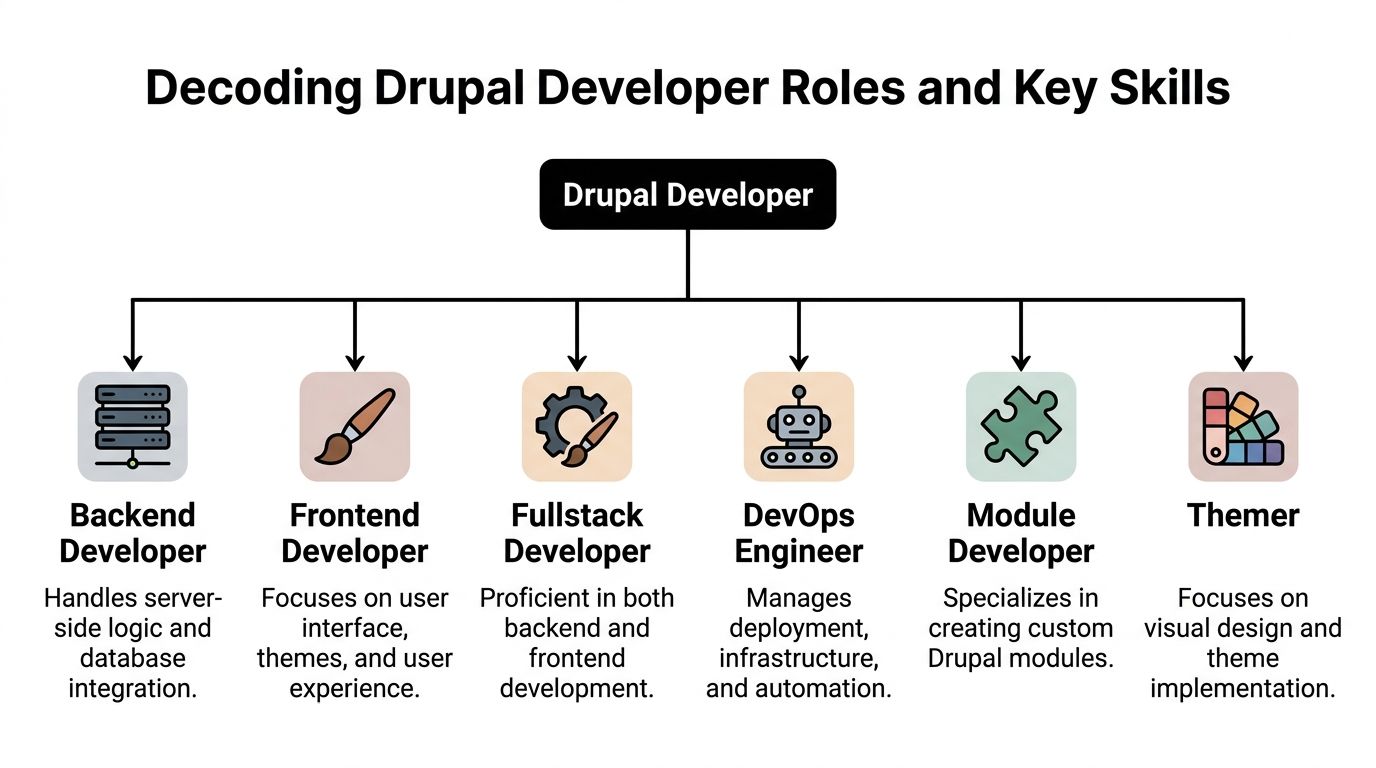
One reason clients struggle with the phrase “drupal developer for hire” is that it sounds like a single role. In practice, Drupal work splits into several specialties. If you hire a strong themer for a backend integration problem, they’ll look weaker than they are. If you hire a backend architect and expect pixel-perfect component implementation, you’ll create friction on day one.
Frontend Drupal developer
This person lives closest to the rendered experience.
They usually handle Twig templates, component styling, frontend behavior, responsive implementation, and collaboration with design. In traditional Drupal builds, they translate design systems into the theme layer. In more modern teams, they may also work alongside React or other frontend specialists when the implementation is hybrid.
Look for:
- Twig proficiency
- Strong CSS judgment
- Accessible markup habits
- Comfort with JavaScript
- Ability to work from Figma or component libraries
A frontend-focused Drupal developer should be able to explain how they approach templates, reusable UI patterns, and editorial flexibility without letting the CMS create visual chaos.
Backend Drupal developer
This is the role most clients need, even when they think they’re hiring “full stack.”
Backend Drupal developers build custom modules, work with Drupal’s APIs, structure data, define business logic, manage integrations, and solve the hard problems around permissions, workflows, and application behavior.
Strong signs include experience with:
- Custom module development
- Drupal services and hooks
- Entity and field architecture
- RESTful APIs
- Relational databases
- Security-sensitive implementation choices
This role matters most when your project includes external systems, workflow logic, ecommerce features, or non-trivial content relationships.
Hire backend depth when the project can fail invisibly. Integrations, permissions, and data quality issues usually don’t show up in screenshots, but they create the most expensive cleanup.
Full-stack Drupal developer
Full-stack Drupal talent can be a great fit when the project has enough variety to justify one owner and enough simplicity that you don’t need separate specialists.
The risk is expecting one person to be elite at every layer. Some are strong across the board. Many are strongest in one area and competent in the other. That’s fine, as long as you know which is which.
A solid full-stack Drupal developer should be able to:
| Capability | What to verify |
|---|---|
| Backend implementation | Can they design and build maintainable custom functionality? |
| Frontend delivery | Can they implement clean, accessible, maintainable UI work? |
| Debugging | Can they isolate whether an issue starts in data, configuration, theme, or infrastructure? |
| Collaboration | Can they work across product, design, QA, and infrastructure teams? |
DevOps support for Drupal
Some projects don’t need a dedicated Drupal DevOps specialist full time. Many still need DevOps capability involved.
Drupal performance and reliability often depend on deployment workflows, cache strategy, environment consistency, hosting decisions, and operational discipline. If your site handles complex traffic patterns, regulated data, or frequent releases, don’t leave infrastructure decisions as an afterthought.
Look for evidence of experience with:
- CI/CD pipelines
- Environment parity
- Caching strategy
- Performance tuning
- Release management
- Incident response discipline
Module developer and themer
These labels still come up, especially in agencies and freelance circles.
A module developer is a narrower backend specialist who focuses on custom Drupal functionality. A themer focuses on the visual layer and implementation of themes. Both can be valuable when the work is tightly scoped. Both become limiting when the project starts to expand into broader application concerns.
If your project has multiple unknowns, hire for problem-solving range, not just task coverage.
Matching role to project
A fast way to map role to need:
- Content-heavy redesign: Frontend Drupal developer plus backend support
- Legacy modernization: Backend-heavy Drupal developer
- Headless build: Backend Drupal developer with API depth, plus frontend specialists
- Small team, moderate complexity: Full-stack Drupal developer
- High-stakes release environment: Add DevOps support early
Role clarity prevents bad interviews. It also makes candidate evaluation fairer, because you’re judging the right person against the right work.
The Technical Vetting Gauntlet How to Interview and Test Candidates
Resumes don’t catch weak Drupal hires. Casual interviews don’t either.
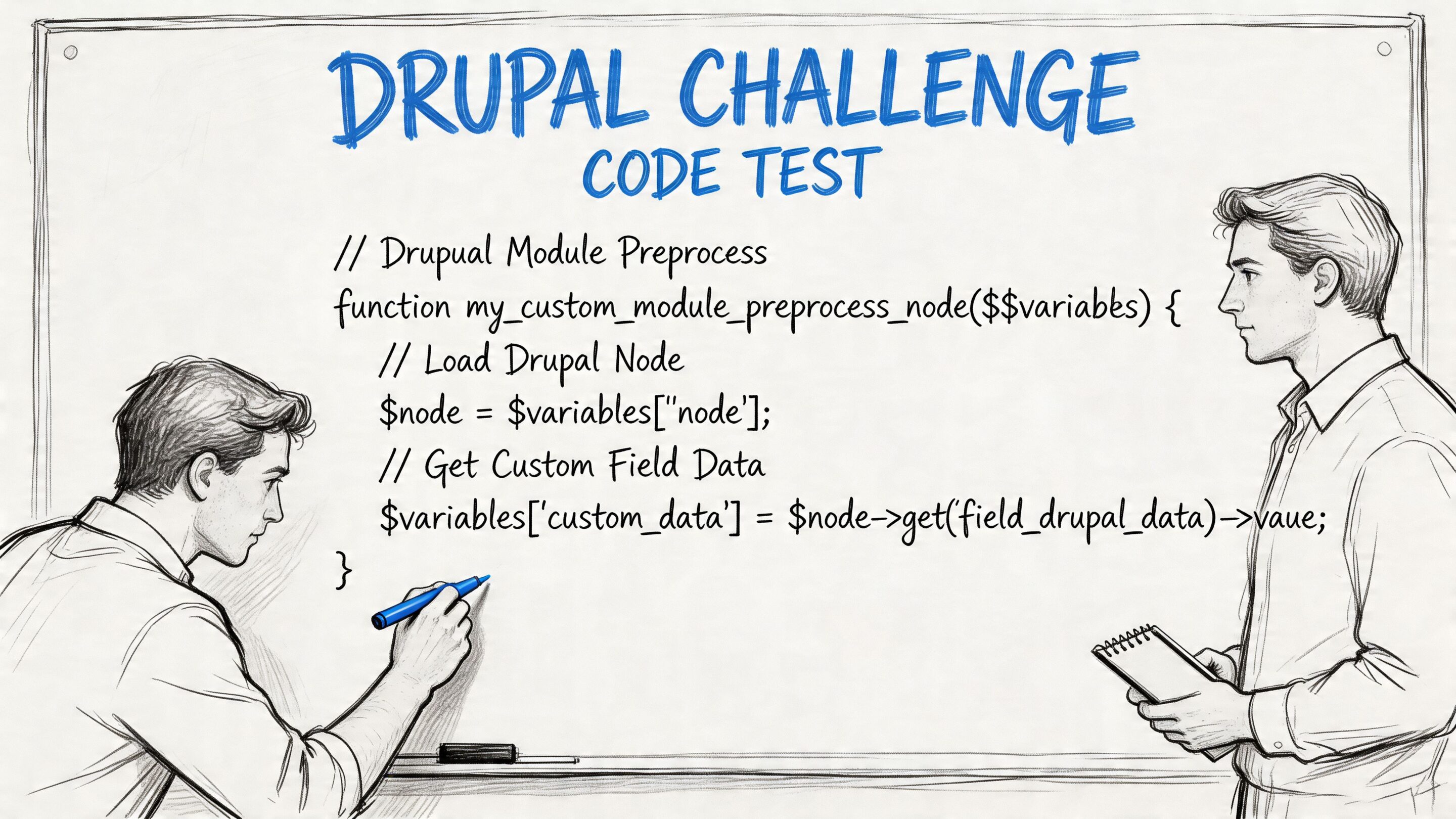
Drupal is too nuanced for that. Plenty of candidates can talk fluently about modules, content types, and APIs without showing they can diagnose a broken view, structure a migration, or write maintainable code under realistic constraints.
A structured hiring process works better. According to the supporting material in Michalak’s hiring process guide, a pre-interview technical assessment can weed out up to 70% of unqualified applicants and increase first-year retention to 85%. The same source notes that ignoring community contributions or skipping a small coding task can lead to mismatches and security problems.
Screen for truth before chemistry
Don’t start with a long culture interview. Start by validating technical fit.
A practical sequence looks like this:
Brief resume screen
Check whether the candidate’s experience matches your project type. Generic PHP or CMS work is not enough for complex Drupal needs.Short technical questionnaire
Ask version-specific questions, architecture questions, and one or two debugging questions.Targeted assessment
Use a small, realistic task. Keep it narrow enough to complete without resentment and broad enough to expose habits.Live technical interview
Review their thinking, not just their final answer.Behavioral interview
Confirm they can work with product, QA, content, and leadership without chaos.
Ask better Drupal interview questions
Good questions force candidates to show judgment.
Try prompts like these:
- How would you decide between a contributed module and a custom module for a business-critical feature?
- Tell me about a migration that became harder after discovery. What changed?
- How do you debug a slow or unreliable View?
- What would make you avoid a decoupled Drupal architecture on this project?
- How do you handle configuration management across environments?
- What do you look for when reviewing another Drupal developer’s custom module code?
- How do you protect editorial flexibility without letting content structure become inconsistent?
- How would you expose Drupal content to another application safely and cleanly?
- What’s your approach to keeping a Drupal build upgrade-friendly?
These work because they reveal trade-offs. Strong candidates will talk about maintainability, security, operational constraints, and team workflows. Weak ones will give tool lists.
Use a coding task that resembles real work
A good take-home challenge should feel like a slice of the job. Not a puzzle.
Examples that work well:
| Task type | What it reveals |
|---|---|
| Build a small custom module | Code organization, Drupal fluency, naming, maintainability |
| Expose a simple API endpoint | Understanding of routes, controllers, serialization, access control |
| Debug a broken or slow View | Troubleshooting process and practical Drupal experience |
| Review flawed code and suggest improvements | Seniority, communication, architectural judgment |
| Implement a small editorial workflow change | CMS thinking, permissions, usability awareness |
Set clear boundaries. Ask for a short README. Review how they explain decisions. That explanation often matters as much as the code.
Hiring signal: Great candidates reduce complexity as they work. Average candidates add it.
Don’t ignore community signals
Drupal is still a community-shaped ecosystem. Candidates don’t need to be prolific contributors, but community involvement can tell you a lot.
Look for signs like:
- Module contributions
- Issue queue participation
- Drupal event attendance or talks
- Awareness of version changes and community standards
This isn’t about gatekeeping. It’s about spotting candidates who stay current in a platform where outdated habits can linger for years.
Include QA and delivery thinking
A strong Drupal hire should respect testing. Not just coding.
Ask how they validate content workflows, regression risk, permission changes, and integrations. If you want a good primer to align internal teams around the broader testing picture, this overview of the main types of software testing is a useful companion for hiring managers who need to evaluate delivery maturity as well as code skill.
What weak vetting looks like
Avoid these traps:
- Portfolio-only hiring
- No hands-on technical test
- Generic PHP questions instead of Drupal-specific ones
- No version-specific discussion
- No evaluation of communication
- No check for maintainability or upgrade path thinking
The best candidates usually appreciate a rigorous process. It signals that your team knows the difference between “can talk Drupal” and “can deliver Drupal.”
Navigating Pricing and Engagement Models
Cost matters. So does cost shape.
Hiring a Drupal developer isn’t just about the hourly number or salary line. It’s about what you’re buying, how much management you need to provide, how much delivery risk you’re willing to accept, and whether the work is one discrete job or an evolving product need.
What Drupal talent costs
In the United States, the average annual salary for a Drupal developer is $93,346, with full-time roles commonly ranging from $85,000 to $140,000 depending on experience and specialization, according to Arc’s Drupal rate guide. The same source notes that Drupal powers 2.3% of all websites globally, is supported by a community of 1.3 million members, and has produced over 39,000 free modules.
That same market context helps explain why hiring remains competitive. Arc also reports 42,536 Drupal developer profiles available for hire in Indeed’s database, with candidates averaging 12 years of professional experience, and highlights worldwide freelance rates averaging $61-80 per hour, with U.S. freelance rates including $53.82 and a 25th to 75th percentile of $44.23 to $61.78. The source also cites Upwork rates with a median of $25, typically in the $20-40 range.
Global pricing varies even more. CloudDevs’ Drupal hourly rate guide is not the source for rate data, so use your internal budgeting resources separately for planning software cost. For Drupal-specific hiring numbers, global hourly rates span $20-200, with North America and Western Europe generally at the premium end, and Asia and Africa often at the lower end, according to the verified Drupal market data.
The number is only part of the budget
Rate comparisons become misleading when buyers ignore hidden work.
You still have to factor in:
- Hiring time: sourcing, screening, interviews, coordination
- Management overhead: backlog shaping, code review, QA, communication
- Risk exposure: rework, weak documentation, delayed launches
- Continuity: what happens if the contractor disappears mid-project
- Specialization gaps: whether you also need design, QA, DevOps, or product support
If your finance or talent team is trying to tighten process discipline around hiring spend, this guide on how to reduce your recruitment cost per hire is a useful operational reference.
Drupal Hiring Models Compared
| Model | Best For | Cost Structure | Pros | Cons |
|---|---|---|---|---|
| Freelancer | Small fixes, narrow tasks, overflow work | Hourly or project-based | Flexible, fast to start, useful for discrete work | Vetting burden is on you, continuity risk, quality varies |
| Contractor | Medium-term roadmap support, migrations, specialized delivery | Hourly or fixed-term contract | More availability than a casual freelancer, good for focused execution | Still requires internal management, can leave with knowledge gaps |
| Agency partner | Complex builds, modernization, regulated or high-stakes delivery | Monthly, milestone, or managed project pricing | Access to broader team skills, stronger process, easier scaling, delivery coverage beyond one person | Higher upfront cost than low-cost marketplaces, less suitable for tiny one-off tasks |
Which model fits which situation
For a narrow bug backlog or small theme cleanup, a freelancer can be enough.
For a migration, a decoupled build, an application with multiple integrations, or a roadmap that includes AI features, a single developer often isn’t enough by themselves. You may also need QA, architecture review, product coordination, and release discipline. That’s where buyers who optimize for the lowest rate often end up paying more in missed deadlines and rework.
Cheap Drupal hiring can be expensive Drupal delivery.
Budgeting with realism
Here’s the practical way to frame it internally:
- If the work is simple and well-scoped, optimize for speed and fit.
- If the work is strategic, optimize for quality and delivery reliability.
- If the work affects regulated data, revenue flows, or modernization goals, don’t buy talent as if it were a commodity.
That’s especially true when the hire will influence architecture decisions that last longer than the contract itself.
Beyond the Hire Partnering for Long-Term Success
A successful Drupal hire doesn’t stay successful on autopilot.

The first few weeks set the tone. If your new developer gets vague priorities, partial access, missing documentation, and conflicting stakeholder requests, even a strong hire will stall. If they get clean context, defined ownership, and a practical roadmap, they can start creating value quickly.
Onboard like you expect results
Most onboarding failures are operational, not technical.
Make sure your new Drupal developer has:
- Environment access: repositories, hosting, staging, deployment process
- System context: architecture notes, module inventory, integration map
- Business context: who the users are, where the pain is, what matters most
- Decision rules: who approves architecture, design, content, and release changes
- Near-term priorities: the first few tickets should reveal the system, not bury them in chaos
The best first assignments are diagnostic and useful at the same time. A small performance issue. A workflow fix. A code review of a brittle custom module. Something that lets the developer learn the shape of the platform while producing an immediate win.
Think in systems, not just tickets
Long-term Drupal success comes from maintaining the whole operating model.
That includes:
| Area | What strong teams do |
|---|---|
| Documentation | Keep architecture notes, integration details, and release instructions current |
| Code stewardship | Review custom code for maintainability, upgrade path, and security exposure |
| Release discipline | Use staging, QA, rollback planning, and predictable deployment routines |
| Product alignment | Tie Drupal work to business outcomes, not just backlog volume |
| Platform evolution | Revisit whether the CMS is supporting current needs in mobile, app, and AI experiences |
This matters even more when the Drupal platform is becoming part of a broader digital product ecosystem. Once content flows into mobile apps, customer portals, recommendation layers, support tooling, or AI-driven experiences, the developer is no longer just maintaining pages. They’re helping shape a product platform.
AI modernization changes what “good hiring” means
A lot of companies now want Drupal connected to smarter experiences. Content summarization. Internal search assistance. admin copilots. recommendation logic. workflow enrichment. structured content generation with human review.
Those goals are achievable. But they create a new layer of operational needs.
A team adding AI features to a Drupal-based product has to manage:
- Prompt versioning
- Model selection
- Input parameters
- Logging across AI interactions
- Spend visibility and control
- Governance around what gets automated
That’s why future-facing hiring should assess whether the developer understands not only APIs and integrations, but also how AI features are administered responsibly inside a product.
A modern Drupal build isn’t only about content delivery anymore. It’s also about how content, data, workflows, and AI services interact without creating a mess for editors or engineers.
Why vetted partnerships change the outcome
The broader Drupal market offers plenty of options, but the pricing spread tells only part of the story. Global hourly rates can range from $20-200, and the verified hiring data notes that the true cost includes risk and management overhead. It also states that partnering with a vetted talent provider can mitigate the risk associated with unvetted freelance marketplaces while ensuring access to top-tier expertise, based on the Drupal rate analysis from CloudDevs.
That distinction matters for businesses with real delivery pressure.
A vetted partner changes several things at once:
- Role matching improves because the hiring process starts from project shape, not keyword matching.
- Risk drops because technical screening, delivery standards, and accountability are already in place.
- Team composition gets easier because you can add QA, design, project leadership, or adjacent engineering support without restarting the hiring cycle.
- Modernization moves faster because the developer isn’t inventing every process from scratch.
Many ecommerce, fintech, healthcare, media, nonprofit, and public-sector teams find this particularly beneficial. They don’t just need someone who can “do Drupal.” They need someone who can help Drupal coexist with modern product expectations.
The tooling question matters too
Strong engineering partners also help teams avoid a common AI trap. Shipping AI features without operational controls.
A practical prompt management system should give your team:
- A prompt vault with versioning so prompt changes are traceable
- A parameter manager for controlled access to internal data and variables
- A logging layer across integrated AI features
- Cost management visibility so leaders can see cumulative spend and control model usage
Those capabilities reduce chaos for product teams and give developers a cleaner way to integrate AI into existing software. They also make AI modernization much less fragile over time.
That’s the long-term lens most hiring conversations miss. The right Drupal developer can absolutely move a project forward. But the strongest outcome usually comes from pairing the right talent with the right delivery model, platform guidance, and operational tooling so the software can keep evolving after launch.
If you’re looking for a drupal developer for hire and you want more than a resume match, Wonderment Apps can help. Their team supports Drupal modernization with vetted engineering talent, UX-driven delivery, and a practical AI administration toolkit that includes a prompt vault with versioning, parameter management, integrated logging, and cost visibility. It’s a strong fit for teams that need to upgrade a Drupal platform, add modern integrations, and build AI features that are manageable in production.