

A lot of software teams hit the same wall at the same time. The roadmap gets more ambitious, leadership wants AI features in the product, customers expect polished mobile and web experiences, and the current team is already buried in delivery work.
Then the actual blocker shows up. You don’t need “more developers” in the abstract. You need one person who knows prompt orchestration, or a QA engineer who can automate regression coverage in a modern stack, or a senior React Native developer who can clean up a release that’s drifting toward chaos.
That’s usually the moment a staff augmentation company becomes relevant. Not as a shortcut. Not as a body shop. As a practical way to bring in the exact capability your team is missing while keeping product direction, architecture, and delivery control in house.
That matters even more if your roadmap includes AI modernization. Shipping AI into an app isn’t only about model access. Teams also need prompt versioning, parameter controls, logging, cost visibility, and developers who understand how those pieces fit inside real production software.
Your Project Is Stuck You Might Need a Staff Augmentation Company
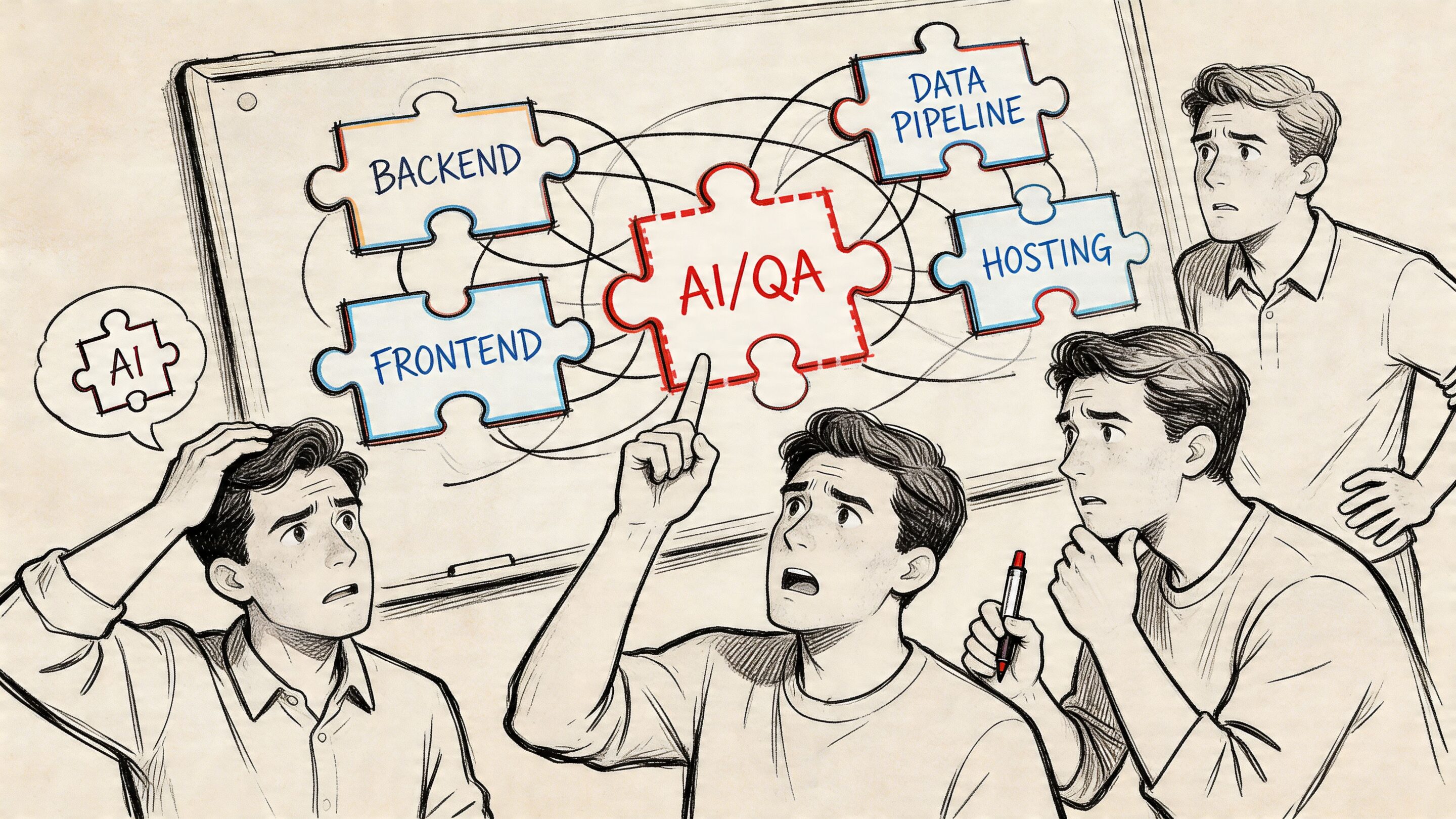
The common version looks like this. Your team is capable. They know the product, the business rules, the customer pain points, and the release process. But they don’t have enough depth in one critical area, and that gap is now driving the whole timeline.
Maybe the app team can build the interface, but nobody has shipped AI model integration into a production workflow. Maybe your engineers can move fast, but test coverage is thin and every release introduces anxiety. Maybe your platform upgrade needs a senior .NET specialist for one phase, not a permanent hire.
The stall usually starts with one missing skill
When a project slips, leaders often reach for the wrong fix first. They ask the existing team to work longer, spread specialists across too many priorities, or start a full-time hiring search for a role they may only need during a specific delivery window.
That rarely works well. The product still lacks the missing expertise, the team gets stretched thinner, and delivery risk increases.
A staff augmentation company solves a narrower problem more effectively. It adds targeted expertise into your current team structure so the work keeps moving under your direction. The model has become mainstream enough that the global IT Staff Augmentation Service market is projected to reach USD 857.2 billion by 2032, growing at a CAGR of 13.2%, according to Codewave’s staff augmentation market overview.
Practical rule: If one missing specialty is holding up architecture, QA, security, or AI delivery, solve the skill gap directly before you redesign the whole org chart.
Where teams feel this most
This pressure shows up in regulated products, ecommerce replatforming, and AI feature launches. Finance teams feel it too, especially when experienced talent becomes harder to retain. If that’s your world, the analysis on the banking talent crisis is useful context because it reflects a broader hiring strain many digital teams are dealing with.
The other shift is technical. AI projects don’t only need model experimentation. They need developers who can wire prompts into business workflows, manage quality, and avoid turning a promising feature into a black box no one can maintain.
That’s why the stronger staff augmentation engagements today aren’t just about filling seats. They’re about injecting delivery capability into a live team without losing momentum, code ownership, or product judgment.
What Is a Staff Augmentation Company Really
The simplest way to think about a staff augmentation company is this. Your team remains the owner of the project. The outside specialist joins your team to strengthen it in a specific area.
A good analogy is surgery. Your primary doctor still understands your full history and oversees the broader care plan. But for a complex procedure, you bring in a specialist surgeon. The hospital vets that specialist, handles credentials, and makes sure the right expertise is available when needed.

The specialist joins your workflow
That distinction matters. In staff augmentation, the developer, QA lead, designer, DevOps engineer, or product specialist usually works inside your normal operating rhythm.
They attend your standups. They use your Jira board. They contribute to your repository, follow your coding standards, and report through your delivery structure.
That’s very different from handing an entire project to an outside team and waiting for status updates.
Here’s the mental model:
| Role | In the analogy | In your project |
|---|---|---|
| Your internal leadership | Primary doctor | Owns roadmap, priorities, and decisions |
| Augmented specialist | Surgeon | Brings niche expertise for a defined need |
| Staff augmentation company | Hospital | Sources, vets, and supplies the specialist |
Why this model keeps showing up
This model keeps expanding because companies are building against technologies that change faster than standard hiring cycles. The growth of staff augmentation is driven by adoption of cloud computing, big data, artificial intelligence, and IoT, as organizations face capability gaps that traditional hiring cycles can’t fill, according to One Federal Solution’s technical staff augmentation analysis.
If you want a broader primer on the operating model itself, this breakdown of IT staff augmentation is a useful companion read.
The best augmented hires don’t feel “external” by week two. They feel like the team finally has the missing piece it should’ve had from the start.
What it is not
It’s not a magic substitute for product leadership.
It’s not a license to skip onboarding.
And it’s not the right fit if you want zero management involvement from your side.
A staff augmentation company works best when you already know the outcomes you want and need sharper execution capacity to get there. If your project needs stronger delivery ownership, looser staffing won’t solve that by itself. In that case, a managed project model may be a better choice.
The Pros and Cons of Augmenting Your Team
Staff augmentation works well when leaders are honest about both sides of the arrangement. It can facilitate delivery speed and niche skills fast. It can also create friction if the team treats augmented staff like temporary extras instead of real contributors.
Where the model works well
The biggest advantage is precision. You don’t need to hire broadly when the actual need is narrow. If the product needs AI integration help, security review, mobile release expertise, or automated QA, you can add that capability without restructuring your whole department.
A second advantage is flexibility. Teams can scale for a launch, a replatform, a compliance push, or a modernization sprint, then reduce external support once the pressure window passes. That’s often easier on budgets and easier on internal managers than carrying permanent roles that aren’t needed year-round.
There’s also practical operating value in keeping control. Your team still owns priorities, architecture, and acceptance standards.
Helpful gains often include:
- Faster access to scarce skills: You can bring in people who’ve already worked in the stack or domain you need.
- Less hiring drag: Internal recruiting can stay focused on core long-term roles.
- Better sequencing: The permanent team handles continuity while specialists handle spikes, migrations, integrations, or remediation work.
- AI modernization support: Teams can add engineers who understand model integration, prompt handling, evaluation, and production safeguards.
For a deeper look at the trade-offs, Wonderment’s article on IT staff augmentation pros and cons is worth reviewing alongside your own delivery needs.
Where teams get burned
The downside usually isn’t technical skill. It’s integration failure.
If the team doesn’t onboard augmented staff properly, they won’t have enough business context to make strong decisions. If nobody defines ownership, work gets duplicated or dropped. If communication norms are fuzzy, even excellent developers start missing expectations.
The most overlooked risk is knowledge loss. A frequently unaddressed challenge is that firms can experience a 20% drop in velocity due to disrupted team cohesion and up to 40 to 50% knowledge loss when augmented staff leave projects without proper handover protocols, according to Right Angle Solutions on staff augmentation risks.
That risk is real. It’s also manageable.
What actually reduces the downside
A workable engagement usually has a few essential elements:
- Clear ownership: Someone on your side decides priorities and approves work.
- Structured onboarding: Give access, architecture context, coding standards, domain rules, and meeting cadence early.
- Documentation habits: Don’t wait until the final week to ask for handoff notes.
- Paired delivery: Have augmented specialists work closely with internal engineers on core areas that need long-term continuity.
- Exit planning from day one: Every temporary role should have a transfer path before the contract end is in sight.
If an external engineer owns a critical workflow, but nobody internal can explain it, you don’t have capacity. You have hidden dependency.
A useful way to judge fit
Staff augmentation is usually a strong fit when the problem is “we know what to build, but we’re missing execution bandwidth or specialty skill.”
It’s a weaker fit when the problem is “we don’t have internal alignment, our requirements are unstable, and nobody owns delivery.”
That distinction saves a lot of pain. Augmented talent can strengthen a functioning system. It won’t repair a broken one by itself.
Staff Augmentation vs Other Talent Models
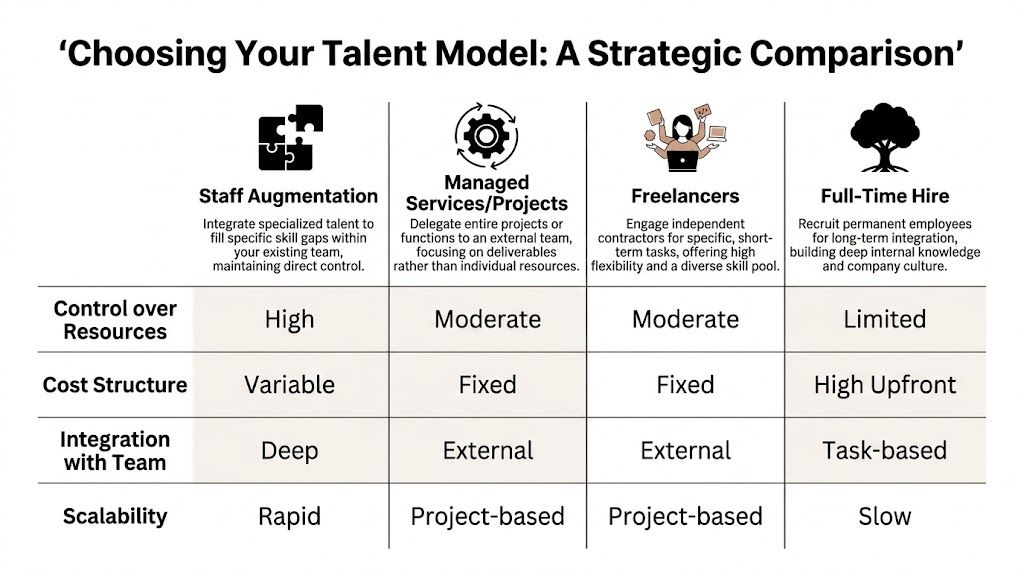
Choosing a talent model is less about preference and more about control, speed, and risk. Teams often don’t need the same staffing approach for every phase of a product. A modernization effort might start with strategic internal hires, add augmented specialists for a migration, and use a managed team for a defined workstream.
A side by side view
| Model | Control over day-to-day work | Cost shape | Team integration | Scalability | Delivery risk |
|---|---|---|---|---|---|
| Staff augmentation | High | Variable | Deep | Fast | Mostly on you |
| Managed services or projects | Moderate | Scope-based | External but coordinated | Moderate | More on provider |
| Freelancers | Varies a lot | Variable | Task-based | Fast for small needs | Mostly on you |
| Full-time hires | High | Ongoing internal cost | Deepest | Slowest | Mostly on you |
If you’re weighing two of the most commonly confused options, this guide on staff augmentation vs managed services gives a practical distinction.
When staff augmentation is the right call
Staff augmentation wins when you need direct control and close collaboration. Your managers still assign work. Your standards still define quality. Your engineers still shape architecture.
This makes sense for situations like:
- Feature acceleration: You have a working product team and need a few specialists to ship faster.
- Technical gap coverage: The team needs a senior mobile developer, QA automation lead, or AI integration engineer.
- Temporary depth: You need stronger execution during a launch, migration, or stabilization period.
It’s especially strong when the internal team already has product context that would be expensive to transfer to an outside delivery firm.
When another model is better
A managed services or managed project approach is stronger when you want outcomes more than individual contributors. If your team doesn’t have the capacity to direct multiple external specialists, asking for self-managed delivery is more realistic.
Freelancers can work for narrow tasks, quick fixes, prototypes, content updates, or design support. They are less reliable for highly interdependent product work where continuity, security, and shared process matter.
Full-time hiring is still the best option for roles that represent permanent strategic capability. If you know you’ll need the same leadership, architecture ownership, or product function for years, build that internally.
A simple test helps here. If you want to manage the person, augment. If you want to manage the outcome, consider managed delivery.
The decision filter leaders actually use
Use these questions:
Do we want direct control over daily work?
If yes, augmentation or in-house is more natural.Is the need temporary, spiky, or specialized?
If yes, augmentation or freelancers may fit.Can our internal team absorb management overhead?
If not, managed services becomes more attractive.Does this role represent long-term institutional knowledge?
If yes, a permanent hire may be worth the slower path.
The wrong model creates friction even with talented people. The right model makes execution feel calmer, clearer, and much less dramatic.
How to Choose the Right Staff Augmentation Partner
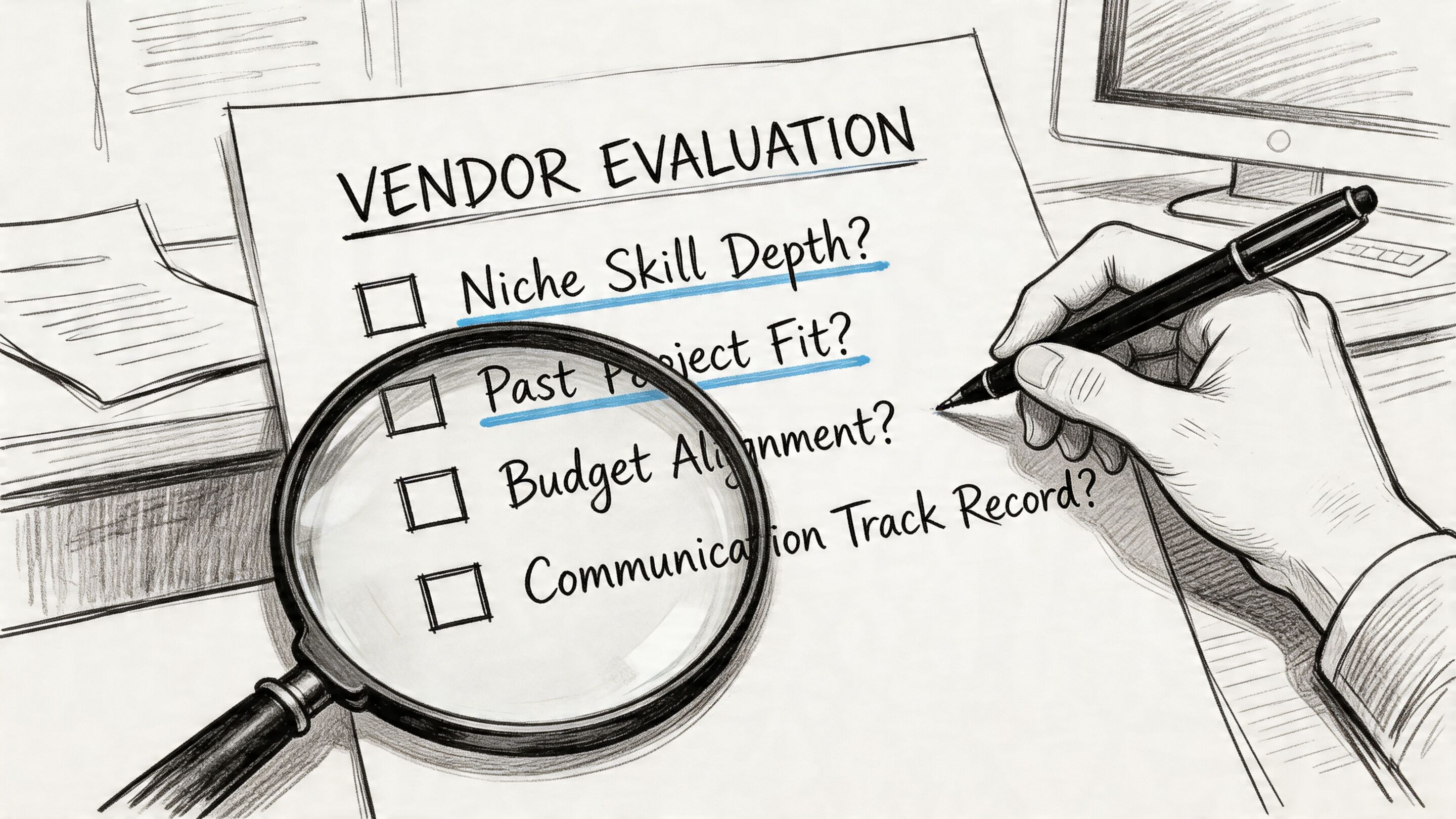
A staff augmentation company should be easy to describe in operational terms. You should know how they source people, how they test skills, how they handle security, what happens if someone isn’t a fit, and how they support continuity.
If those answers stay vague during the sales conversation, they won’t get clearer once work starts.
Questions worth asking before you sign
Skip generic questions like “Do you have experience in software development?” Ask questions that expose operating maturity.
Try these:
- Role vetting: Describe your screening process for a senior React, .NET, QA automation, or mobile engineer.
- Domain familiarity: What experience do your candidates have in ecommerce, fintech, healthcare, media, or public sector products?
- Security handling: How do you protect client IP, repository access, and production data for remote contributors?
- Replacement process: What happens if the first match isn’t right?
- Onboarding support: How do you help new team members become productive inside an existing workflow?
- Continuity planning: What documentation and handoff practices do you require before an engagement ends?
A useful comparison point is whether the partner helps you think through staffing options at all. The article on in-house tech hiring vs bringing in burstable partners frames that decision in a practical way.
What to measure once work starts
Don’t evaluate an engagement on vibes alone. Performance measurement should combine delivery output with quality and collaboration signals.
Effective performance measurement combines velocity such as story points per sprint, bug discovery rates, and qualitative indicators. For cost, the formula is full-time hiring costs minus total augmentation costs, accounting for all expenses against contractor rates, as explained in Ontik Technology’s staff augmentation KPI guide.
A clean KPI set often includes:
| KPI area | What to watch |
|---|---|
| Delivery | Story progress, sprint completion, blocked work |
| Quality | Bug discovery, defect trends, rework patterns |
| Collaboration | Responsiveness, clarity in handoffs, peer feedback |
| Cost | Internal hiring alternative versus actual augmentation spend |
A simple test task beats a polished résumé
For technical roles, use a short practical exercise. Not a puzzle. Not a marathon. A realistic slice of work.
Examples:
- Developer task: Extend a small API endpoint, add validation, and write a compact explanation of trade-offs.
- Frontend task: Build a simple component from a design, including state handling and edge-case behavior.
- QA task: Review a user flow, identify likely failure points, and outline an automation approach.
What you want to see is judgment. Does the person ask good questions? Do they document assumptions? Can they work inside constraints?
Strong candidates usually show their thinking clearly. Weak screening processes often confuse confidence with competence.
Red flags that usually mean trouble
Watch for these signs:
- Unclear sourcing: They can’t explain where talent comes from or how it’s screened.
- Hand-wavy security answers: They mention “best practices” but avoid specifics on access control or confidentiality.
- No replacement policy: Every staffing engagement needs a path for course correction.
- Résumé forwarding as a business model: If all they do is pass profiles along, you’re doing the vetting yourself.
- No handoff discipline: Temporary staffing without knowledge transfer is borrowed speed with a delayed invoice.
A solid partner won’t just promise resumes quickly. They’ll make the engagement easier to run.
Staff Augmentation Use Cases for Your Industry
Staff augmentation gets easier to evaluate when you stop thinking in titles and start thinking in delivery problems. Different industries tend to hit different bottlenecks, and the right specialist can remove the one that matters most.
Ecommerce and retail
An ecommerce team often runs into a seasonal crunch. The platform team has enough people to maintain the storefront, but not enough personalization or QA bandwidth to support a major release under deadline.
In that case, augmenting with a recommendation-engine specialist, frontend developer, or test automation lead can help the internal team ship without dragging permanent hiring into a temporary peak. The internal product team keeps control of customer experience, merchandising logic, and release timing.
Fintech and healthcare
These teams carry a different kind of risk. It’s not just speed. It’s compliance, trust, and secure implementation.
In regulated industries like healthcare and fintech, general staff augmentation can increase risk exposure if providers lack sector-specific vetting for standards like HIPAA or PCI-DSS. Global data breach costs averaged $4.88 million in 2024, a risk amplified by non-compliant remote staff, according to IPS Technology Services on compliance risks in staff augmentation.
That means a healthcare product may need a UX designer who understands patient privacy flows, while a fintech team may need a DevOps or backend specialist who can work inside stricter controls without slowing delivery to a crawl.
Media and entertainment
Media teams usually care about launch timing, performance, and content-heavy experiences. A streaming, publishing, or event-based app can’t afford weak mobile execution close to release.
Augmenting with iOS, Android, or backend performance specialists can help the existing team stabilize the product before a major launch. This is often more practical than trying to hire permanent experts for a short release window.
Public sector and nonprofits
These organizations often modernize legacy services while balancing procurement rules, internal approvals, and long review cycles. They may not need a large external squad. They may need a few dependable specialists who can work carefully inside an established process.
A business analyst, product designer, QA specialist, or full-stack engineer can make a disproportionate difference here, especially when the goal is digitizing a service without disrupting systems that still matter to daily operations.
The pattern across industries is consistent. The best engagements solve a specific business constraint with targeted expertise, not generic “extra hands.”
The Wonderment Apps Edge AI Modernization and Curated Teams
A lot of augmentation providers stop at staffing. They’ll help fill a role, but they won’t help much with the operational complexity that comes with AI-enabled software, modern app delivery, and long-term maintainability.
That gap matters. AI modernization creates a new layer of work beyond code. Teams need prompt governance, logging, parameter control, model visibility, and a way to understand usage costs before experimentation spreads into production debt.
What practical support should look like
A capable partner should be able to help in three different modes, depending on what your team needs.
One mode is curated staffing. That’s useful when your team already has product leadership and just needs specialists in areas like React, .NET, Java, mobile, QA, product management, or UX.
Another mode is managed project support. That’s a better fit when your internal team wants accountability for a full workstream, not just individual contributors.
The third mode is AI modernization support, which is where many software teams need more than staffing alone.
The tooling layer many AI projects miss
For AI work, the operating model matters as much as the model choice. If prompts live in scattered documents, parameter changes are handled ad hoc, logging is inconsistent, and no one can see cumulative spend, the team will struggle to run AI features responsibly.
One option in this category is Wonderment Apps, which offers a prompt management system that teams can plug into an existing app or software environment. It includes a prompt vault with versioning, a parameter manager for internal database access, a logging system across integrated AI tools, and a cost manager for tracking cumulative spend.
That kind of tooling is practical because it supports how real teams work. Developers need version control for prompts just as much as they need it for application logic. Product owners need visibility into how AI behavior changes over time. Leadership needs cost visibility before AI usage becomes a budget mystery.
AI features are easier to trust when prompts, parameters, logs, and spend are visible to the team that owns the product.
Why this changes the staffing conversation
Once AI becomes part of the roadmap, staffing decisions get sharper. You aren’t just asking for “an engineer.” You’re asking for someone who can integrate model-driven behavior into software that still has to be secure, testable, maintainable, and cost-aware.
That’s why the better staff augmentation decisions now sit inside a bigger delivery strategy. The partner should help you add the right people, fit them into the right model, and support the operating layer the software will need after launch.
A staff augmentation company is useful when it removes a bottleneck. It becomes much more valuable when it helps your team build something modern enough to last.
If your team is trying to add AI capabilities, close a delivery gap, or figure out whether augmentation or managed delivery makes more sense, a conversation with Wonderment Apps is a practical place to start. Ask for a demo of the prompt management system if you want to see how prompt versioning, parameter controls, logging, and AI cost tracking can fit into an existing product workflow.