

If your product roadmap currently depends on a few freelancers, one overloaded internal lead, and an agency that disappears between milestones, you don’t have a software team. You have a coordination problem.
That usually works for a while. A landing page ships. A mobile bug gets fixed. Someone adds a payment integration. Then the demanding work starts. You need faster releases, tighter QA, clearer ownership, and a plan for modern features like AI search, summarization, recommendations, or internal copilots. Suddenly every small change touches prompts, model settings, logs, costs, security reviews, and customer experience.
Most CEOs feel this pain before they know the term for the solution. They see missed handoffs, repeated onboarding, and product knowledge leaking out of the business every time a contractor rolls off. If you’re weighing whether to keep patching the system or move to a more stable delivery model, this breakdown of in-house tech hiring versus burstable partners is a useful companion read.
A dedicated software team solves a different problem than a freelancer marketplace or a fixed-scope agency project. It gives you stable delivery capacity that stays with the product long enough to learn the business, improve the architecture, and support ongoing modernization. That matters even more when AI becomes part of the core app, because AI features don’t just need builders. They need sustained operational ownership.
Moving Beyond Freelancers and Project Delays
A common pattern shows up in growing companies.
The founder hires a freelance developer for the first version. Then a second contractor adds checkout improvements. A small agency builds the admin panel. Later, another specialist plugs in an AI feature. Nobody did anything irrational. Each decision made sense at the time.
The problem is cumulative.
After a few quarters, the business is running a patchwork product. The frontend logic lives in one person’s head. Test coverage is partial. Release steps are tribal knowledge. AI prompts are stored in documents, messages, or hardcoded files. When something breaks, the company pays twice. First in delay, then in rediscovery.
What breaks first
Usually, it isn’t code quality alone. It’s continuity.
A modern product needs people who can make connected decisions across design, engineering, QA, infrastructure, and product priorities. If you’re adding AI capabilities, the coordination burden rises again. Someone has to manage prompt versions, control what data flows into model calls, track output behavior, and keep an eye on cumulative usage costs.
Most software delays aren’t caused by one big technical failure. They come from dozens of small ownership gaps.
Freelancers can be excellent. Agencies can be excellent. But when the work shifts from isolated tasks to continuous product evolution, a rotating cast becomes expensive in the one currency leaders care about most. Momentum.
What changes with a dedicated model
A dedicated software team gives you a stable unit instead of a series of separate vendors. The same people stay close to the roadmap. They learn your workflows. They remember why a feature was built the way it was. They don’t need to be re-taught the business every few weeks.
That stability is what turns software delivery from a stop-start service into an operating capability. For CEOs, that’s the key point. You’re not just buying coding time. You’re building a repeatable engine for product progress, including the newer operational layer that comes with AI-enabled applications.
What Is a Dedicated Software Team Really
A dedicated software team is an external product team assigned to your company for an extended period, with the expectation that priorities will change as the product evolves. For a CEO, the practical difference is simple. You are not buying isolated tickets or a one-time build. You are putting a standing delivery unit around a roadmap that needs ongoing decisions.
That matters even more when AI is part of the product strategy.
An AI-enabled application is not just a set of model calls added on top of existing software. It needs product judgment, backend engineering, data handling, testing, infrastructure control, and ongoing measurement of quality, cost, and risk. A dedicated team is one of the few delivery models that can hold all of that together over time.
What it is not
A lot of confusion comes from treating several service models as if they solve the same problem.
| Model | Best fit | What you actually get |
|---|---|---|
| Freelancers | Narrow tasks or short bursts | Individual contributors you coordinate yourself |
| Fixed-price project | Stable scope and defined deliverables | A vendor responsible for shipping a specified outcome |
| Dedicated software team | Long-running product work with evolving priorities | A managed team working continuously on your roadmap |
Each model has a place. Freelancers work well for specialist tasks. Fixed-price delivery works when scope is clear and unlikely to move. A dedicated software team fits products that need continuous iteration, shared context, and fast reprioritization without restarting the relationship every few weeks.
For companies modernizing an existing application with AI, that distinction becomes operational, not theoretical. You may need to improve legacy APIs, add retrieval or agent workflows, redesign parts of the user experience, and set guardrails around data use at the same time. Splitting that work across disconnected vendors usually creates handoff delays and inconsistent decisions.
Why CEOs choose this model for product growth
Requirements move. Customer feedback changes priorities. Compliance introduces constraints. AI features need prompt tuning, evaluation, fallback logic, and cost controls after launch, not just before it.
A dedicated team is built for that kind of environment because the same people stay close to the product long enough to make connected decisions. Team composition usually resembles an actual delivery unit rather than a staffing transaction. That often includes software engineers, QA, DevOps, design, product or delivery management, and, for AI initiatives, people who can handle model integration, data pipelines, and output evaluation.
This structure works especially well for companies that want software delivery to become a repeatable operating capability. Wonderment’s approach to AI modernization fits that model well because AI work rarely succeeds as a side project. It performs better when the same team can improve the application, integrate the intelligence layer, and manage the production realities that come after release.
A dedicated software team works best when the business needs regular releases, active maintenance, and room to adjust course without renegotiating scope every time the roadmap changes.
The Strategic Benefits and Real-World Trade-Offs
A CEO usually feels the need for a dedicated team at the same moment. The roadmap is growing, internal hires are taking too long, and the product now needs both core engineering work and AI capability in the same release cycle. In that situation, splitting work across separate contractors often slows decisions more than it speeds delivery.
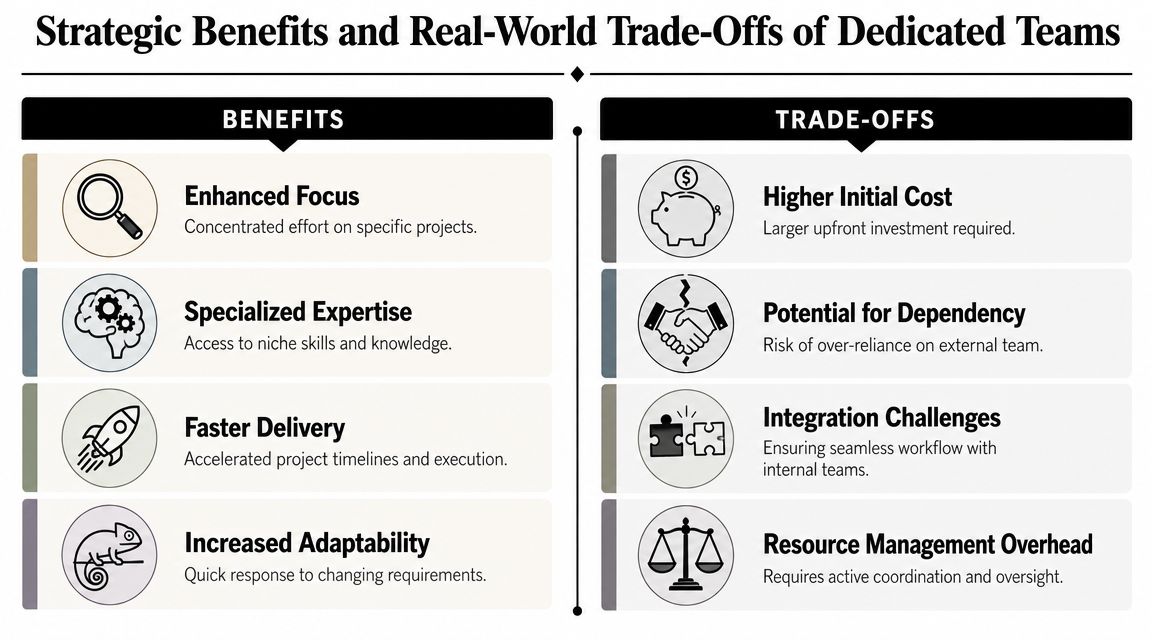
A dedicated software team gives you continuity where it matters most. The same people stay close to the product, the architecture, and the business goals long enough to make better trade-offs. That shows up in fewer resets, less duplicated work, and faster response when priorities change mid-quarter.
Where the model creates real advantage
The biggest gain is coordinated execution.
Products rarely fail because one engineer writes poor code. They fail because backend work, frontend changes, QA coverage, infrastructure updates, and product decisions drift out of sync. A dedicated team reduces that drift because the same unit owns delivery across those functions.
The advantage gets stronger when AI is part of the product roadmap. AI modernization is not one feature ticket. It usually includes model integration, prompt and workflow design, fallback logic, evaluation, monitoring, cost control, and changes to the user experience. Those pieces affect each other. A dedicated team can improve the application and the intelligence layer together, which is one reason this model fits the kind of AI modernization work Wonderment delivers.
In practice, the benefits usually show up in three places:
- Context stays inside the team: Engineers and QA remember why past decisions were made, which shortcuts are dangerous, and where hidden risk lives in the codebase.
- Priority changes cost less: You can shift from one initiative to another without rewriting contracts or re-scoping the entire engagement.
- AI work becomes operational, not experimental: The team can ship AI features, measure output quality, refine behavior, and keep the rest of the application stable at the same time.
Companies that want long-term product velocity usually benefit from building and maintaining effective tech teams with clear ownership and delivery discipline.
Where the trade-offs show up
This model asks for commitment from both sides.
You are not buying isolated output. You are funding a standing delivery capability. That works well when there is a steady backlog, active product ownership, and enough strategic clarity to keep the team pointed at valuable work.
The common failure points are predictable:
- Weak internal ownership: If nobody on your side can make timely product decisions, the team waits, guesses, or builds the wrong thing.
- Uneven backlog quality: A dedicated team needs a flow of work that is prioritized, defined well enough to start, and tied to business goals.
- Poor fit for fixed-scope work: If the project is short, tightly defined, and unlikely to change, a fixed-price or project-based model may be simpler.
- Misreading AI complexity: Some leaders assume one ML specialist can “add AI” to an existing app. In reality, useful AI features often require application changes, data handling decisions, testing strategy, and production monitoring across the full team.
I have seen this model work extremely well when leadership treats the team as part of the product operation, not as an external coding bench.
The practical rule is simple. Choose a dedicated team when you need sustained delivery across evolving product and AI priorities. Choose another model when the actual problem is unclear ownership, a thin roadmap, or a short project with little expected change.
Anatomy of a High-Performing Dedicated Team
A good dedicated software team isn’t defined by headcount alone. It’s defined by whether the team can move work from idea to production without constant outside rescue.
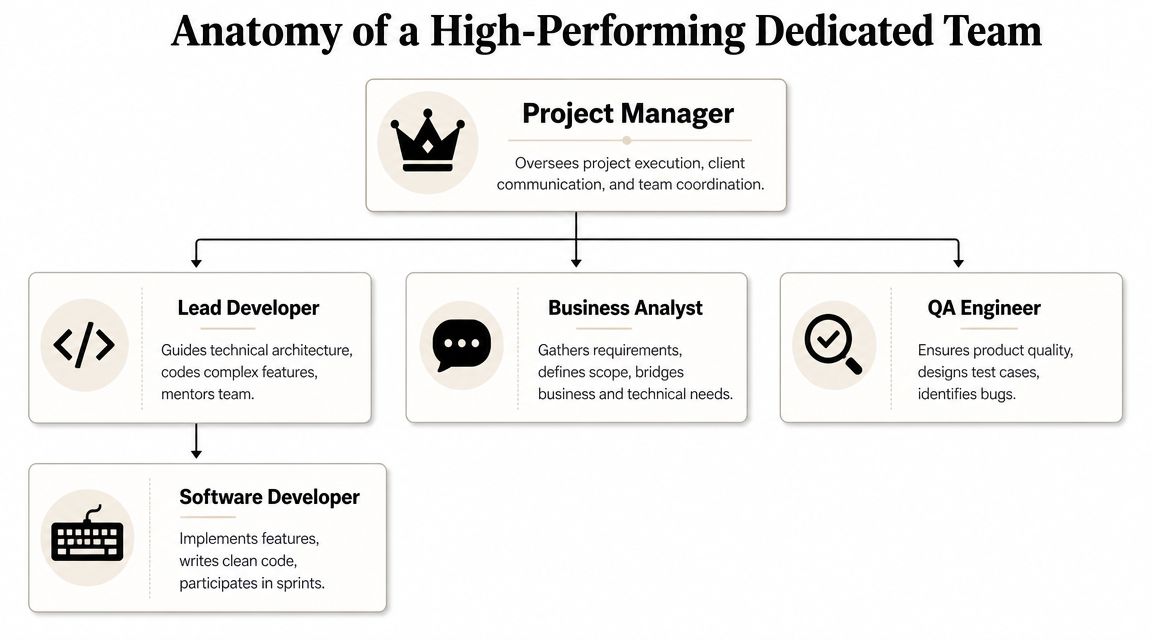
An effective setup is cross-functional by design. A medium project is commonly staffed with 5 to 8 specialists, while larger initiatives often grow to 9 or more with added architecture and DevOps support, according to this guide to dedicated team composition. The point isn’t to hit a number. The point is to remove bottlenecks.
Core roles that should exist from the start
Most strong teams include a few essential functions:
- Project manager or product lead: Keeps delivery organized, manages communication, and makes sure open questions don’t sit idle.
- Business analyst: Translates business requirements into workable technical definitions. This role is underrated and often saves weeks of confusion.
- Frontend and backend engineers: Own user-facing behavior and application logic.
- QA engineer: Protects release quality through testing strategy, regression coverage, and defect management.
Without these roles, CEOs often end up acting as informal translators, escalation managers, and acceptance testers. That’s not optimal. That’s drift.
Roles that become critical in more advanced products
Some projects need additional specialists early, not later.
If your platform has cloud complexity, release automation, or environment sprawl, add DevOps. If your roadmap includes AI search, recommendations, summarization, or workflow automation, you may also need deeper product and data thinking around model behavior, validation, and integration controls.
A stable team should be shaped around the system you’re building, not around a generic org chart. That’s one reason building and maintaining effective tech teams matters so much. Team design is part of product strategy.
The wrong team structure creates invisible queues. The right one removes them before they appear.
What high-performing teams do differently
They own outcomes end to end.
That means they don’t throw requirements over a wall, write code in isolation, and hope QA catches the rest. They work as one unit with shared context and a common delivery rhythm.
A high-performing dedicated software team usually has these traits:
- One clear point of accountability on both the client and delivery side.
- Direct access to product context so engineers understand why they’re building something.
- Testing embedded in the workflow instead of postponed until the end.
- Release ownership inside the team, especially when infrastructure or AI integrations are involved.
When that structure is in place, the team behaves less like an outside vendor and more like a reliable product function.
Understanding Engagement and Pricing Models
Most dedicated software teams are engaged on a monthly retainer. You pay for stable team capacity, not for a one-time deliverable. That usually makes sense when the product will keep evolving and you need the same people available month after month.
This is different from fixed-price work, where the vendor prices a defined scope and change becomes a negotiation. It is also different from staff augmentation, where individual contributors join your process and you carry more of the management burden yourself. If you’re comparing those options, this breakdown of staff augmentation versus managed services helps clarify where each model fits.
What the pricing usually reflects
Dedicated teams are built for long-term collaboration, with annual costs commonly cited in the range of $120,000 to $500,000, depending on team size, expertise, and location, according to this team sizing and cost reference.
That range is broad because several variables move together:
- Team size: Small projects may start with 3 to 5 people.
- Role mix: A team with QA, DevOps, and senior architecture support will cost more than a developer-only pod.
- Seniority and specialization: AI integration, cloud engineering, and complex platform work raise the level of expertise required.
- Location: Labor markets and operating costs vary significantly across regions.
The same source also notes that classic project management thinking often points to a team of about 7 people as a good balance between communication and productivity for many initiatives.
How to think about the investment
Don’t ask only, “What does the team cost?”
Ask these three questions instead:
| Question | Why it matters |
|---|---|
| Will this product need continuous change? | If yes, a retainer model often maps better than fixed-scope procurement. |
| Can leadership feed the team a steady backlog? | If not, utilization drops and value erodes. |
| Does the work require multiple disciplines at once? | If yes, a dedicated team often reduces coordination overhead compared with separate hires or vendors. |
For CEOs, the cleanest financial framing is simple. A dedicated software team is not the cheapest way to ship isolated tasks. It’s a way to buy dependable execution on an important product line without building the entire capability from scratch inside your company.
Onboarding and Management for Peak Performance
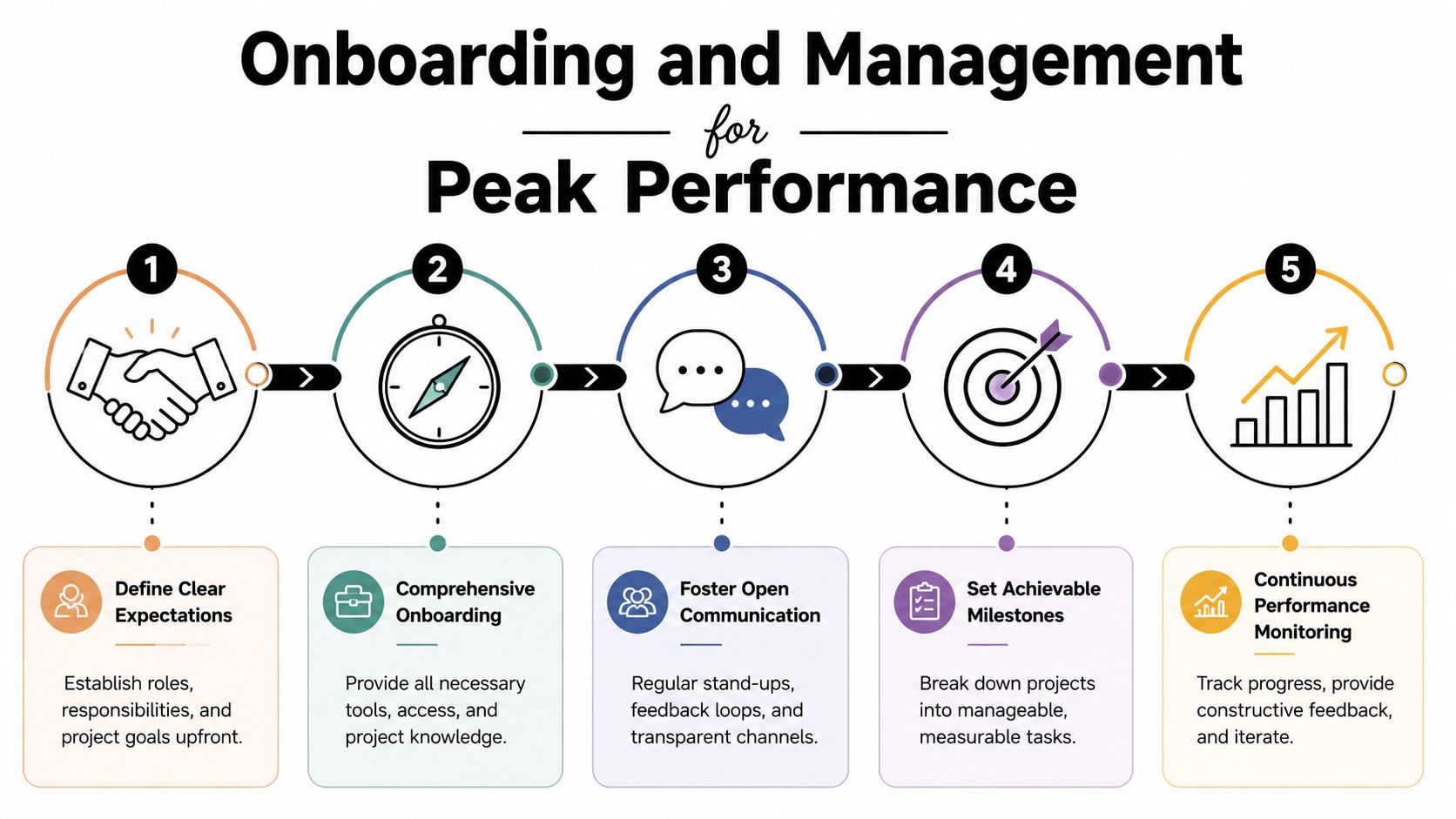
A dedicated software team only becomes valuable when onboarding is disciplined. If access is late, priorities are fuzzy, and tools are scattered, the team won’t look slow because of talent. It will look slow because the operating model is sloppy.
The best teams start strong because the client gives them enough structure to move independently. That means defining the tech stack, team roles, and success metrics up front. It also means setting the communication rhythm early. According to this guide on dedicated teams and delivery alignment, aligning staffing to architecture and parallel work streams depends on that early clarity, especially when API work, UI delivery, testing, and release management need to proceed together.
What a strong onboarding setup includes
You don’t need a giant process manual. You need a working system.
Start with these basics:
- Shared tools: Jira, Linear, Trello, GitHub, GitLab, Slack, Notion, Confluence, Figma, and your cloud environment should be accessible early.
- A decision owner: Someone on your side must answer scope questions and approve trade-offs quickly.
- Known release rules: Define code review expectations, QA gates, deployment ownership, and rollback procedures.
- A live backlog: Prioritized work must exist before the team arrives, not after.
If you’re hiring across regions, it also helps to understand how strong remote candidates think about communication and async work. A practical way to see the broader market is to find remote jobs and study how strong companies describe ownership, collaboration, and delivery expectations in their engineering roles.
How management should actually work
Many CEOs overcorrect here. They either disappear completely or try to manage each ticket personally.
Neither works.
A dedicated software team needs operational visibility without micromanagement. In practice, that usually means:
- Weekly planning and review: Discuss priorities, risks, blocked items, and what shipped.
- Short daily coordination: Not always with the CEO, but with clear attendance from delivery owners.
- Shared dashboards: Track open work, release readiness, defects, and unresolved decisions.
- Fast escalation paths: If compliance, data access, or architecture choices are blocking progress, someone should own the answer.
A dedicated team should never be waiting days for a business decision on a feature that’s already in motion.
Why AI apps need one more management layer
Traditional app delivery already requires control over releases, quality, and scope. AI-enabled products add another operational surface.
Prompts evolve. Parameters change. Model outputs need review. Logging matters. Cost visibility matters. If your team is integrating AI into an existing product, these controls shouldn’t live in random spreadsheets and code comments.
One practical option is Wonderment Apps, which offers a prompt management system that includes a prompt vault with versioning, a parameter manager for internal database access, logging across integrated AI systems, and cost tracking for cumulative usage. In a dedicated software team setup, that kind of administrative layer helps the team move faster while still giving leadership visibility into what changed, how the app is behaving, and where spend is accumulating.
What good governance looks like
The highest-performing setups usually share a few habits:
- Product requirements are written down before sprint planning.
- AI behavior changes are versioned, not improvised.
- Costs are reviewed as part of delivery, not as a finance surprise later.
- QA validates user outcomes, not just technical acceptance criteria.
When these practices are in place, a dedicated software team becomes easier to trust. That trust is what allows the team to operate with speed.
Where Dedicated Teams Drive the Most Value
A dedicated software team creates the most value where software is never really finished.
In ecommerce, that often means continuous optimization of checkout, merchandising tools, search, customer accounts, and personalization features. If AI is part of the roadmap, the same team can own recommendation logic, admin tooling, prompt behavior, and release quality without splitting accountability across several vendors.
In fintech, the model works well for products that need regular releases, security discipline, and careful change management. Mobile banking features, underwriting flows, fraud-review tooling, internal operations dashboards, and AI-assisted support all benefit when the same team carries context from sprint to sprint.

Healthcare and wellness teams also gain a lot from continuity. Patient-facing experiences, care coordination workflows, remote monitoring, and AI-assisted administrative tools need consistent design, engineering, QA, and infrastructure ownership. The same is true in SaaS, media, and public-sector platforms where user expectations change faster than procurement cycles.
The broader pattern is simple:
- Choose a dedicated software team when the roadmap is alive.
- Use it when product knowledge needs to accumulate rather than reset.
- Lean on it when AI modernization is part of the core application, not a side experiment.
For a CEO, this isn’t really a staffing decision. It’s an operating model decision. You’re choosing whether software will remain a chain of disconnected projects or become a durable capability your business can rely on.
If you’re planning a major app rebuild, AI modernization effort, or long-running product roadmap, Wonderment Apps can be a useful partner to evaluate. Their work spans dedicated delivery teams, web and mobile product development, and AI administration tooling for prompt versioning, logging, parameter control, and cost visibility.