

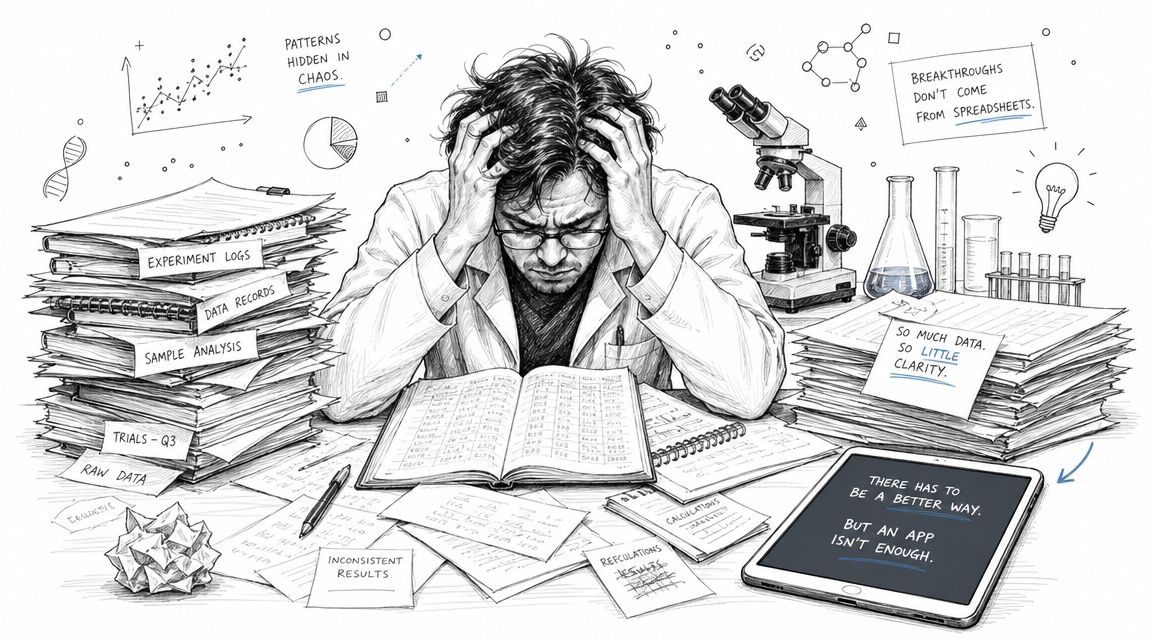
A lot of biotech teams hit the same wall at the same moment. The science starts working, the data starts piling up, and suddenly the business is running on spreadsheets, emailed CSVs, sticky-note exceptions, and one heroic operations person who knows how everything fits together.
That setup can carry a lab through an early phase. It doesn't carry a product, a clinical workflow, or a regulated operation very far.
Your Biotech Breakthrough Needs More Than an App
A founder usually notices the problem long before they know what to call it. Results live in one system, sample metadata lives in another, instrument output sits in local folders, and the team still copies key values into slide decks by hand. Everyone feels busy. Nobody feels confident.
That's where biotech application development services start to matter. Not as a fancy way to say “we build software,” but as a way to turn fragile manual operations into a system the company can trust. Good biotech software reduces handoffs, standardizes workflow states, connects instruments and databases, and gives teams one place to see what's happening.
The first win is operational clarity
A useful biotech app often does three simple things first:
- Collects data consistently so researchers aren't reformatting every experiment by hand.
- Routes work through defined steps so samples, approvals, and analysis don't disappear into side channels.
- Creates a reliable record of who did what, when, and under which conditions.
Those sound basic. In biotech, they're foundational.
Practical rule: If your team can't explain how a result moved from instrument to dashboard to decision, you don't have a software problem alone. You have a traceability problem.
The harder problem starts after launch
Founders now hear “add AI” from every direction. Sometimes that's right. Sometimes it's expensive decoration.
An AI-powered biotech product can help with experiment analysis, classification, summarization, and workflow acceleration. But once you add models, prompts, retrieval, and external AI services, you've introduced a second system to govern. Prompts change. Model behavior shifts. Logging becomes important. Costs creep upward. Audit questions get sharper.
That's why the smartest teams don't just ask, “Can we build this app?” They ask, “How will we manage the AI layer once real users depend on it?”
Consider building a modern lab. The instruments matter. So do calibration, access controls, logs, and maintenance. Software works the same way.
What Are Biotech Application Development Services
Biotech application development services are the design, engineering, integration, and long-term support work needed to build software for scientific and regulated environments. That usually means software shaped around lab operations, clinical processes, bioinformatics workflows, and data-heavy research programs.
A plain business app and a biotech app are both software. In the same way, a family sedan and a Formula 1 car are both vehicles. One gets groceries. The other is engineered for speed, precision, telemetry, and failure prevention in a high-stakes setting.
What these services usually include
In practice, teams hire for biotech application development services when they need software such as:
- LIMS platforms to manage samples, test runs, chain of custody, and lab operations
- CTMS tools for clinical trial workflows and study coordination
- Bioinformatics applications for analysis pipelines, result review, and structured scientific data handling
- Compliance-aware dashboards for approvals, reporting, and internal oversight
- Research collaboration tools that let scientists, operators, and reviewers work from the same source of truth
The shape of the product depends on the business model. A diagnostics company may need instrument integration and patient-result workflows. A therapeutics company may need experiment management and analysis pipelines. A lab platform business may need customer-facing portals plus internal operational software.
Why demand is rising
The business backdrop matters. The global biotechnology market is estimated at US$550.83 billion in 2024 and is forecast to reach US$2.667 trillion by 2034, with a projected 17.09% CAGR, according to Fact.MR's biotechnology market analysis. When a market grows at that scale, software demand tends to follow. Teams need automation, better reporting, cleaner integrations, and systems that can handle larger volumes of scientific and operational data.
Here's the practical takeaway:
| Software type | Generic app approach | Biotech approach |
|---|---|---|
| Data capture | Flexible forms | Structured scientific metadata |
| Workflow | Simple task states | Validated process states |
| Security | Standard user permissions | Role-based access tied to regulated work |
| Reporting | Business dashboards | Submission-ready and audit-aware records |
A biotech product succeeds when the software fits the science, not when the science is forced to fit generic software.
That's the difference buyers should care about.
The Unique Architecture of Biotech Software
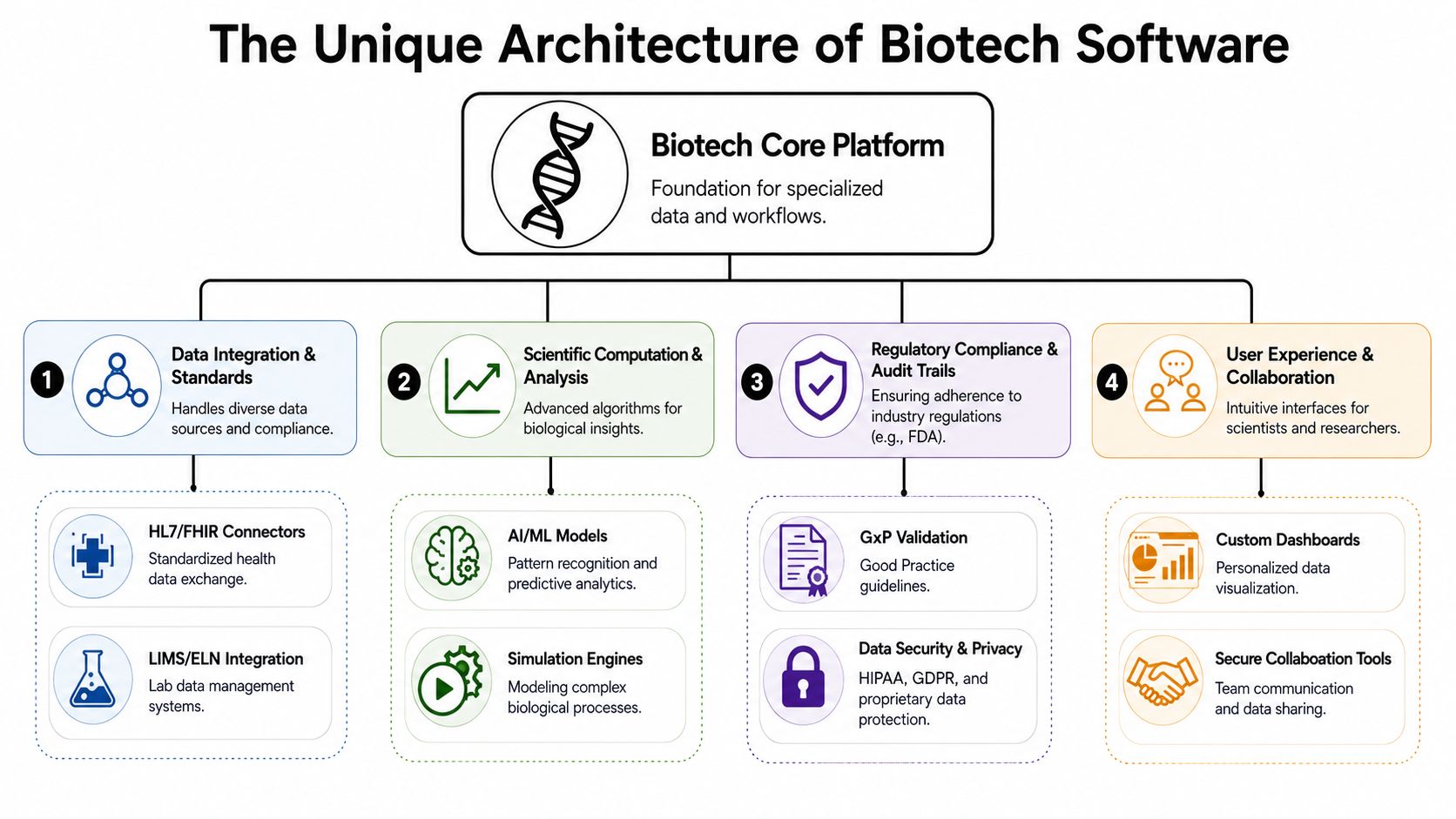
The architecture of biotech software looks unusual because the product has to do several jobs at once. It needs to ingest messy scientific data, turn that data into something usable, connect across systems, and preserve enough context that outputs remain trustworthy.
AI and ML only work when the data is disciplined
AI and ML can shorten cycle times for data-heavy work such as experiment analysis and genomics, but the value depends on domain-specific data engineering. Clean schemas, metadata normalization, and integration across datasets matter because bad inputs distort model outputs. That's the central point in Software Mind's biotech software development overview.
That sounds technical, but the business meaning is simple. If two instruments label the same thing differently, or if patient and trial data don't line up, the model may still return an answer. It just won't be one you should trust.
A lot of failed AI features in biotech aren't model failures. They're plumbing failures.
Data pipelines do the heavy lifting
Most biotech platforms need a pipeline that can:
- Ingest source data from instruments, lab systems, uploaded files, and external datasets
- Normalize context so sample IDs, assay definitions, timestamps, and user actions line up
- Preserve lineage so teams can trace outputs back to source records
- Feed downstream tools such as dashboards, analytics engines, and review workflows
Without that middle layer, teams end up building analytics on top of contradictions.
Treat the data pipeline like a water treatment plant, not a pipe. If contaminants enter upstream, every dashboard downstream inherits the problem.
APIs create the operating system for the business
Biotech companies rarely run on a single platform. They have lab instruments, internal portals, cloud storage, trial systems, identity systems, and sometimes customer-facing products. Secure APIs are what let those parts exchange data without turning the company into a copy-paste operation.
Good API design in biotech does more than connect systems. It also enforces rules. It decides what can be written, who can approve a workflow change, what gets logged, and which systems are authoritative for which data.
The user layer still matters
Founders sometimes underinvest in UX because the scientific problem feels more important. That's a mistake. Scientists, lab managers, coordinators, and reviewers need software that helps them move through complexity without making mistakes.
The best biotech apps make hard tasks feel orderly. They don't hide complexity. They organize it.
Navigating the Compliance and Data Integrity Maze
In biotech, compliance isn't a security wrapper you add near launch. It's part of the product definition. If the app touches sensitive health data, regulated workflows, or records that may support a submission, the design has to reflect that from day one.
HIPAA often enters the conversation first because it's familiar. It matters, but it's not the full map. Teams also need to think about electronic records, signatures, validation, procedural controls, and whether the system can prove that a result is authentic and complete.
Think in terms of chain of custody
The easiest way to explain this is with a legal analogy. Evidence in court needs a clear chain of custody. You need to know where it came from, who handled it, whether it changed, and whether the record can be defended.
Biotech data works the same way.
Blackthorn Vision's biotech software article notes that biotech apps must support standards such as FDA 21 CFR Part 11, which requires architectures with immutable audit trails, role-based access, and validated workflow states so data is defensible in regulated submissions. In plain English, that means the system can't just store records. It has to preserve trust.
What compliant architecture looks like
A compliant biotech app usually needs:
- Immutable audit trails so critical actions can't be rewritten
- Role-based access control so users only perform approved actions
- Validated workflow states so the process itself is controlled, not improvised
- Data provenance so outputs can be traced back to instruments, users, and source events
If your team is working with protected health information, a practical companion topic is de-identification. This healthcare data de-identification guide is useful because it explains how teams reduce exposure while still preserving analytical value.
For a broader product perspective, this guide to HIPAA-compliant app development is also worth reviewing before architecture decisions get locked in.
Compliance work done late feels expensive because it forces redesign. Compliance work done early feels like architecture.
That's why experienced teams treat data integrity as a product feature, not a legal chore.
Building Your Biotech App The Right Way
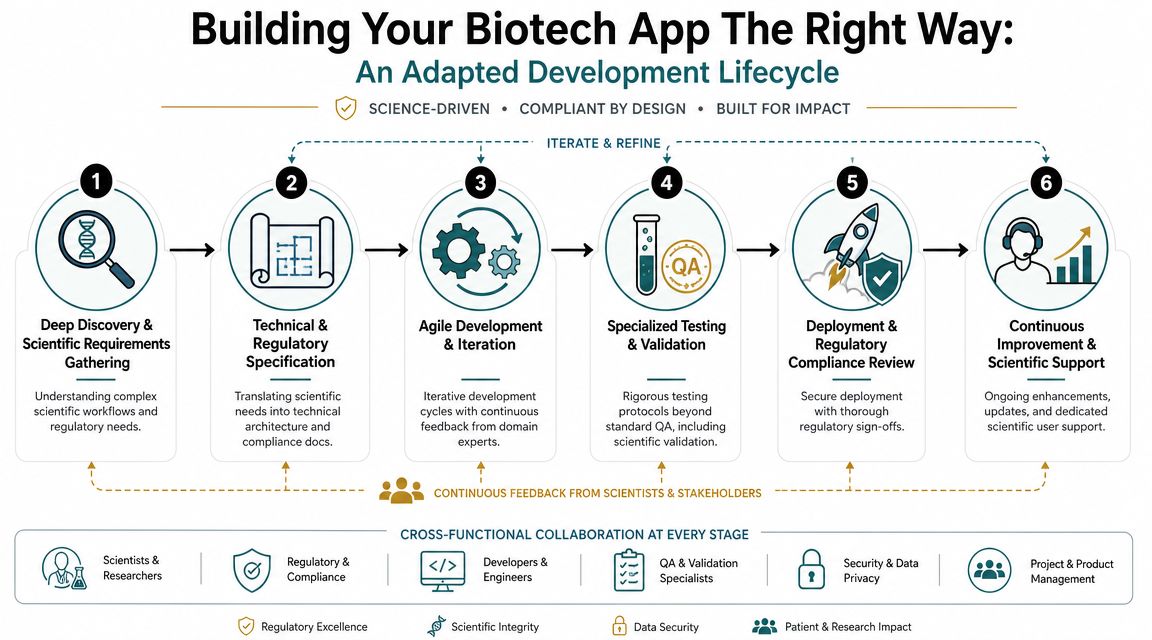
The delivery process for biotech software shouldn't look like consumer app development with a few extra approval meetings. The work needs speed, but it also needs evidence. Teams have to move forward while preserving enough structure to test, validate, and trust what they ship.
Validated Agile beats fake certainty
A practical model is what many people informally call validated agile. You still build in increments. You still review working software often. But each increment has clearer acceptance criteria, more formal test evidence, and tighter involvement from domain experts.
That matters because biotech teams learn by seeing real workflow behavior. A specification can say “sample approval,” but only a scientist or operator can tell you where exceptions happen, what metadata matters, and which steps are essential.
The team needs more than engineers
A strong biotech product team is cross-functional in a very literal sense.
- Engineers build the app, integrations, and infrastructure.
- UX designers turn dense workflows and data review into interfaces people can use correctly.
- QA specialists test not only features but system behavior against required rules.
- Domain experts catch the dangerous mismatch between “software logic” and “how the lab really works.”
- Product leadership keeps the build tied to business outcomes instead of feature sprawl.
When one of these roles is missing, the project usually drifts. The code may still ship. The product won't fit.
Modernization is often the real job
Many biotech companies don't start with a blank slate. The U.S. biotechnology industry is estimated at $249.5 billion in 2026 with 3,322 businesses, and the number of firms is estimated to grow at a 4.8% CAGR from 2021 to 2026, according to the OECD-linked industry summary in this OECD reference document. In a market with that many established firms, a lot of software work is modernization, not greenfield invention.
That usually means one of three moves:
| Situation | Smart response |
|---|---|
| Legacy system still runs core operations | Wrap it with APIs and replace pieces gradually |
| Data lives in multiple tools | Build a unifying data layer before rebuilding every interface |
| Team wants AI fast | Start with narrow, reviewable workflows instead of platform-wide automation |
A useful reference here is this article on custom healthcare application development, especially if your product sits close to clinical or patient-facing workflows.
The cleanest roadmap isn't always the one that replaces the most software. It's the one that reduces operational risk while improving the workflow people already depend on.
Choosing a Partner and Measuring Success
A polished dev shop can demo dashboards, talk about cloud scale, and still be the wrong fit for biotech. The deciding question is simpler: can they translate the actual workflow into software without flattening the science or missing the regulated parts?
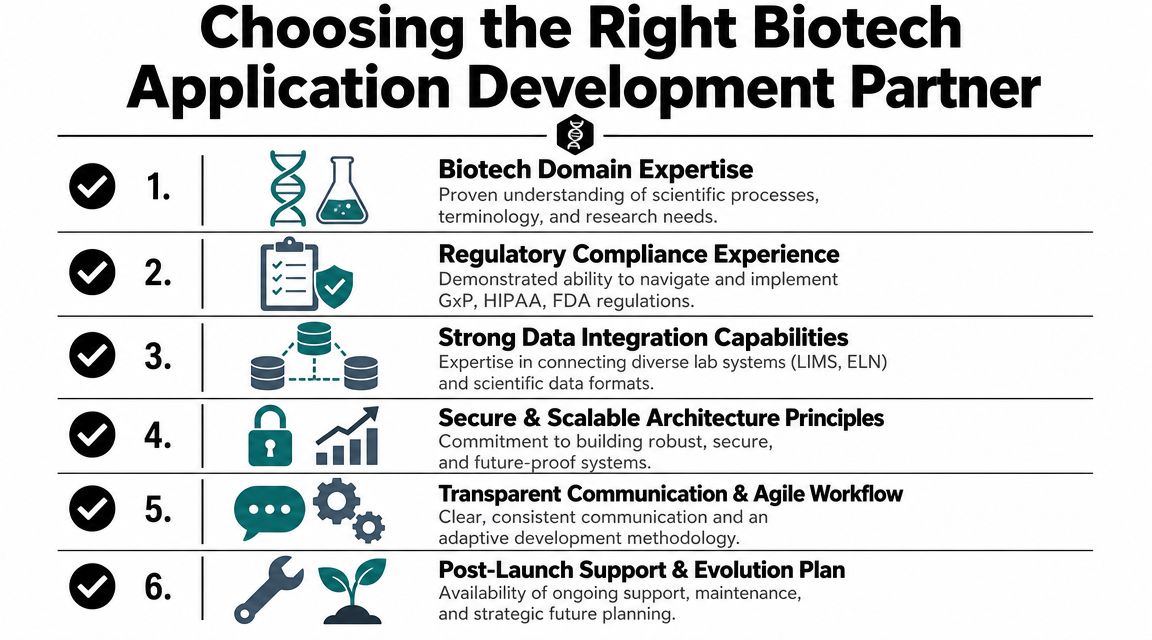
The biggest risk in biotech software isn't cloud architecture. It's failing to translate the actual wet-lab or clinical workflow into the product. That's the central vendor-selection issue highlighted in this Molecular Biology of the Cell discussion.
Questions worth asking in an RFP
Use questions that force a partner to show how they think.
Ask how they map the actual workflow
Don't accept “we run discovery workshops.” Ask how they document instrument steps, handoffs, exception paths, approval points, and user roles.Ask what they validate and when
A mature answer should include test evidence, workflow validation, release controls, and how they handle changes after launch.Ask who on the team understands the domain
If no one can talk comfortably about sample tracking, trial operations, electronic records, or scientific review, you'll spend the project teaching basics.Ask how they handle AI governance
If they propose AI features, ask how they version prompts, log outputs, review failures, and monitor ongoing cost.Ask how they modernize around existing systems
Most biotech firms can't stop operations for a rewrite. Good partners know how to layer, integrate, and replace safely.Ask for examples of bad-fit features they would reject
This is an underrated question. Strong partners say no when an idea adds risk without business value.
Measure outcomes that matter to the business
Success shouldn't be framed only as “the app launched” or “manual work decreased.” Better measures are operational and strategic.
- Faster scientific throughput because teams spend less time re-entering or reconciling data
- Better submission readiness because records are more complete and traceable
- Lower compliance exposure because permissions, logs, and workflow controls are built in
- Stronger data quality because the system enforces structure upstream
- More room for new products because the software becomes a platform, not a one-off internal tool
Pick the partner who understands where your process can break, not the one who only talks about how fast they can code.
That advice sounds unglamorous. It saves companies a lot of pain.
The Final Piece Modernizing AI for the Long Haul
A biotech app with AI features can look impressive in a demo and become messy in production. That happens when teams treat AI as a feature instead of an operational system. Once real users rely on it, someone has to manage prompts, review outputs, track changes, log model behavior, and understand what the AI layer is costing.
That burden is easy to underestimate.
If you want a simple example of how AI can become usable when it's packaged around a clear workflow, this overview of simple sperm health analysis is helpful. The lesson isn't about one category. It's that AI creates business value when the input, interpretation, and user context are tightly designed.
For teams building healthcare or biotech-adjacent products, this broader guide to AI solutions for healthcare is a useful starting point for evaluating where AI belongs and where standard automation may be the better bet.
An administrative toolkit is essential. The right system should give teams a prompt vault with versioning, so prompt behavior doesn't drift. It should provide a parameter manager for internal database access, so retrieval and context stay controlled. It should include logging across integrated AI tools, so outputs are reviewable and auditable. And it should expose a cost manager, so founders can see cumulative spend before “small usage” turns into a budget problem.
Building biotech software is hard. Running AI-powered biotech software responsibly is harder.
If you're planning a biotech product and want a partner that can help with both the build and the long-term AI operations layer, take a look at Wonderment Apps. They help teams modernize software, integrate AI into web and mobile products, and manage the messy post-launch details with tooling for prompt versioning, logging, database-aware parameters, and cost control. A demo is a practical way to see whether your app can be not just smart, but manageable.